The Affect of Social Intimacy: Mélanie Matranga’s 0,1,2,3,4

Mélanie Matranga’s 0, 1, 2, 3, 4 

Nottingham Contemporary

Saturday, 22 May 2021 – Sunday, 31 October 2021

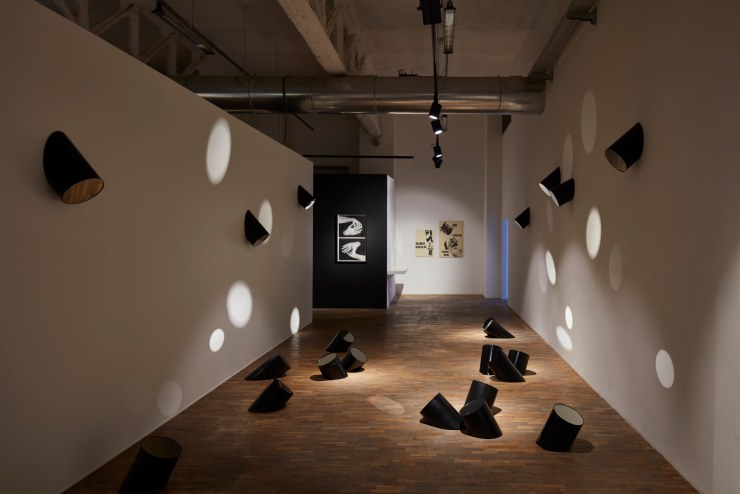
Mélanie Matranga, 0,1,2,3,4 Nottingham Contemporary, 2021. Installation shots, Stuart Whipps.

By Sophia Arnold

In Frames of War, Judith Butler explores the notion that surviving in the contemporary world is only possible due to the “social network of hands”[1] that supports, raises, and recognizes life, and in the current Coronavirus pandemic, it has never been more clear that this is the case. Mélanie Matranga’s exhibition 0, 1, 2, 3, 4 at the Nottingham Contemporary, her first solo show in the UK, is a stark reminder of Butler’s sentiment and an enriching break from the daily broadcasts of impersonal, popular jargon of the global economic instability caused by the pandemic.[2] Highlighting, both explicitly and tacitly, how care, community, and intimacy are essential in our daily lives, the exhibition evocatively invites the viewer to reflect on personal and societal pre-pandemic connection and speculate what our lives may look like post-pandemic, after the immense loss and instability of the past year and a half.

The sensuality, companionship, care, and connection that is omnipresent throughout the exhibition, yet simultaneously eerily absent depending on the room you are in, is the embodiment of the pandemic; it evokes what we, on an individual and societal level, have been deprived of in the name of safety and the effects of isolation. After a year of virtual exhibitions, Matranga’s exhibition was the first I had seen in person for what felt like a lifetime. Moreover, in conjunction with this already amplified initial viewing experience, I am writing and ruminating on my multiple ensuing visits to the exhibition while isolated in Canada’s legal hotel quarantine requirement, therefore heightening its impact. Curated by Olivia Aherne, the show is resoundingly pertinent at this moment; an effigy to all that has been lost since the early months of 2020.[3]

Mélanie Matranga, 0,1,2,3,4 Nottingham Contemporary, 2021. Installation shots, Stuart Whipps.

When first entering Matranga’s exhibition, you are welcomed into a model of the Nottingham Contemporary’s office kitchen, adorned with fruit and flowers that will slowly rot away until the end of the exhibition’s installation.[4] This materiality embodies one of Matranga’s main ideals for an exhibition: “to try to escape the notion of artworks as dead things in the exhibition”[5] in an almost ironic way, as the installation wilts with the passing of time. The kitchen itself, dimly lit and with an ambiance of abandonment, conceals a miniature replica of the artist’s own living space within one of the tenebrous cupboards. Matranga’s use of scale and temporality, suggests an almost heterotopia through the layered, juxtaposing environments, linked through their jarring absence of the human presence that would usually embody the spaces. This austere atmosphere is only heightened by the security guard sitting at behind you, waiting to ID you before entering the next room.

Mélanie Matranga, 0,1,2,3,4 Nottingham Contemporary, 2021. Installation shots, Stuart Whipps.

After proving to the guard that you are 18 years or older, visitors are guided through a door to a lightless room, with four socially distanced seats, to view Matranga’s video work, People (2021). The 25-minute black and white film, separated into parallel and conjoining storylines by the classic film countdown numbers, enters you in the minutiae of individual universes, exploring the social relationality of different couples and groups.[6] An illusion of historicity, created by the old-fashioned aesthetics, undulates throughout the film with stark reminders of the present social dynamics and almost prophetic scenes, of what friendships and communities could become, breaking through the aesthetics of the staged time period. 

The video work’s storyline seemingly jumps between different character’s environments and the complex interactions that take place inside them, despite the work being filmed in the artist’s apartment.[7] As Jon Day notes in Homing, “homes… provide the still, stable point around which our thoughts and lives orbit. But they are also thresholds: places we must depart from before we can fully understand what they mean.”[8] The minutiae of conversation explored in People wordlessly articulates how our homes have changed over the past year, from spaces of sociability to isolation and loneliness, and the running thread through the exhibition, of the eerie emptiness we have experienced during the pandemic, is once again brought to mind now that we have temporally crossed the ‘threshold’ from the pre-pandemic life portrayed in the video. From social gatherings in Matranga’s apartment to tarot card readings, to couples engaging in a multitude of sexual activities, to intimate confessions and reflection, the viewer is pulled into the characters’ world and home, whether that be a person or a place.

The shattering moment in People happens when one of the characters starts to display symptoms of the virus that we have become all too familiar with, and the insular bubble the visitors are lulled into by watching the characters in the video, safe from the world of COVID outside of the museum space, immediately breaks. At this moment, I couldn’t help but call to mind what Achille Mbembe called “the hour of autophagy.”[9] We have been sheltered from death, but the pandemic has brought a global reckoning, an explosive reality-check for those who have been’ ‘business as usual’ for decades. This was also brought starkly into mind when I revisited the exhibition a month later and all of the aforementioned kitchen flora was wilting down to their final moments, reminding us not only of the pandemic’s egregious, awful consequences but also of the intrinsic tie between nature and people that has become a recurring theme as we battle the climate crisis.

Mélanie Matranga, 0,1,2,3,4 Nottingham Contemporary, 2021. Installation shots, Stuart Whipps.

When entering the third and final last room of Matranga’s exhibition, the visitor enters a kind of effigy to this binaristic nature/human rhetoric: harsh plastic covers hanging from the ceiling with more decaying roses scattered on top, plastic-wrapped clothes, and mattresses as an installation in the center of the room, with more flowers under the plastic. It almost reflects the separation of humanity from the natural environment, as if we are outside of the decay and we can contain the spread of contamination. Yet at the same time, the bagged clothes and mattress, with cut-out felt the word ‘COME’ under the plastic in the center of the installation, could be a re-enactment of a crime scene, a liminal space, so silent, still, and sterile. 

However touching this work is for myself and potentially a large percentage of the population, it is hard to ignore the fact that the artist’s experience, portrayed specifically in People, inside a large Parisian apartment, is not the reality for those that Butler has described as ‘transient,’ debilitated and precarious before the pandemic began, with the pandemic only exacerbating the inequality and ostracization of certain societal groups.[10] Matranga captures a moment of upheaval and dissociation in a very postmodern way of individual storytelling and unique experiences. However, with a pandemic that is universal, affecting every being on this planet, and yet the burden of which is not universally felt, the video work remains within a specific socio-political reach. 

Mélanie Matranga, 0,1,2,3,4 Nottingham Contemporary, 2021. Installation shots, Stuart Whipps.

Despite the above, the slow ease of restrictions, the entire process of being able to go to a museum after months of restrictions, and the immense changes we have seen in the past year and a half, is paralleled by the installation of Matranga’s work; the trough to the peak of normality, sociability and loneliness, all separate affective curves the visitor is travelling through, intertwining in an almost emotional rendition of the government statistic graphs presented to us every day on the news. In contrast to the art that has been created during the pandemic that asked what it means to be alone, this exhibition asks what it means to be together, navigating ‘unprecedented’ times through affect; an urgent question that opposes the cold spirit of economic jargon.

As a closing reflection, I was completely overwhelmed with how this exhibition, in the short space of a two-hour visit, helped me understand and retrospectively reflect on how the extended, slow, enduring, measures taken over the past year and a half immensely affected myself and my community. I left empty, deflated, heartbroken, for all those who have been lost to the virus and all the connections severed the chances that were lost for interpersonal and societal care in due to the pandemic, but also optimistic that one day we could return and understand the importance of sentiment and the community that raises, cares, and shelters us. Now that we have crossed the “threshold” from our pre-pandemic experiences of home and community, and soon have the ability to create the infamous ‘new normal,’ Mélanie Matranga’s exhibition 0,1,2,3,4 provides a pertinent frame of reflection for an individual’s “social network of hands.”[11]  

[1] Judith Butler, Frames of War: When Is Life Grievable? (repr., London: Verso, 2016), 14.

[2] “Mélanie Matranga: 0, 1, 2, 3, 4”, Nottinghamcontemporary.org, 2021, https://www.nottinghamcontemporary.org/whats-on/melanie-matranga/.

[3] Ibid.

[4] Ibid.

[5] Fredi Fischli and Niels Olsen, “Melanie Matranga”, Kaleidoscope, 2018.

[6] Ibid.

[7] “Mélanie Matranga: 0, 1, 2, 3, 4”, Nottinghamcontemporary.org, 2021, https://www.nottinghamcontemporary.org/whats-on/melanie-matranga/.

[8] Jon Day, Homing: On Pigeons, Dwellings and Why We Return (London: John Murray Press, 2019).

[9] Achille Mbembe, translated by Carolyn Shread, “The Universal Right to Breathe”, Critical Inquiry, 2020, https://critinq.wordpress.com/2020/04/13/the-universal-right-to-breathe/.

[10] Judith Butler, “Capitalism has its Limits,” Blog, Verso Books, 2020, https://www.versobooks.com/blogs/4603-capitalism-has-its-limits.

[11] Judith Butler, Frames of War: When Is Life Grievable? (repr., London: Verso, 2016), 14.

BLOOMDOOMROOM: Face to face with the slow apocalypse

BLOOMDOOMROOM

the plumb

March 12 – April 8, 2021

BLOOMDOOMROOM installation shot, documentation by Alison Postma, courtesy of the plumb. 2021.

By Angel Callander

One prominent outgrowth from the beginning of last year was the rush from European intellectuals to contextualize a burgeoning global health crisis for a frightened global public. Notably, Bruno Latour and Slavoj Žižek connected the pandemic to its already existing relatives in climate and economic crises. Giorgio Agamben, on the other hand, was heavily criticized by colleagues and journalists for his reactionary take on the false choice between health and privacy—neither mutually exclusive nor binary opposites—decrying quarantine as a loss of freedom (proceeding from a cynical and individualist definition of ‘freedom’).[1] Žižek’s book Pandemic!, an expansion on his mid-March essay “Monitor and Punish? Yes, Please!”, was offered for free pre-orders at the end of the same month, and available for eBook download by mid-April. This rush to add multiple voices to dissect a new crisis is characteristic of our oversaturated information economy within a larger system of excess.

Even so, it was smart for leftist thinkers to be quick in shaping a straightforward narrative that connected the dots from systemic exploitation to the Sixth Mass Extinction and something as (quasi-)unpredictable as a pandemic. By attempting to mediate our material processes through knowledge, there was a fundamental truth emerging about how regular people, particularly in the working class, are increasingly broken down to maintaining the bare minimum, to the fight for sheer survival. Horizons of understanding and possibility, cycles of growth and recovery, are all often forestalled by desperation. Solidarity—with each other and our environments—is clouded by obligation and discord.

The group show BLOOMDOOMROOM takes up a response to these problems. Described as “an exhibition about flowering, fruiting, ecological fall-out, late-stage environmental capitalism and art at the end of days,” the show adopts a unique approach in the ecosystem of art shows about climate anxiety and slow apocalypse. On view at the plumb gallery in Toronto from March 12 – April 8, 2021, partially during a spring lockdown, the exhibition uses these themes to tease out the necessary symbiotic relationship of vitality and entropy in all life, aspects of the fundamental dialectics in which all things are constantly in a dance with their own contradictions. It accentuates both the human and non-human dimensions in tandem,showing plant and animal life as equal agents in creative endeavours, while the human dimension fades into the background, revealing itself only through artifacts.

Zooming both in and out, the works in the show invoke larger philosophical and political questions as well as personal inventories of being in the world presently, conjuring a darkness without nihilism or despair.

Contrary to the didactic and moralizing strategies of large institutional shows like AGO’s Anthropocene in 2018, which seek to show ecological ruins that elicit feelings of despair—while also being beholden to not offending the capital interests of museum donors—BLOOMDOOMROOM benefits from the DIY artist-run model, allowing for a more autonomous approach. Zooming both in and out, the works in the show invoke larger philosophical and political questions as well as personal inventories of being in the world presently, conjuring a darkness without nihilism or despair.

Unsurprisingly, Anthropocene did not point to capitalism, instead vaguely referencing “how we, individually and collectively, are leaving a human signature on our world.”[2] Far be it from a large institution to do so, it is probably high time to dispel with the narrative that naming the system is radical, or that the responsibility for causing and consequently solving the crisis should be equally placed at the feet of every person on earth. Accepting that climate change is not just anthropogenic, but, to use Jason W. Moore’s word, capitalogenic (“made by capital”)[3], it is more apt to shift the focus in a different direction. BLOOMDOOMROOM carves out a space to contemplate these multifaceted relationships, aesthetics of transformation, and the value of creatively interrogating the present.


HaeAhn Kwon, The Baroness Model. 1874, 2021. Documentation by Alison Postma, courtesy of the plumb.

HaeAhn Kwon’s The Baroness Model. 1874 (2021) consists of an open suitcase with a working pond pump and small fountain inside, attached to meandering latex tubing and extension cords. As the fountain thoughtlessly dribbles into the suitcase, I imagine an abandoned airport strewn with long-neglected luggage. At once deliberate and involuntary, it is a strange relic. Describing her practice as recombinations of everyday objects, Kwon uses these items to emphasize a tension between our culture of excess and the ingenuity that emerges out of crises. This work emblematizes a certain feeling throughout the show, as though documenting not a human civilization as such, but its legacy through strange, disembodied artifacts, repurposed and repossessed by non-human entities and the passage of time.


Alex Tedlie-Stursberg, Woolly Marker, 2018. Documentation by Alison Postma, courtesy of the plumb. 2021.

Woolly Marker (2018) by Alex Tedlie-Stursberg lingers across the room, producing a similar impression. A tall abstract figure made with a mud-like texture, adorned with tufts of white fur and an artificial schefflera branch, the sculpture has the aura of something made with a distinct purpose and left behind long ago. The neon eyes of Colin Miner’s Untitled (red eye) (2017), one at each end of the room, along with sets of amphibious eyes peering out of Sarah Davidson’s paintings along the walls, follow and keep watch like portraits of ageless mystics as non-human stewards for the space.

Brennan J. Kelly, SUM, 2021, publication, 11 3/8” x 14 7/8.” Documentation by Alison Postma, courtesy of the plumb.

SUM, a broadsheet published by Brennan J. Kelly and available to take away, acts as a companion and sub-exhibition to the show through an archival object. Featuring works by Shannon Garden-Smith, Alex Tedlie-Stursberg, Sarah Davidson, Sonya Ratkay, an interview with HaeAhn Paul Kwon Kajander, and a recipe by Mohammed Rezaei, among other texts and printed works, the publication provides an alternative presentation space for creative experiments. In the same DIY model as the plumb itself, together they demonstrate the types of creative ecologies available outside of the institution.

Susannah van der Zaag, Gloriosa and Hellebore, 2021, Inkjet print on archival paper.16” x 14” framed.
Documentation by Alison Postma, courtesy of the plumb.
Susannah van der Zaag, Untitled arrangement, 2021, Documentation by Alison Postma, courtesy of the plumb.

Susannah van der Zaag contributed a series of photographic prints and a floral arrangement to the exhibition. A farmer and florist, as well as a multidisciplinary artist working in photography and ceramics, Van der Zaag has expressed her mixed feelings about making a living that revolves around the consumption of nature, and the demands for perfection from something so diverse and imperfect in service of a huge aesthetic industry such as floristry. Her prints play out this tension by composing plants she grows with less traditionally photogenic items, like bread, driftwood, and a cracked vase, while the large floral arrangement is left to decay and dry out in the gallery in front of where they hang.

Latour discusses the plight of a Dutch tulip grower, interviewed for the news in an emotionally wrought state at having to discard several tonnes of tulips, as fewer customers around the world meant fewer shipping opportunities. I recall a local news story at the time of a nursery in the Niagara region with the same bent, in which a certain shame about discarding beautiful things—things of nature—meets the fear of economic collapse. Latour notes a camera shot behind the florist of the tulips under artificial lights, not growing in any soil, in preparation to be shipped to the airport and flown on commercial air-freighters. He asks plainly about whether it is useful to maintain this model for producing and selling flowers (of course, it isn’t), following with a phrase that has deeply resonated: “Injustice is not about the redistribution of the fruits of progress, but about the very manner in which the planet is made fruitful.”[4] I would contend it is both in equal measure, accounting for multiple dimensions of our capitalogenic crises in both the environment and the economy.

Since the early to mid-2010s, there has been an influx of texts within the canon of Western science and academia (such as Timothy Morton’s Dark Ecology, Anna Lowenhaupt Tsing’s The Mushroom at the End of the World, Eduardo Kohn’s How Forests Think, and much of Donna Haraway’s oeuvre from the 1980s onward) that encourage a well-rounded, fundamentally anti-capitalist understanding of ecology as the solution to environmental crisis, invoking the knowledge Indigenous peoples have had for thousands of years. Nevertheless, the prevalence of these ethical discourses has not done much to sway policy makers. Because we live in the empire, theory in and of itself is non-threatening; it is only when knowledge resonates to precipitate a mass movement for serious changes that those with power may have their hands forced.

I have been thinking more about the text Desert (2011), written by a self-proclaimed British anarchist in their late 40s, but otherwise anonymously, and titled as a double entendre: one, detailing the rapid desertification of more regions on Earth through global warming, and two, the desire to desert the society that created this crisis as such. One particular line stands out to me within the scope of this exhibition: “Our lives can be better, freer, and wilder than this… we do our utmost to make them so, not in the ever-after of post-revolutionary heaven, but now.”[5] There are always small opportunities to make each other’s lives more liveable, even amidst collective anxieties and despair. In Pandemic!, Žižek describes an ecological public as “a group of bodies, some human, most not, that are subjected to harm.”[6] Hopefully, we have moved beyond internalizing this as true even if Western society at large does not reflect this understanding. BLOOMDOOMROOM takes this as a starting point, evaluating natural life in its many incongruities, and with the implied viewpoint that recognizing our larger entanglements is the most substantive. 


[1] See Latour: http://www.bruno-latour.fr/sites/default/files/downloads/P-202-AOC-ENGLISH_1.pdf; and Agamben: https://www.journal-psychoanalysis.eu/coronavirus-and-philosophers/

[2] https://ago.ca/exhibitions/anthropocene

[3] Jason W. Moore, “Capitalocene & Planetary Justice,” Maize Magazine 6 (Summer 2019), https://jasonwmoore.com/wp-content/uploads/2019/07/Moore-The-Capitalocene-and-Planetary-Justice-2019-Maize.pdf

[4] Bruno Latour, “What protective measures can you think of so we don’t go back to the pre-crisis production mode?” p. 3, http://www.bruno-latour.fr/sites/default/files/downloads/P-202-AOC-ENGLISH_1.pdf

[5] Anonymous, Desert (2011), p. 59

[6] Slavoj Žižek, Pandemic!: COVID-19 Shakes the World (OR Books, 2020), p. 97


Of Colour by Katherine Agyemaa Agard

Of Colour by Katherine Agyemaa Agard

Essay Press, 2020

Of Colour by Katherine Agyemaa Agard. Essay Press, 2020.

By Margaryta Golovchenko

In the second half of the untitled introductory section to Of Colour, Katherine Agyemaa Agard asks, “What colour am I?” By way of an answer, she then offers the reader a photograph of herself, pairing it with a column titled “Proportional Palette” that shows the colours found in said image. Since 29.4% of the photo’s surface area is identified as Sapphire (Blue), Agyemaa Agard concludes: “I think that I am blue.”[1] It is easy to instantly jump to Maggie Nelson’s Bluets and to the colour’s broad spectrum of affects, as Agyemaa Agard states herself in the References section when she lists the books people would mention “[w]ithout fail when [she] talked about [her] project.”[2]

Of Colour is an artbook memoir that straddles the line between essay and poetry. In an interview for the University of Washington-Bothell, Agyemaa Agard also uses the term “speculative non-fiction” to discuss the work, as it “allows me to reflect on basic truths and speculate on various matters related to them. It’s important to retain that freedom when I write.”[3] Of Colour is a living document rather than a static and fixed text that similarly treats colour as a container for the self to step into when language fails to convey and to soothe.

While the exploration of colour’s optics and affects, its artistic and material side, in the work of ‘colour writers’ like Nelson is present to an extent in Of Colour, the term “colour” takes on a multivalent function within the book. For Agyemaa Agard, colour serves as an entry point into locating the self within artistic and cultural traditions, of thinking about racialized bodies, and beginning to theorize personal and familial trauma. In the beginning of the second section, “Surface,” Agyemaa Agard’s photographic documentation of Trinidad is coupled with a questioning of the “colored signs” that line the road of identity, of asking yourself “who am I?” Later, this question of identity is expanded to the way identity is still used as an obstacle to keep out people from countries seen as undesirable in the hierarchical eyes of Western countries like the United States, limiting their mobility as well as work and study opportunities. The legacy of the historical, colonial binaries of colour are shown to persist to this day, a system that, by virtue of being upheld, continues to engage in anti-Blackness. Agyemaa Agard’s role in this is that of an interlocutor, “a colorman, mixing colors for others,”[4] one who sorts through lived and inherited experiences as if through vials of pigments on a shelf to show how they intermingle and work together, of the way they work together when they are laid down on the page like paint on a canvas.

It is through colour that Agyemaa Agard also documents the fraught understanding of race and colour within her own family, the importance placed on her lighter skin and, “the whole mess” when she stated “I’m [B]lack, betraying the family.”[5] In the first section, “Interior,” Agyemaa Agard includes her three milk paintings (2014) as a material manifestation of this questioning, each of the three square canvases that bring to mind handmade bars of soap representing Agyemaa Agard and her two siblings. The association with soap feels fitting, given that the connection between milk and bathing resurfaces only a few pages later in the form of a recipe for a milk bath meant “for a cooling head.”[6] Where some artists make art based on their experiences or as a way of processing knowledge inherited from family or culture, Of Colour is a demonstration of Agyemaa Agard’s immersive practice. It does not come from a place of obsession so much as a space of emotional intensity where “anxiety is urgency.”[7]

Visuals, both literal and the kind constructed from snippets of memory and oral history, are one of the primary modes of communication for Agyemaa Agard. Screenshots of email correspondences and website pages, photographs of Trinidad and Tobago, collages created out of pages from historical texts and documents on the slave trade and European colonization — these are some of the images that populate the pages of the book, yet they do not exist to merely illustrate Agyemaa Agard’s text. Instead, these images form a separate thorough line that runs through Of Colour as an additional layer of inquiry into autoethnography.

One of the most interesting uses of visuals in Of Colour are little snippets of textures scattered throughout the book. A note in the reference section tells the reader that these are textures of various surfaces from Trinidad that were taken by the author and artist using a handheld book scanner. The effect of these scraps of colour ranging in size and shape is one of unmediated, almost sobering, sort of looking, the kind where nothing stands between the individual and the world other than those few seconds before they reach out their hand to grab it. Whereas later in the book Agyemaa Agard takes two such textured surfaces and expands them to the size of a painting reproduction, pairing them with computer-generated alt-text as well as her own affect-based caption, the smaller scans function more as fragments of the peripheries gravitating to the centre, becoming one with the text in the form of a new whole. Similarly, Agyemaa Agard states that she “learned to see [herself] by seeing how other people read [her] […] learned to write [herself] against the language of those gazes.”[8] The reader reads Agyemaa Agard through this rich combination of text and image, which in turn prevents the flat simplification of character that would otherwise be tempting to partake in if the work were strictly fictional or even biographical.

Of Colour is a new addition to the growing genre of autotheoretical texts as Agyemaa Agard manifests one of the primary features of the form: the refusal to conform to white colonial expectations of what a text looks or sounds like. It is also not a text that exists to be at the service of the reader. Rather, Of Colour is a testament to narrative’s plasticity, the way experiences and stories are braided together into a thick thread that is constantly being worked on. “I must tell you that this grandmother — as are all characters including myself — is an amalgam of all my mother’s stretching back,” Agyemaa Agard says at one point in the section “Surface.” “Fictional and true all at once, a monstrous creation meant to allow for both plausible denial and recognition.”[9] The reader is a spectator witnessing the unfolding of Agyemaa Agard’s practice, in which colour is a catalyst rather than an entry point, and where, like on a canvas, words participate in an ongoing stratification of the self.  


[1] Katherine Agyemaa Agard, Of Colour. Essay Press, 2020. p. 4

[2] Of Colour, p. 198

[3] Stephanie Segura and N.L. Sweeney. Interview with Katherine Agyemaa Agard, 2020. University of Washington. https://www.uwb.edu/mfa/publications/essay-press-book-contest/katherine-agyemaa-agard

[4] Of Colour, p. 100

[5] Of Colour, p. 147

[6] Of Colour,p. 32

[7] Of Colour, p. 64

[8] Of Colour, p. x

[9] Of Colour, p. 56

Migueltzinta C. Solís’s “The Gay Villain Rides Again”

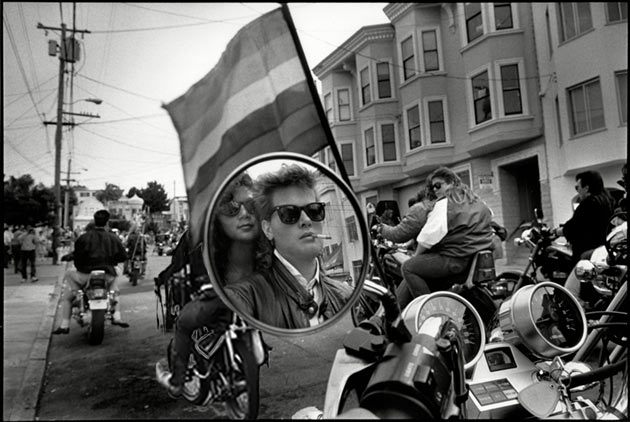
The Gay Villain Rides Again: The History of A Queer Biker” by Migueltzinta C. Solís

Performance lecture, 16 April 2021

Co-presented by the University of Lethbridge and Queer/Disrupt (UK)

This is Not a Bike, Migueltzinta Solís, 2021.Image from performative academic presentation, The Gay Villain Rides Again

By Lauren Gabrielle Fournier

TW/CW: Mention of residential schools

“I love a sloppy archive,” Migueltzinta C. Solís says during the Q&A of his recent performance lecture. There is power-to-be-harnessed in the mess, in the slop, in the spaces that resist sanitization and homogenization, that resist ossification. There is power in the sour spaces, the spaces where one can harness the possibilities of art practice, including performance and parafiction (art and literary work in which fiction is presented as fact), in history-making, in the resisting of the power of singular status-quo narratives that uphold those in power and protect them from being questioned. And at a time when the very grim aspects of Canada’s history are being revealed—with the unearthing of the remains of hundreds of Indigenous children at the former grounds of a residential school in Kamloops and, more recently, Manitoba—the urgency around Indigenous peoples and other marginalized groups having agency in the telling of history is resounding. These events remind us of the consequentiality of history and how it is told—what is included in historical stories and what is left out. While coverage of recent news events can make it look as though these horrors are outlying events, marking singular “sad days” for Canadians, Indigenous folks will point out, rightly, that these horrific, genocidal events are at the heart of the very founding of Canada—a colonial country on stolen, Indigenous lands, with very long histories for thousands of different Indigenous groups.

With the colonialization of lands comes other colonial inheritances, including the University. Academia and its rituals, methods, and languages are another impact of European colonialization, and we are experiencing a moment of reckoning right now. Challenging and subverting colonialist academia from Indigenous, BIPOC, and queer perspectives is a worthy endeavour. In Mestizx artist Migueltzinta C. Solís’s recent performance lecture “The Gay Villain Rides Again: The History of a Queer Biker,” we get what the artist himself calls an “academically-subversive performance.” In it, Solís tells a story from queer history that he happens upon and in some senses discovers; through personal experience, archival research, interviews, reading, and embodied reflection and deduction. As an artist with a background in performance art, Solís experiments with how research can be presented to academic, art, and non-academic communities, and in this way his practice can be said to ‘queer’ academic structures—which includes bringing more depth and breadth to the archives recognized by academic institutions,  and “queering” the very methodologies recognized as legitimate and worthwhile in those spaces.                           

Tugmented archival image from performative academic presentation, The Gay Villain Rides Again. This is Not a Bike, Migueltzinta Solís, 2021.Original photograph by Sylvan Rand.

The turning toward history from one’s personal and research-based art practice seems particularly generative in a present moment where issues from “history” are urgent and still being processed and uncovered—including the aforementioned news about Canada’s residential schools, and the challenging of the names of many Canadian universities, including Ryerson University, named after one of the architects of the so-named Indian residential school system. The tendency for queer artists to engage with history and the archive is common, often as a way for queers to find their “ancestors” and better understand their own selves and sense of belonging in history. Other queer artists working on the colonized lands of so-called Canada, like Cait McKinney and Hazel Meyer (their collaborations at the Toronto Reference Library and the Canadian Lesbian and Gay Archive in Toronto, for example), have used the performance lecture format to present their embodied findings as queer settlers engaging in the writing of queer histories and interventions in the archive. Solís extends the performance lecture from his perspective as a queer artist, Indigenous to Mexico but situated today on Treaty 7 Blackfoot territory, to reveal the changeability of history as a story. Indeed, the telling of “history” is always the telling of a story, from a particular, subjective perspective, even as there might be rhetorical attempts at objectivity by those who self-identify as historians.

This is Not a Bike, Migueltzinta Solís, 2021.

            The artist’s presentation centers on the story of a figure named Solitaire, a mysterious spectre in the background and fringes of gay and lesbian (queer) motorcycle clubs of the mid through late 20th century. Before he begins the story, Solís apologizes preemptively for his “treatment of history:” he is not trained as a historian or a sociologist, he notes, but is an artist “dabbling” in history and the archive. While I take his point, I have a feeling that his “dabbling” is going to be much more than what it sounds like. After all, this work emerged after nearly a decade of lived experience, research, and practice tied to the topic at hand, and demonstrates rigorous academic research alongside oral storytelling, imaging, and parafiction. The fact that Solís feels compelled to make this statement in his opening points to the urgency of decolonizing what constitutes legitimate methodological approaches within universities and who can do what kind of work, especially when it comes to the understanding, interpretation, and production of history—itself wrapped up in often violent colonialist, hetero and cis, Eurocentric biases.

            The story begins in San Francisco in 2012, when Migueltzinta lived in Oakland and was cruising on the Castro and shopping in consignment stores, before finding a leather jacket that fit him almost “magically.” He found a single playing card with handwritten inscriptions in the pocket, and this moment becomes the engine driving the narrative that ensues. It is this card as a cultural object which launches Migueltzinta into a practice of historical research, him comparing the card’s design to playing cards from the 1900s onward, and ultimately coming to the Satyrs, a Gay Motorcycle Club from the 1950s. Coincidence, happenstance, lived experience, all become drivers in what Migueltzinta researches and what questions he asks.

            The artist tells the story in the first-person “I,” moving between the autobiographical/anecdotal and the historical and presenting this in the form of a lecture: a Powerpoint presentation enlivened by Migueltzinta’s dynamic, live narration. Solís’s bridging of gay motorcycle clubs and Dykes on Bikes was a nice way of cultivating queer solidarity across differences—specifically gay male versus lesbian difference—with Solitaire as a figure being the figurative bridge between the two. Solís learns, through interviews and archival (specifically image-based/photographic) research, that Solitaire rode a bicycle which they called the “Gay Villain;” they put playing cards in the spokes of their bicycle to make it sound like a motorcycle, the cards loudly flapping in the wind. Contemporaneous historical events are discussed, including the Occupation of Alcatraz, an occupation of Alcatraz Island by Indigenous students and other Bay Area Native Americans from 1969 through 1971.

This is Not a Bike, Migueltzinta Solís, 2021.Original photograph sourced from The Los Angeles Times.

            Grounded in historical research and more traditional academic methods, Solís also engages in speculation as part of his process of forming hypotheses. As he works to uncover the “real story of Solitaire,” nearing a conclusion, he engages in a practice of “a theorizing of what Solitaire might have looked like,” and “a theorizing of what a female-presenting Solitaire might have looked like,” and a theorizing of a timeline of Solitaire’s life. And when he finally came to a place in the work where he felt he had a solid theory of Solitaire, Solís was presented with new evidence—photographs of Solitaire wearing what Solís lovingly calls the “vajacket” (jacket with a slit that resembles a vagina), and which radically changed what Solís had thought. “Had I been tricked?” Solís asked, aloud. “Had I somehow tricked myself?” Solís devises two solutions, which move the performance into the realm of parafiction: Solitaire might be a time traveler.

Solís does not stop there but goes on to auto-theorize his own parafictional move: “The act of longing for an idea of the past turns desire into a time machine.” Thus, the lecture concludes on the note of collective queer desire and the ways this drives what questions we ask.

Augmented archival image from performative academic presentation, The Gay Villain Rides Again. This is Not a Bike, Migueltzinta Solís, 2021.Original photograph by Saul Bromberger and Sandra Hoover.

            By bringing in his own queer, trans, Indigenous perspective alongside varied forms of research and writing, Solís shows the potential for autotheoretical modes of art practice in the present-day university. He brings in “queer evidence,” both forms of evidence that lie somehow outside of traditional, colonial, academic structures, but also queerness as itself a form of evidencing—an idea that Dr. Suzanne Lenon, a Professor of Women’s and Gender Studies at the University of Lethbridge, brings up in the Q&A after the talk. There, Lenon and Solís discussed academic methodologies and what it means to “queer” evidentiary support, as well as ideas of the “bad academic” and the politics, aesthetics, and ethics of engaging “unreliable” forms of knowledge and narration. The artist describes this performance as a “project of self-envisioning within a history;” here, he as an Indigenous and queer person is envisioned alongside and as part of the history, now present and speaking within and about contested histories that are changeable.


Jess MacCormack’s SHAME SHAME, Go Away Illustrates the Invisible

Jess MacCormack, SHAME SHAME, Go Away, 2020. Photo courtesy of the artist. ID: A colourful book resting closed on a wooden table, its front cover facing up. The book’s title reads “Shame Shame Go Away” in hand-painted letters with the author’s name, Jess MacCormack, neatly painted below. The title is written on the back of a blue hand with bright red fingernails painted in watercolor. The backdrop of the cover is a juicy pink and a few leafy plants grow out from the edges of the cover. Half of a skull peers out from the spine of the book and a rainbow shoots across it to the opposite corner of the book. 

By Rebecca Casalino

Trigger and Content Warning: trauma, sexual assault, police violence, and mentions of medical procedures and suicide.

Settler Canadian culture can be summarized in one word: silence. Many difficult topics like mental health, trauma, and gender identity are considered taboo and continue to be policed by social norms and ‘politeness,’ stigmatizing these very real experiences. These cultural aspects are supported and enforced by colonial police forces and medical institutions. These topics become the monsters living under our beds; always there, always hidden just beneath, seen by children and invisible to adults. Jess MacCormack’s book SHAME SHAME, Go Away grabs these monsters by their ankles and pulls them out from under the covers into the light of day. That being said, please take the time to steady yourself before reading this review (and Jess’s book) and make space for your own emotional needs.

Jess MacCormack, SHAME SHAME, Go Away, 2020. Photo courtesy of the artist. ID: White hands holding a book open on a wooden table. These pages have blocks of printed text and painted imagery. A group of three figures in conversation is repeated twice on the left page. In the second iteration, one figure pushes another to the side as they accept a gift. On the right “Empathy” is painted in cursive over a patch of white that covers a grey face with red cheeks and lips. Three little hearts rise above their bald head. A hand reaches down from the top of the page with blood-red nails.
Jess MacCormack, SHAME SHAME, Go Away, 2020. Photo courtesy of the artist. ID: White hands hold the book open on a wooden table. These pages have blocks of printed texts with painted text and imagery surrounding it. A bald head is peaking up from the bottom of the page, their eyes are rimmed with blue and they are holding cursive text that reads “help us” above their head. The opposite page is a grey stylized torso with red pigment accenting nipples, bellybutton, crotch, knees, and elbows. A block of text is in a white circle in the center of the torso.

SHAME SHAME, Go Away is written and illustrated by MacCormack, a Vancouver-based artist, activist and educator invested in queer politics, mental health, embodiment, and decriminalization.  Dedicated to their late friend Mia Rose Cameron, a teenager who died by suicide, SHAME SHAME, Go Away shares MacCormack’s experiences to bring light to the impacts of childhood trauma on people’s mental health and the damaging effects of medical and [in]justice systems.

SHAME SHAME, Go Away begins with the story of a series of police encounters. At age six little Jess presents a hand-written book to the police, MacCormack writes that they were “Eager to please [the cops] with my extensive knowledge.”[1] The small book outlines details of their sexual assault and lists the names of other girls who were abused. A small green puzzle piece, which had been a gift from their abuser, was taped in the book as proof. This is written out in the first two-page spread of SHAME SHAME, Go Away in a stylized hand-written font, rotating in colour across paragraphs. Within this first spread, two floating faces look back at the reader with wide eyes framed by arched brows, their mouth is in a soft grimace as the black watercolour bleeds out to meet a rim of red. Two pools of black pigment make nostrils and thick black lines frame wide blue eyes like clumpy mascara. Fingertips bleed into grey skin and stylized black lines form deep nail beds as two hands reach in to touch the pages. Even with details of the assaults written out as proof, it was not enough to convince the Canadian [in]justice system this man was not some imaginary monster under their bed. MacCormack writes: “He got two months in jail. And when he got out, he stalked us. After a few years, everyone seemed to have forgotten I was abused at all.”[2] He was never charged for crimes against Jess, as they were considered “too young” to know what had really happened and they might be “making things up.” It is no wonder why most people choose to not report their assaults at all.

Jess MacCormack, SHAME SHAME, Go Away, 2020. Photo courtesy of the artist. ID: White hands hold open a book on a wooden table. This spread is mostly illustrated, with some text, and is all hand-painted using watercolour. Blue hands with red knuckles and nails reach up from the bottom edge of the book. Leafy plants grow from their fingertips and along the edge of the pages. Two faces that are blue and red, with horns are crying, are accompanied by a pair of red apples and toothy skulls. Snakes and grey horned figures, with red accenting their eyes, nipples, and crotches. A starry sky is painted in the upper corner. One page reads “triggered”. The other says “i’m not dead i’m hiding.”

SHAME SHAME, Go Away feels like the second iteration of MacCormack’s book that they made as a child, in the sense that they are reaching out to explain what has happened to them and to the people they care for. In presenting their personal narratives, readers are freed from the constraints of medicalized terminology and language so often associated with research around mental health, childhood trauma, and sexual assault. MacCormack tells their own story, in their own way, making space to explain, understand, and process dissociative identity disorder (DID) from the perspective of their lived experiences instead of the sweeping terms that doctors, and medical writing present such personal realities. MacCormack lists parts that make up themself in SHAME SHAME, Go Away: an outgoing teenage girl, a protective boy, an anxious six-year-old as well as other parts and fragments to explain their experience of DID to readers. MacCormack makes room for all their parts amongst drawings of human and cat faces painted in greys. On the more monochrome pages spot colour stands out, bleeding red pigment marks mouths and genitals. Blue eyes look back at the reader, the watercolours extending like outstretched fingers. “feel” is written lightly in watercolor, so is “help me.” The DSM (Diagnostic and Statistical Manual of Mental Disorders) has historically been harmful to queer people, women, Black people, Indigenous folks, and communities of colour, yet it remains as the de facto resource for doctors, patients, and loved ones to learn about illnesses. SHAME SHAME, Go Away becomes a tool for preventing further shame by sharing experiential knowledge through creative, affective, and personalized means, instead of universalized (isolating and stigmatizing) medical terminology.

Jess MacCormack, SHAME SHAME, Go Away, 2020. Photo courtesy of the artist. ID: White hands holding a book open on a wooden table. The page on the left is all hand-painted. “they won’t believe us” is written over a starry sky at the top of the page framed by two grey-horned figures. Below is a pair of red-rimmed eyes with tears streaming past a nose and mouth. A grey body with red veins running down its neck and legs lays in a pool of blue water surrounded by grass and leafy plants. Above the figure hovers a toothy skull. On the right page, a horned demon hangs upside down with tears coming out of its horns. A block of printed text is in the center of the page. Beneath the text is a grey skull with two rainbows shooting out of its head on either side. Two blue hands with red nails are on either side of the skull and leafy plants grow from the edge of the page.

Women, trans and non-binary bodies are not welcome within medicine. We come with too many complications, too many differences to cis men for whom these institutions are built for.[3] Our concerns of pregnancy, miscarriage, and abortion are rumours in hallways or secrets wrapped in shame. These realities have a far greater impact on Black and Indigenous folks, as well as communities of colour, within the medical systems on Turtle Island (North America) because of institutional racism. Jess details their experience of being pregnant at twenty, going through the abortion without anesthesia, and the fallouts of the first procedure. MacCormack writes “I’d realized it was a botched procedure when I started hemorrhaging at work. The manager said there was no one to cover me. I couldn’t leave.”[4] I gag on the story with Jess as we try to understand this trauma.

SHAME SHAME, Go Away deals with many forms of trauma. Reading MacCormack’s experience resurrects stories I had buried long ago. Stories of loved ones’ sexual assault and violence I had kept in fear and paranoia. My own stories are made real again with old screenshots and lists of witnesses hidden in my computer. (I remember disclosing to a friend the next day, I was blushing in my naivety, but her face was angry and serious. It wasn’t until years later while listening to #MeToo stories I realized what had happened to me was attempted sexual assault.)[5] These experiences are tattooed on my skin and it surprises me how invisible they are to everyone else. MacCormack knows this powerful invisibility, as they write: “I like how they dust powder on the walls and it makes the prints of his fingers appear. They should brush our bodies.”[6] My bound copy of SHAME SHAME, Go Away is a physical reminder of these hard truths and realities people seem so eager to erase. A skull wraps around the spine of the book, one eye peers at the reader on the cover, a little horned figure dances on its head at the spine and its toothy grin stretches onto the back cover. Sitting on my bookshelf the skull looks back at me tracing invisible lines with its pages, making real what others hope to bury.

This article corresponds with the event that took place on April 25, 2021 in collaboration with the London Ontario Media Arts Association (LOMAA) “Jess MacCormack in Discussion with Rebecca Casalino.” You can grab a copy of SHAME SHAME, Go Away on Jess MacCormack’s website.


[1] Jess MacCormack, SHAME SHAME, Go Away, Hemlock Printers, (Vancouver: 2020).

[2] MacCormack, SHAME SHAME, Go Away.

[3] Roman Mars and Caroline Criado Perez, “Invisible Women,” 99% Invisible, Episode 365, July 23rd 2019, Last Accessed May 17th 2021, https://99percentinvisible.org/episode/invisible-women/.

[4] MacCormack, SHAME SHAME, Go Away.

[5] Even writing this here seems silly but then I walk myself through the whole night and it all becomes very serious.

[6] MacCormack, SHAME SHAME, Go Away.


The Unexpected Subject: 1978 Art and Feminism in Italy

The Unexpected Subject • 1978 Art and Feminism in Italy. Installation shot, FM Centre for Contemporary Art. 2019. Photos courtesy of Raffaella Perna.

April 4 – May 26, 2019

FM Centre for Contemporary Art, Via Giovanni Battista Piranesi 10, Milan

by Gabrielle Moser

A mouth, open wide and mid-speech, hovered over a black ground on the enormous banner hanging above the entrance to the FM Centro per l’Arte Contemporanea in Milan, soundlessly announcing the exhibition The Unexpected Subject: 1978 Art and Feminism in Italy. Superimposed in a diagonal line, the words “ti AM O” (a play on “I love you” in Italian) articulated the lips’ unheard utterance. A Letraset collage on cardboard created by the Rome-based artist and curator Mirella Bentivoglio and titled AM – (ti amo) (1970), the visual poem conjures up the way that identity is constituted: every “I” must have a “you” to address itself to. But it also calls to mind the words of the Rivolta Femminile, a feminist collective founded by Carla Lonzi, Carla Accardi and Elvira Banotti that, between 1970 and 74, self-published a series of essays condemning the omission of women from Western philosophy and communist politics, and argued for the vital force of language, both written and spoken, in constituting women’s identity. “Not being trapped within the master-slave dialectic, we become conscious of ourselves,” they wrote. “[W]e are the Unexpected Subject… An entirely new world is being put forward by an entirely new subject. It only has to be uttered to be heard. Acting becomes simple and elementary.”[1]

The Unexpected Subject • 1978 Art and Feminism in Italy. Installation shot, featuring Mirella Bentivoglio’s AM – (ti amo) (1970). 2019. FM Centre for Contemporary Art. Photos courtesy of Raffaella Perna.

            But if the unexpected subject can be uttered and heard, it is less clear how it comes to be seen, especially when, as so many Italian feminists of the 1970s pointed out, the visual codes for women’s subjectivity were (and one could argue still are) constrained by patriarchal modes of representation. A contradictory impulse lies at the heart of this historical moment in Italian feminist practices. On the one hand, artists, philosophers and writers sought to generate what J.L. Austin would describe as new visual, verbal, textual and performative utterances to signify female subjectivity and sexual difference,[2] while on the other, figures like the art critic Carla Lonzi insisted that de-culturation (the un-learning of male culture) and “dropping out” were the only strategies through which women could achieve freedom.[3] As a visual arts exhibition that incorporated archival materials, video, ephemera, textiles and sound, alongside the more conventional fine art modes of collage, sculpture, painting and photography, the show navigated these two drives while also attempting to translate the particularities of Italian feminist thinking for a wide, implicitly international audience.

The Unexpected Subject • 1978 Art and Feminism in Italy. Installation shot, FM Centre for Contemporary Art. 2019. Photos courtesy of Raffaella Perna.

            Curated by Marco Scotini and Raffaella Perna, the exhibition’s global address speaks to a wider resurgence of interest in the practices of 1970s Italian feminism, both within and outside Italy. Elena Ferrante’s wildly successful Neapolitan novels, for instance, have been read as a take on the feminist practice of affidamento, or entrustment, between two life-long female friends, in which the differences (or disparities) between two women are a generative source of sustenance and recognition.[4] The work of contemporary artists Claire Fontaine and Alex Martinis Roe, meanwhile, takes up the politics of the Rivolta Femminile and the Milan Women’s Bookstore explicitly in both its form and content, while groups such as the Feminist Duration Reading Group in London and the EMILIA-AMALIA collective in Toronto (of which I am a member) have worked to translate, annotate and activate key texts from the period.[5] Largely unknown in the English-speaking world until recently, Italian feminist thought was explicitly at odds with the horizontal model of sisterhood that dominated 1960s Anglo-American feminism. [6] Coming after the surge of “second wave” feminist activity in the United States and England, Italian feminism sought to correct or avoid what it saw as the failings of this earlier movement, including the devaluation of the authority of older and more experienced women, the fight for the legalization of abortion, the refusal to ask for maternity leave (particularly in the US), and, most importantly, the investment in equality with men as a political goal.[7]

            In the place of these bids for legal and formal equality, the women’s groups meeting in Milan and Rome in the 1970s sought two parallel forms of freedom: a representational one that required discarding an existing repertoire of representations that privileged the male perspective, and a symbolic freedom, centered on making spaces for women to think themselves differently. For this reason, many feminist groups of the 1970s turned to autocoscienza, or consciousness-raising, activities, to autobiography, and to group psychoanalysis as practices that would allow women to create a new symbolic order that could transform their everyday relationships and their understanding of their position in history.[8] Carried out in separatist, largely private spaces (another difference from the public, collective imperative of Anglo-American feminism), these activities embodied the mantra that one must “start from oneself,”[9] centering personal, lived experience as the only grounds for knowledge production.

The Unexpected Subject • 1978 Art and Feminism in Italy. Installation shot, FM Centre for Contemporary Art.2019. Photos courtesy of Raffaella Perna.

            In the context of exhibition-making, Scotini and Perna, therefore, set themselves a tall task: to not only try to coherently narrate an often ungainly explosion of feminist activist, artistic, political and filmic production that emerged during the period around 1978 (there were no less than 100 artists and artist groups on display across the exhibition), but of cataloguing the visual gestures that needed to be invented to articulate women’s previously unthinkable position as speaking, acting subjects. The thematic sections of the exhibition—language and writing; objects and the domestic world; image and self-representation; and the body and its performativity—were necessarily permeable and messy, and the show sometimes contradicted itself. While this is not an uncommon curatorial gesture that ideally unsettles curatorial authority and signals the dynamic ways histories are told and contested, when combined with the encyclopedic scope of the exhibition, it occasionally produced abrupt disconnections and doublings as the viewer moved through the galleries.

            Operating as a prelude to the exhibition, for instance, was a darkened semi-circular space, reminiscent of a theatre proscenium, surrounded by black curtains onto which the nearly four-hour long film Anna (1975), directed by Alberto Grifi and Massimo Sarchielli, was projected. Warped and misshapen in its tiny theatre area, the film took on a ghostly aspect: the din of a street scene on the Piazza Navona in Rome was almost unintelligible, and its visuals nearly opaque. While the film is infamous in Italy for its depiction and exploitation of its eponymous subject, a 16-year-old pregnant young woman that Grifi took into his home, it was presented in the exhibition without any explicit curatorial framework, leaving the viewer to infer that everything Anna represented provided the negative ground onto which the figure of the unexpected subject could emerge.[10]

The Unexpected Subject • 1978 Art and Feminism in Italy. Installation shot, FM Centre for Contemporary Art. 2019. Photos courtesy of Raffaella Perna.

            Pushing through one of two openings hidden in the curtained screen, I entered into the main room, in which a towering vinyl print out of a black and white photograph of Carla Lonzi—leaning authoritatively against a gallery wall, one hand on hip, smartly dressed in a white button-down and leather skirt—announced the pivotal impact of her work on the feminists and artists of her generation. A vitrine set into the same wall displayed archival photographs of the women of Rivolta Femminile, images of Lonzi at work over her typewriter—her famous Dictaphone in hand—as well as first editions of Lonzi’s books in their identical green covers. Their titles alone are thrilling in their imperative tense and their playful, antagonistic approach: Self-Portrait (1969); The Clitoridean Woman and the Vaginal Woman (1971); Let’s Spit on Hegel (1974); Shut up. Or, rather speak: Diary of a Feminist (1978); Now You Can Go (1980). Nearby, sound and video work by Cathy Berberian, Betty Danon, Ketty La Rocca, and Katalin Ladik activated these ideas through the artists’ bodies. La Rocca’s video, Appendice per una supplica (Appendix for a Petition) (1972), was particularly evocative of the problematic that Italian feminists sought to address. In this performance for the camera, a closeup shot shows the artist’s hand as it attempts to slowly navigate the small spaces left between the fingers and palms of another pair of men’s hands. Soundless, the video plays with a repertoire of possible gestures responding to the male subject, from the sensuous and erotic, to the suffocating and forceful.

            Like Lonzi, La Rocca is a central figure for 1970s Italian feminist art practice and is one of the reasons the exhibition focuses on the date 1978. Though the works in the exhibition span the early 1960s to the 1980s, 1978 was marked by several important moments of international resonance, including the exhibition of 80 women artists at the Venice Biennale, organized by Bentivoglio (a show that is painstakingly recreated in one room of The Unexpected Subject), a posthumous exhibition of La Rocca’s work also at the Biennale (she had passed away at the age of 38 two years earlier), the publication of Lonzi’s Taci, anzi parla. Diario di una demminista (Shut up, or rather speak. Diary of a Feminist), and the issuing of a collective book/self-portrait by the “Wednesday group,” titled Ci vediamo mercoledi. Gli altri giorni ci immaginiamo (I’ll see you on Wednesdays. The other days, we’ll imagine one another). But in many ways, 1978 can also be thought of as part of the “long history” of international student protests of ten years earlier (Lea Melandri’s essay for the exhibition catalogue is tellingly titled “1968 Lasting a Decade”) in which that earlier moment’s “undetonated potential”[11] met with Italy’s particular history of armed working class strikes and autonomia post-war politics.

The Unexpected Subject • 1978 Art and Feminism in Italy. Installation shot, FM Centre for Contemporary Art. 2019. Photos courtesy of Raffaella Perna.

            The most surprising discoveries of the exhibition were those works that elucidated this particular tension between local concerns and transnational movements. Tomaso Binga’s Alphabeto poetico monumentale (1976), for instance, echoed the strategies of conceptual art photography but made them engagingly vulnerable by manipulating the artist’s nude form into the shape of every letter of the alphabet. Documented in spare black and white photographs taken from above, the body here becomes an unactivated medium for speech. Similarly, Irma Blank’s Trascrizioni Documenta ABCD (1977) toys with the limits of speech and the politics of opacity, seeming to transcribe a 36-page typed manuscript into indecipherable scribbles that—while refusing the legibility of language—are nonetheless faithful signs of the artist’s hand moving across the page.

A room devoted to Betty Danon’s work with the International Mail Art movement, beginning in 1973, displayed more than 200 responses to her initial postcard project: a doubled pentagram which she invited international artists to intervene upon before returning it to her. Hanging banner-like from the ceiling, respondents included Carolee Schneemann, Ray Johnson and Shozo Shimamoto. Liliana Barchiesi’s Casalinghe (Housewives) series of gelatin silver print photographs (1979), meanwhile, offered intimate, moving portraits of women at their unpaid domestic and care work that resonated with the urgent politics of Silvia Federici’s landmark book, Wages Against Housework (1975).

            Given how eloquently these works spoke to Italian feminist art production’s links to international conversations, it was ironic that one of the exhibition’s missteps was its room explicitly devoted to the “international dialogue” between artists in Italy and those from the United States and Europe (and especially Eastern Europe). Featuring performance documentation, sculpture, video and photography by Schneemann, Valie Export, Joan Jonas, Marina Abramović, Gina Pane, and Sanja Iveković, among others, the section threatened to succumb to the tendency of legitimating underrepresented histories by comparing them to the Western canon of art historical and feminist works. By telling the viewer that Italian feminist art responded to international audiences, rather than allowing the artworks to show it, the gallery had the strange effect of making the earlier works feel redundant: a disappointment when the need for nuanced transnational connections between feminist artists and practices is more urgently felt than ever.

            The exhibition catalogue that accompanied the show is thankfully rich with historical context, including reprints of key essays by Italian thinkers and curators from the period, alongside generous reproductions of the artworks on view, and related press coverage from 1970s issues of Flash Art magazine. Although the English translations of the curatorial texts are sometimes awkward, the publication’s visual material and richly researched footnotes make up for them. Perhaps the issue of translation is the most urgent and unresolved one for the exhibition, beginning with its title. While the translation of Carla Lonzi’s wonderful phrase il soggetto imprevisto as the “unexpected” subject is not wrong, there are (as with all translations) nuances to the term that are lost in the economic move to its English equivalent. Imprevisto also suggests the un(fore)seen, the suddenly emergent, or the yet-to-be-realized. With its foundations in psychoanalytic thinking, Italian feminist practice has consistently recognized the powers of the unconscious on human behaviour and our limited capacity to know ourselves—it has also put great hope in the symbolic realm as the site of radical political transformation. It is perhaps this aspect of the exhibition that is the most potent: the suggestion that there is so much more to be excavated, uncovered and uttered in the unfinished project of the feminist movement.


[1] “Manifesto di Rivolta Femminile” in Carla Lonzi, Sputiamo su Hegel (Milan: Scritti di Rivolta Femminile, 1974). English translation by Veronica Newman available at http://blogue.nt2.uqam.ca/hit/files/2012/12/Lets-Spit-on-Hegel-Carla-Lonzi.pdf

[2] J.L. Austin, How to Do Things with Words: The William James Lectures, edited by J. O. Urmson (Oxford: 1962).

[3] The Italian art critic Carla Lonzi was particularly vocal in advocating for “dropping out” as a feminist strategy of withdrawal. See Lea Melandri, “Autonomy and the Need for Love: Carla Lonzi, Vai pure,” MAY 4 (2010), n.p.; Giovanna Zapperi, Carla Lonzi: un art de la vie – Critique d’art et féminisme en Italie (1968-1981), Christophe Degoutin, trans. (Paris: Les presses du reel, 2019); and Claire Fontaine, “We Are All Clitoridian Women: Notes on Carla Lonzi’s Legacy,” e-flux journal #47 (September 2013), https://www.e-flux.com/journal/47/60057/we-are-all-clitoridian-women-notes-on-carla-lonzi-s-legacy/.

[4] The Milan Women’s Bookstore Collective is credited with first writing about the practice of affidamento, or “entrustment,” a term used to describe the long history of relationships between women founded on difference.

[5] For further context about these returns to 1970s feminisms from Italy and abroad, see Helena Reckitt, “Generating Feminisms: Italian Feminisms and the ‘Now You Can Go’ Program,” Art Journal 76.3-4 (January 2018), pp. 101-111; and Catherine Grant, “Fans of Feminism: Re-writing Histories of Second-wave Feminism in Contemporary Art,” Oxford Art Journal 34.2 (June 2011), pp. 265–286.

[6] It is problematic to homogenize the practices of Anglo-American feminism, especially under the rubric of “second wave” feminism, just as it is impossible to argue there is any one thing called Italian feminism. Both movements were networked, dispersed, and heterogeneous and the most interesting aspects of each have been obscured in dominant narratives of the period. See, for instance, South Atlantic Quarterly’s excellent special issue on 1970s Feminisms (Lisa Disch, ed., Volume 114, Issue 4, October 2015), and in the Italian context, Paola Melchiori’s essay “The ‘Free University of Women.’ Reflections on the Conditions for a Feminist Politics of Knowledge,” in Gender and the Local-Global Nexus: Theory, Research, and Action V. Demos and M Texler Segal, eds, Advances in Gender Research, Vol. 10, (Bingley: Emerald Group Publishing Limited: 2006), pp. 125-144.

[7] For an overview of some of Italian feminism’s main claims, see the Milan Women’s Bookstore Collective, Sexual Difference: a theory of social-symbolic practice, Teresa de Lauretis, trans. (Bloomington: Indiana University Press, 1990),pp 60-63. The original title of the book in Italian translates to “Don’t think you have any rights.”

[8] In the model put forward by performance studies scholar Diana Taylor, it is not only the repertoire of female stereotypes that needed to be jettisoned, but also, importantly, its archive. It is for this reason that groups like the Milan Women’s Bookstore and the 150 Hours School began by generating bibliographies, and eventually literal libraries, of women’s writing that could constitute an alternative or counter archive. See The Archive and the Repertoire (Durham, NC: Duke University Press, 2003).

[9] “Doing justice starting with oneself” in the Milan Women’s Bookstore Collective, Sexual Difference: a theory of social-symbolic practice, Teresa de Lauretis, trans. (Bloomington: Indiana University Press, 1990),pp 134-142.

[10] See Rachel Kushner, “Woman in Revolt: Alberto Grifi and Massimo Sarchielli’s Anna,” Artforum (November 2012), https://www.artforum.com/print/201209/woman-in-revolt-alberto-grifi-and-massimo-sarchielli-s-anna-36151.

[11] Elizabeth Freeman, Time Binds: Queer Temporalities, Queer Histories (Durham, NC: Duke University Press, 2010).


Nameless: Exploring Bezimena by Nina Bunjevac

Bezimena by Nina Bunjevac.Photo courtesy of Fantagraphics.


By Anna Maria Sordjan

CW: Sexual Assault, Rape, Suicide

Bezimena (Serbian): Nameless

Nina Bunjevac is a Canadian-born artist, who was primarily raised in the former Yugoslavia but returned to Canada at the start of the Yugoslav wars in the early 1990s. Her second comic, ​Fatherland​ (2014), propelled her into the spotlight and earned her a spot on the ​New York Times ​best-seller lists. Bezimena is her third publication and won the Artemisia prize in the category of best drawing at the Angoulême International Comics Festival in 2019.                     

In her comics, Bunjevac explores contentious and harrowing topics and brings them out from under the shadows and into the public. Thematically, Bezimena is more akin to ​Heartless,​ her collection of comics dealing largely with female sexuality and sexual assault, in comparison to ​Fatherland’s f​ocus on complex family histories. Visually, however, Bezimena’s style echoes its direct predecessor ​Fatherland​, with a strikingly haunting and realistic stippled technique that “resembles woodcuts or intaglio . . . [that] creates a stagey tableau . . . [with] frozen pictures that suggest carefully posed selfies”.[1] 

Bezimena i​s a complex story to digest, both on the narrative and visual level. What does it mean to be nameless? T​o be without a name is, in large part, to exist without identity, agency, or power. The process of naming is a political one, bound by power dynamics and structures. In the author’s afterword, Bunjevac dedicates the graphic narrative “to all forgotten and nameless victims of sexual violence.” This situates the comic as one directly confronting the violence of sexual trauma and a traumatic past—one of the nameless victims at the center of the story is Bunjevac herself. In the Afterword, Bunjevac recalls her own experiences with sexual assault as a young teenager in Serbia, positioning the comic as semi-autobiographical. 

Bezimena ​is a graphic narrative that refuses to abide by the conventions of narrative or genre. Told through the perspective of the perpetrator, Bunjevac’s graphic text​ ​explores the psyche and mind of a sexual predator. The text details a story of a man named Benny who begins losing his grip on reality as he pursues an obsession with a former classmate. Many reviews of the comic highlighted the controversial and unsettling manner in which Bunjevac chose to tell a story of sexual violence. ​Bezimena ​is by no means an easy read, as Bunjevac explicitly confronts the morally grotesque both through narrative and visual tactics. It is this hybrid form of storytelling that positions the graphic narrative as unique and especially vital in our understanding of trauma.

Bezimena by Nina Bunjevac. Photo courtesy of Fantagraphics.

           The story opens with a mystical encounter between a young Priestess and an elderly witch-figure— Bezimena. The Priestess has come to the old lady for help following the desecration of her temple and idols. Despite the distress of the Priestess, Bezimena remains “calm, and seemingly undisturbed” which causes the Priestess to proclaim “how can you just lie there, so indifferent to my pain? Don’t you care, have you no heart?” Bezimena then takes the Priestess and plunges her into a body of water, akin to an aggressive baptism. This is where the comic takes its surreal turn. 

Readers are taken on a visual journey of reincarnation that culminates in the Priestess’ rebirth as a young boy. The story of Bezimena and the Priestess offers direct parallels to the Greek myth of Artemis and Siproites in which Siproites, after seeing Artemis naked, is punished and turned into a girl. However, in ​Bezimena​ this myth is inverted, and it is the victim rather than the predator who undergoes a transformation and is turned into a boy by the name of Benny. The comic follows Benny from his birth as a miracle child to parents who thought they would never get pregnant; his adolescence where “he was a funny child, always leering at his classmate ‘White Becky,’ with his hand down his pants”; and finally, to a young man who was “always lurking in the shadows, for the infliction of his childhood had never fully taken its leave—it had merely learned to hide.” Benny becomes an isolated and troubled young man struggling with his sexual obsessions. One day, he runs into Becky from his past and steals her sketchbook. This mysterious book contains sexually explicit instructions prophesying future sexual encounters between Benny, Becky’s maid and friend, and finally Becky herself. For Benny, “it was clear that the encounter had not been purely accidental, and that the sketchbook had been purposely left there for him to find, perhaps as an invitation to fulfill these fantasies.” This encounter propels the text into depictions of Benny’s sexual encounters with these women, told through a dark surrealist lens that allows Bunjevac to explore the unexplorable. By the end of the graphic narrative, Bunjevac subverts the expectations of readers by revealing that Benny has been delusional all along and that the reality of what was going on is much more sinister. It is revealed that the sexual encounters Benny has been partaking in were actually him raping and murdering young girls. This sinister revelation comes to readers as a gruesome shock, problematizing the content of the text as a whole, and leading us to ask: what is the purpose of exploring the psyche of a predator and acts of evil?

Bunjevac challenges culturally dominant portrayals of trauma most evidently by upending the assumption that these stories can only be told through the lens of the victim. She moves beyond this assumption by telling her story through the eyes of the predator. She then takes it one step further by blurring the lines between victim and predator, forcing readers to wrestle with taxing and complex questions about morality, violence, and the darkness that may linger deep within all of us.  Bezimena captures what comic scholar Hillary Chute’s calls the “risk of representation” which refers to the, “complex visualizing it takes [in order to] rethink the dominant tropes of unspeakability, invisibility, and inaudibility that have tended to characterize trauma theory as well as current censorship-driven culture.”[2] The “it” that Chute refers to encompasses the delicate and intricate work undertaken by the cartoonist who creates and constructs a series of visual images that challenge the status quo. 

Bezimena by Nina Bunjevac. Photo courtesy of Fantagraphics.

Throughout the text, Bunjevac blends the genres of dark surrealism and hyperrealism to explore the troubled psyche of a sexual predator. The surrealist style is seen through Bunjevac’s emphasis on the unconscious, dreams, and the uncanny, while the hyperrealism is evident in the way in which she draws her characters with extensive detail, almost as if they were being reproduced from photographs. Bunjevac alternates between the use of hyper-realistic visual images and more mystical, and surreal symbolism and metaphors. Bunjevac dedicates a lot of time to detailing the human body in very authentic and graphic forms. The drawing of Benny demonstrates this hyperrealism. On one page, Benny occupies the center of the page and is surrounded by a background of leaves. “In Understanding Comics, Scott McCloud writes that “backgrounds can be another valuable tool for indicating invisible ideas [… ] particularly the world of emotions”. He expands on this, highlighting the fact that “even when there is little or no distortion of the actual characters in a given scene, a distorted or expressionistic background will usually affect our “reading” of characters’ inner states.”[3] In this case, the leaves help submerge Benny within the shadows. The background that serves as a veil for Benny simultaneously serves as an instrument of clarity for readers, revealing his unseen, and troublesome nature.

Hyperrealism is also evident in Bunjevac’s depictions of sexual encounters. Bunjevac depicts bodies in their utmost raw and uninhibited state, her depiction of the female body being especially graphic. This can be seen, for example, in a lengthy eight-page spread dedicated to Benny’s first sexual encounter with Becky’s nameless friend. The first two pages depict the woman masturbating to the contents of a book. She is seen touching her breasts in one panel and in the next, she is stimulating her genitals. Her genitals are drawn with detail, down to the minute details of her pubic hair. The graphic and hyperreal depictions of sex force readers to engage with the abject as they depict visceral bodily interactions, BDSM, ejaculation, and blood. Bodily fluids are especially abject as they are both a part of the body, and outside of it. The visualization of ejaculation and blood both expose bodily vulnerabilities while simultaneously breaking the taboo of publicizing and visualizing sex, something often restricted to the private realm. Another element that is important to consider in these sexual encounters is the fact that the woman’s face emphasizes the eroticism of the act, and gestures toward her enjoyment and gratification.

Bezimena by Nina Bunjevac. Photo courtesy of Fantagraphics.

     This tension between titillation and disgust is one that Bunjevac explores through the visually visceral and hyper-realistic sexual encounters between Benny and the women. The depiction of these sexual encounters is complicated by the fact that by the end of the narrative, it is revealed that they have been a fabrication of Benny’s perverse and delusional mind. ​ Peggy Orenstein writes that “the most explicit images threaten to implicate the reader, transforming a sympathetic eye into a voyeuristic one.”[4] This implication is important as it forces the reader to confront the uncomfortable. It makes the reader grapple with the fact that the graphic scenes they have been witnessing have been the result of a man’s delusions, and that they have actually been witnessing rape. The fact that Bunjevac chooses to depict this through a lens of hyper-realism reinforces this unsettling reality.       

This sexually explicit and graphic scene is an example of how Bunjevac pushes back against invisibility and is taking what Chute calls the “risk of representation.” Bunjevac pushes the boundary of how the female body and sexuality can be talked about in a public and cultural space. Her graphic images can be labelled excessive, pornographic even. These types of images are powerful because they emphasize a deconstruction of tropes of unspeakability. They actively challenge what women are ​allowed​ to talk about.   

Bezimena ​ends with Benny’s suicide in jail, instigating a parallel to the beginning of the comic in which the Priestess is transformed into Benny, except this time, Benny is transformed back into the Priestess. Bezimena, the old mystical lady, pulls the Priestess out from the water. “Who were you crying for?” she asks, not once, but twice. [5]This emphasis suggests a controversial claim: that one may cry for the predator, as well as the victim. Through her visual style of both hyperrealism and surrealism and exploring her own sexual assault through the eyes of a predator, Bunjevac challenges the ethics of visualizing trauma and sexual violence. She demonstrates how emotional survival following sexual violence doesn’t always fit into a prescribed and correct box that society seems to impose upon victims. The ending is radical in that it explores what it means to go beyond sanitized and accepted forms of healing. It is within this radical reimagining that Bunjevac creates space for how we can begin to rethink and break free of what society has deemed an appropriate way to experience and heal from trauma. 

[1] Lehoczky, Etelka. NPR Review: ‘Bezimena’ by Nina Bunjevac. NPR.org, May 2019. 

[2] Chute, Hillary. Graphic Women: Life Narrative and Contemporary Comics. Columbia University Press, 2010. 

[3] McCloud, Scott. Understanding Comics: The Invisible Art. NY: HarperCollins Publishers, 1994.

[4] Orenstein, Peggy. A Graphic Life. The New York Times, August 5 2001. 

[5] Bunjevac, Nina. Bezimena. Fantagraphics, August 2018.


Making Attachments: In Discussion with Barbara Weissberger

Barbara Weissberger. Alter-hand, 2019. Photo documentation by Ivette Spradlin. Photo courtesy of the artist.

By Anna Mirzayan

Barbara Weissberger’s mixed-media creations feature a complex interplay between soft sculpture and photography. Her playfully staged images invite viewers to consider the nature of meaning, embodiment, and attachment. Recently, she has been delving more into sewing and other art forms traditionally labelled as ‘craft work,’ placing herself in the rich history of women in craft arts.

In 2019, Weissberger visited the Whitney’s ongoing exhibition Making and Knowing: Craft in Art (2019), which showcases a diversity of so-called craft art over seven decades, bringing together a historical litany of artists who use a wide array of materials and techniques from glass to sewing, pottery, and mosaic. Some artists at the Whitney make explicit connections between so-called women’s work and craft; Liza Lou’s Kitchen (1996) is a painstakingly crafted bead mosaic based on the 1950s American kitchens and a particular role that women’s labor, both material and emotional, played during that period of American industrialization. The resurgence of interest in art that references craft, coupled with Weissberger’s recent work with sewing and quilting, prompted this conversation. We discuss her ongoing interest in assemblage and embodiment, as well as the evolution of her work and the relationship between craft arts and feminist ideologies.

Anna: As a woman artist working in sculpture, collage and photography, do you feel that you fit in the lineage of artists and techniques represented by this exhibition? If so, how? And were you influenced directly by any of the artists from the show?

Barbara: I would say that my work has been inching toward craft over a very long time. I started as a sculptor and at a certain point I felt like I had hit a wall with objects, and I made a somewhat abrupt turn to making drawings, works on paper and collage, and, through a long circuitous route, arrived at making the photo-based work that I’ve been making for several years. I use a lot of cardboard and discarded material, so there was already this inkling of craft, DIY ‘low materials.’ But I think it was still rooted very much in ‘fine art’ traditions, as opposed to craft traditions. Now I’m making these photo quilts, so it’s very explicitly connected to craft forms.

Barbara Weissberger. More Fragile but More Enduring. 2019. Courtesy of the artist.

You mentioned that you started in sculpture, and there’s often also a dimension of photography in your work. But you print the photography, often on these non-traditional, softer substances, even if they’re mounted on the wall, some of them are more free-flowing. How do you see the relationship between photography, sculpture and the soft materials in your work?

Photography and sculpture have a long and intertwined relationship. After many years of making sculpture, I moved to drawing and collage using my own photographs. Eventually I started printing those, and then I started making installations with the photo fragments that I was using in the collages. And in documenting one such installation, something turned for me. I realized that I was quite interested in making such installations in my studio and making photographs of those. It was never quite exactly documentation, but the camera and photographs were a way of framing, organizing and keeping an artifact of what were temporary installations in the studio.

            For a long time, my photographs were printed on paper and then I often would treat the frame in some way to make it part of the photographic image. I might have an image printed on paper and also on fabric, then wrap the frame with the fabric. And in that way, that photographic image would expand out from the print. I was always trying to bring the photograph back into this realm of objects, which is where it came from, right? It came from this physical arrangement of things in space and I wanted to return it to that.

            Printing on fabric came out of an installation called GENERAL DELIVERY 59631 (2016) that I did at Incident Report in Hudson, NY, which was the first time that I had photographs printed on fabric. I quickly realized that printing the digital image on fabric made a very ephemeral image incredibly physical, and it would move in the wind with suppleness and fluidity. It was yet another way to make the image have this kind of physical embodiment.

Barbara Weissberger. Slash and Burn, 2020.

You say that you’ve now more fully embraced sewing and you have these quilts. It seems like you’ve been inching, as you said, more towards, for something that we would firmly call “craft.” What’s at stake for you in that move towards more craft objects and how does that fit with or change the overall themes of your work?

I thought about sewing and its relation to art-making [for a while]. I resisted it for a couple of reasons, partly because of learning to sew as a kid and feeling that it was connected to domesticity and femininity, in ways that I was not interested in attaching myself to. I also felt that there were lots of feminist artists who had made work in the generation before me who had beautifully mined those traditions. I just put it out of my mind, because it felt linked to craft and women’s work in a way that I did not want to embrace. So naturally, here I am embracing it!

I would say that my interest in bodies has always driven the work. It’s a discourse associated with female bodies and feminist perspectives (at least in Western art traditions), which has to do with boundaries, with fluidity, with anxieties about female bodies, with an idea of bodies as unruly things, tensions between control and unruliness. Sometimes it’s difficult to parse the space in my images. Even that instability has to do with boundaries and containment, and, ultimately, links back to some of those notions of bodies as container versus spills or unruliness. And then sometimes explicitly, there are body parts, fragmentary body parts, often mostly hands and feet, which are, arguably, not gendered (or able to move around gender).

Barbara Weissberger. Navel, 2019. Photo documentation by Ivette Spradlin, courtesy of the artist.


I think of bodies and attachment, and about how a viewer’s body might feel in relation to the work—intimacy and separation is the relationship between artwork and viewer.

Freud has this word unheimlich, which means ‘not at home,’ but in English it’s ‘uncanny,’ and its etymology fits with what you’re talking about, about not being in the domestic space, not being at home, in the body, all of these sorts of things. I saw your show, Mother (2019) at The Silver Eye Center for Photography, and your collaborative show with Eleanor Aldrich, The Soft State of Custodia (2020), at Bunker Projects, and I noticed many of these themes in both of the shows. What are the most impactful and memorable exhibitions that you’ve done, and how did it evolve your relationship to your practice?

The exhibition Mother was a key one for me. A lot of that show was about separation. I think of bodies and attachment, and about how a viewer’s body might feel in relation to the work—intimacy and separation is the relationship between artwork and viewer.  To make some of the photographs, I cut a hole in a piece of paper that I’ve painted – or cut a hole in a photographic print or a piece of cardboard – and hold that right in front of the camera lens when I make the image.  So, then a blurry aperture is in the foreground of the resulting image and that aperture acts as a frame within the picture, framing whatever so-called subject is in there.

 When I look at those images, it heightens my sense of looking out of my own body. The image becomes this kind of opening in a screen, like looking out of your eye and then into another opening. I think it heightens the sense of embodiment for the viewer.

For the fabric photographs I am making now, for the quilts, I’ve been sticking a knee-high pantyhose on my arm. And putting objects, like I have one of a banana in the stocking…so in the image, it’s my arm and hand enclosed in a stocking with some kind of object in there. And I’ve been thinking of those as attachments—a kind of hybrid—a body and a thing as one, and a way of attaching a thing to a body. And I do think it’s funny that I did a show titled Mother and was thinking about separation. I even had a piece in Mother titled Hold Me in which people were invited to pick up and hold these blobby large limb-like soft sculptures. And I thought, oh, funny, I made a transitional object for everyone! And so just to stick with the Freudian early childhood theme, I thought, oh, and now I’m making attachments.

And the quilts—I can’t help but think about a security blanket, particularly in our age of great anxiety; a blanket that covers, that comforts, that keeps warm, that sustains… which is not unrelated to mothers. It’s been amusing me thinking about making those quilts because they are the first body of work that I’m making after Mother.

Barbara Weissberger. Elephant, 2019.

That’s all very intimate, and I think that feels very vulnerable to do in a public place. It is almost opposed to the attitude that a lot of people have going into a museum space, or a formal gallery space because it’s so formalized and public. Even though a lot of artworks lend themselves to these really strong feelings, people are very private and individualized in museums. That’s sort of the antithesis of what you’re doing with dissolving boundaries and reforming attachments and inviting these different kinds of attachments. Quilts are meant for bodies, to enclose them, they’re meant to be warm, they’re meant to be comforting… so in a lot of ways they don’t lend themselves to this world of the virtual that we find ourselves in with COVID. Many artists have responded with new ways of making art, but I would call your quilts ‘anti-Zoom’ in a certain sense. Why is it important for you to keep making these tangible works during COVID?

Perhaps there is something to the physicality of the object. This is what I think is missing; I love that we can go to talks that are being held in cities far flung from where we are, and we can hear music and go to readings, and we can do all these things. And we can see pictures, we can see digital images, we can see screen images. But what we don’t have is being in physical proximity with artwork and having not only a visual but a physical relationship to it, with temperature and sound and smell and scale and material.

I have been posting images of the quilts but when I do that, I think of it as a placeholder. In reality, looking at a photograph always involves a physical dimension.

Barbara Weissberger. Adoration, 2019.Photo courtesy of the artist.

Part of what I was referring to with the experience of the museum space is, particularly with experiencing something like photography or painting, and even sculpture and installation, can really put you into this almost purely perceptive hypnosis, where you’re just this solipsistic, Cartesian cogito, and that’s how you’re looking at the art. I think that that’s very pernicious.

At Olafur Eliasson’s 2019 show at The Tate, Olafur Eliasson: In real life, there was an older piece that wasn’t accessible, but the Tate decided to just leave the piece as-is, and that it wouldn’t be accessible to anyone other than an able-bodied person. Eliasson’s wall text said something about how when you go to a museum or a gallery, and you’re looking at art, you ‘move as if [you] don’t have a body.’ And I read that, in response to this Ciara O’Connor who writes for the Irish Sunday Independent, and who’s not able-bodied, said ‘I am always, ALWAYS aware of my body.’  Looking at art is disarming, vulnerable, and intimate, which may be part of why museum spaces have an unspoken protocol of privacy and discretion.

Yes, and there are so many protocols against tactility— these taboos of not touching the art, and in some cases that makes sense; some pieces are fragile objects, and the materials lend themselves to corroding and eroding over time. And somehow that’s not acceptable. The temporality is not part of the work in a certain sense. Yet you have these works that are asking to be touched. It seems like that connects with your use of discarded or cheap or easily accessible objects and, which fights against the high/low art dichotomy. Can you talk a bit about that aspect of your work?


I use cheap materials, I use scraps, I recycle things a lot. Things cycle through the work; I might have a photograph printed on a fabric more than once, for various reasons. And then that means that certain bits of imagery appear in multiple pieces. I think using scraps is connected to an ethos of working that considers waste. Using what’s at hand also has to do with improvisation and making do with what you have. In addition to that, particularly with fabric, it’s very connected to the tradition in quilt making of using the fabric scraps, of not throwing them out, which is something about making the quilts that really suits me. It’s like I already have what I need in this stack of things that I haven’t yet looked at in quite the right way. And in that way, a photograph also becomes raw material.

Your work brings the material to the fore, which makes me consider the relationship to waste and trash in different ways. You’re using ready-to-hand materials. And to me, it strikes me as so different from ready-mades, which were considered art largely due to the critical discourse around them. What about your relationship to the things you make, and their status as art vs. object?

Apropos to what you’re saying about this teasing feeling between the functional object and the art object, how you decipher and determine or designate really goes back to the actual object and its application, and perhaps the uncomfortable way that it might slip between those. Something that I’ve been thinking about a lot lately, and it’s a somewhat new thought for me, has to do with the quilts and this idea of use and function. When I’m sitting in the studio and my studio gets really cold in the winter, and I think, “well, I have all these quilts…” They’re funny shapes, and I finish them with grommets, so they hang on the wall. But still, they are quilted and I’m putting batting in them, so they give warmth. They have this other aspect to them where they are not far from how they would function or be used as the thing that they are, and yet they’re not that thing; they are also the thing on the wall, pictorial, collage-like. Quilts are collages, they are fragments joined together.

Barbara Weissberger. Punchline (diptych), 2019. Photo Documentation by Ivette Spradlin, courtesy of the artist.

One thing that jumped out at me in Mother was that there were no object labels or titles or attributions, which made the viewer work hard and also resisted fixed interpretation. That was a fecund aspect of the show for me, yet I also found it anxiety-producing as a person who goes to museums a lot and sees a lot of object labels. Having that support structure suddenly removed was very jarring, and then I sort of embraced it. It really opened me up to a feeling that I’m not very open to when I go to museums, which is humor—art can be so serious. There’s a lot of slapstick and funny stuff in your work. What do you think is the role of humor in artwork and in the works that you’re making?


I find joking irresistible, and it’s irrepressible. It’s like a language. Humor is a language that I like to speak or feel comfortable speaking. But also, I think that humor in artworks can somehow poke at that tension between high and low art.

Since you are concerned with bodies, one aspect of the body is age. Earlier you mentioned coming up in a certain world and resisting traditional feminized roles. I’m interested in how your age has factored in, if at all, to your art and you as an artist and whether or not your work has changed as you’ve grown?

You were talking about how in the museum it’s about preservation and not decay. With the presence of bodies, you’re speaking about mortality, living and dying bodies. I think as you age, you think about mortality differently, and that changing relationship to mortality is something that I feel in the work. I think I felt that with Mother; I would not have made an exhibition and a body of work that was titled ‘Mother’ when I was younger. I don’t even think I would have looked at that kind of vulnerability around attachment and separation in quite the same way.

I think one of the things for me with the collaboration with Eleanor [Aldrich], who’s of a generation younger than mine, is the delightful co-existence of our differences and connections, it really brings to life what we’re doing. There’s something hopeful about it. We often say there’s what each of us is doing and then when we come together it’s like another life for the objects that we’re making—it’s a third thing.

Barbara Weissberger was recently part of Modicum, a group exhibition at Artspace New Haven. She is currently working on a series of photo quilts. In addition to being a Guggenheim Fellow and a past participant in the Drawing Center Open Sessions program, she is also on the faculty at the University of Pittsburgh in Studio Arts. You can see more of her work on her website or by following her on Instagram.

The Power is in the Black Gaze: Out of Many

Out of Many, Jorian Charlton – Curated by Emilie Croning 

Online Exhibit Launched February 6, 2021

Wedge Curatorial Projects 

Jorian Charlton, Untitled (Georgia), 2020. © 2021 Jorian Charlton.

By Nya Lewis 

Outside of my grandmother, whose matriarch status reigned supreme, the second most important member of my family puzzle was the uncle with the camera. He showed up at family picnics, at weddings, on front stoops. He captured us in our most intimate and vital times and held an ever-present commitment to capturing us in our truth. The keeper of this title changed from generation to generation, but never the importance. The see-er, the documenter, every Black family deserves an archivist. Author bell hooks describes the snapshot as the launch point of the visual in Black life, and I immediately consider the Caribbean proverb “We are the stories we are allowed to see.” The power of the snapshot is that it exists in opposition to the imposed imagery of Blackness. It is self-preservation. It is a representation of self-love and understanding. The Black family snapshot is a declaration of worthiness and authority, returning a sense of presence, too often lost in the white imagination. 

In collaboration with Gallery TPW, Wedge Curatorial Projects presents Out of Many. Curated by Emilie Croning, the exhibition pairs vintage 35mm slides loaned from photographer Jorian Charlton‘s family archive from the 1970s and 80s in Jamaica, Toronto, and New York, with Charlton’s photographic practice exploring contemporary visuals of Black aesthetics and Jamaican-Canadian identity. Both the exhibition and archive explore the inter-relations of the immigration story, new ways of thinking about Caribbean-Canadian culture, and rediscover the family album through a contemporary lens.

Jorian Charlton, Untitled (Ayo & Georgia), 2019. © 2021 Jorian Charlton

Out of Many, the exhibit’s title is a nod to Jamaica’s national motto, ‘Out of Many One People,’ created in 1962 to celebrate the unity of the country’s multiracial roots. The motto is represented on the Coat of Arms. Like many of its neighboring Caribbean populations, the stain of British colonization is imprinted on the makeup of its people: Indigenous, African, Chinese, South Asian- all brought to the island as enslaved people, or indentured laborers now contribute to this quilt of Jamaican identities. Large waves of forced and independent migration shifted the quilt’s makeup as early as 1960 as Great Britain and Canada called for British colonized Caribbean countries to send their best and brightest overseas. 

According to Statistics Canada, Canadians of Jamaican origin make up one of Canada’s largest non-European ethnic groups. Ontario is home to 85% of the total Jamaican Canadian population. It is here that the impact of Jamaican culture and its people permeate North America. The landing pad for the travel and spread of their intergenerational stories and the dialogue surrounding the preservation of Afro-diasporic identities and imagery become prevalent. 

At the center of this conversation, a Toronto-based, Black, Caribbean-Canadian powered organization: Wedge Curatorial Projects, “a non-profit organization with a focus on Black identity in contemporary art.” Under director and founder Kenneth Montague, Wedge explores Diasporic narratives, identity, and representation issues through exhibitions and lectures. Established in 1997, Wedge Curatorial Projects was initially conceived as a private and public art experience. Since then, it has evolved into a curatorial organization, representing national and international artists, creating a much-needed shift in Toronto’s art community, “wedging” Black artists into a mainstream market from which they are too often excluded.

Vintage 35mm slide (Ja Maica No Problem), photographed by Clayton Charlton, c.1979. Collection of Jorian Charlton, reprinted 2020. © 2021 Jorian Charlton.

Charlton’s father’s archive presents an opportunity for intergenerational dialogue on lineage, culture, and land. In an intimate welcome into the so-called “living room” of the contemporary Black experience through the Charlton family, we are given familiar representations of home, freedom, agency. Displayed in conjunction with the slides, Jorian Charlton uses analog and digital photography to visualize new storytelling methods. As Croning describes, together these images create a tangible remembrance of “what was, what is, and what will become.” Autonomy captured -the ultimate snapshot, Charlton’s work, influenced by fashion photography, centers Black bodies and reflects self-awareness and acceptance. Confident and direct, yet delicate and playful, the audience is all at once given and denied access to inter-communal recognitions of beauty and existence. In a country where the Black community encounters displacement, transformation, and mending, mitigated by site, the subjects actively communicate the complexities of agency simply by existing in contrast to their surroundings. Their “Home.”   

Jorian Charlton, Untitled (Jem & Mikki), 2020. © 2021 Jorian Charlton.

The beautiful, light-filled, colorful photos, oozing melanin, capturing piercing gazes, embody a sense of joy and freedom that is truly a relief. They are relatable; they are humanizing. Acknowledging the power of the Black gaze, the exhibit calls the audience making the invitation clear, an opportunity for the Black Caribbean community to see themselves. To discuss the importance of capturing images of the Black experience is to discuss civil rights, equity, and access. In full participation, the photography positions itself as a powerful reclamation, a visual resistance. To Black families, cameras give access to critical intervention, a disruption, shifting from being seen to seeing. Out of Many emotionally contextualizes immigrant Canadians’ experiences and the interconnectedness of their impact on first-generation Canadians. The exhibit homes in on the joy of photo taking, which is as important as displaying them when capturing marginalized groups. There is magic in documenting an existence that is consistently challenged. Through Black portraiture, Out of Many carves out an empowering show of record and representation on their terms.

Mes Beaux Enfants et Autres Anomalies

Montserrat Duran Muntadas, Mes Beaux Enfants et Autres Anomalies

Centre d’exposition Lethbridge

January 28 – March 21 2021

Montserrat Duran Muntadas. ©Centre d’exposition Lethbridge, 2021.

By Vania Djelani

Diagnosed with a uterine malformation in early adolescence, Montserrat Duran Muntadas’ solo Exhibition Mes beaux enfants et autres anomalies addresses a seamless blend between fragility and comfort through her material conscious practice. As a way of coping with a condition that causes infertility, Muntadas begins to negotiate concepts of femininity and motherhood. In displaying her own intimate experience within a public setting, the show aims to normalize conversation between the two terms that are often expected to be mutually exclusive in our society.

Montserrat Duran Muntadas. ©Centre d’exposition Lethbridge, 2021.

Following a series of wall hangings, visitors are faced with a rusted crib located in a sectioned-off area in the gallery. In exposing an empty frame with the mattress spring made entirely out of blown glass, the display embodies a material tension. Glistening in the dimly lit room and seen with an ultrasound projected on the wall, the heaviness of the installation is heightened through the apparent brittleness of each interlacing glass piece. There is an anxiousness inhabited by both works as it materializes the anticipation of a new life. In exposing the fragile stages of development, the significance of the crib is strengthened through the apparent absence that allows the structure to hold itself up. The installation acts as a painfully beautiful reminder of the gentle nature of life.

Montserrat Duran Muntadas. ©Centre d’exposition Lethbridge, 2021.

The rest of the exhibition leads to an array of blown glass sculptures embedded with multiple textiles. In making organic shapes with elements that extend, Muntadas’ pieces are reminiscent of cells and microorganisms. While anomalies are commonly associated with irregularity and error, the deliberateness of her installation demands the space for her condition to exist unapologetically. Her use of lush fabrics and vibrant colours that are incorporated within the glass adds sweetness to the internal landscape of struggle. The play between the ornaments mounted on the walls, cushion-like forms on pedestals, and bubbly orbs hanging from the ceiling transforms the sombre topic into an enlightening environment. The smoothness of the glass and the softness of the textiles alludes to a weightlessness that is no longer burdened by loss. As a coping mechanism created to take over and inhabit a place, Muntadas’ anomalies are uplifted.

Displayed at the Centre d’exposition Lethbridge in Saint Laurent, Québec, the gallery’s further position within the Library du Boisé adds to the transformative aspect of her show. As many of the visitors happen to be students and families passing by, this specific location enables the opportunity for conversation and liveliness that Muntadas intended. As an attempt in addressing the resilience of life, Muntadas creates these intricate, gut-wrenching, and humorous pieces. The exhibition invites us to engage with her experience, play within her installation, and incorporate art and healing in our daily lives.