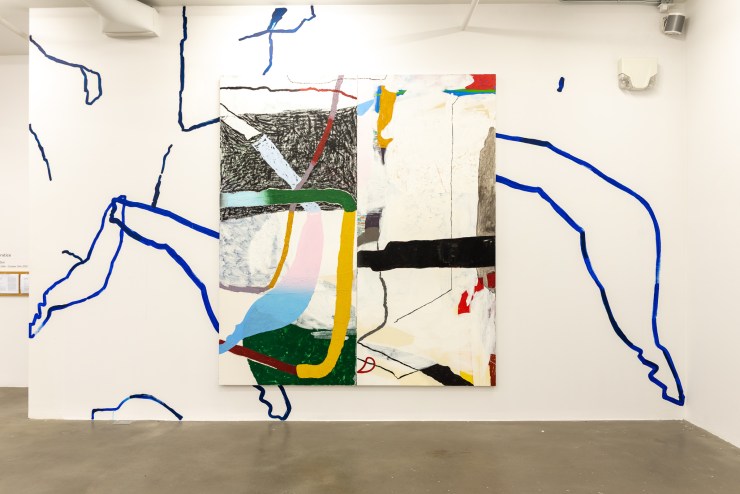
Queer Identities at I.C. Contemporary

Queer Identities Opening Shot. Image Courtesy of I.C. Contemporary.

Queer Community in the Gallery: Queer Identities at I.C. Contemporary

Chase Joynt, Devin Wesley, B G-Osborne, Reitano Holly, Shane Oosterhoff, Joslyn Panasiuk

Curated by Ignazio Colt Nicastro

August 2020 – October 2020

By Rebecca Casalino

Queer communities connect like links in a chain, each circle intersecting with the next, spanning identities, generations, and geography. The tangles of my community lead me to art that reflects queerness in its ever-changing form. I met writer, singer-songwriter, and trans activist Robbie Ahmed, through my friend and fashion designer Adrienne Wu, in the cheap seats of Vivek Shraya’s How to Fail as a Pop Star (2020) in Toronto’s Distillery District. So, when I saw Ahmed’s portrait in my daily flash of Instagram stories, I had to click through to see where it was showing. The image is moving — purple haze warps the composition, so his nose is in focus and centred while the glow of purple blurs his features in a halo effect. A few quick taps lead me to I.C. Contemporary’s pre-recorded tour of the digital exhibition Queer Identities shown on their website through an embedded Youtube video. The wood floors of the gallery are pixelated, the ceilings are high with walls acting as stark panels of white and black. I hear people talking right away and the frame moves towards a black and white video in a dark alcove.

Queer Identities Installation Shot.Chase Joynt, I’m Yours (2012). Image Courtesy of I.C. Contemporary.

I’m Yours (2012) is an experimental short video by moving-image artist and writer Chase Joynt, featuring two people appearing in rotation, seemingly giving answers to unasked questions. They speak into the camera and introduce themselves, “My name is Nina,” says a woman with dark curly hair and dramatic winged eyeliner. Her lips are dark and shining, a delicate mole rests on her cheek, she’s wearing silver hoop earrings and an assortment of necklaces. “Hi, my name is Chase Ryan Joynt,” says a bare-chested man with tattoos and trim facial hair, he is wearing a thick silver ring on his hand. The camera flashes to performance artist Nina Arsenault again, “Before my name was Nina, my name was Rodney,” and my heart tightens, she’s blinking and looking away from the camera, but her voice is smooth and casual. The video cuts to Joynt, “I don’t tend to answer that question. Mostly just because people who know that name tend to start using it,” he’s shaking his head and looking away, blinking just like Arsenault but is more outwardly uncomfortable, shifting in his chair. He shrugs at the end of his answer.

The media, which Joynt casts as the voiceless interviewer in this performance video, is a frequent platform where people are deadnamed or misgendered because of the ignorance or bias of uninformed cis people. Both artists’ experiences are tied by the same questions posed to gender non-conforming people but split through their individual lived experience and identity. This video is not intended as an educational balm to correct cis prejudices. Rather, the video showcases the difference in trans people’s experience and the shared monotony of answering cis people’s questions. 

Queer Identities Installation Shot. Chase Joynt, I’m Yours (2012). Image Courtesy of I.C. Contemporary.

Both Arsenault and Joynt have extensively written and made work about their transitions. Despite prominent examples such as Arsenault’s solo show Silicone Diaries (2009), presented at Buddies in Bad Times, and Joynt’s co-authored book You Only Live Twice (2012), written with HIV-positive movie artist Mike Hoolboom, people continue to question their bodies and identities by making it the focus of every conversation.

Queer Identities Installation Shot. Joslyn Panasiuk, category: HUMAN. Image Courtesy of I.C. Contemporary.

            The walkthrough’s frame exits the dark alcove and backs up to view a series of portraits along a white wall. Photographer Joslyn Panasiuk presents their on-going series category: HUMAN, which centers on trans men as its subjects. The first three portraits are glowing with oranges and yellows blurred over the subjects’ faces as Panasiuk uses tilt-shift lensing and motion blur to complicate each composition. The next three portraits are blue and purple, and amongst them, I spot Robbie Ahmed’s image as well as the face of photographer Wynne Neilly, whose portrait is hung beside Ahmed’s. Half of Neilly’s face is blurred while he wears a silver hoop in one ear—an abstract effect is created by the repetition of the shining earring. Ahmed’s portrait is blurrier with only the center of his face in focus. Panasiuk has maintained her subjects’ auras as I can still recognize my peers’ faces in these distorted images.

Their voice begins to explain the work’s emphasis on humanness and the similarities that join people. The blurring and distortion function to protect her subjects from toxic stereotypes projected onto trans masculine people and to move away from documenting differences like surgery scars or hormone shots. They speak about the making process as a bonding experience between herself and community members, as well as an opportunity to engage with other aspects of her queer identity. Viewed together from afar, Panasiuk’s subjects look like a colourfully lit chorus on stage.

Queer Identities Installation shot. Reitano Holly, Metamorphosis I. Image Courtesy of I.C. Contemporary.

            The main room of the digital exhibition breaks off into a brightly lit room with blocks of poetry on each of the six panels on the curving white wall. Wide columns of thick glass bricks make up sections of the opposite edge of the space which creates an airy tranquil space for reading. Reitano Holly uses the collection of poetry, from his up-coming series Metamorphosis I, to lay out stages of queer self-discovery and self-acceptance. Through my headphones, the artist’s voice explains the work as a “schematic for the process of queer identity that can be used as almost a guide or a reference.” He uses coloured text allowing for moments of vibration, the word ‘faltered’ melts like butter into the white wall. I can spot myself and others in his words—forbidden longings, confused fumbling of young queers finding themselves, and self-love. His words trace queer lines of desire and push against perceived limitations of the queer body; “too far to try to reach” (emphasis added). Holly flips crude conversations or curiosity of queer people’s bodies into lust and love writing “[a]nd found Gold between the richness of your thighs.” His writing brings the works in the exhibition to thoughtful pause. What changes when queer subjects are portrayed by queer creators? Can sick curiosity become tender attention?

Queer Identities Installation shot. Image Courtesy of I.C. Contemporary.

Curated by fellow queer artist and curator Ignazio Colt Nicastro, Queer Identities is in response to the subliminal thought processes of queer artists. In email correspondence with Nicastro, he points to the exhibits’ unintentional weight on more ‘masculine’ artists, and the overall pattern of “the display of hegemonic gender roles [and] male dominance in art spaces” which he hopes to tackle more intentionally in future projects. This level of self-awareness in his practice was, to say the least, refreshing as a femme queer woman working in spaces dominated by cis men.

The artists featured in Queer Identities exist under minority stress in a heteronormative society that dictates so-called ‘masculine’ and ‘feminine’ norms. Nicastro includes moments of acceptance and celebration for viewers, and this inclusion provides a fuller spectrum of queer experience. No artwork is a token or stand-in for a whole aspect of the queer community. However, these artworks trace the interconnectivity of queer experience as bodies are linked through romance, friendships, encounters, and art.

Vivek Shraya made a play about her career in the Canadian music scene, including how Tegan and Sara helped her get her start. Robbie Ahmed is an alum of Shraya’s mentorship program. Adrienne Wu introduced me to Ahmed and takes me to plays when I’m too nervous to go otherwise. Spaces, online or in person, that carve room for queer voices to speak the truth freely without censorship or misidentification allows queer bodies to gather in community. It’s essential that queers make space for other queers, linking each other together across identities, generations, and geography.

Impenetrable intimacies: the body as a fever dream

the body as a fever dream, 2020. Installation view. Work by Eija Loponen-Stephenson, Sheri Osden Nault, and B Wijshijer in view. Photo credit: Roya DelSol. Courtesy of Xpace Cultural Centre.

the body as a fever dream

Xpace Cultural Centre

October 9 – November 7, 2020

Séamus Gallagher, Eija Loponen-Stephenson, Sheri Osden Nault, Camille Rojas, Lauren Runions, and B Wijshijer

Curated by Dallas Fellini

By Dana Snow

The back of my head rests at a right angle on shutters made of composite wood pulp, craning at my laptop screen—I have forgotten about good posture. Trapezius muscles in my neck hold the tension of overdue bills and the strain of a heavy grocery load. The sharpness in my tailbone presses into my partner’s firm mattress. My hamstrings are taut after a morning run in old sneakers. In the privacy of the bedroom, my body belongs to me, supporting and warming the person asleep next to me. I am fully present, existing on my own terms. I am safe from consumption.

The body as a fever dream teeters between thresholds of the corporal, constricting and constructing form. Spectral absences refuse the optical cannibalism lurking around every sightline in the gallery space. I have seen many exhibitions on the Body — in its academicized capital B — it has become synonymous with an essential identity, co-opted most frequently by a cis-white feminist framework.¹ The body as a fever dream works outside of this history, centring the body as an opaque form; one that honours trans experience. Using elements of absence, refusal and opacity, the exhibition refigures the body as something that exists in the slash between either/or, granting self-governance to a form that has historically been framed under the cisgender gaze.

Séamus Gallagher, THINKING OF YOU THINKING OF ME. Video. 2019. Photo credit: Roya DelSol. Courtesy of Xpace Cultural Centre.

Scarlet LCD screen emissions beckon me into the gallery—I think of Sara Cwynar’s Red Film first. An examination of ideal cosmetic femininity under late-stage capitalism, Red Film’s didactic lines have stuck with me the most: “Remember that dull scanners and digital cameras have problems with highly saturated reds.” Artist Séamus Gallagher plays with these “problems” in THINKING OF YOU, THINKING OF ME. After an opening close up of artificial flowers printed on foam core, the camera cuts to ersatz velvet red shower curtains in the middle ground. Gallagher emerges as their drag persona, Sara Tonin, dripping in ruby sequins. Her Oz-worthy strapless dress blows out the focus on the torso of her performer, focusing the viewer’s attention on her paper maquillage. Under her mask, she— or perhaps Gallagher—speaks to biological “cheap imitations” in animal behaviour. Sara Tonin is a construction of mimetic lust. She moves just beyond reach, a technicality away from tangibility. “I am thinking of you, thinking of me. Watching myself the way you watch me.” In the wash of reds, I can’t tear my eyes away from her face, her décolletage. Gallagher’s use of red is a formal refusal to be completely captured as an object of desire. It’s a performed understanding of the freedom afforded by elusiveness — a refusal that grants breathing room. I think about my own red slip, a silky garment that lays in a whisper against my skin. A reminder of sensuality against exposed flesh that stretches over my bones and often feels like it does not belong to me, especially when it is on view. Wearing the garment becomes a literal exposure therapy. I think it is my form of a cheap imitation, that I am playing a vision of a woman that I will never be. But it also means that I do not have to truly reveal myself, I remain unwounded through performance. I re-watch THINKING OF YOU, THINKING OF ME hoping that I will catch a glimpse of Gallagher revealing an aspect of themself, something that will point me to the person behind the performance. I am unable to find anything.

Eija Loponen-Stephenson, Net Interface. Forest-green privacy netting, button thread, brass grommets. 2019. Photo Credit: Roya DelSol. Courtesy of Xpace Cultural Centre.

Eija Loponen-Stephenson’s Net Interface leaks into my space before I can tear myself away from Sara Tonin. A wheat-pasted image of a construction shroud veils while Sara bares her collarbones. As I wander over to the installation, I think that it might be out of place, until I see the four drooping gloves protruding like weeds from the netting. I feel like I am intruding on this work, like a voyeur unable to access their subject. Within the folds that reach the floor, I find a knuckly plaster mass. Sheri Osden Nault’s Mimic, Lake Ontario offers relief, an assurance that my own body is not implicated to fill the vacant gaps in the work.

The two installation pieces lap at each other’s edges in the gallery space. They contain complimentary absences— while the site-specific images of Net Interface sever a body into limbs, Mimic, Lake Ontario materializes the body as a larger contextual whole in the space. As I walk around gently heaped piles of sand, I imagine the animate plaster peeking through to have spindly roots, a nearly neural network of connection between the islands in the gallery. The piles lead me to Hold, a sculptural work from Osden Nault using the same technique of cast plaster fingers inside a burrowed-in log. Corroded by insect trails, the work centers the embedded remnants of bodies reliant on one another. I am looking at the intersection between the human artist and the movements of insects as artists in their own right, one tracing another’s presence. I am reminded that I am not the sole being in the gallery space. Underneath my feet and poured concrete flooring there is soil, microbes, water. I am reminded of the mask I am wearing in the gallery to keep out virulence, and the open wound in my hand the sanitizer sears into upon entry—we are all embroiled together. In the unease, I recognize the intimacies of interconnection.

Sheri Osden Nault, Hold. Log, plaster, acrylic medium, epoxy resin. 2017. Photo credit: Roya DelSol
Sheri Osden Nault, Sovereign Bodies 01. Found wood, human hair, epoxy, nylon rope.
2018. Photo Credit: Roya DelSol. Courtesy of Xpace Cultural Centre.

Sovereign Bodies 01 hangs within the sightline of Hold, the boughed found wood and human hair evoke a closed eye with lashes looking over their fleshy parts. Osden Nault’s works contain what feminist scholar Donna Haraway would call a “becoming-with…  the cat’s cradle games in which those who are to be in the world are constituted in intra- and interaction.”² The independent works become an involved landscape. If Net Interface asks you to fill its voids, Hold, Mimic, Lake Ontario and Sovereign Body 01 interpellate the viewer’s body into their becoming. In their use of abstraction and union with the non-human, Hold and Mimic, Lake Ontario deny a singular corpus, allowing a horizontal relationship to the other bodies of the landscape (including the viewer’s) to emerge. I cannot distance myself from the objects as a singular viewer to gaze at the landscape the works create. I can only become a subject with an impact in their world.

B Wijshijer, How to Edit Your Selfies. Video. 2019. Photo credit: Roya DelSol. Courtesy of Xpace Cultural Centre.

B Wijshijer’s How to Edit Your Selfies flashes west of Hold, jarring the world it has built for me. The artist sifts through filters on FaceApp, a popular application used to swap genders and ages, predominantly for social media posts. After each filter a screenshot is taken, moving Wijshijer further and further away from their origin point. Over time, the face of the artist becomes exponentially more bizarre, unrecognizable by mid-film and at the end, reminiscent of Francis Bacon’s suffering figures. Wijshijer’s face is not absorbed by the algorithm, but defiant to the cis, neoliberal “beautiful” versions of the self the app was created to produce. In their exhibition essay, curator Dallas Fellini describes Wijshijer’s transformations as “monstrous.” As I embrace my own femme identity, monstrousity is somewhere I feel most comfortable. Tracing the scholarship of Judith Butler, the monstrous is “a way of writing ourselves out of the ‘bind’ of gender binaries, heteronormative desires and traditional forms of kinship.”³ Wijshijer has written themself out of the teleological nature of cis beauty the app promises to deliver, and into a cyborgian realm of possibility. How to Edit Your Selfies feels like a finale to Gallagher’s THINKING OF ME, THINKING OF YOU, a performance of data mined mimicry stretched beyond recognition.  A mutated, distorted face is one that has agency over its aesthetic co-optation, one that cannot be easily digested — it is what I would call a “power move.”

Quartet with “Net Interface” and “Mimic, Lake Ontario”, Performed by Camille Rojas and Lauren Runions. Work by Sheri Osden Nault and Eija Lopponen-Stephenson. Photo credit: Philip Leonard Ocampo. Courtesy of Xpace Cultural Centre.

             Quartet with “Net Interface” and “Mimic, Lake Ontario” punctuates the exhibition in its notable absence of action. The only ephemera left from the performance between Camille Rojas and Lauren Runions are fingers scraped through the sands of Mimic, Lake Ontario. The atemporal aspect of the performance is a spectre in the gallery, stretching from far before I arrived when the act took place, and realized in a video work I pulled up from the comfort of my own home. I could describe the curious movements made by Rojas and Runions, inhabitants of the work and the space before I, or any other viewer for that matter, saw the work. I could speak to their loving cradling of Mimic, Lake Ontario or I could tell you about the playful insights bodies in movement bring to Net Interface. But I think the work is at its strongest in its frustrating inaccessibility. What the viewer can know in the space is that an activation took place, but until they seek it out for themselves, they cannot see through anything but its remnants. In its frustrating opacity, Quartet is whole—a completely inconsumable body of work, a haunting refusal to be present. It reminds me that as you read my words, I am not the voice that exists in your head. Or, that I am becoming another as you digest me. And I can exist as both, unburdened.

¹Louis Fermor, “The Feminine, The Grotesque and the Reclaimed,” Canadian Art, November 24, 2020. 

²Donna Haraway, When Species Meet (Minneapolis: University of Minnesota Press, 2008), 4-5

³Judith Butler, “Afterword.” In Animating Autobiography: Barbara Johnson and Mary Shelley’s Monster. (Palo Alto, California: Stanford University Press, 2014) 40.

The Shrugging Lady Emoji and Russna Kaur’s Abstractions

Russna Kaur, Suddenly her lips sharpened—it was splendid installation shot, the sky seems to be the only one to Notice, 2020. Burrard Arts Foundation. Photograph by Ada Dragomir.

Suddenly her lips sharpened—it was splendid

Burrard Arts Foundation

August 29, 2020 — October 10, 2020

By Ada Dragomir

The first time I saw one of Russna Kaur’s monumental paintings, Ironing, Bored, I couldn’t stop staring. Sized at 12 feet x 9 feet, occupying a quiet corner on the top floor painting gallery at Emily Carr University, it was hard to leave, difficult to walk away. It wasn’t until much later that I understood why I felt that way.

When I first saw Kaur’s work, I was an exhausted third year BFA student, equal parts overwhelmed and in awe, walking through offerings at The Show—Emily Carr University’s graduating exhibition. Her work was a welcome reprieve from an onslaught of poorly executed new media works and frenetic installations filled with broken things, clumsily glued back together. Kaur’s work moved me, held me, and invited me in because it walked a tightrope across the complex political and visual histories of abstraction and representation. Though her work is situated in the realm of the abstract, she manages the concomitant baggage with intention and grace. While the art world reckons with representation, Kaur keeps on going—making work with the practiced pragmatism of the shrugging lady emoji.

Russna Kaur, Suddenly her lips sharpened—it was splendid installation shot. They are midway between the sun and the moon, 2020. Burrard Arts Foundation. Photograph by Ada Dragomir.

That initial encounter was with a painting constructed from multiple abutting surfaces, strips of canvas, sawdust, and saturated acrylic paint. It was mimesis of absolutely nothing and an image of absolutely everything. It made sense to me and yet alluded to so many unanswerable things. My girlfriend thought it was a very ‘pretty’ painting—and her passing attraction speaks to the seduction of Kaur’s style, but all good work deserves a closer encounter, a longer breath, a deeper look. Ironing, Bored made me think of my grandmother ironing bibi’s fotă, the velvety red embroidery flattening under the weight and steam, a mostly-ash cigarette hanging from her mouth—dangerously drooping over the entire operation. I didn’t know Russna then, hadn’t heard the stories she tells about and around her paintings, hadn’t yet understood how someone manages the burden of representation, juggling what to reveal and what to conceal, forging a possible path forward for the rest of us racialized diasporic femmes, sharp as fucking tacks—especially, those of us who think carefully, skeptically, and often, about identity-based politics in art.

You see, much of 21st-century art history is filled with White men making abstract paintings. From de Kooning to Pollock, from Malevich to Yves Klein, an entire century’s worth of artists with class, gender, and most notably race privilege, have escaped the burdens of representation, marshaling abstraction into a purportedly universal language. How many White guys in modern, post-modern, or contemporary art paint consciously and representationally about the specific circumstances of Whiteness and masculinity? How readily can you name 10 White men working in abstraction historically or contemporaneously, and how readily can you name 10 racialized women doing the same? Go ahead, count them on your fingers.

If abstraction is coded as both White and male—and we can trace this back to Whiteness and masculinity situating themselves as central, normal, default, everything and everywhere—then inadvertently, the assumption falls that racialized and women artists’ purview is—or ought to be—representational.

Representation can be articulated as making mimetic work. That is, paintings and sculptures which aim to communicate likeness to life, but representation can also be inflected in order to increase political visibility, literally to see more racialized artists exhibited and collected. Abstraction, on the other hand, presupposes a stifling universality—a ‘pure’ and singular visual language, more connected to platonic ideals or some eternal spiritual principle than to the muddy meatspace we all live in. It’s messy since the politics of representation are just as dangerous as white-washed and colour blind universalisms, both in art and in life. Our political forms—and our artistic ones—need subtler inflections. In other words, why use a hatchet when a scalpel is needed? In other words, is justice for BIPOC better served by a cop with a dastār or an RCMP commissioner who thinks that systemic racism doesn’t exist?

In other words, are the politics of representation the road to liberation?

While I have serious doubts about the potency of identity politics and the real political power of representation in our current world, the fact that I’ve had exactly two instructors of colour in my six year stint in art schools (none of them women), and that a recent survey of Canadian art institutions breaks down a dismal percentage of BIPOC in executive leadership[1] all tell me that Whiteness is still very much the norm, the neutral, the abstract and amorphous center of the universe art world. Buricul Pământului.

What makes Kaur’s paintings worth the second look is that they imbricate this tension, navigating both the possibilities of the utopic and the political burdens of representation.

Russna Kaur, Suddenly her lips sharpened—it was splendid installation shot, 2020. Burrard Arts Foundation. Photograph by Ada Dragomir.

When I sit with Suddenly her lips sharpened… it was splendid, Kaur’s recent show at Burrard Art Foundation, it feels like a breath of fresh air. For an exhibition which demands so much space—a monumental almost endless picture plane crawling across 13+ canvases and occasionally the walls—Kaur offers a surprisingly subtle political inflection. Sometimes reminiscent of maps, sometimes of rich velvets or shalwar kameez, and sometimes of a secret story held in too long, Kaur’s paintings invoke her “Punjabi-ness” without essentializing it and convey her stories without performing them. There’s a lot going on within those adjacent canvases, packed with colour and line, a feast of texture and material, but there’s also a lot of space for me, and in all likelihood, space for you as well.

On display at Burrard Art Foundation from August 29th to October 10, 2020, the exhibition consists of 10 works. Ranging from the humble 4 x 6 inch blinking your eye—an energetic painterly swath of milky acrylic and thread over burgundy pastel—all the way to the enormous 192 x 108 inch They are midway between the sun and the moon, the show towers over the viewer with discordant gradations of purples and greens, pinks and lime-yellows.

Kaur’s use of colour—that jarring, clashy, raucousness—recalls walls covered with the covoare and ştergari of my childhood in Romani homes. Abstracted tree of life motifs or screaming regional floral symbols reaching across and beyond the linen they were embroidered or woven onto, jumping from one surface to the next in a cacophony of colour and texture. The world never finished, the arrangement always growing. Kaur’s paintings work similarly, modular and mutable, puzzle-like in composition and title, enormous and ever expanding. Her use of multiple surfaces—in size as well as material presence—include the traditional canvas and cradleboard panel, but also extend well into the diversity of cloth that one would find in any self-respecting fabric store or bridal boutique in South Main. Ranging from silk, muslin, and twill, to paper and found wood, the substrates are rendered with thread, cold wax, acrylic, crayon, pastel, sand, and spray paint. In parts it’s sprawling and enormous, in parts tiny and spacious; all of it is full to the brim. Suddenly her lips sharpened…is a lot.

Russna Kaur, Suddenly her lips sharpened—it was splendid installation shot, 2020. Burrard Arts Foundation. Photograph by Ada Dragomir.

It’s as if there’s just too much to pack in: too much life, too many imperfect abutting pieces in tension, too much emotion, too much colour, too much ornament. That too-much-ness exists in sharp differentiation from the not-enough-ness of Kaur’s titles. Constructed, like the work itself, from pieces—Kaur uses redacted poetry to generate titles like when the mirror, It asked for more—there is barely enough information to achieve anything but a short nod towards a hidden world of meaning.

It is this same dynamic, this too-much-ness wedged in beside a not-enough-ness, that compels me to sit with Kaur’s paintings. I do so because they make me think. I am reminded that it is a similar and simultaneous too-much-ness and not-enough-ness of which young racialized women are constantly accused. Too loud, too bright, too unprofessional, too rude, too angry, too emotional, too smart. Not subtle enough, not perfect enough, not rich enough, not enthusiastic enough, not bright enough, not White enough.

Remarkably amongst all that, Kaur’s paintings seem to be a kind of artistic manifestation of the shrugging lady emoji—and just to be clear, not the “default” yellow one. While the world wants racialized artists to wage political battles and carry around the baggage of representation, Russna Kaur choses to just do what she wants—what she has to do.

Certain elements cross the expanse of the broken-up picture plane gesturing the continuity and integrity of the whole, but there are just as many instances of imperfection, of line or shape or colour which don’t add up, popping up inverted, truncated, or somewhere where they aren’t “supposed to be,” but are so desperately needed. Imperfection is inevitable, and in Kaur’s work, it’s accepted—recognized as a necessary facet of existence—and as they say, so in art as in life. I imagine the shrugging lady emoji, too, when I think about the assumptions and associations made with such bright and profuse colour. While some of us live in a world where simplistic and essentialist cultural mores direct us to believe that vivid and loud colour equals exotic and signals happiness, others live by the adage “laugh so you don’t cry.”

Russna Kaur, Suddenly her lips sharpened—it was splendid installation shot, 2020. Burrard Arts Foundation. Photograph by Ada Dragomir.

The shrugging lady emoji is of that latter persuasion. Having exhausted her finite store of shits left to give somewhat early in life, she spends her time wedged in the fissures between culture, race, gender, and labour. The shrugging lady emoji is not so much about resignation as it is about the recognition of a cruel irony, a prosaic pragmatism—facing the way things are, accepting that shit is profoundly fucked, and figuring out a way to move on, move in, and move through.

The shrugging lady emoji is intergenerational trauma wrapped in eggplant purple embroidered with gold silk thread. She is sexualized abuse and the wounds of diaspora shimmying into teal silk with lime green and hot pink trim. She is my grandmother ironing bibi’s fotă, tired and hunched over. She is a human pyramid of tiny stooped women with kind eyes, or squat fat women with gnarled hands, or once graceful but now stiff women with tongues like freshly sharpened knives upon whose shoulders the rest of us stand. She is the person who pretends to not speak English to get a discount, who expects you to work till you drop dead and then rise from the beyond to put in just two hours more. She is far from perfect, but….

¯\_(ツ)_/¯

_________________________

Sometimes, I like to think about artworks making arguments. Not every artwork makes an overt contention, but there are almost always ideological underpinnings to the aesthetic choices we make, even if they are buried deep, instrumentalized later, completely unconscious, or intentionally concealed. Think about Alfred Loos’ essay against decorative adornment titled Ornament and Crime[2] in which he takes a moral (and extraordinarily racist) approach to the “degeneracy” and “wasted labour” of embellishment. Or Hans Holbein’s The Ambassadors filled with hidden symbols and double entendres which reflect the politically and religiously treacherous waters in which it was painted.

A particularly apposite example, in our case, is Abstract Expressionism’s collaboration with the CIA during the Cold War. Soviet Era Socialist Realism, with its idyllic, heroic and pastoral inflections, ideologically presents an image of a united proletariat or sometimes their magnanimous yet salt-of-the-earth leaders living harmoniously, sucking from the fertile bosom of Mother Russia. As someone who grew up in Eastern Europe in the long shadow of the setting Soviet sun, I assure you that’s not quite how it went. Ideologically, Abstract Expressionism was America’s answer—a modern movement dominated by individualism, capitalism, expressive creativity, freedom of emotion and mark-making, monumentality, and masculine vigor. In Rockefeller’s words, it was “free enterprise painting,” and so it remains, a movement whose works are scattered across billion-dollar bank lobbies, executive offices, and prestigious galleries throughout America.[3]

What is Kaur’s work then saying if it speaks with the embouchure of abstraction, the scale of the monumental, the colours and rhythms of Punjab? What does it say when spoken in the halted staccato of redaction? What is concealed and what is revealed? What does it say about gender, and race and representation, about how much space there is, where, when, and for whom?

Her work says you can look but you won’t be able to see, you can consume but you’ll never be sated, there is a story but told only in fragments, it’s not perfect and was never meant to be. There is space for you, but not in the center.

¯\_(ツ)_/¯

You can view the virtual exhibition tour of Suddenly her lips sharpened — it was splendid at Burrard Arts Foundation here.


[1] https://canadianart.ca/features/a-crisis-of-whiteness/

[2] Loos, Adolf, and Adolf Opel. 1998. Ornament and crime: selected essays.

[3] https://www.independent.co.uk/news/world/modern-art-was-cia-weapon-1578808.html

Celebrating the Work: Marlene Yuen at grunt gallery

Cheap! Diligent! Faithful!

Marlene Yuen

grunt gallery

September 25 — December 12th, 2020

Marlene Yuen. Cheap! Diligent! Faithful! installation shot. Image by Dennis Ha courtesy of grunt gallery.

By EA Douglas

Entering grunt gallery, I am initially struck by the kelly green and turquoise mural which occupies the entirety of the back wall. The mural is easily distinguishable as the facade of a building from Vancouver’s Chinatown, a neighbourhood a short walk from where I stand now. Simply illustrated in white and red, green and blue, the pretend storefront is a memorial to Ho Sun Hing Printers, Canada’s first Chinese-English print shop that was shuttered in 2014 after over a hundred years of business.

On the wall, a pretend awning stretches out over a faux garage door. A sign with red Chinese characters and green English font reads, “Quality Printing at Reasonable Prices.” There are painted plants in the painted window, beside a bold little placard that shouts “Colour Copies.” A nod to Marlene Yuen’s time spent in the letterpress studio creating her latest work, Ho Sun Hing Printers, is an artist book inspired by and made with blocks gleaned from the business the book takes its name from. When the established Chinatown print shop closed, there was a swoop of community interest in preserving the printing equipment that had been in use for over a century. Yuen added several woodblocks to her personal collection, on display in a glass case in the corner, and the WePress Collective, a community art space in the Downtown Eastside acquired over eight thousand characters of Chinese type which Yuen was able to borrow in her completion of Ho Sun Hing Printers.

Marlene Yuen, Ho Sun Hing Printers. Printed in collaboration with Moniker Press riso studio. Cheap! Diligent! Faithful! installation shot.Image by Dennis Ha courtesy of grunt gallery.

Yuen is a printmaker and comic artist, mediums that can be difficult to translate into physical spaces. grunt pulls it off by highlighting Yuen’s cheeky storytelling through a series of largescale comic posters, each one narrating the life and labour of a Chinese-Canadian. There’s Stewart Wong the begrudging restaurant owner, who ran Public Lunch Cafe in Olds, Alberta for nearly 30 years, Jean Lumb, the celebrated entrepreneur and activist working in Toronto’s Chinatown and John Woo, the dedicated launderer in Hamilton, Ontario. With storytelling that exists within the pictures as much as words, the linework is thick and distinct. Backgrounds of black juxtapose the simple outlines of the people featured. The overall impact is heavy, burdensome like the hours these Chinese-Canadians laboured to run their businesses. Still, emotion is conveyed easily throughout the poster boards. A frowny faced plate of bacon and eggs echoes Wong’s misery of having to wake early to run a restaurant he didn’t want. Lumb’s armfuls of children outlined in a rigid, jagged edge depict her dedication to a large, and perhaps chaotic, family. A clothesline of various outfits, including judicial robes and football jerseys, communicates the impact that Woo’s laundry company had on his community.

Marlene Yuen. Cheap! Diligent! Faithful! installation shot. Image by Dennis Ha courtesy of grunt gallery.

Accompanying these black and white pieces on opposing walls are two cheerfully screenprinted accordion books stretched out in a display case. Here, we find the colourful biographies of Mary Ko Bong, a military mechanic and watchmaker, and Cheng Foo, a railroad worker. Leafing through the display copy of Ho Sun Hing Printers the beauty of letterpress radiates. Yuen’s artistry occurs in the composition and patterning of the images as they dance their way across the pages. Weaving between a quick history of Ho Sung Hing Co. and an interview with the last owner of the print shop, Norman Lam, the effect is ethereal while grounding. The book emits a sense of timelessness with its spellbinding pull that causes me to lose myself as I become aware of the history these pages preserve. Through the prints, the importance of these woodblocks and their specific purpose within the Chinatown community is highlighted. Slanted rows of Lanxiang Snow Chrysanthemum tea parade across a lavender page. On soft seafoam, waves of a pictorial guide to using chopsticks flow in three straight columns. Prior to the interview with Lam, we are treated to a photograph of a heavy-looking chase prepped for printing. The English text reads, “SECOND BEAUTY SALON” in reverse.

Utility is the backbone of this work. Ho Sun Hing Printers uplifts tools formerly of the everyday into art. Within the art book, the prints from these blocks are displayed as graceful facsimiles but through the translation, their importance as tools rings clear—these blocks, although beautiful, were acquired to serve and support the Chinese-Canadian community in Vancouver. When Ho Sun Hing Printers closed, due to the combined impacts of the digital age and gentrification, Chinatown lost a part of its charm.

Yuen’s work is a consistent endeavour to document the history of Chinese-Canadians, specifically their labour and dedication. Through the profiling of these business owners, she manages to capture both the sweet and the sweaty moments of a fading history. Yuen celebrates this value of industriousness, a trait that is clearly evident in her own practice. The hard work pays off—Cheap! Diligent! Faithful! is as captivating as it is informative, a true celebration.

On God’s Own Country

God’s Own Country film still. 2017. Image via Orion Pictures.

By Harper Wellman

I have two unrevolutionary mantras in life. While the generic nature of mantras leaves them open to many applications and interpretations, the two ring clear now more than ever. 

The first is “This, too, shall pass.” I tell myself this whenever I find myself in an unwanted place or situation. The second, related or contradictory depending on your perspective, is “Life is cyclical.” Life has proven this to me time and time again, not just through physics but also through lived experiences. Everything will change, but we’ll also find ourselves in well-known situations. We might find ourselves surrounded by familiar people, going through habitual spaces, or maybe confronting an ongoing struggle. Simultaneously, events and experiences have changed our perspectives. 

These ideas are explored through the character development and themes in 2017’s God’s Own Country, written and directed by Francis Lee and starring Josh O’Connor and Alec Secareanu. Receiving rave reviews upon its release, aspects that could have been the downfall for the film work brilliantly well when combined, and the themes raised seem oddly apt for our current social climate. While we have been blessed with so much queer content during the pandemic (Priyanka for Prime Minister!), watching God’s Own Country prompted me to realize the cycles we all find ourselves in, and the one I was in on a micro level.

After years of having access to communities of my choice and my creation, public safety saw the shuttering of most gay bars, art galleries and museums, and isolation from friends and chosen family. Quite quickly, the communities I relied on were just as inaccessible as when I was shuttered in the closet. As I had done then, I turned to a familiar solution that had provided me with my first sense of queer community—the media.

This image has an empty alt attribute; its file name is Gods-Own-Country-1-1-1024x540.png
God’s Own Country film still. 2017. Image via Orion Pictures.

Growing up, I was lucky. White, cis-gendered gay men, like myself, were an easy way for companies to pinkwash their content without much thought or representation given to any of the intersections of our LGBTQ2+ community. I fell for it. There were Jake & Karen, the OG Fab Five, and side characters in teen movies or sitcoms. Then, just as I was entering middle school, I discovered Queer as Folk.  

The show, however problematic, rocked my world at the time. There were gay white people, living their gay white lives! The characters’ experiences were just as rich and complex as the lives of the Ally McBeal characters that I loved so much. I truly felt like I was seeing a representation of queer people like myself for the first time. Since, queer representation has expanded: Moonlight, Orange Is The New Black, and Special, to name a few, show that queer experiences are intersectional and dynamic. More people can see themselves represented in mainstream media, just as I had the privilege of having when I was younger. God’s Own Country is lacking in the diversity department but does offer a portrayal of white cis-male queerness that is unexpected and subverts many mainstream stereotypes.

The plot beats in God’s Own Country are relatively standard: A man, Johnny (O’Connor), struggles with society and familial expectations. Enter transient love interest Gheorghe (Secareanu). Initial resistance. Togetherness. Complication. Realization. This is a well-known dance.

At first glance, the formulaic story combined with heavy-handed metaphors and sometimes shaky cinematography shouldn’t work well, yet, these elements combine in a way that allows the character development to take center stage.

Our protagonist starts off drunk, racist, scared of intimacy and has a terrible relationship with his parents. By final credits, he has decided to drink less, loves the object of his racism (can we not?), and develops a better relationship with his family. These transformations are handled with subtlety and grace and a realistic sense of ambiguity. Johnny reaches for a beer but haunted by mistakes, decides against it. Do we get the sense that Johnny will never drink again? No, but we see the desire and effort of Johnny to be a better person. Similar evolutionary moments involve Johnny’s relationships with both his father and the farm animals, telling of Johnny’s gradual emotional growth.

Likewise, Johnny’s parents (played by Gemma Jones and Ian Hart) develop throughout the film. They grow to accept Johnny’s choice in Gheorghe as a partner as they see Johnny change for the better due to his company. Interestingly, neither parent is ever overtly homophobic in the film. If anything, they have more of a problem with Johnny’s drinking and lack of responsibility than his sexuality. Once again, this is a refreshing change in an onscreen adult/queer child relationship, especially in the development between Johnny and his father. By not focusing on such queer-specific moments, the space in the film is able to be filled with more interesting moments of their relationship; the intimate, universal, and relatable moments.

This image has an empty alt attribute; its file name is Gods-own-Country-3-1-1.jpg
God’s Own Country film still. 2017. Image via Orion Pictures.

Unfortunately, Gheorghe, the love interest, has the weakest arc in the film. He is kind from the start, and if anything, his kindness is disseminated throughout his new community and other characters. We learn little about his back story, and he seems, like so many pixie dream girls before him, there mostly for Johnny’s development. Gheorghe shines in one scene when he physically confronts Johnny over his racism. They get into a brawl, inevitably ending with thick sexual tension between the two. We can interpret Johnny’s racism as a tool for masking his attraction for Gheorghe. Still, it feels like the closeted playground bully attacking the proudly out kid, something that is not the case of Johnny’s white partners in the film. These racist tropes are a low point for the film and seem especially tiresome in 2020. 

With these shortcomings in mind, God’s Own Country still offers a refreshing representation of queer men. They filled few gay stereotypes (I could do without the promiscuity) but instead presented two capable and rugged men, riding quads, building fences, and helping birth animals. This type of representation was well-received in 2005’s Brokeback Mountain; however, what makes GOC’s portrayal refreshing, is that there is no struggle with sexuality. Yes, Johnny struggles with intimacy and societal expectations, but he is cocksure of his sexuality. Gheorghe, likewise, accepts his attractions to men. There is no cheating on women or even hiding their sexuality from the rural community, which works to undermine the long-held prejudice that members of the LGBTQ2S+ are inherently deceptive or untrustworthy. It also seems more accurate to outness today and how our community is fighting for all queer experiences to be recognized, not just those that appease our heteronormative overlords. For me, watching another coming out story on film is comparable to watching Batman’s origin story again on film: I’ll do it, but I’d like his relationship with Robin explored more.

Through the various characters’ development, some strong themes arise, directly reflecting issues many of us are facing today. Beyond the universal theme of unfulfilled parental expectations (especially true in LGBTQ2S+ communities), there is the theme of familial responsibility. While initially flippant about these responsibilities, as his father’s health descends, Johnny embraces his duty to care for his parents, both directly with physical assistance and indirectly by caring for their legacy, the family farm. We have realized a societal duty to protect our elderly during the ongoing pandemic, whatever form that may take, and embracing it sooner than later can help ease our older community members’ suffering.

The idea of stuckness was strong in the film as well, something we can all relate to during this pandemic holding pattern and as queer people. We may have felt stuck in the closet, in a town, or in a body. Even though Johnny initially feels stuck, his perspective is altered by embracing the unexpected changes life tosses at him. Through a new lens, Johnny can embrace the responsibilities that burdened him before. Each time we revisit a situation, we carry with us new tools and insights to better navigate the circumstances. As many of us find ourselves in unexpected cycles, whether that by living with parents or unemployment, at a time when major life changes seem on hold, it is worthwhile to focus on more immediate and tangible changes.

A final theme that spoke to our current situation is that of community. By the end of the film, Johnny has come out of an isolation of sorts by embracing what community is available to him—his family—while creating a new sense of community through his relationship with Gheorghe. This pandemic imposed isolation has prompted many of us to embrace what community we have and seek new ways of connecting. As queer people, we have been in this isolation before, but we have new tools, knowledge, and relationships to help us through this time. 

While Johnny’s cycles of stuckness, community and responsibility play out on a small scale, his journey in God’s Own Country speaks to a 2020 audience, perhaps more so than upon release in 2017, on a large scale. Pandemics, social uprisings, and volatile politics – we have been here before, and we’ll be here again. With each time around, however, we have the ability to better our actions and reactions and, hopefully, achieve something better than before.

And just remember, this, too, shall pass.

THIS IS GREAT MATERIAL: Rearranging Remnants for Resiliency

Tamara Bond, A Pearl in N’s Hair, 2016. Collage (silkscreen, intaglio fragments, acrylic on paper). 22 in x 22 in. Image courtesy of the artist.

By Ella Adkins

THIS IS GREAT MATERIAL

Gallery Gachet

July 17-August 21, 2020

Unprecedented times call for unprecedented futures. Within the unknown future, there’s the potential to re-imagine our known spaces. There’s a possibility for a new; a never before.

THIS IS GREAT MATERIAL, an online exhibition and poster series exhibited by Gallery Gachet, explores the notion of reimagined spaces and potential realities through the celebration of collage. The exhibition features the work of five artists: Marissa Diamond, Afuwa, Tamara Bond, Mary Phyllis O’Toole, and Krystle Coughlin Silverfox, all of whom are located throughout the region of the unceded Esquimalt, Songhees, Musqueam, Squamish and Tsleil-Waututh territories.

As I meander through the virtual exhibition, I first find pause in the vibrant patterning and diverse textures of artist Marissa Diamond’s work. Throughout her five works, I get lost in the layers of cross lateral landscapes of vibrant pinks and greens, triangles of orange felt, a cheetah print ‘x,’ and a hole punched strip ripped out of a Hilroy notebook. I’m reminded of my own past doodles in the margins of my Hilroy as I panic about my upper lip acne, wishing for high school and hormones to be over.

Marissa Diamond, Broken Limbs, 2020. Collage on paper: paint remnants, acrylic paint markers, fabric, plastic, pen. 8.5 in x 11 in. Image courtesy of the artist.

 The title of her fifth piece ‘Skinny Dip’, prompts me to look for the naked body. I cock my head at the purple and the pink with black dots and focus on a small curved pink shape submerged in a blue mass. There is no resolve as to whether or not this is a ‘human’ body, I’m only reminded of the tingling sensation of my bare skin entering cool water.

Through her titling and abstract shapely reminders of bodily parts and forms, Diamond reworks preconceived ideas about the body:

“Piecing and rearranging the components of each artwork allows me to create this new ‘world’ where bodies are liberated. The shapes I use are bodily, but simultaneously reference things found in landscapes and nature such as the moon, sun, sky, plants, rocks, hills, and animals — I think of the collages as ‘bodyscapes.’”

         Diamond cuts and peels remnants of dried paint, as well as other scrap materials, that no longer exist in their wholeness. She sees this discarded material as a speculative metaphor for bodies and physical traits that do not meet the westernized standards of beauty. ‘Unconventional’ bodies are discarded by the male gaze and no longer have use in being ‘beautiful.’ Diamond recuperates these discarded parts and re-appropriates the ‘useless’ body into a useful, functional, and celebrated state and space.

Mary Phyllis O’Toole, Who Am I? An Old Hag or A Beautiful Young Woman?, 2019. Mixed-media collage. 11 in x 15 in. Image courtesy of the artist.

Throughout the exhibition, there is a repeated theme of collecting ‘scraps’ of reality in order to recreate a more inclusive and celebrated future. In Mary O’Toole’s work, she utilizes collage to present the dichotomy of realities she experiences as an individual with schizophrenia.

O’Toole explains that individuals with schizophrenia “view themselves as the person they are and as an imaginary person.” She uses magazine cutouts of recognizable forms such as images of cars, cartoon and real-world animals, and depictions of female bodies and faces. This keeps the viewer rooted in reality, however, her arrangement of this media creates new shapes and spaces, such as that of a castle, or the silhouette of a face, or a neighbourhood. O’Toole depicts the unseeable—her own experience with schizophrenia living between two realities. She hopes to create landscapes “without discrimination and acceptance” for those with schizophrenia.

The exhibition also presents the possibilities for healing through the process of collage. Artist Tamara Bond utilizes collage to cover up written diary entries she crawled on sheets of paper during a past psychotic episode she experienced. The writing is hardly visible: the viewer is enchanted by fantastical fairy-like figures, horses, faces with large exaggerated mouths and gouache strokes. Bond uses collage as a healing practice, almost like placing a whimsical medicinal cloth over a written wound.

‘THIS IS GREAT MATERIAL’ not only strives to create resilient future worlds of healing and inclusion, but calls upon the interconnection of history, land, and culture that makes up an individual and a life story. Both artists Afuwa and Krystle Coughlin Silverfox loosely use the form of the portrait paralleled with textured materials to recall ideas of belonging and interconnectedness. 

Krystle Coughlin Silverfox, Hats’adän echo (Elders teachings) 2, 2020. Digital collage. 18 in x 12 in. Image courtesy of the artist.

Coughlin Silverfox’s works Hats’adän echo (elder’s teachings) are four digital collages inspired by family photos. Each work contains a silhouette of bodies in different constructed landscapes. In one work, two figures stand on a deck near the ocean, in another, two figures are in an upside-down forest next to a bridge to the moon. The spaces that the silhouettes leave are filled with their own landscapes whether it be blue sky, a mountain view, a fir tree branch, or fluffy clouds.

Regardless of the lack of a human figure, these portraits seem to more viscerally connect people’s narratives and history to place and landscape. The non-human elements construct the personal narrative and connection without the human being present. Each figure is outlined with small coloured beads, which recalls Coughlin Silverfox’s Indigenous heritage and practices. The beads act as a visual and tactile tether, evoking the traditional Indigenous craft and demonstrating how one’s cultural traditions and practices form their identities. Coughlin Silverfox creates the shape of her familial figures with evocative elements from her own heritage, figuratively reminding us of the interconnected cultural elements that construct an individual.  

Afuwa, The Matriarch, 2014/16. 23K gold leaf, handmade paper, and hand-painted paper on wood panel. 12 in x 13 in. Image courtesy of the artist.

Afuwa also employs the human empty portrait silhouette in her collection Familiar Icons in order to explore the precious bonds of blood, land and spirit. Her works have a rich opulence in colour and texture—gold leaf on wooden panels make up the background of each work, and each figure is made up of handmade printed patterned paper of rich blues, reds, greens, purples and oranges. These portraits evoke a stunning and iconic family, saturated in colour and intricate textures.

“I focused on the precious and the portable, using handmade paper and 23 karat gold — not only to underscore the value of these relationships that resisted the destruction wrought by enslavement and indentureship, but to lay claim, as well, to the gold and other resources extracted with neither recompense nor acknowledgement of the poisoned landscape left behind.” The process of assembling for Afuwa is part of the gratitude to the sacred artefacts of her history, as part of the ritual and prayer.

This exhibition externalizes anxieties, intimacies, and connectivity in a tactile and visceral sense. Through the process of collage, we can see the layering, recognize material and forms, and are reminded of our reality. However, we must abandon what these familiar images, textures, and titles signify in order to experience these works. We don’t see the naked woman’s body skinny dipping into the cool water in Diamond’s work. Instead, the feeling of the ‘skinny dip’ is evoked, allowing for all ‘imperfect’ shapes forms, and bodies  to experience the sensation. We aren’t seeing the family posed portrait, rather we are  seeing  the opulence and vibrancy of history and blood love, and the felt natural manifestations of one’s heritage. Collage has a foot rooted in reality, and the other in the imagined, a speculative metaphor utilized by O’Toole to explore the experienced dichotomy of the schizophrenic mind.

Collage collects the discarded, the scrap, the small, the insignificant, the forgotten, and blends, mixes, layers, and weaves known materials into new imagined spaces. These are spaces built on the remnants of our troubled worlds that envision more resilient and respectful potential futures. The five artists show how picking through the troubles and complexities of our current realities can result in portraying progressive and magical future perspectives, creating imperfect possibilities through a hopeful craft.

‘THIS IS GREAT MATERIAL’ was exhibited from July 17-August 21, 2020 at Gallery Gachet . Gallery Gachet is located in the DTES neighbourhood of Vancouver, British Columbia. http://gachet.org/


Contaminating states: Sophie Cundale’s The Near Room


Sophie Cundale, The Near Room, 2020 (film still). Installation view at the South London Gallery. Photo: Andy Stagg. Courtesy the artist and FVU.

South London Gallery

Aug 15- Sept 13, 2020 (Main Gallery)

By Kit Edwards

Arriving at the South London Gallery to see Sophie Cundale’s ‘The Near Room’ last week, I felt already irritated by the return to IRL art. Obviously not the seeing work in the flesh bit, but all the other stuff that comes along with the experience – the pressure to be enriched in some way, all the standing about, the feeling of being watched whilst watching (am I looking in the right way, for the right amount of time?), now delightfully combined with the fear of spreading/catching COVID. But I had truly forgotten how much I liked being out in the world looking at things, and the quiet closeness of the SLG, the dark blanket of the (well distanced) screening room, felt not dissimilar to the isolated space in which I’d been consuming art for the past five months.

Sophie Cundale’s new film ‘The Near Room’ takes its title from Muhammad Ali’s description of the nightmarish space which came to him in the depths of a fight, as described by George Plimpton in his book Shadow Box (1977):

            …a door swung half open [into a room of] neon, orange and green lights blinking, bats blowing trumpets and alligators playing trombones, snakes screaming. Weird masks and actors’ clothes hung on the wall, and if he stepped across the sill and reached for them, he  knew that he was committing himself to his own destruction.

Inspired by this vivid and strange psychic space, Cundale constructs a similar dichotomy between the life of a boxer and the manifestation of his post-knockout hallucinations. The film begins with a carousel of scenes from a life of constraint, and though we have not yet entered the ring there is something strange on this side of the psyche. The tight choreography of the training boxers gives a sense of the constructed nature of this reality as they pause and begin in perfect unison. Things become increasingly uncanny as the close images that punctuate the boxer’s life swing round again: he wakes, he weighs, he sweats. These repetitions situate the viewer in the disorientation of monotony – have we been here before? How many times has this scene replayed? Groaning audio sways us into a state of anxiety as the boxer’s fears that he may be past his prime are articulated in this impotent cycle of discipline. A sand timer bathed in red light slithers on, and the lip of his opponent begins to curl – almost imperceptibly – into a threat. This first part of the film is tight and affecting in its quickening pace, working to untack the pins of coherence.

Sophie Cundale, The Near Room, 2020 (film still). Installation view at the South London Gallery. Photo: Andy Stagg. Courtesy the artist and FVU.

The bell rings and the boxers take their places beginning their slow dance. Devotional singing starts up and as their bodies wash over each other, the boxer is knocked unconscious and we enter into the ‘near room’. We are introduced to a queen from times past, and her courtiers who are concerned about her deteriorating mental and physical state. The action that ensues takes on the conventions of melodrama and Greek tragedy: a chorus is recognizable in the two courtiers gossiping between song, the sensationalizing of lust and violence is active in nearly every scene, and there is a sense of catharsis achieved through the enactment of a fantasy so concerned with defilement.

As the boxer deprives himself in pursuit of physical greatness, so the queen of the near room disintegrates, the two strangely connected by the psychic threads of the near room. The queen is afflicted with ‘Cottard Dellusion’—a rare neurological condition in which the sufferer believes themselves or part of their body to be decaying or already dead—but she nevertheless remains the far more tangible protagonist. Brilliantly played by artist and poet Penny Goring, the queen maintains a chaotic sense of erotic potency over the other characters. Lipsticked and filthy, she cackles wildly whilst abusing and seducing her courtiers. The notion that she must be diseased and deluded to believe her body is decaying becomes less convincing as she hovers over the lifeless body of her son (once the boxer, now the prince) and a parallel between their mental states becomes apparent. The queen is aware of our fleshy precarity and so lives voraciously, whereas the boxer/prince lives in denial of his vulnerable and changing humanity and so lives in a relative un-world of discipline. She stands above him, symbolic of the threat of all he guards against.

Sophie Cundale, The Near Room, 2020 (film still). Installation view at the South London Gallery. Photo: Andy Stagg. Courtesy the artist and FVU.

This tethering of reality and the near room to the mother/child dynamic between the boxer and the queen enacts elements of Julia Kristeva’s theory of abjection as outlined in her essay “From Filth to Defilement.”[1] Kristeva explains the occurrence of abjection as the process by which our perception of the world first splits in two. The first object we encounter in infancy is the mother (the model for all proceeding ‘others’) which we must ultimately ‘abject’ or cast out in order to realize ourselves as distinct. The abject is the horror that exists in the liminal space of the in-between—between self and object, our internal and external worlds. This process according to Kristeva is the impetus behind the incest taboo which veils the threat of the loss of the self across the ultimate boundary of life and death, and prevents the temptation to enter into the murky waters of liminality where one might ‘find death, along with nirvana.’[2] This process of abjection is enacted in the film through the blurring of boundaries between previously distinct realms (psychic/physical, self/other, reality/fantasy, desire/disgust) which works to expose their closeness and the inescapable reality of being as a state of flux.

Consumption and excretion are recurring features of the near room in contrast with the boxer’s abjection of all indulgence. In one playful scene, the queen’s advisor is seduced by the revelation of her filthy feet and writhes in pleasure on her lap before she pulls out a dagger and slits his throat – blood gushing in place of ejaculation. The drinking of urine features a number of times in the near room referring to uroscopy, a medieval medical practice used to assess health. The queen, cognizant of her internal rot, seems to revel in this realm of the abject.

Sophie Cundale, The Near Room, 2020 (film still). Installation view at the South London Gallery. Photo: Andy Stagg. Courtesy the artist and FVU.

One aspect of the film that I was unsure of was the use of sound. From the moment we enter the near room out-of-sync audio is layered over each scene. Initially the effect made me think of the moment between dreaming and consciousness when real but distant sounds (an alarm, the tv, a loved one’s voice) become enveloped in the dream space, bending in and out of sense. The video/audio can never quite sync and the more you strain to cohere it, the more it is lost. As it continued however, I began to recognize the repetitive nature of this layering, that the audio of the following scene was simply layered over the present one in a way that made the process transparent and wearisome. I think a more playful and varied layering of voice and sound would have worked better to disrupt a chronological narrative, aligning with the film’s concern with flux.

Still though, the visuals are consistently strong, implicating the viewer in the strange delight achieved through the corruption of opposing sensibilities. In the final scene the boxer looks on at his slippery reality, bathed in deep blue light. We can’t unsee the chaos of the near room, can’t shake the sense that this is the unreal space where movements appear nauseatingly rehearsed. The two realms, though separate, touch each other and therefore contaminate. The film constructs a space in which the precarious nature of our fleshy and psychic realities is exposed, and we are invited to slip deep into a playful world of polluted borders where the fear of destruction is not so far from the realization of pleasure.

The Near Room is commissioned and produced by Film and Video Umbrella with support from Arts Council England, South London Gallery, Bonington Gallery, Curator Space and The Gane Trust3 and is available (for free) at the South London Gallery until 13th September 2020.

The film will also be on display at Bonington Gallery, Nottingham
December 2020 – February 2021


[1] Julia Kristeva, “From Filth to Defilement” in Powers of horror: an essay on abjection, (New York: Columbia University Press, 1982)

[2] Kristeva, p.64

Tear of Nature: Ajuan Song at Manhattan Graphics Center

August 1-11th, 2019

Manhattan Graphics Center

song_01
Tear of Nature, 2018. Manhattan Graphics Center. Installation Shot. Image courtesy of the artist.

By Chiara Mannarino

Although she is known for her stunning, abstract work with alternative photographic processes, Ajuan Song’s most recent series, Tear of Nature, reflects an entirely new venture for the artist, one that Song notes has signaled a moment of artistic growth and coming into her own.

Unlike Song’s previous work, Tear of Nature is a deeply personal series that has allowed the artist to explore her own identity as a woman born in China during the years of government-enforced population control along with her relationship to and understanding of femininity. As a second-born child, Song witnessed her mother lose her job by choosing to keep her daughter alive. She grew up in a society where women weren’t permitted to do certain things merely because of their gender. Consequently, she felt so stifled by the societal expectations imposed upon her that she often wished she were a boy instead. Song sees these new photographs as a way for her to softly speak about the issues she has witnessed and experienced firsthand.

Although softness usually carries a negative connotation, Song believes that “soft” does not mean “weak.” While reflecting upon her upbringing in a society where women are expected to be docile and humble, she asked me to consider how water is capable of slowly eroding a stone over time, a testament to the power of gentle, slow work in the face of stubborn persistence.

unnamed (1)
Tear of Nature, 2018. Image courtesy of the artist.

As I walked around the Manhattan Graphics Center, I felt Song’s past, present, and dreams for the future coalesce in each photograph. All of the images contain the silhouette of a female figure composed of delicate tree branches, which intersect to create spindly webs that resemble human veins. The female figure is Song herself—each self-portrait is shot with film on the artist’s Rolleiflex camera and then digitally abstracted to include only the body’s outline. The tree branches that live within the figure’s form entirely fill the body and provide it with all it needs to survive, becoming its life force and infusing it with energy and vitality. These fine and bare wooden limbs were captured in photographs taken in parks across New York City mostly in the wintertime and later superimposed with Song’s outline through Photoshop layering. This digital manipulation allows Song to produce composite images that are entirely harmonious, from their serene gray background to their flawless union of images. Her melding of analog and digital technologies yields results that could not be achieved by choosing between the two. This artistic decision demonstrates her belief in the power of union and balance to create otherwise unattainable outcomes.

Every detail in these intricate images is significant for Song, and her choice to include her own body in the work reflects the personal nature of this series. Though natural, her poses are strategic, intending to embody the Chinese belief that one must be humble in front of nature, which holds divine wisdom. By artistically conceiving a harmonious accord between humanity and nature, Song envisions a reality in which all entities sharing this earth are equal, a condition that often seems inaccessible within the context of our current moment.

unnamed
Tear of Nature, 2018. Image courtesy of the artist.

In today’s world, the once-ambiguous term “global warming” has become all too tangible, and, in New York, hectic inhabitants often fail to appreciate the few and precious patches of green that exist in the bustling hub of concrete high-rises and construction. Through this series, Song shares her belief that these realities could all be prevented if humans and nature coexisted respectfully and harmoniously with one another. However, she acknowledges the precariousness of this notion in her series title, which references the delicate line that lies between division and unity. Song revealed that she is currently in the process of creating the second part of this series, which will focus on the same motifs but now from a discordant rather than peaceful perspective. Through Tear of Nature, Ajuan Song is claiming ownership of her heritage, exploring the relationships that can exist between dualities, and sharing her vision of what our world has the potential to look like—and what a beautiful world it could be.
Ajuan Song’s Tear of Nature is on view at the Manhattan Graphics Center until Sunday, August 11th, 2019.

Virginia Lee Montgomery: Ponytails, power drills, and political action

By Laura Demers

3_DEEPSEE_still_1920
Deep See (2017), video still. Courtesy of Virginia Lee Montgomery.

A blinking eye peers through a circular opening in a foam board seabed. A manicured hand then reaches through the hollow, extending its fingers towards a disembodied ponytail that dangles alluringly (Deep See, 2017). The suspended blonde prop appears again on another display screen across the hall. The viewer is transported from a natural environment to a sterile business setting; this time, the prop slithers through a corporate landscape of hotel furniture (Pony Hotel, 2018).

5_PONYHOTEL_press_1920
Pony Hotel (2018), video still. Courtesy of Virginia Lee Montgomery.

Texas-born, New York-based artist Virginia Lee Montgomery’s video practice has recently received great acclaim; her work is accurately described as an exploration of “the economic, ecologic, and emotive uncanny”[1] that characterizes both psychic and daily life under capitalism. Upon first seeing VLM’s work in the New Museum’s Screens Series, I quickly became captivated by the narratives she conjures. Palimpsestic historical references, found footage, sensuous sound samples, and idiosyncratic visual motifs come together in surprising ways, thus “enabling surreal awakenings.[2] Drawing from materialist philosophy, metaphysics, semiotics, psychology, environmental activism, and personal experience, VLM makes masterfully layered videos. Beyond their initial hypnotizing effect, these pieces left me pleasantly bemused. I revisited her work online, again and again, eventually noticing the cyclical themes underpinning her works; psychic loops, redundancies in history, geological and meteorological patterns, the reproduction of labour, the circulation of symbols and signs, etc. Most striking, I think, is VLM’s way of showing how feminist and elemental agencies are affected by —and implicated in — these cycles of hope and oblivion.

Most of VLM’s videos are set inside hand-built maquettes. She perforates the walls of these fabrications with a Dewalt hole saw, producing holes wide enough to allow parts of her body to interact with objects and substances embedded within. Fingers stretch, stroke, prod, and probe, sometimes wielding power tools or other instruments, while viscous liquids such as tar and pastry frosting drip across various surfaces. Her works bear the same magnetic effect as ASMR youtube clips; uncanny yet appealing.

WaterWitching_image_3_3840
Water Witching (2018), video still. Courtesy of Virginia Lee Montgomery.

At first glance, the works also remind me of Mika Rottenberg’s absurd video installations where female bodies and body parts are compartmentalized according to their function in the production chain. Rottenberg exposes, with perverse humour, the structures that feed off of Sisyphean forms of labor and that embroil women across the globe in complex and rather dubious relations of power. In No Nose Knows (2015), for example, “female workers cultivating pearls on an assembly line [in coastal China] take sustenance of noodles that are sneezed out of the massive nose of their [North American] manager.”[3] Likewise, with works like Innovation Porthole (2015), VLM is interested in the ways in which the body —and perhaps even more so, the psyche —experiences daily life within a neoliberal economy that “emotively engineers [its] employees.”[4] The artist drills through the fabric wall of an office cubicle to grab a gooey pastry from a platter that rests on the opposite side. She drills another hole in the back of a protective helmet in order to better accommodate her ponytail, adjusts the gear on her head, and proceeds to navigate her corporate surroundings like an obstacle course. “The activities you see in the video are […] portrayals of ridiculous hoops that I must jump through, reach through, squeeze through in order to be acceptable”[5], she says. It is important to mention that aside from making art, VLM does graphic facilitation at conferences across the United States. In this particular professional context where women are largely underrepresented, she is required to present herself as a “businesswoman”, an identity that is somewhat at odds with her own —hence the “Business Witch” persona that occasionally makes an appearance in her artistic work.


18_VLM-copy_1500
Innovation Porthole (2015), video still. Courtesy of Virginia Lee Montgomery.

VLM_InnovationPorthole_VideoStill_Image2
Innovation Porthole (2015), video still. Courtesy of Virginia Lee Montgomery.

In one of her latest works, VLM’s focus seems to shift away from the corporate realm of cubicles and conference rooms, and towards the natural world. Water Witching (2018) suggests a scenario where the elemental world and feminism, together, take action against patriarchal structures of instrumentalization and domination. Weaving together images of nature and of feminist protests, this work is about “conjuring the strength to weather chaos.”[6] The artist re-contextualizes the ancient pseudoscientific practice of dowsing — a method by which diviners would, with the help of rudimentary instruments, locate underground rivers and buried minerals — to address current climate concerns. VLM’s interest in dowsing is the result of her foray into the history and philosophy of various elemental materials such as rock, water, and metal, historically activated within theological or medicinal contexts by priestesses and healers. In her video, VLM cuts a wire coat hanger borrowed from a women’s march protest sign (a poignant plea for reproductive justice and for the right to access safe abortions) and bends it into two L-shaped divining rods. The artists’ manicured hands reappear once again, this time covered in blobs of black and blue dye, and re-enact the ritual so as to summon a stream of moving images depicting exploitative operations that continue to endanger the environment and women’s lives/livelihoods. Documentary clips of decaying nature, habitat destruction, and resource extraction cascade at a rapid pace, along with current and historical footage of feminist manifestations, to the sounds of wind chimes, tornadoes, power drills, and field recordings.

WaterWitching_image_2_3840
Water Witching (2018), video still. Courtesy of Virginia Lee Montgomery.

The manifesto titled Feminism for the 99% was recently recommended to me by a friend; this book concisely addresses some issues that are also at play within VLM’s work. Like the artist, the three authors advocate for feminism that does not lean into the capitalist ideology (by “empowering” select privileged women within corporate positions), but that instead seeks to dismantle it. Furthermore, the authors state that “if today’s ecological crisis is directly tied to capitalism, it also reproduces and worsens women’s oppression.”[7]

Indeed, statistical data has shown that in situations of ecological catastrophe, women with precarious incomes and housing situations often become the sole supporters of their families and communities. Their exposure to poverty, displacement, and violence are also disproportionately exacerbated. Using self-organized women’s groups who have struggled for potable water, clean air, and habitat conservation in their communities as case studies, the authors of the manifesto explain that:

“In their refusal to separate ecological issues from those of social reproduction, [grassroots] women-led movements represent a powerful anti-corporate and anti-capitalist alternative to ‘green capitalist’ projects that do nothing to stop global warming while enriching those who [contribute to its abstraction]. Women’s struggles focus on the real world, in which social justice, the well-being of human communities, and the sustainability of nonhuman nature are inextricably bound together.” [8]

Similarly, through visual meta-structures and a panoply of signs that elegantly slip into one another, Water Witching (2018) points to the intimate connection between the exploitation of natural reserves, and that of women’s bodies and social reproductive labour[9] — especially as both are seen as infinitely renewable resources. More broadly, the looping video alludes to circular rhythms and to humanity’s perpetual indebtedness to nature’s processes.

WaterWitching_image_6_3840
Water Witching (2018), video still. Courtesy of Virginia Lee Montgomery.

VLM’s practice as a whole proves to be rather difficult to pin down and can raise more questions than answers. Yet her work, to me, begs for political action that encompasses ecological issues and shows us that for any iteration of feminism to fulfill its mandate (that of emancipation) it must necessarily align itself with environmentalist and anti-capitalist ethics. Her interests, as varied and wide-ranging as they seem, are embodied in the props, gestures, and visual associations that reappear from one video to the next, producing an overarching narrative in which feminist and ecological concerns are tightly enmeshed in the most whimsical and jarring of ways.


[1] http://www.shefolk.com/creatorinterviewsrss/2017/8/17/8y1l5msefksjvf3wanv5mqld34xziz

[2] https://www.banffcentre.ca/articles/its-okay-be-many-things-once-conversation-virginia-lee-montgomery

[3] http://www.leapleapleap.com/2016/02/mika-rottenberg-no-nose-knows/

[4] https://www.banffcentre.ca/articles/its-okay-be-many-things-once-conversation-virginia-lee-montgomery

[5] https://www.banffcentre.ca/articles/its-okay-be-many-things-once-conversation-virginia-lee-montgomery

[6] https://virginialeemontgomery.com/WATER-WITCHING

[7] Feminism for the 99%: A Manifesto, by Cinzia Arruzza, Tithi Bhattacharya, and Nancy Fraser. Verso Books, 2019. p.47

[8] Ibid. p.48-49

[9] The labour that occurs in the domestic sphere (and is therefore relegated predominantly to women, especially women of colour). This unpaid labour, despite being devalorized and taken for granted within capitalist societies, serves to sustain the economic profit of others in the long run. These “people-making” activities, according to Arruzza, Bhattacharya, and Fraser, include, among many other things, the raising of children who will one day become compliant adults fit for the workforce, education, and healthcare work.

Enchantment by Greg Ito at Arsenal Contemporary

January 26-March 30, 2019


IMG_1158
Greg Ito, Enchantment installation shot, 2019. Courtesy of Arsenal Contemporary Toronto.

By Adi Berardini

At the opening reception of Enchantment by Greg Ito, I met a woman who was very intrigued to discover what the symbolism in the show meant. As a result, she wanted to find the artist and have him explain it to her. Courteously, he did and explained to her not only the general symbolism but also how the neon lights and the tinted glass windows worked. He went into detail about how the warm and cool colours correspond within the paintings. There’s a sense of theatricality behind the exhibition—once you entered you could tell that you’d see photos splattered on social media of people posed beside the life-sized neon candles or beside the gigantic frog. But what’s underneath? Surely something so seemingly strong is inspired.

This woman disclosed to me afterward that although it was kind of him to explain, somehow having the exhibition explained to her ruined the mystery of it all. Ito’s paintings are technically amazing, so crisp that they first appear like silkscreened prints rather than acrylic paintings. However, the magic that elevated the show is its surreal quality and the wonderment within it. The exhibition engages in the emotionality of his family history, Ito’s grandparents falling in love despite being imprisoned in an Arizona internment camp. The symbols used in the paintings such as a rabbit, a spider, and snake, could symbolize rebirth and resiliency, addressing love as a powerful force of spiritual rebirth after significant trauma. The following is a text that I wrote as a response to the show in a Toronto cafe. 

IMG_1119
Greg Ito, Enchantment installation shot, 2019. Courtesy of Arsenal Contemporary Toronto.

Within a warm bog, an oily frog leaps

mushrooms grow on the peripheral.

A romance ignites, the lovers’ hands reaching out for each other.

If you wander deeply enough, witness the neon flames

Fire growing from tragedy, candle wax trapped in time and space

The lovers met entrapped;

the cell gave way to a new life.

Still together, their hands joined

since the night is long without one another.

Without hope, life becomes a perpetual spiral.

Black and white swim with cerulean, teal, rose and blood-red

The blood the colour of the hourglass tipping

acting as a thread.

Whatever time they had they spent it together

The snake with two heads is the memories haunting them

slipping and sliding unexpectedly

they can never prepare for when it arrives.

They gaze at themselves through a magnified keyhole

sailing on a ship across the Pacific

What does it mean when from great suffering, love grows?

Could there be anything more poetic,

than two lives binding after the panic?

Is there anything more powerful

than love emerging from darkness, a white rabbit running

IMG_1098
Greg Ito, Enchantment installation shot, 2019. Courtesy of Arsenal Contemporary Toronto.