Colour, Perception, and Affect: Christina Mackie

September 21-November 2, 2019

Catriona Jeffries, Vancouver, BC

by Helena Wadsley

Mackie_2TRACKS_2019_CJ_2019_install_01
Christina Mackie, 2TRACKS, 2019, audio, 9 minutes, 54 seconds. Installation view, Catriona Jeffries, Vancouver, 2019. Photo: Rachel Topham Photography. Courtesy Catriona Jeffries, Vancouver

The new location of Catriona Jeffries in an industrial area of East Vancouver has high black fencing hems in the courtyard, with a stretch of busy train track just metres away. Installed in the far corner across a stretch of beige gravel is Christina Mackie’s audio piece, her first work in this medium. She recorded the grinding, squealing and clanking sounds of the trains that trundle past frequently. The only difference between the real and the recorded is that the audio piece plays at regularly timed intervals. The mimetic sounds pull at memory in an affective way; the recognition of the sound as it becomes more audible conjures up images of station platforms on dark nights in the mode of a romantic film set. It is haunting and surprisingly delicate, which also sums up the large installation waiting inside.

fullsizeoutput_a
Christina Mackie, Colour Drop, 2014. Installation view, Catriona Jeffries, Vancouver, 2019. Photo: Rachel Topham Photography. Courtesy Catriona Jeffries, Vancouver

When I walk into the gallery, my gaze is drawn upwards, my neck bending back to see the towering cones of Colour Drop. The fabric is membrane-like, so delicate it is almost not there, visible only for the colour each is dyed—red, blue and yellow.  The windsock-like forms hover over circular, parched puddles of textile dye. At the beginning of the exhibition, the shallow pools were half full of the liquid dye, the colours matching the silk and nylon fabrics of the cones. On the final day, the blue and yellow have dried up completely, giving the tray of blue dye the appearance of ice on a puddle—sharp shards cracking the surface, a visual record of time passing. The pools have the feel of topographical images of mining residue, evoking the sense that nature has been altered. The red pool never fully dried, and one half of it is like viscous blood. The cones were inspired by Mackie’s childhood when she accompanied her marine biologist father on expeditions and observed similar forms in the nets he used to collect plankton.

fullsizeoutput_7
Christina Mackie, installation view, Catriona Jeffries, Vancouver, 2019. Photo: Rachel Topham Photography. Courtesy Catriona Jeffries, Vancouver

Perception changes over time, hence we often remember visceral images as if they were larger than life. The way we experience art, as with everything, is mitigated by memory, intuition and reason combined, while Mackie’s interest is in the perception of colour. She presents colour that is created by the light that filters through it, whereas we are more accustomed to seeing colour when light is reflecting off a surface. That the viewer can be expected to experience only visual perception feels limiting conceptually because perception is tied with personal experience and memory. The cones also refer to the processes of making colour, especially as Mackie has deliberately chosen to use dyes rather than pigment or paint, and more specifically, dyes that are no longer used, evoking the past as historic as well as nostalgic. As with the audio of the train rolling through, my perception of these large-scale works is scrambling memory with pure visual experience.

fullsizeoutput_3
Christina Mackie, Token no. 14, 2019, stoneware, silk, cup hook, 19 x 9 in. (48 x 23 cm). Installation view, Catriona Jeffries, Vancouver, 2019. Photo: Rachel Topham Photography. Courtesy Catriona Jeffries, Vancouver

In the Token series, Mackie pays homage to clay, approaching it with what seems like a child-like naivete. Some of the pieces appear crudely formed. This and the Chalk series are wall sculptures constructed in layers. In Chalk, the layers of chalk gesso invoke the surface of white lard. The dyes sink into the porous gesso, but the colours remain brilliant. The stoneware works have an imperfection which is balanced by the allure of the glazes, taking me back to the desiccating pools of dye, crystallizing on the narrow points of the silk as well as the pigment poured onto the layered chalk panels. The glazes, the dye pours on chalk, and the dye in the trays illustrate the different processes of applying colour. Both ceramic glaze and dye can be completely transformed by heat, oxygen, or time. Mackie re-creates dyes that are no longer used, referring to a different type of time passage, an extinction of materials through the evolution of new ones.

Minimalist sculptures are self-referential, with strong attention to materials and form and how these interact with the space they occupy. They tend to be geometric, pristine and repetitive forms. Mackie has three cones, dipping into circles. The primary colours reflect on how we see colour when light is filtered through it rather reflected. On the other hand, post-minimalist art, which included feminist art that celebrated textile-based techniques and organic forms are alluded to in the fabric cones and in the torn strips of cloth that wrap around some of the ceramic pieces. Mackie’s work contains these contradictory elements, subverting a patriarchal history of modern art by giving equal attention to the materials and processes, and allowing imperfections of the hand to remain visible. The Token series conveys the potential of clay as a formalist medium, but its vigour is in how Mackie has pushed the potential of glaze as a medium, like a glue. The shapes impersonate the spills of dye over chalk, which in turn refer to the pools of dye and the nuggets of glass. As I leave the gallery, a train is chugging past, its clanking and wheezing referring me back to Mackie’s audio piece and the obfuscation between reality, simulacrum, and memory-affected perception.


Orienta 7: Mapping the City in Unexpected Ways


Students in a guided tour at Moulay Alhassan Gallery
Students touring Orienta 7, courtesy of Chourouq Nasri.

By Chourouq Nasri

Oujda, Morocco

October 10 – November 30, 2019

The way art can transform the city is the theme that knits together the key moments of Orienta 7, an art event organized in Oujda, Morocco from October 10 to November 30, 2019. Orienta’s curator, Azzeddine Abdelouahabi is an artist and art critic who lives between Amiens (France) and Oujda (Morocco). To show art’s potential for social and spatial subversion, he invited local and international artists to remap the city in a new way. Their artworks coalesce into narratives that unlock the parallel between the intimate and the global.

A vast range of media (from painting and sculpture to installation and art-video, digital art, photography and political activism presented as art) are used by artists as a way to expand the limits of representational art and to bring art to life in new spaces in the city. The curator conceived each of the locations of the event as one of the seven provinces imagined by medieval geographer and traveler Charif Al-Idrissi in his map of the world. He distributed the artists among seven venues between the medina (the old city) and la ville nouvelle (the new city).

Mohamed Rachdi
Mohamed Rachdi. Frontiers, aluminum sheet, Orienta 7, Oujda 2019.

The first exhibition in this event is set in Charif Al-Idrissi Library in the narrow, tortuous streets of the old city. Palpable in this first province is a sense that both the city and the event are living systems, mutually shaping one another. Mohamed Rachdi’s art installation occupies a large area of the old library courtyard. The artist created a big round silver basin and filled it with water and objects in the form of alphabet letters. As we get closer to the basin, we have an urge to plunge our hands in the water and play with the letters. On the wall in front of the basin, letters made with scraps of maps read: the world belongs to us. The work is powerful in its simplicity. The artist attempts to understand the philosophies of nomadism; he centers the experience of belonging on the need people feel to move across borders. Boundaries, according to Rachdi, have a different significance depending on who you are. They are constantly shifting and evolving in response to political, social and climate changes.

On the other side of the library courtyard, two sculptures representing Charif Al-Idrissi are set next to each other. One is made with bronze and the other with sponge, an unusual and unpredictable material. The first artwork will last for a long time while the second, paying tribute to the legacy of a fragile and ultimately temporal medium, is doomed to perish shortly. The sponge grey sculpture also symbolizes the transience of life and the intense emotions of living on the edge that Chariff Al-Idrissi, who was an adventurous traveler, must have experienced. Jawad Embarki is searching for a way to make art fulfill a recuperative function, to not only memorialize a loss but to create something out of it.

Imad Mansour
Imad Mansour. The Death Boat, plaster molding and ink on paper, Orienta 7, Oujda 2019.

A sculpture in the form of a sailing boat with three men’s busts in it confronts visitors as they enter the library’s main gallery. The white flower-shaped boat is a funeral tribute to the migrants who die at sea—causing both discomfort and fascination for those who look at it. Like much of the media images we are overwhelmed with, it makes us feel compelled to witness although we would rather look away. Imad Mansour, an Iraqi artist living in Morocco created his sculpture with regular white plaster, the same material he used for another art installation in a different venue. In the middle of one of the rooms of Omar Ibn Abdelazize high school, a building known for its architectural charm and historical significance, a pile of white tied knots lie on a table, as if to point to the interwoven strands of the different exhibitions. The work is also an attempt to draw together the threads of displacement and alienation which have become a condition of contemporary culture within art.

Bachir Amal
Bachir Amal. Stories, mixed technique on paper bags, 660 cm x 450 cm, Orienta 7, Oujda 2019.

The artworks displayed on the walls of the gallery seem to say that life goes on while migrant death tolls continue to rise. Bachir Amal’s unsettling combinations render the complexity of modern life. The artist has used paper shopping bags as canvases for his paintings, drawings, and calligraphies and assembled them into surreal configurations. What makes the work so arresting is its simultaneous evocation of seemingly contradictory states: colonialism, consumerism, and aesthetics. While the collage directly evokes Magritte’s Key to Dreams, it also brings to mind the pop art works of Andy Warhol.

To explore the relation between people and their environment, Hafid Badri uses the language of maps in a very original way. He fashioned scraps of maps combined with Bachar Alassad and other dictators’ pictures into complex forms, reducing countries and even continents into wooden shoe molds hung on a wall and presenting an uncanny tableau. The small sculptures look elegant from a distance, but on closer inspection, we realize that the artist uses the language of surrealism to confront political violence.

Hafid Badri
Hafid Badri. Heartless, collage and wood assembly, Orienta 7, Oujda 2019.

Lala Mariyam Park, a beautiful garden in the heart of the old city explores personal and collective experiences of marginalization and oppression in a different way. Artists Esseddiq Fadhil and Fatima-Zahra Zahraoui have produced a constellation of unusually large Gharnati musical instruments in unabashedly bold colors. The diasporic shift of Andalusi populations is further explored through a retrospective textual view of the history of Gharnati music set at the entrance of the garden.

In the new part of the city, a huge dinosaur sculpture is set in front of the archeology museum that is in preparation. The dinosaur is stylishly provocative, but the provocation seems oddly detached from its subject. This surprisingly huge statue is intended to put the passersby out of their comfort zone—to remind them that Oujda has a rich pre-historical heritage.

One of the most-notable exhibitions of Orienta 7 is organized at Moulay Alhassan Gallery. The exhibition proves a moving tribute to Brahim Bachiri, a Moroccan artist living in France who died earlier this year. Mohamed Rachdi who designed the exhibition scenography took full advantage of the space offered by the gallery and transformed it into a philosophical and aesthetic territory where the art of Bachiri is celebrated. Upon entering the gallery, we are met with a video of the artist shaving his head. The work was made a few years ago as a homage to Driss Berkani, a French man of Moroccan descent who was the victim of a racially motivated murder. But the feeling we get watching the video is that the work is a rumination on death, namely the death of the artist, and on the immortality afforded through art. As if to reinforce this feeling, a white mausoleum-like structure enshrining a photograph of the artist’s naked torso is set in front of the video. The artworks across the gallery walls and floors reflect the multidimensional artistic trajectory of Bachiri and show the artist grappling with his own experience living in France and being of Moroccan heritage in a context marked by Islamophobia and racial discrimination.

Brahim Bachiri
Brahim Bachiri. Artiste Halal (a lawful artist), neon stamp in French flag colors (blue, white, red), 200 cm x 200 cm, Orienta 7, Oujda 2019.

“A halal (lawful) artist” and “Slaughtered according to Islamic dietary law”, the formulas Bachiri sculpted using neon found their way onto the gallery walls. The words bring to mind brutal images posted online by Daesh jihadists and remind viewers that in the aftermath of 9/11, it is difficult to disentangle Islamism from terrorism. The formulas which are used to ensure the Islamic origin of meat have been voluntarily politicized by Bachiri and transformed into a way of denouncing state-sanctioned violence and brutality. The words have become a sort of stamp that provides an overview of the artist’s varied satirical art practices which highlight his layered, idiosyncratic visual identity, one that places a particular emphasis on calligraphy. The viewing experience could almost be meditative; it eschews the easy possibilities of false catharsis. The exhibition narrates a story of activism.

Orienta 7 visitors walking through the streets of the old city to explore the different venues of the event.
Students touring Orienta 7, courtesy of Chourouq Nasri.

The photos of Khalid Alachari appear alongside Hakim Boulouiz’s in one of the most visually compelling shows of Orienta 7. The works of both artists are an exploration of how identity takes place. The two artists have created artworks that are not merely representational but are worlds in themselves. Alachari focuses on tiny unnoticeable details in such a way as to transform ordinary landscapes into extraordinary abstract-like paintings. Boulouiz, on the other hand, makes fine, carefully composed photographs incorporating flashes of color, unexpected juxtapositions and paving the way for many layers of meaning. His fine art photos attempt to understand what and how people convey, contest, or otherwise negotiate aspects of contemporary urban life. They also offer a rare perspective on the artist’s relationship with the city or what he calls “mise en ville”. Boulouiz’s photos make the viewer feel puzzled, unsettled and mesmerized.

Many of the works displayed in Orienta 7 can be fully appreciated only by prolonged, up-close viewing. They are not isolated in time and space and must be put in context. The ultimate purpose of this important art event is to encourage the viewer to think differently, to stop and take the time to confront their own preconceived notions and to participate in the remapping of the city.

Natalia Goncharova in Florence: A Woman of the Avant-Garde

3.17
Natalia Goncharova. Angels Throwing Stones on the City(Harvest polyptych), oil on canvas, 100 x 129 cm. Moscow, State Tretyakov Gallery, ZH-1439. Bequeathed by A.K. Larionova Tomilina, Paris 1989© Natalia Goncharova, by SIAE 2019

Natalia Goncharova: A Woman of the Avant-Garde with Gauguin, Matisse and Picasso

Palazzo Strozzi

September 28, 2019 – January 12, 2020

By Jennifer Griffiths

It has been an exciting year for advocates of women artists—Phaidon published a volume on Great Women Artists and there have been important group shows about women mounted including She Persists in New York, Hearts of Our People in Minneapolis, By Their Creative Force in Baltimore, and Fighting for Visibility in Berlin. Despite the Chinese government’s disappointing decision to cancel We Woman: One is not born a woman, but rather becomes one, an exhibition of feminist artists slated to open in September in Shanghai, other museums across Europe and America have hosted major retrospectives of Lee Krasner, Käthe Kollwitz, Dora Maar, and Dorthea Tanning. The first UK retrospective of Russian avant-garde émigré artist Natalia Goncharova (1881-1962) opened at the Tate Modern in June of this year.

When she left London, Goncharova made her way to Florence and will move on to Helsinki at the start of next year. I had the opportunity to see her at Palazzo Strozzi, which in recent years has become an important center for major modern and contemporary shows. Located on the piano nobile, the exhibition offers stimulating visuals with paintings, illustrations, and costumes across ten rooms. Curators set intensely colorful canvases against similarly bright and patterned walls evoking the artist’s reputation as “the artist richest in colors.”[1] They were also careful to offer much-needed pedagogical assistance to viewers who are likely being introduced to her for the first time.

Video2 (1)
Ballet Le Coq d’or, music by Nicolai Rimsky-Korsakov, scenes and costumes by Natalia Goncharova, Ballets Russes du Colonel de Bazil. London, Covent-Garden,1937 Moscow, Tretyakov State Gallery, Department of Manuscript.

Several high-mounted video installations compliment displays with black-and-white film reel of Russian peasant life, Ballet Russes performances, and cultural context. In typical fashion, curators sought to attract public attention by including the star power of more canonical artists like Paul Gauguin, Henri Matisse, and Pablo Picasso, yet these figures don’t overshadow the presentation of her own remarkable and versatile career. Alas, they have also resorted to clichés and reiterated erroneous refrains, evidencing simultaneously the progress we have made and the obligations we still have to generate a more complex discussion about modernist women.

The exhibition opens with a wall installation that gives a biographical timeline alongside personal photographs. Before we see much of Goncharova’s work, we see Cézanne, Matisse, Derain, Gauguin, and Picasso. This is clearly done in aid of demonstrating the early influences of Post-Impressionism and Fauvism yet separating them out in this way obstructs the process of creating a dialogue between the French and Russian avant-gardes. Larionov was expelled from one of his classes for experimenting with these contemporary trends and together with several of their peers, he and Goncharova founded a radical painting collective in Moscow known as the Jack of Diamonds, but as subsequent rooms demonstrate it was the bridging of eastern and western influences that gave new life to their art.

IMG_9762
Natalia Goncharova with Gauguin, Matisse and Picasso. Palazzo Strozzi. Installation shot. Jennifer Griffiths.

It feels clichéd when in the next room we are greeted as if by a happily wedded bourgeois couple via two self-portraits of Goncharova and Larionov. It is certainly true that their stories are intimately tied together; it is likewise true that she is quoted as having said, “I laugh at people who preach individuality and find value in one’s ‘self’.”[2] Yet they were radical and non-conformist in their lifestyle choices and attitudes, choosing to marry only for practical purposes near the end of their lives and keeping their union sexually open. Presenting Self-Portrait with Yellow Lillies (1907-8), the exhibit’s advertising headliner, alongside Larionov’s Self-Portrait with Turban (1907), the curators have appealed to the prevalent public taste for a conventional fairytale romance. There is perhaps nothing inherently wrong with this narrative except that it is rarely a point of interest in major exhibitions about men artists.

The couple’s attempts to channel the history and culture of their homeland appear on orange walls and here we see how Goncharova’s Neo-primitivism drew inspiration from Russian history and folklore via kamennye baby (ancient Scythian stone sculptures) and lubki (hand-colored popular prints). Picking Apples (c. 1909) is one of the most remarkable works here, depicting a group of women who seem to be members of a rural aristocracy. It is pointed out that the painting illustrates the equal influences of French Cubism and Russian kamennye baby, yet it also feels very much like a riposte to the entire history of women’s representation in art, specifically Manet’s Luncheon on the Grass (1863) or Cézanne’s Large Bathers (1898-1905) in which nude females allegorize nature, art, and beauty. Instead, Goncharova’s women actively enjoy the delights of the countryside in sisterly camaraderie, fully clothed and without men. This painting and the explosive room that follow make clear the full force of the artist’s unique contributions to the avant-garde.

3.6
Natalia Goncharova. A Model (against a Blue Background) 1909–10, oil on canvas, 111 x 87 cm. Moscow, StateTretyakov Gallery, ZH-1633. Bequeathed by A.K.Larionova Tomilina, Paris 1989© Natalia Goncharova, by SIAE 201.

The thematic focus shifts from influences and partnership toward a celebration of a highpoint of Goncharova’s career: her 1913 solo show in Moscow of 800 pieces showcasing thirteen years of work. An unusual accomplishment for a woman artist of that time, it established her success as the first solo show for a woman of the Russian avant-garde. Making clear the sweep of her wide production from paintings, watercolors, and sculptures to pastels, theatre designs, fabrics, fashion plates, embroidery, and wallpapers the show also reintroduced her controversial female nudes, several stunning examples of which are included. As a consequence of these, she would be brought to court three times to (successfully) defend herself against charges of pornography.

Rooms that follow are arranged into “Religion,” “Theatre,” “Modernism,” “Goncharova and Italy,” and “After Russia.” For those of us who cannot travel to Russian museums, this is an exciting opportunity to see about 170 loans, many from Moscow’s Tretyakov Gallery, which has the world’s largest collection of the artist’s works. In addition to paintings, sketches and costume designs for Sergei Diaghilev’s Ballet Russes are included. Sadly, we are given too cursory a treatment of her part in this phenomenon. A significant development of the avant-garde was the attempt to blur the lines between elite and popular arts. Diaghilev’s dance company had a tremendous cultural impact on new ideas about music, theatre, fashion, and design between 1909-1929, attracting collaborators that included Giacomo Balla, Wassily Kandinsky, Jean Cocteau, Coco Chanel, Leon Bakst, Matisse, and Picasso.

7.9
Natalia Goncharova. Cyclist1913, oil on canvas, 79 x 105cm. St Petersburg, Petersburg, State Russian Museum, ZHB-1600© Natalia Goncharova, by SIAE 2019.

It was also very disappointing to read a common yet deeply erroneous refrain in the “Modernism” wall text: “In 1912 Natalia began for a short while to show an interest in urban and modern themes – machinery, factories, speed – in response to Futurism, yet she disputed the group’s celebration of war and its male chauvinism, for it admitted no women.” As a scholar who specializes in Futurist women, I stood aghast. It seems like willful ignorance on the part of the organizers that such a claim could be made yet again in 2019. Despite thirty years of recuperative work by Italian scholars,[3] major Anglo-American scholarship continues to assert the “absence of women in futurism.”[4]

When in 2009 the Pompidou, the Tate, and the Quirinale put on a traveling anniversary exhibition of Futurism, curated by Didier Ottinger, Matthew Gale, and Ester Coen, they made no mention of the Italian women writers and artists who had been direct early contributors: writers like Irma Valeria and Maria Ginanni or artists like Adriana Bisi Fabbri and Rougena Zatkova. They didn’t note that women constituted the first international members of Futurism. Mina Loy (British), Frances Simpson Stevens (American), Alexandra Exter and Olga Rozanova (Russian), were the first non-Italians to exhibit with the Futurists at the First Free International Futurist Exhibition in Rome (1914). It is frustrating to see the same error reiterated ten years later by the same curator. Stars of Italian Futurism, Giacomo Balla, Fortunato Depero, and Umberto Boccioni, feature in the show, but like the Post-Impressionists, they have been separated out in an independent space. This choice reifies their reputation as a misogynist band of brothers while truncating possibilities for more engaged, progressive, or comparative dialogues with Goncharova.

In spite of these problems, I came away from the exhibition with a profound respect for her intellectual curiosity and virtuosity. British critic Waldemar Januszczak had a decidedly different opinion of the Tate show, describing her talent as “unstable,” her understanding of Cubism “charming but slight,” and her stylistic borrowings as “gadfly skipping.” His ultimate takeaway was of an artist of “uncertainty and shallowness.”[5] I was sad to hear a voice whose opinion I have often shared recycle the tired, centuries-old, chauvinist criticisms that a woman artist produces charming but facile work that does not “penetrate below the surface.”[6] What failed to penetrate below the surface here was perhaps the curation, but certainly not the content.

[1] Elena Basner, “The Artist Richest in Colors,” Natalia Goncharova: The Russian Years (Saint Petersburg: State Russian Museum, 2002)

[2] Quote from the preface to 1913 catalogue qtd. in Olga Furman, “Natalia Goncharova: Artistic Innovator and Inspiring Muse,” Marianne Werefkin and the Women Artists in her Circle, Tanja Malycheva and Isabel Wunsche, eds. (Brill, 2016), 195-96.

[3] Claudia Salaris, Le Futuriste: donne e letteratura d’avanguardia in Italia, 1909-1944 (Milan: Edizioni delle donne, 1982); Mirella Bentivoglio and Franca Zoccoli, Women Artists of Italian Futurism: Almost Lost to History (New York: Midmarch Press, 1998); Giancarlo Carpi, Futuriste. Letteratura. Arte. Vita (Roma: Castelvecchi, 2009)

[4] Hal Foster, Prosthetic Gods (Boston: MIT Press, 2004)

[5] The Sunday Times (June 9, 2019) https://www.thetimes.co.uk/article/natalia-goncharova-at-tate-modern-review-not-a-convincing-case-for-her-talent-r68fnjpxj

[6] See Cindy Nemser, “Art Criticism and Women Artists,” The Journal of Aesthetic Education 7:3 (July 1973): 73-83.

The Resistance Tour: Saffron A’s Priceless Advice

304939F9-6FA2-4C7F-A5EB-93AE55EF9C51 (1)
Saffron A, portrait. Photo by Kadee McFarlane. 2019.

By Adi Berardini

CW: Sexual assault

In the sadly saturated rape culture that we live in and the rise of the #MeToo movement, Saffron A’s music is more than timely. In their song “Priceless Advice,” victim-blaming statements are combined in a high energy pop-folk song. Through the strumming of strong chords, the song comments on the absurdity of shaming sexual assault survivors instead of holding rapists responsible.  Saffron A sings them with an ironic joy, and through that, asks their audience to join them on a journey exploring and challenging toxic masculinity and rape culture. In this song, they reclaim their power over the narrative that the behaviour of those affected by sexual assault is the root cause of their trauma.

Their lyrics mention a cop that blames what the victim is wearing for an assault, insisting that the perpetrator is simply “over-friendly.” It’s a narrative that many of us know all too well—not being taken seriously in our experience of pain and sexual assault. These words are difficult to write as I know it well myself. Too often, the responsibility is burdened on the survivor for what was ultimately a violation of trust and abuse of power. It takes a lot of healing after being sexually assaulted, and it can feel like the wound is still open at times. Saffron A uses their own experience to heal and also bring these problematic narratives to light.

FF3EF252-C135-425F-BF43-51DB9BED054C
Saffron A, portrait. Photo by Kadee McFarlane.

Additionally, the lyrics of “Priceless Advice” state, “wear boots so you can run away” and “don’t hang out on that side of town, maybe you should just stay inside.” The haunting statements of “don’t be so enticing, don’t be so inviting,” ring through the speaker. It’s the censorship of women’s behaviour instead of accountability that grinds away at me in hearing these statements. The culture of victim-blaming is the fuel that perpetuates these narratives and breeds shame that should not exist.

The song also has a more hopeful outlook when Saffron sings in the chorus that they will “wear what they like” and that they’re “not going to hide anymore.” It reclaims the bodily autonomy that feels so lost in the aftermath of a sexual assault. Saffron looks toward the possibility to move past these toxic assumptions and the disbelief of survivors in recounting their own experiences. Saffron contests being objectified in a public space, because, like the rest of us, they are tired of it.

98876FF4-3BB6-4E22-9DA9-AC36A12E7EBA
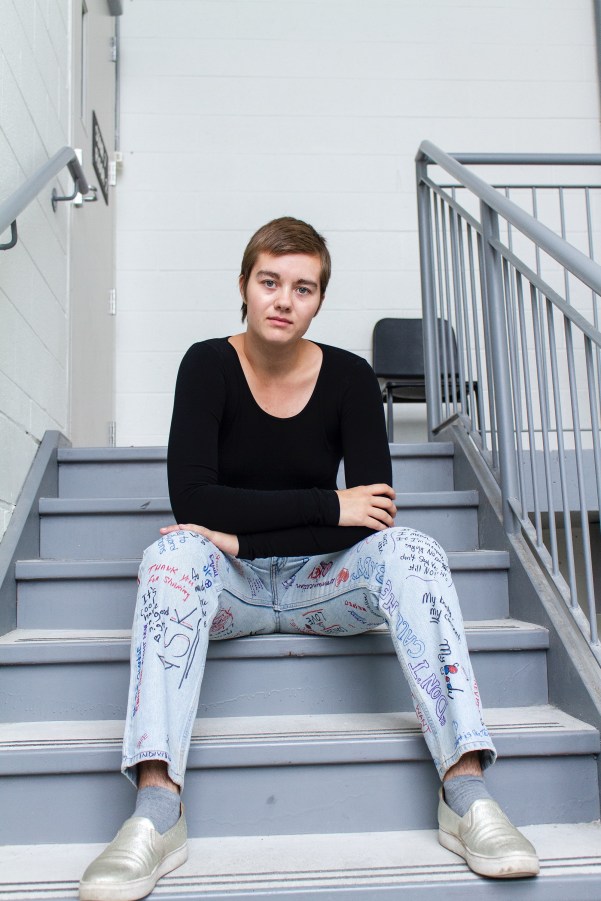
Saffron A, Consent Pants. Photo by Kadee McFarlane. 2019.

On the Resistance tour, Saffron A has brought along with them a pair of “consent pants,” which are jeans they ask the audience to write on them with markers about what consent means to them. “What began as a collaboration with Advocates for a Student Culture of Consent (ASCC), quickly became a community art project,” Saffron A explains. “I co-hosted two concerts at the beginning of my Resilience Tour with ASCC, and they wanted to have an artistic element at the events. I suggested we ask folks to write/draw/express what consent means to them on a pair of jeans.”

0A888215-1B38-4BE2-AE53-F0202F645562
Saffron A, Consent Pants. Photo by Kadee McFarlane. 2019.

The consent pants travelled from Brantford to Montreal, all the way up to Sudbury and beyond. I wrote on the jeans myself at the live show here at the Brown and Dickson Bookstore in London, saying that consent, to me, was “mutual respect.” Writing on these jeans evoked a lot of emotions, mainly since I had to think about what consent personally meant to me. The dictionary defines consent as “permission” or “agreement.” The pants say phrases such as “communication is key,” and “no consent on stolen land,” bringing up what consent looks like when Canadians occupy the land of Indigenous peoples outside of a mutual agreement. Both the consent pants and Saffron A’s music spark an essential conversation—when we don’t discuss consent, it masquerades its meaning, making it easier to become a grey area. The lack of understanding of consent only creates the potential to hurt others. Consent is something rooted in genuine care, and it’s an agreement that is so closely tied to power and trust.

Saffron A taps into their own vulnerability through their music and uses it as a tool for healing—they reclaim their own power and autonomy. Their music echoes so strongly in a society that perpetuates shame for rape survivors. Challenging toxic assumptions and how survivors are not taken seriously, they approach the subject in an open and engaging way. As they sing, “I’d laugh if I wasn’t terrified, I wouldn’t have to sing this song if this behaviour wasn’t going on.” Saffron A initiates the conversation about rape culture and sexual assault and asks us to collectively do better.

You can find Saffron A’s music on Bandcamp. Follow them on Instagram at @saffrockmusic.

Early Riser: A Perspective on Marclay’s The Clock

The Polygon Gallery

July 5- September 15, 2019

Admission by donation

Christian Marclay The Clock 2010 (high res) 2
Christian Marclay, The Clock, 2010, single-channel video installation, duration: 24 hours, © the artist. Photo © White Cube (Ben Westoby)

By EA Douglas

It is just after 5:30 a.m. as I descend my front steps, the sun is rising but the sky is a cool ceiling of gray. I am on my way to The Polygon Gallery’s inaugural overnight viewing of The Clock by Christian Marclay.

I first learned of this piece reading Sarah Thornton’s 33 Artists In 3 Acts in the bathtub back in 2017 when as a form of self-care, I took to submerging myself in hot water as well as the contemporary art world. The Clock is essentially a twenty-four-hour film montage about time. It’s composed of thousands of clips taken from years of T.V. and movies and is synced to the local time of where it is playing. As each minute of the film progresses, the audience watches the people on the screen check their clocks in one continuous loop. Although I’m not a cinema buff, an audio-visual collage of this size is fascinating to me. Seemingly, others feel the same way too, as The Clock has been well received in the art world, being described as “one of the first masterpieces of the 21st Century,”[1]  Unfortunately, in this age of online streaming, there are only 6 copies of the film available for viewing. Fortunately for me, the National Gallery of Canada and Boston’s Museum of Fine Arts acquired a copy in 2011 and it is playing at The Polygon Gallery all summer long.

As I enter the glass underbelly of the building on North Vancouver’s waterfront, the employee behind the desk throws up his hands and welcomes, “Go on up!” There are a few pieces of trampled popcorn on the stairs from the previous evening’s art party. I am not one for the crowds that go along with show openings, especially now that social media has made viewing art so trendy. Although you’re not allowed to take pictures or record while watching the film, you can still scroll #theclock. Since the viewing is going all night, I am skirting the masses by getting up early on a Saturday morning. It has paid off, as I get into the exhibition-space-turned-cinema there are only a handful of others lounging on the low IKEA couches.

Christian Marclay The Clock 2010 (high res) 6
Christian Marclay, The Clock, 2010, single-channel video installation, duration: 24 hours, © the artist. Photo © White Cube (Ben Westoby)

Quietly settling in, the atmosphere feels akin to that of an airport waiting area, but on the screen above me, Kirsten Dunst awakes in a field. The time is now 6:06 a.m. and the film portrays an early morning. The scenes flicker by, actors I do and do not recognize open their eyes, pull up the blinds, put on their slippers and their robes. Some lay awake through ominous ticking, the familiar wide eye of those who long for sleep. In most shots, I can pick out a clock or a watch, either on the wall, the desk, an arm— it becomes a game of eye-spy for the recurring object linking everything together. But at times it is more subtle, the golden glow of early dawn illuminates the aftermath of a wild night, with characters clearly out of sync of the circadian rhythm. As the minutes pile on, I am amused by the abundance of travel alarm clocks, as in my life they’ve been replaced by cellphones, although cells themselves, do not make much of an appearance.

I also begin to notice the women in these scenes; the roles they play and the patterns that emerge. There are those who are awoken in some dramatic way and those who sleep on, completely unaware that they were being watched. Or, the ones who can’t sleep, but instead stare blankly into the air above them as a man in their arms snoozes on oblivious. There are the women who jump up suddenly, leaving a man coiled in sheets, or the women who enter rooms peacefully, to wake a man or small children.

In all circumstances, there are similarities in how women are represented. Perfectly coiffed hair, with not a bang out of place. Dressed in sateen, satin and lace nightgowns, with the floral detailed embroidery or wide flowing sleeves. Their necks, wrists, and ears adorned in jewelry, finely-manicured fingers rocking rings of significant size. Even the ugly sleepers, the women in curlers snoring loudly, are spotless. There is no drool, no rheum (the technical term for eye gunk). It is a picture-perfect depiction.

Christian Marclay The Clock 2010 (high res) 4
Christian Marclay, The Clock, 2010, single-channel video installation, duration: 24 hours, © the artist. Photo © White Cube (Ben Westoby)

Then there are the women in the background, the domestic workers, the servants. They are the ones cooking, cleaning, or making beds. These women are not characters, they are only props in other people’s stories. This feeling is best summarized in one quick scene of a business-type fellow passed out in a bar’s booth, the viewer sees the body of a headless cleaning lady, her chunky, ergonomic shoes behind the vacuum, an apron protecting her dress, as she moves into frame. Even as she collects the dirty glass from his hand, there’s no glimpse of her face.

These portrayals of women are not unexpected, but they leave me downhearted. Looking past the stereotypes and unrealistic beauty standards, there is a severe lack of the LGBTQ+ community, a shortage of people of colour, an absence in the scenes to make them look like real life. Here’s what’s described as one of the first masterpieces the 21st Century and I don’t see myself in it, but Sir Michael Caine is there thrice.

The completist in me wants to see the whole thing before I form an opinion, wants to judge based on the entirety of the work. Due to the nature of this piece that’s impossible, even when I am distracted by the person waking up on the couch directly in front of me—they were there the whole time, asleep out of my sightline —I miss part of the action. While the representation does feel insufficient in the single hour of The Clock that I see, I must also acknowledge the limitations of the materials Marclay is working with. It’s only quite recently that there has been a push for more diverse characters on our TV sets and in our movie theatres.

Christian Marclay The Clock 2010 (high res) 3
Christian Marclay, The Clock, 2010, single-channel video installation, duration: 24 hours, © the artist. Photo © White Cube (Ben Westoby)

Letting go of my awareness, I am pleasantly surprised to notice myself becoming immersed in the work. I realize I am introducing a narrative overtop of the scenes. As I watch, the protagonist and antagonist metamorphize. Their faces age and change shape, their bodies evolve through gender, clothing, posture. It continues as the clips switch from colour to black and white, English to foreign language. The ability to do this, to make me construct an inner storyline, is the art of the piece. It allows me to forget any physical manifestation of character and see only human interactions. This must be chalked up to Marclay’s editing, which he focused on for the majority of the three years it took to make this film, hiring out the video watching to assistants. Prior to the viewing, when I considered a montage of film clips I expected something similar to a Vine compilation video, however, this is so not the case. It is thoroughly enjoyable to watch and not a moment of what I see is choppy. The flow is subtle but astounding. 

As 7 a.m. rolls around, the audience is cajoled by a chorus of coo-coo clocks and I feel ready to restart my day. For the rest of the morning, I am hyper-aware of the time. As I observe someone wearing a watch on the bus home, I think to myself with a laugh that The Clock may not be this summer’s biggest blockbuster, but it is still a marvel to behold.

[1] Luke, Ben. The Art Newspaper Podcast: “Van Gogh in the Asylum. Plus Christian Marclay on The Clock.” Produced by Julia Michalska, David Clack and Aimee Dawson. Aired September 13, 2018, 48 min. https://www.theartnewspaper.com/podcast/van-gogh-in-the-asylum-plus-christian-marclay-on-the-clock


Miss Meatface: Kat Toronto at The Untitled Space

July 2-13, 2019

The Untitled Space

By Chloe Hyman

Starting Tuesday, July 2nd, The Untitled Space in New York City will present a solo exhibition of interdisciplinary work by the artist Kat Toronto, a.k.a. Miss Meatface. The exhibition, curated by Indira Cesarine and named for the artist’s pseudonym, highlights the performance-based photography that Toronto is known for, as well as video and ceramic work and a limited edition of zines. On opening night, the artist signed zines and gave a talk about her practice.

Kat-Toronto-Miss-Meatface-Working_From_Bed-The-Untitled-Space copy 2
Kat Toronto. Working From Bed. Courtesy of The Untitled Space.

Toronto chose her pseudonym as a way to process her hysterectomy, a traumatic procedure that alienated the artist from her body. The persona of Miss Meatface provided Toronto an outlet to explore her sexuality beyond what is typically expected of those who have ovaries. “I found myself stopping to think… about what the heck gender really was,” the artist recalls, “and why society historically placed so much emphasis on sculpting gender stereotypes.”

In her self-portraiture, Toronto stages erotic scenes that play with dominance and submission—games of power that mirror heterosexual power hierarchies—but her sexually ambiguous figures subvert societal standards of beauty, gender, and power. Their skin is replaced by latex which also serves to obscure their genitalia. Dressing in fetish-wear is a joyous process for Toronto, as it frees her from the restraints set on her physical body by a society obsessed with defining and policing gender.

Kat-Toronto-Miss-Meatface-ForniphiliaThe-Untitled-Space copy
Kat Toronto. Forniphilia. 2016. digital photograph. Courtesy of The Untitled Space.

Historically there has been a tension between liberation and objectification when it comes to fetish in art and cinema. Forniphilia bears semblance to the work of Allen Jones, who was also involved with the artistic design of ‘A Clockwork Orange.’ However, Toronto’s identity as a female artist, and her emotional relationship with the persona Miss Meatface, lend her work both agency and depth. There is a raw truthfulness to her photographs that Jones’s Barbie-proportioned fem-bots lack. It radiates from her pink flesh inked with tattoos, and from the realism of her tableaus. Though Toronto visualizes herself in Forniphilia as a submissive sexual object, she remains deeply human, and therefore claims pleasure for herself.

“I found myself stopping to think… about what the heck gender really was,” the artist recalls, “and why society historically placed so much emphasis on sculpting gender stereotypes.”

Central to the realism of the artist’s work is the accoutrement of each domestic space. In Forniphilia, a wall yellowed by an invisible light source, a hard-wood floor, and vintage furniture, paint a simple, albeit dated, interior. A beige lampshade transforms Toronto into a standing lamp, and she assumes the connotations of the room she is in, reading as a willing participant in a sexual game of dominance and submission.

In other photographs, Toronto constructs more overtly retro tableaus, but her utilization of natural lighting maintains their authenticity. These shots, with their unbalanced streams of light, recall old family photographs rather than slick Hollywood sets. In No Time for Tears, a bedside lamp shines so brightly its own form is nearly abstracted—a beacon of blindingly white light. In Parlour, the source of light comes from a window that is almost overexposed by the angle of the sun.

Kat-Toronto-Miss-Meatface-No_Time-_For_Tears-The-Untitled-Space copy
Kat Toronto. No Time for Tears. 2016. Digital photograph. Courtesy of The Untitled Space.

The settings of these works also have a lived-in quality that renders them deeply intimate. Toronto has decorated each space in a manner that recalls a specific time period, but never attempts to achieve Hollywood set design levels of polish. In No Time for Tears, a floral sheet peeks out from the corner of the frame, gently clashing with Miss Meatface’s cheetah-print dressing grown and the burnt-orange walls of her bedroom. Several tissues dot a green doily on her bedside table—an ironic detail given that her nose is obscured by a centimeter of latex. And finally, the strange landscape hanging above her bed follows the room’s color scheme almost too closely, adhering to a 1970s decorative trend that today would be considered tacky.

These elements minimize the work’s artificiality, and as a result, No Time For Tears never registers as a staged scene. Instead, Miss Meatface looks right at home smoking her cigarette on the bed. She is a person engaged in a sexual game rather than an artist’s model posed to elicit shock or titillation. Her agency and comfort enforce the work’s eroticism without subjecting Miss Meatface to voyeurism. Instead, the viewer is privy to a private moment in which Toronto is entirely in charge of her own pleasure.

Kat-Toronto-Miss-Meatface-Parlour-The-Untitled-Space copy
Kat Toronto. Parlour. 2016. Digital photograph. Courtesy of the Untitled Space.

The quality of tackiness that is present in Miss Meatface’s room décor and choice of dress is emblematic of a recurring theme in Toronto’s work—kitsch. The term ‘kitsch’ has historically been employed by the cultural elite as a foil for good taste. Twentieth-century avant-garde artists believed nostalgia and materialism were the greatest obstacles to their utopian goals, and designated any object they deemed sentimental or excessive, ‘kitsch.’ Politically motivated by the perceived need to eliminate kitsch mentality from society, male cultural critics adopted femaleness as a rhetorical device to demonize kitsch objects and champion avant-garde art. This practice led to the debasement of female artists/craftspeople and the women who collected their work.

Despite—and perhaps because of—the history of kitsch, Toronto loves the term. “I don’t happen to think of kitsch as being a dirty word,” she said. “I think it should be celebrated and revered.” She goes on to exalt the kitschy objects she admires, from “doilies, granny squares, and novelty teapots” to “vinyl furniture covers and crochet toilet roll covers.” There is an abundance of such objects in Parlour, which features an array of lace doilies draped over a crimson sofa and a number of whimsical figurines perched on a round table. The inclusion of such kitsch details lends Toronto’s photographs a sense of intimacy that communicates the artist’s comfort in these scenes.

In embracing kitsch, Toronto is part of a generation of artists—often women and/or LGBTQ+ —who are reclaiming a style once used to debase their identities. It’s hard to ignore the gendered history of the term when consuming the artist’s sexually-charged images. After all, she situates submissive figures within historical domestic spaces, which naturally suggests a link between sexual submission and gender hierarchies in the twentieth century. Considering this history is an element of experiencing Toronto’s work, but the artist’s assertion of her agency—communicated through her intimate tableaus—takes center stage.

Kat Toronto aka
Kat Toronto. Meatmaid. Courtesy of The Untitled Space.

The history of kitsch is also the history of porcelain, a material that has been connoted with both masculinity and femininity throughout history. Because it signaled wealth, power, and intellect, porcelain was gendered masculine in the late-seventeenth and early-eighteenth centuries in Western Europe. Sensing the material’s political significance, French court women amassed their own collections, thus refashioning themselves as connoisseurs of court taste and key players in the trade. However, following the French Revolution, the material came to be associated with the materialistic whims of Marie Antoinette and thus fell out of fashion. It’s not surprising that nineteenth-century critics castigated porcelain as feminine, excessive and materialistic, as this rhetoric drew upon existing cultural norms that tied immorality and femininity.

This pattern repeated itself at the turn-of-the-century when many female artists crafted whimsical figurines and charming tableware from porcelain and other cheap substitutes. The masculine cultural elite regarded such goods with disdain, as their predecessors had in the courts of Britain and France.

Given the gendered history of porcelain, it is notable that Toronto has superimposed her photographs onto a number of ceramic plates. Meatmaid Plate is decorated with dainty pink flowers that encircle a photograph of Miss Meatface and her leashed latex pet. The work toys with dominance/submission and masculinity/femininity— themes that are common in Toronto’s practice—but it gains deeper significance by representing such themes on the surface of one of the most gendered materials in history. Sexuality, like porcelain, is marked by a history of power hierarchies that depend on a binary understanding of gender. By fusing the two, Toronto references the past in order to shed light on the present.

Kat Toronto aka
Kat Toronto. Tip Toe: Prurient Apparitions. Courtesy of The Untitled Space.

In addition to photographic and ceramic work, Miss Meatface will feature a limited-edition zine produced and signed by Toronto. The zine, entitled Prurient Apparitions, is printed on silk 170 paper and is sold within a hand-sewn slipcover. Asked about her motivation for incorporating zines into her practice, the artist cites her childhood exposure to the format. “As a child of the 90s zines were a huge part of my high school experience,” Toronto explains. “They were an amazingly cheap and effective way of getting the word out about subjects and interests that were important to us and helped to share information in a pre-internet world.” Although the internet has simplified methods of communication, fine art remains an elusive realm to many and collecting is not financially viable to all. Zines enable more people to collect Toronto’s work, and the portable format of the zine allows the artist’s work to travel with her new collectors and be seen by infinitely more curious viewers.

Prurient Apparitions is emblematic of Toronto’s other work, as it fuses vintage and fetish iconography on a single plane. But what makes this zine particularly intriguing is the seamless blend of contemporary fetish and Victorian iconography within its twenty-four pages. While anachronistic juxtaposition is at the heart of Toronto’s ceramic work, Prurient Apparitions succeeds in its unexpected harmony.

The page Tip Toe situates a polaroid shot of black latex bondage heels within an oval frame. The old-fashioned layout resembles an old scrapbook, with its burgeoning white flowers and the delicately-rendered garden scene peeking out from the top-left corner of the photograph. And yet, the contrast between the shiny black shoes and the frilly femininity of the flowers does not register as dichotomous. Perhaps this is because the artist senses the eroticism lurking beneath the flora in Victorian visual culture.

Toronto describes the Victorian Period as the epitome of sexual repression and rigid gender roles—and the plethora of Victorian pornography confirms this point. “It only seemed appropriate to place my images within Victorian album pages,” the artist says. “When you are flipping through the pages of the zine it feels like you are taking a naughty peek back into a secret Victorian photo album.”

She explains how the repressive atmosphere of the period can be felt in certain Victorian motifs, notably, the orchid. Toronto quotes John Ruskin, the lauded Victorian art critic, to elucidate the significance of the white flower. Ruskin, she says, frequently voiced his disdain for orchids due to their cultural eroticization. The presence of the white flower, therefore, imbues the pages of Prurient Apparitions with a strong sexual charge. Toronto goes on to say that the orchid is a metaphor for her own sexuality, which she feels is instinctive and deeply erotic but often fetishized and objectified by society. The artist and the orchid are similarly stigmatized due to their eroticism, which explains why Toronto’s fetishistic imagery blends so easily into the pages of a Victorian book.

Miss Meatface opens Tuesday, July 2 at The Untitled Space. Please note that the gallery will be closed for the holidays July 3-7, and will re-open on July 8. Miss Meatface will then be on view through the 13th.

Pushing the Limits: In Discussion with Julia Betts

07_2015-2017 (Orange)
Julia Betts, 2015-2017. Personal belongings embedded in plaster. Courtesy of the artist.

Questions by Adi Berardini

Artist Julia Betts channels art as a means of self-destruction—her work Detritus consists of self-portraits that are destroyed by shredding them back to earth, with the dust of the remains left in shades of rose pink, crimson, grey and russet. Betts brings art into the realm of imposing bodily limits through intervention. Veering towards the intersection of sculpture, performance, and installation, her work is defined by intentional unpredictability, the use of unstable materials and orchestration of situations in which her body and constructed space are subjected to forces of disorder.

Betts pushes a range of materials to the limits of their utility while placing herself in precarious circumstances that function as metaphors of emotional and psychic vulnerability and demonstrations of intentional disarray. Interested in the impossible, Betts creates uniquely precarious situations with ambiguous results that often lead to disruption and upheaval. She challenges the limits of representation by reflecting how life and art are hardly static but constantly transforming.

Can you explain more about how your work is influenced by emotional/psychological vulnerability and making a mess, but a highly deliberate mess?

I see messes as related to emotional and psychological vulnerability—they have to do with the need to control, the inability to control, and the subsequent loss of control. You can either lament the failure to control or revel in the messiness as a release from confinement. In this way, messes can embody dread or catharsis, reflecting an inability to keep accidents from happening and a yearning for release. Through viewing a mess, the image of the cultivated performer breaks down, revealing the human imperfection within the artist’s process. The viewer may perceive the spillage as the artist’s mistake and [therefore presume] that they have become privy to the artist’s unintentional expression. A mess becomes a radical expression of an imperfect image of oneself in a society that cultivates perfection. For me, messes also have a certain symbolic resonance relating to notions of femininity. Messes enact all things dirty, grimy, gory, visceral, and sensual in human experience, possibly even extending into the realm of the grotesque and traumatic when the dissolution speaks to bodily breakdowns.

09_Body as Pool
Julia Betts, Body as Pool. Still of performance while pouring paints. Courtesy of the artist.

Your practice seems to involve a mix of performance and traditional fine art (painting/ sculpture/installation), notably in Body as Pool where you create a self-portrait from outlining clay and pour liquidized paint through performance. Can you explain this piece further?

In this piece, I built a self-portrait by making an outline of a body with clay and I poured liquidized paint into the clay outline. The body’s color is made of acrylic paint and water. The area around the body is made of oil paint and vegetable oil, two substances [that] don’t mix. I rip into the clay walls and pour cups of paint into the image. The colors burst, erupt, flow, and penetrate through the body image both by my intentional action and by random circumstance. These intrusions into the body are meant to elicit a pain sensation. I imagine the clay as dams holding waters. I break the dams and let the waters out and the dams also just randomly burst.

Oil and water and their inability to mix relate to my interest in the impossible. The clay dams find the liquids impossible to hold. The oil and water find it impossible to merge. Because of these material properties, separation seems both fragile and unbreakable at the same time. I’m trying to depict unstable and ruptured bodily borders.

For me, there is a connection between material impermanence and the vulnerability of human life.

2015-2017 (white)
Julia Betts, 2015-2017 (white). Personal belongings embedded in plaster. Courtesy of the artist.

Your piece 2015-2017 poetically captures a sense of material impermanence. The work uses your personal belongings mixed with plaster to capture how the materials become altered over time. Can you explain this piece further and how you address transition and unpredictability in your work?

In 2015-2017, belongings accumulated over two years are sorted by color (white, blue, orange, brown, black, red) and frozen in plaster time capsules. As part of the installation, labels situated nearby catalog the ephemera within each brick and describe moments when each object in each block changed colors. For example, a piece of a book with black text fades completely to white from repeated trampling, or a clear piece of hot glue accidentally sits on a window sill for months and when found, has yellowed. Permanence is contrasted with transience, transformation, and entropy. Seemingly insignificant moments and “trash” are elevated into vehicles to hold personal interactions, memories, and the residue of life.

For me, there is a connection between material impermanence and the vulnerability of human life. In my overall practice, I use materials that evoke transience and timelessness. With this piece, I attempt to control what is temporary and fragile, with what is solid and enduring, but, ultimately, the garbage within the plaster erupts with rot. Organic intervention interrupts my attempt to control and stasis.

Betts- Julia-7
Julia Betts. Window Screens, 2016. Ink, steel, window screens. Courtesy of the artist.

In Window Screens, you explain how you created a steel box around yourself in a corner, filled the box with black ink and continuously dipped the sheets in the ink at maximum capacity. It seems to be an impossible task since the screens only hold the ink for a few seconds. Can you explain more about the inspiration behind this piece?

In Window Screens, the clear screen is unable to hold the black ink. Each time the ink drains from the screen, opacity and concealment relent to transparency and exposure. The untenability of the process is furthered when the box springs a leak and begins to empty the contents. The more ink I lost, the more I was unable to perform my process. It became harder and harder to make the screens turn black. I found myself scrubbing the floor with screens attempting to pick up any drop I could find of leftover ink. Eventually, I was completely unable to darken the windows and the performance ended. Even before I began this performance, I knew the possibility that the box might not be able to hold the ink. I intentionally created a precarious situation through lining the box with a tarp that may or may not be up to the task. I’m interested in placing myself in uncontrollable, vulnerable situations where accidents and disasters may happen. In this piece and my overall body of work, I am trying to create helplessness.

Detritus
Julia Betts. Detritus, 2015. Ground self-images. Courtesy of the artist.

It seems as if the self-portrait is a common theme in your work, also appearing in the piece Detritus that shreds multiple self-portraits, displaying them as powdered remains. Can you explain your interest in the anxiety of self-representation (or the representation of self-destruction?)

I’m less interested in the anxiety of self-representation and more interested in the representation of self-destruction. This piece also has to do with my long-term interest in skin. Skin is both boundary and connection between self and other. There is a need for there to be a skin to bear, protect, carry, and represent. In Detritus, I grind images of myself with a household grater, shredded self-images of the body accumulate into layers of dust—with the colors incidental to the photographs used as source material. Photographs are a surrogate for skin. I had been doing work before this that depicted the boundaries of the body being torn, but I fully brought the body to the earth in this piece. Whereas, in Body as Pool, I imagine the body at the edge of the sea.

Your work seems to deal with imposed limitation, and at times, distress. Can you explain more about this interest and what it represents to you?

I’m interested in limits and possibilities. Either can cause distress or comfort.

I use the limitations of my body, time, space, and mark. Confinement can be a metaphor for social or psychological confinement. Within the limits, I am too much or too little. I react with helplessness and determination.

I portray vulnerability in my work in different forms. Materially, I try to create space for material agency to intervene in my authorship. Physically, my work shows the frailty of my body when it is unable to complete its tasks. Emotionally, my work exposes and reveals me in pieces like 2015-2017 where the viewer is allowed to sift through my trash. Situationally, there is vulnerability when I put myself in scenarios that I am unsure of the outcome, and, often, I share this uncertainty publicly through performance.

Check out more of Julia’s work at her upcoming show at Grid Space NYC in December 2019 and on her website and social media.

Profiles on Practice: Soheila K. Esfahani

IMG_7438
Soheila Esfahani. The Immigrants: Canada 150. Installation shot. Courtesy of the artist.

By Nadia Kurd

From manuscripts featuring gilded vegetal motifs to the tiled geometric interiors of mosques, design and ornamentation have played a foundational role within Islamic art. Such designs have long adorned a wide array of objects and buildings. While some historians attribute the prominence of patterning to the preference of non-figural representations in Islam, others argue this is a rather overstated misconception, noting the often-tenuous lines between secular and religious themes within Islamic art.

Artist in Studio
Soheila Esfahani. Courtesy of the artist.

Since graduating with a BFA (Studio) in 2003, artist Soheila K. Esfahani has merged both the patterning traditions of Islamic art (particularly from Iran) and an approach informed by the “terrains of cultural translation.”[1] For example, in her early painting series titled “Reed Flute” (2008), Esfahani drew from the well-known poetic work of Jalāl al-Dīn Rūmī (1207–1273) to create a number of calligraphic, acrylic on canvas works. These paintings feature verses in Perso-Arabic script and involve a process of pouring paint directly onto the canvas, which abstracts the text — ultimately rendering it illegible — and transforming it into pure design.

soheila_reed-flute_within the Notes III”, Acrylic on canvas, 8”x10”, 2008, Collection of Accelerator Centre
Soheila Esfahani. “within the Notes III”, Acrylic on canvas, 8”x10”, 2008, Collection of Accelerator Centre. Courtesy of the artist.

From painting to installation, The Immigrants: Canada 150 (2017) is comprised of 60 custom-made ceramic plates that are infused with images of clothing labels that emphasize the country of origin. Drawing inspiration from the theme of Frederick H. Varley’s painting the Immigrants (1922), the installation is made up of plates that are similar to the tourist souvenirs commonly found in North America that have been transformed to correspond with individual immigration stories. The installation was spurred by a story that resonated with Esfahani involving her second-generation Canadian-Bangladeshi friend. When Esfahani asked her to describe her culture, she provided Esfahani with a “Made in Bangladesh” clothing label from her favorite garment. By accentuating the manufacturing label, Esfahani writes that this installation, “questions displacement, dissemination” by “re-contextualizing culturally specific ornamentation and various collected souvenir objects.”[2]

Her more recent work has continued to explore the circuitous yet closely regulated nature of global trade. For instance, in Cultured Pallets: Small Arms Inspection Building (2018)[3] Esfahani takes the ever-present wooden industrial pallets and stencils onto them a nineteenth century William Morris floral motif named the “Persian,” a pattern very likely inspired by the historic sixteenth-century Ardabil carpet — one of the most prized examples of Islamic and Safavid art at the V&A Museum.[4] Not only do these wood pallets feature floral designs, but they are also inscribed with the artist’s email so that when Esfahani disperses them, their new owners may be in touch.

Soheila Esfahani Cultured Pallets SAIB 2018 acrylic on wooden shipping pallets
Soheila Esfahani. Cultured Pallets: Small Arms Inspection Building. 2018. Courtesy of the artist.

Upon a closer examination of the histories between the West and East — an exchange frequently under the guise of resource control and colonialism — one sees how patterning and design are deeply ingrained in cross-cultural trade, which often sees objects being moved from its place of origin to be transformed into something else entirely. Moreover, while the floral motifs have roots in Iran, the attribution to Morris for the ‘Persian’ speaks to a sense of authorship and authority over the design. Esfahani brings together these layered histories to her work to rethink the meaning and implications of these exchanges on common and even disposable objects.

Esfahani once again explores earthenware and the subject of cultural exchange in Pattern (dis)Placement (2019). Here, the plate becomes a metaphor for “portable culture”, which “can be carried across cultures and nations.”[5] In the Magic Gumball Machine of Fate (2019), for a fee of $2, visitors to the exhibition of this work are invited to take a piece of this patterned displacement home from a gumball machine. Within small plastic enclosures, the artist’s work is distributed and the recipient is encouraged to colour and share the image on social media. Much like the pallets and plates, these small drawings travel and exchange hands at every turn. For Esfahani, it is important to show the instability of categories and ideally, challenge the viewer to situate their own histories through her work.[6]

Soheila Esfahani The Immigrants Canada 150 detail 1 (1)
Soheila Esfahani. The Immigrants: Canada 150. 2017. Courtesy of the artist.

Esfahani’s practice shows the interconnectedness of global networks to emphasize how it is almost wholly informed by political and cultural attitudes, clearly seen in the ongoing economic sanctions on Iran. Despite complying with international regulations on their uranium enrichment program, everyday Iranians continue to endure the most due to the lack of goods entering the country and the resulting widespread failing economy. These sanctions have “slapped barriers on trade involving Iranian metals, as well as its automotive and airline industries” and have adversely affected Iran’s oil and banking sectors, which have faced the most detrimental consequences.[7]

In linking design with trade, manufacturing, and history, Esfahani’s work reminds us that the realm of design, including ornamentation, and concepts of beauty are deeply rooted in our values and ideas as a society – and that these are not merely aesthetic concerns. “My work,” writes Esfahani, “evokes issues on migration as people, ultimately, function as ‘bearers’ and ‘translators’ of culture in our current globalized state.”[8]

To see more of Soheila K. Esfahani’s artwork, visit her website soheila.ca or follow her on Instagram @soheila.esfahani.

Nadia Kurd (she/her) is an art historian and curator based in Amiskwacîwâskahikan (Edmonton, Alberta). She tweets @nadia_kurd and her work can be found on nadiakurd.com.

[1] Soheila K. Esfahani, Artist Statement, 2019.

[2] Artist Statement, 2019.

[3] The Small Arms Inspection Building is a historic, multi-purpose arts and education space in Mississauga, ON: smallarmsinspectionbuilding.ca

[4] http://www.vam.ac.uk/content/articles/p/plant-motifs-in-islamic-art/

[5] Artist Statement, 2019.

[6] Soheila K. Esfahani, interview by author, Edmonton, AB, May 31, 2019.

[7] Colin Dwyer and Larry Kaplow. “U.S. Is About To Reinstate Iran Sanctions. Here’s What That Means,” NPR, last modified November 2, 2018, accessed May 29, 2019, https://www.npr.org/2018/11/02/663377999/u-s-is-days-away-from-reinstating-iran-sanctions-heres-what-that-means

[8] Artist Statement, 2019.

Nevertheless, We Persist: She Persists by Heist Gallery

May 11th–June 10th 2019

Palazzo Benzon, San Marco 3927 – 30124 Venezia

She Persists’ by Heist Gallery 15
She Persists, exhibition installation. 2019. Courtesy of Heist Gallery.

By Adi Berardini

As I walk up the stairs of the Palazzo Benzon, I am greeted with two large poster works by the Guerilla Girls, the anonymous, feminist art group famous for their furry gorilla masks. Known for using humour as a form of activism, one reads:

The Advantages of Being a Woman Artist

Working without the pressure of success

Not having to be in shows with men

Having an escape from the art world with your 4 free-lance jobs

Knowing your career might pick up when you’re eighty…”

Sadly, many women artists can relate to this work. I can’t help but wonder if it’s the improvement that the Guerilla Girls hoped for when they first convened in the 1980s. Although there may be more gallery representation of women artists, there still isn’t equal representation (especially for LGBTQ2+ artists and artists of colour). Additionally, many pioneering women artists are just seeing the recognition they rightly deserve now. She Persists, curated by HEIST gallery founder Mashael Al Rushaid and art historian Sona Datta, is an exhibition with an intersectional approach to feminism. Twenty women artists from all over the world are featured, highlighting how western feminism is far from universal. The exhibition has a strong roster of feminist art legends and contemporary talent, addressing everything from displacement and diaspora to motherhood and the environment.

She Persists’ by Heist Gallery 18
She Persists, exhibition installation. 2019. Courtesy of Heist Gallery.

The walls are painted a blood-red and chandeliers hang like crystal stars of the decorated ceiling of the Palazzo. Upon entering, a sculpture by the notable feminist artist Lynda Benglis lies on the floor on a platform. The growing metallic object constructed by spray foam cast in aluminum is similar to a blanket of silver vines. Benglis often involves the body in its relation to the environment when it comes to creating her art, creating poured sculptures from latex, wax, metal, and foam. Yasue Maetake’s, Urethane Flower on Steel Stem Clad with Foam also has an industrial sensibility melding with the organic. Maetake’s work has a sci-fi element that anthropomorphizes a gigantic sunflower and a white horse’s hoof into an unconventional nude. This futuristic, morphed object appears to have a raised fist like it’s about to give a sucker punch. Depictions of female nudes are often depicted as passive in classical paintings, but Maetake’s sculpture has a sense of agency and power. Maetake addresses the Anthropocene and the overtaking of nature by humans, commenting on the obsession of altering the natural.

She Persists’ by Heist Gallery 12
 She Persists, exhibition installation. 2019. Courtesy of Heist Gallery.

In a room focusing on art and motherhood featured prominently is a tall sculpture Stack 8 (Viridian) by Annie Morris, a stack of turquoise, cobalt blue, crimson, and olive-green spheres, similar to gigantic, saturated pompoms. Although the sculpture seems playful like an enlarged craft, it is ultimately serious in nature, like scientific cells joining together through a microscope. The sculpture echoes the narrative happening now of the autonomy of women’s bodies but also addresses the societal stigma around discussing lost pregnancies, miscarriages, and abortions when they are something that significantly affects women’s lives. The sculpture has a sense of wonder with a close and cutting relationship to loss.

She Persists’ by Heist Gallery 4
Annie Morris, Stack 8 (Viridian). She Persists, exhibition installation. 2019. Courtesy of Heist Gallery.

Displayed on the far wall of the room are selected lavender prints by Judy Chicago, as part of Birth Project 1980-1985, that feature childbirth in an abstracted and almost psychedelic way. The series was initiated since Chicago could not recall any depictions of childbirth in Western art. The project is a collaborative one, since Chicago worked with 150 textile artists, through the mail, and in person, to create variations with different needlework for the designs. Undertaking this project gave her a glimpse of the realities of many women artists within the domestic sphere. Chicago also changed her name to reflect her birthplace rather than her last name, an action releasing her from the patriarchal confines of an inherited family name that is ultimately determined by the father’s side.

Parallel to the room, Souvenir by Anna Boggon uses dozens of collected dolls from Mexico, touristic treasures collected specifically for this work. Dozens of figurines hang upside-down from the ceiling, sparse apart and traditionally dressed. However, once you glance down on the mirror placed on the vitrine, the dolls appear right-side up, reminding us how there are multiple ways to approach seeing and experiencing art and culture. Timely, the work is respondent to the blind hate that is directed towards Mexico in the Trump “fake news” era. Boggon captures the enthrallment of travel which can alter misconceptions held out of ignorance.

She Persists’ by Heist Gallery 16
Anna Boggon, Souvenir. She Persists, exhibition installation. 2019. Courtesy of Heist Gallery.

Walking through the wondrous space, I pass through a room with projected Islamic patterns, an engulfing swirl of lace-like shadows. The installation, Shimmering Mirage, by Anila Quayyum Agha addresses the exclusion from her worship as a Muslim woman, often confined to worshipping at home. Intrigued by the detailed tiling of the exterior mosque, the installation highlights how when she moved to America, there was the opposite effect—she was included as a woman but felt excluded from aspects of American society due to being Muslim. This room creates a sense of wonder since what is tightly confined and detailed becomes elaborate and all-encompassing. Capturing the endless integration of multiple identities due to diaspora, once you get to know someone, their dreams and ideas start to spill over, uncontained. Once you genuinely connect with someone you can see them for their intricate details instead of the labels that society places on people through prejudiced stereotyping.

She Persists’ by Heist Gallery 10
Anila Quayyum Agha, Shimmering Mirage. She Persists exhibition installation. 2019. Courtesy of Heist Gallery.

The exhibition also critically addresses the exoticization of women and the trope of the “submissive” nude within the framework of the East and West. Lalla Essaydi’s Les femmes du Maroc Odalisque (2008) critically addresses Grande Odalisque by Ingres, a painting that depicts a Turkish Odalisque sensually reclined back. Famous for adding in a few vertebrae too many, this historic artwork quite literally unrealistically depicts women. Essaydi uses a photograph with the same composition as the painting and adds Arabic calligraphy using henna, reclaiming and restoring agency within the image. Essaydi is not only critiquing the sexualization of these nudes but also how they were exoticized and viewed as consumable through the art historical male gaze.

She Persists’ by Heist Gallery 2
Hamra Abbas, Paradise Bath. She Persists exhibition installation. 2019. Courtesy of Heist Gallery.

In Hamra Abbas’s Paradise Bath (2009), displayed as eight large photographs, there’s an uncomfortable politics at play since a woman of colour is explicitly seen serving a nude white woman. Further, the women being catered to is viewed as sexual and carefree, even at times with a smirk on her face as the women worker is working away scrubbing diligently. The washing in the Ottoman bathhouse holds symbolic importance in Islam as regaining purity. These images are unsettling, but it causes one to reflect on how often these politics of exploitation play out in reality. The photos display objectification of women on multiple levels: it deliberately points out the ignorance and self-indulgence of the oppressor who benefits from the labour of women of colour and also critiques women as objects with one main benefit—sex. Critically addressing race and violence, if these images were to return to Abbas’s home country, they would have to be destroyed since they are considered pornographic.

She Persists’ by Heist Gallery 19
Indecision IV (2018), She Persists, exhibition installation. 2019. Courtesy of Heist Gallery.

Notably, the exhibition includes the film Indecision IV (2018) directed by Tonia Arapovic starring Rose McGowan, the well-known actress and figure in the Hollywood Me Too movement. In her immersive performance, McGowan responds to ambient sounds in a former Welsh Chapel, paired up with contemporary dancer, James Mulford. The black and blue light casting shadows, McGowan stares vividly with black eyes in a suspenseful and haunting way. She responds with rigid movements to his sounds and dancing, as Mulford grunts and taps, shifting around her. The accompanying acoustics sound like tides rolling in on a beach. The performance is largely inspired by the painting The Allegory of Indecision by artist Maria Kreyn, a painting depicting three dogs leaping up towards a blue heron over a fallen figure. After Mulford’s performance, he lies down silently and McGowan acts in control—she finally can sit down at ease and sing out. The film captures McGowan’s chaotic time while coming forward in the context of the resurgence of Me Too (originally started by activist Tarana Burke) and comments on the resiliency it takes to heal.

Overall, the strength of She Persists is its multiplicity and focus on intersectional feminism. When feminism does not address viewpoints from multiple identities, it cannot achieve what it’s for—equality and space for everyone. With representation from around the globe, She Persists addresses how women of colour are excluded from the art historical canon as a result of Eurocentric patriarchy. The artists in the exhibition possess an unapologetic, feminist approach to their art, challenging the viewer to reconsider their perspectives on topics such as motherhood, the environment, gender, and diaspora. Both women and LGBTQ2+ individuals have been silenced, erased, and spoken over for too long—it’s time to do better. Even though it’s a difficult battle, nevertheless we persist.

In Discussion with Lêna Bùi: Changing Cities, Changing People

home_installation 1
Lêna Bùi good infinity, bad infinity installation shot. Courtesy of the artist.

By Devana Senanayake

Concrete jungles, urban rivers, preserved city spaces, and dynamic mountain villages are all totems in Lêna Bùi’s umbrella project Home. The Vietnamese multi-disciplinary artist takes the audience on her mental journey of processing urban change through breathtaking visuals. Though Lêna is a multimedia artist, her videos function as visual essays that pinpoint the complexities of human life in concrete ecosystems.

“I think that video is very seductive. You have so much to play with: visuals, sound, and light,” Lêna says. “Video is perfect for narrative, but also for abstraction. It can be a story but it does not have to be completely linear. It can also be poetic.”

She focuses strongly on urbanization particularly as her home country, Vietnam, has undergone unprecedented change over the past couple of decades.  Statistics by the World Bank confirm that the country’s extreme poverty rate has declined to under 3 percent and the GDP has increased to 7.1 percent in 2018 as a result of a rise in economic activity.

Lêna understands that all change, even positive economic change, comes at a cost to the environment and to the people occupying it. Through her project good infinity, bad infinity, she uses Saigon as a starting point to explore the relationship shared by physical environments and people.

Through this point of focus, her audience is invited to join her on her personal journey to understand human behaviour, relationships, resilience and belonging across the globe.

river_23
Lêna Bùi. good infinity, bad infinity. Home series. Courtesy of the artist.
mahankaal temple
Lêna Bùi. Diagonal Time. Courtesy of the artist.

I am interested in the depiction of humans and their relationship to urban spaces in your art. Why does this dynamic interest you?

Everyone tries to situate themselves in the environment to make sense of it—this is my way of making sense of existence. Urban development is a tangent of human relationships with the environment and their surroundings.

Saigon has changed so much since my childhood. When I was a kid, it was still mostly bicycles and cyclos [and] there were hardly any cars and very few motorbikes. In the past five to seven years, they started building high rises everywhere so the landscape has transformed.

In Vietnam, the growth rate is very high. However, what are the costs of very rapid development without well-rounded consideration for the future?

I think this is happening all over South-East Asia. Change is inevitable but once we’ve knocked the old things down, we cannot revive them even if we come to regret it.

home_5
Lêna Bùi. good infinity, bad infinity installation shot. Courtesy of the artist.

Waterways are an important totem in good infinity, bad infinity. Why did you focus so strongly on this component?

Both cities developed along waterways. Sharjah is right by the sea. They both have big ports and there is a lot of commerce and exchanges happening there. Saigon is a big port city and along the river are shipyards and ports.

Water is synonymous with life. Large water-bodies connecting to the sea like the Saigon river and the Sharjah creek enable the constant exchange of goods. Nowadays, construction materials are not sourced locally and a lot of it is imported. I was curious about how things were linked and connected to each other.

I was also looking at sand. Sand is a crucial component in the production of concrete [in particular]. For concrete to work, you have to use a particular type of sand with the right texture and size, which is river sand. Though Sharjah has a lot of sand, they cannot use their sand for construction and have to import it.

Vietnam exports sand, often mined illegally, which creates a lot of corrosion along the river-banks. Houses have crumbled along the riverbanks because sand was extracted from the middle of the river without any regulation. In the case of Saigon, you just have to go downstream to see multiple barges extracting sand. If you go a bit further, you see an abandoned cement factory and houses sunken in the water. At the same time, along the riverbanks are booming construction and increasingly large high-rise complex. There’s a full circle of construction and destruction going on here.

macchendranath_2
Lêna Bùi. Diagonal Time. Courtesy of the artist.

What impact did urban developments have on human communities?

In Saigon, over the past ten years, very old structures and areas have been demolished. For example, the oldest shipyard built during the 1790s, during French colonialism has been replaced by villas and high rises.

I’m sure modern high rises cater to certain modern needs, [however] I’m interested in its effect on people. In the past, community networks were very tight which had both good and bad impacts. There was no privacy, everybody was involved in your business. However, people looked out for each other. What modern housing does is, it gives people [the] anonymity and freedom. But does it help people build community? Or, is it detrimental to our ability to connect with each other?

When I was invited to Sharjah for the residency, the reverse was happening there. They experienced a very rapid development phase in the 1970s. Then they realized that they wanted to preserve their old quarters, so they moved everyone out of the area. The old quarters are preserved but they are not lived in. They have become a museum, frozen in time. Even when we want to preserve the old, it changed into something else.

All these old men who had grown up in the area were dispersed all over the city and this broke the social network their old neighborhood provided. Now that they have retired, they regularly come back to the last original teahouse to chat with each other. They do this to find a sense of belonging and to find a community.

sapat shakya
Lêna Bùi. Diagonal Time. Courtesy of the artist.

I would also love to touch on your upcoming project based in Nepal, Diagonal Time. What did you learn about people in Nepal, particularly as it is lesser developed than Sharjah and Saigon and has a greater sense of community?

Nepal seems to be changing rapidly but it is a very special place. It’s old but it is alive, it’s not a museum. People still live in old structures, in small and winding alleys, maintaining many old traditions. I think it is immensely rich in culture.

I speak in the film as an outsider looking from the outside in. Many of the shots are through door-frames or alleyways. Then the viewers feel as if they are peeking into something private. Being a foreigner is being ignorant. It’s good because you don’t take anything for granted. It’s bad because often you can’t fully understand, or you misunderstand. My film is a documentary, but in the end, it is also a personal essay.

I was trying to understand human resilience. What aspects of our life contribute to our sense of wellbeing? I focused on the people who have found strength in something or who gave strength to others.

A character featured in the film is a female woodcarver. She spoke of how she learned to carve. Her trade gave her financial independence and agency. She worked hard and with her skills, made enough money to build her house and put her children through school. There was also an astrologer. People went to him with a problem, got his advice and then felt better. I think he functioned like the Asian version of a psychologist.

A solid sense of community is crucial in helping us find meaning in life. There are all sorts of festivals in Nepal that provide opportunities for people to connect and to feel connected. Rituals, music, and dances are all part of a language of unspoken understanding.

Of course, I cannot make a film about Nepal and not include mountainsthey definitely belong to the sublime. I don’t care much for the spirituality that is woven into tourism in Nepal but the mountains give a good sense of scale. They let us register how small and fragile human beings are. Traditional mountain villages are inaccessible harsh environments and can be a symbol of human resilience.

rajendra bajracharya_astrologer
Lêna Bùi. Diagonal Time. Courtesy of the artist.

What do you hope your audience notices, particularly in relation to the theme of home and changing cities?

In terms of home, home can mean people, home can mean the land and the water. As for changing cities, I’m resistant to changes but also pro-change. A city is a living thing, so it has to change and adapt to keep up, to stay healthy.

I make work about things I don’t understand. I am trying to solve a problem for myself. There is no overarching message and there’s no solution because it is unresolved. I want the audience to look at something they think they know, that they take for granted and see something else in it.