Dark Angels and Amazons: Natasha Wright at SFA Projects

Sista Chapel by Natasha Wright

SFA Projects, 131 Chrystie St, New York, NY 10002

November 13, 2019, to December 15, 2019
fullsizeoutput_2d
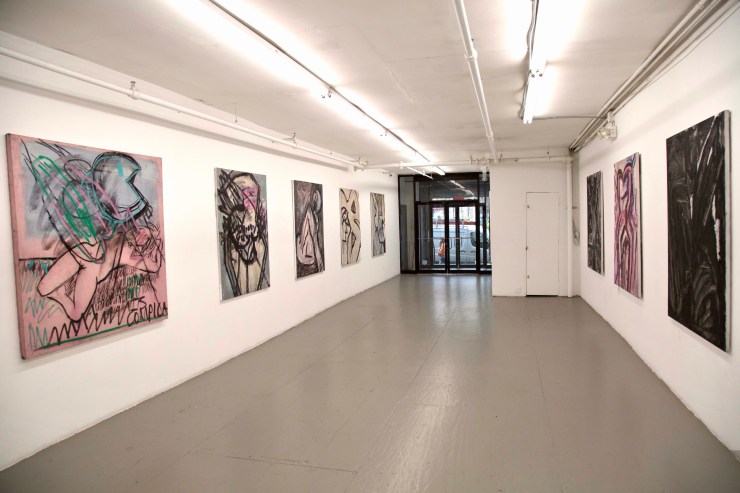
Sista Chapel by Natasha Wright, installation shot. 2019. Courtesy of SFA Projects.

By Nancy Elsamanoudi

The paintings on view in Natasha Wright’s show, Sista Chapel at SFA Projects, convey power with an erotic directness. These bold, exquisitely layered large-scale paintings lure the viewer to muse over the grumbling vibrations of murky, subterranean elements. These works call to mind myth, the underworld, sorcery, dark magic, ancient rituals, primordial energies, and impulses; a violent, dangerous world constantly on the brink of chaos.

Wright’s paintings are peopled with larger than life goddesses, coquettes, amazons and mythological and magical creatures. Her work taps into an imaginary space that collapses the difference between the ancient and the present. These threads that exist simultaneously are seamlessly brought together in the same painting: Cardi B and the Venus of Willendorf, Pac-Man and a sleeping pink nymph, an enormous unicorn smashed against the picture plane against a seafoam green background that at least partly mimics digital space or crouched monsters lurking in an open field at night.

The Unicorn, 60 x 48_, Oil on canvas
Natasha Wright, Unicorn, 2019 oil on canvas 60 x 48. Courtesy of SFA Projects.

The ambiguity at play in Wright’s paintings is compelling. Wright freely incorporates both abstract and figurative elements in a way that heightens the tension and the sensation of suspense in her work.  Her work has a playful openness, a searching quality to it. She seems to allow forms to emerge intuitively.

The thick black lines she uses brings her figures into sharp focus, but then she also sharply crops her figures in a way that frustrates an easy read of them. Various body parts, such as the head, wings, legs, arms are cut off and often lie outside of the picture plane. The figures in Wright’s paintings are cropped as a means of intensifying a feeling—a sense of discomfort. Wright’s work fixates on sensation and the role of the body is central to her work. But the body in her work is not particularly idealized or sexualized. Instead, the body takes on a totemic function—it is more an archetype, a cultural coding of the vitality inherent in a human being.

At times, Wright’s work seems to also touch on death, the macabre and violence. Bodies and parts of bodies are distorted past the point of recognition; the figures writhe in pain. Wright seems to be exploring the precarious and fragile vulnerability often ascribed to the female experience. In Street Ophelia, for instance, a violently contorted female figure appears to be splayed on the ground.

ItsComplicated
Natasha Wright, It’s Complicated, 2019 charcoal and oil on dyed canvas 60 x 60. Courtesy of SFA Projects.

Wright is clearly not interested in making pretty paintings—her paintings aren’t precious. The bodies in her paintings are frequently awkwardly contorted. Grey is often the predominant color and her limited palette of greys, pinks, black and green lend her paintings a gravitas, a weight as does the texture in her work.

Wright builds up the surfaces of her paintings by using a range of materials such as sand, glitter, glass beads, charcoal and black magnum with hand-made oil paint. There is a haptic, textural quality to her work.  The resulting images tend to be suggestive; they seem to hint at a story involving an unfolding drama or possibly a moment of impending danger. She gives the viewer a fleeting glimpse into her world and imagination.

Wright’s work speaks to a fascination with darkness and Wright is tied to her feminist temperament. Wright repositions the female figure at the center by re-envisioning the feminine gaze and rethinking the importance of female agency. The adventuress, the seductress, the muse, the fallen or scorned women all become protagonists that motivate her studio practice. The painting When Black Swallows Red, for instance, looks like large swaths of leather mixed with latex, it is suggestive of the way black leather and latex might feel strapped tight against the skin and in doing so calls to mind straps, whips, and pain folded into pleasure.

Willendorf (Cardi B) 60 x 48_, oil on canvas_
Natasha Wright, Willendorf (Cardi B), 2019 oil on canvas 60 x 48. Courtesy of SFA Projects.

Wright is drawn to the dark, mysterious and dangerous aspects of feminine power and the female experience. By focusing on the body as a vehicle of power and agency, Wright’s work seems to rebuff the so-called feminine virtues of purity, chastity, and modesty.  This can be seen in Already a Saint, a painting of cropped thrusting forward, half-naked torso clothed in animal skins. Or The Swan, a painting that seems to be referencing, “Leda and the Swan.” In this painting, a bent and twisted sullied swan appears like a dark angel covered in volcanic ash flying into a lake.

These paintings speak to feminist concerns, but not in the way that is didactic. Wright seems to be most interested in what may be construed as threatening, destabilizing or emasculating about feminine power.  This feminine power has traditionally sparked fear or has been seen as evil, unnatural and suspect, resulting in images of conniving hags and witches.  Wright’s paintings attempt to reclaim and prize this “darkness” of female power by treating it like black gold—tapping into it as an energy source and an intuitively life-affirming way of knowing.

Natalia Goncharova in Florence: A Woman of the Avant-Garde

3.17
Natalia Goncharova. Angels Throwing Stones on the City(Harvest polyptych), oil on canvas, 100 x 129 cm. Moscow, State Tretyakov Gallery, ZH-1439. Bequeathed by A.K. Larionova Tomilina, Paris 1989© Natalia Goncharova, by SIAE 2019

Natalia Goncharova: A Woman of the Avant-Garde with Gauguin, Matisse and Picasso

Palazzo Strozzi

September 28, 2019 – January 12, 2020

By Jennifer Griffiths

It has been an exciting year for advocates of women artists—Phaidon published a volume on Great Women Artists and there have been important group shows about women mounted including She Persists in New York, Hearts of Our People in Minneapolis, By Their Creative Force in Baltimore, and Fighting for Visibility in Berlin. Despite the Chinese government’s disappointing decision to cancel We Woman: One is not born a woman, but rather becomes one, an exhibition of feminist artists slated to open in September in Shanghai, other museums across Europe and America have hosted major retrospectives of Lee Krasner, Käthe Kollwitz, Dora Maar, and Dorthea Tanning. The first UK retrospective of Russian avant-garde émigré artist Natalia Goncharova (1881-1962) opened at the Tate Modern in June of this year.

When she left London, Goncharova made her way to Florence and will move on to Helsinki at the start of next year. I had the opportunity to see her at Palazzo Strozzi, which in recent years has become an important center for major modern and contemporary shows. Located on the piano nobile, the exhibition offers stimulating visuals with paintings, illustrations, and costumes across ten rooms. Curators set intensely colorful canvases against similarly bright and patterned walls evoking the artist’s reputation as “the artist richest in colors.”[1] They were also careful to offer much-needed pedagogical assistance to viewers who are likely being introduced to her for the first time.

Video2 (1)
Ballet Le Coq d’or, music by Nicolai Rimsky-Korsakov, scenes and costumes by Natalia Goncharova, Ballets Russes du Colonel de Bazil. London, Covent-Garden,1937 Moscow, Tretyakov State Gallery, Department of Manuscript.

Several high-mounted video installations compliment displays with black-and-white film reel of Russian peasant life, Ballet Russes performances, and cultural context. In typical fashion, curators sought to attract public attention by including the star power of more canonical artists like Paul Gauguin, Henri Matisse, and Pablo Picasso, yet these figures don’t overshadow the presentation of her own remarkable and versatile career. Alas, they have also resorted to clichés and reiterated erroneous refrains, evidencing simultaneously the progress we have made and the obligations we still have to generate a more complex discussion about modernist women.

The exhibition opens with a wall installation that gives a biographical timeline alongside personal photographs. Before we see much of Goncharova’s work, we see Cézanne, Matisse, Derain, Gauguin, and Picasso. This is clearly done in aid of demonstrating the early influences of Post-Impressionism and Fauvism yet separating them out in this way obstructs the process of creating a dialogue between the French and Russian avant-gardes. Larionov was expelled from one of his classes for experimenting with these contemporary trends and together with several of their peers, he and Goncharova founded a radical painting collective in Moscow known as the Jack of Diamonds, but as subsequent rooms demonstrate it was the bridging of eastern and western influences that gave new life to their art.

IMG_9762
Natalia Goncharova with Gauguin, Matisse and Picasso. Palazzo Strozzi. Installation shot. Jennifer Griffiths.

It feels clichéd when in the next room we are greeted as if by a happily wedded bourgeois couple via two self-portraits of Goncharova and Larionov. It is certainly true that their stories are intimately tied together; it is likewise true that she is quoted as having said, “I laugh at people who preach individuality and find value in one’s ‘self’.”[2] Yet they were radical and non-conformist in their lifestyle choices and attitudes, choosing to marry only for practical purposes near the end of their lives and keeping their union sexually open. Presenting Self-Portrait with Yellow Lillies (1907-8), the exhibit’s advertising headliner, alongside Larionov’s Self-Portrait with Turban (1907), the curators have appealed to the prevalent public taste for a conventional fairytale romance. There is perhaps nothing inherently wrong with this narrative except that it is rarely a point of interest in major exhibitions about men artists.

The couple’s attempts to channel the history and culture of their homeland appear on orange walls and here we see how Goncharova’s Neo-primitivism drew inspiration from Russian history and folklore via kamennye baby (ancient Scythian stone sculptures) and lubki (hand-colored popular prints). Picking Apples (c. 1909) is one of the most remarkable works here, depicting a group of women who seem to be members of a rural aristocracy. It is pointed out that the painting illustrates the equal influences of French Cubism and Russian kamennye baby, yet it also feels very much like a riposte to the entire history of women’s representation in art, specifically Manet’s Luncheon on the Grass (1863) or Cézanne’s Large Bathers (1898-1905) in which nude females allegorize nature, art, and beauty. Instead, Goncharova’s women actively enjoy the delights of the countryside in sisterly camaraderie, fully clothed and without men. This painting and the explosive room that follow make clear the full force of the artist’s unique contributions to the avant-garde.

3.6
Natalia Goncharova. A Model (against a Blue Background) 1909–10, oil on canvas, 111 x 87 cm. Moscow, StateTretyakov Gallery, ZH-1633. Bequeathed by A.K.Larionova Tomilina, Paris 1989© Natalia Goncharova, by SIAE 201.

The thematic focus shifts from influences and partnership toward a celebration of a highpoint of Goncharova’s career: her 1913 solo show in Moscow of 800 pieces showcasing thirteen years of work. An unusual accomplishment for a woman artist of that time, it established her success as the first solo show for a woman of the Russian avant-garde. Making clear the sweep of her wide production from paintings, watercolors, and sculptures to pastels, theatre designs, fabrics, fashion plates, embroidery, and wallpapers the show also reintroduced her controversial female nudes, several stunning examples of which are included. As a consequence of these, she would be brought to court three times to (successfully) defend herself against charges of pornography.

Rooms that follow are arranged into “Religion,” “Theatre,” “Modernism,” “Goncharova and Italy,” and “After Russia.” For those of us who cannot travel to Russian museums, this is an exciting opportunity to see about 170 loans, many from Moscow’s Tretyakov Gallery, which has the world’s largest collection of the artist’s works. In addition to paintings, sketches and costume designs for Sergei Diaghilev’s Ballet Russes are included. Sadly, we are given too cursory a treatment of her part in this phenomenon. A significant development of the avant-garde was the attempt to blur the lines between elite and popular arts. Diaghilev’s dance company had a tremendous cultural impact on new ideas about music, theatre, fashion, and design between 1909-1929, attracting collaborators that included Giacomo Balla, Wassily Kandinsky, Jean Cocteau, Coco Chanel, Leon Bakst, Matisse, and Picasso.

7.9
Natalia Goncharova. Cyclist1913, oil on canvas, 79 x 105cm. St Petersburg, Petersburg, State Russian Museum, ZHB-1600© Natalia Goncharova, by SIAE 2019.

It was also very disappointing to read a common yet deeply erroneous refrain in the “Modernism” wall text: “In 1912 Natalia began for a short while to show an interest in urban and modern themes – machinery, factories, speed – in response to Futurism, yet she disputed the group’s celebration of war and its male chauvinism, for it admitted no women.” As a scholar who specializes in Futurist women, I stood aghast. It seems like willful ignorance on the part of the organizers that such a claim could be made yet again in 2019. Despite thirty years of recuperative work by Italian scholars,[3] major Anglo-American scholarship continues to assert the “absence of women in futurism.”[4]

When in 2009 the Pompidou, the Tate, and the Quirinale put on a traveling anniversary exhibition of Futurism, curated by Didier Ottinger, Matthew Gale, and Ester Coen, they made no mention of the Italian women writers and artists who had been direct early contributors: writers like Irma Valeria and Maria Ginanni or artists like Adriana Bisi Fabbri and Rougena Zatkova. They didn’t note that women constituted the first international members of Futurism. Mina Loy (British), Frances Simpson Stevens (American), Alexandra Exter and Olga Rozanova (Russian), were the first non-Italians to exhibit with the Futurists at the First Free International Futurist Exhibition in Rome (1914). It is frustrating to see the same error reiterated ten years later by the same curator. Stars of Italian Futurism, Giacomo Balla, Fortunato Depero, and Umberto Boccioni, feature in the show, but like the Post-Impressionists, they have been separated out in an independent space. This choice reifies their reputation as a misogynist band of brothers while truncating possibilities for more engaged, progressive, or comparative dialogues with Goncharova.

In spite of these problems, I came away from the exhibition with a profound respect for her intellectual curiosity and virtuosity. British critic Waldemar Januszczak had a decidedly different opinion of the Tate show, describing her talent as “unstable,” her understanding of Cubism “charming but slight,” and her stylistic borrowings as “gadfly skipping.” His ultimate takeaway was of an artist of “uncertainty and shallowness.”[5] I was sad to hear a voice whose opinion I have often shared recycle the tired, centuries-old, chauvinist criticisms that a woman artist produces charming but facile work that does not “penetrate below the surface.”[6] What failed to penetrate below the surface here was perhaps the curation, but certainly not the content.

[1] Elena Basner, “The Artist Richest in Colors,” Natalia Goncharova: The Russian Years (Saint Petersburg: State Russian Museum, 2002)

[2] Quote from the preface to 1913 catalogue qtd. in Olga Furman, “Natalia Goncharova: Artistic Innovator and Inspiring Muse,” Marianne Werefkin and the Women Artists in her Circle, Tanja Malycheva and Isabel Wunsche, eds. (Brill, 2016), 195-96.

[3] Claudia Salaris, Le Futuriste: donne e letteratura d’avanguardia in Italia, 1909-1944 (Milan: Edizioni delle donne, 1982); Mirella Bentivoglio and Franca Zoccoli, Women Artists of Italian Futurism: Almost Lost to History (New York: Midmarch Press, 1998); Giancarlo Carpi, Futuriste. Letteratura. Arte. Vita (Roma: Castelvecchi, 2009)

[4] Hal Foster, Prosthetic Gods (Boston: MIT Press, 2004)

[5] The Sunday Times (June 9, 2019) https://www.thetimes.co.uk/article/natalia-goncharova-at-tate-modern-review-not-a-convincing-case-for-her-talent-r68fnjpxj

[6] See Cindy Nemser, “Art Criticism and Women Artists,” The Journal of Aesthetic Education 7:3 (July 1973): 73-83.