Leaky Boundaries: In Conversation with Isabella Covert

Isabella Covert. Surgeon _ Gestator detail, Nylon, latex, medical tubing, IV pole, IV bag, forceps, breathing simulator, 30 x 54 x 75 inches (variable), 2025.

By Adi Berardini

Painter and sculptor Isabella Covert approaches the body as a shifting site of biological, political, and material negotiation. A graduate of the University of Wisconsin–Madison (BFA, 2023), she is currently an MFA Candidate and Graduate Fellowship recipient at the Savannah College of Art and Design, where she continues to expand on her practice inspired by feminist theory and posthuman inquiry. Living and working in Savannah, Covert produces paintings and sculptural forms that blur the boundaries between flesh and fabrication, seduction and abjection.

Covert’s work examines “the relationship of reproducing bodies within current biopolitical frameworks,” exploring how gendered power structures contain and instrumentalize corporeality. Through entangled, unstable anatomies rendered in materials such as latex and hair, Covert constructs surrogate forms that swell and resist permanence. Inspired by the language of feminist horror films, Covert is interested in the biosynthetic approaches that intersect with the body. In her work, disgust becomes alluring, containment gives way to leakage, and the body emerges as a boundary-less site of speculative liberation, challenging the logics of collective futurity.

Adi Berardini: As you describe, the forms in your work “abstract the body and its capabilities.” How did you first become interested in the body and the abject, and exploring this in your art?

Isabella Covert: My work is very interested in the bodily ecosystems that allow space to overtly welcome and celebrate bodily excess, change, and overflow. They’re allowed to change and mutate within frameworks that are constantly changing for them, for the bodies themselves, and the people that inhabit them.  I think that in shifting towards structures that facilitate potential, there is more room for that.

This initially began for me personally with my experience of living with a progressive chronic illness, which worsens with age. So the relationship between bodily atrophy and that kind of DNA replication causing internal decay was the starting point in my work. Then it evolved into this curated lab of experiments, combined with radical political theory. And having that experience with the unknowingness of the body led to the relationship to the biopolitical structures that we exist in.

And you can see it’s very scientific, even the way you present the sculptures, too.

Yeah, they exist within a medical alternate landscape in a way. My work thinks about the fundamental impacts that a shift in perspective can have and how we can restructure institutions of medical care, but also collective mindsets to reimagine a utopian experience that regards reproduction and bodily capacities as something to facilitate rather than prevent.

Isabella Covert. Specimen Bags (preservation study) detail, Nylon, latex, specimen bags, metal hook, 52 x 7.5 inches, 2026.

Especially as women, we face issues such as medical misogyny and the dismissal of physical pain and pressures for our bodies to look a certain way with modern beauty standards. Are these veins of thought in the back of your mind as you create your work?

I think that the systems that you’re referring to are interconnected systems of thought relating to what I am discussing. I think that they’re all perpetuated by the same group of people, a small group of people with a mutual purpose and a broad spanning idea of perpetuating shame in that way.

So that’s where I’m interested in the abject and the self and the other. Within these works, I perform surgery in their innards, but also with the cosmetics of them. And so, in relation to beauty standards and cosmetic surgery, that kind of fits within the broader discussion of altering perspectives of care and how societal collective mindsets can alter and shift. Because with my work, I consider them never fully finished; they’re always aging or becoming something else. They’re fusing with one another, slicing open, stitching back together— birthing, doing, undoing, redoing. These processes reflect how we could consider bodies as a concept and the relationship to the self.

Isabella Covert. Simulated Incubation (embryonic fluid), Nylon, latex, glass specimen jar, metal connector, plastic cap, breathing simulator, 21 x 35 x 10 inches (variable), 2026.

You mention your interest in feminist reconfigurations of the body and posthuman relationships to power and reproduction. How do you materially address these concerns?

When it comes to the stitching and surgical aspect, I act as a surgeon in that way — both with synthesizing the research element of it, but also with the physicality of the materials and letting the materials evolve and age as they do. It is a process that just kind of naturally evolves in that way. I have bits and pieces and experiments (sometimes failed experiments) set to the side that I suture together. They become an amalgamation of flesh. It’s taking piles of things and then seeing what can fuse together.

I study a lot of feminist critiques that characterize the body as beyond the constructed margins that we have. I am interested in the dismantling of current patriarchal colonial pillars of power dynamics. At the core, there is the life-bearing expectation on reproducing bodies, and that’s also rooted in the state’s fear of bodily capabilities.
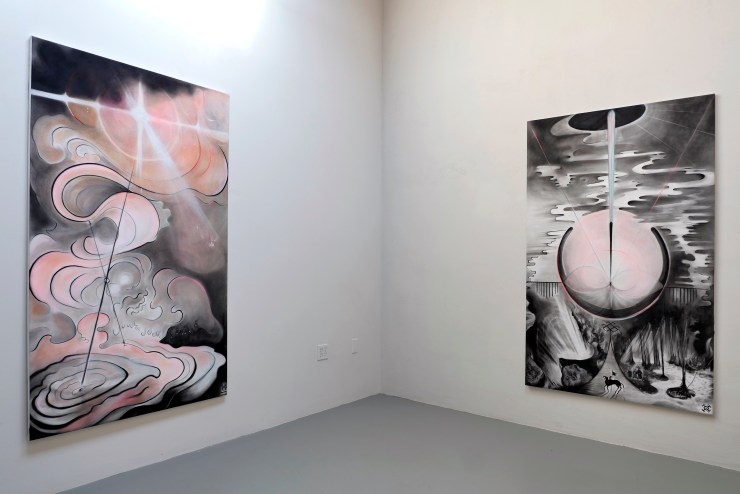
In post-human relationships and developments, technological developments and social relationship developments, there is the potential ability to utilize and distribute them without boundaries or biases in this utopian sense. That would entail a shift in mindset, especially about the dualism between the body and the machine. We’re at a point where there’s capitalistic misuse that we see today in those terms. It requires new modes of thinking to ensure that they don’t maintain those narratives and those eugenic perpetuations. And so much of what I research is of feminist reconfigurations, basically stating that the old tools we have used in the past won’t be useful in this sense, and they’re rendered obsolete in this era. It ties back to the saying, “The master’s tools will never dismantle the master’s house” by Audre Lorde.

[I am interested in] thinking of a more pervasive system that reimagines current nuclear family orientations and dissolves those reproductive expectations that are tied to that. And also, when it comes to the familial structures, understanding kinship is not naturalistic. And instead, thinking about all gestational labor as already assisted and not “natural.”

I am thinking about potential post-human technologies and synthetic options, thinking about how we can pave a path for mutual aid structures, and just in general, less constrained family structures. In relationship to the general biopolitical structures that we exist in, the current notion is producing and reproducing as a self-replication method. And so, in this rethinking and reimagining, it shifts from self-replication to general regeneration that comes with mutual support and communal support.

In that radical rebuilding, we can understand care as wanting autonomy for others. It is a shift in mindset that I’m kind of picking at and prodding at with my work.

Isabella Covert. Incubation Spawn (ontology of abundance), Nylon, latex, hair, resin teeth, incubator, 18.25 x 33.86 x 14.13 inches, 2026.

You reference abjection, disgust, and humour as intertwined affects. How do you intentionally balance allure and repulsion in your work?

I think that in general, there is an othered nature of both reproducing bodies, but also any body that exfoliates and changes beyond constructed margins.

I think that in the current collective lens, those bodies are viewed as in “excess.” But when you consider it, aren’t we all really in excess all the time? We’re all, in a way, hosts to a myriad of bacteria, viruses, and things in our innards that we aren’t fully aware of, even when it comes to the scientific aspects. I find irony in that. And I think that’s where the humour lies. Like the leaky boundary between the thinness of skin and the insides. I kind of take that to a more nonsensical extreme version of bodily emancipation in that way. So, thinking about the self and the other and the morbid curiosity we all have, but in a colorful and playful way, that’s where the humour lies for me.

Isabella Covert. Navel Extension, Nylon, latex, hair, 12 x 9 x 64 inches, 2026.

Do you have any influences or other inspirations for your art practice?  

The area of inspiration that’s slightly more unconventional is the conversations within my work have a lot of overlap with feminist filmmaking.

Primarily French feminist films from the early to mid 2000s under the subgenre of New French Extremity. Those are something that I revisit in my research, because they see autonomy as exaggerated in a similar sense. Obviously, it’s gorier and darker in relation to what I do, but I have inspirations in prosthetic work and that hyperbolic nature of it.

The way that they depict autonomy is more monstrous and viewed through different outlets and different storytelling devices, such as cannibalism and other abject broader themes. These types of films altered the way that I view embodiment. And every time I watch them, I really do garner something new about my work and the way that their internal spaces are exhibited outward, how they tell emancipation through monstrosity in their art form, and the sequence of absurdity in their work. That’s something that I really gain inspiration from.

A lot of the discussions are symbiotic to what I’m discussing in my work. Many of the French feminist filmmakers that I study, whether they were making films in the 2000s or if they are currently making films and inspired by it, they are taking more neoconservative undertones from their male predecessors and, again, altering the perspective of how we engage with the world in a similar manner to what I am trying to unpack in my work.

Sometimes things that you first find unsettling can unpack a lot of important conversations. Like when it kind of holds you there and makes you process it or it lingers with you. That’s the world that I’m interested in.

Check out Isabella Covert’s MFA thesis show from April 14th to April 20th at Gallery 2424 in Savannah, GA.

Rachel Feinstein: The Miami Years

Image of Old Cutler installation, with wall text: Rachel Feinstein: The Miami Years Project Wall. Photo by Zaire Aranguren. Courtesy Bass Museum.

The Bass Museum of Art

2100 Collins Avenue

Miami Beach, FL 33139

Sep 25, 2024 – Aug 17, 2025

By Yvonne Owens

The exhibition was approached through a dark green entrance hall transformed by Rachel Feinstein into an encompassing art installation. Old Cutler (2024) is a new site-specific work commissioned by the Bass, drawing inspiration from an archival photograph of the historic thoroughfare. As viewers entered into Feinstein’s rendering of a dark, lush landscape, the entry hall gave the sense of a verdant mystical threshold experience. Journeying through the liminal space beckons the viewer into a place where (as the curatorial statement promises), “…beauty and fantasy veil potential danger and unease.” Old Cutler is the portal by which we begin to encounter the vital, indecent, burgeoning bud and bubbling rot of Feinstein’s memorial vision. The old Miami two-lane highway is lined with heavily wooded areas and mangrove jungles, reminiscent of the forbidding forests that traditionally serve as the backdrops for the darkest of fairytales. The fronds and vines and coiling, waterborne banyan trees tower and loom in a glimmering light effect.

            My own memories of the historic road are triggered by the ‘sense-surround’ effect of the wallpaper piece. At certain times of year, hordes of giant blue land crabs would migrate across Old Cutler. Claws raised, waving defiantly at the oncoming cars, they were on a mission, travelling inland to mate. Then, job done, the survivors would journey back again like a diminished army returning home, battered and scarred, sometimes with claws missing entirely. At other times, droves of giant toads could be seen hopping across the thoroughfare on their mysterious missions, en masse. The squashed remains of all manner of wild creatures would regularly coat the old country road, violently contrasting the aspirational splendour of the luxurious Deering family’s private estates that once inhabited the stretches of mangrove forest between Old Cutler and the sea (now converted into public gardens and museums). At night, the heady odours of night-blooming Jasmine, ever vying with those of vegetal rot and still darker, more fleshly decay, scented the air. The dense green growth serves as the backdrop for a phantasmagorical scene, like a surreal suburban diorama from a David Lynch movie, accented with trademark grisly and macabre close-ups. And now, of course, there are giant pythons to consider.

Rachel Feinstein, Hawaiian Wedding floor sculpture (1999), in front of Panorama of Miami mural painting on mirror (2024), with The Tourist figural sculpture from the “Angels” series (2000). Installation photo by Zaire Aranguren, courtesy Bass Museum of Art.

            Resident in New York since the early 1990s, Rachel Feinstein is best known for her baroque, fantasy-inspired sculptures and haunting fantasy realist paintings. With over two dozen group and solo showings of her work in the United States, Europe, and Asia, she was most recently featured in a thirty-year retrospective survey exhibition at the Miami Bass Museum of Art. Titled “The Miami Years,” the show focused on her experience of having grown up in America’s tropical playground during the 1970s and 80s. Fantastical and mythical and fey in the telling, the story the show relates is part memoir, part wonder tale—part homage and part beautiful freak out in response to the surreality of coming of age in Miami. “Since it’s a museum show, it has almost all borrowed older works. It’s based on my growing up in Miami, so anything related to that.” In the current show, as in a fairytale, all the elements and elementals of Feinstein’s remembered Miami dream landscape are weighing in—its landmarks, bizarre creatures, underworld denizens, and freaky lushness. Children in idyllic sub-tropical ocean-girt settings swim with dolphins. Florida kids laugh in the face of dire peril and swim with sharks, cottonmouths, barracuda, and alligators. Unsuccessful Miami wannabe drug lords swim with the fishes, though everyone in America’s Disney-esque playground nowadays struggles to keep their head above water.

            Amid a virulent miasma of political chaos, agricultural chemical run-off, toxic algae bloom infestation, and leaky decommissioned nuclear reactors (with the retired Turkey Point Energy Plant as a perfect example), the Miami scene may look idyllic. It might seem All-American, possibly even somewhat decorous on the surface, but a close-up will take you under the surface into a simmering underworld forged primarily of paradox. Wildness and decadence, amorality and innocence, sex and crime, drama and burlesque, wonder and threat exist side-by-side in equal measure in Feinstein’s vision. Extraordinary beauty and stygian grotesques vie for one’s complete attention, constantly. Growing up in 1980s Miami, the young Feinstein acted out artistically. For her medically inspired wearable art designs, she took alginate impressions of her vulva, cast them in various materials, and wore the resulting jewelry around the house. In a precocious blossoming of what would later become a performance art-based practice, she also wore them to school, to the mall, and to family dinners. Her fascination with the beautiful/terrible before-and-after photos of repaired accident victims and sequential images of remedial dermatological results, lavishly illustrated in her father’s medical books, emerged later in multi-disciplinary photo series and sculptures. Fairytale themes emerged in beguiling (if somewhat disturbing) performance art pieces. As an emerging artist, Feinstein created short films that can be described as both whimsical and terrifying.

Rachel Feinstein: The Miami Years Projection, Photo By Zaire Aranguren. Courtesy of Bass Museum of Art.

            Attributing the wild inventiveness of her vision to the freedoms allowed for by the near anarchy of the city’s cultural stew, Feinstein regards growing up in Miami during the 1980s and 90s as key to her artistry and imagination. She describes the beauties and the grotesqueries, cultural deprivations and social endowments alike, as boons to her darkly exotic imaginarium.“Growing up in Florida as we did, we were able to breathe as young people,” she said to me, “…it was such a lawless and fruitful time. Like the American West.” Like children in a prairie town bordering on a desert wasteland, we who grew up in Miami contemplated a vast, primordial, untrammelled space to stretch into, conceptually. A place where we could expect our voices would emerge unhindered, to grow unique and resonant—perhaps not to be ‘heard’ so much, as to echo back to us, enlarged. Only ours was different than the arid Western movie wilderness. It was one of sea, and Everglades, and social free-fall. A cultural and environmental mosh pit.

Rachel Feinstein, Far left panel, Panorama Of Miami, Detail (2024). Photo: Maris Hutchinson. Courtesy of Gagosian.

            Feinstein’s exhibition includes another new site-specific commission by the Bass—a massive thirty-foot-long installation of painted mirrored wall panels, titled Panorama of Miami (2024). The mural reimagines the iconic landmarks, roadside tourist attractions, and historic locales of Miami as a rolling landscape of towering aspirations and faded glory. Contrasting the kitschiness and lux of the famed tourist Mecca, the painting includes images redolent of Old Miami and the burgeoning 20th-century tourist resort. The Vizcaya mansion (once the centrepiece of a wholly apocryphal story about how it was built as a marriage gift for a Spanish princess who never arrived, breaking the heart and spirit of the would-be groom), the Serpentarium road-side attraction (the founder of which, Bill Haas, died in 2011 at the age of one hundred years, attributing his longevity to the scores of venomous snake bites he’d endured), the Parrot Jungle (escapees from which flocked hammocks, orchards and backyards across Miami), the iconic Biltmore Hotel in Coral Gables (which, when it was built in 1926, held the twin distinctions of having the tallest tower in Florida, modelled on the medieval tower of the Cathedral of Seville, and the biggest pool in the world, where Tarzan actor Johnny Weissmuller gave swimming lessons) –all make an appearance. The Venetian Pool, the Hotel Breakwater on South Beach’s Ocean Drive, the Atlantis Condominium featured in Miami Vice, Fairchild Tropical Botanic Gardens, and the Seaquarium also feature in Feinstein’s memorial to Miami’s storied past.

Rachel Feinstein, Parrot Guardian, in Panorama Of Miami, Detail (2024). Photo: Maris Hutchinson. Courtesy of Gagosian.

            One of Feinstein’s traditional vanitas signifiers is the image of the typically hastily erected, carelessly designed faux-historic mini-mansion as an icon of conspicuous consumption. Architectural follies such as these tend to advertise newly acquired fortunes, garnered from licit or not-so-licit means, and have infiltrated old and established neighbourhoods throughout the Miami area. They cropped up with irritating frequency near Feinstein’s family home in Coral Gables, but can also be seen on Miami Beach, embedded in the stretches of mangrove forest between Old Cutler Road and the Atlantic, and amid the tropical hardwood hammock of Coconut Grove. They receive their rightful pillorying in Feinstein’s representations of the satirical “McMansions” as vain spectacle and vulgar display. Another of Feinstein’s signature motifs is the gleaming, luxury collector car icon. The car images have been part of her specialized visual vocabulary since her 2018 “Secrets” solo exhibition at Gagosian in Los Angeles. Her brilliantly polychromed, classically posturing Victoria’s Secret “Angel” sculptures also made their debut in that show. They show up here as the perfect exemplars of Miami fashion, transience, and ephemerality.

            My Miami childhood experience took place roughly two decades earlier than Feinstein’s, during the 1960s. There was no resident opera guild or ballet company. You’d have to wait for ABT or New York City Ballet to come to town (which they did only once or twice a year) and put up a show at the Coconut Grove Playhouse. During my teenage-to-early-adulthood tenure, my art club friends and I would drive regularly to Key Biscayne on school nights to skinny dip in the balmy waters off the pristine, private, white sand hotel beach. Richard Nixon was known to hang with well-known gangster, Bebe Rebozo, at the Key Biscayne Hotel of an evening. They’d get drunk together in the lounge, sing Frank Sinatra songs at the grand piano (which Nixon would play—quite well, apparently), get maudlin, talk about invading Cuba, and fantasize about assassinating Castro. (We can assume Rebozo’s organized crime-affiliated enterprises in Cuba took a hit from Castro’s Communist takeover.) Every other fledgling millionaire with a Donzi outboard ‘cigar boat’ pulled up on a trailer in their “McMansion” driveway was a drug dealer, wallowing in cocaine and armed to the teeth. The lively, lawless vibe of Miami was tangible, visceral—an integral part of the texture of the place. Feinstein’s fond memorial to her youthful haunts in the fabled, bizarre ‘Magic City’ serves as the sentinel of a bygone Miami, one receding ever more rapidly into a copper-tinted, lachrymose haze.

            In the past, the artist’s singular approach has landed on topics of: Women; women as witches; feminism; Victoria’s Secret models and their milieu; fairytales and their influential, ancient narratives;  Los Angelinos’ vanities, excesses, and conceits; and the magic and psychology of mirrors in art and history. Among the many subjects of her penetrating, fond and unsparing gaze, Feinstein’s take on Miami-of-the-past reimagines it as the bygone wild frontier of human behaviour—of angelic aspirations and primal impulses in America’s haunted playground. The cars, the McMansions, and the Victoria’s Secret fashion model-inspired sculptures function as vanitas cyphers and memento mori insignia for a disappeared world.

In Discussion with Nicole Chaput: Disobedient Women

Nicole Chaput. Embalsamada con picante [Embalmed in Spice], 2024
9 oil on bleached denim paintings stretched on custom made wooden canvases mounted on a rotating wooden and stainless-steel structure of three tiers, base composed of 9 pigmented concrete cylinders. Photo by Davit Cruz Puebla, Cortesía del Museo de Arte Carrillo Gil.

By Naomi Oko

Embodying what it truly means to be a contemporary artist, Nicole Chaput profoundly toys with and reshapes the dated, conventional, and familiar representation of women and femininity throughout art history. Deeper than the need for expression via painting, is her calling to be a storyteller. She stands as a messenger for and a mouthpiece to the feminine entities she creates, mediating between the feminine in its unruly essence and its traditional representation in materiality. Chaput disrupts established but tired norms, actively manipulating anatomical forms and the materiality of the canvas itself in her search to blur the boundaries between the juxtaposition of what is good and bad, celestial and demonic, or inside and outside. Her oeuvre stands as an excitingly interesting and new inspection and exploration of traditionally feminine portrayal, challenging the ever-present and ever-stifling oppression of existence under the scrutiny of the male gaze. Chaput’s figures serve as more than mere eye candy but rather, as she describes it herself; [as manifestations of the] “defiance and resilience born from enduring hostility. Similar to pearls, which form unique layers as a defense mechanism, her paintings evolve organically, embracing their own anomalies as a testament to their existence.”


Nicole Chaput, born in 1995, is a painter who lives and works in Mexico City. She holds a BFA from the School of the Art Institute of Chicago (2018) and participated in the Skowhegan School of Painting and Sculpture (2019). She has received numerous grants and fellowships from prestigious institutions during her artistic career; and has shown her work in the United States, United Kingdom, Brazil, Australia, Puerto Rico, and Mexico. Embalsamada con picante [Embalmed with spice] is a solo exhibition by Nicole Chaput curated by Isabel Sonderéguer at the Museo de Arte Carrillo Gil, that ran from February 10 – April 21, 2024.

Nicole Chaput. Femme Fillet Formalism. 2023. 2.10 x 1.30 x 15 cm. Oil on bleached and primed denim, hand-sewn silver polyester applications, mounted on custom made wooden stretcher and concrete booties.

Your presentation of femininity and comparison to traditional representations in art calls to mind angels, and the comparison between biblically accurate representation versus secular Western representation in terms of accuracy, conformity, and digestibility. Can you explain this further?

My work is pretty intuitive and research-based because it’s trying to inspect the inspector and the inspector is Western art history. I’m really interested in how women have been represented in that area. And for that, I needed to read a lot about the dissonances. Your first question is so on point because It’s a great example of how I connect art history with storytelling and how an image can tell the story of a misrepresented body to create an idea of femininity. 

I constantly get into discussions about Mary Magdalene. I am obsessed with her as a figure because just by seeing how she has been represented throughout history, you can get a [sense] of the ideals of women at a certain time and the ideologies that paved the way. For example, how women must obey, how women must not act, what is considered beautiful or sexy, for example. 

Nicole Chaput. Sangre Rubia. Oil on bleached denim mounted on custom wooden stretcher. Photo by Ramiro Chaves, Cortesía de Galería Agustina Ferreyra. Courtesy of the artist.

I feel like I created this algorithm of how my research is catalyzed and by chance, I ran into this image of Mary Magdalene covered in hair, like she’s an animal. I became very upset with how she was being represented so I began to question what happened that she had to be represented in that way. I kept reading about her in the bible and in the actual text there was nothing that mentioned or cued why she ended up being represented as an animal. 

Reading about the history of her representation, you can tell that, at first, she’s depicted as this woman who is bathing Jesus’ feet. She discovers Jesus when he is risen, but also by Tintoretto and all these other pictures, she becomes this very sexy woman who has long hair, and then she becomes an animal in a cave in France, then she becomes a hermit doing penance for her sins.

I think that the disruption between the actual tale and how art has illustrated the story is very divergent. A lot of people at the time were illiterate, so images became a theatricalized version of the story and the agenda that the religion was pushing. Iconography has been a storyteller throughout time and images have their own language that we don’t all have access to what we are reading or who is the writer. I think that is the main perversity of images that we see there, we don’t have enough information to analyze who the person saying all of this is or why we are having these subliminal images planted in our heads. I think that happened with Mary Magdalene and it happens today with Kendall Jenner selling us lipstick, this image of a woman that appears to you like a vision followed by this internalization of that face or that idea of sensuality, or beauty, or the grotesque. 

I’m very interested in how these images are like divine apparitions or hallucinations, we can ignore them or dismiss them, but they’ll make some sort of impact on how we read history, or how we read the body. 

Nicole Chaput. Embalsamada con picante [Embalmed in Spice], 2024
9 oil on bleached denim paintings stretched on custom made wooden canvases mounted on a rotating wooden and stainless-steel structure of three tiers, base composed of 9 pigmented concrete cylinders. Photo by Davit Cruz Puebla, Cortesía del Museo de Arte Carrillo Gil.

What sort of reaction do you imagine your work elicits in the ideal audience? Have you had the opportunity to be with some of your audience to see them reacting to your work for the first time?

Yes, it’s one of the things I enjoy the most. The first ones that come to mind are when I had my show Venus Atomica at Galería Karen Huber. It was my first formal solo Gallery show and the last day I visited, I saw this whole family taking a selfie with one of the works as if it was this deity of some sort. I wanted those works to feel like they had power or like they had a soul contained inside of them. It was great when I saw that because they’re doing this touristy thing where they are visiting this goddess-form that they don’t completely understand, but they find beautiful, important, and mysterious.

Recently, in the show I have in Museo de Carrillo Gil, called Embalsamada con Picante, there was this little girl who was about four years old with her dad who was also carrying her sister. He was entering to see the work and she was very scared to go inside the room. Then slowly, she walked in grabbing onto his legs and she pointed out one of the works that is like a medusa. She was crying and I asked her dad why she was crying and instead of saying she was sad or something he said, “she’s emotional.” In Spanish, that didn’t sound like, “Oh yeah, she’s being emotional or irrational,” it was like, “she’s feeling a lot.” It was so beautiful to see how this little girl could connect to that image and feel her feelings. And that translated into emotion and not automatically demonizing her feelings. It was great to see how she slowly leaned into the room and started getting to know these figures. 

Nicole Chaput. Medusa Deluxe. Oil on bleached denim mounted on custom wooden stretcher.Photo by Ramiro Chaves, Cortesía de Galería Agustina Ferreyra. Image courtesy of the artist.

Can you expand on the celestial nature of your work?

I am very inspired by images of celestial beings and also by Celestial beings from the underworld. In Spanish, I like to call these figures, “infra cuerpos,” which would mean “under bodies”, but in Spanish, “infra” doesn’t connote something that is below. The “belowness” is more like they are from this esoteric hell, so they are ardent, not underneath. So, they are bodies that are in this area of not well behaved. Like Mary Magdalene, she is both celestial and this is also [depicted as] this whore that should burn in flames. 

For me, it’s important to emphasize the narrative of how painting can fictionalize itself, similar to the ways women too can fictionalize themselves. Via my installation, we’re able to explore just how those two can come together to create an experience of uncovering and discovering something new while being completely disoriented by your understanding of its ingredients separately but confused and disoriented by their combination and juxtapositioning. One is left with questions like; is it the past or the future? Are we in heaven or hell? Are they angelic or demonic? I think that all of those contradictions coexist in one body: the superficial with the subcutaneous and the visceral with the hyper-airbrushed face. Disorienting someone makes them have to relearn where they are to reorient themselves. 

Nicole Chaput. Mi madre es un ventilador con cara de vaca, 2022. Four anthropomorphized femme cosmetic instruments (mirror, comb, mascara, powder brush) displayed on wooden and velvet badalone. Each instrument is accompanied by a surreal user manual written by the artist and presented in an acrylic frame. Instruments: oil on wood, silicone mascara wand and hand-dyed wood. Installation view of solo show at Biquini Wax ESP, Mexico City.

Your wooden sculptures from Mi madre es un ventilador con cara de vaca resemble ritualistic objects in their form and context. Would you consider the beautification objects to stand as a metaphor for the sacredness of the routines they help in? 

I think that these routines are sacred in an intuitive way, but also in a capitalist way. That was the commentary I was doing in the show or, the question I was asking/answering. These objects were very beautiful and intricate, and I wanted to capture the magic of when you go to the makeup store and just how the packaging is so beautiful to make it an object of desire. The packaging just projects this feeling of luxury and how it’s going to give you the power to be beautiful. Beauty itself is the most political thing because it’s guarded by the most colonial and patriarchal standards. I think that beauty is this thing where we either have the power or we don’t. Makeup is this thing that can give us the power to be more beautiful, more captivating, have more power, and therefore take up more space.

…Makeup and beauty constantly create these images to orient ourselves throughout territories, how we move around the world, how our body is just existing, and how it’s perceived by the other.

This is a construct by consumerist culture but also, I think that there is something empowering in creating these rituals for oneself because they situate you in your own body. They can help you create an appearance or a mask. There is this great anecdote that I love about Marisol the artist, who I’m greatly inspired by. She goes to this party and she’s wearing a Japanese mask. Everyone at the party wonders who she is and asks her to remove the mask. She doesn’t remove it until a while later after they keep pressing her. She removes the mask and has full makeup on, so they can’t see her face. 

I think that’s such a great anecdote because makeup and beauty constantly create these images to orient ourselves throughout territories, how we move around the world, how our body is just existing, and how it’s perceived by the other. Being seen by the other is very present in my life. In me being a woman and living in Mexico, the eye of the other is always there. It just doesn’t go away, it’s ever-present. Haunting, even. 

Painters construct how the eye flows in a picture plane. This is done by contrast, color, texture, et cetera. Formally painting marks draws the path for the eye in a place. I think that similarly, women do this all the time to control when we are seen and when we are not. In that same way, I think it is important in my work to be able to give the women I am representing, volume. Because the idea of flatness and volume in a woman’s body is this canonical culture of where you should have flesh and where you shouldn’t. At the same time, an image in art history is flat and without volume, even volume as sound and volume as shape and space. It’s not decided by the women that are being represented. It’s decided by someone else. If my work would have a volume, I think it would be very high and it wouldn’t be very pleasant. I think about the voices these women would have, and how some of them would maybe cry, like the myth of La Llorona in Mexico, who hauntingly cries for her children.

I had never thought about the voices they would have, but I think it would be interesting because we know so much about, for example, Frida Kahlo as an image, but her voice is very mysterious to us.  And doing that exercise of how strong the voice of these women would be, or how much space it would occupy is important as well. The voice matters as much as the face and the face gives it the voice. As I said, Mary Magdalene would be one of the mothers of my sculptures and Marisol would be one of my mothers artistically. I love to think about genealogy, making a genealogical tree, and to think of contemporary ideas as family inside the world we are creating as artists.

Nicole Chaput. Woman-Comb and Instructions (Detail of Mi madre es un ventilador con cara de vaca).34 x 14 x 2,5 cm. Oil on cut wood. 2022.

You make use of a lot of accessorizing and beautification and yet, the figures still come out resembling these alien strange beings. Do you see your work as an intentional commentary on how people, women especially, go through so much in the process of beautification that sometimes they end up morphing into whole other beings? 

I think that there is this collective dysmorphia of how we want to look and how we want others to see us so much that it’s never enough and it becomes opaque. Many models have been instrumentalized to sell more things, right? And to endure this concept of European beauty standards that leave a lot of women out and create this very narrow idea of femininity. A lot of these Hollywood icons are canons of beauty, but when they start aging, they are not the same as the image we have of them in our heads. I think that these tools for beautification, they’re anthropomorphized women who are grabbed by women to beautify themselves and then be objectified. It’s like this cycle where subjects and objects bleed into each other in a way that they’re almost inseparable.

Nicole Chaput. Woman-Comb and Instructions (Detail of Mi madre es un ventilador con cara de vaca).34 x 14 x 2,5 cm. Oil on cut wood. 2022.

And in that sense, there’s also this funny aspect or fun aspect where the tools with their manuals, they can pull your hair, or they can bite you. They have some sort of autonomy. These wooden tools, the sculptures, have a user manual that is kind of surreal and it speaks to the power of these tools. For example, the mascara wand is an Oracle or the mirror and spits out a flesh-eating worm. I wouldn’t want to look in that mirror. It goes to question these beauty icons, and what their mirror view looks like. What do they see? Especially for [those who] have done so much plastic surgery that they have become totally different people. I can imagine that when you go through that much physical transformation, your psyche is transformed as well. That physical trauma of the surgery, I feel like it speaks to a trauma that is inside. And that trauma inside that wound, I’m very moved by it.

And I think that the image we have as women is that of a wound. And I wonder how we can heal it, or what it would take to look at ourselves without having our eyes played by the male gaze. I think that is the question that encompasses all my work. I don’t have an answer yet, but as I’m making it, I feel more at peace with looking at myself in a mirror.

Beautification has become such a mechanical process in the way it’s carried out and even spoken of, that it’s kind of lost its sacred magic. Your work in Mi madre es un ventilador con cara de vaca ritualizes, romanticizes, and even sexualizes the process involved. Is this something we should all be opening our minds towards when viewing, despite the oppressive nature of conformity?  

Yes, I think it could be very liberating to start seeing everything as a story or as fiction and as different characters. In this work, the comb, the mirror, the mascara brush, and the powder brush are all characters. The installation was inspired by the Beauty and the Beast rose which has this beautiful pink light emanating from it. Next to the rose is a mirror where Belle can see the rest of the world. Instead of seeing herself, she can see as if she were looking at something that is not there. So, that kind of magical tool or magical process I think can lead us to self-invention.

The power of self-invention comes with language, with what each sign means. Having long lashes has certain connotations, having long nails as well. They’re also more related to how animals spread their nails when they want to attack. I think that the way we accessorize our bodies and fictionalize our appearances is by using prosthetics like lashes and nails, for example. All of these prosthetics add to the story of our body. I think we can find a way where those prosthetics are not only accessories for the other, but, thinking about Wonder Woman, where all her accessories have superpowers, like self-defense. If our prosthetics could have superpowers, or if we can imagine, through fiction, what the things we add to our bodies could do? Not just in terms of image, but in terms of narrative. 

Nicole Chaput. Embalsamada con picante [Embalmed in Spice], 2024. 9 oil on bleached denim paintings stretched on custom made wooden canvases mounted on a rotating wooden and stainless-steel structure of three tiers, base composed of 9 pigmented concrete cylinders. Photo by Davit Cruz Puebla, Cortesía del Museo de Arte Carrillo Gil.

Trends and beauty standards change, courtesy of pop culture and mass media consumption. Women’s bodies kind of go in and out of style, almost like vehicles. I like the contrast created between your representation of women as complete sufficient beings as opposed to the mass message being pushed of women eternally needing changes and tweaks just to fit in and exist. How does your work touch more on this topic?

In Embalsamada con picante, I created one woman with three heads, three torsos, and three legs that has 27 possible combinations. What was important to me was that each fragment was autonomous and was a whole, not a part. All the bottoms have heads and faces. The legs have a face, the skirt has a face, and the snail creature that looks kind of like Naomi Campbell has a face as well. 

I think of fragments as a pole that is cut from a larger portion of a thing but can live on its own. When you cut one limb off a salamander, another one grows. I love how Donna Haraway says that maybe we should all cut off our limbs to have new bodies that are monstrous and surprise us in their own regenerative processes. Part of my hope with this show and with my work is that there is a wound and I am going off from an iconographic stump. I think the iconography is basically women trapped inside geometric shapes, their bodies are stumps, and they’re mutilated, so I try to imagine what can grow from those stumps and that regenerative process of the icon and the body.

It’s so amazing to do the exercise of imagining what would grow if we continued having the body grow out of its frame. I think that the irregular figures of all my canvases speak to the intent of having this regenerative process that has its own functionality and intelligence. It’s not necessarily thinking about the other, but it’s thinking about how it exists in the world and the necessities it has; it needs to survive or to evolve even.

You can find more of Nicole Chaput’s work on her Instagram.

Make Me Less Evil: In Conversation with Angie Quick

Angie Quick. Make Me Less Evil installation shot, Museum London. Image courtesy of the artist.

By Adi Berardini

The first thing to know about Angie Quick is that she isn’t afraid to express herself. Whether that means speaking her mind or making fluid and fleshy paintings, Quick has a way of captivating an audience. I have gotten to know Angie since she is my studio mate and last spring, we switched studio spaces. We helped each other move our paintings and supplies, and I admit, I may have gotten a bit excited about stumbling upon one of the erotic lesbian magazines she uses as a reference. Tenderness across time is at the forefront of Quick’s mind. Inspired by the everyday and encapsulating effortless eroticism, she is interested in how modern life can seem just as antiquated as the classical periods before and what it means to envision a more empowered way of being.

Working in both painting and performance as a medium, Quick is a self-taught artist who has established herself in the local London art scene over the past years. Her recent solo exhibitions include The Moonlight Made Me Do It at the McIntosh Gallery in 2021 and when i die i will have loved everything at Glenhyrst Gallery in 2019. She has had an exciting year with her first commercial solo show at the Michael Gibson Gallery, A Life of Crime, and an exhibition at Museum London, entitled Make Me Less EvilQuick forefronts the question: Can art make you less evil? 

Angie Quick. i won’t be happy until you’re dead, 72x60in., oil on canvas, 2022. Image courtesy of the artist.

Can you explain more about your exhibition ‘Make Me Less Evil’ at the Museum London and your inspiration behind it?

I didn’t know what the show was going to look like. I was just looking at stuff, researching, trying to figure out what I wanted to make. The earlier paintings were the Vermeer paintings. I was looking at a lot of Vermeer work and that was the impetus for it.

I was looking at classical works and the idea of the figure within them. That body of work is about tenderness and vulnerability and looking at intimacy. And I think that was often portrayed through bodies and the title Make Me Less Evil. That came midway while I was working on the series.

I was thinking a lot about personal ethics, like the idea of [someone] asking to be made less evil. But then also the power of art and if art can make one less evil, by the viewer looking at the work. I like that title as an overarching theme because as I was making the work, it just seemed fitting. I think because people find some of my work eroticism or see erotic things within it there’s like this “turning away.” I think it’s asking a question of the viewer and embracing it.

Angie Quick Make Me Less Evil installation shot, Vermeer inspired series. Museum London. Image courtesy of the artist.

The way I interpreted it is a lot of times, especially women, if they’re promiscuous or sexual, they’re made out to be “evil” when that’s not the same standard as men. So, I thought that was an interesting title because it’s almost reclaiming eroticism itself.

 I felt like the title could mean something to anyone who reads it because I think anyone could have a sense of what that looks like to be made less evil or what they carry within themselves or what society puts on [them]. I think a lot of my work is breaking down those boundaries of what we consider right or wrong or what we’re allowed to do or not allowed to do.

In addition to ‘Make Me Less Evil’ you recently had a solo show at Michael Gibson Gallery, A Life of CrimeA Life of Crime deals more with the implication of people in the space, with a more abstract approach and an inspiration from the Rococo era of opulence. On the other hand, ‘Make Me Less Evil’ is more erotic and depicts people in intimate settings. Can you explain the difference in your artistic vision in ‘A Life of Crime?’

I feel like the difference is more something I can see once I saw both works separately, but they almost bled into each other. They were similar and yet different. I made the museum work, but as I was making the museum work, Michael Gibson asked me to do this exhibition.

I made a whole new body of work and some of the work that was going to go to the museum ended up going to the Gibson Gallery. I think there must have been a shift occurring where fewer bodies were visibly present within the work. And it was almost like the bodies are present but absent at the same time. Whereas within the museum work, they’re very much in your face and present. I don’t know why that shift started happening. I do think I was looking at more Rococo work and more at the furniture and the interiors and the sense of someone maybe having just left the room or the memories that exist within the room.

Angie Quick. the night you wore your jogging suit to bed, 60 x 60, oil on canvas, 2022. Museum London. Image courtesy of the artist.

You can see the influence of your everyday life in your paintings. For example, referencing parts of your living room in ‘A Life of Crime’ or your self-portrait Make Me Less Evil depicting yourself napping on your studio couch. Can you explain more about your interest in referencing the everyday in your work? 

 I think everything that I experience in a day culminates onto the canvas. Not so much that it’s a portrait of myself, but I think my interest in being obsessed with something in my everyday life can make its way into the canvas and then it is next to something not directly related to me.

I think those things being in relation allows room for a viewer to make their own narrative within the canvas. So [that’s] why I like having personal stuff—it’s the same with my titles. My titles are probably the most autobiographical parts of all the paintings because those are usually direct snippets from my life while I’m working.

I think that kind of sensibility also lends itself to personal items that make it into [the work]. And I like the idea that there are moments in the canvas that are maybe just for me, but then suddenly it’s for everyone else. I think that the difference between what’s personal and impersonal. The lines blurring is exciting to me.

Can you touch upon your interest in depicting vulnerability in ‘Make Me Less Evil’? Can you also expand on your interest in intimacy and eroticism through your paintings?

It’s one of those things where I maybe am not hyper-aware that I’m making very erotic work. It’s maybe after the fact, having people look at the work and then tell me it’s either shocking or erotic. I don’t think I’m aware of it when I’m making a painting. I like the interactions of bodies and self and it just feels natural for me to come out into those dialogues. I don’t know if it just comes down to being shameless or if that’s just what I’m fascinated and obsessed with.

I love how you spoke about how butts are universal because everyone has one during your artist tour at Museum London.

I don’t even know what the psychoanalysis of that is, but I think there is something about how it’s a non-gendered thing. Everyone has a butt. And I also like the idea of the naked body just existing almost in a timelessness.

But are we just like a Caravaggio painting with a cell phone?

I sometimes wonder how much we’ve progressed or changed as people, when I’m looking at so much classical work and stuff, I think okay, now we have cellphones. But are we just like a Caravaggio painting with a cell phone? There’s so much moralism that still exists and restrictions that I have a hard time thinking that there’s much liberation within a lot of how we live.

I think it’s an interesting parallel to think of, they had letters before, but now we have texts. There are a lot of parallels even though it’s such a different time. 

I think now we can get things more immediately. We still love Shakespeare so much. It makes me think that as people, we only have a certain [number] of emotions and that’s why Shakespeare still seems relevant because it still resonates with all that we can express.

I also love Anne Carson. She’s like a classicist and she’ll take classical work and make it relevant to today so it’s almost like collapsing the timeline. But sometimes I can find that depressing too. It’s not that I don’t believe in progress necessarily, but sometimes when people look at my work and they’re like, “oh, this is happening,” I think that shouldn’t be shocking. It just seems like there’s no change.

You hope and you think that there’s progress, but even just seeing what’s happening now politically, rights are being rolled back. How far have we actually come?

It seems medieval almost. I feel like one of the differences now is that we do have the internet so it’s easier to make propaganda, but it’s also harder at the same time to control a whole population. I can be in communication with somebody in Europe and finding out information and stuff can be translated quicker. But sometimes I think we’re just very medieval, just wearing Adidas or something. Then that sense of humanity is important to me in my work and when I’m saying tenderness, it is seeing people as people.

Angie Quick. the cannoli eaters, 60x120in., oil on canvas, 2022. Image courtesy of the artist.

You have explained how you are interested in certain symbolism such as animals (lambs, rabbits, etc.) and religious symbolism in art historical contexts. Can you explain more about your use of symbolism?

I think because I was raised by two atheists that religion and Christianity are constantly very shocking to me. I was talking to my mom today about how people can be so horrified about sexuality or just like the freedom of an individual to be themselves.

And yet we can walk by churches all the time and there’s just like crosses and crosses resemble someone being killed. A naked man dying on a cross is constantly in our subconscious. Since I was a kid, I was wrapping my head around that.

I think I find it fascinating how so much of western art history uses those things, but they don’t necessarily mean what they’re supposed to mean to me, they become something else. I think I’m creating a personal narrative and ownership of certain symbols and then playing against universal ones. 

I think I just get attracted to certain things and I’m also really into emojis. I think the emoji is like the modern-day crucifix. It’s a sense of using something to delineate information in the shortest amount of time. And so, utilizing that in painting is interesting to me. And then, I can have my own symbolism that I start to create in my work by constantly or obsessively using it. I think they relate to each other since it’s a pictorial language and that’s why I find it exciting. I like the idea of information being condensed and then becoming something that can mean something to everybody. And then maybe skewing that slightly.

Who are some artists (or other inspirations such as books or music) that influence you and your work?

I like Salman Toor a lot. I liked like his sense of playfulness in his work, but then also there’s like a very strong resonance of personal meaning within it.  

I’ve read a lot of Sheila Heti this year, I read all her work. And Jesse Ball wrote Autoportrait, which is inspired by a [memoir by a French writer Édouard Levé], but I was reading a lot of works of autofiction and auto portrait. I think I was also listening to a podcast, and they were talking about how that’s like a new feminist way of writing and I think it’s taking control of one’s narrative. I find that was very influential in how I was working. I don’t know exactly how, but like somehow just taking in all that information. Anne Carson is also a huge influence.

I’ve always loved Cecily Brown because I think she’s like a good painter’s painter. Yeah, I feel like since I was fifteen, I’ve been haunted by Cecily Brown’s paintings.

Do you have anything you’re working on that you’d like to share?

I’m interested in the idea of horniness. At the Gibson opening, someone described my work as being horny and I love that. That’s the best compliment to me because I feel like that’s such a huge encompassing feeling. I’m interested in it and countering the impulse to procreate, the idea of being horny being almost universal, and the way that we can engage in that and the sense of purpose in life and horniness, but in a liberated sense. Like that horniness is liberation.

I was listening to a podcast with Meeka Walsh, who’s the editor for Border Crossings [Magazine], and she was talking about how a good piece of art makes you want to make love. And I was like, oh, horny. It was a more intellectual way of saying horny—I love that.

Check out Angie Quick’s exhibition Make Me Less Evil on view at Museum London until May 28th, 2023.

Mother, Earth, Air: Yulia Pinkusevich and Sakha Aesthesis at MPAC

Sakha Aesthesis by Yulia Pinkusevich. Installation view 5, MPAC. Photo courtesy of the artist.

Sakha Aesthesis by Yulia Pinkusevich

MinEastry of Postcollapse Art and Culture

July 23 to September 29, 2021

By Mia Morettini

“As far as my identity is concerned, I will take care of it myself. That is, I shall not allow it to become cornered in any essence; I shall also pay attention to not mixing it into any amalgam”.[1] In his famed work The Poetics of Relation, Caribbean scholar Édouard Glissant raised an impassioned defense of personal opacity as an opposition to a prevailing liberal ideology, one that absorbs and assimilates difference into its multicultural quilt. As Glissant insists, while there is a need for mutual understanding and respect across cultures, this understanding cannot be found through assimilation. In fact, insisting on difference, on a relational opacity, opens space for a truly radical coexistence built on irreducible contrasts that colonialism has long sought to iron out.

I first encounter Yulia Pinkusevich’s Sakha Aesthesis from this position. Crafted in the slow, solitary beginning months of the COVID-19 lockdown, Pinkusevich’s installation reflects a singular and deeply personal perspective — one best approached with opacity in mind. Her visual lexicon approaches the surrealists; unnaturally pastel skies frame dreamlike, fluid forms. I immediately imagine Hilma Af Klint’s mystic abstractions lining the walls of the Guggenheim and attempt to follow what visions this artist might be summoning. But Pinkusevich’s work shudders past this relation, disrupting my index of her work into the art historical amalgam in which artists like Af Klint now firmly reside. 

Sakha Aesthesis by Yulia Pinkusevich. Installation view 6, MPAC. Photo courtesy of the artist.

I am humbled by scale. Six-foot-tall viewers are dwarfed by the saturated blacks of her imagery, pulled close into mysterious elliptical orbits. A challenging opacity permeates the odd figural and narrative glimmers scattered throughout. In one piece entitled Tree of Life, 2021, a disembodied mouth suspended in scream bursts with a radiance delineated by pale pink sunbeams forming a saintlike corona around it. In another piece, Mother Spirit (ije-kut), 2020, a triumphant, flag wielding figure on horseback confronts a walkway that bends unnaturally skyward. The eye dances across these vibrant, organic, and finely detailed shapes only to be stopped short by crisp, geometric lines that divide the compositions and sever their narrative potential. 

Sakha Aesthesis by Yulia Pinkusevich. Installation view, MPAC. Photo courtesy of the artist.

The exhibition text questions: “Can the ancient enunciate the present?”. I read Pinkusevich’s conversation with MinEastry of Postcollapse Art and Culture (MPAC) curators Ilknur Demirkoparan and Vuslat D. Katsanis, in which she cites her research into Gaia theory, a scientific theory adopted into the Western canon in the 1970s. The hypothesis posits that Earth operates as one large, complex organism sustained by interactions between both organic and inorganic material. Regularly woven into the multicultural amalgam through buzzword-ridden “everyone must do their part” incentives (see: Starbucks banning plastic straws), Gaia theory finds roots in Indigenous knowledge. This knowledge re-emerges with frightening urgency in the weeks since the Intergovernmental Panel on Climate Change declared a “code red” on impending environmental collapse. Pinkusevich heeds this warning and insists on space for ancestral knowledge, offering glimmers of personal history and Indigenous Siberian Sakha tradition to re-center a decolonial framework. 

The influence of these combined practices is immediately evident in Pinkusevich’s use of omniscient perspective representing the three central Sakha spirits—Mother, Earth, Air—that are carried with the individual throughout life. In this context, I feel the ova and womb filling the oxygen of Mother Spirit (ije-kut), 2020 and Tree of Life. I see Earth Spirit’s light graze the pinks of a baby’s blush, ribboning across the composed surface as tendrils of a tree’s roots carve a vascular pattern. Struggling to shake my post-Enlightenment vernacular, I see light above and beyond a horizon — composing a horizon, slipping beneath a horizon — as the promise of futurity or absolute truth. But any sense of grounded linear temporality in these paintings is unstable, trembling with an almost extraterrestrial levity.

Sakha Aesthesis by Yulia Pinkusevich. Installation view, MPAC. Photo courtesy of the artist.

Undulations of the Earthy Spiny Serpentina Making the World, 2021 call again to a sense of fecundity, to the garden, to the feminine. While its title speaks to a literal, reality-building enormity, the serpent itself is surprisingly mundane. Sculpted from biodegradable materials sourced from Pinkusevich’s own garden, its Jim Henson-esque face hovers mid-air, a casual, bemused expression revealing neither the historically-indexed predator nor temptress, but a figure approaching a companion—a co-inhabitant of the room. Glissant’s opacity finds harmony with the serpent. In contrast to the density of the images, the serpent’s gentle curvature around a too-silver air duct again guides the eye to yet another horizon beyond the pictorial plane, shattering the carefully composed gravity of Pinkusevich’s paintings.

Previously noted affinities between Pinkusevich’s work and other artist-mystics are only glancing, nestled on aesthetic similarities. Pinkusevich’s work finds home with MPAC for this very reason. MPAC provides Pinkusevich the space to insist on opacity, to celebrate the unique positionality of her work which, bolstered by the curators’ careful interpretation, reaches beyond the essentialist realm of aesthetics and into the experience of aesthesis. Wrenching discussion away from surface-level visuals, aesthesis denotes a sensuous and experiential relationship to art—one that resists formal classification or definition by adhering to a wider range of subjectivities. This range opposes a colonial amalgam and is essential to MPAC’s mission to explore contemporary art from the perspective of East Europe and Central and Western Asia post-1989.

Sakha Aesthesis by Yulia Pinkusevich. Installation view, MPAC. Photo courtesy of the artist.

Pinkusevich’s overlaying sense of humor within Sakha Aesthesis is one such opposition. While confronting an alarming present and a violent past, Pinkusevich admits her work is also, “about love and life; there’s hope in it. It’s also silly and there’s something a little funny about it”. I’m reminded of Bakhtin’s carnival—that which is immersive, joyous, and communal. That which confronts Order from societal margins, declares itself in a moment of “relational becoming.” That which sends a tremor through linear temporality. If Bakhtin floats in these well-lit walls, he bounces off the earth-colored serpent vertebrae and unassuming face. He lifts from the moments of pale pink fluidity in the paintings, from the silhouetted shoulders of the horse-drawn hero.

Activist and author adrienne maree brown asks in her 2017 text Emergent Strategy: Shaping Change, Changing Worlds, “How do we cultivate the muscle of radical imagination needed to dream together beyond fear?”[2] Following brown’s query, the hope that necessarily radical imagination can build a new dream, Pinkusevich proposes an elevation of heritage, humor, and humility as a multi-sensory site of imagining. She constructs a space of exploring how hidden knowledge may unveil healing possibilities between ourselves and the opaque, ancient, and re-emerging earthly systems at play.

Sakha Aesthesis is on view until September 29, 2021, at the MinEastry of Postcollapse Art and Culture at 2505 SE 11th Ave Suite 233 Portland, OR 97202.

Mia Morettini is a Chicago-based interdisciplinary artist and writer. She is recent graduate of the Master of Arts in Visual and Critical Studies at the School of the Art Institute of Chicago. Her curatorial and written work has been shared with Holly and the Neighbors, a grassroots arts  collective based in Chicago, and most recently at the Smart Museum’s 2021 Health Humanities  in Times of Crisis symposium.


[1] Édouard Glissant, The Poetics of Relation, trans. Betsy Wing (Ann Arbor: The University of Michigan Press, 1997), 192.

[2] adrienne maree brown, Emergent Strategy: Shaping Change, Changing Worlds (AK Press,  2017), 59.


Memory and Place: In Conversation with Michelle Paterok

Michelle Paterok. Night Snow, oil on panel, 9×12″, 2021.

Interview by Adi Berardini

Michelle Paterok’s paintings are hauntingly arresting, depicting everyday landscapes and portraits of those surrounding her using deep hues of violet, cerulean blue, and pale pinks. In her painting untitled (snow) (2021), footprints in the snow lead over the scene as if walking over the horizon at the end of the earth, depicting a solemn landscape. Almost as if viewing the surrounding environment in a nightscape, the imagery in her work looks like it’s been pulled from a dream, like emotive snapshots of everyday life.

In the painting Spring Ends (2019), leaves are suspended in space, falling from mid-air amongst the obscured background. Although they take a familiar shape, the leaves seem uncanny like another dimension exists within them. The overlapping imagery is reminiscent of the difficulty in remembering life moments as they replay in our heads repeatedly, each variation straying from the next like an altered reel.

Paterok often uses photography from her travels abroad and everyday life as a starting point in her work, allowing for interpretation in the rendering of the images to embody memory and lived experience. Through this, she is interested in capturing the “poetic infrastructures” of everyday and exploring the subjective nature of memory and how it relates to place. Michelle Paterok is currently pursuing her Master’s in Fine Arts at Western University. She speaks more about her practice in the following interview.

Michelle Paterok. Night on Earth, oil on linen, 14×18″, 2021.

Can you further explain your interest in place and how you address the poetics of everyday life through your work? Can you speak to your interest in travel as well?

When I was an art student in my undergraduate years, I had the opportunity to travel abroad to complete a research project. Something about being in a completely different environment and country made me consider my immediate surroundings more closely than when I was here in Canada. For that project, I had a specific research interest, but the idea of a fascination with my (often mundane) immediate surroundings has persisted, and I have redirected that lens to my local environment here. I’ve found that if I pay everyday scenes enough attention, they often transform into unexpectedly beautiful, interesting things. In a way, it’s also destabilizing: looking at something seemingly familiar long enough, it starts to become unfamiliar. The practice of closely at things I may have otherwise taken for granted or not noticed—examining and reflecting on the things I encounter in everyday life with more consideration—is part of what sustains my interest in making art. When I sit and I paint a landscape, I have to contemplate what it meant to be in that place as I record it on a canvas. That exercise is fascinating to me.

I’ve noticed that in your work too. The paintings are of everyday scenes but the way you approach them is other-worldly, it reminds me of dreamscapes.

I like that idea of the dreamscape. When I was first learning how to paint, I aimed to represent things as realistically as possible—but once I felt I had a good handle of the medium, representing reality became much less interesting to me. Right now, I’m thinking a lot about how I can convey a precise emotional atmosphere in my work. What interests me the most currently is representing subjective experience and a sense of mood. The recent work has drawn just as much on imagination and memory as it has on references from life or photos.

I’ve found that if I pay everyday scenes enough attention, they often transform into unexpectedly beautiful, interesting things. 

You have a strong sense of layered imagery in your work, almost like double exposure photography. Can you describe your process of using photography as reference in your paintings? How does this tie into the broader themes of your work?

Working in layers started by accident. It was a way to reuse old canvases that I had deemed unsuccessful and left in the corner of the studio, hoping for a solution to materialize. After a few weeks (sometimes months or years), I lose my attachment to these images and feel less precious about them. Usually, rather than trying to complete the painting, I paint something new on top of the old image. Through this process, incidental narratives are created, and later I embraced them. I like the idea of material memories embedded in the layers of the paintings.

The relationship between painting and photography has a long history—the invention of photography fundamentally changed the medium of painting. Painting has existed in dialogue with photography ever since. In my own work, I think about painting’s affordances—what can paintings do that photos might not be able to? One of these is the kind of emotional atmosphere I mentioned previously. Representing subjective experiences, like perception, memory or dreams, is one of the affordances I think painting has. I often use photos as a kind of foundation for some of the work’s formal aspects, but reinterpret light, colour and composition through the process of painting. I’ve recently tried to challenge this working process, as it’s become something like a habit for me over the years. These days I’m more often working from observation or memory—the latter of which has really changed the direction of the work.

Michelle Paterok. Spring Ends, oil on wood, 10×16″, 2019.

In your work Spring Ends, you use a sense of obscurification that provides a snapshot glimpse into a landscape from the outline of falling leaves which I was intrigued by. I was wondering if you could speak more about this piece and your use of both opaqueness and fragmentation?

At the time I painted it, I was living in rural Japan and making work about my experiences there. I initially painted a landscape. Where I was living, the landscape was full of rice paddies, which farmers flood in the spring. I tried to capture the reflection of the sky in the flooded fields, but (as often happens when I try to paint a scene that’s already too beautiful) the painting wouldn’t work—it gets dangerously close to hyper-sentimental territory.

The painting sat unfinished for a while. A few months later, in the fall, the ginkgo tree near my workplace shed its leaves, which covered the ground in a huge yellow and green blanket. I thought the silhouette of the leaves might speak to the landscape I had painted previously. Both scenes—the flooded rice field and the fallen leaves—indicate seasonal change and time’s passage. Using the silhouette of the leaves to reveal and obscure parts of the landscape, I was thinking about how time exists in our memories: some aspects of memories obscured and others clear, but both experiences of memory are mediated by the present moment.

It might also be important to mention that all of the images that I use in my work are based on sketches or photos I took. I don’t usually go on missions to find art photos or anything like that. Often, I’ll be going for a walk, or be on my way to work, and I’ll see things on the street that I think are interesting or poetic [so] I try to record them.

I’m also a walker. I love to walk, especially when I lived in Vancouver, and even here, I just walk around my neighbourhood. If you look you can find some interesting things. Even though they’re just part of everyday life, they can spark interest in different ways.

Yes! I’ve always gravitated towards walking as a means of collecting references. I used to be self-conscious of this way of working, especially among peers with more research-based practices. Although, I guess walking is its own form of research, a kind of local research. It reminds me of the flaneurs—the idea of wandering as a means of reflecting on contemporary life.

Michelle Paterok. Existing Among Others, oil on linen, 14×18″, 2021.

What has your process been working on larger paintings? How do you think scale affects your process?

When I was living in Japan, I converted my living room into a studio, and there wasn’t much space to make large work. The pandemic added more challenges, and the result was that I didn’t make any large work for about three years. It wasn’t until recently, when I started my MFA, that I had the space to work large scale again.

It might just be a result of working this way for such a long time, but small-scale comes more easily for me: I can approach the canvas intuitively, and if I need to make a big change, the stakes (cost of materials, time) are low. There is also something important to me in the small-scale work about the economy of the brushstrokes. When the work is scaled up, for me it requires more planning—sketches, colour studies—and being minimal in my mark-making becomes much more challenging. That said, it seems like the current work is asking to be big. I’m interested in creating work that’s more immersive. I’m trying to listen to the work more and let it go in the direction it suggests it wants to, rather than imposing my own restrictions on it.

Who are some artists that inspire you and your work?

Even though I’m mostly making paintings these days, print artists have been a really big influence. I saw a retrospective of Tetsuya Noda’s work at the British Museum a few years ago, and I was really moved. I still think about it often. Since the late 60s, he’s created a diary series that’s become his life’s work—he has a distinct process of photographing places, objects or people in his daily life, then screen printing them onto paper printed with a subtle woodblock texture. I think the woodblock is a nod to the tradition of ukiyo-e, but his works depart significantly from traditional Japanese printmaking due to his use of a camera. What I really love about his work is that it’s personal and specific, but at the same time, somehow highly universal. Compiling all these seemingly mundane moments from daily life, when done over such a long period of time and with such focus and craft, turns them into something that feels really meaningful.

Of course, I also love paintings! Vija Celmins is my current favourite. I’ve also been staring at Maja Ruznic’s work a lot. My friend also recently introduced me to Agnes Pelton’s work, those paintings are magical.

Michelle Paterok. Ghost Plant, oil on canvas, 24×24″, 2021.

There can be a lot of meaning in the everyday. I think that’s the biggest question with painting is “what do I paint?” And like you were saying, there’s so much you can do with colour—It’s so tied to emotions. I’m drawn to your work because of the way you use colour too.

Before I start a painting, I ask myself, “what kind of emotional climate do I want this to have?” like I mentioned before. Often reducing my variables in terms of my palette has been a lot more conducive to capturing what I’m after as opposed to working with a lot of colours. This has grown into working with more of a limited palette in a more intentional way than what I used to. 

I was looking at these historical palettes, limited palettes people used to use. I made a few paintings with the Zorn palette, which is traditionally white and only three other colours—but its namesake (Anders Zorn) was able to get almost a whole spectrum of hues with just these colours. Working often with fewer hues, but more intention, has been useful for me lately in addressing the question of “how do I want this painting to feel?” Colour can be so evocative, and it’s one of those things that artists can spend their whole lives trying to understand. There are almost endless combinations and colour relationships. As a painter, you can never get bored.

Do you have any plans or projects coming up in the future that you’d like to discuss? I will be part of a Western MFA show in the fall—date TBA. My work right now is all very much in development, and I’m spending most of my summer in the studio seeing how things progress. I love this stage of the process where things feel like they could go in any direction. I’m excited to be starting a new larger-scale body of work and I’ll share things as they develop.

You can view more of Michelle Paterok’s work on her website and Instagram.

The Shrugging Lady Emoji and Russna Kaur’s Abstractions

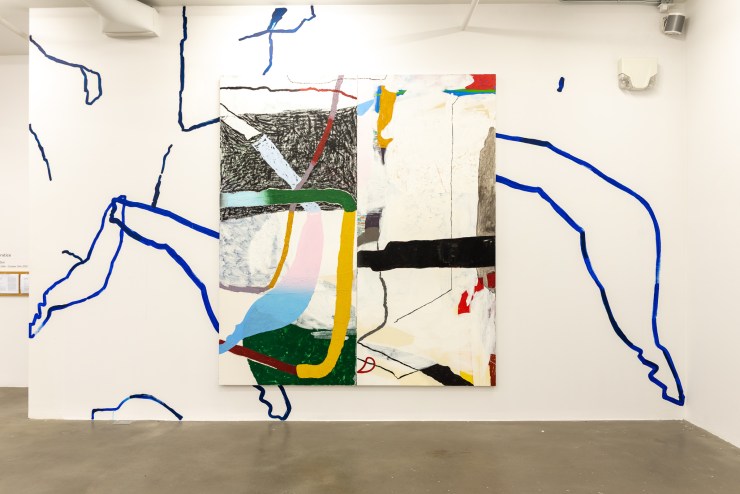
Russna Kaur, Suddenly her lips sharpened—it was splendid installation shot, the sky seems to be the only one to Notice, 2020. Burrard Arts Foundation. Photograph by Ada Dragomir.

Suddenly her lips sharpened—it was splendid

Burrard Arts Foundation

August 29, 2020 — October 10, 2020

By Ada Dragomir

The first time I saw one of Russna Kaur’s monumental paintings, Ironing, Bored, I couldn’t stop staring. Sized at 12 feet x 9 feet, occupying a quiet corner on the top floor painting gallery at Emily Carr University, it was hard to leave, difficult to walk away. It wasn’t until much later that I understood why I felt that way.

When I first saw Kaur’s work, I was an exhausted third year BFA student, equal parts overwhelmed and in awe, walking through offerings at The Show—Emily Carr University’s graduating exhibition. Her work was a welcome reprieve from an onslaught of poorly executed new media works and frenetic installations filled with broken things, clumsily glued back together. Kaur’s work moved me, held me, and invited me in because it walked a tightrope across the complex political and visual histories of abstraction and representation. Though her work is situated in the realm of the abstract, she manages the concomitant baggage with intention and grace. While the art world reckons with representation, Kaur keeps on going—making work with the practiced pragmatism of the shrugging lady emoji.

Russna Kaur, Suddenly her lips sharpened—it was splendid installation shot. They are midway between the sun and the moon, 2020. Burrard Arts Foundation. Photograph by Ada Dragomir.

That initial encounter was with a painting constructed from multiple abutting surfaces, strips of canvas, sawdust, and saturated acrylic paint. It was mimesis of absolutely nothing and an image of absolutely everything. It made sense to me and yet alluded to so many unanswerable things. My girlfriend thought it was a very ‘pretty’ painting—and her passing attraction speaks to the seduction of Kaur’s style, but all good work deserves a closer encounter, a longer breath, a deeper look. Ironing, Bored made me think of my grandmother ironing bibi’s fotă, the velvety red embroidery flattening under the weight and steam, a mostly-ash cigarette hanging from her mouth—dangerously drooping over the entire operation. I didn’t know Russna then, hadn’t heard the stories she tells about and around her paintings, hadn’t yet understood how someone manages the burden of representation, juggling what to reveal and what to conceal, forging a possible path forward for the rest of us racialized diasporic femmes, sharp as fucking tacks—especially, those of us who think carefully, skeptically, and often, about identity-based politics in art.

You see, much of 21st-century art history is filled with White men making abstract paintings. From de Kooning to Pollock, from Malevich to Yves Klein, an entire century’s worth of artists with class, gender, and most notably race privilege, have escaped the burdens of representation, marshaling abstraction into a purportedly universal language. How many White guys in modern, post-modern, or contemporary art paint consciously and representationally about the specific circumstances of Whiteness and masculinity? How readily can you name 10 White men working in abstraction historically or contemporaneously, and how readily can you name 10 racialized women doing the same? Go ahead, count them on your fingers.

If abstraction is coded as both White and male—and we can trace this back to Whiteness and masculinity situating themselves as central, normal, default, everything and everywhere—then inadvertently, the assumption falls that racialized and women artists’ purview is—or ought to be—representational.

Representation can be articulated as making mimetic work. That is, paintings and sculptures which aim to communicate likeness to life, but representation can also be inflected in order to increase political visibility, literally to see more racialized artists exhibited and collected. Abstraction, on the other hand, presupposes a stifling universality—a ‘pure’ and singular visual language, more connected to platonic ideals or some eternal spiritual principle than to the muddy meatspace we all live in. It’s messy since the politics of representation are just as dangerous as white-washed and colour blind universalisms, both in art and in life. Our political forms—and our artistic ones—need subtler inflections. In other words, why use a hatchet when a scalpel is needed? In other words, is justice for BIPOC better served by a cop with a dastār or an RCMP commissioner who thinks that systemic racism doesn’t exist?

In other words, are the politics of representation the road to liberation?

While I have serious doubts about the potency of identity politics and the real political power of representation in our current world, the fact that I’ve had exactly two instructors of colour in my six year stint in art schools (none of them women), and that a recent survey of Canadian art institutions breaks down a dismal percentage of BIPOC in executive leadership[1] all tell me that Whiteness is still very much the norm, the neutral, the abstract and amorphous center of the universe art world. Buricul Pământului.

What makes Kaur’s paintings worth the second look is that they imbricate this tension, navigating both the possibilities of the utopic and the political burdens of representation.

Russna Kaur, Suddenly her lips sharpened—it was splendid installation shot, 2020. Burrard Arts Foundation. Photograph by Ada Dragomir.

When I sit with Suddenly her lips sharpened… it was splendid, Kaur’s recent show at Burrard Art Foundation, it feels like a breath of fresh air. For an exhibition which demands so much space—a monumental almost endless picture plane crawling across 13+ canvases and occasionally the walls—Kaur offers a surprisingly subtle political inflection. Sometimes reminiscent of maps, sometimes of rich velvets or shalwar kameez, and sometimes of a secret story held in too long, Kaur’s paintings invoke her “Punjabi-ness” without essentializing it and convey her stories without performing them. There’s a lot going on within those adjacent canvases, packed with colour and line, a feast of texture and material, but there’s also a lot of space for me, and in all likelihood, space for you as well.

On display at Burrard Art Foundation from August 29th to October 10, 2020, the exhibition consists of 10 works. Ranging from the humble 4 x 6 inch blinking your eye—an energetic painterly swath of milky acrylic and thread over burgundy pastel—all the way to the enormous 192 x 108 inch They are midway between the sun and the moon, the show towers over the viewer with discordant gradations of purples and greens, pinks and lime-yellows.

Kaur’s use of colour—that jarring, clashy, raucousness—recalls walls covered with the covoare and ştergari of my childhood in Romani homes. Abstracted tree of life motifs or screaming regional floral symbols reaching across and beyond the linen they were embroidered or woven onto, jumping from one surface to the next in a cacophony of colour and texture. The world never finished, the arrangement always growing. Kaur’s paintings work similarly, modular and mutable, puzzle-like in composition and title, enormous and ever expanding. Her use of multiple surfaces—in size as well as material presence—include the traditional canvas and cradleboard panel, but also extend well into the diversity of cloth that one would find in any self-respecting fabric store or bridal boutique in South Main. Ranging from silk, muslin, and twill, to paper and found wood, the substrates are rendered with thread, cold wax, acrylic, crayon, pastel, sand, and spray paint. In parts it’s sprawling and enormous, in parts tiny and spacious; all of it is full to the brim. Suddenly her lips sharpened…is a lot.

Russna Kaur, Suddenly her lips sharpened—it was splendid installation shot, 2020. Burrard Arts Foundation. Photograph by Ada Dragomir.

It’s as if there’s just too much to pack in: too much life, too many imperfect abutting pieces in tension, too much emotion, too much colour, too much ornament. That too-much-ness exists in sharp differentiation from the not-enough-ness of Kaur’s titles. Constructed, like the work itself, from pieces—Kaur uses redacted poetry to generate titles like when the mirror, It asked for more—there is barely enough information to achieve anything but a short nod towards a hidden world of meaning.

It is this same dynamic, this too-much-ness wedged in beside a not-enough-ness, that compels me to sit with Kaur’s paintings. I do so because they make me think. I am reminded that it is a similar and simultaneous too-much-ness and not-enough-ness of which young racialized women are constantly accused. Too loud, too bright, too unprofessional, too rude, too angry, too emotional, too smart. Not subtle enough, not perfect enough, not rich enough, not enthusiastic enough, not bright enough, not White enough.

Remarkably amongst all that, Kaur’s paintings seem to be a kind of artistic manifestation of the shrugging lady emoji—and just to be clear, not the “default” yellow one. While the world wants racialized artists to wage political battles and carry around the baggage of representation, Russna Kaur choses to just do what she wants—what she has to do.

Certain elements cross the expanse of the broken-up picture plane gesturing the continuity and integrity of the whole, but there are just as many instances of imperfection, of line or shape or colour which don’t add up, popping up inverted, truncated, or somewhere where they aren’t “supposed to be,” but are so desperately needed. Imperfection is inevitable, and in Kaur’s work, it’s accepted—recognized as a necessary facet of existence—and as they say, so in art as in life. I imagine the shrugging lady emoji, too, when I think about the assumptions and associations made with such bright and profuse colour. While some of us live in a world where simplistic and essentialist cultural mores direct us to believe that vivid and loud colour equals exotic and signals happiness, others live by the adage “laugh so you don’t cry.”

Russna Kaur, Suddenly her lips sharpened—it was splendid installation shot, 2020. Burrard Arts Foundation. Photograph by Ada Dragomir.

The shrugging lady emoji is of that latter persuasion. Having exhausted her finite store of shits left to give somewhat early in life, she spends her time wedged in the fissures between culture, race, gender, and labour. The shrugging lady emoji is not so much about resignation as it is about the recognition of a cruel irony, a prosaic pragmatism—facing the way things are, accepting that shit is profoundly fucked, and figuring out a way to move on, move in, and move through.

The shrugging lady emoji is intergenerational trauma wrapped in eggplant purple embroidered with gold silk thread. She is sexualized abuse and the wounds of diaspora shimmying into teal silk with lime green and hot pink trim. She is my grandmother ironing bibi’s fotă, tired and hunched over. She is a human pyramid of tiny stooped women with kind eyes, or squat fat women with gnarled hands, or once graceful but now stiff women with tongues like freshly sharpened knives upon whose shoulders the rest of us stand. She is the person who pretends to not speak English to get a discount, who expects you to work till you drop dead and then rise from the beyond to put in just two hours more. She is far from perfect, but….

¯\_(ツ)_/¯

_________________________

Sometimes, I like to think about artworks making arguments. Not every artwork makes an overt contention, but there are almost always ideological underpinnings to the aesthetic choices we make, even if they are buried deep, instrumentalized later, completely unconscious, or intentionally concealed. Think about Alfred Loos’ essay against decorative adornment titled Ornament and Crime[2] in which he takes a moral (and extraordinarily racist) approach to the “degeneracy” and “wasted labour” of embellishment. Or Hans Holbein’s The Ambassadors filled with hidden symbols and double entendres which reflect the politically and religiously treacherous waters in which it was painted.

A particularly apposite example, in our case, is Abstract Expressionism’s collaboration with the CIA during the Cold War. Soviet Era Socialist Realism, with its idyllic, heroic and pastoral inflections, ideologically presents an image of a united proletariat or sometimes their magnanimous yet salt-of-the-earth leaders living harmoniously, sucking from the fertile bosom of Mother Russia. As someone who grew up in Eastern Europe in the long shadow of the setting Soviet sun, I assure you that’s not quite how it went. Ideologically, Abstract Expressionism was America’s answer—a modern movement dominated by individualism, capitalism, expressive creativity, freedom of emotion and mark-making, monumentality, and masculine vigor. In Rockefeller’s words, it was “free enterprise painting,” and so it remains, a movement whose works are scattered across billion-dollar bank lobbies, executive offices, and prestigious galleries throughout America.[3]

What is Kaur’s work then saying if it speaks with the embouchure of abstraction, the scale of the monumental, the colours and rhythms of Punjab? What does it say when spoken in the halted staccato of redaction? What is concealed and what is revealed? What does it say about gender, and race and representation, about how much space there is, where, when, and for whom?

Her work says you can look but you won’t be able to see, you can consume but you’ll never be sated, there is a story but told only in fragments, it’s not perfect and was never meant to be. There is space for you, but not in the center.

¯\_(ツ)_/¯

You can view the virtual exhibition tour of Suddenly her lips sharpened — it was splendid at Burrard Arts Foundation here.


[1] https://canadianart.ca/features/a-crisis-of-whiteness/

[2] Loos, Adolf, and Adolf Opel. 1998. Ornament and crime: selected essays.

[3] https://www.independent.co.uk/news/world/modern-art-was-cia-weapon-1578808.html

The figure does not win every time: In Discussion with Celeste Rapone

By Elaine Tam

March in London gifted a few spring pleasures; memorably that telltale smell of oil paint, one takeaway impression among many from Celeste Rapone’s exhibition Retreat at Josh Lilley gallery. Dressed by electrifying palettes and deftly rendered textures, her eccentric characters go about their daily dealings in paintings oscillating between figuration and abstraction. Swelling to their borders, they occupy “impossible positions” and defy gravity in multiplanar views. Yet it seems that — for all their brazen flair and over-zealous accessorizing — a maelstrom of incidental activity surrounds the figures, swallowing them.

Rapone never does preliminary studies, which means that any self-doubt, struggle, or transformation becomes part of a complex unfolding on the canvas as the painting is realised. The result of this highly personal process is not overtly autobiographical. Nonetheless, the paintings impart an intimate insight into the painter’s psyche, and the ways in which the discomforts and discontents of painting parallel universal human experiences. With remarkable reflexivity, Rapone explores the many personalities of failure and the possibilities for invention, humour and discovery that lie therein.

Elaine Tam: How do you begin the process of creating new work?

Celeste Rapone: I’ll start a painting by mixing colour, usually with some sort of narrative prompt in mind. One of my favourite challenges is assigning a palette to a narrative that has no colour associations. I start my paintings like an abstract, rather than figurative, painter — with colour, shape, composition, form. The figure and environment are secondary elements that come after. There’s a lot of wiping down; I really like figuring it out on the canvas and having the problem exist there.

Elaine Tam: How does this tension register on the canvas or in its contents — with the presence of more control or less gestural swathes of paint?

CR: I’m constantly skeptical of my decisions as a painter. That’s one of the prerequisites of being a painter, right? Doubt about everything. The paintings I struggle through I have trouble seeing after they’re finished; it’s like seeing your significant other for the first time after a really big fight. There are ones that go a bit more effortlessly, but I’m also skeptical of those. Maybe I’ll second guess the speed of something being resolved.

Yawn
Celeste Rapone. Yawn, 2020. Oil on Canvas. Image courtesy of Corbett vs. Dempsey and the artist.

ET: Slightly earlier works like Flirt (2018) or Artist Wife (2017) centre on Guston- or Eisenman-esque caricatures, whilst a recent work like Yawn (2020) is more scenic and features lots of minutiae. How do you relate to your earlier work and the way your practice has developed?

CR: There’s something about the idea of the women contained, occupying these impossible positions anatomically, but also in terms of expectations, ambition, defeat and self-awareness. It is a lot of what embodies painting as a process and practice. In the past couple of years, I started having the figures fill out the entire composition, taking away flattering cropping. When the whole body is exposed, there is a discomfort [and] vulnerability.

ET: The objects slip and slide through the viewing corridors created by the entangled bodies. On your flattened planes, there is no hierarchy — the body never seems to fully possess or grasp the objects. You have described your paintings as anxious. Is anxiety an intended effect?

CR: I don’t set out to make anxious paintings. I see the paintings as an intersection of my personal history — growing up Italian Catholic in North Jersey — art history, and whatever the current circumstances are, both in my studio and in the world. Your comment about hierarchy is something I think about a lot. I’m interested in the figure sort of drowning in their environment and being totally overwhelmed by their context. When I was in grad school, an advisor once asked me: “How do you make figurative painting and not let the figure win every time?”

Screen Shot 2020-07-30 at 1.17.58 PM
Celeste Rapone. Practice for the Real Thing. 2017. Oil on Canvas. Image courtesy of Corbett vs. Dempsey and the artist.

ET: Yes, and in many of your paintings, certain objects are very prominent. Some are even named or branded.

CR: There is a specificity to the imagery. But because of my illustration major at Rhode Island School of Design during undergrad, I’m aware of not being too specific — that the narrative is not overly linear or only hits one note. RISD is a pretty technical school, [so] my whole background is in observational figure and portrait painting. I realized quickly I was not an illustrator. That’s why I went back to grad school for painting.

ET: So as to not be only illustrative or purely representational?

CR: It was about trusting and translating the skillset [so] that I had enough to make totally intuitive work, invent light scenarios or palettes for convincing flesh tones… For years, I was painting with a hyperrealist approach. Sometimes, I have to re-train my hand to paint in a way that’s looser, more gestural, guttural [and to] not paint this thing the way I know, but paint it for what the painting needs. One of my favourite essays is Mitchell’s What do pictures want? I’m interested in that dialogue.

ET: Your background as an illustrator explains so much, as your work certainly exhibits moments of stunning technical prowess. Yet the faces of the characters are mysteriously smudged and less defined…

CR: That’s been happening more lately; the portraits are getting more generic or partially concealed because they are less overtly autobiographical. I don’t know the identity of the person I’m painting, so it seems like a lie to give them a specific face. The more autobiographical elements have been popping up as objects and accessories, [such as the] sneakers I always wanted in junior high that my parents wouldn’t let me buy. I’m making a painting of a woman fishing right now. It’s a night-time painting, and just yesterday, I added those glow light necklaces.

ET: Of course! The ones that crack —

CR: And then they light up and they don’t last long. That was a very popular thing [to wear] when I was growing up, [if you wanted] to look really cool.

ET: Very raver chic.

CR: Totally! Except back in Jersey we weren’t ravers or chic. It was a thing you would wear to a party to have the aesthetic of raver chic. Some of these little nods in the paintings are [to] my own history and life, where I come from: a cough drop wrapper, tooth flosser, or a can of something on the floor of my studio that just makes it into the painting. But these are not things viewers need to know — I don’t want the paintings to turn into an archaeological dig — it’s about how they all collide in a composition.

27941_Rapone_Four Eyes
Celeste Rapone. Four Eyes, 2019. Oil on Canvas. Image courtesy of Corbett vs. Dempsey and the artist.

ET: For someone unfamiliar with “Jersey” as a cultural phenomenon, how would you describe it?

CR: I was growing up in Jersey, amongst all these opulent, maximalist visual stimuli, adopting bad taste tactics. And now I’m working through some of that when making the paintings. I’ll make a painting and look at an area and go, “That’s a real Jersey move”.

ET: That’s so telling!

CR: You know, I heard a recording of Charline von Heyl for her show at the Hirshhorn, and she talked about finding this level of “upgraded cringe”. What a wonderful phrase, right?

ET: It’s a fine line though. How do you distinguish between cringe and upgraded cringe?

CR: That’s a question I ask myself all the time in my studio. What’s one step too far? What’s about bad taste versus just bad taste? I’ve always been interested in this gentle idea of shame and embarrassment in the paintings, and that has become heightened in some of the moves I’ll make in recent ones.

ET: Could we consider these kinds of questions the “narrative prompts” that help you to start a work?

CR: What gets me into a painting can come from anywhere, which is one of the reasons I reference Dutch Golden Age painting. I love the idea of a simple start. There’s something in simplicity that allows me to have total freedom to take it wherever I want, like the women playing dominoes in Yawn. “What a dumb idea for a painting!” I’ll say in my head, but I love that because it’s something to push back against. What’s more interesting to me is the absurdity in how a painting is constructed. A woman stretching canvas, who would want to look at a painting of that?

Swan
Celeste Rapone. Swan, 2019. Oil on Canvas. Image courtesy of Corbett vs. Dempsey and the artist.

ET: It’s funny you say that, because I find this work of yours delightfully witty; the painting becoming the back of its own canvas, revealing its sub-structure. Why did you title it Swan (2019)?

CR: There’s something awkward about your body stretching a canvas. I wanted to play with that in the title; the lack of grace and this idea of transformation. But even if there are sub-narratives occurring in the paintings, inherently they are all about trying. That notion of effort or expectation that goes into trying, which tries to counter failure. But failure is always one aspect of a larger cycle, in life and in painting.

ET: That reminds me of the famed Beckett phrase: “Ever tried. Ever failed. No matter. Try again. Fail again. Fail better.”

CR: Absolutely. I see it as this overarching thing, and I like to think that failure enters the work in different ways: humour as a coping mechanism or trying really hard as the concealment of failure. It shows up in the painting as, perhaps, one too many accessories. She’s trying just a little too hard. Am I trying too hard to paint this necklace perfectly?

Viewfinding
Celeste Rapone. Viewfinding, 2019. Oil on Canvas. Image courtesy of Corbett vs. Dempsey and the artist.

ET: It’s like that fine line regarding “upgraded cringe.”

CR: Right, like I’m gonna paint this rainbow and it’s going to be très embarrassing, but is it going to be more embarrassing if it’s a perfect rainbow, or if it’s a crappily painted rainbow? These are conversations I have with myself ten hours a day, so it’s an all-encompassing practice: thinking about trying too hard, failing, starting over again. I always have to be really honest with myself about the painting. There has to be an evocative undercurrent. Then, there’s the laughter, which lets me know I’m hitting on something. There are times I tell my husband, “I haven’t laughed yet, so I don’t know how it’s going.”

Take the Sacred Pause: Talking Tarot with Laura Dawe

978D39DD-98FB-4C48-A8C1-48315263ADA5
Laura Dawe, Pack of Dogs tarot deck 2019. Courtesy of the artist.

By EA Douglas

In early 2018, a blocky mauve building with green eaves appeared on my Explore feed and brought Laura Dawe and her work into my life. A painter, a filmmaker, an occasional tattooist, the host of BUMP TV’s Valentine’s MATCHtacular, Dawe released her Pack of Dogs Tarot Cards in 2019. We got on the phone to discuss her process of making the deck and the rituals surrounding her readings and creative practice.

EA Douglas: Let’s start with your own history with the Tarot. When did you first start engaging with Tarot? When did you decide to make your own deck?

Laura Dawe: I decided to make my own deck and I started engaging with Tarot at the exact same time, which was when I was a 14-year-old goth and I knew nothing about it. I didn’t own a deck, I didn’t know anyone who did, I had never had my cards read or anything. But obviously the mystical depictions, I was just like “this is the coolest thing ever” and I started to make a deck.

Then I went to Newfoundland for my grandfather’s funeral, and my Uncle was there, and he’s actually an artist as well. He’s pretty deeply religious. We went for a walk to the Ocean and I was telling him excitedly about this thing I was making, thinking that he would think it was cool, and he basically had an intervention. He was like, “These are tools of the Devil, if you open the door for the Devil to come into your life you may never be able to close it.” I abandoned the project and then didn’t really start doing the Tarot thing until my ex-boyfriend bought me a deck close to 10 years ago. I used that deck to make some very major decisions in my life, that still resonate until this day, and slowly I started learning the cards.

While I was doing my Master’s, it occurred to me that I might make a deck. I was making a lot of art about archetypes and studying Carl Jung who made his own Tarot deck. Then I’m writing this movie and in the movie, the girl has a Tarot deck, they live in a very resource scare apocalyptic world. I knew the aesthetics of the movie; I knew how she would make a deck and so that’s how I ended up making mine. Basically, pretending I was her.

6F661823-0D7D-47FC-863D-EC4F9DE1DD90
Laura Dawe, Pack of Dogs, tarot deck 2019. Courtesy of the artist.

EAD:  I have a quote here, that each Tarot deck “tends to have its own voice and story written in the images.”[1] I know it’s called Pack of Dogs, and the large black dog almost prances from one card to another. What’s the source behind the dog?

LD: The dog has been in my paintings for a long time, kind of representing our shadow selves. I have a painting that I made when I was having a very serious shame-over called Bad Dog Wants to Be Good. It’s a black dog smoking a cigarette with a white dog in its mind, surrounded by empty wine bottles and there’s a full moon outside.

It’s sort of that idea, it’s different for all of us, as an extrovert (like) me, sometimes I will leave a social situation and feel this incredible shame that I dominated the conversation or neglected people. I would think about that and (know) I can’t control it. I think we all have these things, some people have anger issues, some people binge eat, some people have all three or seven.

We all have these little black dogs running around inside of us and I feel sometimes they’re definitely deeply tied to our unconscious; sometimes we’re aware of them, sometimes we’re not, sometimes we’re aware of them and we still can’t control them.

For example, the Lovers card we think about like “Oh! It’s definitely a good omen for romance!” While that is true, there’s also a lot of guilt linked to the Lovers card for a lot of readers. RuPaul said it best “If you can’t love yourself, how the hell you gonna love somebody else?” So, in my version, it’s a woman embracing a black dog and they’re embracing equally. I see that as a kind of a self-union.

6 lovers
Laura Dawe, Pack of Dogs, Lovers card. 2019. Courtesy of the artist.

EAD: Loving yourself first?

LD: Loving and accepting your shittiness. Which isn’t to say we shouldn’t all be trying to make sure our shittiness doesn’t spill into the world, but we also need to not punish ourselves for being human. Accepting because there’s no other way to make sure it’s accepted.

EAD: That’s super cool. The black dog stood out to me.

LD: They kind of represent our anxiety, (when) I say shadow self I mean that in the Jungian sense.

EAD: The things we don’t want to admit about ourselves.

LD: Even when we’re looking for it in analysis we sometimes can’t find (it) because of how much of our personality is a fortress that we build to protect ourselves from our humanity.

Someone offered me the tip of like if you want to get in touch with your shadow self, think about someone who sets your teeth on edge. Someone who stresses you out so much you find them so offensive and guaranteed the qualities you find so appalling in them are your shadow characteristics.

EAD: Oof, yes. The Tarot deck consists of 78 cards, each one containing an image or archetype. Did you approach each card with an idea in mind?

LD: The way that I did it was imagining I was this woman and she would have been travelling, so she would’ve been making one card at a time. I made most of the deck where I would be doing a reading for myself or someone else and then whatever cards I would pull I would then make those cards for my deck. It made it easier to remember the meanings because it was tied to a reading.

Also, it helped me try and communicate the meanings because I was applying it to a situation; I would find a way to express it to myself to make sense.

Like most Tarot decks it is based in many ways off of the Rider-Waite. There’s some of the cards that are pretty closely Rider-Waite and those are the earlier ones. I started to understand how to use my own voice the more that I made, some of them I would go back later and remake them so they’re much more my own thing.

LAURA DAWE bad dog wants to be good
Laura Dawe. Bad Dog Wants to be Good. Courtesy of the artist.

EAD: Were there any that were super hard to make?

LD: The Three of Wands, I do not know what that card means. Every single time I pull it I’m like “I’m going to look this up” which means I should really know. I really struggled to draw it because I don’t know. It’s a picture (of) a dog climbing some candles and there’s a chicken wing in front and it’s smiling. I feel like it’s a bit of meditation on the grass is greener mentality. When I say the grass is greener I kind of mean projections, the suit of Wands (is) a suit of manifestations, and so projection/manifestation (are) synonymous in some ways.

EAD: When you’re performing the Tarot readings does interacting with them bring them into your studio? You were making the cards after you read for someone, but now that the deck is completed and that’s what you’re using?

LD:  Oh, I never read in the way that I read now until this deck was made. I would (read) in the way that anyone would read with their friends at a party. It was never the way that it is now where I am off book. I didn’t do that until I went to Foire Papier in Montreal; that acted like my deadline to get the deck finished. I read for people there and I was really scared. Of course, people loved it because it’s all about them.

EAD: It’s also such a unique experience in the art world, I think that being the artist and then sitting there and providing an intimate moment…

LD: A service?

EAD: A service but also a chance for intimacy because Tarot readings are so intimate.

LD: They’re extremely intimate. You pass small talk and you zoom past medium talk right into, “My Dad is dying.” And then you’re like, “What was your name again?” You hold intense eye contact with people, you don’t know what the card is going to say, you don’t know what is going on with them. It’s a profound privilege to get to communicate so deeply, so quickly and to feel so trusted. 

12 hanged man
Laura Dawe, Pack of Dogs The Sacred Pause 2019. Courtesy of the artist.

EAD: Have any of the conversations you’ve had over the Tarot come back into your work?

LD: I guess everything does affect, who even knows what ways (things) manifest. I haven’t been painting really at all for a couple of months and I’m circling the studio, I need to make a bunch of paintings for the new year. I’ve been thinking about them, all the time, and prepping the studio. I’ll go in there, stare at the wall, build a canvas and then get freaked out and run away.

It’ll be interesting to see when these paintings start coming out, whether this kind of archetypal language (will appear). Those are the conversations you have with people, it’s the Major Arcana moments in their life. No one is rushing for Tarot reading if they don’t have big questions. The people who are first in line are heartbroken, they’re grieving, they’re moving, they’re falling in love, they’re stagnant in a way that feels unbearable, you know? I (am) curious to see.

19 sun
Pack of Dogs, Sun Card. 2019. Courtesy of the artist.

EAD: I look forward to seeing it too! I have another friend who reads Tarot and between readings, they put their deck on a milky hunk of selenite, to clear the energy. Do you have any rituals around your readings?

LD: I have a cloth I use, a piece of canvas, that I read on. Each of the elements in the deck represents an element in nature. So, I’ll light a candle for fire, anything works for earth, a flower, a grapefruit, whatever. I have a baby goblet that I’ll put some water or wine in, and then for wind, if we’re near an open window it’s okay. Otherwise, I might light an incense (to) activate the air a bit. I feel like it’s grounding, it grounds the reading a bit. It sets the tone and invites things to enter in equal amounts. Although the cards really typically just reflect what is exactly going on and what the person already knows.

EAD: Sometimes you need someone else to spell it out. What sort of rituals are built into your creative practice? What rituals do you have in the studio?

LD: I wish I knew! I want to become a structured person because I am wildly not. I clean the studio usually. If I haven’t been in there in a while the big ritual is to go in and re-organize and clean, see what’s there.

If I am really struggling to get into a painting, I’ll put on This American Life. It really brings me back to my studio so many times over the years. Ideally, I’ll be zoned into the work by halfway through the episode, and if I can’t get into some kind of flow by the end of the episode then I may have to give up.

15 devil
Laura Dawe, Pack of Dogs, Devil Card. 2019. Courtesy of the artist.

EAD: Okay, last question. Do you have a favourite card in the Tarot?

LD: Jeez, I mean if it’s something you want to pull, obviously, The Sun. Which is also the 19th card, which I am born on the 19th and 19 is lucky my number. I don’t know. I wouldn’t call it my favourite.

My first response was the Devil – it’s the card I pull the most. It has seen me through many different experiences [and] it has changed meaning for me many times. I think it has to do with addictive thinking and not being in control of our mental domain so it can be a reminder to me about checking in. If I pull the Devil then I need to personally pull a Hanged Man and take a bit of a spiritual step back and chill.
EAD: Put your head upside down and figure it out.

LD: Put my goddamn head upside down and take the Sacred Pause.

Pack Of Dogs Tarot Cards are available to purchase through the Likely General website.

[1] Jaymi Elford, Tarot Inspired Life (Woodbury: Llewellyn Worldwide, 2019), 9.

Dark Angels and Amazons: Natasha Wright at SFA Projects

Sista Chapel by Natasha Wright

SFA Projects, 131 Chrystie St, New York, NY 10002

November 13, 2019, to December 15, 2019

fullsizeoutput_2d
Sista Chapel by Natasha Wright, installation shot. 2019. Courtesy of SFA Projects.

By Nancy Elsamanoudi

The paintings on view in Natasha Wright’s show, Sista Chapel at SFA Projects, convey power with an erotic directness. These bold, exquisitely layered large-scale paintings lure the viewer to muse over the grumbling vibrations of murky, subterranean elements. These works call to mind myth, the underworld, sorcery, dark magic, ancient rituals, primordial energies, and impulses; a violent, dangerous world constantly on the brink of chaos.

Wright’s paintings are peopled with larger than life goddesses, coquettes, amazons and mythological and magical creatures. Her work taps into an imaginary space that collapses the difference between the ancient and the present. These threads that exist simultaneously are seamlessly brought together in the same painting: Cardi B and the Venus of Willendorf, Pac-Man and a sleeping pink nymph, an enormous unicorn smashed against the picture plane against a seafoam green background that at least partly mimics digital space or crouched monsters lurking in an open field at night.

The Unicorn, 60 x 48_, Oil on canvas
Natasha Wright, Unicorn, 2019 oil on canvas 60 x 48. Courtesy of SFA Projects.

The ambiguity at play in Wright’s paintings is compelling. Wright freely incorporates both abstract and figurative elements in a way that heightens the tension and the sensation of suspense in her work.  Her work has a playful openness, a searching quality to it. She seems to allow forms to emerge intuitively.

The thick black lines she uses brings her figures into sharp focus, but then she also sharply crops her figures in a way that frustrates an easy read of them. Various body parts, such as the head, wings, legs, arms are cut off and often lie outside of the picture plane. The figures in Wright’s paintings are cropped as a means of intensifying a feeling—a sense of discomfort. Wright’s work fixates on sensation and the role of the body is central to her work. But the body in her work is not particularly idealized or sexualized. Instead, the body takes on a totemic function—it is more an archetype, a cultural coding of the vitality inherent in a human being.

At times, Wright’s work seems to also touch on death, the macabre and violence. Bodies and parts of bodies are distorted past the point of recognition; the figures writhe in pain. Wright seems to be exploring the precarious and fragile vulnerability often ascribed to the female experience. In Street Ophelia, for instance, a violently contorted female figure appears to be splayed on the ground.

ItsComplicated
Natasha Wright, It’s Complicated, 2019 charcoal and oil on dyed canvas 60 x 60. Courtesy of SFA Projects.

Wright is clearly not interested in making pretty paintings—her paintings aren’t precious. The bodies in her paintings are frequently awkwardly contorted. Grey is often the predominant color and her limited palette of greys, pinks, black and green lend her paintings a gravitas, a weight as does the texture in her work.

Wright builds up the surfaces of her paintings by using a range of materials such as sand, glitter, glass beads, charcoal and black magnum with hand-made oil paint. There is a haptic, textural quality to her work.  The resulting images tend to be suggestive; they seem to hint at a story involving an unfolding drama or possibly a moment of impending danger. She gives the viewer a fleeting glimpse into her world and imagination.

Wright’s work speaks to a fascination with darkness and Wright is tied to her feminist temperament. Wright repositions the female figure at the center by re-envisioning the feminine gaze and rethinking the importance of female agency. The adventuress, the seductress, the muse, the fallen or scorned women all become protagonists that motivate her studio practice. The painting When Black Swallows Red, for instance, looks like large swaths of leather mixed with latex, it is suggestive of the way black leather and latex might feel strapped tight against the skin and in doing so calls to mind straps, whips, and pain folded into pleasure.

Willendorf (Cardi B) 60 x 48_, oil on canvas_
Natasha Wright, Willendorf (Cardi B), 2019 oil on canvas 60 x 48. Courtesy of SFA Projects.

Wright is drawn to the dark, mysterious and dangerous aspects of feminine power and the female experience. By focusing on the body as a vehicle of power and agency, Wright’s work seems to rebuff the so-called feminine virtues of purity, chastity, and modesty.  This can be seen in Already a Saint, a painting of cropped thrusting forward, half-naked torso clothed in animal skins. Or The Swan, a painting that seems to be referencing, “Leda and the Swan.” In this painting, a bent and twisted sullied swan appears like a dark angel covered in volcanic ash flying into a lake.

These paintings speak to feminist concerns, but not in the way that is didactic. Wright seems to be most interested in what may be construed as threatening, destabilizing or emasculating about feminine power.  This feminine power has traditionally sparked fear or has been seen as evil, unnatural and suspect, resulting in images of conniving hags and witches.  Wright’s paintings attempt to reclaim and prize this “darkness” of female power by treating it like black gold—tapping into it as an energy source and an intuitively life-affirming way of knowing.