ActiVisions: Trans Histories and Activism, 1950s-1990s

The ArQuives 

In partnership with the Museum of Toronto (formerly Myseum Toronto)

Curated by Tobaron Waxman

April 19 – May 19, 2023

Installation view of ActiVisions: Trans Histories and Activism, 1950s -1990s. Photo by Davina Hader, courtesy of The ArQuives.

By Adi Berardini

Walking down Church Street in the Village, I turn my head from left to right to see rainbow flags, symbols of LGBTQ2S+ pride and acceptance. Making the trip to Toronto from the smaller, mid-size city of London, Ontario viewing the volume of flags and symbols of acceptance is powerful. As the LGBTQ2S+ specific spaces dwindle in the city I currently reside in, seeing ActiVisions: Trans Histories and Activism, 1950s -1990s curated by Tobaron Waxman for Museum of Toronto at The ArQuives, reassures me how the LGBTQ2S+ community, specifically trans communities, establish both public and private spaces through art, gatherings, and publishing, no matter the suffocations of a heteronormative society.

Curated by interdisciplinary artist Tobaron Waxman, ActiVisions: Trans History spotlights the ArQuives’ Trans Collections and focuses on the history in Toronto from the 1950s to 1990s, however, the reach extends beyond that across Canada through the letters, buttons, documents, music, art, video, photography and periodicals featured. The exhibition focuses on the legacy of activists Mirha-Soleil Ross and Rupert Raj, alongside many other transgender artists and advocates.  Waxman explains that their approach to the exhibition stems from “non-binary thought,” a term they coined. As they detail, “Rather than juxtaposing one person’s timeline against another, I’m hoping that people are encountering a developmental flow in their experience of the exhibition, as well as contexts where you could sit and relax and read.” On display is a breadth of ephemera covering essential Canadian transgender history.


Top Left: Transisters, Hans Schierl – Dandy Dust, L to R: Book by Candy Darling, My Face For The World To See, Mirha-Soleil Ross and Xanthra Phillippa MacKay original gendertrash original collage and buttons; sketches by Beth Tyler. Photo by Tobaron Waxman, courtesy of the ArQuives.

Based in Toronto and Montréal, Mirha-Soleil Ross is a trailblazer trans activist, artist, and sex worker, whose work develops intersections of prisoner justice, animal liberation, sex work advocacy, and more. She published the zine gendertrash from hell with her then-partner, Xanthra Phillippa MacKay.[1] Published for five volumes, the zine “[gave] a voice to gender queers, who’ve been discouraged from speaking out & communicating with each other,”[2] including art, poetry, writing, and information by transgender individuals, low-income queers, sex workers, and prisoners. Advocacy for incarcerated prisoners was deeply important to Ross, and a plinth in the far corner is dedicated to her correspondence with prisoners, including a cartoon drawing created for her and a folder with letters to and from prisoners.

Illustration, gift to Mirha-Soleil Ross from an incarcerated friend, Many thick folders, closed, a significant portion of prison correspondence. Photo by Davina Hader, courtesy of The ArQuives.

Ross also established a film, spoken word, and performance art festival, Counting Past 2, by and for transgender artists and filmmakers. As detailed in its mandate in the raw sienna-coloured pamphlet featured in ActiVisions, the festival aimed “to show audiences that transsexual people are creative and that it is through our own work they can best start to grasp what our lives, sexuality, and political struggles are all about.” Periodicals and newsletters by trans artists and writers by and for the community, with a focus on mutual aid, are a strong focus of the exhibition, with many available for visitors to read through.

Trans activist and community builder Rupert Raj is featured in a documentary titled Rupert Remembers, directed and produced by Xanthra Phillip MacKay, which documents Raj’s trans activism in Toronto from 1971 to 1990. Raj is shown quite earnestly in front of a plethora of locations that were essential to the activism that he did in the community. The locations also included safe private venues, such as Vicky’s apartment on the 9th floor where Rocky Horror Picture Show screenings occurred. Raj sparked healthcare activism and provided space for transgender people, providing social events and support for significant others.

L: Rupert Remembers, directed and produced by Xanthra Phillipa MacKay, documenting Rupert Raj’s trans activism in Toronto from 1971 to 1990. Rupert Raj Fonds, The Arquives.R: Kyle Scanlon (1971-2012). Black and white photograph by Laura Spaldin part of The Arquives National Portrait Collection. Photo by Davina Hader, courtesy of The ArQuives.
Advertisement from ‘Metamorphosis Newsletter’ (original 2” x 3”, enlarged and framed for this exhibition) and flowers. Photo by Davina Hader, courtesy of The ArQuives.

Raj created, edited, published, and distributed publications FACT and Metamorphosis Magazine, which specifically focus on access to clinical research, hormones and surgery, legal reform, and life-saving information on medical care for trans men,[3] are on display on the table in the center of the exhibition, along with letters to surgeons. The publications were often under different aliases he adopted for privacy and legal reasons. He helped establish the “Foundation for the Advancement of Canadian Transsexuals” (FACT) providing social support and exchange of information, medical, social and legal resources, counselling, and education.

L to R: ‘My Breasts, My Choice Mirha-Soleil Ross,  Photo of Willi Ninja and local Toronto friends, Toronto,
Table with iPad of the complete run of Metamorphosis, multiple books of theory, poetry, first-person nonfiction narrative on the table and windowsill.
Photo by Davina Hader, courtesy of The ArQuives.

Across the room from the film screenings, a vibrant pencil crayon portrait of Rupert Raj by Maya Suess adorns the wall composed of a prism of colours, which was commissioned by the ArQuives for their National Portrait Collection. Waxman explains how the portraits of activists are placed higher on the wall to reach the gaze of the other activist portraits featured, almost as if they are glancing at each other from across the exhibition, such as the striking colour portrait of Mirha-Soleil Ross on the adjacent wall by Julia Stringhetta, newly revealed to the public through the exhibition. On the window ledge was an award to Jackie Shane made of amber-coloured glass, with her album playing on the turntable, over a background soundtrack of Waxman’s curated playlist of trans musicians and trans anthems from the first half of the 20th century. The reading nook beside a stack of transgender literature near natural light creates a lovely space to absorb all the information while listening to the soundtrack.

Whore Culture Festival program, 1995. Photo courtesy of The ArQuives.

Displayed across the right side of the room are newspapers, posters, a t-shirt, and zines showing solidarity and coalition with trans individuals, sex workers, cabaret, and nightlife culture. Included are page excerpts from Maggie’s Zine: By Sex Workers for Sex Workers: 1993-1994 displayed in frames. In an article titled, “Sweeping Us Under the Rug: A Pro Talks About the ’89 Shriners’ Sweep,” the pages include an account by activist Anastasia Kuzyk, who was one of 350 women picked up over eight days during the Shriners’ Convention. The edited transcript explains in first person how her rights were violated after being arrested by an undercover cop. She details being kept in a holding cell, having her phone call withheld from her for thirty-three hours, and then having the right to plead guilty taken away as well. Although the charges were dismissed, Kuzyk ended up serving an eleven-day sentence and didn’t have the option to be let out on bail.[4] She had never had a previous conviction and explained how her friends were shocked. The framed zine pages demonstrate how transgender sex workers were criminalized, swept off the streets, and dehumanized. However, the exhibition displays how cis and trans sex workers used art and cultural production as a means of resistance and demonstration of solidarity.

Installation view of ActiVisions: Trans Histories and Activism, 1950s -1990s. Photo by Davina Hader, courtesy of The ArQuives.

In the LGBTQ+ Oral History Digital Collaboratory, interviews highlight figures who have advocated for equal rights for the trans community such as Rupert Raj, Susan Gapka, Greta Bauer, Martine Stonehouse, and Cheri DiNovo. The activists and researchers speak to the 1998 delisting and the 2008 relisting of gender affirmation surgery under the Ontario Health Insurance Program (OHIP). As a former MPP, Cheri DiNovo passed more LGBTQ+ bills than anyone in Canadian history, including Toby’s Act (named after Toby Dancer) which added trans rights to the Ontario Human Rights Code in 2012.[5] As DiNovo explains, it’s important to mention something when someone’s wrong. She says, “Step up and it has a chance of getting better. Never be afraid to tell the truth—Never be afraid to stand up to bullies.”

ActiVisions highlights essential activist work through art, zines, buttons, and cultural production, especially at a time when the transgender community is attacked for living their lives authentically, with lifesaving healthcare and resources currently being threatened due to hateful rhetoric. It’s important to learn these histories to prevent the injustices towards the transgender and queer community from simply occurring again in a loop ad infinitum. When it comes to advocating for the transgender community, it’s essential to demonstrate support beyond the bottom line and the month dedicated to pride. As ActiVisions: Trans Histories and Activism, 1950s -1990s demonstrates, art and the revisiting of the archive prove a powerful mode of doing so.

Check out the ActiVisions playlist by Tobaron Waxman:


[1] Xanthra Phillippa MacKay was an influential activist in her own right. The ArQuives is actively seeking donations of her materials.

[2] Mackay, Xanthra Phillippa; Ross, Mirha-Soleil (1993). gendertrash from hell, vol 1. Toronto, ON: genderpress.

[3] Raj, Rupert. Metamorphosis vol. 1, no 1. (February 1982), 1.

[4] Maggie’s Zine: By Sex Workers for Sex Workers: 1993-1994. Pg 17.

[5] Toby’s Act (Right to be Free from Discrimination and Harassment Because of Gender Identity or Gender Expression), 2012″Legislative Assembly of Ontario.

Surveillance Eyes: In Conversation with Harley Morman

Southern Alberta Art Gallery – HARLEY MORMAN: DON’T DREAM IT, BE IT.

Don’t Dream It, Be It

Harley Morman

Southern Alberta Art Gallery

May 11 – June 22, 2024  

Interview by Migueltzinta Solís

There’s something about Harley Morman’s work that makes you want to sink your teeth into it. I’ve been close friends with Harley for seven years – in the good times and the bad – and I always look forward to being transported to the colorful, gummy world that is his trans, queer creative practice. We are at the Southern Alberta Art Gallery (SAAG) during Lethbridge Pride, a few hours after riding together in the parade as part of our local queerdo bicycle club. After what I felt were too many cheering children, it feels good to bask in the simmering glow of plastic, rubber, and knitted objects that comprise Harley Morman’s solo exhibition, Don’t Dream It, Be It.

The exhibition space, once a library, is transformed by an overlay of trans-metaphysical subliminality. Coloured tape crisscrosses the hardwood floor, mirrors hang from above on bright plastic chains, nearly life-size Perler bead self-portraits stand sentinel, and lenticular images wiggle and wink as you move through the room. A knitted rope sways from the ceiling, delightful yet foreboding, ending in a sprinkling of rainbow aquarium gravel. A full wall is dedicated to an enigmatic map made from strips of tape which, upon scrutiny, reveals itself to be a play diagram for the exhibition space. At the end of the room, behind the hanging mirrors, a scoreboard with a clock, and a rainbow collage of plastic figurines surveil the visitor. Inhabiting the space, one may feel that a game is in play, and one, in their queerness, might feel a looming sense of anxiety about what the game is, what the rules are, and whether they are getting it “right” or not.

Southern Alberta Art Gallery – HARLEY MORMAN: DON’T DREAM IT, BE IT

Migueltzinta Solís (MS): Hi, Harley. (laughs)

Harley Morman (HM): Hi, Miguel. (giggles)

MS: My first question is, who are the different Harleys in this show?

HM: There are a lot of different Harleys here. There’s the Harley that is me, that’s my body…

MS: That I’m talking to.

HM: Yes! That is speaking. There’s also a ton of different Harleys. The most literal Harley is the work that is called Megan number 3: Harley. It makes good narrative sense to say it was the last thing I finished for the exhibition. There are three Perler bead works in this show. Each one represents me at a different stage of my transition, which wasn’t the plan at first.

When I made the first Megan, the one that looks like it’s diving for a clock, it’s trying to catch something. That Megan was made during my MFA, for a specific project that was essentially me bouncing around the volleyball or balloon-like heads of teachers who I had worked with during my MFA. I had worked with Perler beads before, and at the time when I made that Megan, in 2016, it represented a new direction in terms of the size and complexity of the pieces in terms of the way I was using and interpreting colour information. I wanted to make more of them.

The second one is from 2019. That was made specifically for the Dunlop Art Gallery in an exhibition of queer art on the prairies. Each one that I make of these gets bigger and more complicated in terms of the pattern. The third one took a long time, much longer than they normally do, even though I’ve gotten quick at it. Although I’m slower than I might have been before 2017 just because of the plaid jacket I’m wearing in the work.

MS: I like this idea of increasing complexity over multiple iterations or replications of Harley. First, I relate to the complexity of embodiment across these different replications of self. In simpler language you could say, “the complexity of gender,” but because of the temporal and kinetic questions here, it’s more than just about gender, which is why I love this work. I’m curious to hear you say more about the kinetic movements or actions that the figures are doing.

HM: Each of the figures represents an evolution of complexity of how I’m working with material. But in terms of the gestures that each of the figures is doing: each one plays off the others but could be understood as – I don’t want to use the word “evolution” – but is a direct response to the others. In the first one, I’m in a diving action pose because originally, I wanted to make it look like I was attempting to catch the heads that were coming at me, that were bouncing all over the place. They were up high and coming at the viewer and at the “me” that was on the wall. I wanted to make it look like that figure was an approximate life-size figure actively interacting with things. But if you look at my pose, the diving pose, it’s very much a responsive pose. I have my hands together, clasped with my wrists flattened, in the way that I [was] taught that you’re supposed to hit a volleyball. I never really knew how to hit a volleyball. It’s watching: that figure is looking up towards stuff but is very much in a ready pose but not in a “go” pose yet.

Southern Alberta Art Gallery – HARLEY MORMAN: DON’T DREAM IT, BE IT

In the second one, where my hands are up, I was imagining something akin to a volleyball serve– there’s no reason that I’m using volleyball as a metaphor here aside from the fact that it was a sport that as a girl in the Midwest, I was often called upon to do in gym class. It was also a thing that because of my vision problems, I am hopeless at it and always have been. I’m just incapable of seeing things that come at me fast. Anyway, I was thinking of the jumping up action and reaching for something, so it looks a little bit more active. And here in this exhibition, it’s reaching up towards an alarm clock that’s sitting at the top of the wall.

In this third one, I wasn’t sure if it would quite “go” because it’s not an indoor sport: I’m riding a bicycle. The bicycle is rendered photographically except for the outline of the bike, which is in flat colors that are similar colors to the wall. And it’s away from the others. The other two on either side of the scoreboard are a symmetrical set. But this is something else, it’s away and it’s very much watching what’s happening.

MS: I love this hypothetical engagement with sport. (laughs)

HM: It is very much just an imaginary sport. The lines on the floor seem to be fooling people, and that’s what they’re supposed to do, but they’re not based on any sort of official diagram. I’m looking at the scoreboard with the mirrors, and there is a “basketball key,” a word that I only knew when I said that I wanted to make one. I think sport and activity in this show is not a literal reference to actual practices, it’s more a field on which actors play.

MS: As a gay villain, I, of course, love the language of “fooling people.” I love the queer permission you’ve given yourself to define the space into an imaginary sports field.

HM: Most of the time, a lot of the references really core to this show are not visible. And I don’t expect them to be and it’s not necessary. I wanted it to look like a gym. When I was in elementary school, the only reason I would participate in sports activities was when I was forced to. I was always sitting to the side and crafting. No matter where we were, whether we were indoors or outdoors, I was always finger knitting.

Southern Alberta Art Gallery – HARLEY MORMAN: DON’T DREAM IT, BE IT

MS: Is that what this is over here?

HM: Yeah. Kind of. It’s not literally the finger knitting that I made long ago. So, the finger knitting, you’re using your fingers as the pegs or needles so there’s only four of them. It ends up making super thin and loose rope that doesn’t have a really good use.

MS: In looking at this long rope of finger knitting that attaches to the ceiling with a carabiner and ends on the floor in a pool of…is that aquarium gravel?

HM: It’s aquarium gravel, some plastic gems, and a few beads. I wanted something to be on the ground. I wanted for this knit object to look at least as threatening as the original object felt to me. The aquarium gravel is there as an uncomfortable fall, instead of there being a cushy mat underneath. If you attempted to climb this, you’d fall onto an uncomfortable surface that would be super jabby.

MS: That would probably stick to your skin and leave those little indents.

HM: [The gravel] is its own security since it makes so much noise if you step on it. You can hear it, easily, outside of the gallery.

MS: I saw the diagram of the space on the wall, and the thing that made me realize that it was a diagram of the space – a bird’s eye view of the space – was the gravel there.

HM: The diagram is so provisional and messy looking; I don’t expect people to necessarily know what it’s supposed to be. Because my work tends to be so intricately thought out and polished, the way that this drawing came together was kind of uncomfortable. It’s weird to say that fully intuitive making can be uncomfortable, but it is. When I saw the court lines on the floor, they gave me permission to have the drawing on the wall be as wacky as I wanted it to be. I used a level to make the blue and pink lines on the background, but everything else was done by eye. When I look at it, in one sense it’s kind of a picture of how I’m dizzy, because it’s not straight or even kind of straight in a typical way. The whole thing is a bit rotated in exactly the way things are spinning for me all the time.   

…The drawing on the wall was hypothetically meant to represent a real thing but the drawings on the floor – the messiness and the realness, the solid, well-delineated care of the essentially imaginary sport – I feel that is an important dichotomy in terms of “realness” and “imagination.”   


MS: I feel like this is a map of how you move as well. I can visualize you moving in this set of blue lines much more easily than I can imagine myself. It represents you offering your own perspective and experience of a space and how you move through it.

HM: I love that. The lines did have a logic when I was making them. I forget what that was, and I don’t think it’s important. The important thing was some of them were meant to represent actual physical trajectories and others, sidelines, looking back and forth.

MS: You described this piece as important as well as uncomfortable.

HM: That is important, oh my gosh. I mean the drawing on the wall was hypothetically meant to represent a real thing but the drawings on the floor – the messiness and the realness, the solid, well-delineated care of the essentially imaginary sport – I feel that is an important dichotomy in terms of “realness” and “imagination.”

MS: I feel like there’s something in here about the difference between the hypothetical and embodied experience, and how it relates to understanding “the rules of the world.”

HM: A lot of my past work has been concerned with the rules and conventions of gallery spaces and institutional spaces. I think part of what I have a hard time articulating is just the fact these are good visual metaphors for the difference between the smooth and the striated.

Southern Alberta Art Gallery – HARLEY MORMAN: DON’T DREAM IT, BE IT

The Scoreboard is one of the things that I have shown before. It was in the iteration of the show that was at the Art Gallery of Alberta (AGA). When it was at the AGA, it was much more prominent because of the lighting, and the color of the walls, and the way the space was set up in general. It was essentially the focus of the entire room and it’s not necessarily that prominent here. It reads not as the most important thing that you see upon entering but just as one of many. The Scoreboard was made to only be legible when you stand inside the arc of the mirrors. If you look in a mirror, you could see not only yourself but also the scoreboard and things reflected the right way round. The clock is running the right way in the reflection, you can read the mirrored letters that are on The Scoreboard.

Southern Alberta Art Gallery – HARLEY MORMAN: DON’T DREAM IT, BE IT

I love when people take selfies in the reflection, so that things are the right way around. Because generally The Scoreboard is incredibly ambiguous – it is not, and I don’t want it to be, apparent what it’s tracking. I think of it actively, and I know it doesn’t necessarily read like this directly because on one level it is very colorful and full of glittery beads and it’s shiny. But I think of it as a threatening piece, in the same way I think of gross, dirty climbing things as also being very threatening just by their existence. It’s just the idea that you might be tracked or that something about your interaction will be seen and could be accounted for.

MS: It’s a looming metric.

HM: Yeah, exactly! I mean in terms of transness, which was obviously a huge thing when I was making it back in 2021, it’s like competition as a bodily metaphor, but also a representation of tracking in terms of the timelines of change, of transition, and of growth and change in general.

MS: I think we both know that within trans experience and trans societies, there is a weird competitiveness. Whose transition is the best, who’s doing it right.

HM: It’s one of the things everyone knows, and nobody likes, but also you end up participating in it. I often find myself, or parts of my brain, echoing this hypercompetitive [sense]…I don’t think I necessarily have good things to say about that. It’s like tracking bad behaviour, bad feelings in general. This is very different from the affect that I think this show has for most people. I want it to, when you really think about it or look at it in the right way, look not happy but kind of threatening and scary.

MS: I definitely see it as sinister. A lot of people are like, “It’s playful”, “It’s a game”, “It’s a fun thing,” and “Kids will love it.”

HM: Yeah, and it is, and kids do absolutely love it. And I love that they love it, but also that’s only one reading of it and it’s not the most interesting reading of it.

MS: I think it’s interesting in the context of recent trans history, how we are from the late 90s, early 2000s, certainly in terms of FTMs and trans men, which is language that isn’t even cool anymore. We had Buck Angel and Chaz Bono and there were these metrics of passing and who had the most masculinization result. And then, of course, more recently there has been a shift away from that but now we have metrics of who has the better politics. It’s like whose is the best gender.

HM: But the gender isn’t necessarily based on hairiness. The gender is like a different, less physical aesthetic, but a politicized aesthetic.

MS: Hypothetical gender. Who has the most evolved gender and self-contextualization.

HM: Oh my god.

MS: Like the metric is different but there’s still a metric, but what even is it?

HM: In a way a person could think of it as being worse because it’s wider, and there are so many more expectations because transition is very much hypervisible at the moment, and because it’s so visible, the one who is undergoing transition is accountable to an even wider group of people.

As I’m standing over here, through the arc of the mirrors I’m looking at the lenticulars over there and thinking about how the stripes look like bars in a way. Some of them, not all of them.

Southern Alberta Art Gallery – HARLEY MORMAN: DON’T DREAM IT, BE IT

MS: Because my work has been about trans self-imaging, I’m curious about the way the mirror’s been working in here and the way time is part of that. Because there doesn’t seem to be mirrors without clocks in here.

HM: I like the mirrors with the references to time because of how it implicates a person and their body at a specific moment. It’s hard to not realize that you’re a viewer, which I insist on hitting people over the head with. I think there are considerably less mirrors in this show than there are in most of my shows. What are they reflecting? It’s kind of like going back in time, in a way. I feel like it’s important to have mirrors with the lenticular stuff because they do a weird thing with simultaneity and travel.

I’ve heard from some trans people who come into the show and see the lenticulars, that they make them feel weirded out and uncomfortable. Because I started transitioning so late and had already been practicing for years, it was not even a thought that I could or might want to be secretive about it. It seems like the obvious thing to do for me at this point in my life and career, to be completely fine with having my old photos interlaced.

MS: Transness has different generations that are not necessarily attached to chronological time. How I feel you and I are of a similar trans generation even though you started your transition later in life than I did, and our transitions happened within distinct decades of trans history and discourse. And it’s very different than the other generations that are simultaneously unfolding.

Southern Alberta Art Gallery – HARLEY MORMAN: DON’T DREAM IT, BE IT

HM: Yeah, that makes sense in terms of me because you’re always teasing me by saying how my gender is very anachronistic like my gender is a time period. I’m kind of curious about how my students might interpret the lenticulars. I hope that at least some of them might think that this was naughty. (laughs) Like it was somehow transgressive to show them blending into each other instead of a binary on/off situation.

MS: I certainly find these works to be very transgressive. As a completely immersive space, I sense the question, “Am I doing it right?”, on a societal level. “Is this how it’s done?”

HM: Yes, that exact thing. That nebulous sense of anxiety about “Am I being watched?” and “Is this okay?” is really important.

MS: “Is this how you play the game?” “Am I winning?” “Is this scoring?”

HM: (laughs) Yeah. The fact that it’s in a gallery, in an art space considered in relation to not trans but art communities, which are their own kind of weird hyper-competitiveness.

MS: To go back to lenticulars, and unease, I would say that in their layered-ness, discomfort, and unsettling-ness, they express the embodied experience, that is both uncomfortable and really rich, of being a person stretched across different points of time, mapped through gender pinpoints, kind of like that map over there.

HM: Oh my gosh, I love that. I think that kind of temporal experience of aging and of thinking about yourself…because I think, or hope, everyone would probably think or feel this like they’ve been several different people since they were that age. In the past 25 years, I’ve been a bunch of different people. Some are probably a lot more important than technically whichever gender I might be perceived as. I feel like aside from transness, the depiction of aging might be relatable more generally.

Southern Alberta Art Gallery – HARLEY MORMAN: DON’T DREAM IT, BE IT

This little best girl and best boy (referring to stickers on the gallery wall display) is one of my favorite things in the show. It’s just one of the scholastic stickers and both exist as separate stickers and all I did was just put them together and they worked perfectly. I feel like the scholastic stickers in general are rich in terms of references and material and lend themselves to turning into lenticulars. This cluster wall doesn’t get a lot of attention, but one of things that I like is the big clock. This wall – the eyes that are at the important points, the twelve, the three and the six, etc, are all eyes from stickers. This wall has just a bunch of other references to surveillance and stuff.

MS: Metrics of performance and surveillance. Can we just touch on that? (Referring to the front page of a notebook with handwriting displayed on wall.)

HS: Yeah, that’s an actual page from a notebook because I said I’m a keeper, I do have all the paperwork I’ve produced throughout school and after that because I keep everything. I feel really justified in it because it’s coming in handy, repeatedly.    

MS: Given that the paper refers to Megan’s rules, have you been following Megan’s rules?

HM: I can’t remember what Megan’s rules are. “This is a notebook, my notebook. Don’t bother it or you’ll have to answer to me.” I think that I’ve totally virtually destroyed Megan’s notebook by removing the cover.

MS: “P.S. Have fun”, is that what it says at the bottom?

HM: I think it probably does.

MS: Was there more you wanted to say about this wall?

HM: No, I just wanted to say, “Surveillance eyes!” (Points at lenticulars of eyes.) I just wanted to point them out.

MS: Transness continues to be so surveilled in terms of policy, particularly in Albertan trans and queer school and health policy right now. I think this show expresses the metaphysical experience of that kind of surveillance that is part of trans experience.

HM: Like what are the psychic implications of surveillance that trans people put themselves under before transitioning, or just in general, because of gender feelings.

MS: Yeah totally, think about in medical transition when you go on hormones, you have to do the experimental dose and you self-surveil as part of that. There’s an expectation to self-surveil.

HM: Yeah, it’s a requirement.

For more of Harley’s dizzy delights, follow him on IG: @Harley_Morman.
For more queerdo adventures that include Harley & Migueltzinta, visit his website here.


5 Must-Read Books by Trans and Non-Binary Authors

By Adi Berardini

To celebrate and recognize Trans Awareness Week from November 13-November 19, Femme Art Review has once again highlighted books written by transgender and non-binary authors for what we deem as “Trans Lit Week.” By sharing the books of transgender and non-binary authors, we hope it will help increase awareness of trans stories and experiences. Many of our favourite books are by trans and non-binary authors so read on and find a new favourite!

I Hope We Choose Love: A Trans Girl’s Notes from the End of the World by Kai Cheng Thom.

I Hope We Choose Love: A Trans Girl’s Notes from the End of the World

by Kai Cheng Thom


First featured is I Hope We Choose Love: A Trans Girl’s Notes from the End of the World by acclaimed poet and author Kai Cheng Thom. This book dives deep into the questions that haunt social movements today through a collection of heartbreaking yet hopeful personal essays and prose poems. I Hope We Choose Love “proposes heartfelt solutions on the topics of violence, complicity, family, vengeance, and forgiveness…This provocative book is a call for nuance in a time of political polarization, for healing in a time of justice, and for love in an apocalypse.” (Adapted summary via Arsenal Pulp Press)

Gender Outlaw: On Men, Women and the Rest of Us by Kate Bornstein.

Gender Outlaw: On Men, Women and the Rest of Us

by Kate Bornstein


In Gender Outlaw, first published in 1994 yet decades ahead of its time, Bornstein takes readers on a “wonderfully scenic journey across the terrains of gender and identity. On one level, Gender Outlaw details Bornstein’s transformation from heterosexual man to lesbian woman, from a one-time IBM salesperson to a playwright and performance artist. But this coming-of-age story is also a provocative investigation into our notions of male and female, from a self-described “nonbinary transfeminine diesel femme dyke” who never stops questioning our cultural assumptions.” (Adapted summary via Vintage Books)

Dear Senthuran: A Black Spirit Memoir by Akwaeke Emezi.

Dear Senthuran: A Black Spirit Memoir

by Akwaeke Emezi

In Dear Senthuran: A Black Spirit Memoir, best-selling author Akwaeke Emezi “reveals the harrowing yet resolute truths of their own life. Through candid, intimate correspondence with friends, lovers, and family, Emezi traces the unfolding of a self and the unforgettable journey of a creative spirit stepping into power in the human world. Their story weaves through transformative decisions about their gender and body, their precipitous path to success as a writer, and the turmoil of relationships on an emotional, romantic, and spiritual plane, culminating in a book that is as tender as it is brutal.” (text via Penguin Random House).

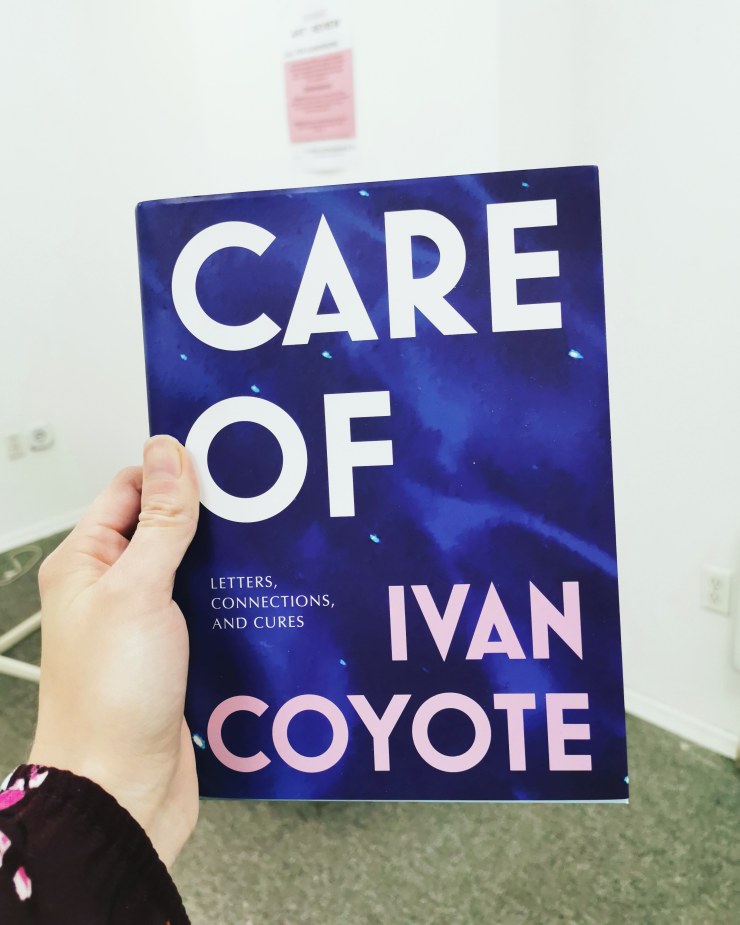
Care Of: Letters, Connections, and Cures by Ivan Coyote.

Care Of: Letters, Connections, and Cures

by Ivan Coyote


Storyteller Ivan Coyote has spent years on the road collecting letters from audience members and readers. Like many other artists, they found themselves at a standstill with the pandemic in early 2020. Their latest book Care Of combines the most powerful of letters they have received over time with their responses, creating a body of intimate correspondence. Taken together, “they become an affirming and joyous reflection on many of the themes central to Coyote’s celebrated work—compassion and empathy, family fragility, non-binary and trans identity, and the unending beauty of simply being alive.” (Adapted summary via Penguin Random House).

I’m Afraid of Men by Vivek Shraya

I’m Afraid of Men

by Vivek Shraya

Last but certainly not least, is I’m Afraid of Men by Vivek Shraya—a must-read about toxic masculinity, patriarchy, and accountability. In this book, Shraya unpacks both her fear and desire as a trans woman, delivering an “important record of the cumulative damage caused by misogyny, homophobia, and transphobia, releasing trauma from a body that has always refused to assimilate. I’m Afraid of Men is a blueprint for how we might cherish what makes us different and conquer what makes us afraid.” (Adapted summary from Penguin Random House).

We hope that you enjoy this selection and check out some of these books!

Six Must-Read Books by Trans and Queer Authors

By Adi Berardini

To celebrate and recognize Trans Awareness Week from November 13-November 19, Femme Art Review highlighted some books written by talented transgender and non-binary authors and/or books with trans themes for what we deemed as “Trans Lit Week.” By sharing the books of transgender and non-binary authors, we hope it will help increase awareness of trans stories and experiences. Ranging from fiction to poetry anthologies, read on to see why so many of our favourite books are written by trans authors.

ZOM-FAM by Kama La Mackerel. Published by Metonymy Press.

ZOM-FAM

by Kama La Mackerel


The newly released poetry collection ZOM-FAM is by Kama La Mackerel, who you may recognize as a Montreal-based Mauritian-Canadian multi-disciplinary artist, educator, writer, and community-arts facilitator. Kama La Mackerel mythologizes a queer/trans narrative of and for their home island, Mauritius. Composed of expansive lyric poems, ZOM-FAM (meaning “man-woman” or “transgender” in Mauritian Kreol) is a voyage into the coming of age of a gender exploring child growing up in the 80s and 90s on the plantation island, as they seek vocabularies for loving and honouring their queer/trans self, amidst the legacy of colonial silences. (Adapted summary from Metonymy Press).

Little Blue Encyclopedia by Hazel Jane Plante. Published by Metonymy Press.

Little Blue Encyclopedia (for Vivian)

by Hazel Jane Plante

Vancouver-based writer Hazel Jane Plante’s debut novel Little Blue Encyclopedia (for Vivian) explores a queer trans woman’s unrequited love for her straight trans friend who passed away. Acting as a love letter and homage, the story is interspersed with encyclopedia entries about a fictional TV show set on an isolated island. The experimental form functions at once as a manual for how pop culture can help soothe and mend us and as an exploration of oft-overlooked sources of pleasure.  Heartbreakingly beautiful, Little Blue Encyclopedia (for Vivian) reveals with distinct detail the level of loss she experiences in losing her close friend and love, Vivian. (Adapted summary from Metonymy Press).

Girl Mans Up by M-E Girard. Published by Harper Collins.

Girls Mans Up

By M-E Girard

Girl Mans Up by M-E Girard is a young adult novel that provides ground-breaking representation of a gender non-conforming teen named Pen. Dealing with not fitting the box of womanhood defined by her strict Portuguese family and a friendship with the local cool kid turned sour, Pen learns how to assert herself against people who don’t have her best interests in mind. 

Rebent Sinner by Ivan Coyote. Published by Arsenal Pulp.

Rebent Sinner

by Ivan Coyote

Rebent Sinner is Ivan Coyote’s take on the patriarchy and the political through personal stories of what it means to be trans and non-binary today. Coyote traces back a heartbreaking queer history while combatting those who try to misgender them and deny their existence. Through these relatable and often humorous stories, Coyote also paves a path for younger trans folk to realize that there is hope and a way out of the darkness. Coyote is a gifted storyteller who we recommend seeing speak live in person if you get the chance! (Adapted summary from Arsenal Pulp Press).

Fierce Femmes and Notorious Liars: A Dangerous Trans Girl’s Confabulous Memoir by Kai Cheng Thom. Published by Metonymy Press.

Fierce Femmes and Notorious Liars: A Dangerous Trans Girl’s Confabulous Memoir

by Kai Cheng Thom


In Fierce Femmes and Notorious Liars: A Dangerous Trans Girl’s Confabulous Memoir by Kai Cheng Thom, a lyrical and winding sort-of-true coming of age story, a young girl runs away from an oppressive city called Gloom where the sky is always grey in search of love and sisterhood. She finds her true family in a group of larger-than-life trans femmes who live in a mysterious pleasure district known only as the Street of Miracles. Under the wings of this fierce group, the protagonist becomes the woman she has always dreamed of being.

When one of their number is brutally murdered, she joins her sisters in forming a vigilante gang to fight back against the transphobes, violent johns, and cops that stalk the Street of Miracles. But when things go terribly wrong, she must find the truth within herself in order to stop the violence and discover what it really means to grow up and find your family.(Adapted summary from Metonymy Press).

it was never going to be okay by jaye simpson. Published by Nightwood Editions.

it was never going to be okay

by jaye simpson

jaye simpson is an Oji-Cree non-binary trans woman writer who lives in Vancouver. Their debut book, it was never going to be okay, is a touching collection of poetry and prose exploring the intimacies of understanding intergenerational trauma, Indigeneity and queerness, while addressing urban Indigenous diaspora and breaking down the limitations of sexual understanding as a trans woman. As a way to move from the linear timeline of healing and coming to terms with how trauma does not exist in subsequent happenings, it was never going to be okay breaks down years of silence in simpson’s debut collection of poetry:

i am five

my sisters are saying boy

i do not know what the word means but―

i am bruised into knowing it: the blunt b,

the hollowness of the o, the blade of y 

(text via Nightwood Editions)


We hope you enjoy this selection and make sure to check out these books this Holiday season!