Weaving it all on the Dancefloor: A Discussion with dani lopez

dani lopez portrait. Courtesy of the artist.

Interview by Harper Wellman

There is something eternal and necessary about textiles — Clothing, canvas, tapestries, and tools are just a few of the almost universal applications of textile work. For dani lopez, textiles are at the center of an artist practice that transforms an ancient and ubiquitous undertaking into a modern and personal endeavour. Her work entwines weaving, text, and modern iconography with queerness, camp, pop culture, and personal experience, generating a body of work that is both sincere and relatable.

After studying at the University of Oregon for her BFA, and later at the California College of the Arts for her MFA, lopez has continuously shown at a variety of spaces, including Tropical Contemporary, Amos Eno Gallery, and the Frank Ratchye Project Space among others. As her work continues to evolve, the personal experience expressed in lopez’s early work has amalgamated into an expression of queer collectiveness, creating a cohesive body of work in which ongoing themes are given space to exist and evolve in time and various incarnations.


dani lopez,(for the ACT-UP dykes who cared for their gay brothers while they were dying of AIDS), film still from BPM (Beats per Minute) Hand-embroidered sequins, imitation silk, thread, and interfacing 36 in. x 18 in. 2019.

Can you tell us a little bit about what attracted you to textiles? You describe your work as a sight of both regret and redemption. Can you elaborate on that for us?

When I discovered textiles, it was the start of some soul searching. I was working with a fibers professor who is an out, Black man. I have often said that meeting and learning from him was a lot like a gay friend taking you out and showing you the ropes. I didn’t come out until my early 30s. Textiles gave me the space and time to process my life and why being straight felt so damn hard. Weaving was the meditative space that slowly unravelled the fact that I couldn’t stay in the closet anymore. I knew I was queer for over a decade, but thought, well if I like men too, why make it harder on myself? (This is something many bisexual women are familiar with). I can’t separate my coming out from discovering textiles. They are inextricably connected. My coming out late in life has so much regret tied to it. For a long time, there was also shame connected with that regret—Now I see that regret as an opportunity. I can attempt to redeem myself or atone for all the times I chose a man over a woman/non-binary person. Now, I’m giving myself back that lost time, the lost opportunities, the lost hook-ups, and those lost loves with the work I make and how I make it.

dani lopez, i want to be her/i want her. synthetic hair, muslin, fabric paint, cardboard 60 in. x 24 in. 2017.

dani lopez, your sinner in secret. handwoven fabric, cotton yarn dyed with commercial dye, crochet thread, dowel, finials, curtain tie backs 67”x108” 2016.

When looking at your work, there is seemingly a shift over time. Your early work, such as pieces like i want to be her/i want her, 2017, and your sinner in secret, (2016) are much softer and femme, evoking ideas of magic girls and comfortability. Your more recent works, DYKES ON THE DANCEFLOOR, 2019, are tonally darker and almost mysterious. There is also a shift, seemingly from the personal experience to the experiences of a community. How did this progression happen?

While the focus now is on the larger project, DYKES ON THE DANCEFLOOR, I shift back and forth from community-minded work to personal work. The shift is a big one and it came from the desire to see myself in culture and to also illustrate how and where other queer women could find their stories in the world. Coming out later in life is often compared to a “second adolescence” and that has been true for me. I was searching, desperately, to find stories that looked like mine or just to see stories of queer women in general (beyond The L Word). So, once I found those images, I decided to commemorate them, to celebrate them, and to adorn them. The progression always starts as a small question or idea that begins to grow and evolve, and if it becomes big enough, I start to pursue it. Often, access to resources and limitations of space have a bigger impact on the work than I’d like. With DYKES ON THE DANCEFLOOR, I had just finished grad school and lost access to the loom I worked on. I moved into a small studio and I wondered to myself, well, okay, what do I make now? What’s that saying? Necessity is the mother of invention? In my case, it was true.

dani lopez (for the trans dykes who never felt safe enough to come out), still from tv show Euphoria. Hand-embroidered sequins, imitation silk, thread, and interfacing 36 in. x 18 in. 2019.

Pop culture plays a big role in your practice. Euphoria, Carly Rae Jepsen, and Robyn are just a few references you have made throughout your career. Why was it important for you to consciously include and highlight queer, and queer-claimed, media and performers in your work?

I’m so glad you picked up these references because I often wonder if anyone is catching these signals I’m throwing out into the world. I would say personal and cultural research are at the crux of my practice. We find ourselves, as queers, looking out into the culture that at times doesn’t reflect much back. So, when I do find these signals being sent out to queer folks, I feel compelled to continue to push that signal forward. How far can these signals reach? Will someone feel connected to me or my work because they see a certain signal or clue? Artists love to leave little clues around in their work for certain audiences and having it picked up on is truly such a joy to me. It’s an acknowledgment, it’s a nod, it’s an “I see you,” which is what I’ve always wanted, being a straight-presenting queer woman. I’m not “visibly queer” (whatever that even means), so I am constantly trying to signal to others that yes, I am one of you.

We find ourselves, as queers, looking out into the culture that at times doesn’t reflect much back. So, when I do find these signals being sent out to queer folks, I feel compelled to continue to push that signal forward.

The dancefloor is another recurring theme, and I know personally, the dancefloor and clubs are often safe spaces for queer communities. How have you dealt with the loss of physical queer spaces throughout the pandemic, both personally and within your practice? Now that those spaces are opening again, what are you most looking forward to having back in your life?

Personally, it’s been a huge blow to the sense of community. [I miss] the sense of abandon, joy, and research that happens for me at a dance club. Within my practice, it means that I have to do other sorts of research and looking. Whether that’s through mainstream media, music, literature, or critical theory, I’ve continued to look and attempt to find others to talk about this. I’m still not ready to be in a club space, enclosed spaces still make me really nervous, and I highly doubt I’ll be going to a club until next year. For me, that just means more reading, more research, [and] more conversations. I miss the dance floor so much, but safety is important to me. But when I am ready, I’m just hoping to see joy, excitement, and lots of queer desire.

Finally, what can we expect to see from you in the future, and where can our readers find you online?

You can expect more work! The DYKES ON THE DANCEFLOOR series will get more sculptural and strange. I just got a grant to help with the exploration of that project. By the end of the year, I should have my own loom (!), so you’ll be seeing new weavings too.  Next year I am in the Bay Area iteration of Queer Threads curated by John Chaich, which I am so excited to be a part of. I will also be talking queer textiles with another artist, Liz Harvey, on Textiles Arts LA this September.

You can find more of dani’s work on Instagram at  @dani___lopez___, or at www.danilopez.us.

Migueltzinta C. Solís’s “The Gay Villain Rides Again”

“The Gay Villain Rides Again: The History of A Queer Biker” by Migueltzinta C. Solís

Performance lecture, 16 April 2021

Co-presented by the University of Lethbridge and Queer/Disrupt (UK)

This is Not a Bike, Migueltzinta Solís, 2021.Image from performative academic presentation, The Gay Villain Rides Again. 

By Lauren Gabrielle Fournier

TW/CW: Mention of residential schools

“I love a sloppy archive,” Migueltzinta C. Solís says during the Q&A of his recent performance lecture. There is power-to-be-harnessed in the mess, in the slop, in the spaces that resist sanitization and homogenization, that resist ossification. There is power in the sour spaces, the spaces where one can harness the possibilities of art practice, including performance and parafiction (art and literary work in which fiction is presented as fact), in history-making, in the resisting of the power of singular status-quo narratives that uphold those in power and protect them from being questioned. And at a time when the very grim aspects of Canada’s history are being revealed—with the unearthing of the remains of hundreds of Indigenous children at the former grounds of a residential school in Kamloops and, more recently, Manitoba—the urgency around Indigenous peoples and other marginalized groups having agency in the telling of history is resounding. These events remind us of the consequentiality of history and how it is told—what is included in historical stories and what is left out. While coverage of recent news events can make it look as though these horrors are outlying events, marking singular “sad days” for Canadians, Indigenous folks will point out, rightly, that these horrific, genocidal events are at the heart of the very founding of Canada—a colonial country on stolen, Indigenous lands, with very long histories for thousands of different Indigenous groups.

With the colonialization of lands comes other colonial inheritances, including the University. Academia and its rituals, methods, and languages are another impact of European colonialization, and we are experiencing a moment of reckoning right now. Challenging and subverting colonialist academia from Indigenous, BIPOC, and queer perspectives is a worthy endeavour. In Mestizx artist Migueltzinta C. Solís’s recent performance lecture “The Gay Villain Rides Again: The History of a Queer Biker,” we get what the artist himself calls an “academically-subversive performance.” In it, Solís tells a story from queer history that he happens upon and in some senses discovers; through personal experience, archival research, interviews, reading, and embodied reflection and deduction. As an artist with a background in performance art, Solís experiments with how research can be presented to academic, art, and non-academic communities, and in this way his practice can be said to ‘queer’ academic structures—which includes bringing more depth and breadth to the archives recognized by academic institutions,  and “queering” the very methodologies recognized as legitimate and worthwhile in those spaces.                           

Tugmented archival image from performative academic presentation, The Gay Villain Rides Again. This is Not a Bike, Migueltzinta Solís, 2021.Original photograph by Sylvan Rand.

The turning toward history from one’s personal and research-based art practice seems particularly generative in a present moment where issues from “history” are urgent and still being processed and uncovered—including the aforementioned news about Canada’s residential schools, and the challenging of the names of many Canadian universities, including Ryerson University, named after one of the architects of the so-named Indian residential school system. The tendency for queer artists to engage with history and the archive is common, often as a way for queers to find their “ancestors” and better understand their own selves and sense of belonging in history. Other queer artists working on the colonized lands of so-called Canada, like Cait McKinney and Hazel Meyer (their collaborations at the Toronto Reference Library and the Canadian Lesbian and Gay Archive in Toronto, for example), have used the performance lecture format to present their embodied findings as queer settlers engaging in the writing of queer histories and interventions in the archive. Solís extends the performance lecture from his perspective as a queer artist, Indigenous to Mexico but situated today on Treaty 7 Blackfoot territory, to reveal the changeability of history as a story. Indeed, the telling of “history” is always the telling of a story, from a particular, subjective perspective, even as there might be rhetorical attempts at objectivity by those who self-identify as historians.

This is Not a Bike, Migueltzinta Solís, 2021.

            The artist’s presentation centers on the story of a figure named Solitaire, a mysterious spectre in the background and fringes of gay and lesbian (queer) motorcycle clubs of the mid through late 20th century. Before he begins the story, Solís apologizes preemptively for his “treatment of history:” he is not trained as a historian or a sociologist, he notes, but is an artist “dabbling” in history and the archive. While I take his point, I have a feeling that his “dabbling” is going to be much more than what it sounds like. After all, this work emerged after nearly a decade of lived experience, research, and practice tied to the topic at hand, and demonstrates rigorous academic research alongside oral storytelling, imaging, and parafiction. The fact that Solís feels compelled to make this statement in his opening points to the urgency of decolonizing what constitutes legitimate methodological approaches within universities and who can do what kind of work, especially when it comes to the understanding, interpretation, and production of history—itself wrapped up in often violent colonialist, hetero and cis, Eurocentric biases.

            The story begins in San Francisco in 2012, when Migueltzinta lived in Oakland and was cruising on the Castro and shopping in consignment stores, before finding a leather jacket that fit him almost “magically.” He found a single playing card with handwritten inscriptions in the pocket, and this moment becomes the engine driving the narrative that ensues. It is this card as a cultural object which launches Migueltzinta into a practice of historical research, him comparing the card’s design to playing cards from the 1900s onward, and ultimately coming to the Satyrs, a Gay Motorcycle Club from the 1950s. Coincidence, happenstance, lived experience, all become drivers in what Migueltzinta researches and what questions he asks.

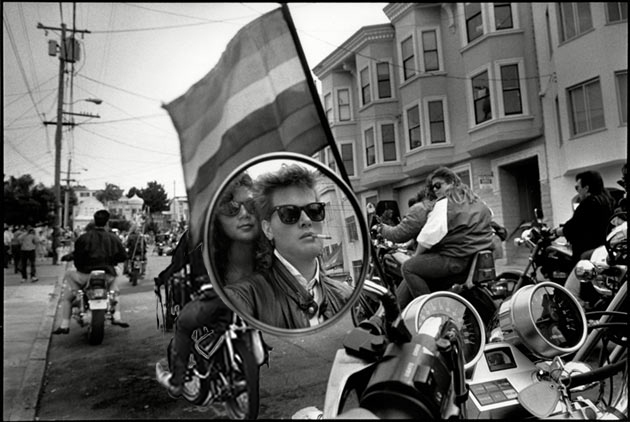
            The artist tells the story in the first-person “I,” moving between the autobiographical/anecdotal and the historical and presenting this in the form of a lecture: a Powerpoint presentation enlivened by Migueltzinta’s dynamic, live narration. Solís’s bridging of gay motorcycle clubs and Dykes on Bikes was a nice way of cultivating queer solidarity across differences—specifically gay male versus lesbian difference—with Solitaire as a figure being the figurative bridge between the two. Solís learns, through interviews and archival (specifically image-based/photographic) research, that Solitaire rode a bicycle which they called the “Gay Villain;” they put playing cards in the spokes of their bicycle to make it sound like a motorcycle, the cards loudly flapping in the wind. Contemporaneous historical events are discussed, including the Occupation of Alcatraz, an occupation of Alcatraz Island by Indigenous students and other Bay Area Native Americans from 1969 through 1971.

This is Not a Bike, Migueltzinta Solís, 2021.Original photograph sourced from The Los Angeles Times.

            Grounded in historical research and more traditional academic methods, Solís also engages in speculation as part of his process of forming hypotheses. As he works to uncover the “real story of Solitaire,” nearing a conclusion, he engages in a practice of “a theorizing of what Solitaire might have looked like,” and “a theorizing of what a female-presenting Solitaire might have looked like,” and a theorizing of a timeline of Solitaire’s life. And when he finally came to a place in the work where he felt he had a solid theory of Solitaire, Solís was presented with new evidence—photographs of Solitaire wearing what Solís lovingly calls the “vajacket” (jacket with a slit that resembles a vagina), and which radically changed what Solís had thought. “Had I been tricked?” Solís asked, aloud. “Had I somehow tricked myself?” Solís devises two solutions, which move the performance into the realm of parafiction: Solitaire might be a time traveler.

Solís does not stop there but goes on to auto-theorize his own parafictional move: “The act of longing for an idea of the past turns desire into a time machine.” Thus, the lecture concludes on the note of collective queer desire and the ways this drives what questions we ask.

Augmented archival image from performative academic presentation, The Gay Villain Rides Again. This is Not a Bike, Migueltzinta Solís, 2021.Original photograph by Saul Bromberger and Sandra Hoover.

            By bringing in his own queer, trans, Indigenous perspective alongside varied forms of research and writing, Solís shows the potential for autotheoretical modes of art practice in the present-day university. He brings in “queer evidence,” both forms of evidence that lie somehow outside of traditional, colonial, academic structures, but also queerness as itself a form of evidencing—an idea that Dr. Suzanne Lenon, a Professor of Women’s and Gender Studies at the University of Lethbridge, brings up in the Q&A after the talk. There, Lenon and Solís discussed academic methodologies and what it means to “queer” evidentiary support, as well as ideas of the “bad academic” and the politics, aesthetics, and ethics of engaging “unreliable” forms of knowledge and narration. The artist describes this performance as a “project of self-envisioning within a history;” here, he as an Indigenous and queer person is envisioned alongside and as part of the history, now present and speaking within and about contested histories that are changeable.