Dreaming in Dollar Signs: Russna Kaur at W Projects

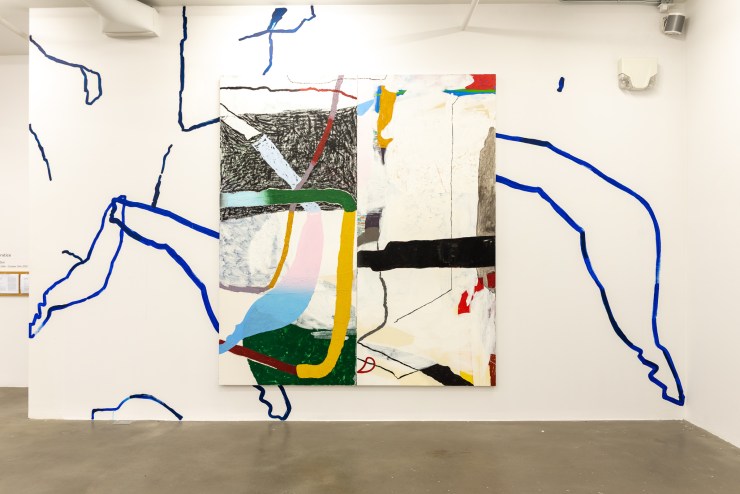
Installation view of Russna Kaur: DREAM MACHINE (try walking on a path of splinters with no shoes) at W Projects. Photo: Dennis Ha. Photo Courtesy of W Projects.

DREAM MACHINE (try walking on a path of splinters with no shoes)

W Projects

Vancouver, BC

September 30 – November 18, 2023

By Lauren Lavery

The other day, as I was browsing through unreasonably high prices for olive oil at the grocery store, a woman standing nearby exclaimed, “Why are grocery prices so expensive?!” This moment verbalized my internal thoughts and further solidified the main source of my recent anxieties—money.

Maybe the question I really want to ask is, who doesn’t think about money these days? Amongst the plethora of many things that I think and worry about—a ceasefire in Palestine, climate catastrophe, what I’m going to make for dinner—money consistently floats to the top. In this post-capitalist, consumer-oriented society, we are living at a point in human history that is constantly bombarded with billions of ways in which we should spend money. Despite the increasing cleverness of targeted advertising and AI-curated mood boards, I am personally finding myself more and more alienated from consumption culture at large, but instead more obsessed with the concept of “having” money. How life-changing would having a large sum of money be? What amazing things could I achieve and experience with said money? What about the confidence and peace I could achieve in knowing I could support my friends and family for the foreseeable future? In its essence, these are all questions that make the concept of the lottery so indisputably irresistible.

Installation view of Russna Kaur: DREAM MACHINE (try walking on a path of splinters with no shoes) at W Projects. Photo: Dennis Ha. Photo Courtesy of W Projects.

In Russna Kaur’s solo exhibition DREAM MACHINE (try walking on a path of splinters with no shoes) at W Projects in Vancouver, her distinguishable brightly-coloured abstract paintings are not hung against bare white walls, but on a sea of old lottery tickets. The walls of the entire gallery have been painstakingly wallpapered with (a small portion) of her father’s collection of lottery tickets. Since he immigrated to Canada from India in the 1980s and learned about the prospect of the lottery, he has made a daily ritual of purchasing a ticket. Additionally, his practice includes the dutiful saving and notation of each one, which he stores in dated and numbered plastic bags in suitcases in the basement of their family home in Brampton, Ontario.

Installation view of Russna Kaur: DREAM MACHINE (try walking on a path of splinters with no shoes) at W Projects. Photo: Dennis Ha. Photo Courtesy of W Projects.

In my conversation with Kaur at the gallery, she revealed this information with a sigh and shake of her head, adding that her whole family is perplexed by his lifelong fascination. However unconventional this habit may seem, the accumulated mass of tickets and their physical presence in actual space makes real society’s collective obsession with aspiring to instantaneous wealth. It’s the ultimate dream of any immigrant or underdog story, to strike it rich despite the impossible odds stacked against you.

The collage of lotto tickets spans approximately ten to fifteen years as you move around the gallery, and through this time travel the colour and aesthetic design of the tickets also transform. Beginning in a white base with light green accents, then transitioning through a period of orange in the late ‘90s, and finally returning to the green and yellow scheme, the tickets ebb and flow on your eyes like a wave lapping the shore. But if that description is too cliché, how the subtle gradients of the tickets both collide and integrate themselves with the vibrating lines of Kaur’s paintings was thrilling.

The artist often works on separate panels that are then placed together for installation, resulting in the thickly layered lines either connecting or terminating at the divide. Brightly coloured abstraction can come off as superficial, however, Kaur skillfully defies easy interpretation with the constantly surprising tactility of her surfaces, mixing paint with sand, sawdust, and cut canvas, or through incorporating letters of the alphabet. When compounded with her distinctive bright, often neon colour palette, the textures transform into a kind of alien landscape, pushing the abstraction into otherworldly dimensions.

Installation view of Russna Kaur: DREAM MACHINE (try walking on a path of splinters with no shoes) at W Projects. Photo: Dennis Ha. Photo Courtesy of W Projects.

Viewing Kaur’s work is always a pleasure, but it is in this in-person experience where the details truly sing. Against the backdrop of what feels like a thousand tickets, suddenly the weight of her experience growing up as the oldest daughter in a Punjabi family comes into play. Is it any wonder that Kaur’s father dreamed of the impossible of supporting his family through the luck of the lotto? It’s through this generous and intimate gesture of the tickets that the artist provides the viewer insight into both the eternal optimism and desperation of yearning for a better life.

Now that the show is down, the allure of the lottery continues its physically tempting presence to us in the usual ways. Long lineups of people waiting for their turn at the BC Lottery kiosk in the mall snakes around a set of stanchions, not unlike the thick brushstrokes of Kaur’s paintings. As I walk towards the exit with my expensive bag of groceries, I think about Kaur’s father’s daily ritual that inspires his undying faith and optimism despite the hurdles he has endured throughout his life. If he does finally win one day, maybe that proves that dreams do come true. However naive it may be, I’d also like to believe that this world exists, a humbling reminder to keep pursuing and creating the reality I want for myself and the world. One in which we aren’t always thinking about money would be a nice start.
The Shrugging Lady Emoji and Russna Kaur’s Abstractions

Russna Kaur, Suddenly her lips sharpened—it was splendid installation shot, the sky seems to be the only one to Notice, 2020. Burrard Arts Foundation. Photograph by Ada Dragomir.

Suddenly her lips sharpened—it was splendid

Burrard Arts Foundation

August 29, 2020 — October 10, 2020

By Ada Dragomir

The first time I saw one of Russna Kaur’s monumental paintings, Ironing, Bored, I couldn’t stop staring. Sized at 12 feet x 9 feet, occupying a quiet corner on the top floor painting gallery at Emily Carr University, it was hard to leave, difficult to walk away. It wasn’t until much later that I understood why I felt that way.

When I first saw Kaur’s work, I was an exhausted third year BFA student, equal parts overwhelmed and in awe, walking through offerings at The Show—Emily Carr University’s graduating exhibition. Her work was a welcome reprieve from an onslaught of poorly executed new media works and frenetic installations filled with broken things, clumsily glued back together. Kaur’s work moved me, held me, and invited me in because it walked a tightrope across the complex political and visual histories of abstraction and representation. Though her work is situated in the realm of the abstract, she manages the concomitant baggage with intention and grace. While the art world reckons with representation, Kaur keeps on going—making work with the practiced pragmatism of the shrugging lady emoji.

Russna Kaur, Suddenly her lips sharpened—it was splendid installation shot. They are midway between the sun and the moon, 2020. Burrard Arts Foundation. Photograph by Ada Dragomir.

That initial encounter was with a painting constructed from multiple abutting surfaces, strips of canvas, sawdust, and saturated acrylic paint. It was mimesis of absolutely nothing and an image of absolutely everything. It made sense to me and yet alluded to so many unanswerable things. My girlfriend thought it was a very ‘pretty’ painting—and her passing attraction speaks to the seduction of Kaur’s style, but all good work deserves a closer encounter, a longer breath, a deeper look. Ironing, Bored made me think of my grandmother ironing bibi’s fotă, the velvety red embroidery flattening under the weight and steam, a mostly-ash cigarette hanging from her mouth—dangerously drooping over the entire operation. I didn’t know Russna then, hadn’t heard the stories she tells about and around her paintings, hadn’t yet understood how someone manages the burden of representation, juggling what to reveal and what to conceal, forging a possible path forward for the rest of us racialized diasporic femmes, sharp as fucking tacks—especially, those of us who think carefully, skeptically, and often, about identity-based politics in art.

You see, much of 21st-century art history is filled with White men making abstract paintings. From de Kooning to Pollock, from Malevich to Yves Klein, an entire century’s worth of artists with class, gender, and most notably race privilege, have escaped the burdens of representation, marshaling abstraction into a purportedly universal language. How many White guys in modern, post-modern, or contemporary art paint consciously and representationally about the specific circumstances of Whiteness and masculinity? How readily can you name 10 White men working in abstraction historically or contemporaneously, and how readily can you name 10 racialized women doing the same? Go ahead, count them on your fingers.

If abstraction is coded as both White and male—and we can trace this back to Whiteness and masculinity situating themselves as central, normal, default, everything and everywhere—then inadvertently, the assumption falls that racialized and women artists’ purview is—or ought to be—representational.

Representation can be articulated as making mimetic work. That is, paintings and sculptures which aim to communicate likeness to life, but representation can also be inflected in order to increase political visibility, literally to see more racialized artists exhibited and collected. Abstraction, on the other hand, presupposes a stifling universality—a ‘pure’ and singular visual language, more connected to platonic ideals or some eternal spiritual principle than to the muddy meatspace we all live in. It’s messy since the politics of representation are just as dangerous as white-washed and colour blind universalisms, both in art and in life. Our political forms—and our artistic ones—need subtler inflections. In other words, why use a hatchet when a scalpel is needed? In other words, is justice for BIPOC better served by a cop with a dastār or an RCMP commissioner who thinks that systemic racism doesn’t exist?

In other words, are the politics of representation the road to liberation?

While I have serious doubts about the potency of identity politics and the real political power of representation in our current world, the fact that I’ve had exactly two instructors of colour in my six year stint in art schools (none of them women), and that a recent survey of Canadian art institutions breaks down a dismal percentage of BIPOC in executive leadership[1] all tell me that Whiteness is still very much the norm, the neutral, the abstract and amorphous center of the universe art world. Buricul Pământului.

What makes Kaur’s paintings worth the second look is that they imbricate this tension, navigating both the possibilities of the utopic and the political burdens of representation.

Russna Kaur, Suddenly her lips sharpened—it was splendid installation shot, 2020. Burrard Arts Foundation. Photograph by Ada Dragomir.

When I sit with Suddenly her lips sharpened… it was splendid, Kaur’s recent show at Burrard Art Foundation, it feels like a breath of fresh air. For an exhibition which demands so much space—a monumental almost endless picture plane crawling across 13+ canvases and occasionally the walls—Kaur offers a surprisingly subtle political inflection. Sometimes reminiscent of maps, sometimes of rich velvets or shalwar kameez, and sometimes of a secret story held in too long, Kaur’s paintings invoke her “Punjabi-ness” without essentializing it and convey her stories without performing them. There’s a lot going on within those adjacent canvases, packed with colour and line, a feast of texture and material, but there’s also a lot of space for me, and in all likelihood, space for you as well.

On display at Burrard Art Foundation from August 29th to October 10, 2020, the exhibition consists of 10 works. Ranging from the humble 4 x 6 inch blinking your eye—an energetic painterly swath of milky acrylic and thread over burgundy pastel—all the way to the enormous 192 x 108 inch They are midway between the sun and the moon, the show towers over the viewer with discordant gradations of purples and greens, pinks and lime-yellows.

Kaur’s use of colour—that jarring, clashy, raucousness—recalls walls covered with the covoare and ştergari of my childhood in Romani homes. Abstracted tree of life motifs or screaming regional floral symbols reaching across and beyond the linen they were embroidered or woven onto, jumping from one surface to the next in a cacophony of colour and texture. The world never finished, the arrangement always growing. Kaur’s paintings work similarly, modular and mutable, puzzle-like in composition and title, enormous and ever expanding. Her use of multiple surfaces—in size as well as material presence—include the traditional canvas and cradleboard panel, but also extend well into the diversity of cloth that one would find in any self-respecting fabric store or bridal boutique in South Main. Ranging from silk, muslin, and twill, to paper and found wood, the substrates are rendered with thread, cold wax, acrylic, crayon, pastel, sand, and spray paint. In parts it’s sprawling and enormous, in parts tiny and spacious; all of it is full to the brim. Suddenly her lips sharpened…is a lot.

Russna Kaur, Suddenly her lips sharpened—it was splendid installation shot, 2020. Burrard Arts Foundation. Photograph by Ada Dragomir.

It’s as if there’s just too much to pack in: too much life, too many imperfect abutting pieces in tension, too much emotion, too much colour, too much ornament. That too-much-ness exists in sharp differentiation from the not-enough-ness of Kaur’s titles. Constructed, like the work itself, from pieces—Kaur uses redacted poetry to generate titles like when the mirror, It asked for more—there is barely enough information to achieve anything but a short nod towards a hidden world of meaning.

It is this same dynamic, this too-much-ness wedged in beside a not-enough-ness, that compels me to sit with Kaur’s paintings. I do so because they make me think. I am reminded that it is a similar and simultaneous too-much-ness and not-enough-ness of which young racialized women are constantly accused. Too loud, too bright, too unprofessional, too rude, too angry, too emotional, too smart. Not subtle enough, not perfect enough, not rich enough, not enthusiastic enough, not bright enough, not White enough.

Remarkably amongst all that, Kaur’s paintings seem to be a kind of artistic manifestation of the shrugging lady emoji—and just to be clear, not the “default” yellow one. While the world wants racialized artists to wage political battles and carry around the baggage of representation, Russna Kaur choses to just do what she wants—what she has to do.

Certain elements cross the expanse of the broken-up picture plane gesturing the continuity and integrity of the whole, but there are just as many instances of imperfection, of line or shape or colour which don’t add up, popping up inverted, truncated, or somewhere where they aren’t “supposed to be,” but are so desperately needed. Imperfection is inevitable, and in Kaur’s work, it’s accepted—recognized as a necessary facet of existence—and as they say, so in art as in life. I imagine the shrugging lady emoji, too, when I think about the assumptions and associations made with such bright and profuse colour. While some of us live in a world where simplistic and essentialist cultural mores direct us to believe that vivid and loud colour equals exotic and signals happiness, others live by the adage “laugh so you don’t cry.”

Russna Kaur, Suddenly her lips sharpened—it was splendid installation shot, 2020. Burrard Arts Foundation. Photograph by Ada Dragomir.

The shrugging lady emoji is of that latter persuasion. Having exhausted her finite store of shits left to give somewhat early in life, she spends her time wedged in the fissures between culture, race, gender, and labour. The shrugging lady emoji is not so much about resignation as it is about the recognition of a cruel irony, a prosaic pragmatism—facing the way things are, accepting that shit is profoundly fucked, and figuring out a way to move on, move in, and move through.

The shrugging lady emoji is intergenerational trauma wrapped in eggplant purple embroidered with gold silk thread. She is sexualized abuse and the wounds of diaspora shimmying into teal silk with lime green and hot pink trim. She is my grandmother ironing bibi’s fotă, tired and hunched over. She is a human pyramid of tiny stooped women with kind eyes, or squat fat women with gnarled hands, or once graceful but now stiff women with tongues like freshly sharpened knives upon whose shoulders the rest of us stand. She is the person who pretends to not speak English to get a discount, who expects you to work till you drop dead and then rise from the beyond to put in just two hours more. She is far from perfect, but….

¯\_(ツ)_/¯

_________________________

Sometimes, I like to think about artworks making arguments. Not every artwork makes an overt contention, but there are almost always ideological underpinnings to the aesthetic choices we make, even if they are buried deep, instrumentalized later, completely unconscious, or intentionally concealed. Think about Alfred Loos’ essay against decorative adornment titled Ornament and Crime[2] in which he takes a moral (and extraordinarily racist) approach to the “degeneracy” and “wasted labour” of embellishment. Or Hans Holbein’s The Ambassadors filled with hidden symbols and double entendres which reflect the politically and religiously treacherous waters in which it was painted.

A particularly apposite example, in our case, is Abstract Expressionism’s collaboration with the CIA during the Cold War. Soviet Era Socialist Realism, with its idyllic, heroic and pastoral inflections, ideologically presents an image of a united proletariat or sometimes their magnanimous yet salt-of-the-earth leaders living harmoniously, sucking from the fertile bosom of Mother Russia. As someone who grew up in Eastern Europe in the long shadow of the setting Soviet sun, I assure you that’s not quite how it went. Ideologically, Abstract Expressionism was America’s answer—a modern movement dominated by individualism, capitalism, expressive creativity, freedom of emotion and mark-making, monumentality, and masculine vigor. In Rockefeller’s words, it was “free enterprise painting,” and so it remains, a movement whose works are scattered across billion-dollar bank lobbies, executive offices, and prestigious galleries throughout America.[3]

What is Kaur’s work then saying if it speaks with the embouchure of abstraction, the scale of the monumental, the colours and rhythms of Punjab? What does it say when spoken in the halted staccato of redaction? What is concealed and what is revealed? What does it say about gender, and race and representation, about how much space there is, where, when, and for whom?

Her work says you can look but you won’t be able to see, you can consume but you’ll never be sated, there is a story but told only in fragments, it’s not perfect and was never meant to be. There is space for you, but not in the center.

¯\_(ツ)_/¯

You can view the virtual exhibition tour of Suddenly her lips sharpened — it was splendid at Burrard Arts Foundation here.


[1] https://canadianart.ca/features/a-crisis-of-whiteness/

[2] Loos, Adolf, and Adolf Opel. 1998. Ornament and crime: selected essays.

[3] https://www.independent.co.uk/news/world/modern-art-was-cia-weapon-1578808.html