Burning in Loops: DIRD’s Animated Apocalypse and Alternative Futures

DIRD, Mountain of Reincarnation film still. Photo courtesy of the artists.

By Adi Berardini

In the world of DIRD, narrative glitches behave like corrupted files—flickering, freezing, and repeating themselves. Stories unfold, collapse, and reappear across shifting landscapes, building what they call a cyclical apocalypse: a world where endings are never final, and the possibility of an alternative future flickers in and out of view.

Formed by Rui Shi and Zijing Zhao, DIRD works at the intersection of stop-motion animation, sculpture, and moving image. Their practice is rooted in the logic of animation—an understanding that movement and transformation are not just techniques, but philosophical conditions. “All cinema is animation,”[1] Alan Cholodenko once remarked. DIRD extends this proposition into a world where myths, ruins, and spectral bodies refuse to remain still.

Hand-sculpted forms appear alongside digital models; web-based interactives are layered with hand-painted textures. A single puppet might be sculpted from paper, its fragile limbs flickering in stop-motion, only to be re-imagined as a digital avatar wandering a frozen, browser-based mountain. In this sense, animation is a mechanism for conjuring life and provides a way of activating matter, generating illusion, and testing non-linear time.

DIRD, Mountain of Flames film still. 2020-ongoing. Photo courtesy of the artists.

DIRD’s ongoing project Mountain of Flames (2020–ongoing) embodies this philosophy. It builds a burning world shaped by Eastern funerary culture and the legend of Princess Miaoshan, a figure who defies patriarchal authority, dies by fire, and reincarnates as the bodhisattva Guanyin. In DIRD’s retelling, Miaoshan’s body is constructed from fragile paper. She collapses and reassembles in endless loops, as if trapped inside the broken machinery of myth itself.

This myth is dismantled and recomposed, becoming a structure for queer worldbuilding and cyclical regeneration. The project has expanded across multiple works: Mountain of Reincarnation (2020), a browser-based 3D landscape in which viewers must wait through endless loading loops; and Miaoshan (2023), screened at Goldsmiths CCA, where gestures falter and images stutter, producing an unstable visual terrain. In these works, apocalypse is not a singular collapse, but a sustained condition—the cooled ember of fire, the residue of a failing system, the afterglow of political exhaustion.

DIRD, Mountain of Flames film still. 2020-ongoing. Photo courtesy of the artists.

If the apocalypse in DIRD’s cosmology is ongoing, their new work asks: what keeps producing it? Increasingly, they turn to the worlds of videogames, not as fans of gaming culture, but as critical observers of its embedded structures. For DIRD, videogames often encode patriarchal and violent logic: war as the default narrative, technological advancement as a weaponized drive, progress defined through domination.

In these works, apocalypse is not a singular collapse, but a sustained condition—the cooled ember of fire, the residue of a failing system, the afterglow of political exhaustion.

Their next project, provisionally titled Every Videogame Depicts the End of the World, examines how digital spaces rehearse violence again and again, simulating crisis as both entertainment and control. Battles are repeated, maps are drawn, and borders between self and other are endlessly re-inscribed. In these systems, the apocalypse is a design principle.

DIRD does not seek to replicate gaming aesthetics in a literal sense. Instead, they extract the logics of loading screens, glitches, and respawns, and bend them into queer, feminist, and monstrous imaginaries. If games produce war, DIRD asks how art can produce peace, not through naïve utopia, but through speculative failure, haunted spaces, and monsters that refuse to play by the rules.

Central to this vision is the figure of the monster. In DIRD’s works, monsters are not villains but alternative hybrid bodies. They inhabit the cracks of collapsing worlds, carrying with them new ethics of survival. For the duo, monstrosity is a form of magic: a way of suspending the violence of dominant systems and opening portals into parallel dimensions.

In their upcoming installation, these monsters are imagined as guardians of a counter-world, holding open a protective “enclosure” where war and technological violence lose their grip. Within this fictional spell, destruction is not the end but a threshold. Fiction itself becomes a weapon, or perhaps more accurately, a healing device and an imaginative structure that interrupts violence by inventing other ways of being.

Rather than escapism, it’s a critical use of fantasy, what they call “ruinous worldbuilding.” By constructing spaces that flicker between collapse and possibility, DIRD positions fiction as a necessary tool for confronting the real, where crises of climate, patriarchy, and technology demand alternative visions to resist despair.

Artist photo: Rui Shi (right) and Zijing Zhao (left). Photo courtesy of the artists.

DIRD’s works insist that apocalypse is something we are already inside and not an event waiting in the future. From burned paper bodies to frozen browser mountains, their worlds mirror the sense of living amidst political, ecological, and technological systemic breakdowns. Yet their vision is not nihilistic. In the ruins, they conjure cycles of rebirth, queer spaces of reorientation, and monstrous figures that refuse violence.

In Every Videogame Depicts the End of the World, this vision turns explicitly toward peace as an ongoing, fragile practice and a willingness to imagine otherwise. If patriarchal war games train us in repetition, DIRD proposes different loops: flickering, failing, regenerating. They create spaces where endings multiply, and where another kind of arrival might just begin.

To see more of their work, visit Instagram: @ruishi.ruins / @orchidmoths.


[1] Alan Cholodenko and Australian Film Commission, The Illusion of Life (University of Sydney, Power Institute of Fine Arts, 1991).

Farewell Likely General: An Interview with Brooke Manning

By Ashley Culver

On August 13, 2023, Brooke Manning posted to Likely General’s Instagram account a closing announcement. It included a photo of her hanging a GenderFail t-shirt with the text ‘Radical Softness as a Boundless Form of Resistance’ in the storefront window along with five slides of a letter Manning penned sharing her decision rationale, gratitude, reminiscing about the beginning, and outlining her vision for the final two months. “Nothing lasts forever,” she writes, “and that’s what makes everything we touch in life so very remarkable.”

For a decade, Manning tended to Likely General, the independent “artist-focused shop and gallery primarily supporting the expressions of 300+ queer and marginalized artists.” She opened the small business, located at 389 Roncesvalles Avenue in Toronto, in 2013. Later, she began programming a gallery space in the back of the rectangular shop. Likely General grew into a hub of activity with workshops, events, book launches, lectures, and gallery openings unique to the space and the people it attracted, such as poly-potlucks, annual kids art show, iridology, and tarot readings. In a move counter to the capitalist nature of running a business, Likely General donated to numerous local non-profits and activist groups, proving Manning was guided by her own goals and dreams, eager to root into the community.

I met Manning along with her dog, Jane, who often joined her in Likely General, months after she had emptied the shop space. We sat at a picnic table in Trinity Bellwoods Park and chatted as Jane eyed the squirrels. We spent the afternoon talking, until the sun was too low, about growing into ourselves, the grief of closing, running a business with chronic illness, and embedding rituals into life.

Brooke Manning. Headshot by Andrew Blake McGill. Photo courtesy of Brooke Manning.

AC: It’s been awhile since Likely General closed. How are things with you these days?

BM: There’s a bit of dissonance for me, [Likely General] ended, and now, me as a person, I’m moving on to the next thing, and yet, there is the grief. I still receive messages that people miss it. I’m feeling that in waves too. But I’m also feeling the lessening of having to be that space.

AC: What does it mean to receive those messages?

BM: I’m touched. Before there was a little bit of a veil so I couldn’t sink too much into it. I didn’t want the ego of it. But I see that it’s not about me at all. You make something and it becomes bigger than you.

Before I would cry and wonder ‘I am letting you down?’ Now I can hold those things. I see that they see I need to do what I need to do. And also, these are gifts from them to say, ‘Thank you for doing that, you provided this for me,’ which is lovely.

AC: On the website, Likely General is described as “an independent community-minded small business.” What does community mean to you?

BM: I grew up in a small town. I feel like small towns are communities in the way that I went to kindergarten with the people that I went to high school with. It was ingrained in the fabric of my being. Coming here [to Toronto] I see community can be as big as the world. It’s the quality of vibrancy, of connection, and wanting to do something effective not just for yourself but for all that surrounds yourself. There’s a danger in the definition of community, also, because it creates separateness.

Likely General departure show. Photo by Ness Devos. Photo courtesy of Brooke Manning.

AC: How did you bring the queer community into Likely General?

BM: I’ve always been queer. I’ve always known that about myself since I was a little kid. I wasn’t open in the world about it until maybe my early- to mid-twenties. And I’m 39 now. When I opened the shop, in 2013, I had been living with my girlfriend at the time. We got [our dog] Jane together, and we still share her back and forth; it’s a beautiful extended Jane family — she’s 10 now. But even our relationship was so closeted. We had separate rooms, which was important to us for our autonomy, but many people didn’t know we were together.

I was looking at myself and realizing what that meant to me as a queer pansexual femme—being with many other queer people behind doors and then being with cishet men out in the world. And having people make assumptions about heterosexuality or all these things that aren’t on the surface. There was part of me that wanted to claim that for myself in an open space. I came to this conclusion in 2014 or 2015 and I kept thinking I have this space; I want to use it. I want to highlight people in a way that feels important to me. It wasn’t altruistic; I knew it would give me something, too. So, I opened the gallery section of the store to honor artists who are queer, or marginalized, or women. And then I very quickly [realized] the whole store has to be like this.

It’s remarkable and helped me come out in this way. I want to be seen for exactly who I am. There’s a seed inside all of us that desires that so badly—we all want to be watered.

Photo by Ness Devos. Photo courtesy of Brooke Manning.

AC: The experience of coming out is a universal one for so many of us who are queer. Would you share your story?

BM: It surprised people. I came out to my mom at the same time as opening Likely General. I remember we were in Zellers and my mom said “You keep talking about this person all the time. But you don’t say their name… Is it a woman? It’s okay if it is.” It was powerful. She very openly accepted me. In that moment, it was scary, but once it happened, it felt like no big deal, which taught me that I could do this in other ways, in bigger ways. And maybe it might be a big deal. Now I’m in this space where I don’t care what people think about me, which is very cool. It allows you to keep going and keep doing all of these things that you want to do. Like I would change the store all the time, just on a whim.

I realized the quality of asking for help and being honest, not just with myself, but with the community and others.

AC: What surprised you in the 10 years you ran Likely General?

BM: This is personal and it’s very simple: I surprised myself and the people who know me best when I came out of my shell. When the store opened, I was coming out of one of the most depressive episodes of my life. I couldn’t see myself. I was 28, and if you believe in this stuff, you’re entering your Saturn Return, it’s a tumultuous time. And holy crap, mine was tumultuous. Then 10 years later, I look at how I’ve been able to blossom, but also believe in myself, and create a self-belief that wasn’t there before. And with that, help other people find their own and shine on them a little bit, in a way that people shone on me so that I could get there. I didn’t expect that would come from opening a store.

AC: How did your chronic illness shape running the shop?

BM: I realized that I can’t do things alone. And I was the kind of person that has since I was born, done things alone. I’m an only child to a single mother. I realized the quality of asking for help and being honest, not just with myself, but with the community and others.

Something shifted, the pandemic started a conversation about people who are immunocompromised or have an autoimmune disease, [I thought] I’m going to be honest. When I can’t show up for work, I’m not just going to pretend that I’m fine when I’m in so much pain. Instead, I’m going to say, ‘I’m closing today.’

I started to hire employees, which helped greatly. I realized that I couldn’t let people into the parts of me that I kept hidden. But the staff texts, the way that we communicated with each other [ended that]. It was beautiful, like a team. Someone would say, ‘I got my period today and I don’t want to be in public, can anyone work?’ And sometimes nobody could, and I said well, we’re just going to close today. Sometimes I couldn’t walk down the stairs and [I thought] ‘If I can’t walk down the stairs, I can’t be in public.’

It’s the people that hold us, it isn’t the money.

Emblem for Likely General by Alicia Nauta. Photo courtesy of Brooke Manning.

AC: You describe a ritual in which you painted boobs when repainting the gallery space in an Instagram post. Can you tell me more about this?

BM: In the early days, I was constantly wearing all-black and nice shoes. I never changed out of my clothes to paint the gallery white — it was funny to me, the dance of it, the fragility. I wasn’t necessarily careful.

I kept thinking about how many layers of paint were on the wall before I got here. I wanted to write something funny [on the wall] and then I thought I’m going to paint a set of boobs every time. Different every time. Because they are all different every time. I would paint these big things, and then laugh to myself, and then paint over them. I did this 100 times before I told a person. Later, I revealed [this ritual on Instagram] and it made people smile. They would come into the gallery and tell their friends, ‘There are 200 pairs of boobs [under the paint].’

AC: Were there other rituals?

BM: I’m pagan and [that informs] my culture and who I want to be in the world and how I want to honour my life. So, I do things, such as candle work and nature stuff, daily. It was really important to ingrain aspects of that into the store to mark time. Time is important to me because I see it as non-linear.

Another ritual I had was around closing the store at the end of the day. I love metal music and Doom. I find it so happy. I grew up with metal and the metal heads that I hung out with in high school were some of the softest people I’ve ever met. So I would blast metal music after I close the store and do my close-out procedures.

Also, I charged a rod of selenite with a particular person and put it above the door so that when people entered the space, they passed under it—whether it’s a placebo or not, that’s magic, and people would walk into the store and be like, ‘I feel different.’

AC: Now that it’s closed, what legacy do you want for Likely General?

BM: That’s a good question. It’s the question I ask people that I work with at the end of life [as a death doula]. I want people to feel like it gave them something that they didn’t have otherwise, couldn’t see otherwise, or couldn’t find in themselves otherwise, but it was always there. It, you know, shone, something on it. I hope it allows people to see that they can do the thing, too. They can open a store that’s a bit against the grain. It doesn’t have to be about making a million dollars, it can be about making a life for yourself that’s joyful, peaceful, and calm.

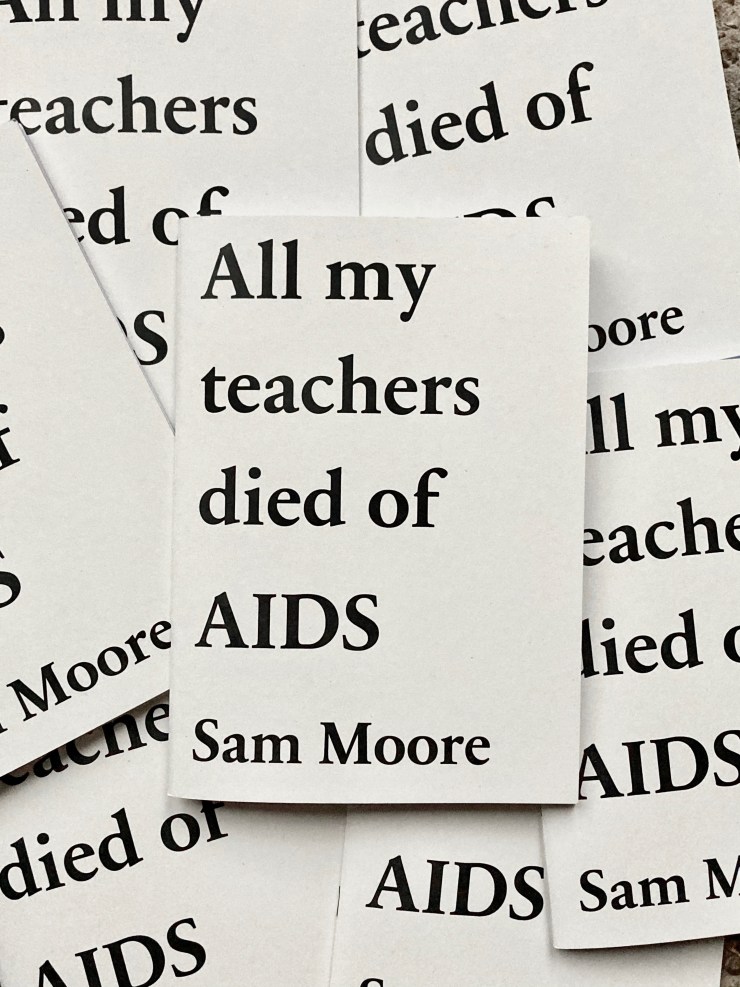
Talking Death with Sam Moore: All my teachers died of AIDS

All my teachers died of AIDS by Sam Moore. Published by Pilot Press London. 2020.

Interview by Harper Wellman

CW: Death, discussion of transphobia

Sam Moore began their writing career while working toward their Master’s at the University of Oxford in 2017. While exploring various forms, Moore found their style, and success, with poetry and short stories, publishing pieces in Harts and Minds, DASH, Fearsome Critter, and Modern Queer Poets. Moore has developed a cross-genre style of writing that is on display in their book, All my teachers died of AIDS, from Pilot Press. Equal parts academic research, pop culture critique, and personal reflections, All my teachers died of AIDS explores the intersection of queer identity and death, and how the inseparable two inform each other. Below, Moore discusses Teachers, their process, their community, and what’s next. Moore is an editor for Third Way Press and a freelance journalist in London, UK.

Thank you for talking with us Sam. Teachers is a wonderful book that I think many people can relate to. Can you talk about how this project came to be? 

I spent a lot of time writing very traditional prose when I was finishing up my master’s degree – writing the first half of a novel for my thesis, something I keep saying I’ll come back to, and one day I will… but alongside that, I was also reading more and more experimental work, that existed between different styles and literary traditions. It was the first time I was reading Maggie Nelson, and diving into more of Chris Kraus’ work, and I basically ended up wanting to write something more along those lines, something that defied easy categorization. And then I went to a few of the Queers Read This events at the Institute of Contemporary Art here in London, run by Isabel Waidner, and Richard Porter (who runs Pilot, and would go on to publish the book), and was just incredibly struck by the range and strangeness of queer writing; Isabel read from their novel, Dodie Bellamy read from When the Sick Rule the World, Verit Spott read from Prayers, Manifestoes, Bravery, and it was impossible not to just be swept up in the power of this kind of writing, and wanting to contribute to it in one way or another.

Around the time I went to Queers Read This I also found the courage to start going to open mic nights (even after years of graduate workshops, the thought of actually standing up and reading poems out loud to strangers remains terrifying), and to begin with, I was reading lots of more traditional poems – all of which are from a book about bisexuality called Alex(andra), that I wrote between years one and two of my master’s degree and that I’m still hoping to get out into the world (so if anyone’s interested in publishing it, you know where to find me…) but gradually ran out of material and used that as an excuse to write something new and weird, which eventually became the first section of Teachers. I read it at a launch event for Modern Queer Poets (another book by Pilot that features a poem of mine, alongside some of my literary heroes like Eileen Myles and Wayne Kostenbaum), and jokingly said “it’s part of a longer, book-length poem, so if anyone wants to publish it come and talk to me after the reading.” Rich came to talk [to] me, and the rest is history.

I also think that Teachers kind of captures my development as a writer, in terms of this desire to write more experimental work; something that comes through in the sort of poem/essay hybrid (although structurally I don’t think it’s quite a lyric essay); poetry is the guiding force for the language when it comes to rhythm, line breaks, and the presence of rhyme in the text. But a lot of people have said that the depth of the book is more of an essay; rooted in an argument, in history and criticism, but written in the form of a poem. In their blurb for Teachers, Isabel (the author of We are made of diamond stuff, and Gaudy Bauble), calls it a “personal essay,” and the more time I’ve spent on the book the more I think that rings true. I also think that it’s ended up being a sort of signpost for how much more comfortable I’ve become writing about and through personal experience.    

Sam Moore, All my teachers died of AIDS excerpt.All my teachers died of AIDS by Sam Moore. Published by Pilot Press London. 2020.

Death is the major theme in Teachers. You discuss how there is danger in being queer and queer love, whether that is the physical act itself, or the threat of a bigoted society. How do you come to terms with the inherited history of HIV/AIDS, that still affects many members of our community? Was this book a way of navigating that?

It’s an incredibly difficult thing to come to terms with, and I feel like I also should acknowledge that it’s probably an easier thing for me to navigate than it will be for other queer people; living in the UK it’s arguably a relatively safe and liberal place (although there are still times when this theory is disproven), and I think as the continued fight for liberation goes on – which it very much is – we need to acknowledge that certain members of our community are more vulnerable than others. The continued quote-unquote debate around trans rights highlights the fact that while for some of us it’s become easier to feel safe, or assimilate, we still need to show up to fight for our trans brothers, and sisters (and those who are both or neither).

Teachers is something that’s more about navigating the past than it’s about offering any kind of roadmap for the present (something that feels vital but would probably be better off being written by someone else). A lot of the book is about coming of age – both from an individual perspective and across the wider landscape of queer history and culture – and is about the shadow of death that remains cast over the queer community. That’s what the book is about coming to terms with (or trying to come to terms with anyway; I don’t think it entirely offers neat closure, but I also think that that’s good), a way of trying to understand – if not accept – the generation of queer people who were taken too soon. And while things are better, the threat of a bigoted society remains; certain victories on politics or policy aren’t enough to erase the very real danger a lot of queer people still face, and I think that’s an easy thing to forget.

All my teachers died of AIDS by Sam Moore excerpt. Published by Pilot Press London. 2020.

Even with HIV/AIDS treatments progressing to where we are today, with viral suppression and PrEP, for some, especially multiply marginalized people, HIV/AIDS is not a thing of the past, and there remains a strong link between the queer community and death. Crimes against our trans and gender non-conforming friends are rising, while the number of hate and white supremacy groups increase.  What do you see as the next fight that queer communities must take on to stop these cycles of death and violence?

I think that the next fight for queer communities is one to defend the rights of trans people, which, even in supposedly liberal countries, are under attack; here in the UK, court rulings on trans teens being unable to consent to puberty blockers is a very real threat to trans people. Between that and the continued megaphones given to TERFs and transphobes, it becomes clearer and clearer that liberation is still a ways off, and we need to keep fighting for it.

And it’s things like this that restart cycles of death for queer people; I can’t help but go back to the puberty blockers court ruling, and can’t stress enough the kind of impact that this could have on trans people. Between rulings like this, the continued acceptance of transphobia in a lot of mainstream media, the atmosphere of violence and danger from a generation ago that’s in Teachers is still here today, it’s just that the violence has become more focused on a specific group of queer people. And as much as people like to talk about debating those who disagree on the issue of trans rights, this feels like an inherently disingenuous position to take; so often it forces people in marginalized positions to debate their existence as if it were some kind of Oxford union debating idea rather than the reality of people’s lives. 

It felt poignant to read Teachers during the current pandemic. The loss of life, marginalized communities being more harshly affected, and the loss of shared safe spaces, all feel somehow familiarly queer. What effect do you think COVID will have on queer communities moving forward? 

Back in Lockdown 1.0 here in the UK in the spring (which feels like forever ago), is when Rich and I first started talking about bringing Teachers into the world, and if this was the best or worst time to do it. In the end, I’m glad we ended up waiting a little while because I always wanted to bring it out on World AIDS Day. Having the conversation did make it clear how strange it might feel to bring out a book about plague during a new plague year (although I find the comparisons between COVID and AIDS to be a bit of a reach, especially when it comes to how politicians have responded; the rapid response for a vaccine is obviously wonderful and should be commended but it also seems to highlight just how stark and long-lasting the government inaction was during the height of the AIDS crisis).

You’re right about the way in which this current outbreak feels uniquely queer, like a kind of echo of queer history. And I think that COVID will impact queer communities in ways that remind us how precarious queer life can still be, and how vital solidarity is moving forward. The racial disparities in COVID mortality rates are something that we need to keep in mind, especially given the fact that communities of colour remain the most heavily impacted by continued cases of HIV/AIDS. This is something that should galvanize people to action, to continue fighting for members of the queer community who continue to struggle and face oppression.

All my teachers died of AIDS by Sam Moore excerpt. Published by Pilot Press London. 2020.

Have you found any new teachers during this pandemic? Have you read/seen/heard anything that has been inspiring you? 

I think my reading highlight of 2020 might be Writers who love too much, an anthology of New Narrative writing that was co-edited by Dodie Bellamy; it’s so uniquely queer to me in the way that it refuses to adhere to convention (especially when it comes to writing around politics and sex), and in the way it explores life and literature in inherently intersectional ways. I found myself reading more non-fiction, and specifically more political writing this year, and a highlight from that is absolutely If They Come in the Morning: Voices of Resistance, an anthology edited by Angela Davis about racism, activism, and the prison system that remains vital almost 50 years after its publication.

Finally, I wonder if you can tell us a little bit about your next project, Search History.

I touched on Search History a little at the end of the Teachers launch reading I did on the Pilot Press Instagram (which is still available to watch there, and if people are interested in checking out the book then that’s definitely a great place to start), and just like I did with Teachers at the reading last year – and with Alex(andra) in this interview – I decided to say “if anyone wants to publish this weird book of essays, slide into my DMs.”

Search History is, as the title suggests, about history; both in the big-picture way that Teachers was, but also specifically in reference to a computer’s search history. It’s a series of experimental, lyric essays that each look at different ways in which sex and desire are acts of performance. So the book is about erotic archetypes (cowboys, bikers, schoolgirls), the performance of gender roles, and how that plays into sexual power dynamics, internet porn, and (auto)biography. Like a lot of my writing, it balances pop culture criticism with a dive into specifically queer aspects of cinema, theory, and porn. There’s one essay about catholic schoolgirls and bikers (the two archetypes are tied together through an autobiographical thread), and it touches on Britney Spears, Kenneth Anger, and Kathy Acker. 

I’d say about half of the essays have been written in one form or another, and the first one to be published – An elegy to the Nob Hill Theatre, an exploration of the geography of 70s gay porn, and the non-space of the internet archive – is coming out in early 2021 with Take Shape.

________________________________________

With new work to come, Moore continues to explore more topics at the crossroads of queer identities, collective history, and personal experience. In All my teachers died of AIDS, Moore is able to weave together their research, exploring important and morbid topics in an earnest and engaging read that many queer people will find relatable. All my teachers died of AIDS is available now through Pilot Press, and Moore can be found musing on Twitter and Instagram.

Queer Identities at I.C. Contemporary

Queer Identities Opening Shot. Image Courtesy of I.C. Contemporary.

Queer Community in the Gallery: Queer Identities at I.C. Contemporary

Chase Joynt, Devin Wesley, B G-Osborne, Reitano Holly, Shane Oosterhoff, Joslyn Panasiuk

Curated by Ignazio Colt Nicastro

August 2020 – October 2020

By Rebecca Casalino

Queer communities connect like links in a chain, each circle intersecting with the next, spanning identities, generations, and geography. The tangles of my community lead me to art that reflects queerness in its ever-changing form. I met writer, singer-songwriter, and trans activist Robbie Ahmed, through my friend and fashion designer Adrienne Wu, in the cheap seats of Vivek Shraya’s How to Fail as a Pop Star (2020) in Toronto’s Distillery District. So, when I saw Ahmed’s portrait in my daily flash of Instagram stories, I had to click through to see where it was showing. The image is moving — purple haze warps the composition, so his nose is in focus and centred while the glow of purple blurs his features in a halo effect. A few quick taps lead me to I.C. Contemporary’s pre-recorded tour of the digital exhibition Queer Identities shown on their website through an embedded Youtube video. The wood floors of the gallery are pixelated, the ceilings are high with walls acting as stark panels of white and black. I hear people talking right away and the frame moves towards a black and white video in a dark alcove.

Queer Identities Installation Shot.Chase Joynt, I’m Yours (2012). Image Courtesy of I.C. Contemporary.

I’m Yours (2012) is an experimental short video by moving-image artist and writer Chase Joynt, featuring two people appearing in rotation, seemingly giving answers to unasked questions. They speak into the camera and introduce themselves, “My name is Nina,” says a woman with dark curly hair and dramatic winged eyeliner. Her lips are dark and shining, a delicate mole rests on her cheek, she’s wearing silver hoop earrings and an assortment of necklaces. “Hi, my name is Chase Ryan Joynt,” says a bare-chested man with tattoos and trim facial hair, he is wearing a thick silver ring on his hand. The camera flashes to performance artist Nina Arsenault again, “Before my name was Nina, my name was Rodney,” and my heart tightens, she’s blinking and looking away from the camera, but her voice is smooth and casual. The video cuts to Joynt, “I don’t tend to answer that question. Mostly just because people who know that name tend to start using it,” he’s shaking his head and looking away, blinking just like Arsenault but is more outwardly uncomfortable, shifting in his chair. He shrugs at the end of his answer.

The media, which Joynt casts as the voiceless interviewer in this performance video, is a frequent platform where people are deadnamed or misgendered because of the ignorance or bias of uninformed cis people. Both artists’ experiences are tied by the same questions posed to gender non-conforming people but split through their individual lived experience and identity. This video is not intended as an educational balm to correct cis prejudices. Rather, the video showcases the difference in trans people’s experience and the shared monotony of answering cis people’s questions. 

Queer Identities Installation Shot. Chase Joynt, I’m Yours (2012). Image Courtesy of I.C. Contemporary.

Both Arsenault and Joynt have extensively written and made work about their transitions. Despite prominent examples such as Arsenault’s solo show Silicone Diaries (2009), presented at Buddies in Bad Times, and Joynt’s co-authored book You Only Live Twice (2012), written with HIV-positive movie artist Mike Hoolboom, people continue to question their bodies and identities by making it the focus of every conversation.

Queer Identities Installation Shot. Joslyn Panasiuk, category: HUMAN. Image Courtesy of I.C. Contemporary.

            The walkthrough’s frame exits the dark alcove and backs up to view a series of portraits along a white wall. Photographer Joslyn Panasiuk presents their on-going series category: HUMAN, which centers on trans men as its subjects. The first three portraits are glowing with oranges and yellows blurred over the subjects’ faces as Panasiuk uses tilt-shift lensing and motion blur to complicate each composition. The next three portraits are blue and purple, and amongst them, I spot Robbie Ahmed’s image as well as the face of photographer Wynne Neilly, whose portrait is hung beside Ahmed’s. Half of Neilly’s face is blurred while he wears a silver hoop in one ear—an abstract effect is created by the repetition of the shining earring. Ahmed’s portrait is blurrier with only the center of his face in focus. Panasiuk has maintained her subjects’ auras as I can still recognize my peers’ faces in these distorted images.

Their voice begins to explain the work’s emphasis on humanness and the similarities that join people. The blurring and distortion function to protect her subjects from toxic stereotypes projected onto trans masculine people and to move away from documenting differences like surgery scars or hormone shots. They speak about the making process as a bonding experience between herself and community members, as well as an opportunity to engage with other aspects of her queer identity. Viewed together from afar, Panasiuk’s subjects look like a colourfully lit chorus on stage.

Queer Identities Installation shot. Reitano Holly, Metamorphosis I. Image Courtesy of I.C. Contemporary.

            The main room of the digital exhibition breaks off into a brightly lit room with blocks of poetry on each of the six panels on the curving white wall. Wide columns of thick glass bricks make up sections of the opposite edge of the space which creates an airy tranquil space for reading. Reitano Holly uses the collection of poetry, from his up-coming series Metamorphosis I, to lay out stages of queer self-discovery and self-acceptance. Through my headphones, the artist’s voice explains the work as a “schematic for the process of queer identity that can be used as almost a guide or a reference.” He uses coloured text allowing for moments of vibration, the word ‘faltered’ melts like butter into the white wall. I can spot myself and others in his words—forbidden longings, confused fumbling of young queers finding themselves, and self-love. His words trace queer lines of desire and push against perceived limitations of the queer body; “too far to try to reach” (emphasis added). Holly flips crude conversations or curiosity of queer people’s bodies into lust and love writing “[a]nd found Gold between the richness of your thighs.” His writing brings the works in the exhibition to thoughtful pause. What changes when queer subjects are portrayed by queer creators? Can sick curiosity become tender attention?

Queer Identities Installation shot. Image Courtesy of I.C. Contemporary.

Curated by fellow queer artist and curator Ignazio Colt Nicastro, Queer Identities is in response to the subliminal thought processes of queer artists. In email correspondence with Nicastro, he points to the exhibits’ unintentional weight on more ‘masculine’ artists, and the overall pattern of “the display of hegemonic gender roles [and] male dominance in art spaces” which he hopes to tackle more intentionally in future projects. This level of self-awareness in his practice was, to say the least, refreshing as a femme queer woman working in spaces dominated by cis men.

The artists featured in Queer Identities exist under minority stress in a heteronormative society that dictates so-called ‘masculine’ and ‘feminine’ norms. Nicastro includes moments of acceptance and celebration for viewers, and this inclusion provides a fuller spectrum of queer experience. No artwork is a token or stand-in for a whole aspect of the queer community. However, these artworks trace the interconnectivity of queer experience as bodies are linked through romance, friendships, encounters, and art.

Vivek Shraya made a play about her career in the Canadian music scene, including how Tegan and Sara helped her get her start. Robbie Ahmed is an alum of Shraya’s mentorship program. Adrienne Wu introduced me to Ahmed and takes me to plays when I’m too nervous to go otherwise. Spaces, online or in person, that carve room for queer voices to speak the truth freely without censorship or misidentification allows queer bodies to gather in community. It’s essential that queers make space for other queers, linking each other together across identities, generations, and geography.

Six Must-Read Books by Trans and Queer Authors

By Adi Berardini

To celebrate and recognize Trans Awareness Week from November 13-November 19, Femme Art Review highlighted some books written by talented transgender and non-binary authors and/or books with trans themes for what we deemed as “Trans Lit Week.” By sharing the books of transgender and non-binary authors, we hope it will help increase awareness of trans stories and experiences. Ranging from fiction to poetry anthologies, read on to see why so many of our favourite books are written by trans authors.

ZOM-FAM by Kama La Mackerel. Published by Metonymy Press.

ZOM-FAM

by Kama La Mackerel


The newly released poetry collection ZOM-FAM is by Kama La Mackerel, who you may recognize as a Montreal-based Mauritian-Canadian multi-disciplinary artist, educator, writer, and community-arts facilitator. Kama La Mackerel mythologizes a queer/trans narrative of and for their home island, Mauritius. Composed of expansive lyric poems, ZOM-FAM (meaning “man-woman” or “transgender” in Mauritian Kreol) is a voyage into the coming of age of a gender exploring child growing up in the 80s and 90s on the plantation island, as they seek vocabularies for loving and honouring their queer/trans self, amidst the legacy of colonial silences. (Adapted summary from Metonymy Press).

Little Blue Encyclopedia by Hazel Jane Plante. Published by Metonymy Press.

Little Blue Encyclopedia (for Vivian)

by Hazel Jane Plante

Vancouver-based writer Hazel Jane Plante’s debut novel Little Blue Encyclopedia (for Vivian) explores a queer trans woman’s unrequited love for her straight trans friend who passed away. Acting as a love letter and homage, the story is interspersed with encyclopedia entries about a fictional TV show set on an isolated island. The experimental form functions at once as a manual for how pop culture can help soothe and mend us and as an exploration of oft-overlooked sources of pleasure.  Heartbreakingly beautiful, Little Blue Encyclopedia (for Vivian) reveals with distinct detail the level of loss she experiences in losing her close friend and love, Vivian. (Adapted summary from Metonymy Press).

Girl Mans Up by M-E Girard. Published by Harper Collins.

Girls Mans Up

By M-E Girard

Girl Mans Up by M-E Girard is a young adult novel that provides ground-breaking representation of a gender non-conforming teen named Pen. Dealing with not fitting the box of womanhood defined by her strict Portuguese family and a friendship with the local cool kid turned sour, Pen learns how to assert herself against people who don’t have her best interests in mind. 

Rebent Sinner by Ivan Coyote. Published by Arsenal Pulp.

Rebent Sinner

by Ivan Coyote

Rebent Sinner is Ivan Coyote’s take on the patriarchy and the political through personal stories of what it means to be trans and non-binary today. Coyote traces back a heartbreaking queer history while combatting those who try to misgender them and deny their existence. Through these relatable and often humorous stories, Coyote also paves a path for younger trans folk to realize that there is hope and a way out of the darkness. Coyote is a gifted storyteller who we recommend seeing speak live in person if you get the chance! (Adapted summary from Arsenal Pulp Press).

Fierce Femmes and Notorious Liars: A Dangerous Trans Girl’s Confabulous Memoir by Kai Cheng Thom. Published by Metonymy Press.

Fierce Femmes and Notorious Liars: A Dangerous Trans Girl’s Confabulous Memoir

by Kai Cheng Thom


In Fierce Femmes and Notorious Liars: A Dangerous Trans Girl’s Confabulous Memoir by Kai Cheng Thom, a lyrical and winding sort-of-true coming of age story, a young girl runs away from an oppressive city called Gloom where the sky is always grey in search of love and sisterhood. She finds her true family in a group of larger-than-life trans femmes who live in a mysterious pleasure district known only as the Street of Miracles. Under the wings of this fierce group, the protagonist becomes the woman she has always dreamed of being.

When one of their number is brutally murdered, she joins her sisters in forming a vigilante gang to fight back against the transphobes, violent johns, and cops that stalk the Street of Miracles. But when things go terribly wrong, she must find the truth within herself in order to stop the violence and discover what it really means to grow up and find your family.(Adapted summary from Metonymy Press).

it was never going to be okay by jaye simpson. Published by Nightwood Editions.

it was never going to be okay

by jaye simpson

jaye simpson is an Oji-Cree non-binary trans woman writer who lives in Vancouver. Their debut book, it was never going to be okay, is a touching collection of poetry and prose exploring the intimacies of understanding intergenerational trauma, Indigeneity and queerness, while addressing urban Indigenous diaspora and breaking down the limitations of sexual understanding as a trans woman. As a way to move from the linear timeline of healing and coming to terms with how trauma does not exist in subsequent happenings, it was never going to be okay breaks down years of silence in simpson’s debut collection of poetry:

i am five

my sisters are saying boy

i do not know what the word means but―

i am bruised into knowing it: the blunt b,

the hollowness of the o, the blade of y 

(text via Nightwood Editions)


We hope you enjoy this selection and make sure to check out these books this Holiday season!

Adrien Crossman: Fake Childhood, No Future

Adrien Crossman. Lavender Culture. digital render, 2018. Courtesy of the Artist.

By Adi Berardini

CW: Brief mention of transphobic/homophobic media tropes; discussion of LGBTQ+ suicide

When my friends had discovered that I had never seen But I’m a Cheerleader, they were appalled and assigned the film to me as queer culture homework. After watching it, I could tell why—I had never seen a feature film that distinctly depicted the experience of being femme before. The protagonist Megan is a stereotypical blonde cheerleader; however, she doesn’t realize that the Melissa Etheridge poster in her room, not being that into her boyfriend, and checking out other women, points to the fact that she is a lesbian. Although with a light-hearted approach, the film, with its campy, John-Waters-like, pink and turquoise aesthetic, depicts her condemnation to a conversion camp where she learns the ‘how-tos’ about heterosexuality and gender roles. Any attempt to brainwash Megan into straightness dramatically fails, and (spoiler alert) she falls for the dreamy rebel, Graham. It’s no surprise that the film has now become a cult classic within the LGBTQ+ community. It’s also no surprise to me that I was late to learn about this film since I didn’t fully come to terms with being queer until early adulthood, and like Megan, I think my friends picked up on my queerness first. Although not to be mixed up with confusion, it’s more like a lack of realization as a result of under-representation and erasure.

Often referencing cult-classic films such as But I’m a Cheerleader, interdisciplinary artist, educator, and curator Adrien Crossman both unpacks and reclaims the ambiguity of queer culture, in a heteronormative society that struggles to acknowledge and accept queerness. They are interested in critically analyzing how media largely depicts queerness as either “abhorrent or invisible,” with reference to what Adrienne Rich calls compulsory heterosexuality, the idea that heterosexuality is assumed and enforced by a patriarchal society.[1] Further, Crossman is interested in how the potential of queerness can provide space for exploration beyond rigid binaries and gender roles. They reference how popular childhood characters, such as SpongeBob or Furby, have queerness built into their creation or storylines but were protested by religious groups due to a sense of “moralism” and “protection” of children. As a result, these pop culture figures are often reclaimed or named by the community as signifiers of queer identity.


Crossman’s work heavily points towards queer iconography itself, whether it’s a virtual projection of a neon sign reading ‘lavender culture’ or felt pennants reading ‘Silence=Death’ reminiscent of the posters of the HIV/AIDS crisis. Just as the edited volume Lavender Culture attempts to explore, the neon sign had me thinking what I am always asking myself while doing a project like Femme Art Review—what exactly is lavender culture? The introduction to the book notes how more mainstream culture is influenced by queer culture, yet there’s a failure to name this influence due to homophobia.[2] However, Crossman is more interested in establishing a queer sensibility, or perhaps a shared frame of reference, than defining queer culture, recognizing that queer experiences are intersectional and widely differ. Although without this sense of shared understanding and reference, it can create a sense of isolation within being queer, especially when aspects of queer history remain in the background yet still influences our lives today. For example, the trauma of the 1980s/90s HIV/AIDS crisis that perpetuated, and still perpetuates, stigma towards queerness due to the homophobic media coverage and lack of government response due to conservatism. The Lavender Culture sign is digitally rendered instead a physical object in space, which speaks to the intangibility of lesbian culture often existing on the fringes of LGBTQ+ narratives.

Adrien Crossman. Queer Still Life, digital render, 2016, courtesy of the artist.

In addition, Crossman is interested in challenging the binary of the real versus artificial, or fiction and reality. They form a 3D rendered stack of queer theory books as a still life, including a Furby and a Tamagotchi, that subversively reads an Audre Lorde quote, “The master’s tools will never dismantle the master’s house.”[3]  They explore their relationship to these objects and texts, and the power structures that Lorde references in the quote, the force of the white, cis-heteronormative patriarchy that leaves little room for queer expression, particularly for racialized queer people. Crossman has a distinctly digital way of working to subvert the binary of digital and real, rendering in 3D, then casting in aluminum, then back to the digital plane, in order to transcend these binaries and fixed categories. They define these objects, such as Tamagotchis and Furbies, as “relational artifacts” that possess a sense of queer affect and intimacy.[4] The Furby symbolizes the potential for queerness since they are objects undefined by gender or race. Crossman also explores how certain technologies, like the beloved 90s toy Tamagotchi, require human care and attention as a way to exist out outside of the binary of real and fake.

There’s also a lack of representation of outwardly queer women and Non-binary/Trans characters in television and media which perpetuates this sense of isolation and erasure. There’s the obvious L-Word, or Orange is the New Black, however the lack of media representation from our own perspective haunts us with the misunderstanding of our own identities (and other people misunderstanding them, too). Tinky Winky from the Teletubbies carried a women’s handbag, potentially signalling his gayness and gender non-conformity, which was made out to be blasphemy. The original L-Word misconstrued Trans men as violent. Orange is the New Black has representation of queer and Trans women, yet in the setting of a women’s prison. How do we come to terms with queer identity when it’s not depicted at all, or if so, so inaccurately; being fetishized and sexualized, or being made out to be monstrous or criminal? The lack of queer media representations often leads to depictions that are able-bodied, cis-gender and white, which are deemed more ‘palatable’ under the male gaze and white supremacy. The erasure of queer experiences in pop culture and media ultimately contributes to the erasure of us.

Adrien Crossman. Exist, video still, 2019, courtesy of the artist.

For this reason, the words I see depicted on Adrien’s ankle tattoo of a flag reading ‘EXIST,’ and their leg tattoo spelling out ‘NO FUTURE’ in their film Exist, hit me hard. In the film, they tattoo their own ankle with a version of their artwork to address that being queer is an act of resistance in a heteronormative society, providing a new queer orientation.[5] The words of their one tattoo are in reference to the queer theory text No Future by Lee Edelman in which he challenges the archetype of the child symbolizing future and innocence, positioning the embodiment of queerness as anti-social and future-negating.[6] The self-inflicted pain of their stick and poke tattoo reflects the pain queer people experience, a pain that is often left undiscussed or brushed over. To ‘exist’ is to live under adverse conditions—it’s exhausting being labelled as resilient or strong in a world that so often deems queer as “abnormal.” The lack of the reflection of our experiences and the way that queer identity is depicted as too taboo to explicitly address in film and television, re-upholds the belief that it’s morally wrong for us to authentically exist as ourselves. This framework of thinking is so often why we internalize homophobia, it contributes to feeling ashamed to be who we are, and why we lose lives in the queer community to suicide. Countering this, the flag that reads ‘EXIST’ reaffirms that existing in a heteronormative regime is an act or resistance in itself for queer and marginalized folx. The flag signals a sense of protest, pride, and celebration, counteracting the sense of shame these harmful ideologies perpetuate. The film is a meditation that affirms that you are enough—you’re more than enough.

Adrien Crossman, Heaven is a Place on Earth install shot, 2019, photo by Polina Teif.

The title of Crossman’s 2019 exhibition Heaven is a Place on Earth at Patel Projects is not only in reference to the Belinda Carlisle song, but the Black Mirror episode, San Junipero. In this modern cult classic, the shy Yorkie, eventually meets the uninhibited Kelly, a soulmate connection that encourages her to let go. With its 1980s bisexual colour scheme, the episode details their relationship, including hookups in a beach house and convertible rides along the shoreline. Although, (another spoiler alert) the episode becomes a utopia within a broader dystopia—the couple is in a simulation that the dead can live in and the elderly can visit as part of immersive nostalgia therapy. In reality, their lives were much more plagued by hurt and pain. Trans and bi activist and scholar Julia Serano theorizes that the “bi” prefix of bisexuality is not between two genders, but of two worlds—navigating one of heterosexuality and one of queerness.[7] Although she was happily married to a man, Kelly, who is bisexual, feels the grasp of compulsory heterosexuality and never acted upon her desire for women during her lifetime. Yorkie was also never able to act on desire since she was brought up in a highly religious family. The episode uses imagined reality to create an alternate space, one that’s not confined by fear or repression, but love and connection that moves beyond gender and racial boundaries. In Heaven is a Place on Earth, Crossman references Toronto queer spots like the Henhouse bar, addressing how spaces that formed a sense of queer community are vastly disappearing at the hands of capitalism and gentrification. Crossman also subverts the rainbow ‘Cocksucker’ matchbox in But I’m a Cheerleader to the ‘Henhouse’ reflecting on how LGBTQ+ spaces often center cisgender gay men, perpetuating lesbian, bisexual and trans erasure. The necessary physical spaces also disappear, leaving little room for queer connection.

Adrien Crossman. Dystopia, neon sign, 2019, photo by Polina Teif.

All too reflective of the current moment, Crossman forms neon signs reading ‘dystopia’ and ‘utopia’ in Heaven is a Place on Earth. This touches upon utopia and queer futurity (the concept that queerness exists in a futuristic potentiality) with such reference to Cruising Utopia by José Esteban-Munoz, and how it’s necessary to form a sense of political imagination, particularly for queer people of colour.[8] The etymology of the word utopia is ou-topos or ‘no place,’ which is a void that queerness knows well—neither here nor there—but a space of infinite in-between. And with this potential ambiguity or space for liminality, endless possibilities beyond binaries emerge.

Additionally, Crossman co-runs an online publication called Off Centre with artist Luke Maddaford, which covers art exhibitions that exist outside of metropolitan city centres. In my own experience in London, Ontario, a mid-size, conservative city, my queer friends and I create small pockets of utopia in order to counter the outsider feeling of living in a city filled with frat bros and toxic masculinity (a personal dystopia). In the midst of a global pandemic and Black Lives Matter protests standing up to the injustices of a white supremacist police state, things seem rather dystopic. However, there’s an importance of having a sense of hope and collaboratively working towards a goal of a better future. An imagined place, a utopia, where everything is perfect may seem overly naïve, but demanding that queer identities are seen as valid and that our humanity is recognized should not be too much to ask.

Adrien Crossman. Utopia, neon sign, 2019, photo by Polina Teif.

But I’m a Cheerleader likely resonated with young queer people since it was written and directed by Jamie Babbit, a queer director—the fact that so many saw their experience reflected back to them is meaningful when LGBTQ+ experiences are often erased and ignored. Crossman references visual imagery, from pop culture and cult-classics, to ground a sense of unity, countering how queer identities become fragmented due to erasure both in the mainstream media and in physical space. They refuse to let queer culture fade into an un-defined background by reclaiming it through the assertion that, try as you might to erase us, we’re here and we’re queer.


[1] Rich, Adrienne (1980). “Compulsory Heterosexuality and Lesbian Existence.” Signs: Journal of Women in Culture and Society. 631–660.

[2] Ed. Jay, Karla. Lavender Culture. NYU Press. 1994.

[3]Lorde, Audre. “The Master’s Tools Will Never Dismantle the Master’s House.” 1984. Sister Outsider: Essays and Speeches. Ed. Berkeley, CA: Crossing Press. 110- 114. 2007. Print.

[4] Relational artifacts, also known as sociable robots, was coined by Sherry Turkle. Crossman speaks more to this in their artist talk as part of Art Intersections Meetup found here: https://www.youtube.com/watch?v=55PlIb5fHlY

[5] From Crossman’s description of Exist for Barbed Mag. https://barbedmagazine.com/Beyond-Measure-A-Performance-Art-Survey-in-Metro-Detroit-and-Windsor Likely in reference to Ahmed, Sara. Queer Phenomenology: Orientations, Objects, Others. Durham: Duke UP, (2006).

[6] Edelman, Lee. No Future. Duke University Press. 2004.

[7] Serano, Julia. “Bisexuality and Binaries Revisited.” 2012. http://juliaserano.blogspot.com/2012/11/bisexuality-and-binaries-revisited.html

[8] Muñoz, José Esteban. Cruising Utopia: The Then and There of Queer Futurity. New York: New York University Press, 2009.

Dana Buzzee: The Coven on Her Back

016_PunishmentRituals_DanaBuzzee_LEFTContemporary
Punishment Rituals, installation view. Dana Buzzee. 2019. Size varies. Courtesy of the artist and LEFT Contemporary.

Punishment Rituals

LEFT Contemporary March 1-May 4, 2019

By Lucas Cabral

I walk in and I get a little excited. This excitement has been growing with every image the artist and LEFT Contemporary have posted of works and installation progress leading up to the opening. The imagery and energy are something I’ve been looking for (and missing) since I moved from my Toronto-adjacent hometown whose proximity to Toronto’s queer density granted me easy access to bondage and fetish communities and their meeting spaces. Is this excitement the effect of the spell cast by Buzzee’s work? Or is it evidence of my newfound curse?

Why not both?

The constellation of works making up Punishment Rituals forms a warm entanglement of community and queerdos spanning generations and geographies. Buzzee has inducted viewers, makers, participants, and their predecessors, materializing them in studded leather collars and cuffs, a wide-cast web woven of leather and chain, and prints retelling possible engagements of these or similar sculptural works, all of which in this space cast a circle around an a-frame and knot of nylon rope.

005_PunishmentRituals_DanaBuzzee_LEFTContemporary
Punishment Rituals, installation view. Dana Buzzee. 2019. Size varies. Courtesy of the artist and LEFT Contemporary.

Hand-pulled images of rope and leather-bound performers on newsprint reference and resurrect community-based erotica like that found in publications like On Our Backs, the first women-run erotica magazine that featured lesbian erotica for a lesbian audience. Images are captured when Buzzee opens calls for community members to perform freely with the leather works she makes. Groups, pairs, and strangers, bond over a shared bondage experience. Buzzee captures these moments of liberation, exploration, and connection, offering the images as a part of an incantation. Like with the previously mentioned On Our Backs publication, Buzzee continues a legacy of by-and-for community erotica. An exhibition poster with exhibition text by Taylor Harder has a likeness modeled after On Our Backs and chronicles the development of and differences between British and North American traditions, making note of the ways that intimacy is an activator during initiation.

The exhibition reclaims the formula of ritual witchcraft initiation ceremonies, making space for homoeroticism which is rejected by British traditions (heavily informed by the legalization of witchcraft preceding the legalization of homosexuality in Britain), and taking up traditional initiation elements like blindfolds, nudity, bondage, and whipping not adopted by North American traditions.[1] In Punishment Rituals, artwork takes the spot of coven members who typically circle the initiator and postulant during the ceremony. These stand-ins are embedded with the energy of those who have been a part of their making. Buzzee engages community members who are also artists, writers, printmakers, leatherworkers, arts administrators and peers in their production. With the intention of initiation being “spiritual rebirth into new identities and new communities,” Buzzee sets the stage for those possibilities to be impacted by queer-femme homoeroticism.

001_PunishmentRituals_DanaBuzzee_LEFTContemporary
Punishment Rituals, installation view. Dana Buzzee. 2019. 9′ by 9′. Courtesy of the artist and LEFT Contemporary.

The show, the space, and it’s making reflect the collective queer mobilization that’s taken up out of necessity to meet the needs of one’s community that aren’t satisfied or even acknowledged by the heteronormative structures that dominate our spaces. As we pay more attention to the disappearance and lack of queer spaces especially for femmes (even in bigger cities), it is important to celebrate the perseverance of those who dedicate their time and energy into producing space and opportunity for their community to gather and engage. In connecting community members with the knowledge, perseverance, and legacy of those before to produce the various elements of the show, Punishment Rituals penetrates communities past and present and binds them together through webs of leather, chain, intimacy, and possibility, creating an opportunity to find community and affirmation, and to reflect on the ongoing task of collective queer organizing and reclaiming.


[1] Harder, Taylor, Art Thou Willing to Suffer to Learn: An Analysis of Witchcraft Initiation Rituals, 2019.


Travel, Terminology and The Not Cooking Show: An Interview with Ayo Tsalithaba

_MG_6107
Ayo Tsalithaba, Portrait by Kezia Chapman.

Questions by Adi Berardini

Ayo Tsalithaba’s primary mediums include digital art, film photography and digital filmmaking. Largely influenced by music and travel, transporting the viewer everywhere from a dreamy alpaca farm to the village of Cheshee, their films address identity and the intersections of race, gender, and sexuality. Ayo is also the founder of The Bacon Berry Card Co., a small company specializing in cute greeting cards, stickers, prints and more.

Ayo has been featured in Huffington Post Canada, The Kit, TFO, the University of Toronto magazine and Munch Magazine. Additionally, they have screened their films and appeared on panels at the TIFF Bell Lightbox, University of Toronto, George Brown, the Revue Cinema, Xpace Cultural Centre, among others. Ayo is currently specializing in Women and Gender Studies and minoring in Linguistics at the University of Toronto. They hope to continue learning, taking risks, sparking conversations and above all else, advocating for positive social change.

Screen Shot 2018-11-29 at 4.39.02 PM
A KIKI WITH BOBBY BOWEN –  direction, camera operating, editing, cinematography by Ayo Tsalithaba

  1. One of your films interviews Bobby Bowen and discusses queer terminology specific to the African/Caribbean/Black community. I was wondering if you could further discuss this work?

The film that I made with Bobby was actually a final project for a class I took in my second year. We were supposed to work on a project that “produces knowledge” and to be honest, I didn’t really know what that meant. Instead, I wanted to turn to knowledge that is often overlooked and decided to blend what I was learning about linguistics and women and gender studies with my interest in film and make a short doc about queer terminology. I was also just getting into archiving and documenting Black queer histories, so this project was perfect. It’s stuff like this that keeps me going through school because I know that I can take what I’ve learned, strip it of pretentious (and unnecessary) gate-keeping academic jargon and put it on a screen. I know Bobby through my siblings and from admiring his work as a stylist, so I sent him an Instagram DM and we worked together. I just love this project because it was the first interview that I shot after my feature documentary and I felt like I got to apply what I’d learned to something short, sweet, educational and queer.

gb3
GOODBYES by TiKA, DESIIRE, and CASEY MQ– direction, camera operating, editing, cinematography by Ayo Tsalithaba

  1. I noticed that you often collaborate with musicians. What is your process for creating films for music?

I spend a lot of time listening to music and imagining what I would do with a song if I were given a budget and permission to make a visual for it. I would like to think that I’m constantly practicing music video filmmaking in my head whenever I listen to music, which makes it easier when an opportunity arises to be in the right frame of mind to come up with a concept. I usually start by listening to whatever song I am working with and jotting down ideas. Then I show them to the artist and see what they think and go from there. I like having a plan, but I also like letting go of it to some degree during the shoot. I make sure we have all the shots we need and then I like to play around and try out new things. After the shoot, I like taking a look at the videos and then I have to take some space before I start editing (unless I’m super excited to edit – in which case I could probably finish the video in a few hours).

_MG_5398 (1)
TiKA ft. HLMT All Day All Night – direction, camera operating, editing, cinematography, casting, concept by Ayo Tsalithaba

  1. You mention on your site how travel first influenced your discovery of documentary filmmaking. Can you explain this further? In what other ways does travel inspire you?

I was very lucky to be able to travel a lot as a kid because whenever my dad was going on a trip and I didn’t have school, my mom and I would go with him. However, the first time I remember making a good travel film was when my parents and I went to visit my aunt in Mauritius. I spent the whole trip filming our journey across the island. I think that my [documentary] work was influenced by my travels because I remember just wanting to document everything I saw – whether it was through film or photos – and that would allow me to keep taking it all in long after I had returned home. It’s become a bit of a tradition for me to make a film on every trip that I go on, and if I don’t have the time for a film, I make sure to take as many photos as I can. It’s funny because now I don’t travel nearly as much anymore because of school, because I’m trying to save up and also because I hate flying. I would still love to shoot a documentary that allows me to travel, but for now, I just have a list of places I want to visit.

  1. Do you think that photography and film can be used as a tool for social change? If so, how do you think it contributes to change?

Oh yes, absolutely a hundred times yes! I think my life’s work resides in art for social change – I’m so committed to it. I love making things look, sound, and feel beautiful, and to mix that with an important message is the best harmony there could be. I want to broaden photography and film to art, in general, to answer this question, because art has always been so important in championing change and artists have played an instrumental role in such. I can’t help but think of Nina Simone and how strongly some of her songs pushed for dreaming about Black liberation. I think art contributes to change by allowing people to sink into a struggle and see, hear, or feel something that was made with love and care. I want my art to be something that allows people to experience a shared struggle remotely. In a lot of my films, I try to make space for fear, anger, sadness, outrage, happiness, jubilation, love, hate and more emotions that I have felt while I was alone. In a lot of cases, I wish I had one of my films to watch and cry to or laugh to or just be angry about the current state of affairs to. One of the little ways I try and contribute to social change is making art for it. Eventually, when people trust me enough to give me a bunch of money to make things, it’ll be about bringing people who haven’t had access to funded art together and paying them. And then it’ll be about putting money and opportunities back into communities that need them.

  1. Who are some artists that influence you?

I know I’m going to forget people and this list is in no particular order, but: my whole family, Nina Simone, Kara Walker, Mickalene Thomas, Tika, Miriam Makeba, Lynette Yiadom-Boakye, Noor Khan, Sean Brown, Twysted Miyake Mugler, Syrus Marcus Ware, Solange Knowles, Vivek Shraya, Ruth E. Carter, Morgan Sears-Williams, Sean Leon, Kelly Fyffe-Marshall, Elisha Lim, Barry Jenkins, Sydney Allen-Ash, Tegan and Sara, Ava Duvernay, Nayani Thiyagarajah and so many more that I know I’m forgetting!

Screen Shot 2017-04-07 at 2.09.45 PM
Hallmark of Tolerance film by Ayo Tsalithaba

  1. You are multi-talented—you work as a digital artist/photographer/filmmaker and you have a greeting card business, Bacon Berry Card Co. What are you interested in exploring next?

I am very interested in cooking! I absolutely love cooking and eating. I have a food Instagram account (@notcookingshow) that I’m trying to turn into a cooking show because I know that I’d be a great cooking show host. Other than that, I see myself designing clothing because I struggle to find clothes that fit me and don’t give me dysphoria and I know there are other people who feel the same. Ultimately with all of the things that I’m interested in, I just want to help provide and spread opportunities, experiences and stories that aren’t out there. And also make money and give it to people who need it and help create programming and services that cater to underserved communities.