Profiles on Practice: Tazeen Qayyum

tazeen.qayyum-painter_Installation (1)
Portrait of Tazeen Qayyum, courtesy of the artist.

By Nadia Kurd

Trained as a miniature painter from the National College of Art (NCA) in Lahore, Pakistan, artist Tazeen Qayyum points to her mother’s encouragement as the source of her success. “She constantly encouraged me, drove across town every evening after her tiring job to take me to after-school art lessons” reflects Qayyum.[1] Such foundational encouragement prompted Qayyum to have confidence in her own voice and to pursue her art in Pakistan.

This encouragement soon paid off and Qayyum’s time at NCA during the 1990s solidified her practice. Much of her work critically draws on the long illustrative tradition of Central Asia, South Asia, and Iran. The practice of miniature painting — the brilliantly coloured miniaturized folio images—emerged in the Islamic lands during the 8th century with the introduction of paper from China. Commonly referred to as karkhana or ‘the painting workshop’, numerous medical manuscripts, legal treaties as well as the histories of rulers and most importantly, the holy Quran, were part of the elevated art practices amongst Ottoman, Persian and Mughal empires.[2]

The practice of miniature painting is an arduous one. Students training in the karkhana will sit on the floor for hours, focused on mark-making on handmade paper. The paper is often mounted on a takhti or ‘tablet’, which the student keeps propped up on their lap. The brush and paints are also skillfully handmade during the student training. The technique consists of “minute, repetitive brushstrokes render delicate figures in a painstaking technique called pardakht, a kind of linear pointillisme.”[3] While this finite yet vibrant practice serves the basis of Qayyum’s past and present work, she has continuously pushed the genre both conceptually and formally.

Thee only do I love (1)
Tazeen Qayyum. Thee Only Do I Love. Flexible acrylics, canvas, and plastic, 2010. Courtesy of the artist.

For example, in the work “Thee Only Do I Love” (2010) the floral designs commonly found in traditional miniature works are transformed by the ice bags canvases upon which they are painted on. Moreover, the phallic nature of “Thee Only Do I Love” pushes the boundaries of accepted norms regarding sexuality and modesty within Muslim and South Asian cultures. The flowers depicted on the ice bags also represent fidelity and loyalty in Western culture.

Since 2002, one of the most enduring themes in Qayyum’s work has been the cockroach motif. The symbolism of the cockroach – a hardy insect that has long adapted to human life – is one that Qayyum uses because it elicits fear and has often been used as a metaphor for immigrants and those considered as outsiders.[4] In her 2011 work “Incubate” depicts a series of small paintings of cockroaches encased in Lucite (acrylic). In the 2013 work “A Holding Pattern”, installed at Toronto’s Pearson International Airport, the cockroach pattern features prominently throughout the backdrop and furniture of the work and is made of painted pieces of acrylic. These pieces are meticulously arranged in a grid pattern that mimics the wood lattice room dividers commonly found in Islamic architecture. The installation references the airport transit terminology for continuous routing loops when planes are unable to land, which serves as an apt metaphor for the various socio-political (often life or death) conundrums faced by refugees today.[5]
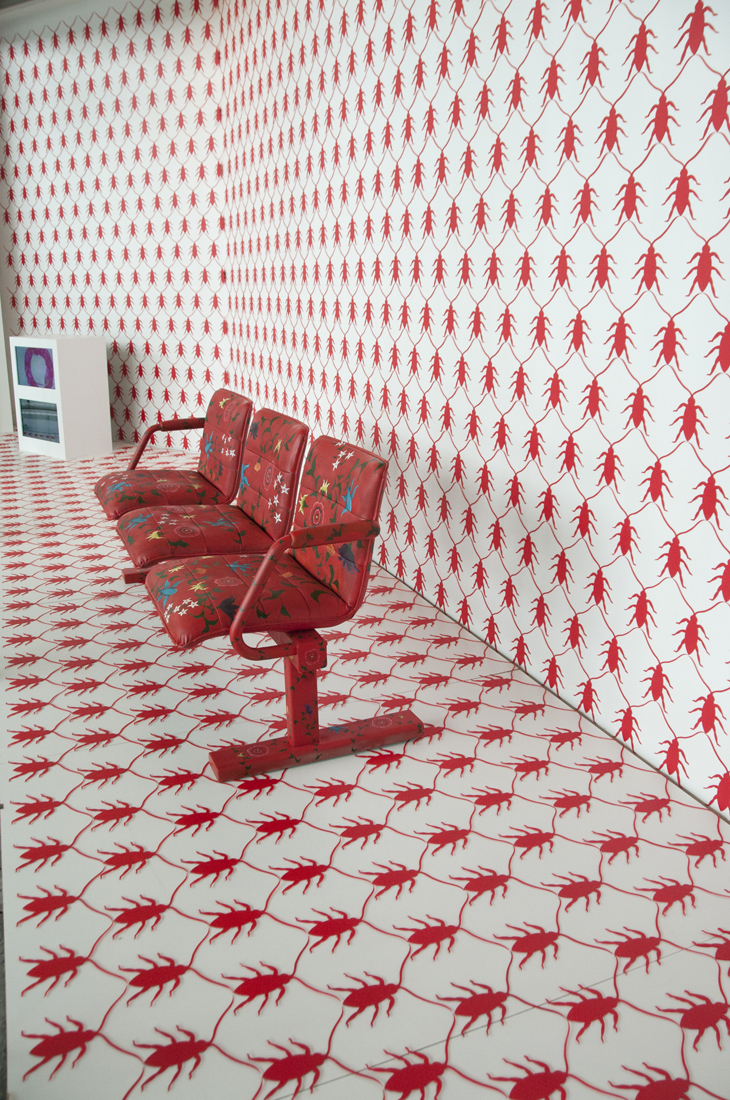
 

01-A Holding Pattern detail (1)
Tazeen Qayyum. A Holding Pattern. Site-specific, mixed media installation
at the Toronto Pearson Airport, 2013. Courtesy of the artist.

This repetitive patterning common in her cockroach themed work has evolved and informed her performance work. For example, in her recent performances such as “We Do not Know Who We Are Where We Go” (2012 and 2014-15), Qayyum centers herself on the drawing surface and begins to write in her native Urdu language using Perso-Arabic script in concentric circles. The repetitive, trance-like process of creating these works can span several hours. For Qayyum, the process to create these works allows the audiences of the performance to see how her body fully becomes the instrument, melded with the paintbrush, to create the cursive lines of script.[6]

MIXER-Yuula B (1)
Tazeen Qayyum. We Do not Know Who We Are Where We Go-II, drawing performance, MIXER. 2014-15. Photo by Yuula Benivolski. Courtesy of the artist.

“I am confident to say that I have always prioritized my home and being a mother over my professional life,” reflects Qayyum. This has often meant passing on opportunities that may have propelled her into the limelight, however, this has not lessened the potency of Qayyum’s artistic output. Instead, her work continues to be driven by “what my narrative is, what is it that I want to investigate or say, what has moved me enough that I need to express my feelings, and then comes the ‘how.’”[7]

Qayyum’s work continues to push the limits of modern miniature painting. Her latest project, a series of multidisciplinary works called “Cover The Same Ground” (2020), has been “created as worksheets of learning to draw a dead cockroach, breaking it down as fictional letters and language.”[8] Here, Qayyum continues to evaluate and piece together visual imagery to challenge the conceptions long shaped by colonialism and white supremacy in the imagining of the ‘Other’. Indeed, the ability to address the misuse of knowledge and its translation “into acts of bigotry and brutality through misrepresentations of socio-political and religious ideologies” features prominently in Qayyum’s art.”[9] In her work, Tazeen Qayyum brings these issues to the forefront using and expanding the established vocabulary of traditional miniature painting.  “Fear is no longer a mute condition” Qayyum points out, “I believe we are infinitely connected through thoughts, words, and actions, and I want my work to convey that as well.”[10]

To see more of Tazeen Qayyum’s artwork and future projects, visit www.tazeenqayyum.com or her Instagram @tazeenqayyum.

Nadia Kurd (she/her) is an art historian and curator based in Amiskwacîwâskahikan  (Edmonton, Alberta). Her work can be found on http://www.nadiakurd.com


[1] Tazeen Qayyum, interview by author, Edmonton, AB, May 16, 2020.

[2] Jonathan Bloom and Shelia Blair, Islamic Arts (New York: Phaidon Press Inc. 2006), 220.

[3] Louis Werner, “Reinventing the Miniature Painting”, (accessed May 20,2020).

https://archive.aramcoworld.com/issue/200904/reinventing.the.miniature.painting.htm

[4] Leah Sandals, “Into the Deep”, Canadian Art, https://canadianart.ca/features/into-the-deep/ (accessed May 20,2020).

[5] Ibid.

[6] CBC Arts, “Why Tazeen Qayyum is Willing to Suffer Joint Pain for Her Art” https://www.youtube.com/watch?v=cPUeQ4XSBMU, (accessed May 20,2020).

[7] Artist interview with Author.

[8] Ibid.

[9] Ibid.

[10] Ibid.

Profiles on Practice: Yen-Chao Lin


EG_Penny_01jpg
Yen-Chao Lin. The Eroding Garden. Copper, glass enamel, stainless steel. 200cm x 49cm. 2019.

By Nadia Kurd

Dowsing is known as the process of finding water using divination rods. This old technique of sourcing water can be found in various cultures across the globe. For modern-day dowsers, in addition to sourcing water, “they frequently can report its volume, depth, flow direction and potability.”[1]

For Taiwan-born, Montréal-based multidisciplinary artist Yen-Chao Lin, this practice has been a significant inspiration to art. Many of Lin’s works begin organically and can be sparked by the items she collects, hears or senses. The combination of spirituality, folklore, and DIY practices—as found in dowsing— has foregrounded much of Lin’s film, installation, and textile-based works. Moreover, as a child, she was exposed to a variety of religious philosophies, as her mother would take her to places such as Buddhist temples, Sunday mass, and Mormon gatherings.[2]

52605184_2821561034649559_4139083906123038720_n
Yen-Chao Lin, portrait. Photograph by Ashutoshk Gupta. Courtesy of the artist.
EG_Penny_04
Yen-Chao Lin. The Eroding Garden. Copper, glass enamel, stainless steel. 200cm x 49cm. 2019.

Lin’s long-term research into dowsing which included conducting interviews and attending monthly meetings with the Ottawa Dowser’s, led to the creation of her installation Eroding Garden (2019). As a result, Lin created a three-part installation that combines 2000 glass enamelled Canadian pennies, a porcelain bowl with an erected chopstick, and several suspended, casted hands holding dowsing sticks, both in real and imaginary ways. As Lin writes, the work also incorporates her own family history. This history is symbolically reflected, as Lin notes;

The porcelain bowl with the chopstick is drawn from my family oral history, where my grandmother made a chopstick stand in water and communicated with the spirit of a deceased relative who was causing illness to my mother. In many East Asian cultures, chopsticks should not be left vertically stuck into a bowl of rice because it resembles the ritual of incense-burning that symbolizes feeding the dead.[3]

While the work evokes a more intuitive approach to connecting with land and water, dowsing also has an insidious, political history as well. As Lin points out, “dowsing is also used by the petroleum industry to locate oil wells, mining companies for ore, as well as the US army in Korea and Vietnam,  to find tunnels and food caches.”[4]

EG_Bowl_02
Yen-Chao Lin. The Eroding Garden, 2019. Porcelain, hand-forged steel, 22k gold leaf. 12cm x 12cm x 25cm.

In another installation Perchance (2018), 23 booklets, silk tapestries, and several divination sticks are arranged in a way that creates a space whereself-administered divination is offered.”[5] For this project, Lin “visited fortune tellers in Hong Kong and Taiwan, observed different collective and individual divination practices, studied the ancient tradition of I Ching and explored the materiality of silk.”[6] The work melds the sensibilities of traditional East Asian aesthetics and religious practices to forge a contemporary ‘system for divination.’ Here, visitors are permitted to interact with the I-Ching bundle (placed in the centre of the silk banners) and interpret their own numerically based fortune from reading the 23 booklets on the wall. This process ultimately melds chance and instruction and asks visitors to reflect on “socially determined networks of information distribution.”[7]

2018-04-18-SBCDeadLetter-021
Yen-Chao Lin, Perchance, 2018. Photography by Paul Litherland, courtesy of SBC Gallery of Contemporary Art.

Her most recent project, The Spirit Keepers of Makut’ay (2019) also follows a highly intuitive process. This short, experimental film was shot on the rural coast of Taiwan in collaboration with the local Amis Indigenous community. Largely abstract in nature, the film poetically “unravels mixed-faith expressions from Daoist ritual possession to a Presbyterian funeral” to reveal the past Amis healers. For Lin, this work brings together the past and present to show how “nature, colonization and population migration” comes together in Taiwan’s unique spiritual landscape.[8] The Spirit Keepers of Makut’ay will have its Canadian premiere the Vancouver International Film Festival this October.

Makutaay still 10
Yen-Chao Lin. The Spirit Keepers of Makuta’ay Still. 10:57. 2019.

Since migrating to Canada at the age of thirteen to pursue an education, Lin recalls that she had, “this overwhelming strong pulsation darting out from my heart, telling me I must leave in order to pursue what I want out of this life. I wanted to leave since I was 11, it took two years to convince my parents and it was not easy.”[9] This determination led her to pursue an arts education. After earning a Cégep (Studio Arts) diploma and a BFA (Film Production) from Concordia University (Montréal) in 2008, Lin has gone on to participate in numerous residencies, exhibitions, and performances in Canada and abroad.

With an understanding of how she may be perceived as an immigrant woman of colour, a large part of Lin’s work has also involved working with arts organizations to develop equity policies and practices. In 2019, she was the Equity Officer for La Centrale Gallerie Powerhouse, a feminist artist-run centre in Montréal. This experience made her realize “how important and challenging it is to make space for equity-seeking folks within institutions, and how education, leadership development, and solidarity can contribute to change.”[10]

Combined with an intuitive sensibility, Lin’s practice, on the whole, is rooted in examining equity and justice. “I believe in self-empowerment, the accessibility of arts, and the possibility of change through art,” reflects Lin, “I’m a critical person and I will always question the dominant structure of power, either through my work as an artist or as a cultural worker.”[11]

To see more of Yen-Chao Lin’s art and upcoming projects, visit her website: yenchaolin.com

Nadia Kurd (she/her) is an art historian and curator based in Amiskwacîwâskahikan (Edmonton, Alberta). She tweets @nadia_kurd and her work can be found on nadiakurd.com.

[1] Canadian Dowsers Association. https://canadiandowsers.org/introduction-to-dowsing/ (accessed September 10, 2019).

[2] Yen-Chao Lin, interview by author, Edmonton, AB, September 6, 2019.

[3] Ibid.

[4] Yen-Chao Lin, Artist Website: yenchaolin.com, (accessed September 7, 2019).

[5] Ibid.

[6] Ibid. Note: I Ching can be described as “philosophical taxonomy of the universe, a guide to an ethical life, a manual for rulers, and an oracle of one’s personal future.” For more information, see: http://www.chinafile.com/library/nyrb-china-archive/what-i-ching

[7] Ibid.

[8] Ibid.

[9] Interview by author.

[10] Ibid.

[11] Ibid.