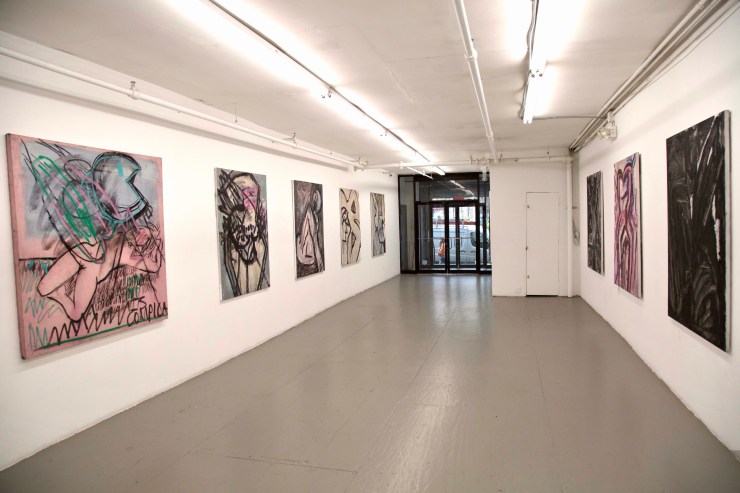
Ayanna Dozier on the Sacred Labour of a Whore

Installation view from Get on Your Knees, Jesus Loves You by Ayanna Dozier at Microscope Gallery. Photo courtesy of Microscope Gallery.

By Gladys Lou

Ayanna Dozier is an artist, writer, and scholar who approaches sex work as a sacred form of labour. For her, erotic labour is not just performed, it is studied, historicized, and positioned alongside artistic and mystical practices as a site of spiritual, intellectual, and emotional expertise. Drawing on biblical narrative, Black feminist theory, and personal experience, Dozier traces the porous boundaries between submission and autonomy, resistance and care. Her work asks: Why is spiritual labour exalted, domestic labour expected, and erotic labour condemned, especially when all three are so often enacted by the same gendered and racialized bodies?

In a scene from Dozier’s recent narrative short film Forgetting You is Like Breathing Water, the dominatrix Anna jokingly asks her friend Danielle over the phone, “What would men do without us?” to which Danielle wryly replies, “What would their wives and girlfriends do without us?”Across Dozier’s work, women’s bodies glided through moments of prayer, performance, and cathartic releases: whipping, crawling, and pole dancing. Their movements are at once solemn and seductive, devotional and defiant, collapsing the gateway between the holy and the wild, between heaven and hell.

I first encountered Dozier’s work in her 2025 solo exhibition Get on Your Knees, Jesus Loves You at Microscope Gallery. Projected in loops of film and housed within cathedral-shaped frames, the installation, Doing It for Daddy, staged a sensual encounter where Christian fundamentalist iconography, BDSM aesthetics, and intimate postures become all entangled.

The architectural motif of the cathedral frame operates more as a formal device than a spiritual symbol. Dozier remixes these ornamental silhouettes, often used to house pious slogans in evangelical décor, and fills them with scenes of erotic gesture. By doing so, she stages a confrontation between the idealized, sacred image projected onto figures like Mary Magdalene and the lived realities of labour performed through and upon women’s bodies.

In our conversation, we discuss the politics of women’s labour, the history and nuances of sex work, and why deploying the term whore, for its ability to cut through identity categories and recognize those outside of solidarity groups, can reveal the realities of labour that are often silenced or marginalized.

Ayanna Dozier, “Doing it for Daddy,” 2024, 16mm film, installation view. Courtesy of the artist and Microscope Gallery, New York.

Gladys: Your work addresses multiple forms of labour, from sexual, spiritual, to gendered. Can you speak more about how you understand labour in relation to the body, particularly as a form of devotion and resistance? How do you personally define labour within your practice?

Ayanna: To paraphrase one of my favorite quotes from Angela Davis, referencing Marx: labour is like fire, it’s tangibly felt, but you can’t grasp it. I think that resonates with how I’ve been thinking about labour, especially as it relates to the gendered body. This came through strongly in my last solo show.

I’m interested in the contradictions around labour and how they manifest through gender. In the church, for example, prayer is considered a woman’s labour because it’s biblical. As women, you’re not afforded much autonomy beyond that. In the church I grew up in, it was heavily structured so that if you were an unmarried woman, you’d become a “prayer warrior.” Men could be pastors; They could take on public-facing roles. But women? You got married, you had babies, and your role in the church centered around reproduction. So, what is a woman’s labour to God beyond childbirth? It’s prayer.

And I took that very seriously. I was good at praying. But here’s the contradiction: as someone in a gendered body, regardless of whether I fit into mainstream beauty standards or not, my body was still seen through a sexualized lens. The very labour I was encouraged to do — being on my knees, getting into a state of spiritual ecstasy — was seen as inappropriate or even erotic, so then you’re punished for it.

That tension between condemnation and ecstasy is what undergirded the exhibition. What does it mean to be punished for the kind of transcendence your body seeks? You’re conditioned to pursue it, but also forbidden from fully accessing it. That’s where I find an important analogy to sex work.

Sex is labourious. It requires skill. We live in a sex-negative society, one that doesn’t advocate for sexual education. People are expected to enter these mostly heterosexual unions already knowing how to have sex, how to please their partners, how to keep them satisfied. Meanwhile, sex workers develop actual skill sets. They edify the body. You have to be deeply perceptive as a sex worker, not just “do” sex, but understand it, guide someone through intimacy, through shame, through discomfort, toward pleasure.

And yet, we don’t consider that labour. We dismiss it, we vilify it. Even though it’s something we claim to value within romantic partnerships, we undermine those who practice it professionally. That contradiction between sex, service to God, and gendered labour is what the exhibition tried to explore. It’s like, you can do it, but don’t do it too well. Because then it becomes too provocative, too threatening. And once it becomes threatening, it must be condemned. It’s always this constant push and pull.

Detail view from Genesis 38:14-15, 2025 by Ayanna Dozier. 16 mm film still. Photo courtesy of the artist.

Gladys: In your artist talk, you described God as a ‘non-consensual dom. ‘ Could you elaborate on what this metaphor conveys about the dynamics of authority and submission?

Ayanna: As individuals, as human beings, I don’t think subjugation is necessarily a bad thing. History shows that people have long craved subjugation. Look at kings and monarchies. There’s something innate in the human experience about wanting to surrender to something larger than yourself. That can be ecstatic, even transformative. There’s beauty in being able to serve or to devote yourself to something that claims to know better, to offer relief from suffering.

What I challenge is when institutions weaponize that impulse, when submission becomes a tool of control or degradation, particularly in how it interacts with self-worth. That’s what I wanted to explore in the exhibition: this tension between ecstatic devotion and systemic cruelty, especially for women. There’s something deeply erotic and spiritually resonant about prayer. And when you strip away the dogma, it’s not unlike meditation, quieting the body, focusing the mind, speaking your desires and intentions out loud.

But within the church, you’re often taught that you’re undeserving of the very connection you’re trying to cultivate. In the New Testament, especially in Paul’s letters to early churches, two to Corinth (1 & 2 Corinthians) and two to Timothy (1 & 2 Timothy), there’s this recurring emphasis on human unworthiness (“You have been bought with a price: therefore glorify God in your body” 1 Corinthians 6:20). You’re devoting your time, and yet constantly reminded that you don’t belong, that you’re lucky to be here.

That’s where the phrase I used, calling God a “non-consensual dom,” comes from. It’s funny, but it’s also serious. What does it mean to be conditioned to want to serve, but told that your service is never good enough? That you’re inherently unworthy, and that’s the whole point?

Detail view from Doing it for Daddy, 2024 by Ayanna Dozier.16 mm film still. Photo courtesy of the artist.

Gladys: In your work Doing it for Daddy, you’ve depicted the ritual of anointing pastors as emotionally intense, even carrying an erotic charge. How do you approach the balance between sensuality and spiritual devotion, especially when these acts are typically presented as sacred? Also, how do the differing biblical accounts of anointing inform your film?

Ayanna: Biblically, there are contradictions, especially in the Gospels. Matthew, Mark, Luke, and John all recount more or less the same events from Christ’s life and miracles, but from different perspectives. Each writer brings their own interpretation of what they’re witnessing. Take the scene of Mary of Bethany anointing Jesus: it appears in all four Gospels, but with striking differences.

In Matthew, it’s a single, almost chaste verse: she anoints his feet and gifts the perfume. The act becomes more embodied and intimate with each retelling (this also changes depending on the translation but for this purpose I am speaking of the New Kings James Version). Mark focuses on the cost of the perfume and Peter’s disapproval. In John, it’s Mary of Bethany anointing Christ’s feet and wiping them with her hair. By the time we reach Luke, the account expands to four or five verses. Luke portrays a “sinful woman” performing the act with intense emotion, describing a woman crawling to Christ, her tears falling on his feet, pressing her cheek to them, pouring perfume, and drying them with her hair.

The act of anointing is devotional, but also, undeniably, erotic in its intimacy, especially in the way Luke and John describe it. That contradiction lives in the text itself. What’s considered sacred is so often also sensual, but the church can’t tolerate that ambiguity. That’s what I’m drawn to, biblically, visually, symbolically, and what I try to hold in my work. I like those contradictions, and I lean into them technically as well. That’s part of the surface gag of the film: it was shot in double 8mm, all in-camera, and purposefully constructed so that two simultaneous images oppose each other, printed onto 16mm film. This forces the audience to watch four projected images at once on a single strip, a construction meant to reveal the hypocrisy in all of it.

Gladys: Can you talk about some of the key inspirations and philosophical or cultural references that inform your work, especially how you engage with Christian narratives, and the portrayals of desire and self-love?

Ayanna: The Faust myth, sometimes it’s called Faustus, sometimes Mephistopheles, goes by different names depending on the version. It’s a very popular folktale: someone makes a deal with the devil in exchange for knowledge, power, or eternal life. In some versions, Mephisto is the name of the devil; in others, Faustus himself becomes a kind of devil figure. But at its core, the story is always about bartering with the devil for an extended or enhanced life, only to find that life ultimately unfulfilling.

It’s a very Christian kind of propaganda. The moral is always that true satisfaction comes not from surrendering to yourself or your flesh, but from surrendering to God. The flesh is weak. And what I love are the films that challenge that, suggesting this surrender to desire, to the body, to pleasure, can actually be a wondrous, fulfilling experience.

There’s a film by Jess Franco from 1968 called Succubus, though it also goes by the title Nymphomaniac in some versions. The protagonist is an S&M performance artist, doing bondage theater, and we come to realize that the devil is seducing her not to punish her, but to help her embrace her gifts: the power to dominate, to force submission, to destroy men. What he offers her is a life of philosophy and freedom: freedom from masculinity.

By the end of the film, she enters a dream state with the devil, who says something like, “My beautiful Faustian bride, now we will pursue earthly pleasures together.” And I love how that’s framed not as a tragedy, but as something positive. It’s a twist from the idea that spiritual servitude to God is the only “good life,” while you only get one life in the flesh.

There’s a term in Christian theology: homo incurvatus in se—a life turned inward. I used that phrase as a title for one of my artworks in the show. It’s considered a negative concept in Christianity, a threat to God, because it suggests centering the self over divine authority. Historically, Christian fundamentalism, via the Reformist doctrine, has often been against education, against art, against self-expression because these things open us up to our bodies, to each other, to difference.

There are many passages in the Bible that discourage empathy, even though people like to say, “But what about Christ’s teachings?” Christ’s compassion was conditional. He believed in forgiveness, yes, but only if you chose God. If you didn’t, you were damned to go to hell. That damnation was seen as justified. Pleasure, sex, and bodily joy—these things open us up. They make us more empathetic, more generous. And that is a threat to a religion built on servitude.

That’s what the Faustian parable warns against: don’t seek philosophy, don’t study knowledge, don’t write, don’t make art. The real purpose of life is to give yourself to God. And the greatest enemy in the Faust myth isn’t the devil, it’s self-love. That’s what I find so interesting, and what I try to explore in my work. The actual threat to Christianity isn’t the devil. It’s the question: What if we just love ourselves?

Ayanna Dozer. Detail view from Forgetting You is like Breathing Water, film still. Image courtesy of the artist.

Gladys: In your recent short film, Forgetting You is like Breathing Water, there’s an overlap between physical intimacy and emotional vulnerability, especially in the final scene, where the man confesses his struggles to the dominatrix. Do you think sex work could be a form of therapy or self-reflection?

Ayanna: My clients often treated me like their therapist. It was shocking when I was 21 and had men in their fifties telling me about their marital problems. There’s a certain humour in that, because it’s a weird situation. I’m retired now, but I’m still doing research on it, and it hasn’t changed. My conversations with friends who are still in the industry reveal that it’s the same: clients unload and project so much onto you, and you have to be good at accepting that.

Then, it can feel like a type of therapy. It’s a job where you need to be okay with yourself because you’re dealing with people projecting their problems and opinions about you. I recently curated a film series at Anthology called Women, Workers, and Whores on Film. One of the shorts in the program, “Whore Writers” by Tall Milk, interviewed sex workers who are also writers about their experiences. One of them, Stoya, an infamous porn star, wrote a book called Philosophy of the Pussy, where she talks about having clients, mid-session, project their reasons as to why “[she] probably does this.” It’s messed up, but the point is, you have to understand that the sense of projection and entitlement is part of the job.

Sometimes, it has less to do with the physical act of sex and more to do with how you manage the emotional load and understand the root of your client’s issues. It’s like a therapist’s role, in a way. You use sex, which is broadly defined here because it happens in dominatrix sessions too, that do not center penetration, where it’s not always about physical pain, but rather a dynamic of control. It’s the same in escorting, which sometimes isn’t about sex at all but just being a companion for the night. It’s all part of the larger industry.

In this line of work, you have to figure out quickly what your goal is. Not just to get paid, but if it’s your day-to-day job, to get hired again. You need to understand when to break the script of what you thought your job was and adjust when doing the job. That’s what the film was getting at: a woman who is also in need of the type of care and consideration that she gives to her clients.

I don’t believe that gender and race are stable, singular categories to symbolize. And I don’t think being a “whore” is a stable category either.


Gladys: How did you approach bringing the complex emotional and power dynamics between the dominatrix and her client to life on screen, especially in portraying their connection while maintaining the boundaries of the work?

Ayanna: The film starts with her heartbroken, which is why we spend so much time with her in the beginning to give us a sense of her life outside of her job. Then, as her client talks, she realizes she understands exactly what he’s going through. She sympathizes with him. She understands the intersection of desire and loss that she, too, is experiencing. That’s why we get that flashback to her own breakup. She gives him both a spiritual and physical release, one that is traumatic to the body but mentally ecstatic.

I wanted to keep it clear in the film because, often, when sex workers are portrayed on screen by non-sex workers, they bond with their clients in a way that feels unrealistic. Like, “Call me by my real name.” In the film, even the client thinks her real name is Faith, but the audience knows it’s Anna because of her previous conversation with her friend. There’s still that boundary, that pretense, because safety comes first. But that boundary doesn’t make the experience any less real or impactful.

In other films, the sex worker might cry and say, “I’ve been heartbroken too,” but no, that’s not it. She’s still doing her job, but she also understands that he needs what she’s giving him because she, too, needs it. Whether he recognizes that as her bonding with him is beside the point. He gets what he needs, but she and the audience understand that she’s also connecting with him while keeping the structures of the job intact. He’s projecting onto her, and she’s projecting onto him.

And in the context of dominatrix work, or sex work in general, people often assume that power dynamics don’t shift, but they do. Power changes all the time. There are so many negative assumptions about sex work, and in the past, I used to feel like I had to defend it. But now, I’m tired of having to do that. Sometimes, it’s messy, but that doesn’t invalidate the work.

Ayanna Dozer. Detail view from Whore in the House of the Lord, 2024 by Ayanna Dozier. 16 mm film still. Photo courtesy of the artist.

Gladys: I’m curious about the use of the word “whore” in the title of your film, A Whore in the House of the Lord. It’s a term that’s often weaponized to degrade women, so why did you use it in your work? I also know that in your art practice and community work, you’ve encountered many confrontations. How do these experiences shape your views on the intersections of race, gender, and sex work?

Ayanna: In my opinion, the term “sex worker” doesn’t quite capture everything. It’s a useful way to describe the industry to people outside of it, and it’s certainly better than the police term “prostitute.” Some sex workers may call themselves prostitutes, but that term originates from law enforcement. It’s always been tossed around by the police, and even though it’s sometimes embraced in a more affectionate sense within the community, it’s still loaded.

I like the term “sex worker” in the context of organizing, especially around labour. But let me tell you: the number of people who have screamed in my face, yelled at me, or kicked me out of labour and leftists organizing spaces because I bring up sex work is a lot. I had an experience three months ago where this guy just turned bright red and went off about how sex workers are basically getting paid to be raped and they have no agency. He was like, “They’re all trafficked. How could you advocate for them? They need to be in jail.”

It’s encounters like that which have made me double down on the term “whore.” Because no matter what, whether I’m retired or not, in these encounters, I’m always reminded, as journalist Melissa Gira Grant says in Playing the Whore (2014), that once you’re a whore, you’re always a whore. You can’t escape that. You can’t fit into a neoliberal framework of labour rights because people in those spaces will remind you that you’re a whore. Using the term “whore” allows us to cut through identity and understand that it’s a specific configuration of experience that’s only fully understood by other whores.

Gladys: Can you expand on what the term represents in terms of identity and labour within the sex work community?

Ayanna: I don’t believe that gender and race are stable, singular categories to symbolize. And I don’t think being a “whore” is a stable category either. Deploying that term gets at the disenfranchisement and displacement that happen across those gender and racial divisions.

Because I exist at two visible intersections of Blackness and gender, I’ve always felt dissatisfied by this idea that I should mobilize around a shared experience of a universal Black womanhood. That doesn’t take into account my light skin or being cis and thus that I’m perhaps not the best person to speak on behalf of dark skin or trans women as part of that assumed universal marker of Black womanhood. It also doesn’t address the divisions within and how some Black cis women can be incredibly transphobic and conservative.

When I start to frame the work that I do as a “Black whore,” it allows the audience to grasp these very violent fractures across identity. Looking at Black whores reveals some very poignant disenfranchisements of Black women at the margins like how Black trans women are disproportionately affected by sex work.

For example, the National Transgender Discrimination Survey from 2015 and the Visual AIDS Day Without Out pamphlet: Alternate Endings, Radical Beginnings document from 2017 estimated that roughly 40-50% of Black trans women have done sex work and often take up the labour because of gender discrimination in the workplace. A report by Amnesty International indicated that 40% of people detained in the United States for sex work are Black women. An average of 60-80% of street-based sex workers are Black women, according to this decriminalization report, street-based reporting by Coyote based in Rhode Island, and Melissa Gira Grant’s statistics in her 2014 book, Playing the Whore, and across multiple news articles. Hacking/Hustling also outlines some of the policing towards street-based sex workers with regards to race.

This is why I deploy the term “whore” both in solidarity, having been one, and as a recognition that other terms don’t allow us to get to the heart of the matter. We can use other terms and hope someone will see our humanity, but they probably won’t.

Ayanna Dozier, “A Whore in the House of the Lord,” 2024, 16mm film (still). Courtesy of the artist and Microscope Gallery, New York

Gladys: You referred to your work Genesis 38:14–15 as a “partially non-consensual collaboration” with James Turrell. Could you explain what you meant by that and why you reference his work? And considering you weren’t allowed to perform at the original site, what does that reveal about institutional control, power, and exclusion in relation to bodies and visibility?

Ayanna: I like James Turrell’s work, but I’m also critical because he represents a broader issue in the art world: white male artists often acquire public land for private projects. Most of his Skyspaces are on private land, and Roden Crater is an example. So, these are not truly public spaces.

The only Skyspace Turrell has that’s genuinely public is the one in Chicago, owned by the University of Illinois at Chicago (UIC)’s architecture school. But it became “too public” when unhoused people started sleeping there. As a result, it’s the only Skyspace Turrell has more or less disowned. It’s not even listed on his official website anymore.

All his other Skyspaces, including the one I shot at the Walker Art Center, are private. This ties into what we call the “public sphere,” which speaks to the privatization of spaces meant to be public but, in reality, exclude certain groups: unhoused people, people using substances, those with mental illnesses, and sex workers. That’s what I find interesting about Turrell’s Skyspaces: they are part of this idea of the public sphere, but the only one that’s truly public is the one he has abandoned.

Access is an important issue. What does it mean for me to visit a site on public land that’s historically connected to sex workers? Turrell calls his Skyspaces “holy” and “spiritual,” and I agree with that. But I also see erotic labour as sacred and transformative, and in that sense, you’re literally on territory that I feel connected to more than you do.

Most modern art buildings and districts occupy land with deep ties to sex work. As Anne Gray Fischer writes in her book The Streets Belong to Us, many downtown centers in the U.S. are built on land from which sex workers, often racialized, were displaced, arrested, and removed. For example, the area around Gansevoort and Washington Streets, where the Whitney Museum is now, was once where Black trans sex workers worked. Times Square and Boston’s South End were also sex work areas. The South End now houses the ICA.

The title of the piece references Genesis 38:14-15, which tells the story of the first sex worker in the Bible. She’s kept outside the city, yet her labour is essential to the city’s wellbeing. Using Turrell’s Skyspace alongside this history highlights the larger forces of modernity, architecture, gentrification, and erasure.

This interview was edited for clarity and length. You can find more of Ayanna’s work on her website or Instagram.

Unruly Images: In Conversation with Carly Ries

Carly Ries. Centerfold (2nd Edition) spread. 2023.

By Emma Fiona Jones

Carly Ries is an artist and curator working with images, photo books, and archives. I was first introduced to them by photographer Justine Kurland at her Dumbo studio, where the group show Garden—featuring a photo book, video installation, and window transparency by Ries—was on view from December 14, 2024–January 8, 2025. The exhibition grew out of an experimental workshop run by Kurland and Speciwoman founder and director Philo Cohen that Ries participated in.

In 2019, they published the first edition of Centerfold, a photo book juxtaposing Ries’ portraits and botanical photographs with strategically manipulated images drawn from 1980s pornographic magazines depicting lesbian scenes enacted for male pleasure. Images are interrupted with overlays and made multiple through the use of vellum pages, shifting the dynamic between subject and object.

I recently sat down with Ries in their Bed-Stuy studio to discuss Centerfold, gender, the gaze, and the physicality of the image.

Carly Ries. Centerfold (2nd Edition) spread. 2023.

EFJ: Tell me about Centerfold. How did the project first come about?

CR: I’ve always been interested in the power dynamics of who’s looking at who, and the agency of the person being photographed. I loved trying to find the ways that the models in the pictures were slipping outside the bounds of the directions given by the photographer on set. They were doing these repeated gestures. Everything was shot on film, everything had to be orchestrated and choreographed—so you can see this boredom seeping in. But in that boredom, sometimes you would see that the two women who had been placed together might have a natural way that their bodies were falling together, in the way that would happen if you were spending time with your coworker or your friend doing this repetitive scene. But there was a physicality and an intimacy between the participants that wasn’t sexual—or it could’ve been—but that was intimate, that was outside of the gaze, that was visible but because it was so separate from what the purpose of the images are. The people who were making the porn or the people who were buying it weren’t going to notice it. But it was there.  I was looking for the things that slipped outside of the gaze, but that were visible all along.

I was looking for the things that slipped outside of the gaze, but that were visible all along.

And I put the images in conversation with my own images that I had made with a friend of mine, Ruby, who’s also an artist. I’d done this set of portraits of her that I didn’t know what to do with when I made them. I was like, these are intense. They don’t belong with anything else. And when I encountered the pornography, I was like well, this is the counterpart. Because there’s a friendship between me and my fellow queer artist, and beyond being a willing participant in what we were doing, she was a full-blown collaborator in the pictures. They wouldn’t exist without her. Same with the models in the pornography. The pictures wouldn’t exist without their participation and creative contributions. Having her as a counterpart highlights the subjectivity of the individuals, because she’s a known person, whereas they’re all a cast of many different characters, and there were repeating people.

Carly Ries. Centerfold. 2023.

EFJ: In Centerfold, there seem to be these protective layers built in, these mechanisms that redirect the viewer’s gaze.

CR: [I didn’t want to] show you the thing you would expect to see. I thought of it as: if the models were to come across my book now, how would they feel, seeing their images? I didn’t want to enact a violation. But I also don’t get rid of nudity or sex. I just use the layering of images to camouflage. Things are visible, but lightly obscured. I like playing with the seen and the unseen.

EFJ: How do you view your relationship with your own subjects or collaborators?

CR: I’ve always thought of them as collaborators because the images don’t exist if they’re not there to help me make them. But I consider them subjects too because I author the images. I’ve been photographing people nude since I was a teenager. I did a project photographing older women. I always said, if you’re willing to be photographed, you can leave on as much clothing as you want. The idea was to take these embodied pictures. So, from the jump, someone can choose what they’re comfortable with, so that’s the ground that we start with. We often photographed in people’s homes. So often we’re in an environment that isn’t artificial. It’s more about the relationship that we build during that moment.

I used to be overly cautious, and then I realized that the people who want to be photographed feel a lot less protective of themselves than I thought. It’s a self-selecting situation. There are a couple of friends of mine who I’ve photographed over the years, but it’s always been portraits because the feeling in their bodies is that they don’t want to be naked. I don’t have that sort of relationship with them, but I have a series of psychological portraits of them. But for other people, it comes more naturally to be at ease in your body, and some people seek it out, they want to be photographed.

As much as the image is mine, I always feel like their image is also theirs. So, if we made it together, the way it is enacted in the world always has to be on those same terms of mutuality.

EFJ: Is that partly what drew you to books as a medium or format—the ability to control the way that the image is enacted in the world?

CR: I struggle with putting my imagery on the internet because it’s such a fast thing, and also portraits are sort of commodified online. We had that moment as the image was being created, and I have this kind of feeling about this image, and then I’m just going to put it up and have it dissipate in a moment? And I don’t know if anyone’s going to take the time to look at this image of this person. With a book, it’s this intimate viewing experience.

Returning an image to an object, it becomes possible to think about the person a little bit more, because you’re holding something physical.

Carly Ries. Centerfold (2nd Edition) cover. 2023.

EFJ: Do you feel like there are ways in which your experiences growing up inform your current work or the way you relate to your subjects?

CR: I grew up in Baltimore, and my mom was always taking pictures. I was always making things, and when I was 14, she showed me how to use her 35 mm. Shortly after that, she got sick with breast cancer, which she recovered from, but it was several years of treatment.

Before she got sick, I was photographing her, because she was a readily available subject. She is not naturally someone who wants to have her picture taken, but she was allowing me to do it as I was starting out and needed a subject. And then when she got sick and started to have reconstructive surgery, we started to play with the tropes of art history together. The process was very collaborative, and she felt really good about at least making something from her experience. And it was really helpful to me. She showed them to her doctor, who thought they were great. He was like, if you want, I can find other women who’d be interested in this.  That was a project of mine that I did for many years.

That’s how I got started. It was the beginning of trying to think about gender and body modification. But I didn’t want to be a documentary photographer or jump from a group of people to a group of people. So, I ventured out into my own realm.

My own top surgery was partially related to having a breast cancer gene. I had known from a very young age that I would have to do something. Doctors never presented that I could just go flat. It was always about reconstruction, and it really depressed me for many years. I stalled out about what I was going to do. But then I realized that there’s totally another way to be, and it connected so much with my queerness.

The surgery allowed me to experience my gender as a more ambiguous thing, and to let my interior self match my exterior self for the first time ever. If it wasn’t for the cancer gene, I don’t know if I would’ve had the guts to do it. I think about it, but it’s the best thing that ever happened to me. So, in that vein, I’ve been photographing myself, since just before my surgery to now. But I now use my body as a tool to explore bodies in general and their relationship to space and environment and creatures and fluidity. In a way it reverts to the early work I did.

EFJ: The word “slippery” comes to mind with your work.

CR: I love that it’s so hard to put language to gender, and in that way, I find that it’s slippery. And while it’s frustrating in some ways not to feel like you are in one way or another, it’s much more freeing to feel like you’re one foot in, one foot out. In that way, I think of my gender as slippery, and I really enjoy that. Not slippery as in you’re going to slip and fall—slippery in the sense of you might be able to hold it for a little while but it’s going to slip out.

Carly Ries. Centerfold. 2023.

EFJ: Does that relate to your use of film, materially or conceptually?

CR: Film is a physical material. It’s a little unruly, in the sense that sometimes things don’t register on it the way you had hoped. But you can sometimes get lucky—I always shoot when there’s not enough light, because you just never know,  very interesting things can happen, and then they can exist more in the subconscious space. I like that film is not a perfect dance partner, because it enables chance to happen, and the material itself to have its own agency.

I like that film is slippery. I like things that don’t necessarily behave all the time. And that’s also why photographing people who aren’t used to being photographed all the time is interesting. Like you get the image that you think you can get. But also, there are micro-expressions on people’s faces, and you might get the one that’s right after the one that you want to get. It’s about how you relate to people.

I like that film is slippery. I like things that don’t necessarily behave all the time.

EFJ: Going back to the origins of the Garden show, the workshop with Justine Kurland and Philo Cohen, how do you work towards carving out the art world you wish to see?

CR: I value having studio visits that are not about something necessarily happening, but just a chance to enter into what someone’s doing. I like the reciprocity of going to someone else’s space and seeing how they think.

In Baltimore and Chicago where I went to school, it’s cheaper and there are apartment galleries. I grew up having these ad-hoc spaces, which are great, but difficult to have in New York.

Books are a huge way that I feel like I can show up for people, so I go to book signings every week, and there’s such an exchange that happens. And the photo book community is really supportive. Publishing is a large beast. But on the smaller level, people who are into it are really interested in sharing and being collaborative. And that art world can be a positive place that’s very generative. And it’s not all individual’s work—it’s people mining archives, it’s people seeing someone else’s work and wanting to make a book for them. And I would love to do that myself. I’m talking with a couple of friends of mine about collaborating on a book, although it’ll probably take years for it to actually happen.

You can find more of Ries’ work on their website.

Framing Black Sisterhood: An Interview with Gio Swaby By Nya Lewis

Claire Oliver Gallery (Harlem, NY) presents debut exhibition by artist Gio Swaby Both sides of the Sun on view April 10 – June 5, 2021

Gio Swaby. New Growth 8, Fabric and Thread Stitched onto Canvas, Claire Oliver Gallery 2021. Image courtesy of the artist.

By Nya Lewis

Gio Swaby‘s work seeks to underscore joy and resilience while showcasing the beauty in imperfection and individuality as a counterpoint to the often-politicized Black body. Ranging from creating life-scale black and white sewn line portraits, to polychrome floral quilted works, Swaby is a multimedia textile artist whose figurative work explores the intersection of womanhood and Blackness: celebrating individuality and multiple ways of being rather than a flattened singular narrative. Swaby is a graduate of Emily Carr University of Art + Design in Vancouver, Canada. She is currently an MFA candidate at OCAD University in Toronto, where she currently resides.

Sunday mornings are for waffle brunch, soulful music, plant watering, and sisterhood. I had the honor of sitting down with artist Gio Swaby, who allowed me to be a slow witness to her practice as we recapped her skyrocket success from her 2018 exhibit in a Vancouver storefront to the National Art Gallery of The Bahamas, The New York Times, and beyond. From one Carib transplant to another, she greets me with a warm recognizable accent. We immediately dive into anecdotes about missing home, food, sunny weather, grannies, and colorful contemporary art. After a decade of performance, film, painting, drawing, prominent art collectors enthusiastically receive her textile work, in her major debut show at the Claire Oliver Gallery.

Gio Swaby, Pretty Pretty 6. Fabric and Thread Stitched onto Canvas, Claire Oliver Gallery 2021. Image courtesy of the artist.

Contributing to a new wave of bad-ass crafters and quilters, Swaby’s bold silhouettes and fabric on canvas work comes alive, meeting the call of freedom, reckoning, and subtlety that encompasses the ever-expanding definition of Black womanhood. The works are in conversation with each other, as she creates an enclave of safety and healing, framing Black sisterhood. It is inspiring. Like many of her influences, Beverly Y. Smith, Bisa Butler, Sherry Shine, Faith Ringgold, Ebony Patterson, Tavares Strachan, and other unnamed, underrepresented, and under-supported Black women artists that have paved the way for textile portraiture to be considered in galleries and institutions, Swaby uses quilting as a medium to challenge identity politics and relay diverse narratives of Black womanhood, speaking to the splendor and skill of the sewing tradition. The humble 29-year-old artist exhibits like a distinguished archive in her evolved ability to capture detail. The life-scale line works, created entirely from thread, the small-scale, intimate 11 x 14 mixed-media textile portraits, every facial inflection, bend of the knee, and movement in the garment is made real through needlework. The works are delicate, emotionally coded, and strategically minimal.

She is reclaiming the aesthetic values of Caribbean practices; the works straddle African traditions and post-modern European ideas of creativity. Swaby’s creations are bright, colorful, tactile artworks that challenge the impossible possibility of inserting marginalized folk art into the mainstream western canon. Swaby is masterfully skilled and has firmly situated herself within art history’s portrait tradition. Afros, dreadlocks, widespread noses, and beautiful smiles on Victorian florals, laces, and needlepoint rings- Swaby contrasts modern diasporic identity, challenging the visual vocabulary and conventions of colonial history and prestige. The models dressed in their everyday clothing assume organic poses and postures, inviting the audience to a self-proclaimed visual inheritance, the Black feminine. Each work is as unique as its subject and successfully portrays a celebration of strength and vulnerability. Though the subjects and stylistic references for her textiles seem oddly juxtaposed, the exhibit speaks to a long and complex relationship with women and sewing. Embroidery, needlepoint, and sewing crafts historically are intrinsically tied to women’s art. Some of the earliest acknowledgments of women’s art are in religious embroidery script and textile. Stich work is loaded with a heritage of women’s protest, activism, and resourcefulness. Predating the right of Black women to be counted members of society, craft, and domestic arts were central to women’s artistic identity. At the unique intersection of womanhood and Blackness, enslaved Afro-descendants used quilting as an innovative way to record and transfer their knowledge and history, and later as one of the only viable forms of labor in colonized regions.

For Gio, there is tremendous ancestral pride and pleasure in crafting. The power is in the doing and in the process of making. The exhibit embodies her connection to the medium, as the artworks are founded on traditions handed down from her mother and grandmother. Swaby’s mother passed away in 2020 and was a lifelong seamstress whose home sewing station was never short of extra fabric and thread. Gio shares that her school uniforms, clothes, and linens were sewn by her mother, who taught her to use the machine. Fabric and tactile work are an ingrained influence that allows for closeness and connection to her departed mum. For her, sewing is meditative, reformative, and revolutionary.

NL: Nassau massive! I have had the privilege of following your career for the last four years, and one of the reoccurring themes for you has been an investigation of displacement and longing. What does Both sides of the Sun vocalize, and are there new concepts in conversation?

GS: My grandmother had a quote that hung in the house, the author always escapes me, but I will never forget the line, “To love and be loved is to feel the sun from both sides” All the women that I have represented and drawn in these works are from the Bahamas, and the physical separation from them (now due to COVID) but in life due to school and other opportunities, has also severed my connection to Black women I love, to the sisterhoods that fuels me. I see the sun as a connector, the spiritual bridge between when I feel the sun and when they feel the sun sustains me.

NL: How have your personal experiences shaped your solo exhibit?

GS: This exhibit needed to feel like joy. It has been a year of working through trauma- and this body of work allowed me to look at resistance through a lens of healing. Love, liberation, joy are all also forms of resistance when enacted by Black communities. There is an emotional labor that goes into Black sisterhood. The adjacency demands work and personal responsibility. On this spectrum of resistance lives restoration. Living in Canada, especially in Vancouver, you are completely isolated from Black community. Finding other Bahamian Black women, befriending them, has been my main support system. That sharing of experiences is important. We hold reflections of love up for one another. Bahamian women show up for you when it is difficult to show up and vocalize fear, pain, stress. They show up with little explanation needed. That is the cultural coding.

Gio Swaby, Love Letter 5. Fabric and Thread Stitched onto Canvas, Claire Oliver Gallery 2021. Image courtesy of the artist.

NL: Bisa Butler, whose exhibition at the Institute of Chicago headlines for the recognition of quilting currently, has influenced your work significantly. There is more discourse now about how Black women artists have contributed to the American canon historically, including the very significant aesthetic and tradition of quilting; how has this impacted your evolution?

GS: It is still unimaginable to me that Bisa Butler and I are represented by the same gallery. Her quilting made it possible for me to see a path to institutional engagement. She led the way. Artists like Faith Ringgold and Ebony Patterson, Tavares Strachan (who showed at the Venice Biennale) their technique specifically for Black artists have forged a distinct artistic identity in relationship to textile work and the diaspora. There are a million more writers and filmmakers, and practitioners who have shaped my perspective, Kachelle Knowles, and her minimalism and simplicity. All of these artists helped me to develop my own sense of authenticity.

NL: There has been a noticeable evolution in your work both in scale and medium. My first introduction to your work was with your moon man, which was more performance and film-based. Your show at the Cheeky Proletariat explored more intimately sized needlepoint portraits. At the time, you created by projecting your image onto the fabric and tracing your shadow. How has the articulation of your craft shifted?

GS: I didn’t want to be tied to any medium. I wanted to make sure I had access to whatever skill would be necessary for the work I was dreaming up. Bold silhouettes and fabric pieces are still a part of my aesthetic. I have introduced more line work. They are sewn some by hand, most by the sewing machine. Blind sewn and displayed on the reverse side of the canvas. There is a beauty in the imperfection of the knots and excess threading hanging, and bare stitching. Going home gave me an opportunity to have models sit for me. This shifted my process to a focus on capturing the power and detail from the photo reference to the canvas, this felt monumental, and so the pieces should be monumental in size. I like to think my practice is circular. I come back around to mediums and pieces as I explore different ways of making. I will never be finished; I am always reaching towards new levels.

NL: There is a complexity both in theory and in form that reminds me of Kehinde Wiley. You use the subject’s personal style as a tool to unpack this experience of invisibility and hypervisibility. It is a spectacle to see Black women in their natural form resisting the power dynamics and harm of misogynoir. Black bodies in public space can become overtly politicized. You have subverted the gaze by posturing them in regal-ity, a rewriting of history similar to Wiley, who repositions Black people into spaces of empowerment, inclusion, and unapologetic self-expression. How does your work respond to the times?

GS: This is a love letter to Black women. A celebration of strength, resourcefulness, usefulness, and vulnerability. I am making space to divest from the tropes and imposed imagery of Black normality to share a moment that encourages the audience to see every line detail that makes these individuals special. There is specificity to the work. It asks us to consider multiple ways of being and seeing. To challenge how we observe Black womanhood and to hold room to have primary, more important dialogue about Black sisterhood, which is to ask how do we want to see ourselves and each other?

Gio Swaby, Love Letter 3, Fabric and Thread Stitched onto Canvas. Claire Oliver Gallery 2021. Image Courtesy of the artist.

NL: Black Artists in North America are experiencing a heightened interest in their expertise and practice. After the murder of George Floyd, many institutions went into survivalist mode, quickly acquiring Black art and hiring Black practitioners as the lack of representation in their galleries was called into question. How do you navigate tokenism, and do you feel forced to create identity-based work?

GS: Not forced, but honored, part of my identity as a Black artist is that I feel called to this work. I have a strong interest in exploring Afro-diasporic identities in my work. This investigation is just for myself, and I often create without the expectation that anyone is going to see it. It is about the process. The work is in the visiting. I am building a balance between aesthetic and concept by trying to prioritize real connection. I love Blackness so much, the creativity and the uniqueness, the similarities between us, between Black women globally, there is always something inspiring to find there. I am always wary of tokenism. I try to take into consideration the historical evidence of the institution before I work with them. Is there a genuine interest in my work, or are you filling a column because you’re curating something “Black”? I position myself in a way where my work is always closely representative of my message, of my honest lived experience as a Black woman. This usually weeds out the possibility of my work becoming homogenous.

NL:Your series, “She Used to be Scared of Hair Comb” 2017 has found its permanent home in The Current in Nassau, Bahamas. What a homecoming! Though there are so many bridges to understanding Caribbean art as its genre or aesthetic, artists from the islands often do not get the recognition they deserve. How do you work to define yourself as an artist within the Caribbean contemporary canon?

GS: I would almost say I am in between. I go home now, and I am considered too Canadian to some Bahamians. It’s strange. When you say Caribbean art, people think of palm trees and beach landscapes, but The Bahamas has some of the most capable artists the world has ever seen. It’s a melting pot of all of our colonial influences. The color palette is representative of our lands—its flora and fauna, and metalwork, pottery, leatherwork, oil-based paintings, textile, beading, folk traditional art. I could go on. There are so many techniques and styles unique to the Caribbean- That mash of multiple identities. I do my best to embody those things when I create. To use bright colors and prints that remind me of home. I want to make sure I do not lose these parts of myself.

Gio Swaby, Love Letter 6, Fabric and Thread Stitched onto Canvas. Claire Oliver Gallery 2021. Image Courtesy of the artist.

NL: So, the saying goes for Canadian artists, it is not that your work is terrible, but that no one has seen it! How has it been to navigate the US art scene?

GS: It is hard to know. Everything has been digital and at a distance—these weird times. I have not even seen my work in person in Harlem. I have done all the press virtually from Toronto. I have been so removed from the physical process. I am not sure that I would call it navigating. It is hard to reconcile when my body isn’t there. It is been a rollercoaster—it is all so incredible exciting. It feels like my career has moved quickly in a very distinct direction in a short space of time. The gallery represents Bisa Butler and has a small roster including a number of Black Women artists, with a historic reputation of acknowledging and collecting Black artists and marginalized artists so I felt it was a good fit at Claire Oliver Gallery. There is definitely more opportunity for my work to be seen, and out in the world. I have more eyes on my work now. I also feel connected to Black collectors and have been prioritizing selling the works to Black collectors, which may not have been an option in Canada. There is a lot of accessibility to Black community with the gallery being situated in Harlem.

NL: Have you had time to take it all in, or are you already contemplating what’s next?

GS: I want to be present with my work. It is consuming to always be thinking about what’s next. It is hard to balance. I didn’t imagine it would get this kind of attention, so I want to manifest long and hard. How can I make the best work for me? How can I maintain a presence at home in the Bahamas? How can I stay connected?

Gio Swaby’s Work is exclusively represented by Claire Oliver Gallery in Harlem, NY. Works from her debut solo show can be seen online.


Nya Lewis is a Vancouver-based, independent curator and MFA student at OCAD. Moved by the goal of equitable access to art and diverse stories in Canada, her work is the culmination of African resistance, love questions, actions, study, and embrace. Currently, she serves as the Founder and Director of Black Art Gastown, a year-round programmer Vancouver Queer Film Festival, and guest curator at the Vancouver Art Gallery and UBC Museum of Anthropology.

Colour and Commodity: Marilyn by Sara Cwynar

Sara Cwynar

Marilyn

27th February 2020 – 30th April 2020

The Approach

SaraCwynar_redlips
Sara Cwynar, Marilyn, installation view at The Approach, London. Courtesy the artist and The Approach.

By Adi Berardini

 “Cezanne…it’s Susan,” the voice in Sara Cwynar’s film Marilyn echoes. Cezanne jewellery boxes act as a signifier of high-class wealth, opening multiple times throughout the collaged-footage film. Suddenly, I have flashbacks of every time someone has mispronounced my name—something that many women likely know well. I have to introduce myself saying, “it’s Adi. Eighty like the number.” Then, I think of how it’s depressing that I have to assign a numerical value to my name in order to be remembered. Isn’t remembering someone’s name a sign of fundamental respect?

In Marilyn, featured as an online exhibition at The Approach, Vancouver born, New York-based artist Sara Cwynar addresses how the commodification of women’s desire is not only prevalent but ingrained in a capitalist society. On the inspiration of the title, Cwynar explains how “the X-Rays of Marilyn Monroe’s chest sold for $45,000—even the inside of her body was up for grabs.” Often with a seductive, vintage feel, the film specifically uses soft pinks and siren reds to display the relationship between colour and commodity. The narrator chimes in with, “colour, decided by someone else, handed down, placed upon us.”  Reminiscent of shopping for lipstick and attempting to find the perfect colour, it causes me to dwell on how individuality can be both a myth and a marketing ploy. I think of how it’s ironic that women don’t have full autonomy over our bodies, yet there are hundreds of shades of lipstick to choose from. 

SaraCwynar_image
Sara Cwynar, Marilyn, installation view at The Approach, London. Courtesy the artist and The Approach.

“I’m telling you these reds aren’t real,” the narrator states in a voice reminiscent of Patrick Bateman in American Psycho. 

The lips are referred to as a red wound, a seductive and vivacious symbol, but also one that is tied to violence. A hand strokes a lavender rose; the film repeatedly zooms in on a fashion editorial, a shot of a woman posing with matte red lipstick. Cwynar is interested in the production of photographic tropes and how they are just as manufactured as the makeup that the models wear. She has worked as a graphic designer for the New York Times, and frequently shoots her colleague Tracy Ma, since Ma is also familiar with media construction and its inherent power imbalance, particularly as a woman of colour. Footage of make-up manufacturers reel, showing the creation of buttery foundation and saturated glitter eye-shadows. While the cogs of the machine hypnotizingly churn, the darkness envelops us, consumed by the same cycles—a loop. Cwynar is fixated on the same few poses the models for popular e-commerce sites repeat. The film speaks of the idea of “a New Woman, “a Face,” and how the patterns were invisible to us before.

“I thought of the women of antiquity who were accused of lying for making up their faces.”

SaraCwynar_image2
Sara Cwynar, Marilyn, installation view at The Approach, London. Courtesy the artist and The Approach.

The film is primarily narrated by a man’s deep voice and a woman who chimes in at times, almost like she’s trying to get in a word during a meeting where a male colleague takes up too much space. The artist is pictured trying to lip-sync the narrator, an act that seems like a reclamation of what he’s saying in a tried but failed manner. The inter-spliced narration is in reference to a myriad of philosophers and cultural icons such as Descartes, Barthes, Plato, Sontag and Eileen Myles, and focuses largely on colour, art, capitalism, and gender. The artist says phrases like, “Women create life, men create art but not anymore, suckers,” and “I know I have a body of a weak, feeble woman but I have a stomach and a heart of a king.” Suddenly, the clearance sale is filmed from the vantage point of an escalator— “60% off!” the red tag reads, illuminated by fluorescent mall lighting. There are deliberately too many media snippets to contemplate simultaneously, enacting the oversaturation of advertisements one subconsciously faces during a trip to a shopping mall or scrolling through their phone.

“A new image comes without warning.”

SaraCwynar_men_bust
Sara Cwynar, Marilyn, installation view at The Approach, London. Courtesy the artist and The Approach.

A key aspect of the film is how nostalgia fades in a capitalist ploy. It also evokes how companies re-appropriate trends and nostalgia to sell their products to consumers. I witness not just the plaster nude bust, but the staging and the men behind it, setting it up. Several shots of a blonde woman’s slick red manicured nails are seen stroking a cherry convertible. Sliding by are a plethora of lipsticks, collaged over a shot of Claude Cahun and vintage film photographs of near-nude women. The voice of the narrator evokes the posts of Instagram influencers, inherently narcissistic in nature, but oh so deep. These days, it’s impossible to tell if someone genuinely likes something or they’re trying to sell it to you. The voiceover proclaims that she loves the times, she can buy anything she wants, but it’s hard to believe her when her face is visibly stressed, tears welling up in her eyes. She searches for pleasure where she can get it, but it hardly seems to be authentic—the glamour fades just as feelings do.

“To choose when to look and when to be looked at, that is the essence of true freedom.”

Cwynar addresses how in art women are thought of as objects and not subjects. With an array of commodified colours in her palette, the films address the painful reality of a society that uses the idea of “freedom” as a marketing method to sell back a sense of feminist empowerment. I can’t help but think we’re trapped in a system that’s difficult to escape.

Dark Angels and Amazons: Natasha Wright at SFA Projects

Sista Chapel by Natasha Wright

SFA Projects, 131 Chrystie St, New York, NY 10002

November 13, 2019, to December 15, 2019

fullsizeoutput_2d
Sista Chapel by Natasha Wright, installation shot. 2019. Courtesy of SFA Projects.

By Nancy Elsamanoudi

The paintings on view in Natasha Wright’s show, Sista Chapel at SFA Projects, convey power with an erotic directness. These bold, exquisitely layered large-scale paintings lure the viewer to muse over the grumbling vibrations of murky, subterranean elements. These works call to mind myth, the underworld, sorcery, dark magic, ancient rituals, primordial energies, and impulses; a violent, dangerous world constantly on the brink of chaos.

Wright’s paintings are peopled with larger than life goddesses, coquettes, amazons and mythological and magical creatures. Her work taps into an imaginary space that collapses the difference between the ancient and the present. These threads that exist simultaneously are seamlessly brought together in the same painting: Cardi B and the Venus of Willendorf, Pac-Man and a sleeping pink nymph, an enormous unicorn smashed against the picture plane against a seafoam green background that at least partly mimics digital space or crouched monsters lurking in an open field at night.

The Unicorn, 60 x 48_, Oil on canvas
Natasha Wright, Unicorn, 2019 oil on canvas 60 x 48. Courtesy of SFA Projects.

The ambiguity at play in Wright’s paintings is compelling. Wright freely incorporates both abstract and figurative elements in a way that heightens the tension and the sensation of suspense in her work.  Her work has a playful openness, a searching quality to it. She seems to allow forms to emerge intuitively.

The thick black lines she uses brings her figures into sharp focus, but then she also sharply crops her figures in a way that frustrates an easy read of them. Various body parts, such as the head, wings, legs, arms are cut off and often lie outside of the picture plane. The figures in Wright’s paintings are cropped as a means of intensifying a feeling—a sense of discomfort. Wright’s work fixates on sensation and the role of the body is central to her work. But the body in her work is not particularly idealized or sexualized. Instead, the body takes on a totemic function—it is more an archetype, a cultural coding of the vitality inherent in a human being.

At times, Wright’s work seems to also touch on death, the macabre and violence. Bodies and parts of bodies are distorted past the point of recognition; the figures writhe in pain. Wright seems to be exploring the precarious and fragile vulnerability often ascribed to the female experience. In Street Ophelia, for instance, a violently contorted female figure appears to be splayed on the ground.

ItsComplicated
Natasha Wright, It’s Complicated, 2019 charcoal and oil on dyed canvas 60 x 60. Courtesy of SFA Projects.

Wright is clearly not interested in making pretty paintings—her paintings aren’t precious. The bodies in her paintings are frequently awkwardly contorted. Grey is often the predominant color and her limited palette of greys, pinks, black and green lend her paintings a gravitas, a weight as does the texture in her work.

Wright builds up the surfaces of her paintings by using a range of materials such as sand, glitter, glass beads, charcoal and black magnum with hand-made oil paint. There is a haptic, textural quality to her work.  The resulting images tend to be suggestive; they seem to hint at a story involving an unfolding drama or possibly a moment of impending danger. She gives the viewer a fleeting glimpse into her world and imagination.

Wright’s work speaks to a fascination with darkness and Wright is tied to her feminist temperament. Wright repositions the female figure at the center by re-envisioning the feminine gaze and rethinking the importance of female agency. The adventuress, the seductress, the muse, the fallen or scorned women all become protagonists that motivate her studio practice. The painting When Black Swallows Red, for instance, looks like large swaths of leather mixed with latex, it is suggestive of the way black leather and latex might feel strapped tight against the skin and in doing so calls to mind straps, whips, and pain folded into pleasure.

Willendorf (Cardi B) 60 x 48_, oil on canvas_
Natasha Wright, Willendorf (Cardi B), 2019 oil on canvas 60 x 48. Courtesy of SFA Projects.

Wright is drawn to the dark, mysterious and dangerous aspects of feminine power and the female experience. By focusing on the body as a vehicle of power and agency, Wright’s work seems to rebuff the so-called feminine virtues of purity, chastity, and modesty.  This can be seen in Already a Saint, a painting of cropped thrusting forward, half-naked torso clothed in animal skins. Or The Swan, a painting that seems to be referencing, “Leda and the Swan.” In this painting, a bent and twisted sullied swan appears like a dark angel covered in volcanic ash flying into a lake.

These paintings speak to feminist concerns, but not in the way that is didactic. Wright seems to be most interested in what may be construed as threatening, destabilizing or emasculating about feminine power.  This feminine power has traditionally sparked fear or has been seen as evil, unnatural and suspect, resulting in images of conniving hags and witches.  Wright’s paintings attempt to reclaim and prize this “darkness” of female power by treating it like black gold—tapping into it as an energy source and an intuitively life-affirming way of knowing.

Tear of Nature: Ajuan Song at Manhattan Graphics Center

August 1-11th, 2019

Manhattan Graphics Center

song_01
Tear of Nature, 2018. Manhattan Graphics Center. Installation Shot. Image courtesy of the artist.

By Chiara Mannarino

Although she is known for her stunning, abstract work with alternative photographic processes, Ajuan Song’s most recent series, Tear of Nature, reflects an entirely new venture for the artist, one that Song notes has signaled a moment of artistic growth and coming into her own.

Unlike Song’s previous work, Tear of Nature is a deeply personal series that has allowed the artist to explore her own identity as a woman born in China during the years of government-enforced population control along with her relationship to and understanding of femininity. As a second-born child, Song witnessed her mother lose her job by choosing to keep her daughter alive. She grew up in a society where women weren’t permitted to do certain things merely because of their gender. Consequently, she felt so stifled by the societal expectations imposed upon her that she often wished she were a boy instead. Song sees these new photographs as a way for her to softly speak about the issues she has witnessed and experienced firsthand.

Although softness usually carries a negative connotation, Song believes that “soft” does not mean “weak.” While reflecting upon her upbringing in a society where women are expected to be docile and humble, she asked me to consider how water is capable of slowly eroding a stone over time, a testament to the power of gentle, slow work in the face of stubborn persistence.

unnamed (1)
Tear of Nature, 2018. Image courtesy of the artist.

As I walked around the Manhattan Graphics Center, I felt Song’s past, present, and dreams for the future coalesce in each photograph. All of the images contain the silhouette of a female figure composed of delicate tree branches, which intersect to create spindly webs that resemble human veins. The female figure is Song herself—each self-portrait is shot with film on the artist’s Rolleiflex camera and then digitally abstracted to include only the body’s outline. The tree branches that live within the figure’s form entirely fill the body and provide it with all it needs to survive, becoming its life force and infusing it with energy and vitality. These fine and bare wooden limbs were captured in photographs taken in parks across New York City mostly in the wintertime and later superimposed with Song’s outline through Photoshop layering. This digital manipulation allows Song to produce composite images that are entirely harmonious, from their serene gray background to their flawless union of images. Her melding of analog and digital technologies yields results that could not be achieved by choosing between the two. This artistic decision demonstrates her belief in the power of union and balance to create otherwise unattainable outcomes.

Every detail in these intricate images is significant for Song, and her choice to include her own body in the work reflects the personal nature of this series. Though natural, her poses are strategic, intending to embody the Chinese belief that one must be humble in front of nature, which holds divine wisdom. By artistically conceiving a harmonious accord between humanity and nature, Song envisions a reality in which all entities sharing this earth are equal, a condition that often seems inaccessible within the context of our current moment.

unnamed
Tear of Nature, 2018. Image courtesy of the artist.

In today’s world, the once-ambiguous term “global warming” has become all too tangible, and, in New York, hectic inhabitants often fail to appreciate the few and precious patches of green that exist in the bustling hub of concrete high-rises and construction. Through this series, Song shares her belief that these realities could all be prevented if humans and nature coexisted respectfully and harmoniously with one another. However, she acknowledges the precariousness of this notion in her series title, which references the delicate line that lies between division and unity. Song revealed that she is currently in the process of creating the second part of this series, which will focus on the same motifs but now from a discordant rather than peaceful perspective. Through Tear of Nature, Ajuan Song is claiming ownership of her heritage, exploring the relationships that can exist between dualities, and sharing her vision of what our world has the potential to look like—and what a beautiful world it could be.
Ajuan Song’s Tear of Nature is on view at the Manhattan Graphics Center until Sunday, August 11th, 2019.

Miss Meatface: Kat Toronto at The Untitled Space

July 2-13, 2019

The Untitled Space

By Chloe Hyman

Starting Tuesday, July 2nd, The Untitled Space in New York City will present a solo exhibition of interdisciplinary work by the artist Kat Toronto, a.k.a. Miss Meatface. The exhibition, curated by Indira Cesarine and named for the artist’s pseudonym, highlights the performance-based photography that Toronto is known for, as well as video and ceramic work and a limited edition of zines. On opening night, the artist signed zines and gave a talk about her practice.

Kat-Toronto-Miss-Meatface-Working_From_Bed-The-Untitled-Space copy 2
Kat Toronto. Working From Bed. Courtesy of The Untitled Space.

Toronto chose her pseudonym as a way to process her hysterectomy, a traumatic procedure that alienated the artist from her body. The persona of Miss Meatface provided Toronto an outlet to explore her sexuality beyond what is typically expected of those who have ovaries. “I found myself stopping to think… about what the heck gender really was,” the artist recalls, “and why society historically placed so much emphasis on sculpting gender stereotypes.”

In her self-portraiture, Toronto stages erotic scenes that play with dominance and submission—games of power that mirror heterosexual power hierarchies—but her sexually ambiguous figures subvert societal standards of beauty, gender, and power. Their skin is replaced by latex which also serves to obscure their genitalia. Dressing in fetish-wear is a joyous process for Toronto, as it frees her from the restraints set on her physical body by a society obsessed with defining and policing gender.

Kat-Toronto-Miss-Meatface-ForniphiliaThe-Untitled-Space copy
Kat Toronto. Forniphilia. 2016. digital photograph. Courtesy of The Untitled Space.

Historically there has been a tension between liberation and objectification when it comes to fetish in art and cinema. Forniphilia bears semblance to the work of Allen Jones, who was also involved with the artistic design of ‘A Clockwork Orange.’ However, Toronto’s identity as a female artist, and her emotional relationship with the persona Miss Meatface, lend her work both agency and depth. There is a raw truthfulness to her photographs that Jones’s Barbie-proportioned fem-bots lack. It radiates from her pink flesh inked with tattoos, and from the realism of her tableaus. Though Toronto visualizes herself in Forniphilia as a submissive sexual object, she remains deeply human, and therefore claims pleasure for herself.

“I found myself stopping to think… about what the heck gender really was,” the artist recalls, “and why society historically placed so much emphasis on sculpting gender stereotypes.”

Central to the realism of the artist’s work is the accoutrement of each domestic space. In Forniphilia, a wall yellowed by an invisible light source, a hard-wood floor, and vintage furniture, paint a simple, albeit dated, interior. A beige lampshade transforms Toronto into a standing lamp, and she assumes the connotations of the room she is in, reading as a willing participant in a sexual game of dominance and submission.

In other photographs, Toronto constructs more overtly retro tableaus, but her utilization of natural lighting maintains their authenticity. These shots, with their unbalanced streams of light, recall old family photographs rather than slick Hollywood sets. In No Time for Tears, a bedside lamp shines so brightly its own form is nearly abstracted—a beacon of blindingly white light. In Parlour, the source of light comes from a window that is almost overexposed by the angle of the sun.

Kat-Toronto-Miss-Meatface-No_Time-_For_Tears-The-Untitled-Space copy
Kat Toronto. No Time for Tears. 2016. Digital photograph. Courtesy of The Untitled Space.

The settings of these works also have a lived-in quality that renders them deeply intimate. Toronto has decorated each space in a manner that recalls a specific time period, but never attempts to achieve Hollywood set design levels of polish. In No Time for Tears, a floral sheet peeks out from the corner of the frame, gently clashing with Miss Meatface’s cheetah-print dressing grown and the burnt-orange walls of her bedroom. Several tissues dot a green doily on her bedside table—an ironic detail given that her nose is obscured by a centimeter of latex. And finally, the strange landscape hanging above her bed follows the room’s color scheme almost too closely, adhering to a 1970s decorative trend that today would be considered tacky.

These elements minimize the work’s artificiality, and as a result, No Time For Tears never registers as a staged scene. Instead, Miss Meatface looks right at home smoking her cigarette on the bed. She is a person engaged in a sexual game rather than an artist’s model posed to elicit shock or titillation. Her agency and comfort enforce the work’s eroticism without subjecting Miss Meatface to voyeurism. Instead, the viewer is privy to a private moment in which Toronto is entirely in charge of her own pleasure.

Kat-Toronto-Miss-Meatface-Parlour-The-Untitled-Space copy
Kat Toronto. Parlour. 2016. Digital photograph. Courtesy of the Untitled Space.

The quality of tackiness that is present in Miss Meatface’s room décor and choice of dress is emblematic of a recurring theme in Toronto’s work—kitsch. The term ‘kitsch’ has historically been employed by the cultural elite as a foil for good taste. Twentieth-century avant-garde artists believed nostalgia and materialism were the greatest obstacles to their utopian goals, and designated any object they deemed sentimental or excessive, ‘kitsch.’ Politically motivated by the perceived need to eliminate kitsch mentality from society, male cultural critics adopted femaleness as a rhetorical device to demonize kitsch objects and champion avant-garde art. This practice led to the debasement of female artists/craftspeople and the women who collected their work.

Despite—and perhaps because of—the history of kitsch, Toronto loves the term. “I don’t happen to think of kitsch as being a dirty word,” she said. “I think it should be celebrated and revered.” She goes on to exalt the kitschy objects she admires, from “doilies, granny squares, and novelty teapots” to “vinyl furniture covers and crochet toilet roll covers.” There is an abundance of such objects in Parlour, which features an array of lace doilies draped over a crimson sofa and a number of whimsical figurines perched on a round table. The inclusion of such kitsch details lends Toronto’s photographs a sense of intimacy that communicates the artist’s comfort in these scenes.

In embracing kitsch, Toronto is part of a generation of artists—often women and/or LGBTQ+ —who are reclaiming a style once used to debase their identities. It’s hard to ignore the gendered history of the term when consuming the artist’s sexually-charged images. After all, she situates submissive figures within historical domestic spaces, which naturally suggests a link between sexual submission and gender hierarchies in the twentieth century. Considering this history is an element of experiencing Toronto’s work, but the artist’s assertion of her agency—communicated through her intimate tableaus—takes center stage.

Kat Toronto aka
Kat Toronto. Meatmaid. Courtesy of The Untitled Space.

The history of kitsch is also the history of porcelain, a material that has been connoted with both masculinity and femininity throughout history. Because it signaled wealth, power, and intellect, porcelain was gendered masculine in the late-seventeenth and early-eighteenth centuries in Western Europe. Sensing the material’s political significance, French court women amassed their own collections, thus refashioning themselves as connoisseurs of court taste and key players in the trade. However, following the French Revolution, the material came to be associated with the materialistic whims of Marie Antoinette and thus fell out of fashion. It’s not surprising that nineteenth-century critics castigated porcelain as feminine, excessive and materialistic, as this rhetoric drew upon existing cultural norms that tied immorality and femininity.

This pattern repeated itself at the turn-of-the-century when many female artists crafted whimsical figurines and charming tableware from porcelain and other cheap substitutes. The masculine cultural elite regarded such goods with disdain, as their predecessors had in the courts of Britain and France.

Given the gendered history of porcelain, it is notable that Toronto has superimposed her photographs onto a number of ceramic plates. Meatmaid Plate is decorated with dainty pink flowers that encircle a photograph of Miss Meatface and her leashed latex pet. The work toys with dominance/submission and masculinity/femininity— themes that are common in Toronto’s practice—but it gains deeper significance by representing such themes on the surface of one of the most gendered materials in history. Sexuality, like porcelain, is marked by a history of power hierarchies that depend on a binary understanding of gender. By fusing the two, Toronto references the past in order to shed light on the present.

Kat Toronto aka
Kat Toronto. Tip Toe: Prurient Apparitions. Courtesy of The Untitled Space.

In addition to photographic and ceramic work, Miss Meatface will feature a limited-edition zine produced and signed by Toronto. The zine, entitled Prurient Apparitions, is printed on silk 170 paper and is sold within a hand-sewn slipcover. Asked about her motivation for incorporating zines into her practice, the artist cites her childhood exposure to the format. “As a child of the 90s zines were a huge part of my high school experience,” Toronto explains. “They were an amazingly cheap and effective way of getting the word out about subjects and interests that were important to us and helped to share information in a pre-internet world.” Although the internet has simplified methods of communication, fine art remains an elusive realm to many and collecting is not financially viable to all. Zines enable more people to collect Toronto’s work, and the portable format of the zine allows the artist’s work to travel with her new collectors and be seen by infinitely more curious viewers.

Prurient Apparitions is emblematic of Toronto’s other work, as it fuses vintage and fetish iconography on a single plane. But what makes this zine particularly intriguing is the seamless blend of contemporary fetish and Victorian iconography within its twenty-four pages. While anachronistic juxtaposition is at the heart of Toronto’s ceramic work, Prurient Apparitions succeeds in its unexpected harmony.

The page Tip Toe situates a polaroid shot of black latex bondage heels within an oval frame. The old-fashioned layout resembles an old scrapbook, with its burgeoning white flowers and the delicately-rendered garden scene peeking out from the top-left corner of the photograph. And yet, the contrast between the shiny black shoes and the frilly femininity of the flowers does not register as dichotomous. Perhaps this is because the artist senses the eroticism lurking beneath the flora in Victorian visual culture.

Toronto describes the Victorian Period as the epitome of sexual repression and rigid gender roles—and the plethora of Victorian pornography confirms this point. “It only seemed appropriate to place my images within Victorian album pages,” the artist says. “When you are flipping through the pages of the zine it feels like you are taking a naughty peek back into a secret Victorian photo album.”

She explains how the repressive atmosphere of the period can be felt in certain Victorian motifs, notably, the orchid. Toronto quotes John Ruskin, the lauded Victorian art critic, to elucidate the significance of the white flower. Ruskin, she says, frequently voiced his disdain for orchids due to their cultural eroticization. The presence of the white flower, therefore, imbues the pages of Prurient Apparitions with a strong sexual charge. Toronto goes on to say that the orchid is a metaphor for her own sexuality, which she feels is instinctive and deeply erotic but often fetishized and objectified by society. The artist and the orchid are similarly stigmatized due to their eroticism, which explains why Toronto’s fetishistic imagery blends so easily into the pages of a Victorian book.

Miss Meatface opens Tuesday, July 2 at The Untitled Space. Please note that the gallery will be closed for the holidays July 3-7, and will re-open on July 8. Miss Meatface will then be on view through the 13th.