The Queer Electronic Dream of Dinah! The Album & Film

Dinah Thorpe. Dinah! performance and film at Array Space. Photo courtesy of the artist.

By Kalina Nedelcheva

In the quaint Array Space at 155 Walnut Avenue, Toronto-based queer electronic musician Dinah Thorpe performed Dinah! alongside a film which interprets each one of the 17 songs on the album.

Throughout the performance, Thorpe established a synergy between the ebbs and flows of her delicate voice, which sometimes accompanied and at other times contrasted the unpredictable urgency of the instrumentals and the visual language of the film. The cinematography oscillated between the abstract and the everyday, juxtaposing texture and shadow play with experiences of living and navigating the urban environment. Some shots—such as the interpretive dance by collaborator Patricia Allison framed by trees, fallen leaves, and a busy street in the background—were endearing; others were eerie and confrontational. For example, Thorpe presents documentation of the fences and signs that the City of Toronto put up as part of its efforts to remove homeless individuals from park encampments. The sequence and the lyrics of this track remind us of the protests, policing, and the demand for safe spaces for vulnerable citizens that have been going on since January 2021. The beats and lyrics reflected these narratives, shifting between a calming lullaby and heavier, industrial prowess. The experience of Dinah! blends a sense of immediacy and a softness particular to queer identities. The rhythm kept listeners grounded throughout and the artist’s commitment to activist causes was clear and decisive—Thorpe concluded her performance in a tee proudly claiming: “PRIDE IS ABOLITIONIST.”

I had the opportunity to chat with the artist before the Dinah! release show where she elaborated on the creative process for this album and film.

Dinah! album portrait. Photo by Janet Kimber. 

K: Can you tell us about the journey of creating your upcoming album, “Dinah!”? How did the process differ from your previous albums (considering the pandemic context)?

D: It’s hard to talk about the whole process because it spanned for so many years. I always write alone and that didn’t change during the pandemic. But it was a different kind of isolation than experienced in previous artistic work. There was the context of panic and also not being able to go see art in person or be within artist communities outside of Zoom. I got a ukulele bass and a sequencer/sampler, which has helped me make beats in a new way. I felt like these two instruments kept me afloat in the pandemic. With no shows on the horizon, I could concentrate on just writing and not think as much about how to show things in a live context. A lot of the beats in the new album are from that beat machine and practicing for the launch of Dinah!, made me realize that I ended up playing bass on more than half the songs.  

K: How did this period of isolation impact your relationship with your voice and your approach to music-making?

D: It impacted everything—both the content and the structure of the songs. I feel like the things that I was writing about changed. And you know, there’s a particular structure that emerged where it’s sort of quiet and then it’s full-on panic, like a dense, fast panic. I’m not doing that structure anymore, so it feels like a particular pandemic song structure. I also started writing more instrumentals during that period of isolation. I think that was the result of not knowing what to say at all and finding it easier to translate things musically and not lyrically.

K: Your music has been described as “home to both the emotional and the physical.” How did you balance these elements in Dinah!, and what was your creative process like in achieving that balance?

D: As you know, dance parties were not a thing for such a long time and maybe still are not the easiest thing to go to COVID-wise and so, I started dancing more in my studio. I’m not a dancer, but I found that when I would do exercise videos, I’d also have a dance party. I also found myself more drawn to making dancier music. It was such a particular time for the body, remember? I don’t mean to say it’s over for folks but just acknowledging this scary, intense time for the body. At the same time, your body was trapped in one place. I guess I started using my body in different ways. I started doing a lot more yoga in the pandemic which changed my singing; it made me a better singer, which was not part of the plan. It just happened. Moving my body in these new ways helped me have a little bit more of an integrated practice for myself.

Now, I’m moving towards performance that involves lip-syncing, dance, and stripping, which is a whole other direction of embodiment. My practice had to become more integrated during the pandemic because my studio was the place where I could do things with my body when all the other things I usually did—like basketball, for example—were not available. And now, I am taking a cardio dance party class which is humiliating because I can’t keep up. But it’s teaching me to move my body in different ways and I am curious if that will make a difference in my work.


Dinah Thorpe. Dinah! performance and film at Array Space. Photo courtesy of the artist.

K: Your album features a “dynamic frisson,” with starts and stops that seem to mirror the unpredictability of the past couple of years. Can you speak to how you captured this sense of propulsion and tension throughout the album?

D: So, I love a wall of sound—like, I totally love a wall of sound and songs that do that well in all kinds of genres, not just in electronic music but also in band and classical music. I also really love singing quietly and with lots of layers of harmony in a way that you can hear the different parts. And I love bringing those things together, like having a wall of sound and having 10 vocal tracks with harmonies at the same time. The songs in Dinah! reflect the time of the pandemic because it was a very quiet time and a very introspective time, but it was also a time of utter panic and chaos internally. The wall of sound and the more folky, lyrical quietness ended up co-existing in some cases. I find it interesting to try to put them next to each other and see if I can make a coherent narrative that contains both. In some structures, I also like to do an arc where it’s a slow build, slow build, explode, and then the end.

Dinah! Film still. Courtesy of the artist.

K: Have you ever thought about your songs as lullabies?

D: I think that I aspire to write a lullaby but I’m not sure that I would be able to write a lullaby and then not throw something else in to wake the baby up at the end, you know?

K: Maybe it’s not a traditional lullaby but a queer lullaby. Like, wake up to the world and your identity!

D: Totally! Or like songs of queer seduction…the seduction of sleep, the seduction of sex.

K: How do you define queer seduction?

D: Well, I can’t speak for the audience, but people reflect to me that that’s been their experience of a show. I enjoy it when that happens because that’s my memory of going to inspiring concerts. You can’t figure out whether you want to be with them or sleep with them at the end, right? For me, all those early concert experiences were with queer musicians. I mean, I hope I engender that in people too but that’s also weird. Like, it’s this weird thing we project onto artists, right? It’s partly that music is very seductive when people are good at it.

But the other side effect of being a musician for me is that sex can’t involve music in any way because I am too involved in it, and I will check out of the thing that’s going on and pay more attention to the music. I feel kind of jealous of people who can set the perfect vibe by putting on music. Occupational hazard, I guess.

Dinah Thorpe. Dinah! performance and film at Array Space. Photo courtesy of the artist.

K: As an activist and athlete, how do you see your identity intersecting with your music, particularly in the realm of queer alt-electronic music? How does your personal journey inform the themes and messages in your songs?

D: All of the pieces that you’re talking about, like the piece of me that plays basketball and organizes basketball community and the piece of me that organizes for Palestinian liberation, which I’m involved in as much as I can be, make their way into my work. There is a track on the record about helping unhoused folks who are being violently evicted from a park by the police, for example. These pieces are just who I am. They inform my work in that way and vice versa; it just gives me the strength to do other work that I do that’s hard. I’m interested in doing activism in different ways. There’s the sort of obvious way of participating in marches and there are less obvious ways like delivering food to people who need it. I don’t mean to say that I’m doing everything on the activist spectrum, but I like to engage locally and be aware of horrendous global events to try and figure out how to make change happen.

Dinah! Film still. Courtesy of the artist.

I think everyone should be involved in this stuff. As artists, it is our job to look around and see what’s happening. In this sense, we are even more responsible because our job is to observe and reflect. Being an artist, a queer, an activist, and being an anti-capitalist and an anti-racist are all a part of me, and I don’t know that I can say which caused which. If you’re an artist, you’re likely living inside a system where you don’t get paid for your work so presumably that would make you identify with other people who don’t get paid for their work, right? And maybe you also recognize that other people do way harder work than you that they get paid badly for.

I want to be in community and a big way that I have found to be in community is through activism. And I feel like once you have a sense of how messed up things are, then there is no choice but to try to do something about it.

K: What do you hope listeners will take away from experiencing your music?
D: I always think of music as company and as therapy. It’s the thing that you put on while you’re making dinner and maybe you wiggle a bit, or it helps you through your day. I don’t know, it helps you with boring chores. And then the more active pieces are the emotions. I think we’ve probably all had the experience where we’re having a feeling, maybe we don’t even know what the feeling is, and then suddenly we’re listening to the perfect song for that feeling. Maybe the song causes us to dance down the street or to suddenly bawl our eyes out. I do this work in order to work through things and I hope my music works this way for other people, as well.  

K: Can you tell us a little bit about the film you made to go with your record?

D: It’s been a fun, interesting, and difficult project. I think working more in film partly came from the pandemic. There is a video for every song. I wasn’t sure how the film would be as a whole since there are 17 songs but having finished it, I think it does cohere; there are themes and a pace to it. So, you can experience the album by listening to it or you can experience the album by listening to it and watching the videos at the same time. It’s funny, at the very end of the project, I thought, why did I do this to myself? But I just wanted it to exist.

You can find more of Dinah’s music on her website and Bandcamp.

An Interview with Raha Javanfar: Sympathy for the Devil

On theatre, moving hearts, and rock’n’roll

Raha Javanfar performing as part of Sympathy for the Devil at Soulpepper Theatre. Photo by Camille Ng, courtesy of the artist.

By Alexia Bréard-Anderson

I sink into a velvet-lined seat in the centre of the audience, holding my breath as the overhead lights dim at Soulpepper Theatre. The air around us is thick with anticipation as silhouetted musicians step onstage to take their place among a myriad of scattered instrument stands, a grand piano, and tangled microphone cables. We hear a whispered one-two-three and BAM! We’re hit with a thunderous explosion of power chords, a relentless jumpstart into a spectacular theatrical journey of the Devil throughout music history.

Adorned in sequined pants and a feathered jacket, Raha Javanfar embodies the rebellious spirit of rock’n’roll, slamming her guitar in the opening medley of ‘Sympathy for the Devil’ alongside the striking Juno-nominated vocalist SATE and a stellar crew of bandmates whose creative synergy casts an otherworldly glow on the stage.

With intricate compositions of the Baroque era to headbanging heavy metal riffs and everything in between, ‘Sympathy for the Devil’ plunges us into a realm of art and darkness, an exhilarating musical tribute to the eternal allure of the Devil.

Born in Iran and based in Toronto, the brilliant multi-instrumentalist, artist, and theatre designer takes us backstage to discuss her creative process, background, and influences.

Raha Javanfar headshot. Photo by Zahra Saleki, courtesy of the artist.

Alexia: Your creative practice is so incredibly diverse. You’re an artist, you play multiple instruments, and you’ve performed, written, and designed many theatre plays. Tell us about your journey: where did it all begin? How does it all connect?

Raha: I grew up with classical music training that taught me a lot early on in life: practice, discipline, rigor. But it wasn’t all for me during my youth, particularly my teenage years. I craved anarchy and something messier… so I gravitated towards theatre. That’s not to say that discipline and rigor don’t exist in theatre, of course they do. But my young mind perceived more ‘play’ in making plays than music at the time. I ended up pursuing a post-secondary education in theatre production, which is how I became a lighting designer. But I’ve always been restless in my art and eager to widen my horizons and extend my practice in all directions.

I brought music back into my life through playing in rock and country bands and eventually started to make a place for myself in the Toronto music scene. Because I was so connected to both music and theatre, many theatre artists began extending invitations for me to participate in their projects as a musician. Anyway, on and on it went, and I’m lucky to have collaborated with so many genius artists throughout the years, all of whom I have learned more from than I could ever quantify.

Time and time again, we witness the pressure placed on artists to be ‘coherent’ and easily ‘categorizable’… to follow a predetermined path towards success or recognition that prioritizes profit over soul. One glance at Raha’s multiple bands – from playing the fiddle in the Western Swing Band The Double Cuts to being the front-woman bassist and vocalist of Maple Blues Award nominee blues/R&B band Bad Luck Woman & Her Misfortunes – reveals a nonchalant resistance to this – and how often the antidote to this is to be in community with others, to create and witness artistic expression together.

Raha Javanfar and SATE. Sympathy for the Devil at Soulpepper Theatre, 2023. Photo by Camille Ng, courtesy of the artist.

I was absolutely blown away by ‘Sympathy for the Devil,’ which you created and directed the music for. Can you talk about how it came to fruition? Did the Devil come to you in a dream?

‘Sympathy for the Devil’ is not quite your usual ‘concert’ in the traditional sense and not quite a play. We call them docu-concerts at Soulpepper, which is a format that was started by long-time Soulpepper Slaight Music Director, Mike Ross. I’ve had the honour of performing in several of these concerts and it was a thrill to create one of my own. To be honest, the idea was a seed that was planted years ago, and I barely remember how I came up with it. I’ve always been fascinated by the story of Paganini being accused of having sold his soul to the devil to be the greatest violinist. And of course, there is Robert Johnson too. Those two stories, along with my love for the Devil Went Down to Georgia were enough to catapult me into the creation of this entire show.

Sympathy for the Devil at Soulpepper Theatre, 2023. Photo by Camille Ng, courtesy of the artist.

‘Sympathy for the Devil’ has a unique energy that echoes an impromptu, late-night jam session with friends. The chemistry fostered by everyone in the cast was infectious. As Music Director, what was the process of bringing these performers together, and how has it differed from past plays you’ve participated in?

If there’s one thing I did truly right on this project, it’s the people I picked to work with. The musicians in the band are extremely gifted and more importantly, generous with their art and creativity. I spent a lot of time in advance arranging the numbers. We had a workshop last summer with some of the same (but also some different) musicians during which time I had the opportunity to try out some of the arrangements and finesse them. It’s lovely to hear that it gives the energy of a late-night jam session because, to be honest, the process was anything but! Unfortunately, the rehearsal schedule for these shows leaves very little room for collaboration or ‘jamming.’ I had to arrive with a very specific plan in mind. But of course, there were many moments in which something was missing, or something didn’t feel quite right, and the band contributed their musicality to filling some of those gaps.

‘Sympathy for the Devil’ presents a stellar cast of performers including Brooke Blackburn, Rebecca Hennessy, SATE, Jenie Thai, Neil Brathwaite, Naghmeh Farahmand, Michelle Josef, and Royce Rich: whose rendition of Giuseppe Tartini’s ‘The Devil’s Trill’ was the most goosebump-inducing solo violin performance I’ve ever witnessed.

In addition to your kaleidoscope of artistic pursuits, you’re also an educator. You teach violin, piano, and music theory both privately and in different schools, as well as lighting design at Toronto Metropolitan University. What drew you to teaching, and what’s your favourite part about passing on the knowledge?

I love teaching. This year, I had to pass on the TMU teaching position because I was too busy with this show. But I feel like I always gain so much from any opportunity to educate others on the arts. Perhaps it sounds selfish, but the truth is that I learn so much from teaching that it’s always worth pursuing it for my own betterment and development. Kids, especially, are so open-minded and open-hearted. It is so fulfilling to see them absorb everything and send it forward.

Sympathy for the Devil at Soulpepper Theatre, 2023. Photo by Camille Ng, courtesy of the artist.

We’re in such a pivotal moment in time. Amidst so much destruction, rage, and despair… we’re witnessing movements for peace and justice across the globe that remind us how much everything is truly connected. For you, what role does music play within it all?

Not just music, but the arts in general, are the only way I know how to wrap my head around anything. I’m not a religious or spiritual person, and sometimes when there’s so much darkness, it’s hard knowing where to find light. For me, it’s always in books, poetry, music, and art. A single piece of art can help express all the complicated feelings that so many of us have about the world. At the same time, it can bring people together. It can remind us about the humanity that exists in each one of us. It can challenge us to think in different ways. In a world where we’re all so divided, I know it’s impossible for a piece of music or theatre to change anybody’s mind. But it’s definitely possible for it to move their hearts, and sometimes that’s enough.

What’s on your radar? What spaces, people, and projects are blowing your mind?

The incredible Toronto music scene. There are so many gems in this city… Drom Taberna and the Cameron House have lots of great stuff bubbling out of both every night of the week. So many music venues have done a great job surviving the pandemic and continuing to provide opportunities to Toronto musicians. The Drom Artists Collective is a group of extremely talented and wonderful people, who are putting out all sorts of cool stuff. And I know it sounds super biased, but I’m very excited about all that Soulpepper Theatre continues to do, particularly the docu-concert series!

What’s on the horizon for you once ‘Sympathy for the Devil’ closes?

I’ll be turning my attention back to my band, Bad Luck Woman & Her Misfortunes. I’m also performing in the next Soulpepper concert, On A Night Like This, as well as co-creating a concert called Ladies of the Canyon that will be premiering at Soulpepper this spring.

Sympathy for the Devil is showing at Soulpepper Theatre until November 26, 2023.  You can follow Raha’s projects on her website and Instagram.

Meditations on “Positive Energy” with Jen Rao

xiukouxiaoxing, illustration by Jen Rao.

By Jen Kwan

正能量 (zhēngnéngliàng) [positive energy] rose to fame as a catchphrase on Chinese social media in the early 2010s. Anything – a TV series or news article – had zhēngnéngliàng if it could spark optimism and hopefulness. This is easy to apply to the creations of Jen Rao. But there is little to be said for taking art at face value.

“A lot of my personal projects are expressions of identity—as a woman, a queer femme, a sexual person, someone with Chinese diasporic origins…Marginalization is a big motivation for trying to express a darkness beneath the outward appearance of color and positivity.”

Jen left Chengdu in southwest China’s Sichuan province at the age of five. She lived in a few North American cities—mostly in Canada—in suburban, predominantly white neighborhoods. She graduated with a business degree, in her parents’ best interests.

“I struggled to connect with both the children of the Chinese immigrant families we had banquet dinners with and the white children that went to my school, from whom I desperately sought approval. I distanced from the Chinese kids, feeling deeply different from them, rejecting the behaviors and identifications that I felt were traditionally Chinese.”

Over the years, Jen’s perception of China has changed from what was presented to her as a child during trips to “the motherland” (“a patchwork of historical sites and commerciality”) to what she saw after relocating to Beijing in 2015. One night, a Tinder date brought her to School Bar, where she watched all-women Chinese punk band Free Sex Shop. It began a journey of rediscovering cultural identity through the discovery of subcultures she long resonated with outside of China.

“I was surprised to see these empowered and expressive women perform before me, completely uninhibited and unafraid to express their vulnerabilities. My eyes were opened to a scene that I had no idea existed.”

such a cafe, illustration by Jen Rao.

By the time Jen had moved to China, the concept of zhēngnéngliàng was shaping the country’s societal and political messages. It ran parallel with the government’s plans for economic development. In 2014, it announced a campaign to decongest Beijing through urban rejuvenation. Three years later, the “Great Brickening” in 胡同 (hútòng) [traditional alleyway] areas unfolded.

“Buildings that were deemed not up to code or operating under the incorrect zoning were demolished. Windows and doors were bricked overnight. I began, almost obsessively, documenting the changes in the hutongs through watercolor illustrations.”

Under the moniker “drift & dune,” she depicted shopfronts of businesses at risk through a series of postcards, which these establishments would display and sell as souvenirs. Most of them no longer exist. In 2018, she exhibited for the first time in a group show called “Hutong Art Project Vol. 1 — Vitality Remains.”

“The event felt like a collective goodbye to the hutongs as we knew it, and although we were brought together by something that was less than desirable, it felt unifying.”

Ironically, zhēngnéngliàng originates from the Chinese translation of a self-help book by British psychologist Richard Wiseman titled Rip It Up. Ironically, it was through this pivotal event—also colloquially known as the 拆 (chāi) [tear down]—that Jen had inadvertently carved a path for herself in the local art scene. One day, at an affordable art market, she met the co-founder of a Beijing collective that documents underground culture through illustration.

thinking of you zine by Jen Rao.

“Shuilam Wong encouraged me to put my work out there, and so I created my first self-publication, a mini-zine that could fit in your pocket that explored the sentimentality of inanimate objects. I printed 40 copies and sold them at Shui’s table for 5 kuai ($1) a pop. Despite the tiny physical size of the creation, it felt like a milestone.”

In Chinese media, narratives that appear to get a zhēngnéngliàng stamp of approval feature the quality of overcoming a setback. In Jen’s case, that anecdote likely begins with the rescue of a partially blind pug named 包子 (bāozi) [steamed stuffed bun], who sometimes went by “nugget.” When she and her then-partner Dave Carey lost their teaching jobs and studio to the COVID-19 pandemic, they took a leap of faith and invested their life savings into a business venture. The stylized name and image of Baozi’s face became the symbol of a cassette label called nugget records, with a quaint space that houses a café, bar, recording studio, and music venue.

baozi, illustration by Jen Rao.

“We were not experts on any of what we were doing, but everything was done with a lot of heart.”

nugget upholds a purpose to be an inclusive and accessible convergence point for Beijing’s local and foreign communities, which has somehow propelled Jen into a coincidental role as an ambassador for the Chinese diaspora.

“We occupy both of these spaces and I think that’s kind of rare [in Beijing] for someone from the diaspora, so I don’t take that lightly. I want to utilize and implement the things I’ve gained from experiences of my North American upbringing in a household of Chinese values…It’s important to me to operate a radically accepting space, especially in China, where that’s not always the case.”

While co-running nugget, Jen has expanded her creative practice and collaborations in digital art and live visuals. It has brought exposure on local media platforms, including the Chinese-language editions of the Wall Street Journal and Kinfolk magazine. But she often also speaks of the challenges as someone whose identity intercepts peripheral minority categories.

“I experience micro-aggressions and discrimination regularly due to being a young female business owner…Even though my work has been published, I still suffer from imposter syndrome.”

Less than a year after nugget opened, Jen found herself coming to terms with keeping a friendship and business with someone who was no longer a long-term romantic partner. Although she questioned her queerness for years, the breakup prompted a search for answers.

 “I started a journey of introspection. I started reading about comp-het (compulsory heterosexuality). I started sharing with people. They really encouraged and supported me, and it did lead to my coming out…I know how much chosen family and community is important to me. And I want to be able to extend my own communities in a way that might touch upon my insecurities and experiences of marginalization. But I am also compassionate to the fact that other people will want this, too, and I want to bring it to them.”

séance salon graphic by Jen Rao.

For six months, Jen lived in a housing collective, fondly referred to as Studio 702—a nod to the New York night club of the late 1970s, Studio 54. The storied 300-square-meter apartment, infamously known for its parties, has been home to a range of Beijing creatives in the past decade. There, Jen introduced the séance salon, a project aimed at creating a space for women and non-binary people to share knowledge and art and discuss topics related to intersectional feminism in a non-commercial and uncensored setting. The small 20-member gathering is a relatively big feat in a country where there are unpredictable consequences to crossing or even towing the boundaries of censorship.

“We’ve covered menstruation, fertility, birth, abortion, sex, sexuality, and relationships…It was my first time having to be able to speak about these things in such an uncensored way. And just being able to create that for other people’s involvement as well as my own was really rewarding, liberating, and empowering.”

While nostalgia and idealizations of periods, places, and objects have been key to Jen’s art, expressions of vulnerability have become the core of her work. In the process, she is reclaiming a once-rejected heritage, presenting a counter-argument to a homogenous vision of China instead.

火花 illustration by Jen Rao.

“I want to continue to represent and communicate things that are important to me—to strengthen femininity, female sexuality, subjects and themes of the Asian diaspora, and a sense of being embedded in our generational and locational context.”

In China, many are attuned to seek zhēngnéngliàng, even if it means overlooking the direness of a situation. Separate from its political stigma, zhēngnéngliàng denotes proactive optimism that should not necessarily equate to toxic and relentless positivity. For about two months, Jen lived in Guangzhou, southern China, where she opened another nugget under a government-sanctioned program. Since then, efforts have also been made to keep the flagship in Beijing afloat. Operating amid a pandemic has been accented with financial woes and noise complaints about the space’s signature tiny stage concerts and gender bender parties. But Jen believes there is hope to be had from the community she has integrated with, helped cultivate, and given back to in ways beyond business and art.

“It’s hard to say these things with confidence, especially in a time that is plagued with uncertainties. Even though operating from Beijing is so difficult, we’ve been granted a lot of opportunities and have a lot of exciting things on the horizon. So, I’m generally very optimistic, and I know that our community will come through in the end.”

You can find more of Jen Rao’s work at drift-dune.com and on Instagram at @nekObean. Also check out nugget records on Bandcamp.

Time Well Wasted: Yawn By Julia McDougall

Wasting Time by Yawn still. 2021.

By Harper Wellman

Yawn is the latest project for Vancouver-based artist and musician Julia McDougall, who began her musical journey in Saskatchewan before earning a Composition Degree at Simon Fraser University in Burnaby, BC. Post-University, McDougall pursued her career—living and performing in Berlin, producing her self-titled EP alongside Andy Shauf, a Polaris prize nominee, and working at the Sarah McLachlan School of Music. Like McDougall herself, Yawn has seen a journey beginning in 2015. Initially recording and performing with other musicians, Yawn has been distilled down to its originator, following up a folk-influenced debut with a dream-pop statement of a new direction. With the release of Yawn’s new song, Wasting Time, and a new music video, directed by Leanne Kriz and starring dancer Shannon Gray, Yawn’s visuals and sounds are pushing their boundaries, exploring ideas of growth, isolation, and hope.

Yawn, Wasting Time still. 2021.

Thank you for talking with us. Can you tell us about your music career how Yawn as a project came to be? What was your vision when you started the project, and how has that evolved?

I’m originally from Saskatchewan, and I’ve been making music and playing shows since I was young. I grew up in a really small town where there was nothing to do. I have a memory of going into a wheat field to write poems as a kid. Writing kind of came first for me, then when I started playing music it seemed natural to me that they should come together. As a teen, my friends and I would book halls and organize shows and get bands from other places to come and play. I started recording and releasing music – it was all very cute and DIY. When I was older I left to study composition at SFU, continuing to write songs on the side. After university, I moved away to Berlin for a bit where I joined a psych-rock band, and then came back to go back to school for my teaching degree. It was around this time that Yawn started to take shape. It was a slow-moving project that began as a casual band in about 2015 and over the years grew into a more concrete ensemble. We released an EP in the summer of 2019 but for me, it never sat right. It felt close to what I wanted for a project but was somehow misaligned with my vision overall. I ended up parting ways with the band because I realized that I needed to trust my gut and not have to compromise on anything (so diva, right?). This is the version of Yawn you’re hearing today. A version that feels much truer to the project I’ve always wanted and more aligned with who I really am. 

Yawn, Wasting Time still. 2021.

Wasting Time is much different from You and I. Lyrically, things are much more pointed. Can you speak to this transition and why for you, sometimes less is more? What was your intent, or inspiration while writing and recording Wasting Time?

Wasting Time took a totally new and different direction than You & I, which I think you can feel in the music. I wanted to fall deeper into the electro dream-pop world and leave behind the folk side of things. Interesting that you should say it’s lyrically more pointed, maybe I’m just getting to the point more succinctly? For me, the way that I write hasn’t changed since I was a kid writing poems in the prairies. I try to be true and honest about what I have to say. Maybe with Wasting Time I have a better understanding of who I am and what I want to say, which is mostly that I want to capture the kind of human experiences that leave you feeling a bit lost or confused. It’s a way for me to air out my thoughts a bit. 

The song is about accepting life as an artist and persevering in the face of adversity. 

My intent with Wasting Time was to bring a single from this new iteration of Yawn to the table. I had a really clear idea of what I wanted the song to feel like and what came out from this recording mirrors what I had in my mind. For me, the song is about accepting life as an artist and persevering in the face of adversity. It’s also just a reminder to myself, to say “Hey, don’t forget, this is who you are. You can’t run or hide from it, it will find you.” My inspiration really stemmed from frustration. I often feel frustrated by how little artists are appreciated (economically) and how much work it is to push for what you want. Sometimes a song is a way for me to acknowledge myself and hold myself while I’m working through it all. 

Tell us about the video for Wasting Time. While you do make a cameo, it was filmed in LA, quite quickly, while you were in Vancouver. Can you tell us about the process of how this team and video came together? Were you involved in all aspects of the video, or were there certain things you had to entrust to your team? 

The director of this video, Leanne Kriz, is a friend from Vancouver who’s based out of LA. During COVID she started developing these cool music videos and I asked her if she’d be interested in working with me. The way that the whole thing came together really surprised me. It was so natural, Leanne and I were so in sync in our ideas and she has a brilliant mind when it comes to art direction and design. I wanted the video to border pop and art, and I wanted it to be moody and magical. Leanne had this idea of a flower monster that is at first lethargic but over time they kind of evolve into this inspired monster. We circulated around ideas of coming to a kind of higher self or just coming to own who you are which is the essence of the song. I loved the idea and the result was so close to our original concept it was amazing. We had a shoestring budget to work with but Leanne and the team did an incredible job. It was shot in one day, and I should also mention our dancer, Shannon Gray, did an incredible job capturing the emotions of the song and evoking the ideas that we wanted to capture. When Leanne told her we needed to be an apathetic monster she said “that’s great, I did a whole performance workshop on apathy!” (Like, what are the odds?) Paul Helzer was also our lighting designer and he helped with some of the shots. To the team down in California, I am so grateful to you! 

I was involved in all the conceptual aspects of the video but when it came to the actual shoot and execution Leanne and her team did all the work. I felt bad because she would text me photos from the set saying, “Do you like this?” Or “what about this shot?” I guess that’s how things have to work during COVID. I was lucky though because Leanne listened to me and was open to my input. It meant a lot to me and I could tell that everyone involved with the project was super dedicated to making the song come alive through this video.

Yawn, Wasting Time still. 2021.

I am curious to know how your work as a music educator has influenced Yawn, or your music generally. Do they inspire you? Or does your music provide a break from being an educator?

I’ve been a teacher at the Sarah McLachlan School of Music for about 5 years now. I think of teaching as very separate from the music I make but my students inspire me all of the time. They are always showing me new music and new ways of thinking. Or sometimes a student will say something so profound without even meaning to and it gives me life. The school is kind of my one working refuge that isn’t like real-world jobs and I’m very thankful for it. My colleagues also inspire me constantly – they are movers and shakers in the music world, each in their own way, and I look up to all of them.

With the year we’ve had, I think many people are looking for new music. Who are some of the artists that got you through 2020, and what does 2021 look like for Yawn?

That’s a tough one. I listened to a lot of different stuff over COVID but sometimes I found myself feeling like I wasn’t even listening at all, do you know what I mean? Like you’re so lost in what’s happening, so buried in it that really deep listening isn’t there for you? That’s what has been happening for me. Still, I listened to Caroline Polachuck a lot in the summer and Moses Sumney. I listened to Adrianne Lenker, perfume genius, Tirzah. Lots of things. Ethiopian jazz too. 

For Yawn, I hope I can get lots of funding and make a record in 2021. That’s my biggest goal and I’m looking forward to achieving it. This is the record I’ve been wanting to make for a long, long time. I feel ready. I also hope I can just continue. I hope shows and festivals happen again. I hope we get vaccinated. I hope life can resume but I don’t even know what that means anymore. I’m still hopeful anyway, and maybe that’s enough. 

The new music video for Wasting Time is out now. Connect with Yawn online to keep up with what’s next. 

The Resistance Tour: Saffron A’s Priceless Advice

304939F9-6FA2-4C7F-A5EB-93AE55EF9C51 (1)
Saffron A, portrait. Photo by Kadee McFarlane. 2019.

By Adi Berardini

CW: Sexual assault

In the sadly saturated rape culture that we live in and the rise of the #MeToo movement, Saffron A’s music is more than timely. In their song “Priceless Advice,” victim-blaming statements are combined in a high energy pop-folk song. Through the strumming of strong chords, the song comments on the absurdity of shaming sexual assault survivors instead of holding rapists responsible.  Saffron A sings them with an ironic joy, and through that, asks their audience to join them on a journey exploring and challenging toxic masculinity and rape culture. In this song, they reclaim their power over the narrative that the behaviour of those affected by sexual assault is the root cause of their trauma.

Their lyrics mention a cop that blames what the victim is wearing for an assault, insisting that the perpetrator is simply “over-friendly.” It’s a narrative that many of us know all too well—not being taken seriously in our experience of pain and sexual assault. These words are difficult to write as I know it well myself. Too often, the responsibility is burdened on the survivor for what was ultimately a violation of trust and abuse of power. It takes a lot of healing after being sexually assaulted, and it can feel like the wound is still open at times. Saffron A uses their own experience to heal and also bring these problematic narratives to light.

FF3EF252-C135-425F-BF43-51DB9BED054C
Saffron A, portrait. Photo by Kadee McFarlane.

Additionally, the lyrics of “Priceless Advice” state, “wear boots so you can run away” and “don’t hang out on that side of town, maybe you should just stay inside.” The haunting statements of “don’t be so enticing, don’t be so inviting,” ring through the speaker. It’s the censorship of women’s behaviour instead of accountability that grinds away at me in hearing these statements. The culture of victim-blaming is the fuel that perpetuates these narratives and breeds shame that should not exist.

The song also has a more hopeful outlook when Saffron sings in the chorus that they will “wear what they like” and that they’re “not going to hide anymore.” It reclaims the bodily autonomy that feels so lost in the aftermath of a sexual assault. Saffron looks toward the possibility to move past these toxic assumptions and the disbelief of survivors in recounting their own experiences. Saffron contests being objectified in a public space, because, like the rest of us, they are tired of it.

98876FF4-3BB6-4E22-9DA9-AC36A12E7EBA
Saffron A, Consent Pants. Photo by Kadee McFarlane. 2019.

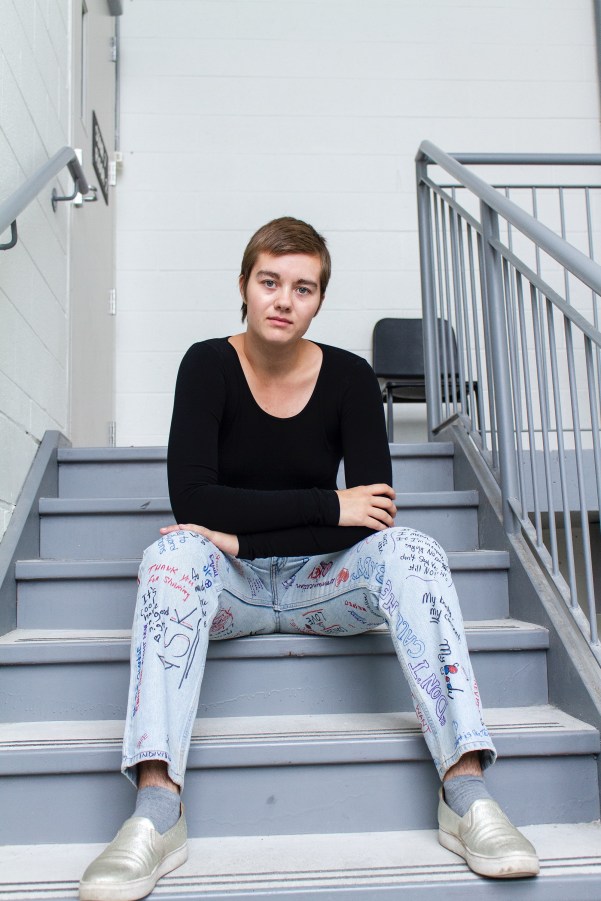
On the Resistance tour, Saffron A has brought along with them a pair of “consent pants,” which are jeans they ask the audience to write on them with markers about what consent means to them. “What began as a collaboration with Advocates for a Student Culture of Consent (ASCC), quickly became a community art project,” Saffron A explains. “I co-hosted two concerts at the beginning of my Resilience Tour with ASCC, and they wanted to have an artistic element at the events. I suggested we ask folks to write/draw/express what consent means to them on a pair of jeans.”

0A888215-1B38-4BE2-AE53-F0202F645562
Saffron A, Consent Pants. Photo by Kadee McFarlane. 2019.

The consent pants travelled from Brantford to Montreal, all the way up to Sudbury and beyond. I wrote on the jeans myself at the live show here at the Brown and Dickson Bookstore in London, saying that consent, to me, was “mutual respect.” Writing on these jeans evoked a lot of emotions, mainly since I had to think about what consent personally meant to me. The dictionary defines consent as “permission” or “agreement.” The pants say phrases such as “communication is key,” and “no consent on stolen land,” bringing up what consent looks like when Canadians occupy the land of Indigenous peoples outside of a mutual agreement. Both the consent pants and Saffron A’s music spark an essential conversation—when we don’t discuss consent, it masquerades its meaning, making it easier to become a grey area. The lack of understanding of consent only creates the potential to hurt others. Consent is something rooted in genuine care, and it’s an agreement that is so closely tied to power and trust.

Saffron A taps into their own vulnerability through their music and uses it as a tool for healing—they reclaim their own power and autonomy. Their music echoes so strongly in a society that perpetuates shame for rape survivors. Challenging toxic assumptions and how survivors are not taken seriously, they approach the subject in an open and engaging way. As they sing, “I’d laugh if I wasn’t terrified, I wouldn’t have to sing this song if this behaviour wasn’t going on.” Saffron A initiates the conversation about rape culture and sexual assault and asks us to collectively do better.

You can find Saffron A’s music on Bandcamp. Follow them on Instagram at @saffrockmusic.

In Conversation with Rae Spoon: Mental Health

Rae Spoon1
Rae Spoon portrait by Dave Todon. Courtesy of the artist.

Questions by Adi Berardini

Rae Spoon is an award-winning, non-binary musician and author whose music bridges indie pop, rock, folk-punk and electronic. Spoon owns and runs an indie record label called Coax Records that has released fifteen albums by Canadian and international artists. They have also been nominated for two Polaris Prizes, a Lambda Literary Award and a Western Canadian Music Award. A strong songwriter and performer who has toured for over 20 years, Spoon’s music is often connected to social activism/change, especially within the LGBTQ2+ community.

Rae Spoon’s latest album Mental Health addresses their own experience with mental health and the issues that arise in LGBTQ2+ communities while navigating the stigma around both mental health and queerness. Spoon describes that “I often think of albums in themes and that will often guide my writing. I try to tie in the songs in terms of that so there’s some continuity between them.” Spoon is well known for their insightful and introspective lyrics, and their new album is initiating the conversation that we need to be having about mental health.

I noticed that water is a particular theme in your music. I was wondering if you could talk about this inspiration and what water symbolizes to you?

I moved to Lekwungen speaking people’s territories in Songhees, Esquimalt and W̱SÁNEĆ territory, otherwise known as Victoria, BC. I have lived on the west coast before, but it has been a while since I lived in Victoria. I live where the pipeline would be, intersecting with the ocean. We all know it’s a big deal in terms of politics right now. There’s a great deal of activism with Indigenous people not wanting the pipeline to be built and the government pushing back, the federal government especially. I feel even more tied to this issue especially being from Alberta originally. [As a result,] I feel especially connected to the water around. That’s how the water theme started and why there’s often landscapes and waterscapes in my songs.

Your book Gender Failure is a collection of autobiographical essays, lyrics, and images documenting co-author Ivan E. Coyote’s and your personal journey from “gender failure to gender enlightenment,” based on your live tour. I was wondering if you could talk more about this tour and the inspiration behind the book?

We started the stage show for Gender failure in about 2013, and it premiered in an off-Broadway theatre in New York. It was the first multi-media narrative show I was doing so I was very nervous.

It was interesting since we were connecting with local audiences in New York about all of these Canadian stories of growing up. It was pretty cool, we could see it was something that was really connecting people despite that since we were talking about the strict gender binary and the rules of the patriarchy or sexism. You would always end up at some point in your life when you’re like “I don’t wanna do that.” Even the people who are benefitting from it [are affected by] how toxic the masculinity is.

We were going to make a show about being transgender and/or non-binary and we realized we made the show about how the gender binary is failing everybody, connecting a lot of people when I look back. We made it into a big show, we did two sets and toured with it for a couple years and we did some in London I think and across North America and Canada. In that process, we figured out some of the book and we added more pieces to create it. Our friend Clyde Petersen who is in Seattle did the live visuals for the show and made the illustrations and visuals for the book.

I saw you in London at the brewery on top of the Root Cellar. I remember that it was really creative and intimate, it was really special. I was wondering what your favourite part of touring smaller communities and maybe difficulties with that as well?

It’s really nice to go to small communities often since the LGBTQ2+ scene is really supportive. Although I’ve also had the same things happen to me in downtown Toronto as I’ve had in small communities. I’ve had issues getting yelled at—it can happen anywhere that the people can be oppressive or violent. However, I don’t usually stick to large cities, I like how supportive it is being there in small communities.

Before I learned to drive it was a challenge to tour on the Greyhound and tour in Western Canada, but now that I can drive it’s a lot easier. It’s great, I can also make my own hours. Often a lot of different people have to hang out since it’s not big enough to separate people into groups. The [different] scenes and the sort of queer scenes will often be connected which I like, with different ages and different backgrounds.

I see that you have started an indie label, Coax, which supports LGBTQ2+ and under-represented artists through community building. Do you have any advice for gender non-conforming/non-binary musicians who are just starting out in the music industry?

I am really all about community building. I think one of the best ways to meet other musicians is to support the music community, so when you’re starting out going to other shows and you then meet the musicians who are playing or supporting college radio, volunteering at festivals, you can meet a lot of people there who like music. The easiest way to try and build a following is to meet a lot of people who like music.

To be able to tour as a new act helps that, you can meet people from other towns, and you trade having people at the shows so that they know who you are. The best way to start out, in the beginning, is to help out other people and it can help you as well. It’s great to build more live scenes and music opportunities.

Print
Rae Spoon, Mental Health. The album will be out on August 16, 2019.

You have an album coming out in August called Mental Health. I was wondering if you could talk about the inspiration behind the album?

The beginning of the inspiration behind [the album] is the communities I am in, and also my own mental health stuff that I face. I think music can sometimes make space for that. I wrote songs about my own journey with mental health and the different perspectives [I’ve had] during my life.

I think there’s still a lot of stigma about mental health and stigma around queerness and [being] LGBTQ+. It’s important to make space for marginalized communities. Often, we lack services, or you can’t go to the hospital since they’re not going to get your pronoun right. Trauma issues aren’t going to go away but there are ways to find different tools. I was thinking a lot about that and also that it’s not something that needs to be cured. Like getting out of ‘caring’ culture [which doesn’t address mental health as an ongoing struggle], and instead, talking about the everyday journeys of survival.

Check out Rae Spoon’s latest album Mental Health which comes out on August 16th, 2019.

The album launch for Rae Spoon’s Mental Health and celebration of the long-list Polaris nominations for Kimmortal’s X Marks the Swirl and LAL’s Dark Beings is happening on August 14 at Fox Cabaret in Vancouver, BC.

Music, Art and Mysticism: Lay the Mystic

By Devana Senanayake

Lay The Mystic is a musician, performer and poet. Born to a Lebanese father and a Tongan-Fijian mother, Lay’s cultural heritage is reflected in his performances. Lay is also strongly influenced by mysticism and is a professional tarot card reader and hobbyist astrologer.

LayTheMusic_photo

Photo by Laura DV

Lay, you are really interested in the idea of mysticism, so much so that it has infiltrated all aspects of your performance. Can you explain this?

I am interested in mysticism—the idea is to go deep into whatever you are doing, as long as you are completely focused on where you need to be for everything to come through. It’s just about going deep, paying attention to what’s happening and being present.

You explore the concept of mysticism through tarot card reading. What led you in this direction?

Honestly, it was a calling. It’s something that I have always done; from maybe three or four, I was finding tarot cards and little books about palmistry and reading them and hiding them in my drawer when no one was looking.

It continued as a personal interest separately, and then I was mentored by a tarot card reader. She trained me in reading tarot specifically and a lot of what she does inspired how I choose to practice. It was a learning process from there.

It’s weird to throw down some cards and then to just see something that I don’t understand at all. Everybody’s perspective, everybody’s life is completely different. When I am reading for someone, for the duration of that [reading], they are the most important thing in the world to me. Literally, they are all I can see and all I can see from. They are sitting in me and I am seeing everything from their perspective. It’s like trying on another brain for a minute.

One of your hobbies is astrology. What’s your astrology practice like?

So that part is completely self-taught.

[Astrology] is mostly about observations, [more] than it is about anything else. It is partially analytical and partially intuitive as well. I know what these planets symbolize and you go deeper and deeper into that and follow the way that they play pinball with your emotions.

With astrology, I keep journals with every kind of transit. I have ten or twenty friends whose transits I am tracking. So, I keep journals on everything that’s happening and make a prediction, and [I’ll] just be like, “this is possibly an assumptive prediction, but let me know what happens on this day because these are the kinds of energies that are popping up,” and at the end of the day, they’ll send me a Facebook message and they’ll be like, “this is what happened, those themes were correct and this is how it actually ended up working out.”

It feels like you want to immerse yourself but also create spaces of immersion as well. Are your music and art similar to your tarot and astrology practices for this reason?

A lot of the time it’s me just studying. I’m less versed with astrology than I am with tarot. So with tarot, I’m confident enough to say that I’m a reader and confident enough to do it professionally. With astrology, I’m confident enough to impress people as a party trick at a party and that’s about it. With astrology, I keep journals with every kind of transit. A lot of the stuff on the Internet is based off a culture system that’s completely expired or incredibly Eurocentric in a lot of different ways.

A lot of the time it’s just recognizing a culture and its difference to European standards. It’s also incredibly hetero-centric in every way, shape and form.

Has your mother’s Tongan heritage particularly influenced your poetry?

So, [my mother’s background is] mostly Tongan, my mother’s father was a Tongan poet. So, apparently, Tongan poetic dialect is a completely different dialect of Tongan. The poetic dialect is sort of classical— instead of referring to a village by its name, you’d refer to it through the flower that grows on its hill. It’s a distinctive feature that defines it.

[I feel like] English is a worker’s language – it is a largely economic language, particularly, the kind of English that we seem to have inherited. It’s like “this many, how much, what’s this”. We have a thousand different words to describe a cash flow. There’s only one word for love.

Are you a completely self-taught musician?

I didn’t have any cash growing up. I just gathered bits and pieces like coins from the back of the couch and stuff. It’s actually the first time that I saved things. I’m horrible with cash. I bought a guitar from someone I met at the train station and taught myself how to play through Youtube. I locked myself in my room for several days in a row and I didn’t leave except to eat a little food and go to the bathroom.


Glass Vacuum by LAY The Mystic

Are you also a lyrical poet?

The first person who coined it was called Wani. We were having a chat about how what we do is so different from spoken word or slam or poetry that’s designed to be written. It’s set to music typically, has rhythmic flow and I guess it’s softer.

It is confessional but because of how I naturally speak and the way metaphor naturally slips into what I’m saying anyway, it does not sound confessional.

What makes the local music community in Melbourne so tight-knit?

When you don’t have a lot of external funding or a lot of cash flow to work with things, you tend to operate on a currency of favors. Rather than having anything on paper or anything like that, its understanding that everything works on goodwill.

A Body Gleaned Flyer with frindge logo

You have an event called the “A Body Gleaned” coming up for the Fringe Festival. Tell me a bit about this?

It’s just the idea that we are all constructed out of all these bits and pieces around us. Our lifestyle, our culture, our personal traditions and everything about what we do is inherited through our environment and our surroundings. If you are kind of born into a shitty story that you’d not continue, you can choose to not continue it, or you can choose to change it.

So the ultimate aim is to make immersive spaces for people. I tend to withdraw from recording all my stuff, from any piece I write ceasing to be a conversation or a dialogue. I don’t like recording a lot of the things that I do or poems or music that I do. I like that every piece that I do grows or changes with me and always acts as a conversation between me and whoever I am speaking to.

How is gender reflected in your work and various practices?

I do identify as a boy, but not as a man. I can’t figure out why man feels wrong to me as [being referred to a] woman does. But yeah, “I’m a boy, that’s what I am.” In terms of my practice, I choose to be completely honest about what my gender is or what my pronouns are without attempting to hate anybody. The idea is: “Ok, I’m here. I’m incredibly feminine but I’m a boy, you just need to get accustomed to looking at my face and thinking this is a boy.” That’s all the education that I’m going to provide to anybody.