Sand after sand, the oyster will cry: Anatomy of an Oyster by Rita Puig-Serra

Rita Puig-Serra. Anatomy of an Oyster, 2023. Courtesy of PhMuseum and the artist.

By Irene Bernardi

“Mother-of-pearl” is one of the most precious and rare types of pearls.

The Italian writer and poet Franco Buffoni crafted a unique poem to tell the story of how a grain of sand becomes this incredible and luminous pearl:


[…]
If you photograph the sand and then magnify it

To three hundred times

Each grain reveals itself as unique:

One looks like Saturn without rings,

Another is Venus, then Mars with colors,

Jupiter that stays under the fingernail

And Uranus that falls

Into the right oyster

And makes it cry

Becomes in a hundred years

Mother’s pearl.[1]

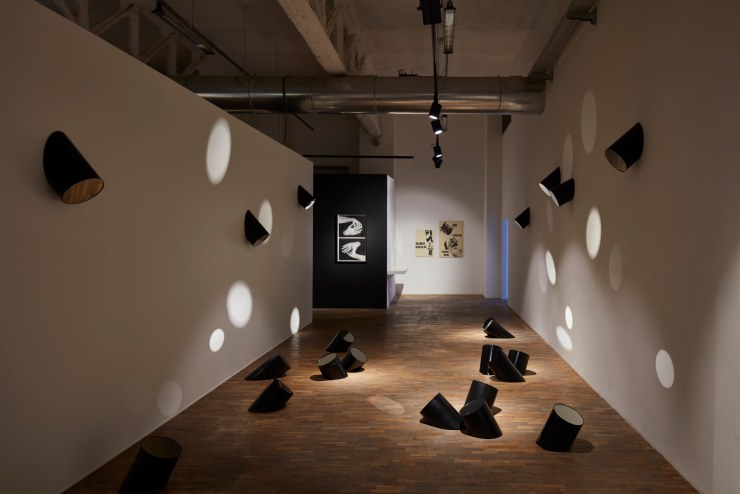
Into the poetic and scientific imagination of the Italian writer, a small and insignificant grain of sand — after a long journey through the planets of our solar system — accidentally slips inside an oyster. This lucky encounter will produce a small but precious pearl that “[…] becomes, in a hundred years, Mother’s pearl.” Anatomy of an Oysterthe solo show by Catalan artist Rita Puig-Serra — is a journey inside the artist’s consciousness that, through the metaphor of analyzing an oyster, tells the story of her personal experience with family abuse.

Rita Puig-Serra. Installation view of the exhibition Anatomy of an Oyster, 2024, PhMuseum Lab, Bologna
Courtesy of PhMuseum and the artist.


Walking inside the small space of PhMuseum Lab in Bologna, are some of the photographs realized by the artist creating a sort of labyrinth, recreating an old installation made by the Italo-Brasilian architect Lina Bo Bardi for the Museum of Art in Sāo Paulo in 1970[2].

The artworks of Puig-Serra as the design of Bo Bardi are placed in clear glass panels, attached to concrete blocks: the exhibition’s layout fades, letting the visitor choose the order in which to see the works. The concrete blocks are as heavy as the words that the artist wants to tell to an absent mother during her childhood. That small insidious grain slowly takes shape and grows, pressing inside the oyster, much like the artist’s thoughts, words, and desires, which, as she grows, can no longer ignore the pearl of fears that have been with her since childhood.

Rita Puig-Serra. Installation view of the exhibition Anatomy of an Oyster, 2024, PhMuseum Lab, Bologna
Courtesy of PhMuseum and the artist.

Rita Puig-Serra. Installation view of the exhibition Anatomy of an Oyster, 2024, PhMuseum Lab, Bologna
Courtesy of PhMuseum and the artist.

Emerging from the labyrinth, a series of photographs are lined on the wall. Some depict the lengthy process of extracting mother-of-pearl, while others showcase the artist’s childhood from her archive, complete with phrases and memories. This is the journey of Puig-Serra inside the process to extract her deep memory of the abuses.

The oyster will produce layers of nacre around the nucleus.

This delicate narrative unfolds like a puzzle of memories: analog photographs from her childhood are interwoven with descriptions of the anatomy of an oyster and memories. The ghosts of her family are both visible and hidden within this narrative, such as old photos in which the artist shows some details of the person who abused her. Isolated on one side of the exhibition space is a letter recreated by the artist, written to her best friend, and then burned in a park. Injustices, abuses, and silences experienced are kept inside a small oyster on the sea floor for years when finally the mother-of-pearl sees the light of truth.

Rita Puig-Serra. Installation view of the exhibition Anatomy of an Oyster, 2024, PhMuseum Lab, Bologna
Courtesy of PhMuseum and the artist.


How small and insignificant can a grain of sand be compared to a planet? What are the chances that this grain can transform into mother-of-pearl? Anatomy of an Oyster gathers all these seemingly insignificant childhood events of Rita Puig-Serra to explore pain and abuse. It’s a self-analysis that takes shape in the anatomy of an oyster, which is studied, analyzed, photographed, and assimilated, only to be removed—just like the memories of the Catalan artist.

Rita Puig-Serra (Spain, 1985) is a photographer living in Barcelona. After a humanistic education and a Master’s degree in comparative literature, she studied graphic design and photography.


The project Anatomy of an Oyster was released by Witty Books in 2023. The exhibition is part of PhMuseum International Photo Festival place from 12 to 15 September 2024 in Bologna, Italy.

The PhMuseum Lab will be open 4pm-7pm during the Festival days in Via Paolo Fabbri 10/2a.


For more information about PhMuseum International Photo Festival, visit their website and Instagram.

For more information about Rita Puig-Serra and her exhibition, visit her website and Instagram.


[1] trad. from Franco Buffoni, Betelgeuse e altre poesie scientifiche, 2021, Mondadori, Milano

[2] Moffit E., How Lina Bo Bardi Built An Art World Without Walls, 14/04/2020, www.frieze.com

A Feminist Curating Gaze with Artierranti

Deconstruction of the Patriarchal Art World

Artierranti team. Left to right, Laura Brambilla and Giorgia Casadei.

By Irene Bernardi

ARTIERRANTI is a cultural association born in 2013 based in Bologna, Italy. The main intention of their project is the concept of curation as the primary form of mediation. Each project stems from a close collaboration with the artists and is defined as a unique event. The research is focused on finding amplifiers for the work and the poetics through curating solo exhibitions and seeking collaborations for each artist with experts, organizations, and institutions.

Today Laura Brambilla and Giorgia Casadei are leading the project, which finds “home” at Officina Artierranti, located in the city center of Bologna.

You define yourself as a Feminist and Woman cultural association.How do you prioritize feminist values in art and curating within your exhibitions and workshops? Especially today where most curatorial and art positions are held by men!

In 2022, when we dedicated ourselves to redesigning our website, we decided to include the description “a female and feminist association” in our presentation. This is a phrase that we might have found somewhat daring in the past, but today, we have chosen to formally declare our stance, in line with what the art world demands. I always think of Carla Lonzi, an art critic and activist, who wrote in Autoritratto: “When I learned that feminism existed, I didn’t even bother to find out what it was, I am a woman, I do feminism.”[1]


Perhaps the same has happened to us. Naturally, our research gravitated towards feminism, opting not only to give more space to female artists but also to promote works that would foster debate, to continue questioning the role we have played throughout history and the space we wish to claim today.

An important topic in your curatorial footprint, is the synergy with spaces where you decide to have an exhibition: not a simple white cubebut places where we can see a strong relationship with the artist, poetics, and artworks. What criteria do you use when selecting unconventional locations for art exhibitions? Can you give some examples from past exhibitions or projects?


Initially, the choice to be nomadic was determined by our lack of a stable location. When we founded Artierranti in 2013, we were still students at the Academy of Fine Arts, quite uncertain about our future, and it seemed best not to commit to managing a space we would struggle to maintain. For this reason, Giorgia and I envisioned a nomadic association, capable of moving and transforming in response to the artist and the project. This curatorial approach stood in stark contrast to the white cube, which tends to eliminate any form of contamination, a thought that believed (and still believes) that every artist and every poetic requires a proper place of resonance.

This, of course, had direct consequences such as the choice to hold only solo exhibitions, besides the fact that, from a logistical standpoint, moving always to unconventional places not intended for exhibitions imposed many more limitations in terms of setup. Over the years, we have searched for places that were increasingly consistent with our research project, even from a content perspective. Consider, for example, what we did with Guido Volpi at the Luigi Fantini Museum of Speleology or, for instance, with Susana Ljuljanovic at the Cassero – Gender Identity Documentation Center in Bologna. In these projects, not only did the location become an integral part of the research, but it also served as a code for understanding the project.   

Susana Ljuljanovic, Song of Invisible Garden, 2022. Cassero – Gender Identity Documentation Center, Bologna. Courtesy  of Eleonora Conti and the artist.

How do you reconcile reflecting on past experiences and planning future projects inside and outside Officina Artierranti?


In 2016, we decided to establish a physical headquarters for the Association. This idea stemmed from the fact that our wandering made it difficult to identify and recognize Artierranti. We wanted to showcase what we had been able to build in the early years by creating a hub where we could meet artists, construct, and store all the staging supports created by Giorgia, and also collect artworks donated by artists who had collaborated with us. Thus, Officina Artierranti was born with the dual soul of an archive and a workshop, facilitated by the presence of a street-level floor with a display window and a basement. In constructing this new phase, we set a rule for ourselves: Officina Artierranti would never become an exclusive exhibition venue, but we would continue to seek other places to set up exhibitions to create increasingly conceptual connections with the city. Collaborating with various local entities has allowed us to create solid relationships that persist.

Adele Dipasquale, I swallowed a Butterfly, 2024. Educational Department, MAMbo Museum of Modern Art of Bologna. Courtesy of Artierranti and the artist.

I would like to talk about the latest exhibition at ART CITY 2024 in Bologna, I SWALLOWED A BUTTERFLY, a solo exhibition by Italian artist Adele Dipasquale. The exhibition focused on the role of sound as a cultural and patriarchal tool. How does this concept contribute to the exploration and subversion of patriarchal power dynamics within Dipasquale’s works?

Meeting and delving into Adele’s work was extremely interesting. When we [encountered] their videos, we were deeply fascinated by the imagery. But each image is a gateway to a complex universe of references to history, mythology, and literature that show how the education we receive from early childhood is fundamentally patriarchal. In Adele’s work, the most apparent trait of this female subordination is addressed through sound: the female protagonist decides to emit all possible sounds, including the guttural and monstrous ones attributed from Aristotle onwards to the female gender, thus losing her own voice. In this way, achieving a state of silence becomes an exercise in freedom.

Adele Dipasquale, I swallowed a Butterfly, 2024. Educational Department, MAMbo Museum of Modern Art of Bologna. Courtesy of Artierranti and the artist.

What I have seen as a “red thread” among many of the recent exhibitions is how the feminine tries to regain the freedom that has been taken away from it, partly because of the many superstitions and attributions throughout history.


Certainly, we deliberately chose to open Adele Dipasquale‘s curatorial text with a quote from the essayist Nicoletta Polla Mattiot, which says, “There is no conviction more deeply rooted than the cliché.”[2] Reflecting on the past two years of work, I realize that we have traversed different worlds and cultures, from Greek mythology to Mexican mythology before and after Spanish colonization. We have encountered powerful female figures, both real and imaginary, who, precisely because of their great power, have been gradually forced to inhabit increasingly small and controlled spaces, eventually becoming figures of the abyss, often monstrous and horrific. In this way, in Noemi Mirata‘s exhibition, the myth of Proserpina encountered Gloria Anzaldúa’s “Borderlands,”[3] finding strong correspondence with the goddess Coatlicue: two women who inhabit the borderlands and contain within themselves the power of life and the power of death.

Noemi Mirata, PROSERPERE. Indicativo presente, 2023. Offina Artierranti, Via Sant’Isaia 56/A, Bologna. Courtesy of Eleonora Conti and the artist.

What advice would you give to someone who is taking their first steps into the world of curation?

We are well aware that working in the arts, especially in Italy, means struggling. Often, we have chosen to self-fund our projects rather than spending unpaid work hours trying to access some form of funding, so the best advice we can give is to always have fun first and foremost. Finding pleasure in one’s research is crucial in order to offer quality work. Another important aspect is to always strive to build a relationship of equality and ongoing exchange with artists, which is one of the most interesting aspects of our work. Finally, I believe that today it is essential to choose how to position oneself and consequently propose exhibitions that are consistent with one’s research line, without running the risk of becoming overly didactic.


Can we have a little preview about your next project?

We are currently following several projects. First, we would like to conclude the trilogy about gender/boundary with a final exhibition by a female artist. At the same time, we are planning the next exhibition to be proposed within Art City Bologna 2025. Additionally, for some time we have been thinking about a much broader project dedicated to the relationship between women and nature, involving various artists who have collaborated with us over the years. In this case, we would like to somewhat disrupt our patterns, perhaps thinking as a curatorial collective…however, at the moment we do not want to reveal too much!

You can find more information about Artierranti on their Instagram or Facebook.


[1] Carla Lonzi, Autoritratto. Accardi, Alviani, Castellani, Consagra, Fabro, Fontana, Kounellis, Nigro, Paolini, Pascali, Rotella, Scarpitta, Turcato, Twombly, Abscondita, Milano, 2021

[2] Nicoletta Polla Mattiot is an Italian essayist and journalist.

[3] Gloria Anzaldúa was an American sociologist and writer of Chicana, feminist, and cultural theory. 


The Queer World of Relationships: In Conversation with Francesco Esposito


Francesco Esposito self-portrait, 2023, Courtesy of the artist.

By Irene Bernardi

The photos taken by Francesco Esposito tell more than meets the eye. They are visual poems that narrate what new generations are experiencing in an increasingly complex world. Through the lens, the Italian artist tells the delicate relational entanglements of a polyamorous couple that he follows step by step in their personal growth. 

Born in Naples in 1997, Francesco Esposito moved to Bologna where he started his artistic career. He attended the Academy of Fine Arts in Bologna and received his BA in Graphic Arts and MA in Photography. Esposito’s works have been exhibited in major art events such as Open Tour and Art City promoted by the Academy of Fine Arts of Bologna, IBRIDA Festival of Multimedia Arts, and BASE Milano.

Irene Bernardi: In your early work, you expressed yourself through graphic signs and engraving, then later you switched to photography, using a completely different medium. Did you ever find a meeting point between the two?

Francesco Esposito: Absolutely. I have been taking photographs since childhood. Later, I started combining these two disciplines and making photogravures. My approach to etching was born from the desire to learn about a new medium of expression and the extreme similarity between these two techniques. Both mediums involve the use of external agents to create an image. In the case of etching, the agent is acid that etches the material, while in photography it is light that impresses a photosensitive surface.

IB: The themes you deal with in your photographs are relevant to today’s society, which tends to suffocate us more and more and homogenize us as a function of productivity: we need to be perfect and neither feel nor demonstrate our emotions. What drives you to confront these major issues characteristic of Generation Z?

FE: Being born between two generations has exposed me to changing ideals and perspectives on life. This [has] had a significant impact on my perception of the world and my artistic expression. Becoming aware of the major issues that have come up in our society at the level of mental health and sexuality, I decided to make them central themes in my poetry. I am talking and taking pictures about these issues to contribute more information and awareness for part of the public.

Understanding and acceptance of sexuality can have a direct impact on people’s mental health, while mental health can influence self-perception and one’s relationship with sexuality.

Worry, 2022, Courtesy of the artist.

IB: Looking at your portfolio, I was very impressed by the Worry series where you discuss when anxiety becomes pathological and the sufferer dissociates from reality, losing control of it.
What technique did you use to make these shots? How did you conclude that it was the best method to render that feeling of loss and dissociation?

FE: When I decided to start this project, I was going through a period in my life fully involved with this theme.
The choice of this technique came from the idea of “glow,” something that blinds you, distances you, and alienates you from reality. I wanted to reproduce these “glows” by using flash on smooth, reflective surfaces; however, the result did not satisfy me. However, I continued to think about the idea of reflection, something that we cannot eliminate, something that often attracts and obsesses us.

The solution came when I visited an Anish Kapoor exhibition in Venice: the Indian artist used distorting mirrors, which made me realize that the distortion effect could best represent my state of mind. So, I began taking photographs of my everyday life using the bottom of a bottle as a distorting filter.

Installation view, QueerPandèmia. Artistic contaminations of other kinds, 2023, Base Milano, Courtesy of Riccardo Ferranti

IB: Your latest project, People’s House, has been selected to be part of QueerPandèmia. Artistic contaminations of other kinds, an exhibition hosted at Base Milano as part of Milano Pride in July 2023. This show by ULTRAQUEER, a project of TWM Factory, aims to give space, voice, and representation back to the Queer community, centering the discourse on how it is perceived by the outside world. Reflections take place on queer identity and its relationships, going through tools, struggles, and new practices with which to invade spaces and gain a place in the world.

The People’s House series includes very complex and delicate shots that run through the lives and relationships of Enea and Luna, a polyamorous couple living in Bologna. How did this collaboration come about?

FE: After becoming interested in the topic of polyamory, having never had this kind of relational experience, I realized that I could only know more about this topic by getting to know people living in that kind of relationship. Conversing with some friends, I met Luna and Enea who gave me the possibility to collaborate with them, making me [closer to] this world.

IB: Photographs of their daily lives are accompanied by shots of natural elements that dialogue with forms and compositions that the bodies create. Flowers, stems, shoots, but also water and light, reflect the relationship of mutual love and trust that polyamory creates, as in the relationships between plants and natural elements.

Nature is wonderfully homosexual, non-monogamous and queer, which is the basis of Queer Ecology(1) theories. This scientific theory aims to unite queer theories and ecology to shift paradigms from binary, rigid, and heteronormative ways of understanding nature toward interdependence and fluidity. How does this theory relate to your shots?

People’s House, 2022, Courtesy of the artist.


 FE: These shots representing nature, aim at an analogy with polyamorous relationships. They don’t have a scientific basis, they are only metaphors for this. Often, we are wrongly pointed out to how the queer, polyamorous world is “against nature.” I tried to metaphorically counter this word with these shots.

People’s House, 2022, Courtesy of the artist.

“Today, polyamory is often misunderstood as strictly sexual behaviour or an open relationship. In reality, this kind of relationship implies much more: it implies bonding, involvement, freedom, and shared growth with multiple individuals, just as it happens spontaneously in nature.”

IB: I think this quote from your project is very important for today’s society to revisit the concept of a “natural relationship” by stepping out of heteronormative dynamics—the queerness of nature has long been ignored, suppressed, and dismissed to reflect society’s underlying prejudice against non-heterosexual and non-cisgender identities.

What reflections arise from this project of yours and your personal experiences?

FE: People’s House is not exclusively about polyamory, but also about freedom and spontaneity. Realizing this project, meeting people, and talking to the people who were part of it, I realized how there is no difference between a polyamorous relationship and a monogamous one. It is often considered a happy little bubble, but what makes it true and equal to monogamy are precisely the same issues that are faced.

Spending time with people who collaborated on the project, I also decided not to focus on the sexual and carnal dimension of this type of relationship more than necessary, but more on their sentimental reality, on the understanding that is normally created in any type of polyamorous or non- polyamorous relationship. This is precisely to depart the idea of polyamory from the concept of an “open” or exclusively sexual relationship, something which it is often confused with.

People’s House, 2022, Courtesy of the artist.

IB: Your photographs give a very strong and pleasing intimacy and delicacy. Is there a shot (or more than one) that is particularly meaningful to you?

FE: It’s hard to find one shot that I consider more meaningful than the others, precisely because from a personal point of view, each shot tells the story of the path that I took with the people I portrayed. Therefore, they all have great meaning for me, even the discarded images.

If I had to choose the most emblematic ones, I think they would be the one depicting hands crossing and the one in which two guys lying in bed, naked and conversing with each other. The first is because I think it is also the one that best summarizes the entire work, the second shot chosen I find is perfect for explaining how much intimacy and freedom there is between each individual member in that relational situation.

IB: As the last question, can you share some visual and non-visual artists who have accompanied you in your personal artistic process?

FE:In this last period I was very inspired by the shots of photographer Ute Klein (2).She is young but with her photography she creates bonds between people by intertwining their anonymous, unidentifiable bodies.
These bodies have souls, feelings and just like the bodies of Enea, Luna and their partners: intertwining they tell us the beauty and fragility not only of their story but of the stories of all.

You can find more of Francesco Esposito’s work on his Instagram @serafjno. You can find out more about Base Milano on their website and Instagram. Check out Ultraqueer on their website and Instagram.

You can find the QUEER PANDÈMIA book here.

1 Ingrid Bååth, Queer Ecology, Explained, https://www.climateculture.earth/

2 Ute Klein, https://cargocollective.com/uteklein


The Unexpected Subject: 1978 Art and Feminism in Italy

The Unexpected Subject • 1978 Art and Feminism in Italy. Installation shot, FM Centre for Contemporary Art. 2019. Photos courtesy of Raffaella Perna.

April 4 – May 26, 2019

FM Centre for Contemporary Art, Via Giovanni Battista Piranesi 10, Milan

by Gabrielle Moser

A mouth, open wide and mid-speech, hovered over a black ground on the enormous banner hanging above the entrance to the FM Centro per l’Arte Contemporanea in Milan, soundlessly announcing the exhibition The Unexpected Subject: 1978 Art and Feminism in Italy. Superimposed in a diagonal line, the words “ti AM O” (a play on “I love you” in Italian) articulated the lips’ unheard utterance. A Letraset collage on cardboard created by the Rome-based artist and curator Mirella Bentivoglio and titled AM – (ti amo) (1970), the visual poem conjures up the way that identity is constituted: every “I” must have a “you” to address itself to. But it also calls to mind the words of the Rivolta Femminile, a feminist collective founded by Carla Lonzi, Carla Accardi and Elvira Banotti that, between 1970 and 74, self-published a series of essays condemning the omission of women from Western philosophy and communist politics, and argued for the vital force of language, both written and spoken, in constituting women’s identity. “Not being trapped within the master-slave dialectic, we become conscious of ourselves,” they wrote. “[W]e are the Unexpected Subject… An entirely new world is being put forward by an entirely new subject. It only has to be uttered to be heard. Acting becomes simple and elementary.”[1]

The Unexpected Subject • 1978 Art and Feminism in Italy. Installation shot, featuring Mirella Bentivoglio’s AM – (ti amo) (1970). 2019. FM Centre for Contemporary Art. Photos courtesy of Raffaella Perna.

            But if the unexpected subject can be uttered and heard, it is less clear how it comes to be seen, especially when, as so many Italian feminists of the 1970s pointed out, the visual codes for women’s subjectivity were (and one could argue still are) constrained by patriarchal modes of representation. A contradictory impulse lies at the heart of this historical moment in Italian feminist practices. On the one hand, artists, philosophers and writers sought to generate what J.L. Austin would describe as new visual, verbal, textual and performative utterances to signify female subjectivity and sexual difference,[2] while on the other, figures like the art critic Carla Lonzi insisted that de-culturation (the un-learning of male culture) and “dropping out” were the only strategies through which women could achieve freedom.[3] As a visual arts exhibition that incorporated archival materials, video, ephemera, textiles and sound, alongside the more conventional fine art modes of collage, sculpture, painting and photography, the show navigated these two drives while also attempting to translate the particularities of Italian feminist thinking for a wide, implicitly international audience.

The Unexpected Subject • 1978 Art and Feminism in Italy. Installation shot, FM Centre for Contemporary Art. 2019. Photos courtesy of Raffaella Perna.

            Curated by Marco Scotini and Raffaella Perna, the exhibition’s global address speaks to a wider resurgence of interest in the practices of 1970s Italian feminism, both within and outside Italy. Elena Ferrante’s wildly successful Neapolitan novels, for instance, have been read as a take on the feminist practice of affidamento, or entrustment, between two life-long female friends, in which the differences (or disparities) between two women are a generative source of sustenance and recognition.[4] The work of contemporary artists Claire Fontaine and Alex Martinis Roe, meanwhile, takes up the politics of the Rivolta Femminile and the Milan Women’s Bookstore explicitly in both its form and content, while groups such as the Feminist Duration Reading Group in London and the EMILIA-AMALIA collective in Toronto (of which I am a member) have worked to translate, annotate and activate key texts from the period.[5] Largely unknown in the English-speaking world until recently, Italian feminist thought was explicitly at odds with the horizontal model of sisterhood that dominated 1960s Anglo-American feminism. [6] Coming after the surge of “second wave” feminist activity in the United States and England, Italian feminism sought to correct or avoid what it saw as the failings of this earlier movement, including the devaluation of the authority of older and more experienced women, the fight for the legalization of abortion, the refusal to ask for maternity leave (particularly in the US), and, most importantly, the investment in equality with men as a political goal.[7]

            In the place of these bids for legal and formal equality, the women’s groups meeting in Milan and Rome in the 1970s sought two parallel forms of freedom: a representational one that required discarding an existing repertoire of representations that privileged the male perspective, and a symbolic freedom, centered on making spaces for women to think themselves differently. For this reason, many feminist groups of the 1970s turned to autocoscienza, or consciousness-raising, activities, to autobiography, and to group psychoanalysis as practices that would allow women to create a new symbolic order that could transform their everyday relationships and their understanding of their position in history.[8] Carried out in separatist, largely private spaces (another difference from the public, collective imperative of Anglo-American feminism), these activities embodied the mantra that one must “start from oneself,”[9] centering personal, lived experience as the only grounds for knowledge production.

The Unexpected Subject • 1978 Art and Feminism in Italy. Installation shot, FM Centre for Contemporary Art.2019. Photos courtesy of Raffaella Perna.

            In the context of exhibition-making, Scotini and Perna, therefore, set themselves a tall task: to not only try to coherently narrate an often ungainly explosion of feminist activist, artistic, political and filmic production that emerged during the period around 1978 (there were no less than 100 artists and artist groups on display across the exhibition), but of cataloguing the visual gestures that needed to be invented to articulate women’s previously unthinkable position as speaking, acting subjects. The thematic sections of the exhibition—language and writing; objects and the domestic world; image and self-representation; and the body and its performativity—were necessarily permeable and messy, and the show sometimes contradicted itself. While this is not an uncommon curatorial gesture that ideally unsettles curatorial authority and signals the dynamic ways histories are told and contested, when combined with the encyclopedic scope of the exhibition, it occasionally produced abrupt disconnections and doublings as the viewer moved through the galleries.

            Operating as a prelude to the exhibition, for instance, was a darkened semi-circular space, reminiscent of a theatre proscenium, surrounded by black curtains onto which the nearly four-hour long film Anna (1975), directed by Alberto Grifi and Massimo Sarchielli, was projected. Warped and misshapen in its tiny theatre area, the film took on a ghostly aspect: the din of a street scene on the Piazza Navona in Rome was almost unintelligible, and its visuals nearly opaque. While the film is infamous in Italy for its depiction and exploitation of its eponymous subject, a 16-year-old pregnant young woman that Grifi took into his home, it was presented in the exhibition without any explicit curatorial framework, leaving the viewer to infer that everything Anna represented provided the negative ground onto which the figure of the unexpected subject could emerge.[10]

The Unexpected Subject • 1978 Art and Feminism in Italy. Installation shot, FM Centre for Contemporary Art. 2019. Photos courtesy of Raffaella Perna.

            Pushing through one of two openings hidden in the curtained screen, I entered into the main room, in which a towering vinyl print out of a black and white photograph of Carla Lonzi—leaning authoritatively against a gallery wall, one hand on hip, smartly dressed in a white button-down and leather skirt—announced the pivotal impact of her work on the feminists and artists of her generation. A vitrine set into the same wall displayed archival photographs of the women of Rivolta Femminile, images of Lonzi at work over her typewriter—her famous Dictaphone in hand—as well as first editions of Lonzi’s books in their identical green covers. Their titles alone are thrilling in their imperative tense and their playful, antagonistic approach: Self-Portrait (1969); The Clitoridean Woman and the Vaginal Woman (1971); Let’s Spit on Hegel (1974); Shut up. Or, rather speak: Diary of a Feminist (1978); Now You Can Go (1980). Nearby, sound and video work by Cathy Berberian, Betty Danon, Ketty La Rocca, and Katalin Ladik activated these ideas through the artists’ bodies. La Rocca’s video, Appendice per una supplica (Appendix for a Petition) (1972), was particularly evocative of the problematic that Italian feminists sought to address. In this performance for the camera, a closeup shot shows the artist’s hand as it attempts to slowly navigate the small spaces left between the fingers and palms of another pair of men’s hands. Soundless, the video plays with a repertoire of possible gestures responding to the male subject, from the sensuous and erotic, to the suffocating and forceful.

            Like Lonzi, La Rocca is a central figure for 1970s Italian feminist art practice and is one of the reasons the exhibition focuses on the date 1978. Though the works in the exhibition span the early 1960s to the 1980s, 1978 was marked by several important moments of international resonance, including the exhibition of 80 women artists at the Venice Biennale, organized by Bentivoglio (a show that is painstakingly recreated in one room of The Unexpected Subject), a posthumous exhibition of La Rocca’s work also at the Biennale (she had passed away at the age of 38 two years earlier), the publication of Lonzi’s Taci, anzi parla. Diario di una demminista (Shut up, or rather speak. Diary of a Feminist), and the issuing of a collective book/self-portrait by the “Wednesday group,” titled Ci vediamo mercoledi. Gli altri giorni ci immaginiamo (I’ll see you on Wednesdays. The other days, we’ll imagine one another). But in many ways, 1978 can also be thought of as part of the “long history” of international student protests of ten years earlier (Lea Melandri’s essay for the exhibition catalogue is tellingly titled “1968 Lasting a Decade”) in which that earlier moment’s “undetonated potential”[11] met with Italy’s particular history of armed working class strikes and autonomia post-war politics.

The Unexpected Subject • 1978 Art and Feminism in Italy. Installation shot, FM Centre for Contemporary Art. 2019. Photos courtesy of Raffaella Perna.

            The most surprising discoveries of the exhibition were those works that elucidated this particular tension between local concerns and transnational movements. Tomaso Binga’s Alphabeto poetico monumentale (1976), for instance, echoed the strategies of conceptual art photography but made them engagingly vulnerable by manipulating the artist’s nude form into the shape of every letter of the alphabet. Documented in spare black and white photographs taken from above, the body here becomes an unactivated medium for speech. Similarly, Irma Blank’s Trascrizioni Documenta ABCD (1977) toys with the limits of speech and the politics of opacity, seeming to transcribe a 36-page typed manuscript into indecipherable scribbles that—while refusing the legibility of language—are nonetheless faithful signs of the artist’s hand moving across the page.

A room devoted to Betty Danon’s work with the International Mail Art movement, beginning in 1973, displayed more than 200 responses to her initial postcard project: a doubled pentagram which she invited international artists to intervene upon before returning it to her. Hanging banner-like from the ceiling, respondents included Carolee Schneemann, Ray Johnson and Shozo Shimamoto. Liliana Barchiesi’s Casalinghe (Housewives) series of gelatin silver print photographs (1979), meanwhile, offered intimate, moving portraits of women at their unpaid domestic and care work that resonated with the urgent politics of Silvia Federici’s landmark book, Wages Against Housework (1975).

            Given how eloquently these works spoke to Italian feminist art production’s links to international conversations, it was ironic that one of the exhibition’s missteps was its room explicitly devoted to the “international dialogue” between artists in Italy and those from the United States and Europe (and especially Eastern Europe). Featuring performance documentation, sculpture, video and photography by Schneemann, Valie Export, Joan Jonas, Marina Abramović, Gina Pane, and Sanja Iveković, among others, the section threatened to succumb to the tendency of legitimating underrepresented histories by comparing them to the Western canon of art historical and feminist works. By telling the viewer that Italian feminist art responded to international audiences, rather than allowing the artworks to show it, the gallery had the strange effect of making the earlier works feel redundant: a disappointment when the need for nuanced transnational connections between feminist artists and practices is more urgently felt than ever.

            The exhibition catalogue that accompanied the show is thankfully rich with historical context, including reprints of key essays by Italian thinkers and curators from the period, alongside generous reproductions of the artworks on view, and related press coverage from 1970s issues of Flash Art magazine. Although the English translations of the curatorial texts are sometimes awkward, the publication’s visual material and richly researched footnotes make up for them. Perhaps the issue of translation is the most urgent and unresolved one for the exhibition, beginning with its title. While the translation of Carla Lonzi’s wonderful phrase il soggetto imprevisto as the “unexpected” subject is not wrong, there are (as with all translations) nuances to the term that are lost in the economic move to its English equivalent. Imprevisto also suggests the un(fore)seen, the suddenly emergent, or the yet-to-be-realized. With its foundations in psychoanalytic thinking, Italian feminist practice has consistently recognized the powers of the unconscious on human behaviour and our limited capacity to know ourselves—it has also put great hope in the symbolic realm as the site of radical political transformation. It is perhaps this aspect of the exhibition that is the most potent: the suggestion that there is so much more to be excavated, uncovered and uttered in the unfinished project of the feminist movement.


[1] “Manifesto di Rivolta Femminile” in Carla Lonzi, Sputiamo su Hegel (Milan: Scritti di Rivolta Femminile, 1974). English translation by Veronica Newman available at http://blogue.nt2.uqam.ca/hit/files/2012/12/Lets-Spit-on-Hegel-Carla-Lonzi.pdf

[2] J.L. Austin, How to Do Things with Words: The William James Lectures, edited by J. O. Urmson (Oxford: 1962).

[3] The Italian art critic Carla Lonzi was particularly vocal in advocating for “dropping out” as a feminist strategy of withdrawal. See Lea Melandri, “Autonomy and the Need for Love: Carla Lonzi, Vai pure,” MAY 4 (2010), n.p.; Giovanna Zapperi, Carla Lonzi: un art de la vie – Critique d’art et féminisme en Italie (1968-1981), Christophe Degoutin, trans. (Paris: Les presses du reel, 2019); and Claire Fontaine, “We Are All Clitoridian Women: Notes on Carla Lonzi’s Legacy,” e-flux journal #47 (September 2013), https://www.e-flux.com/journal/47/60057/we-are-all-clitoridian-women-notes-on-carla-lonzi-s-legacy/.

[4] The Milan Women’s Bookstore Collective is credited with first writing about the practice of affidamento, or “entrustment,” a term used to describe the long history of relationships between women founded on difference.

[5] For further context about these returns to 1970s feminisms from Italy and abroad, see Helena Reckitt, “Generating Feminisms: Italian Feminisms and the ‘Now You Can Go’ Program,” Art Journal 76.3-4 (January 2018), pp. 101-111; and Catherine Grant, “Fans of Feminism: Re-writing Histories of Second-wave Feminism in Contemporary Art,” Oxford Art Journal 34.2 (June 2011), pp. 265–286.

[6] It is problematic to homogenize the practices of Anglo-American feminism, especially under the rubric of “second wave” feminism, just as it is impossible to argue there is any one thing called Italian feminism. Both movements were networked, dispersed, and heterogeneous and the most interesting aspects of each have been obscured in dominant narratives of the period. See, for instance, South Atlantic Quarterly’s excellent special issue on 1970s Feminisms (Lisa Disch, ed., Volume 114, Issue 4, October 2015), and in the Italian context, Paola Melchiori’s essay “The ‘Free University of Women.’ Reflections on the Conditions for a Feminist Politics of Knowledge,” in Gender and the Local-Global Nexus: Theory, Research, and Action V. Demos and M Texler Segal, eds, Advances in Gender Research, Vol. 10, (Bingley: Emerald Group Publishing Limited: 2006), pp. 125-144.

[7] For an overview of some of Italian feminism’s main claims, see the Milan Women’s Bookstore Collective, Sexual Difference: a theory of social-symbolic practice, Teresa de Lauretis, trans. (Bloomington: Indiana University Press, 1990),pp 60-63. The original title of the book in Italian translates to “Don’t think you have any rights.”

[8] In the model put forward by performance studies scholar Diana Taylor, it is not only the repertoire of female stereotypes that needed to be jettisoned, but also, importantly, its archive. It is for this reason that groups like the Milan Women’s Bookstore and the 150 Hours School began by generating bibliographies, and eventually literal libraries, of women’s writing that could constitute an alternative or counter archive. See The Archive and the Repertoire (Durham, NC: Duke University Press, 2003).

[9] “Doing justice starting with oneself” in the Milan Women’s Bookstore Collective, Sexual Difference: a theory of social-symbolic practice, Teresa de Lauretis, trans. (Bloomington: Indiana University Press, 1990),pp 134-142.

[10] See Rachel Kushner, “Woman in Revolt: Alberto Grifi and Massimo Sarchielli’s Anna,” Artforum (November 2012), https://www.artforum.com/print/201209/woman-in-revolt-alberto-grifi-and-massimo-sarchielli-s-anna-36151.

[11] Elizabeth Freeman, Time Binds: Queer Temporalities, Queer Histories (Durham, NC: Duke University Press, 2010).


The end of the road: Julia Frank’s Fine Corsa

1FC_Eye_Entrance1_JuliaFrank
Julia Frank. FC / Eye, Color print on semitransparent textile. Galleria Doris Ghetta. 2020.

By Victoria Dejaco

Preface: Julia Frank’s solo exhibition FINE CORSA at Galleria Doris Ghetta opens with a large curtain of fabric, an all-seeing singular eye. Through FINE CORSA, Frank addresses the environmental concerns of the warming planet we live on through cosmogony. The exhibition contains an artificial crystal—a large, melting block of contaminated ice filled with microplastics. The crystal causes the viewers to dwell on the power of our actions that taint its very nature. Frank asks us how long our human-made illusion can last if the earth’s ecological imbalances are ignored.

The exhibition is situated in the current Northern Italian Covid-19 hotspot. Regardless of its physical inaccessibility, the following text and visual material provide stimulus and relevance during this difficult time that we all face. The new work is accompanied with a text by Victoria Dejaco, a curator, art historian and her lifetime partner, in the form of a love letter. They are both from the same Northern Italian region but have left the area years ago because of its conservative and homophobic ideology.

Upstairs, the upper floor of the gallery is a curated exhibition by Siggi Hofer which has opened simultaneously. Altogether, even under sad circumstances, it seems historical because for the very first time two gay artists, born in the same area but who moved abroad, decided with united forces to provoke what they have been escaping and fearing for years.

Vienna/Ortisei/Vienna, February/March 2020

Dear Julia,

Your exhibition opens with an eye printed on a semi-transparent textile installed like a curtain separating us from the exhibition space. Not two eyes. One. Like we use it to look through a looking glass or a microscope. An invitation to look closer? One left and one right eye, a pair of eyes would be a familiar sight. It’s the one, isolated right eye that is unfamiliar. Seeing something unfamiliar influences our perception. Not long ago we had a conversation about how—in order to save energy—our brain constantly categorizes patterns and acts/reacts accordingly. It also means that we as humans are less susceptible to the details and irregularities of the everyday because automated categorizing blanks them out. To look at a pair of eyes is not irregular, and our brain would recognize the pattern as known. However, the single eye is alien enough for us to switch from a process-orientated everyday into a different rhythm—one that prepares us mentally and physically for the exhibition and focuses our attention.

Because our blind spot is approximately 30 cm in front of our noses, metaphorically this begs the question of how many other things we ignore that we have right before our eyes? The simple apology that puts an end to the fight? The heartfelt salutation that would turn the stranger into a friendly neighbor? Even solutions to the big challenges of our times might be similarly simple. A thorough global redistribution that also produces less CO2? Maybe we just cannot see it clearly yet. We don’t have much time left for good solutions and their implementation. In the race against climate change, we are already “in fine corsa,” if not behind schedule.[1]

Possibly, this is the most important outcome of any artistic practice: the invitation to look closer, to dwell on a topic, to decipher a riddle, to engage with an object longer that we are used to from the scrolling on platforms in our everyday hustle under constant and simultaneous impulses. Who will preserve this skill in the future to ponder on a question as long as it takes for the solution to arise? Or to lose oneself in a painting like the one at the beginning of your exhibition?

The time and skills for contemplation are getting scarce. We find “Contemplor” from “contemplare” in the Stohwasser, the Latin dictionary that always quotes the first person singular of every verb: “1. inspect, regard: contemplator (imp.) cum to observe, when V. 2 metaphor. contemplate, consider. E: templum: observation room.” The last remark is relevant for your exhibition. Temples (or cathedral) are rooms of observation. A room, in which we have time for contemplation, for observation. Not too long ago I read in the Swiss newspaper NZZ:
“In the 1980s […] society’s need for clearly defined spaces of art increased. Their closedness was experienced as reassurance, their institutional character is seen as a confirmation of certain values that seemed to disintegrate in a pluralistic, multicultural media society. […] Enhanced by a previously inexistent public interest the museum became the new community building: Incidentally, those new museums were called the new cathedrals.”[2]
With precise mise-en-scène of the lighting, you turn your exhibition into a cathedral, a temple (for observation). Already in medieval Gothic age, the dramaturgy of light was orchestrated for maximum enhancement of contemplation and worship. Cathedrals were built in order to have dim light in the entrance so that the eyes would need to adjust to the somberness and then be blinded by the rising sun through the colored windows of the apsis in the East during morning congregation.

3FineCorsa2020_ExpoView1_JuliaFrank
Julia Frank. Fine Corsa, Installation shot, Galleria Doris Ghetta. 2020.

The two light sculptures are oriented towards the poles. One towards the North, the other towards the South. Shining bright, albeit their ephemeral presence. Besides the wall text, they are the only source of light.

Light is also the guidance for the viewer through the exhibition: leading from the first sculpture in the South, along with the text work and the second sculpture in the North to the last installation, that closes the apocalyptic atmosphere of the exhibition with a symbol of hope.

The first wall work on the blue membrane on the left wall after passing the eye-“curtain” is part of a series of works in a technique you developed a few years back. The surface of the insulating material with layers of microplastics has as many familiar associations as unfamiliar ones. The newest work is the smallest one yet with a diameter of 150 cm. The works can’t be much smaller by nature because you are 170 cm tall and the synthetic layers applied under gas pressure are pressed together in the folds of the material under the weight of your agile and muscular body, pressed into one another and partly detached from the surface again. The viewer is looking at the backside of the layer of “paint” because the frontside was collapsed to become the middle or bottom layer.

To question things and to think outside the box is second nature to you. In general, sculptures are three-dimensional and have more than one obverse. Pictures, on the other hand, even abstract ones, from an art-historical point of view, traditionally don’t show the viewer their backside. However, we experience the layers of color in your works mainly through their backsides. A very sculptural approach to “painting.” Fittingly, their making is rather a performance than a work process. I am hardly surprised, that you succeeded in transferring the vehemence of stone carving (which you already mastered prize-winningly as a teenager) to the practice of painting. Who else? 80% of your artistic output was done without a studio to work in. Artistic production is like breathing to you; intrinsically interwoven in your actions and thoughts.

The rectangular versions of the membrane work have a cartographic character. Now you have turned the form into a circle and immediately it resembles a distant planet.

Or the iris of an eye? The single “components” of the surface are multi-faceted in their form, individual like configurations of clouds and as co-incidental. The clods seem as fragile as eggshells. Or moss lichen. Or corals. A piece of untouched nature. Or, on the contrary, like the garbage patches of plastic trash floating in our oceans trapping sea animals.

After all, the surface is made of microplastic particles undulating on the blue insulating membrane, like the residues of plastic that regularly get retrieved from the insides of dead sea animals. Every year a million birds and 100,000 ocean mammals die around the planet from ingesting plastic or being caught in it. Also, we humans apparently consume the weight of a credit card in plastic every week.[3] Plastic sediments in the bodies of mammals similarly as on the whole of our planet: in clods and layers. Future civilizations will be able to tell the period between 1970 and 2030 AD from the sedimentation of plastic in our geological strata.

Also, the layers of your wall work function like strata of sediment of colored plastic particles. Residues of this sediment can be found in the ice blocks that form the main body of the sculptures, that melt in front of our eyes, while we decipher your signs in the dimmed light.

18FC_Icewhite2020_detail2_JuliaFrank
Julia Frank. Fine Corsa, Installation shot. Galleria Doris Ghetta. 2020.

Your exhibition is plunged into darkness. Another contribution to sharpening our senses. Light only plays a role as part of three artworks and one wall installation. Implicitly you are showing us that light>enlightenment> (in-)sight comes from the works of art. Both sculptures are composed of a grid on which the ice blocks are resting, a frame, and a rotation motor, that moves a tube light up and down. It looks like a scanning process. In intervals of a few minutes, the wet lights are moving down and up the ice blocks, then switch off again. The first sculpture has a red light. Despite the light source being a cold light, the red color brings a feeling of warmth, a fire that melts the ice. We might think of spring, the sun that melts the ice and awakens nature since the exhibition takes place only a couple of weeks before the official start of spring. But the ice is melting with the room temperature that changes depending on the visitors in the exhibition space. The more visitors in the room, the warmer it gets and the faster the ice will melt. The more people there are on the planet, the more our planet is “sweating…”

Coincidentally, this exhibition takes place under a frightening global state of emergency. Nothing like humanity has ever experienced before. Due to the global pandemic spread of Covid-19 whose European epicenter became Lombardy towards the end of February, the Italian government banned meetings of more than 100 people in the week before Saturday 7 March, the date of the exhibition opening. Initial partial and local restrictions in Lombardy soon applied to the whole of Northern Italy. 48 hours after your unofficial opening, the whole country goes in lockdown. All cultural institutions have to close. 72 hours later, we are both back in our apartment in Vienna when all boarders to Austria shut down and everyone passing the boarders on Brennero, Sillian, and Passo di Resia by train, highway, or state road gets fever checked. In the following weeks, governments [from] all across Europe and most Western countries take up similar measures to curb the spread and “flatten the curve” of exponentially growing infections. International flights are reduced to a minimum. No international conferences are held. The Olympics are postponed for the first time in history. No festivals. No concerts. The CO2 values drop world-wide in the following days. After four weeks under lockdown, in Wuhan, where the virus first broke out emissions are reduced to the point of a blue sky showing behind the lifted smog.[4]Natural light reaches the citizens again.


6FC_IceRed&Cartography2020_JuliaFrank
Julia Frank, FC / Ice (rot). Ice, metal, rotation motor, electrical parts, wet- lamp, LED, translucent red film. Galleria Doris Ghetta. 2020.

The unnatural red light of your first sculpture reminds us of infrared light rather than sunlight. Infrared light is also associated with layers in art history since infrared reflectography is used to reveal underlying layers of a painting or sketches in a non-destructive manner because different pigments of color absorb the light differently. It hence references the synthetic layers of your membrane work too. But it is associated with a second function that relates to your work: The infrared spectroscopy is used in waste management to detect and filter plastic in waste separation processes.

The light bar installed prominently at the far end of the room combines two different practices of yours for the first time to my knowledge. The installation unites the text works that until now have appeared on paper, as photographs, on mirrors, or in shop windows with your sculptural practice. The text, in this case, is applied to a light bar. It connects the wall installation with the freestanding sculptures. It is mounted on the same height as one of the objects too and the residues are frozen into the ice block connect the sculpture with the wall work on the blue membrane. You give the viewer clear signals that for you nothing exists independently, that everything is connected. If this concept of interconnectivity would be clear to humanity, we might stand a chance…

The wall text reads: “You are my last breath. Tell me you care for me. You are the first and the last thing on my mind. We probably risk too much. Is this part of our destiny? You give us all we have, but it’s not enough and your patience has run out, we let it happen. The time is now. All eyes are on the clock (but) the time takes too much… Do we end our waiting? The atmosphere is charged. In you I trust. And I feel no fear as I do as I must. Seduced by the fear… I will not hesitate. The time is now, and I can’t wait. I am empty already too long. Tempted by fate. And I won’t hesitate. The time is now, the time has come.”

14FC_TTIN2020_Zeit_JuliaFrank
Julia Frank. Fine Corsa, Installation shot. Galleria Doris Ghetta. 2020.

Each sentence opens doors to multiple interpretations. The text could be read as a prayer. The worship of planet Earth. Seeing it as an equal partner, to not take the planet and its resources for granted as the basis of our livelihood. No fear of the grand gestures that are necessary for course correction. To shift the metaphor of the Earth as “Mother” to the Earth as “Lover” creates a more emphatic, equal relationship between humanity and the natural world.[5] “You give us all we have, but it’s not enough and your patience has run out.”

The second sculpture is illuminated repeatedly by clear cold-white light shining through the melting, impure ice. This ice block contains the residues of the layers of plastic from the performative membrane works. The lettering on the wall that picked us up in the South at the first ice block, lead the viewer in the North, where a second block is melting away before our eyes. You found a poetic expression, but your message is clear: the poles are melting.

21FC_IceWhite2020_JuliaFrank
Julia Frank. Fine Corsa, Installation shot. Galleria Doris Ghetta. 2020.

Also, outside around your exhibition during these first warm days of March, huge ice sculptures are melting. In the winter in Ortisei, Val Gardena, the valley where your exhibition takes place, up to 30-meter high ice sculptures are traditionally created along the river and in prominent places. They are created by a sprinkler system with a huge tree-shaped scaffolding underneath. It sprinkles the structure with water during the cold winter days that freezes into a big white-blue weeping-willow-resembling frozen waterfall. At night they are illuminated from inside. A bright glow comes from inside the frozen sculpture. They give the landscape the semblance of a magical world. The light behind your second block of ice has a rather disenchanting effect. It shines a clear light on the impurities of plastic scatterings inside the ice.

The South Tyrolean landscape, UNESCO World Heritage Site of the Dolomites, is a multifaceted and fascinating region in the Italian Alps. Mediterranean and alpine.[6] International and vernacular. Bilingual. A transit country and yet largely untouched and undiluted, for example in terms of language development (so many dialects!). Harald Pechlaner talks about a prominent facet of South Tyrol, tourism, in an audio piece that is set on a porphyry “seat.” You asked Harald, with whom you have already travelled half across Europe exploring the non-places along the most frequented routes, to take on the roles of tourist, resident, and critic around the topic of tourism and to alternate between those perspectives. You present this audio piece with headphones on a rock. The stone has a sprawling shape adapting to ones, hips, and thighs, inviting to linger. To observe, to rest, to contemplate. Listening on headphones, we know, creates an intimate space where one loses awareness of the noise level of the outside world. You give the listener the opportunity to dive into the globally omnipresent problem of the familiar abroad and the foreign at home.

27FC_detail_Amethist:Geoide_JuliaFrank
Julia Frank, Fine Corsa installation shot. Rock, Local porphyry rubble, MP3 Player, headphones Audiorecording by Harald Pechlaner. Galleria Doris Ghetta. 2020.

The surface of the stone is replicated on the wall of your last installation. A cave wall with cracks in it makes the viewer approach in curiosity to discover what is hidden behind. In Plato’s allegory of the cave, the true forms are behind the viewers, who are satisfied with shadows on the wall. In your narrative truth, purity, hope all hide behind the wall. As it happens, when you intensively engage with space over a longer period of time, you have intervened in the architecture of the gallery and used the space between the exhibition architecture and the building itself. In a custom-made display, different spotlighted gems nestle behind openings that look as if they were cracks in our dimension and the entrance to another. Hidden behind the wall are four rock crystals which are gems of pure quartz and amethyst, a variant of quartz. The rock crystal is generally assigned to the month of April, the month you were born in.

The Earth is made of 65% of silicon a mineral that derives from the rock crystal. In the Classical world, it was thought to be petrified ice. “Crystal” comes from the Greek “krystallos” which means “ice.”[7] We come full circle: At the end of your Parcours the crystals represent symbolically the rock strata of the planet, the sediments. Layers of history and the history of our planet before it was ours before the Anthropocene began to erode it. Before we added plastic to its historic geological strata.

Around the world, various cultures attribute healing powers to the quartz and in particular to the rock crystal, who can be found almost everywhere on the planet. Among the ancient Egyptians and the Romans, the Aztecs, Mayans, Celts, Tibetan Buddhists, Aborigines, Native American and African tribes, it is a supporting tool in diagnosing diseases. Hildegard von Bingen described its effect on the eyes, against ulcers, heart problems, and stomach troubles.

The rock crystal is a symbol of hope and renewal.[8] We encounter here the hope for healing. Originally you probably related the metaphor of healing to the climate disaster. Now, in an awful coincidence, simultaneously we are hoping for the healing of the over 500.000 infected[9] followed by the healing of the economy. The hope, that this disaster won’t be forgotten and give us a chance to find better methods of developing as a collective species. The last message of your exhibition is hence one of hope. A glimmer of light, the only thing we need, to see, to realize. We turn to leave the exhibition towards the entrance and look at the single left eye staring at us—the mirror image of our first impression when entering the exhibition.

Love, Victoria


[1] Buckminster Fuller, Operating Manual for Spaceship Earth, first edition 1969, new edition 2008/2017, Lars Müller Publishers, Zurich.

[2]  Vittorio Magnago Lampugnani, 23.09.2016, https://www.nzz.ch/feuilleton/kunst_architektur/museen-sind-die-kathedralen-von-heute-unterhaltung-und-erkenntnis-ld.118166 (Last accessed: 17.03.2020) (translated by the author)

[3] CNN Health. “You could be swallowing a credit card’s weight in microplastics each week.” June 17, 2019. (Last accessed 17.03. 2020) https://edition.cnn.com/2019/06/11/health/microplastics-ingestion-wwf-study-scn-intl/index.html

[4] https://www.tagesschau.de/ausland/coronavirus-china-luftverschmutzung-101.html (last accessed 17.03.2020)

[5] “We treat the Earth with kindness, respect, and affection. […] We will stop the rape, abuse and poisoning of the Earth” from the Ecosex Manifesto, (http://sexecology.org/research-writing/ecosex-manifesto/) (last accessed: 17.03.2020)

[6] South Tyrol accommodates many industry leaders of international relevance: Microgate (https://www.stol.it/artikel/wirtschaft/suedtiroler-teleskop-spiegel-fuer-die-nasa-und-co), Durst, Leitner (last accessed 17.03.2020)

[7] https://www.edelsteine.net/bergkristall/ (last accessed 17.03.2020)

[8] Ibid.

[9] The Number of infections globally still rising. 476.000 on the morning of March 26th, 2020. 523.000 on the evening of March 26th, 2020 when I finished translating the text from German. 9 Yuval Noah Harari, The world after Coronavirus. (https://www.ft.com/content/19d90308-6858-11ea-a3c9-1fe6fedcca75) (last accessed: 25.03.2020)