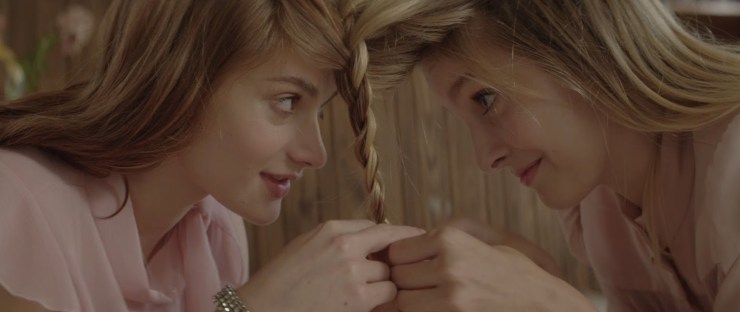
On God’s Own Country

God’s Own Country film still. 2017. Image via Orion Pictures.

By Harper Wellman

I have two unrevolutionary mantras in life. While the generic nature of mantras leaves them open to many applications and interpretations, the two ring clear now more than ever. 

The first is “This, too, shall pass.” I tell myself this whenever I find myself in an unwanted place or situation. The second, related or contradictory depending on your perspective, is “Life is cyclical.” Life has proven this to me time and time again, not just through physics but also through lived experiences. Everything will change, but we’ll also find ourselves in well-known situations. We might find ourselves surrounded by familiar people, going through habitual spaces, or maybe confronting an ongoing struggle. Simultaneously, events and experiences have changed our perspectives. 

These ideas are explored through the character development and themes in 2017’s God’s Own Country, written and directed by Francis Lee and starring Josh O’Connor and Alec Secareanu. Receiving rave reviews upon its release, aspects that could have been the downfall for the film work brilliantly well when combined, and the themes raised seem oddly apt for our current social climate. While we have been blessed with so much queer content during the pandemic (Priyanka for Prime Minister!), watching God’s Own Country prompted me to realize the cycles we all find ourselves in, and the one I was in on a micro level.

After years of having access to communities of my choice and my creation, public safety saw the shuttering of most gay bars, art galleries and museums, and isolation from friends and chosen family. Quite quickly, the communities I relied on were just as inaccessible as when I was shuttered in the closet. As I had done then, I turned to a familiar solution that had provided me with my first sense of queer community—the media.

This image has an empty alt attribute; its file name is Gods-Own-Country-1-1-1024x540.png
God’s Own Country film still. 2017. Image via Orion Pictures.

Growing up, I was lucky. White, cis-gendered gay men, like myself, were an easy way for companies to pinkwash their content without much thought or representation given to any of the intersections of our LGBTQ2+ community. I fell for it. There were Jake & Karen, the OG Fab Five, and side characters in teen movies or sitcoms. Then, just as I was entering middle school, I discovered Queer as Folk.  

The show, however problematic, rocked my world at the time. There were gay white people, living their gay white lives! The characters’ experiences were just as rich and complex as the lives of the Ally McBeal characters that I loved so much. I truly felt like I was seeing a representation of queer people like myself for the first time. Since, queer representation has expanded: Moonlight, Orange Is The New Black, and Special, to name a few, show that queer experiences are intersectional and dynamic. More people can see themselves represented in mainstream media, just as I had the privilege of having when I was younger. God’s Own Country is lacking in the diversity department but does offer a portrayal of white cis-male queerness that is unexpected and subverts many mainstream stereotypes.

The plot beats in God’s Own Country are relatively standard: A man, Johnny (O’Connor), struggles with society and familial expectations. Enter transient love interest Gheorghe (Secareanu). Initial resistance. Togetherness. Complication. Realization. This is a well-known dance.

At first glance, the formulaic story combined with heavy-handed metaphors and sometimes shaky cinematography shouldn’t work well, yet, these elements combine in a way that allows the character development to take center stage.

Our protagonist starts off drunk, racist, scared of intimacy and has a terrible relationship with his parents. By final credits, he has decided to drink less, loves the object of his racism (can we not?), and develops a better relationship with his family. These transformations are handled with subtlety and grace and a realistic sense of ambiguity. Johnny reaches for a beer but haunted by mistakes, decides against it. Do we get the sense that Johnny will never drink again? No, but we see the desire and effort of Johnny to be a better person. Similar evolutionary moments involve Johnny’s relationships with both his father and the farm animals, telling of Johnny’s gradual emotional growth.

Likewise, Johnny’s parents (played by Gemma Jones and Ian Hart) develop throughout the film. They grow to accept Johnny’s choice in Gheorghe as a partner as they see Johnny change for the better due to his company. Interestingly, neither parent is ever overtly homophobic in the film. If anything, they have more of a problem with Johnny’s drinking and lack of responsibility than his sexuality. Once again, this is a refreshing change in an onscreen adult/queer child relationship, especially in the development between Johnny and his father. By not focusing on such queer-specific moments, the space in the film is able to be filled with more interesting moments of their relationship; the intimate, universal, and relatable moments.
This image has an empty alt attribute; its file name is Gods-own-Country-3-1-1.jpg
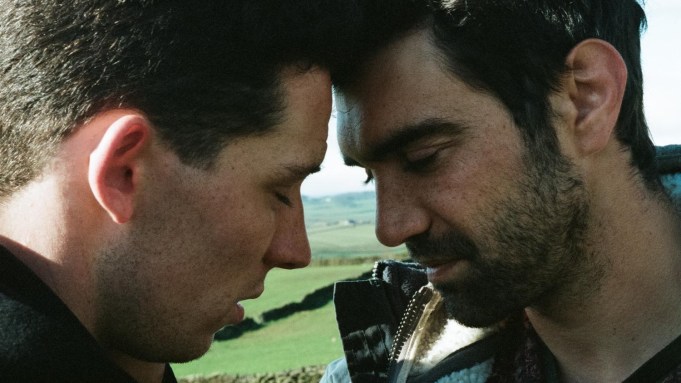
God’s Own Country film still. 2017. Image via Orion Pictures.

Unfortunately, Gheorghe, the love interest, has the weakest arc in the film. He is kind from the start, and if anything, his kindness is disseminated throughout his new community and other characters. We learn little about his back story, and he seems, like so many pixie dream girls before him, there mostly for Johnny’s development. Gheorghe shines in one scene when he physically confronts Johnny over his racism. They get into a brawl, inevitably ending with thick sexual tension between the two. We can interpret Johnny’s racism as a tool for masking his attraction for Gheorghe. Still, it feels like the closeted playground bully attacking the proudly out kid, something that is not the case of Johnny’s white partners in the film. These racist tropes are a low point for the film and seem especially tiresome in 2020. 

With these shortcomings in mind, God’s Own Country still offers a refreshing representation of queer men. They filled few gay stereotypes (I could do without the promiscuity) but instead presented two capable and rugged men, riding quads, building fences, and helping birth animals. This type of representation was well-received in 2005’s Brokeback Mountain; however, what makes GOC’s portrayal refreshing, is that there is no struggle with sexuality. Yes, Johnny struggles with intimacy and societal expectations, but he is cocksure of his sexuality. Gheorghe, likewise, accepts his attractions to men. There is no cheating on women or even hiding their sexuality from the rural community, which works to undermine the long-held prejudice that members of the LGBTQ2S+ are inherently deceptive or untrustworthy. It also seems more accurate to outness today and how our community is fighting for all queer experiences to be recognized, not just those that appease our heteronormative overlords. For me, watching another coming out story on film is comparable to watching Batman’s origin story again on film: I’ll do it, but I’d like his relationship with Robin explored more.

Through the various characters’ development, some strong themes arise, directly reflecting issues many of us are facing today. Beyond the universal theme of unfulfilled parental expectations (especially true in LGBTQ2S+ communities), there is the theme of familial responsibility. While initially flippant about these responsibilities, as his father’s health descends, Johnny embraces his duty to care for his parents, both directly with physical assistance and indirectly by caring for their legacy, the family farm. We have realized a societal duty to protect our elderly during the ongoing pandemic, whatever form that may take, and embracing it sooner than later can help ease our older community members’ suffering.

The idea of stuckness was strong in the film as well, something we can all relate to during this pandemic holding pattern and as queer people. We may have felt stuck in the closet, in a town, or in a body. Even though Johnny initially feels stuck, his perspective is altered by embracing the unexpected changes life tosses at him. Through a new lens, Johnny can embrace the responsibilities that burdened him before. Each time we revisit a situation, we carry with us new tools and insights to better navigate the circumstances. As many of us find ourselves in unexpected cycles, whether that by living with parents or unemployment, at a time when major life changes seem on hold, it is worthwhile to focus on more immediate and tangible changes.

A final theme that spoke to our current situation is that of community. By the end of the film, Johnny has come out of an isolation of sorts by embracing what community is available to him—his family—while creating a new sense of community through his relationship with Gheorghe. This pandemic imposed isolation has prompted many of us to embrace what community we have and seek new ways of connecting. As queer people, we have been in this isolation before, but we have new tools, knowledge, and relationships to help us through this time. 

While Johnny’s cycles of stuckness, community and responsibility play out on a small scale, his journey in God’s Own Country speaks to a 2020 audience, perhaps more so than upon release in 2017, on a large scale. Pandemics, social uprisings, and volatile politics – we have been here before, and we’ll be here again. With each time around, however, we have the ability to better our actions and reactions and, hopefully, achieve something better than before.

And just remember, this, too, shall pass.

Contaminating states: Sophie Cundale’s The Near Room


Sophie Cundale, The Near Room, 2020 (film still). Installation view at the South London Gallery. Photo: Andy Stagg. Courtesy the artist and FVU.

South London Gallery

Aug 15- Sept 13, 2020 (Main Gallery)

By Kit Edwards

Arriving at the South London Gallery to see Sophie Cundale’s ‘The Near Room’ last week, I felt already irritated by the return to IRL art. Obviously not the seeing work in the flesh bit, but all the other stuff that comes along with the experience – the pressure to be enriched in some way, all the standing about, the feeling of being watched whilst watching (am I looking in the right way, for the right amount of time?), now delightfully combined with the fear of spreading/catching COVID. But I had truly forgotten how much I liked being out in the world looking at things, and the quiet closeness of the SLG, the dark blanket of the (well distanced) screening room, felt not dissimilar to the isolated space in which I’d been consuming art for the past five months.

Sophie Cundale’s new film ‘The Near Room’ takes its title from Muhammad Ali’s description of the nightmarish space which came to him in the depths of a fight, as described by George Plimpton in his book Shadow Box (1977):

            …a door swung half open [into a room of] neon, orange and green lights blinking, bats blowing trumpets and alligators playing trombones, snakes screaming. Weird masks and actors’ clothes hung on the wall, and if he stepped across the sill and reached for them, he  knew that he was committing himself to his own destruction.

Inspired by this vivid and strange psychic space, Cundale constructs a similar dichotomy between the life of a boxer and the manifestation of his post-knockout hallucinations. The film begins with a carousel of scenes from a life of constraint, and though we have not yet entered the ring there is something strange on this side of the psyche. The tight choreography of the training boxers gives a sense of the constructed nature of this reality as they pause and begin in perfect unison. Things become increasingly uncanny as the close images that punctuate the boxer’s life swing round again: he wakes, he weighs, he sweats. These repetitions situate the viewer in the disorientation of monotony – have we been here before? How many times has this scene replayed? Groaning audio sways us into a state of anxiety as the boxer’s fears that he may be past his prime are articulated in this impotent cycle of discipline. A sand timer bathed in red light slithers on, and the lip of his opponent begins to curl – almost imperceptibly – into a threat. This first part of the film is tight and affecting in its quickening pace, working to untack the pins of coherence.

Sophie Cundale, The Near Room, 2020 (film still). Installation view at the South London Gallery. Photo: Andy Stagg. Courtesy the artist and FVU.

The bell rings and the boxers take their places beginning their slow dance. Devotional singing starts up and as their bodies wash over each other, the boxer is knocked unconscious and we enter into the ‘near room’. We are introduced to a queen from times past, and her courtiers who are concerned about her deteriorating mental and physical state. The action that ensues takes on the conventions of melodrama and Greek tragedy: a chorus is recognizable in the two courtiers gossiping between song, the sensationalizing of lust and violence is active in nearly every scene, and there is a sense of catharsis achieved through the enactment of a fantasy so concerned with defilement.

As the boxer deprives himself in pursuit of physical greatness, so the queen of the near room disintegrates, the two strangely connected by the psychic threads of the near room. The queen is afflicted with ‘Cottard Dellusion’—a rare neurological condition in which the sufferer believes themselves or part of their body to be decaying or already dead—but she nevertheless remains the far more tangible protagonist. Brilliantly played by artist and poet Penny Goring, the queen maintains a chaotic sense of erotic potency over the other characters. Lipsticked and filthy, she cackles wildly whilst abusing and seducing her courtiers. The notion that she must be diseased and deluded to believe her body is decaying becomes less convincing as she hovers over the lifeless body of her son (once the boxer, now the prince) and a parallel between their mental states becomes apparent. The queen is aware of our fleshy precarity and so lives voraciously, whereas the boxer/prince lives in denial of his vulnerable and changing humanity and so lives in a relative un-world of discipline. She stands above him, symbolic of the threat of all he guards against.

Sophie Cundale, The Near Room, 2020 (film still). Installation view at the South London Gallery. Photo: Andy Stagg. Courtesy the artist and FVU.

This tethering of reality and the near room to the mother/child dynamic between the boxer and the queen enacts elements of Julia Kristeva’s theory of abjection as outlined in her essay “From Filth to Defilement.”[1] Kristeva explains the occurrence of abjection as the process by which our perception of the world first splits in two. The first object we encounter in infancy is the mother (the model for all proceeding ‘others’) which we must ultimately ‘abject’ or cast out in order to realize ourselves as distinct. The abject is the horror that exists in the liminal space of the in-between—between self and object, our internal and external worlds. This process according to Kristeva is the impetus behind the incest taboo which veils the threat of the loss of the self across the ultimate boundary of life and death, and prevents the temptation to enter into the murky waters of liminality where one might ‘find death, along with nirvana.’[2] This process of abjection is enacted in the film through the blurring of boundaries between previously distinct realms (psychic/physical, self/other, reality/fantasy, desire/disgust) which works to expose their closeness and the inescapable reality of being as a state of flux.

Consumption and excretion are recurring features of the near room in contrast with the boxer’s abjection of all indulgence. In one playful scene, the queen’s advisor is seduced by the revelation of her filthy feet and writhes in pleasure on her lap before she pulls out a dagger and slits his throat – blood gushing in place of ejaculation. The drinking of urine features a number of times in the near room referring to uroscopy, a medieval medical practice used to assess health. The queen, cognizant of her internal rot, seems to revel in this realm of the abject.

Sophie Cundale, The Near Room, 2020 (film still). Installation view at the South London Gallery. Photo: Andy Stagg. Courtesy the artist and FVU.

One aspect of the film that I was unsure of was the use of sound. From the moment we enter the near room out-of-sync audio is layered over each scene. Initially the effect made me think of the moment between dreaming and consciousness when real but distant sounds (an alarm, the tv, a loved one’s voice) become enveloped in the dream space, bending in and out of sense. The video/audio can never quite sync and the more you strain to cohere it, the more it is lost. As it continued however, I began to recognize the repetitive nature of this layering, that the audio of the following scene was simply layered over the present one in a way that made the process transparent and wearisome. I think a more playful and varied layering of voice and sound would have worked better to disrupt a chronological narrative, aligning with the film’s concern with flux.

Still though, the visuals are consistently strong, implicating the viewer in the strange delight achieved through the corruption of opposing sensibilities. In the final scene the boxer looks on at his slippery reality, bathed in deep blue light. We can’t unsee the chaos of the near room, can’t shake the sense that this is the unreal space where movements appear nauseatingly rehearsed. The two realms, though separate, touch each other and therefore contaminate. The film constructs a space in which the precarious nature of our fleshy and psychic realities is exposed, and we are invited to slip deep into a playful world of polluted borders where the fear of destruction is not so far from the realization of pleasure.

The Near Room is commissioned and produced by Film and Video Umbrella with support from Arts Council England, South London Gallery, Bonington Gallery, Curator Space and The Gane Trust3 and is available (for free) at the South London Gallery until 13th September 2020.

The film will also be on display at Bonington Gallery, Nottingham
December 2020 – February 2021


[1] Julia Kristeva, “From Filth to Defilement” in Powers of horror: an essay on abjection, (New York: Columbia University Press, 1982)

[2] Kristeva, p.64

Captivated by Film: A Conversation with Eliza Brownlie

The Darcy’s - Itchy Blood - 2013
Eliza Brownlie. The Darcy’s, Itchy Blood. film still. 2013. Courtesy of the artist.

Interview by Harper Wellman

Eliza Brownlie is a Canadian writer-director who’s ethereal visual style creates atmospheres that beguile viewers and linger in the imagination. The quality visuals are balanced with strong storytelling, often exploring societal issues, cultural phenomena, and how they relate to the experiences of women. The combination of formal education and personal drive has led Brownlie to work with many musicians (most recently Big Gigantic), as well as companies like VICE and Dove. Through an innately collaborative practice, Brownlie has managed to establish a distinct voice for her work.

Could you please tell us a little bit about your background and how you got into filmmaking?

I started filmmaking about seven years ago. I was studying Communications at Simon Fraser University in my early 20s (I grew up in Vancouver, Canada), but found myself taking film theory and history electives every chance I could get. I think I always had this intuition that I wanted to direct… from an early age, I was obsessed with films, and I loved making art, writing, and shooting photos and videos on my parent’s camcorder. But when I was growing up, it was a few years before the women in film movement and diversity behind the lens wasn’t really a mainstream conversation, so I was limited in my awareness and ability to envision myself in the role of a director. You know, there’s that adage “if you can’t see it, you can’t be it,” which is painfully true. This is why visibility is so important and something that I push for. And I’m grateful that we’re finally starting to see some positive shifts happen as an effect of diversity initiatives, even though we still have a long way to go.

Anyways, in my second year of university, I decided to honour my desire to make films and pursue directing. I started out making music videos for Canadian indie labels, which gained some exposure and allowed me to develop my style as a director. I kept working on passion projects, pitching creatives, and shooting whenever I could (or whenever I could afford to). Gradually, more work within the music video, fashion film, and commercial space followed. Shortly after graduating, I decided to make the move to Los Angeles to attend film school at UCLA. During this time, I wrote and directed a short film that we funded entirely on Indiegogo, and that got into a few festivals in New York and California. I’m currently represented by Boldly– a Vancouver-based production company that does really amazing work.

Big Gigantic - Burning Love - 2020
Eliza Brownlie. Big Gigantic, Burning Love. film still. 2020. Courtesy of the artist.

What does your writing process look like? Are you able to visualize all the details while writing the first draft of a script, or do you find more ideas come to you the more you edit?

As much as I enjoy writing, I also find it to be one of the most daunting aspects of the filmmaking process. Honestly, I’ve had to deprogram a lot of perfectionism just to get words out on the page. I was actually listening to a Livestream recently with screenwriters Emily V Gordon, Jen Richards, and Naomi Ekperigin on the challenges of writing and I was practically in tears hearing that they experience the same mental gymnastics that I do… it’s hard work and it takes consistency, and even though the divine doesn’t always come through, you just have to show up at the altar every day and try.

Anyways, I think the first and most important part of the writing process is falling in love with an idea because naturally, everything will flow better if it’s an idea that absorbs you! Once I have found this, I will free write for a while and start to form the characters, the world, themes, and the story—remaining open to everything that comes through (even if I know that I’ll probably abandon certain elements later). From here, somehow, a rough foundation emerges, and I’ll start developing the narrative and mapping out the major plot points into a beat sheet, which is like a detailed outline of the screenplay. I’m also constantly collecting visual material—photography, art, and film stills—so early on during the writing process, I will put together a visual treatment or mood board. This provides a reference for inspiration for scenes and for the look and feel of the film (having graphic design skills helps tremendously). For me, it’s an important balancing act of capturing the images I see in my head, while also making sure I’m serving the story, character, emotions, and central themes.

Film is a visual medium, so when I’m writing a script, I’m always thinking cinematically—how can I show versus tell? I’ll often include camera directions in the script, which is generally frowned upon if you’re a screenwriter, but since I’m writing with myself in mind to direct, it’s helpful to dictate and remember how I want to shoot it. All that said, I often have a pretty good sense of how I want to visualize the details in the first draft, but inevitably there are always scenes that require more time and contemplation to figure them out. Sometimes you get lost, and the best thing to do is to step away for a bit and come back with fresh eyes and new ideas. I do a lot of revisions, so the script is constantly evolving as more ideas and imagery come to me.

The Invisible Ones - 2018
Eliza Brownlie. The Invisible Ones. film still. 2018. Courtesy of the artist.

While writing can be a much more individual undertaking, there is something unavoidably collaborative about directing. Throughout all your projects, your work retains a distinct, almost preternatural quality. How do you navigate all those new relationships on each project while still capturing your vision?

You’re right—directing is definitely one of the most collaborative forms of expression. Part of what I love about it is its inherently collaborative nature, and that film relies on all of these different people coming together, working towards a common goal of bringing a story to life on screen. And when the energy on set is good, and you’re in a flow and making something cool, there’s something really beautiful about that process. I live for those moments! 

I think that the key to capturing my vision and ensuring that it is carried through during all stages of production is first to communicate that vision clearly and get everyone excited about it and on the same page. It’s also so crucial that you surround yourself with a team who understands your aesthetic and point of view, and whose work you equally admire. There’s a lot of delegating with directing, so you have to trust people to be able to do their jobs. I try to make sure that everyone on set feels respected and appreciated, and provide a safe space for them to voice their perspectives and ideas. I’m grateful to get to work with many lovely, talented, and creative people who bring so much to the table with their unique expertise. My work has only benefited from these collaborations.

But of course, since you are leading the team as a director, you also have to be careful that you’re not compromising the version of the film you set out to shoot. With the self-confidence I’ve gained with more experience, I’ve learned to speak up when I’m not feeling something, or I don’t agree. Even if it seems super minor, you’re going to regret not having said something when you’re in the editing room and it’s too late to reshoot. That is the worst!

How do you feel like filmmaking will change, given the current social conditions?

We are going through a lot right now as a global community, we’re at the crux of several intersecting crises… it’s hard to say where things are headed right now. But in terms of discrimination, this has been a systemic issue in the film industry since its inception and change is long overdue. In the past few years, we’ve seen a lot of companies talking about equality and representation, partly because we are in an era in which “woke” culture has been capitalized on—but the statistics are still pretty bleak. The industry’s actions and implementation of initiatives don’t always match their words. We’ve reached a tipping point and people are sick of symbolism and tokenism in entertainment (rightfully so), underrepresented creators want transparency and action. Now it’s like, “how do you plan to commit to diversifying at all levels? We want accountability. We want to see the numbers, then we can have a conversation about diversity, equity, and inclusion.” True, systemic change will take time; it’s not going to happen overnight. I’m hopeful that this is the start of some transformation. But time will tell. 

The Darcy’s - Itchy Blood - 2013
Eliza Brownlie. The Darcy’s, Itchy Blood. film still. 2013. Courtesy of the artist.

Can you tell us about one writer who has influenced your work, and also one director who has influenced your work stylistically?

At the risk of sounding all too predictable, I’ve definitely been influenced quite a bit by Joan Didion and Sofia Coppola—two women who have developed their own distinct and singular sensibility and whose work has occasionally been dismissed as superficial (sexism!) I admire both for their poetic ability to juxtapose style and subject matter, astutely dissecting culture and tackling weighty existential themes through spare, haunting prose, or, in Coppola’s case, dreamy, hyper-feminine visuals.  

Many of us have been consuming a lot of film and television during the pandemic. What has been keeping you busy?

I just devoured Michaela Coel’s new HBO series, I May Destroy You. God, she is brilliant. 

I have also been enjoying High Fidelity and Normal People, both are coincidentally adaptations of novels that I have been meaning to read… I have a long list. 

Final question, what project of yours should people check out first?

One of my most memorable projects was getting to work with the wonderful Millicent Simmonds (star of A Quiet Place 1 & 2, Wonderstruck), on the music video for FRENSHIP’s song, Wanted A Name. Set against a lush natural landscape, the video aims to bring awareness to how the deaf community experiences and interprets music, with Millicent delivering the most incredible performance of the song in American Sign Language.

You can find more of Eliza Brownlie’s work on her website or Instagram.

Robyn Strickler’s BIRD MILK

BIRD_MILK_still3
Robyn Strickler. Bird Milk still. 2018.

Questions by Adi Berardini

Robyn Strickler is an animator, installation artist, and live visual performer (VJ). They work with abstraction and interaction to create immersive and experimental animations. Their experimental film, BIRD MILK, will be screened on October 19th at 7 pm as part of Antimatter Media Art in Victoria, BC at Deluge Contemporary Art.

Your film is very influenced by electronic music, which was made by Gil Goletski. What was the process of collaboration like for you on your film Bird Milk?

Our collaboration was an interesting one, I think. To start, I gave Gil an energy chart, mapping out the mood of the song. Then, part by part, they made each segment of the song and I would share my feedback. I don’t know how helpful my feedback was because I have no clue how to talk about music, but eventually, we ended with an amazing 7 and a half-minute song. Now, if you have the chance to see my film, you may notice that it is a sweet 4 minutes and 44 seconds. We ended up cutting it down and changing a section because there was no chance I was going to finish 7 minutes of animation in [9 months]. But if you ever want to listen to Gil’s full song, it’s out there, waiting for you.

How did you come about finding the particular textures and effects that you use throughout your experimental animation?

Norman McLaren’s Begone Dull Care was my kick in the pants to make something like BIRD MILK. It was messy, colourful, erratic, [and] chaotic. It spoke to me on a level an art piece had never reached before. McLaren used ink, so I used ink. McLaren scratched, so I scratched. But that was only the start. I dropped ink into water and alcohol to make delicious splashes of colour.

I did some parts of my film in Autodesk Maya, a 3D animation program. To integrate the 3D footage with the rest of my messy, experimental film, I printed out the frames onto transparent sheets at the size of postage stamps. The effect of close-up ink dots and the fact that these sheets would gather dust and scratches imbued what was previously a lifeless 3D animation with a tactile, textured feeling.

I did the same with some rotoscoped footage of birds and different animals I found, except instead of printing the frames, I laser-cut them. I had a grand time creating different method mark-making and then looking at everything under a macro lens, a lens meant for bug and flower photography. The macro lens is what made everything so juicy and crunchy, magnifying minuscule textures into giant pieces of art. Then once everything starts flashing at 24 frames per second (which may not be so fun if you are photosensitive), that’s when the magic starts happening.

BIRD_MILK_still7
Robyn Strickler. Bird Milk still. 2018.
BIRD_MILK_still2
Robyn Strickler. Bird Milk still. 2018.

How did you move from more representational to abstract/experimental animation and film? Do you move back and forth between them?

Back to Norman McLaren, it was his film that I mentioned before that opened my eyes to abstract animation. Up until that point, I was just going through the 2D character animation pathway because I didn’t quite know what I wanted to do. Then in 3rd year, when I saw Begone Dull Care for the first time, it was a revelation moment. I didn’t have to do character animation, it was okay! Since then, I have been doing almost exclusively abstract and non-representation animation. Maybe one day I will delve back into representational work, but today is not that day.

BIRD_MILK_still4
Robyn Strickler. Bird Milk still. 2018.

Who are some artists and animators that inspire your work?

If it wasn’t already obvious, Norman McLaren is a big inspiration of mine. He was a pioneer of experimental filmmaking and is a pillar of film and animation history. I’m not one to idolize anyone, but I idolize McLaren. Not only his work do I adore, but his work ethic is something I aspire to. If he tried something new and it didn’t work out the way he wanted, he would file it away not as a failure, but as something he could use in the future. No effort went to waste, no such thing as a wasted opportunity. I’m also a big fan of Andrew Benson, Ryder Thomas White, Sara Goodman, and Nadya Bokk. These are all people I follow on Instagram or Twitter. Except [for] McLaren, he’s quite dead.

BIRD_MILK_still6
Robyn Strickler. Bird Milk still. 2018.

Do you have any other projects you are working on that are coming up?

I have a music video with queer pop icon Devours that’s on the back burner until we both have the bandwidth to tackle it. Additionally, Flavourcel, the animation collective I’m a part of, has a couple irons in the fire that we are working on. One is a project for the Emily Carr University writing program, and another is a gallery show and workshop with the Surrey Art Gallery. Both of those will happen sometime in the spring. I’m also always up for VJ gigs that come my way. I love doing visuals for the local bands of Vancouver.

Follow Robyn on Instagram at @doktorgrafiks.

Robyn Strickler’s screening of BIRD MILK as part of the Antimatter Media Art Festival is happening on October 19th at 7pm at The Deluge Contemporary Art Gallery in Victoria, BC. 


In Discussion with Lêna Bùi: Changing Cities, Changing People

home_installation 1
Lêna Bùi good infinity, bad infinity installation shot. Courtesy of the artist.

By Devana Senanayake

Concrete jungles, urban rivers, preserved city spaces, and dynamic mountain villages are all totems in Lêna Bùi’s umbrella project Home. The Vietnamese multi-disciplinary artist takes the audience on her mental journey of processing urban change through breathtaking visuals. Though Lêna is a multimedia artist, her videos function as visual essays that pinpoint the complexities of human life in concrete ecosystems.

“I think that video is very seductive. You have so much to play with: visuals, sound, and light,” Lêna says. “Video is perfect for narrative, but also for abstraction. It can be a story but it does not have to be completely linear. It can also be poetic.”

She focuses strongly on urbanization particularly as her home country, Vietnam, has undergone unprecedented change over the past couple of decades.  Statistics by the World Bank confirm that the country’s extreme poverty rate has declined to under 3 percent and the GDP has increased to 7.1 percent in 2018 as a result of a rise in economic activity.

Lêna understands that all change, even positive economic change, comes at a cost to the environment and to the people occupying it. Through her project good infinity, bad infinity, she uses Saigon as a starting point to explore the relationship shared by physical environments and people.

Through this point of focus, her audience is invited to join her on her personal journey to understand human behaviour, relationships, resilience and belonging across the globe.

river_23
Lêna Bùi. good infinity, bad infinity. Home series. Courtesy of the artist.

mahankaal temple
Lêna Bùi. Diagonal Time. Courtesy of the artist.

I am interested in the depiction of humans and their relationship to urban spaces in your art. Why does this dynamic interest you?

Everyone tries to situate themselves in the environment to make sense of it—this is my way of making sense of existence. Urban development is a tangent of human relationships with the environment and their surroundings.

Saigon has changed so much since my childhood. When I was a kid, it was still mostly bicycles and cyclos [and] there were hardly any cars and very few motorbikes. In the past five to seven years, they started building high rises everywhere so the landscape has transformed.

In Vietnam, the growth rate is very high. However, what are the costs of very rapid development without well-rounded consideration for the future?

I think this is happening all over South-East Asia. Change is inevitable but once we’ve knocked the old things down, we cannot revive them even if we come to regret it.

home_5
Lêna Bùi. good infinity, bad infinity installation shot. Courtesy of the artist.

Waterways are an important totem in good infinity, bad infinity. Why did you focus so strongly on this component?

Both cities developed along waterways. Sharjah is right by the sea. They both have big ports and there is a lot of commerce and exchanges happening there. Saigon is a big port city and along the river are shipyards and ports.

Water is synonymous with life. Large water-bodies connecting to the sea like the Saigon river and the Sharjah creek enable the constant exchange of goods. Nowadays, construction materials are not sourced locally and a lot of it is imported. I was curious about how things were linked and connected to each other.

I was also looking at sand. Sand is a crucial component in the production of concrete [in particular]. For concrete to work, you have to use a particular type of sand with the right texture and size, which is river sand. Though Sharjah has a lot of sand, they cannot use their sand for construction and have to import it.

Vietnam exports sand, often mined illegally, which creates a lot of corrosion along the river-banks. Houses have crumbled along the riverbanks because sand was extracted from the middle of the river without any regulation. In the case of Saigon, you just have to go downstream to see multiple barges extracting sand. If you go a bit further, you see an abandoned cement factory and houses sunken in the water. At the same time, along the riverbanks are booming construction and increasingly large high-rise complex. There’s a full circle of construction and destruction going on here.

macchendranath_2
Lêna Bùi. Diagonal Time. Courtesy of the artist.

What impact did urban developments have on human communities?

In Saigon, over the past ten years, very old structures and areas have been demolished. For example, the oldest shipyard built during the 1790s, during French colonialism has been replaced by villas and high rises.

I’m sure modern high rises cater to certain modern needs, [however] I’m interested in its effect on people. In the past, community networks were very tight which had both good and bad impacts. There was no privacy, everybody was involved in your business. However, people looked out for each other. What modern housing does is, it gives people [the] anonymity and freedom. But does it help people build community? Or, is it detrimental to our ability to connect with each other?

When I was invited to Sharjah for the residency, the reverse was happening there. They experienced a very rapid development phase in the 1970s. Then they realized that they wanted to preserve their old quarters, so they moved everyone out of the area. The old quarters are preserved but they are not lived in. They have become a museum, frozen in time. Even when we want to preserve the old, it changed into something else.

All these old men who had grown up in the area were dispersed all over the city and this broke the social network their old neighborhood provided. Now that they have retired, they regularly come back to the last original teahouse to chat with each other. They do this to find a sense of belonging and to find a community.

sapat shakya
Lêna Bùi. Diagonal Time. Courtesy of the artist.

I would also love to touch on your upcoming project based in Nepal, Diagonal Time. What did you learn about people in Nepal, particularly as it is lesser developed than Sharjah and Saigon and has a greater sense of community?

Nepal seems to be changing rapidly but it is a very special place. It’s old but it is alive, it’s not a museum. People still live in old structures, in small and winding alleys, maintaining many old traditions. I think it is immensely rich in culture.

I speak in the film as an outsider looking from the outside in. Many of the shots are through door-frames or alleyways. Then the viewers feel as if they are peeking into something private. Being a foreigner is being ignorant. It’s good because you don’t take anything for granted. It’s bad because often you can’t fully understand, or you misunderstand. My film is a documentary, but in the end, it is also a personal essay.

I was trying to understand human resilience. What aspects of our life contribute to our sense of wellbeing? I focused on the people who have found strength in something or who gave strength to others.

A character featured in the film is a female woodcarver. She spoke of how she learned to carve. Her trade gave her financial independence and agency. She worked hard and with her skills, made enough money to build her house and put her children through school. There was also an astrologer. People went to him with a problem, got his advice and then felt better. I think he functioned like the Asian version of a psychologist.

A solid sense of community is crucial in helping us find meaning in life. There are all sorts of festivals in Nepal that provide opportunities for people to connect and to feel connected. Rituals, music, and dances are all part of a language of unspoken understanding.

Of course, I cannot make a film about Nepal and not include mountainsthey definitely belong to the sublime. I don’t care much for the spirituality that is woven into tourism in Nepal but the mountains give a good sense of scale. They let us register how small and fragile human beings are. Traditional mountain villages are inaccessible harsh environments and can be a symbol of human resilience.

rajendra bajracharya_astrologer
Lêna Bùi. Diagonal Time. Courtesy of the artist.

What do you hope your audience notices, particularly in relation to the theme of home and changing cities?

In terms of home, home can mean people, home can mean the land and the water. As for changing cities, I’m resistant to changes but also pro-change. A city is a living thing, so it has to change and adapt to keep up, to stay healthy.

I make work about things I don’t understand. I am trying to solve a problem for myself. There is no overarching message and there’s no solution because it is unresolved. I want the audience to look at something they think they know, that they take for granted and see something else in it.