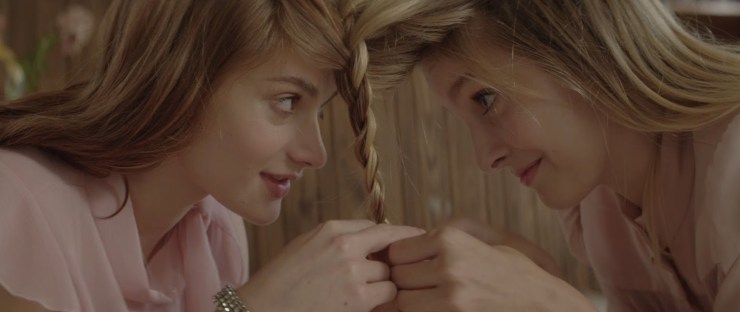
Stephanie Comilang and Simon Speiser’s Piña, Why is the Sky Blue?

Stephanie Comilang and Simon Speiser, Piña, Why is the Sky Blue?, virtual reality still, 16mins, 2021. Courtesy of the artists.

Gallery TPW

September 9 to November 5, 2022

By Mitsuko Noguchi

When I first walked through the exhibition doors into Piña, Why is the Sky Blue?, Gallery TPW’s front desk attendant followed me in, carrying a bulky headset. They directed me: “Sit anywhere you’d like.” Embroidered bean bags slumped on the floor and two uniform benches faced a wall-sized screen. The attendant handed me the headset, and when I successfully goggled up, a humanoid appeared stark in the center of my view–startlingly close and startlingly real. The humanoid gently swayed in turquoise pool water. They wouldn’t stop staring at me. This, I thought, must be Piña.

From September 9th to November 5th, Stephanie Comilang and Simon Speiser presented their popular immersive installation in Toronto. On the exhibition walls, black and white geometric fabric prints hung in irregularly shaped frames, reminding me of tribal art but made by an obviously non-human hand. I later learned that the delicate white fabric was made of pineapple, and the black plastic embroidery by a 3D printer. Shackled to a foreign virtual reality, the gallery walls and their abstract frames disappeared. 

Stephanie Comilang and Simon Speiser, Piña, Why is the Sky Blue?, virtual reality still, 16mins, 2021. Courtesy of the artists.

Throughout the 16-minute VR experience, Piña showed me life as an AI shaman in a futuristic world. Piña often dwelled in water, where they draped wet cloth on rock–informing me that these fabric slips are encoded with data and sent by “messengers.” Sometimes, the shaman stepped into a more familiar world, and I felt as if I were watching another teen beauty-vlogger as they promoted their favourite concealer. Piña also repeatedly held up their iPhone to show me videos of others speaking. The speakers were always muted; Piña and I would share silence. 

Behind the VR video, a half-hour documentary-style film played on repeat, waiting to be experienced separate from the VR story. The film followed three Amazonian “messengers” living in our near future, each of whom communicated through a radio broadcast. Real footage from the Philippines and Ecuador backdropped the fictional stories of women-led knowledge transmitters and community builders. The messengers spoke about their connection to the land, and Piña drifted in and out through voiceover, like a cloud. 

Stephanie Comilang and Simon Speiser, Piña, Why is the Sky Blue?, virtual reality still, 16mins, 2021. Courtesy of the artists.

“Piña” translates to “pineapple” from Spanish. In an interview, the artists explain the colonial commodification of pineapples, tracking from Ecuadorian land, into Filipino plantations, and finally to bourgeois European dining rooms[1]. In Piña, the recurring symbol of the pineapple epitomizes the grounding of culture onto physical earth and what it means for colonization to uproot this connection. 

Comilang and Speiser’s distinct cultural backgrounds are the cornerstones of the installation, and their styles merge with a bold elegance. Stephanie Comilang is a Filipina-Canadian artist who uses the lens of film to explore cultural heritage and futures. Co-creator Simon Speiser is an Ecuadorian artist based in Berlin, who works in a diverse range of media–from sculpture to writing to video. Together, these artists explore the enduring survival of Filipino and Ecuadorian ancestral knowledge and matriarchal lineages. For the project, Comilang and Speiser interviewed shamans about how they have held onto their ways of life amidst colonial violence[2]. The artists re-imagined these documented stories through sci-fi narrative, exploring the trajectory of tradition into our rapidly evolving, techno-laced future. 

Stephanie Comilang and Simon Speiser, Piña, Why is the Sky Blue?, virtual reality still, 16mins, 2021. Courtesy of the artists.

Piña traverses both the interconnected human experience and the deeply personal. Observing Piña’s solitary existence in the VR, I felt alone, too: the enclosed headset felt like a lonely, mysterious passageway. At the end of the passage, Piña both confronted me and comforted me at an eerily spiritual level. When I emerged from the VR, a single stranger and I watched the film together. Here, the air felt a little lighter, and the film’s knowledge flowed freely into this communal space.

Piña, Why is the Sky Blue? tells stories of how nature, technology, and humanity merge. Comilang and Speiser transform reality through layering past, present, and future into a multi-dimensional sphere. When I exited TPW and walked home, Piña faded in my memory the way a dream might, with the feeling that I was walking away from magic. I grasped a memory of Piña’s voice: “Now you’ve found me.” I wondered if I had, and if I might find little slips of Piña’s world again in my own.

—————

[1] Lillian O’Brien Davis, “PIÑA, WHY IS THE SKY BLUE? Stephanie Comilang & Simon Speiser,” MacKenzie Art Gallery, 2022, https://mackenzie.art/site-content/uploads/2022/03/PinaWhyIsTheSkyBlue_Essay_WebVersion.pdf.

[2] Lisa Long, “The Materiality of The Future Stephanie Comilang and Simon Speiser in Conversation with Lisa Long,” JSC Berlin, 2022, https://www.jsc.art/wp-content/uploads/2022/04/JSC_PINA_CATALOGUE_LOW_RES6313811.pdf.

Art and Social Change: In Discussion with Munea Wadud

Munea Wadud. Support Queer and Trans Artists sticker.Image Courtesy of the artist.

Interview by Adi Berardini

I first came across Ottawa-based artist Munea Wadud’s colourful pastel patches on the LGBTQ2+ market site Flamingo Market, and the way xe blends activism and art and design immediately caught my eye. Their art prints, pins, patches, and stickers reading “Support Queer and Trans Artists” and “Destroy White Supremacy” use bright colour schemes to dynamically convey messages of advocacy.

As they describe, Munea Wadud is a “self-taught, multi-disciplinary artist with years of experience in acrylic painting, watercolors, and many other traditional forms of visual arts.” Recently, they have also been exploring digital drawing as a form of expression. Passionate about social change, Wadud creates art that is first and foremost inclusive and feminist, and their “identity and being a queer, non-binary person of colour” informs their work. Wadud’s art also has a strong focus on body positivity, creating representations showing that queer and trans bodies of all sizes are beautiful. Munea describes more about their art practice in the following interview.

Your art is influenced and inspired by culture, for example, the animation you created of a woman going out after Iftar. Your lo-fi city animations also convey the loneliness of the city, which is only highlighted by the pandemic and lockdowns. Can you speak more about how your art and cultural identity intersect in your practice? 

I feel like because I grew up in Canada, I felt really ashamed of my culture and my traditions. I know a lot of other South Asian kids in North America who felt similarly, and there was a lot of internalized racism there. You get made fun of a lot for how your food smells and how you dress. Art has helped me heal from that—it’s helped me fall back in love with that part of myself that I was denied for a long time. I do this by trying to include Bengali text in my works, drawing more traditional clothing, parts of my culture I think are fun and joyous, like going out after iftar, wearing really vibrant and colourful sarees. I’d like to continue rediscovering my culture through my art.

Munea Wadud. Plus Size Nude Series Art Print. Image Courtesy of the artist.

You celebrate body positivity in your art by depicting larger bodies, stretchmarks, and folks with larger noses. I was wondering if you could explain the importance of body positivity in your art and illustrations?

I am passionate about body positivity – it has helped me gain a lot of confidence and see myself in a much healthier way. It made me realize just how many of us struggle with body image issues, so I wanted to create more work that reflects people’s beauty. Things like stretch marks, cellulite, body hair, just larger bodies in general, are not depicted in a lot of art [and] it creates these unhealthy expectations of your body. You feel awful about the way you look and it’s really disheartening. I just want to make art that people can see themselves in. I want them to feel just as beautiful and important as anyone else because they are. It’s really important to me that representation is reflected in my work.

Munea Wadud. Support Black and Brown Artists sticker.Image Courtesy of the artist.

Your art explicitly advocates for support of Queer and Trans folks, particularly Black and Brown Queer and Trans artists, and does so by juxtaposing bright, colourful graphics and imagery (such as your arcade game print stating “Trans Rights are Human Rights”). Can you speak more about this juxtaposition and how you use it to convey important messages and advocacy? How do find creating multiples (like stickers and patches etc.) help communicate messages of support?

I just think that every space should be more inclusive of LGBTQ+ people and BIPOC (Black, Indigenous, People of Colour) but often, I think a lot of work depicts sadness and struggle and though that is a reality for lots of minorities, our pain is not our only story. There’s a lot of media representing our obstacles and ways that we’ve overcome them. I just think I also want to see us being joyful and having good lives. I like adding bright colours and fun imagery with the same messages that represent inclusivity for QTBIPOC (Queer, Trans, Black, Indigenous, People of Colour) because we deserve to have those things too. So that’s why I create the juxtaposition.

Often, I think a lot of work depicts sadness and struggle and though that is a reality for lots of minorities, our pain is not our only story.

As for things like patches and stickers, I guess I’ve just always wanted some similar colourful and pastel designs but that reflect the views of minorities like me—I want people to feel included in my work and like their voices matter. So, I wanted to design my products in a way that fits this design aesthetic that I love, but also incorporates really important issues that matter a lot like advocacy for LGBTQ+ folks, inclusivity of BIPOC folks, and much more!

I think it’s important because these are all items I, as an independent artist, have designed and have decided to share with folks, which is very different than big corporations who create similar messaging only to support themselves rather than the people being directly affected by these messages. I wanted to highlight that difference, too, that although you can find intersectional and inclusive messaging in a lot of different stores now, it’s still important to look at who is making that product and for what reasons. 

Who are some artists (or other influences) that inspire your artistic practice?

I follow so many amazing artists that really inspire me every single day – ha.ha.ha.sina is a talented Black artist on Instagram and I love her painting style. I also follow Manahil Bandukwala who creates everything from watercolour pieces, to jewelry, to written works! There’s also Harar Hall (gold.tinted.glasses on Instagram) who’s work is super lovely as well – I love their poetry and how well it blends with their art style! And Lucky Little Queer who is a supportive fellow artist and creates amazing products too!

Munea Wadud. Trans Rights are Human Rights sticker.Image Courtesy of the artist.

Do you have any advice for other queer and BIPOC creators about starting an art business?

I know a lot of you are hesitant and nervous about starting a business, I was too. I used to feel like my work wasn’t good enough like I needed to practice more and wait longer to post something worthwhile. Honestly, looking back, I just wish I had started my online business sooner. And that’s the advice I have for you – your work is beautiful, you are talented, and I think you should still share it! I would love to see more BIPOC creators thrive and unapologetically show off their amazing art. 

Do you have any other upcoming projects you’d like to mention?

Right now, I am working on a really big print restock of many of my series like my body positivity prints as well as a few others – so please keep an eye out on my Etsy store for that drop! I’ll be posting my latest updates on my Instagram so make sure to follow me on there.

Check out more of Munea Wadud’s art on their Etsy Store, Facebook and Instagram.

Captivated by Film: A Conversation with Eliza Brownlie

The Darcy’s - Itchy Blood - 2013
Eliza Brownlie. The Darcy’s, Itchy Blood. film still. 2013. Courtesy of the artist.

Interview by Harper Wellman

Eliza Brownlie is a Canadian writer-director who’s ethereal visual style creates atmospheres that beguile viewers and linger in the imagination. The quality visuals are balanced with strong storytelling, often exploring societal issues, cultural phenomena, and how they relate to the experiences of women. The combination of formal education and personal drive has led Brownlie to work with many musicians (most recently Big Gigantic), as well as companies like VICE and Dove. Through an innately collaborative practice, Brownlie has managed to establish a distinct voice for her work.

Could you please tell us a little bit about your background and how you got into filmmaking?

I started filmmaking about seven years ago. I was studying Communications at Simon Fraser University in my early 20s (I grew up in Vancouver, Canada), but found myself taking film theory and history electives every chance I could get. I think I always had this intuition that I wanted to direct… from an early age, I was obsessed with films, and I loved making art, writing, and shooting photos and videos on my parent’s camcorder. But when I was growing up, it was a few years before the women in film movement and diversity behind the lens wasn’t really a mainstream conversation, so I was limited in my awareness and ability to envision myself in the role of a director. You know, there’s that adage “if you can’t see it, you can’t be it,” which is painfully true. This is why visibility is so important and something that I push for. And I’m grateful that we’re finally starting to see some positive shifts happen as an effect of diversity initiatives, even though we still have a long way to go.

Anyways, in my second year of university, I decided to honour my desire to make films and pursue directing. I started out making music videos for Canadian indie labels, which gained some exposure and allowed me to develop my style as a director. I kept working on passion projects, pitching creatives, and shooting whenever I could (or whenever I could afford to). Gradually, more work within the music video, fashion film, and commercial space followed. Shortly after graduating, I decided to make the move to Los Angeles to attend film school at UCLA. During this time, I wrote and directed a short film that we funded entirely on Indiegogo, and that got into a few festivals in New York and California. I’m currently represented by Boldly– a Vancouver-based production company that does really amazing work.

Big Gigantic - Burning Love - 2020
Eliza Brownlie. Big Gigantic, Burning Love. film still. 2020. Courtesy of the artist.

What does your writing process look like? Are you able to visualize all the details while writing the first draft of a script, or do you find more ideas come to you the more you edit?

As much as I enjoy writing, I also find it to be one of the most daunting aspects of the filmmaking process. Honestly, I’ve had to deprogram a lot of perfectionism just to get words out on the page. I was actually listening to a Livestream recently with screenwriters Emily V Gordon, Jen Richards, and Naomi Ekperigin on the challenges of writing and I was practically in tears hearing that they experience the same mental gymnastics that I do… it’s hard work and it takes consistency, and even though the divine doesn’t always come through, you just have to show up at the altar every day and try.

Anyways, I think the first and most important part of the writing process is falling in love with an idea because naturally, everything will flow better if it’s an idea that absorbs you! Once I have found this, I will free write for a while and start to form the characters, the world, themes, and the story—remaining open to everything that comes through (even if I know that I’ll probably abandon certain elements later). From here, somehow, a rough foundation emerges, and I’ll start developing the narrative and mapping out the major plot points into a beat sheet, which is like a detailed outline of the screenplay. I’m also constantly collecting visual material—photography, art, and film stills—so early on during the writing process, I will put together a visual treatment or mood board. This provides a reference for inspiration for scenes and for the look and feel of the film (having graphic design skills helps tremendously). For me, it’s an important balancing act of capturing the images I see in my head, while also making sure I’m serving the story, character, emotions, and central themes.

Film is a visual medium, so when I’m writing a script, I’m always thinking cinematically—how can I show versus tell? I’ll often include camera directions in the script, which is generally frowned upon if you’re a screenwriter, but since I’m writing with myself in mind to direct, it’s helpful to dictate and remember how I want to shoot it. All that said, I often have a pretty good sense of how I want to visualize the details in the first draft, but inevitably there are always scenes that require more time and contemplation to figure them out. Sometimes you get lost, and the best thing to do is to step away for a bit and come back with fresh eyes and new ideas. I do a lot of revisions, so the script is constantly evolving as more ideas and imagery come to me.

The Invisible Ones - 2018
Eliza Brownlie. The Invisible Ones. film still. 2018. Courtesy of the artist.

While writing can be a much more individual undertaking, there is something unavoidably collaborative about directing. Throughout all your projects, your work retains a distinct, almost preternatural quality. How do you navigate all those new relationships on each project while still capturing your vision?

You’re right—directing is definitely one of the most collaborative forms of expression. Part of what I love about it is its inherently collaborative nature, and that film relies on all of these different people coming together, working towards a common goal of bringing a story to life on screen. And when the energy on set is good, and you’re in a flow and making something cool, there’s something really beautiful about that process. I live for those moments! 

I think that the key to capturing my vision and ensuring that it is carried through during all stages of production is first to communicate that vision clearly and get everyone excited about it and on the same page. It’s also so crucial that you surround yourself with a team who understands your aesthetic and point of view, and whose work you equally admire. There’s a lot of delegating with directing, so you have to trust people to be able to do their jobs. I try to make sure that everyone on set feels respected and appreciated, and provide a safe space for them to voice their perspectives and ideas. I’m grateful to get to work with many lovely, talented, and creative people who bring so much to the table with their unique expertise. My work has only benefited from these collaborations.

But of course, since you are leading the team as a director, you also have to be careful that you’re not compromising the version of the film you set out to shoot. With the self-confidence I’ve gained with more experience, I’ve learned to speak up when I’m not feeling something, or I don’t agree. Even if it seems super minor, you’re going to regret not having said something when you’re in the editing room and it’s too late to reshoot. That is the worst!

How do you feel like filmmaking will change, given the current social conditions?

We are going through a lot right now as a global community, we’re at the crux of several intersecting crises… it’s hard to say where things are headed right now. But in terms of discrimination, this has been a systemic issue in the film industry since its inception and change is long overdue. In the past few years, we’ve seen a lot of companies talking about equality and representation, partly because we are in an era in which “woke” culture has been capitalized on—but the statistics are still pretty bleak. The industry’s actions and implementation of initiatives don’t always match their words. We’ve reached a tipping point and people are sick of symbolism and tokenism in entertainment (rightfully so), underrepresented creators want transparency and action. Now it’s like, “how do you plan to commit to diversifying at all levels? We want accountability. We want to see the numbers, then we can have a conversation about diversity, equity, and inclusion.” True, systemic change will take time; it’s not going to happen overnight. I’m hopeful that this is the start of some transformation. But time will tell. 

The Darcy’s - Itchy Blood - 2013
Eliza Brownlie. The Darcy’s, Itchy Blood. film still. 2013. Courtesy of the artist.

Can you tell us about one writer who has influenced your work, and also one director who has influenced your work stylistically?

At the risk of sounding all too predictable, I’ve definitely been influenced quite a bit by Joan Didion and Sofia Coppola—two women who have developed their own distinct and singular sensibility and whose work has occasionally been dismissed as superficial (sexism!) I admire both for their poetic ability to juxtapose style and subject matter, astutely dissecting culture and tackling weighty existential themes through spare, haunting prose, or, in Coppola’s case, dreamy, hyper-feminine visuals.  

Many of us have been consuming a lot of film and television during the pandemic. What has been keeping you busy?

I just devoured Michaela Coel’s new HBO series, I May Destroy You. God, she is brilliant. 

I have also been enjoying High Fidelity and Normal People, both are coincidentally adaptations of novels that I have been meaning to read… I have a long list. 

Final question, what project of yours should people check out first?

One of my most memorable projects was getting to work with the wonderful Millicent Simmonds (star of A Quiet Place 1 & 2, Wonderstruck), on the music video for FRENSHIP’s song, Wanted A Name. Set against a lush natural landscape, the video aims to bring awareness to how the deaf community experiences and interprets music, with Millicent delivering the most incredible performance of the song in American Sign Language.

You can find more of Eliza Brownlie’s work on her website or Instagram.

Pleasure Prospects: Counter-Prospective Feminist Futures

TBA_NewMineralCollective_259LakeShore_02
New Mineral Collective, Pleasure Prospects, 2019, single-channel video, 4k. Commissioned by the Toronto Biennial of Art. On view at 259 Lake Shore Blvd E as part of the Toronto Biennial of Art (2019). Courtesy of the artists.

295 Lake Shore Blvd, 2019 Toronto Biennial

September 21-December 1, 2019

By Courtney Miller

The calm, soothing voice of a narrator asks the viewer, “…how to extract meaning, not material?” Pleasure Prospects, a video installation by the New Mineral Collective (NMC), analyzes the current state of resource extraction industries, countering realities of environmental destruction with imagined reparative futures. Responding to the Toronto Biennial’s overarching question what does it mean to be in relation? artist duo Tanya Busse and Emilija Škarnulytė present a dreamy, placid recourse through contemporary dance and alternative medicines, refusing a capitalist trajectory of progress. In an era of panicked attempts to combat the climate crisis, what function does feminist utopian dreaming serve? Positioning environmental ruin as a continuous invasion against a shared life body, NMC knows that this crisis is already well underway, in which Pleasure Prospects demonstrates the impetus for healing.

What happens when artists create space for dreaming and respite?

Beginning with what appears to be footage from a mining trade show, suited bodies strike-through booths and across polished floors, while screens depict the earth’s surface in networks of grids and topographical markers. The counter-narrative to surveying from an overhead view presents the viewer with gentle caressing gestures, touching both human and earth bodies. Whether skin or sand, hands move slowly across surfaces with the intention to console rather than siphon. Shifting from cold, hard edges and detached socialization, machinery is replaced by moving bodies, and what the NMC calls ‘geo-trauma healing theory’; dance, acupuncture, and hydrotherapy. Pleasure Prospects introduces what ‘the least productive mining company in the world’ offers as an approach to repairing and softening, in resisting extractive industry through radical care and rest. The setting of this presentation is Toronto’s Cinesphere, recycling the 1971 geodome theatre to a site of future projections. In the literal slowing of time, dancers glide in undulating and rotating motions, as synchronized swimmers float in star configurations through purple plumes of smoke— possibly a nod to Judy Chicago’s Biennial iteration of her Atmosphere series.

TBA_NewMineralCollective_02
New Mineral Collective, Pleasure Prospects, 2019, columns, casts of prospecting bore holes, rammed earth, hand-pulverized black copper slag, copper, zinc, steel, aluminum, fine gold and silver shavings, concrete. Commissioned by the Toronto Biennial of Art. On view at Small Arms Inspection Building as part of the Toronto Biennial of Art (2019). Photo: Vlad Lunin. Courtesy the artists. 

The Pleasure Prospects narrative begins with an overview of the extractive mining industry’s penetrative effects stemming from a decidedly neoliberal drive for supply and demand. Thinking through what it means to be in relation, the NMC recognizes human impact on land by acknowledging the “apocalypse all around us, and how to alter it.” Current conversations of the climate crisis from a Western perspective tend to position environmental threat as a future concern, rather than a process already begun. Recently, Métis scholar Zoe Todd and settler scholar Heather Davis have argued that the beginning of the Anthropocene on Turtle Island coincides with colonial contact, marking the beginning of apocalyptic changes for Indigenous nations[1]. The Biennial’s curatorial vision of The Shoreline Dilemma calls attention to the shifting and evolving Toronto shoreline, the history of this area as a meeting place for Indigenous societies for over 12,000 years. While the Pleasure Prospects video installation does not touch on Indigenous realities or colonial systems of the Toronto area, the focus remains on extractive industry as the culprit for one of the most aggressively scarring enterprises. Furthermore, NMC offers a contribution to WalkingLab’s and RiVAL’s programming The Bank, The Mine, The Colony, The Crime, in the form of an audio therapy guided tour of the headquarters of a mining company in Toronto’s Financial District. Although the Cinesphere and brief aerial views of Ontario are recognizable locations in the film, the Toronto shoreline is not specified, suggesting that the NMC operates through a global lens. The Biennial’s overarching question, what does it mean to be in relation? can be interpreted within this work as everyone in relation to each other, or extractive industry versus everyone else.

TBA_NewMineralCollective_259LakeShore_13 (1)
New Mineral Collective, Pleasure Prospects, 2019, single-channel video, 4k. Commissioned by the Toronto Biennial of Art. On view at 259 Lake Shore Blvd E as part of the Toronto Biennial of Art (2019). Courtesy of the artists.

In directly challenging the monetary driven power of the extractive industry, what happens when artists create space for dreaming and respite? Rest becomes a radical concept when the NMC touts itself as the least productive mining company in the world. Delivering a persuasive and soothing pitch for their services, the collective seeks to engage in counter-prospecting, the opposite of production, yet not the antithesis of work. The idea of counter-prospecting involves resting, dancing, repairing, and calming, as methods of extracting meaning fueled by desire, poetry, love, and resistance. A minimal amount of technology is present in the film, functioning more as props than tools: two women relax on the beach with a filing cabinet and laptop, and an indeterminate measuring/recording device fashioned out of aggregate materials, is carried in one hand and placed on the ground while dancers whisk by. The reparative approach towards resisting extractive industry, represented through dreaming of a feminist utopia may not outline a definitive plan of action, but rather an alternative to incessant production. This method calls to mind strategies within Afrofuturism and Indigenous futurities to invest power in imaginary prospects. In being ‘unproductive’, the NMC gently calls to halt further destruction of the environment in recognition of the damage already done.

The title, Pleasure Prospects, speaks to the pursuit of pleasure as an industry as well as to the connotation of the equine hobby. Whether this link is intentional or not is uncertain; a pleasure prospect is an equestrian term denoting a horse representing an aesthetic standard of balance, grace, and willingness. Given that these standards place human expectations on the output of intelligent animals, this can be paralleled with a Western view of the earth as an endless resource, taking without giving back. Within the spoken narrative is a clearly defined intention for resisting female characterization of the earth – a protective move in avoiding the essentialization of the earth’s body. Resisting extraction through gestures of care, the New Mineral Collective illustrates a compassionate alternative future.

[1] Heather Davis and Zoe Todd, “On the Importance of a Date, or, Decolonizing the Anthropocene,” ACME: A Journal for Critical Geographies, 16(4) (2017): 761.

This article is an excerpt from our first print issue. To purchase a copy visit our online shop.