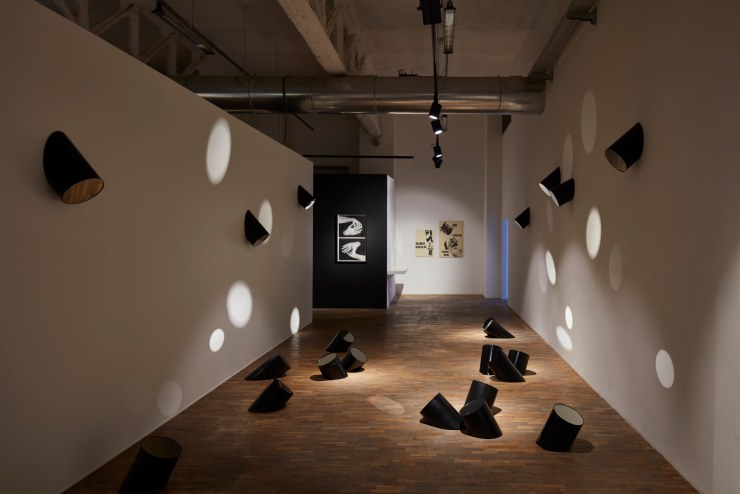
I know about hidden things by Juliane Foronda

“…between two beings across great distance.”

Juliane Foronda. I know about hidden things exhibition view.
Images courtesy of the artist and Trinity Square Video. Photography by Darren Rigo.

January 7 — February 19, 2022

Trinity Square Video

By Katie Lawson

Those who are a part of artistic communities and actively participate in the work of the artist, curator, or critic, know very well that the presentation of one’s work is merely the tip of the iceberg when below the surface of the water is a matrix of relationships that inform the ‘final’ product.

I know about hidden things is a collaborative project initiated by writer and curator Letticia Cosbert Miller which foregrounds Filipina-Canadian artist Juliane Foronda’s ongoing research concerning feminist hospitality, radical care, and traditions of gathering. The exhibition took place at Trinity Square Video in Toronto from January 7—February 19, 2022, yet lives on through its accompanying publication, an art object in and of itself. Foronda and Cosbert Miller invited Danica Evering, Camille Georgeson-Usher, Karina Griffith, and Ronald Rose-Antoinette to become entangled in the process of the exhibition’s making, meeting regularly in the development of the work. Each collaborator would produce contemporaneously a text to accompany the work, not as didactic works of criticism but as a manifestation of a network of relationships based on symbiosis. The artworks in the exhibition consider the role of physical, emotional, and ephemeral support structures, the concealed labour of care and hospitality in spaces and so-called inanimate objects. The texts that make up the printed edition become a support structure for the visitor, a generous gesture that welcomes the reader into a collective dialogue.

I know about hidden things, publication materials. Photo by Katie Lawson.

This approach to publication embodies feminist practices of lateral citation: to cite one’s peers, friends, cohort, and colleagues rather than citing upwards, towards a hierarchy of ‘legitimized’ scholarship, making visible the de-centered labour within artistic communities that so often goes unrecognized in the ‘final’ presentation of exhibitions or artworks. The printed edition that accompanied the show compels me to think about publication as a form of democratic dissemination, which opens this network of relationships to those who in turn hold and care for and think alongside an artist, curator, or critic. The texts are packaged in a sculptural bundle, with each writer’s contribution taking a distinct design, material quality, and typographic form. What holds this bundle together is a thoughtfully folded shell, which has the primary descriptive exhibition text and checklist on it in an embossed pink that I found myself running my hands over as I walked around the gallery with it in my hands. Foronda’s work becomes the literal and figurative container or carrier bag for the contributions held within.

I was struck by a phrase in Ronald Rose-Antoinette’s contribution that points towards an atmosphere diffused through a workshop held by Foronda, “the function of which is to betray the totality power wants us to recite.” Power might be understood as predicated on notions of totality and singular authorship, ways of working that are rejected even within the context of what is ostensibly a solo exhibition for the artist, sharing that space with those deeply engaged in the process of its very making. Rose-Antoinette’s ‘Support the Notes’ is a series of poetic fragments that dance across double-sided peach paper, with a deep yet vibrant blue serif text. It feels atmospheric and ethereal, with a level of subtlety embodied in two of Foronda’s works that, in particular, speak softly: magic hour and valuable and flawed. magic hour consists of two barely-there projections of past light rainbows, aimed at the infrastructural supports of the TSV space, reminiscent of the reflections of light that might dance across a room with the shifting sun. valuable and flawed uses small quantities of wood, paper, stone, and tape which take the form of makeshift wedges in the minor space between the floor and the base of the eastern wall. These two works draw the eye around the architecture of Trinity Square Video, with its tactile delights and quirks as a post-industrial space with historic resonances. How is the space of the gallery its own structure of support?

Juliane Foronda. magic hour, 2021. video projector installation, images of past light rainbows
Images courtesy of the artist and Trinity Square Video. Photography by Darren Rigo.

One can feel held by a space or a place, after all, as Camille Georgeson-Usher reminds us in ‘On being elsewhere – these archives of guilt.’ Perhaps the most narrative in form of the text contributions, she describes the embodied experience of returning home, to Galiano Island, and how that immersion allows her to feel deeply across time, deep time, feeling the remnants of care from ancestors in the trees, the water, and air. Across this long, narrow yellow paper, which folds down into a square, Georgeson-Usher wonders how to contend with feelings of guilt, getting lost, and displacement. Questions of reciprocity arise in reading this work alongside Foronda’s exhibition. If a place, a space, or a so-called inanimate object can provide and impart care, who cares for them in return?

The spoon is an object that Foronda returns to in her practice and finds its way into the exhibition through unit of measure, a series of plaster casts from the concave bowl of spoons. More specifically, spoons that were used during a residency at MeetFactory in Prague in Fall 2021. Their smooth, ambiguous forms rest on a low lying plinth painted the same soothing peach tone as the feature wall of the gallery. The spoon in its shape and function is not so different from using one’s own hands in sharing and consuming a meal, a practice that is common outside of Western dining traditions. Beneath the surface of this work, I am reminded of how place settings can carry colonial coding and inscriptions of race and class. Karina Griffith’s Did you lay the table? Yes, I set the table consists of a pale manila, single-sided half sheet of paper with deep purple sans serif text, a series or list of eighteen ‘rules embedded into traditions of drinking, dining, and hosting.

Juliane Foronda. unit of measure, 2021. plaster casts of the concave of spoons.
Images courtesy of the artist and Trinity Square Video. Photography by Darren Rigo.

Danica Evering offers a series of text fragments, which literally unfold across the many-paneled, accordion-creased paper, which when collapsed fits in the palm of the hand, much like Foronda’s spoon casts. In one panel, Evering wonders how the ephemeral becomes solid, how “plaster makes this archive tender.” The vibrant green text on soft grey paper draws in quotes from Eugenie Waters, Mark Clintberg, Jennifer Doyle, and Tegan Jones, serving as a further expansion of the matrix of relationships held within this project. This contribution takes up aspects of Foronda’s work most literally or explicitly, as aspects of the exhibition come in and out of focus—the false sense of security given by the examination table paper, a direct response to the work coping mechanisms, and questions of harm and harm reduction. There is only one panel that has the text rotated 90 degrees to the left which strikes me as an outlier, and it reads: “between two beings across great distance.”

I have to remind myself that I know about hidden things went from concept to realization during a time of pandemic and isolation, with Foronda, Cosbert-Miller, Rose-Antoinette, Griffith, Georgeson-Usher, and Evering working virtually across great distances. It is no small feat that their collaboration feels so intimate and deeply connected. There is a warmth and tactility to both the exhibition and the publication that draw the visitor in, much like a good host. Is feminist hospitality an attempt to close or narrow that distance between us?

I feel compelled to mention my own personal connection with Foronda, who I feel very grateful to have had in my life as a friend and peer over the last six years. We met just before she moved to Iceland for her MFA, and what would follow was a period of writing one another lengthy emails and letters that moved between the personal and professional. We would send what others might deem the ‘scraps’ of our day-to-day life across oceans as a part of our growing ongoing long-distance kinship—rocks, dried flowers, transit stubs, and exhibitions pamphlets scrawled with notes, home-mixed spice blends, confetti, stickers, pins, postcards, a carefully selected stamp, a packet of dehydrated sourdough starter. We are both collectors, or hoarders, of curious objects and thoughts. I have been grateful to move between guest and host in this enduring exchange, and I can’t help but imagine the many copies of the I know about hidden things publication existing out in the world, a gift and care package from Foronda. In a part of a recent interview in Contemporary Art Stavanger, a quote from Foronda has stayed with me, that captures the ethos behind her practice, this project, and an unending process of being in relation has stayed with me: “The research alone will only go so far if it’s not shared.”[1]


[1]Foronda, Juliane. “Interview: Juliane Foronda” Contemporary Art Stavanger, November 23, 2021. https://www.contemporaryartstavanger.no/interview-juliane-foronda/

You can also find this review in the second print issue of Femme Art Review on Queer and Feminist Collaboration.

Original Sisters: In Conversation with Anita Kunz

Anita Kunz. Original Sisters: 365 Portraits of Tenacity and Courage Installation shot. Photos courtesy of TAP Centre for Creativity.

Interview by Adi Berardini

Walking into Anita Kunz’s Original Sisters: Portraits of Courage and Tenacity at TAP Centre of Creativity on opening night, the gallery was transformed with 365 portraits—one for each day of the year—of remarkable women. Walking through the crowd, it’s clear there were hours of research put into the descriptions of the women depicted in the illustrated portraits. It felt easy to get emotional in response to seeing the spotlight reflected on these women because although some women are widely known, many of these women’s stories remain widely unknown by the larger public. The portraits’ gazes stare back at me with a sense of empowerment. Finally, their names are known, and they receive recognition after too long.

Anita Kunz is an established Canadian illustrator and artist with a wealth of accomplishments. Her socially and politically themed work has been printed in major publications such as Time magazine, Rolling Stone, Vanity Fair, The New Yorker, GQ, The New York Times, and Newsweek, along with many others. She has received an Honorary Doctorate from the Ontario College of Art and Design and a second from MassArt College of Art and Design. Additionally, Kunz has been appointed Officer of the Order of Canada and received Her Majesty the Queen’s Jubilee Medal of Honor. In the following interview, she speaks more about her exhibition Original Sisters: Portraits of Courage and Tenacity.

Anita Kunz. Original Sisters: 365 Portraits of Tenacity and Courage Installation shot. Photos courtesy of TAP Centre for Creativity.

Original Sisters: 365 Portraits of Tenacity and Courage spotlights 365 original illustrated portraits of inspiring women, spotlighting many stories that are too often unknown and excluded. One aspect that stands out in the exhibition is the range and diversity covered by the portraits. You include different faiths, backgrounds, and cultures from different time periods. I also love how you cover diverse fields such as science, math, art, literature, and activism. Can you expand on your process of researching these women?

The most important thing for me in this whole project was diversity. I wanted to celebrate all kinds of extraordinary women, many of whom have been overlooked, starting from the beginning of time and the cave paintings to the very recent ones.

I knew that I was going to do a lot of them, and I didn’t want to make them from Canada or the US only because there are so many more. I mean, there were just so many. I had a couple in mind when I started, and then I started asking people I knew. I asked somebody that I know who’s a scientist and [asked if he could] give me any names of women who have been overlooked. So, he gave me one.

There were a lot of good resources, a lot of blogs, historical blogs, Encyclopedia Britannica, and Google. Even the Google Doodle of the day sometimes I thought “Oh, I didn’t know who that was. Let’s research her.” The New York Times has recently started a new [column], an obituary section where it’s called Overlooked No More. That’s a good resource. But it was not hard to find subjects, that tells you it’s kind of a sad thing.

It was very easy once I started looking. Now, I’ve done 365 and I have at least 300 more than I could do. And I feel that that’s only scratching the surface, this is only the beginning. This is something I could probably do the rest of my life and probably easily do a thousand, but I’m getting ahead of myself!

Anita Kunz. Original Sisters: 365 Portraits of Tenacity and Courage Installation shot. Photos courtesy of TAP Centre for Creativity.

It was fascinating to see. One that I remember standing out to me that I didn’t know was that the creator of Monopoly was a woman [Lizzie Magie].

Why would you know? It wasn’t taught to us and it wasn’t in the culture. For the whole project, I started with stories that nobody knew [until] later, especially in the book. [The publisher] also wanted me to add a few people who were a bit more well-known. 

I feel like I’ve barely begun [with] the sheer number of women who you wouldn’t have known. And even Roxane Gay, who wrote the book forward, she’s an incredibly brilliant feminist academic, and she said, “how come I’ve never heard of half these women?” So even she hadn’t heard of them, somebody who knows more about feminist history than almost anybody I know. Even she was startled by how many were missing from our [cultural narrative].

Since I’m an artist, I was shocked at realizing how limited my art history education was. I mean, there were women whose work, I thought, “How come I didn’t know these?” Incredible artists, poster artists, and painters. I have had an art education background and there are so many that I didn’t know who they were.

…They were out there; they just weren’t in the curriculum. We didn’t know who they were. They weren’t celebrated or even taught or anything like that.

I think it’s outrageous. Everybody talks about how the art world is so skewed in favour of white men, you know? A lot of people get lost in that narrative. I went to school for illustration, and I went to a workshop with all the best illustrators when I was young. They were all white men and they brought in one artist, Barbara Nessim. They brought her in for two hours and that’s the only interaction with a female illustrator that I had as part of my education. That’s really shocking because they were out there; they just weren’t in the curriculum. We didn’t know who they were. They weren’t celebrated or even taught or anything like that.

Anita Kunz. Original Sisters: 365 Portraits of Tenacity and Courage Installation shot. Photos courtesy of TAP Centre for Creativity.

The concept of Original Sisters started during the pandemic. What first initiated the idea behind doing these portraits of remarkable women throughout history during this time?

I worked for a long time as an editorial illustrator back when editorial illustration was a thing. It used to be that you could make a decent living as a magazine illustrator.

I always wanted to do things that had something to do with society, a social issue, or a political issue like that. I wasn’t necessarily interested in the decorative arts. I wanted something with substance, something that could have meaning to it. I was able to make a living with magazines and that was great. I started out doing magazine work, but the trouble with magazine work is that you do maybe two or three a week, and you just do the next one, and then it seems shallow.

I wanted to do, at some point, something that was a deep dive into something. I’ve done so many portraits and it seemed like a logical thing to do portraits of women I admired and whose shoulders I stand on who paved the way.

I did an artist residency in Maine, and we went out on a boat ride, and the captain explained that this windswept island is where a woman lived there in the winter. And I was like, “Whoa, hold back. How could she live on a rock in the winter? She must have built a cabin. I thought, “What would she have eaten?” It was rugged. I had to find more out about this. Turns out she was a trans woman, and I think this was in the 18th century. And again, I could not find anything about her, I wanted to fill in the blanks, and I never could. Then, I thought that I wanted to find women whose stories need to be told.

Who do you have in mind to illustrate next?

I started already; I have done six more. I did one of the first female photographers today and another artist who did the most magnificent covers for Vogue Magazine. I have another one here on my desk–Helen Dryden. [She created] just beautifully designed, brilliant covers.

I’ve also painted Zaha Hadid, the Iraqi Architect. She was amazing. I mean, there are so many more. There are also areas that I’d like to discover more. I need to do far more Canadian and Indigenous women because I was born here, and I think I don’t have enough representation there yet. I’m always happy to hear if anybody has ideas or suggestions. I’m happy to hear them, so if you have any, let me know!

Anita Kunz. Original Sisters: 365 Portraits of Tenacity and Courage Installation shot. Photos courtesy of TAP Centre for Creativity.

I also really liked how you did the text. Was the style of text inspired by the women as well? 

Absolutely. With each of the portraits, I wanted them to be a celebration and I wanted even kids to like them. I deliberately made them colorful and kind of joyous. For each one, I tried to do something about the background that had to do with the person. I tried to [capture] the time that she was living or and the same thing with the typography and wherever possible I tried to find their actual signature. I thought that would just be more authentic. But where I couldn’t find their signatures, I used a font that would sort of indicate the time they lived in. 

For Zaha Hadid, I tried to make the type like her buildings, I had fun with them. For the first photographer, I tried to make it like a stamp, like how photographers used a stamp on the back of their prints. It’s fun for me, and I thought it would just give a little bit extra instead of just a face, you know? I wanted to give it a bit more depth.

Check out Anita Kunz’s Original Sisters at TAP Centre of Creativity until January 14th, 2023. Original Sisters: Portraits of Courage and Tenacity is also available as a book, published by Penguin Random House. You can also find Kunz’s work on her website, anitakunz.com, and Instagram at @anitakunz

Can’t Buy Me Love: A Review of Sara Cwynar’s Source

Remai Modern, Saskatoon, SK

January 30- August 22, 2021


Sara Cwynar, Source, 2021, digital prints, Plexiglas, custom frame structure. Courtesy of the artist; Cooper Cole Gallery, Toronto; and Foxy Production, New York. Photo: Blaine Campbell.

By Madeline Bogoch

            “Beauty is a currency system like the gold standard,” claimed writer Naomi Wolf in her 1990 bestseller The Beauty Myth. I hesitate to open with this quote, as much of the book has not aged well, and Wolf’s recent gleeful tirades against vaccination and public health measures have further discredited any cultural authority the text still held. Despite these detractions, the notion of beauty as a political ideal has endured and is the conceptual terrain explored by artist Sara Cwynar in her recent exhibition, Source. Those familiar with Cwynar’s prior work will recognize the artist’s signature mix of vintage props and feminist-inflected pop-culture critique, tropes which are instrumentalized in Source to examine how late capitalism dictates our collective visual language.


Sara Cwynar, Red Film, 2018, 16mm film transferred to video, 13:00 minutes. Courtesy of the artist; Cooper Cole Gallery, Toronto; and Foxy Production, New York. Photo: Blaine Campbell.

            At the beginning of Red Film, the narrator states: “I am talking about American patterns and French painters” as a variety of cosmetics named for the painter Cézanne are displayed. Red Film is the third installment in a trilogy exploring how beauty and desirability are quantified and is featured here as part of the exhibition. The film is presented alongside two other works by Cwynar: Guide, a series of large-scale photographs, and an installation (also titled) Source, comprising a double-layered glass partition stretching across the length of the gallery. Within the plexiglass, Cwynar displays a collection of found images and texts that broadly elicit the themes synthesized in the rest of the show. The materials include a selection of critical theory texts (highlighted and underlined, evoking a lived-in quality), fashion and nature photography, and reproductions of historical paintings. Marilyn Monroe appears in paper doll form, a recurring figure in Cwynar’s work, and an icon of beauty reinforced by endless reproduction. Monroe’s presence acts as a foil to Cwynar’s textual sources, highlighting the cognitive dissonance between the desire for beauty and an awareness of its most toxic machinations, a tension palpably felt throughout the exhibition.

As feminist discourse has entered the mainstream, it’s an idea that has been exploited for profit by mobilizing the language of empowerment to sell consumer goods.

            Trained as a graphic designer, Cwynar’s visually seductive works demonstrate a honed fluency in commercial aesthetics. Her design background is most apparent in Guide, a selection of vinyl photographs plastered across the gallery walls, with smaller monitors embedded in them. If Source reflects Cwynar’s studio process of gathering materials, then Guide represents the intermediary phase, during which the synaptic nodes between the sources begin to take shape. This sense of provisionality is emphasized by Cwynar’s use of a green screen in several photos, one of which features her mid-scream, wearing Air Pods and a t-shirt printed with a portrait of Bernie Sanders alongside text reading “Rage Against the Machine.” With a degree of embarrassment, I’ll admit to recognizing the shirt, which was well-publicized after being worn by model Emily Ratajkowski last year—more on her later. Socialism, like feminism, could be said to be having a moment, as evidenced by the cult popularity of the shirt and Sanders himself. Yet Cwynar’s expression of inner conflict suggests an awareness of the limitation of consumerism as a form of political consciousness. While not mutually exclusive, the image evokes a timely consideration of the representation of politics versus the practice of one.


Sara Cwynar, Guide (detail),2021,vinyl print and videos on monitors. Courtesy of the artist; Cooper Cole Gallery, Toronto; and Foxy Production, New York. Photo: Blaine Campbell.


            Included in the plexiglass partition is an essay by the aforementioned Ratajkowski titled “Buying Myself Back: When Does a Model Own Her Own Image.”[1]The essay details the author’s experience being dispossessed of her visual likeness and the challenge of regaining control in an era of rampant image proliferation and commodification. The piece received considerable attention, garnering both praise, for Ratajkowski’s frank and engaging writing style, and backlash from those quick to point out the hypocrisy of the author condemning an industry while continuing to profit from it significantly. Ratajkowski is not alone in her conflation of financial success and empowerment, but to follow this suggestion to its logical conclusion leads to a bleak assessment of the potential of feminist politics to serve anyone other than the wealthiest and most privileged women. As feminist discourse has entered the mainstream, it’s an idea that has been exploited for profit by mobilizing the language of empowerment to sell consumer goods. This very phenomenon is parodied in Red Film when the artist declares, “I am speaking now from the inside of power… Woman creates life, man creates art, but not anymore suckers. I can buy anything I want.” But of course, what we want is not immune from politics—beauty, and the allure of that which promises us access to it are both manufactured products. The cheeky and ambivalent tone in which Cwynar delivers the line suggests that she is acutely aware of how easily dissent is co-opted by the systems it seeks to dismantle.

Sara Cwynar, Guide (detail),2021,vinyl print and videos on monitors. Courtesy of the artist; Cooper Cole Gallery, Toronto; and Foxy Production, New York. Photo: Blaine Campbell.

            There’s a self-reflexive underpinning to Cwynar’s brand of critique. Implicated in her line of questioning is art itself, particularly its dual function as both a tool of cultural critique and a luxury commodity. Cwynar implicates art (and artists) as part of a system that sustains the symbolic efficiency of desire and beauty. Although this exchange is most explicitly played out in Source through references to Baroque and Impressionist art, this transaction remains relevant to the contemporary landscape in which artists are incentivized to participate in self-branding, and cultural capital is increasingly brokered as a liquid asset.

            Throughout Red Film the narrator offers a barrage of cryptic statements against an ever-changing backdrop of imagery including red-clad dancers, the hypnotic mechanical motions of a cosmetic production line, and a close-up of boldly painted red lips belonging to Cwynar’s frequent collaborator, Tracy Ma. At one point Cwynar appears onscreen, but as she opens her mouth to speak, the voice that comes out is not hers but that of the calm and self-possessed male narrator. Reminiscent of Mark Fisher’s “slow cancellation of the future,”[2] which mourns the cessation of novelty in a culture of endless recirculation, Cwynar evokes the familiar anxiety of inauthenticity, that our ideas and words are not our own but merely poor imitations of sources we’ve absorbed along the way. While Cwynar exposes how both desire and beauty are fraught constructs, she stops short of implying we are powerless in this. We may never fully extricate what we want from what we’re told we ought to want, but detangling the knots which form our desires remains a worthwhile endeavour. As Cwynar says in Red Film, “I am living in the space between pure desire and actual enjoyment, and I don’t mind at all.”


[1] Emily Ratajkowski, “Buying Myself Back When does a model own her own image?” The Cut, September 15, 2020, https://www.thecut.com/article/emily-ratajkowski-owning-my-image-essay.html.

[2] Mark Fisher, Ghosts of My Life: Writings on Depression, Hauntology, and Lost Futures (United Kingdom: Zero Books, 2013).


Glitch Feminism by Legacy Russell


Glitch Feminism: A Manifesto by Legacy Russell cover. Photo via Verso Books.

By Pauline Nguyen

Legacy Russell opens Glitch Feminism, a part-manifesto, part-art criticism essay collection, by bringing us back to her early teens growing up in New York City. At twelve years old, she christens herself with the online username “LuvPunk12” — a cyborgic meeting of worlds: an “away from keyboard” (AFK) reality and an online digital reality. In reading Russell’s personal history as a Black queer femme experimenting with their selfdom, we’re thrown back to our own first forays into the internet, from first usernames to direct messaging platforms — all existing alongside our AFK names and relations.

Glitch Feminism: A Manifesto by Legacy Russell. Photograph by Pauline Nguyen.

Published in fall 2020, Glitch Feminism is a pocket-sized book and a fairly quick read. The twelve short chapters all circle back to Russell’s central argument: to embrace glitch, as failure and refusal, is to move towards possibilities for other ways of being, worlding, and collectivity beyond the logics of the gender binary, capitalism, and neoliberalism. Russell, who’s a celebrated curator, spotlights contemporary artists who they argue are putting glitch feminism into practice. Russell emphasizes queer, trans, and Black artists such as Juliana Huxtable, Kia LaBeija, and Shawné Michaelain Holloway. Glitch Feminism embeds itself into the realms of art, criticism and curation, queer and feminist thought, Black studies, digital cultures and new media, and critiques of capitalism.

Legacy Russell, author portrait by Andreas Laszlo Konrath. Courtesy of Verso Books.

Glitch Feminism continues the legacies of cyberfeminism and cyborg feminism by evoking questions of how the complexities of embodiment, so entwined with experiences of gender, queerness, and racialization, extend into digital realms. How can glitch, which at its core is refusal, be reworked as something wonderful in our feminist, queer, and anti-racist utopic envisioning and collective mobilizations? What does it mean to embody glitch, to embody malfunction?

How can glitch, which at its core is refusal, be reworked as something wonderful in our feminist, queer, and anti-racist utopic envisioning and collective mobilizations?

Glitch Feminism firmly maintains that digital, online worlds are as real as AFK, offline worlds. The belief that “in real life” (IRL) is solely physical and AFK is to discount the very realness of our online selves and interactions. In fact, as Russell demonstrates, the digital realm and the online realm are deeply intertwined, the boundary between them dissolving, with us travelling seamlessly through this expansive, multidimensional reality. As such, the bridge between the two is bountiful with productive refusals and potential for world-building — beyond the gender binary and its restrictive categorizations, resisting surveillance capitalism, through the queering of digital space.[1] Alongside this grounding argument is the understanding that all technology is architected by people under neoliberal capitalism, white supremacy, and heteropatriarchy; thus, it is never neutral, always political. This continuity between online and offline spaces means that we can program errors, breakdowns, viruses into the fabric of such multidimensional worlds.

The White Pube, Instagram post, courtesy of The White Pube.

As a conceptual framework, glitch reconfigures the typically pejorative way we view failure, brokenness, and the refusal to function. Instead, as Russell convincingly invites us to do, glitch should be welcomed — “the error a passageway” to constructing better worlds.[2] This is because, and here Russell situates glitch feminism in queer-of-colour theory by quoting José Esteban Muñoz: “…this world is not enough, that indeed something is missing.”[3] Russell draws on Shaadi Devereaux’s analysis of social media as a tool for marginalized women to reach each other, build collective support, and engage in conversation where they might usually be excluded in AFK domains.[4] To break, to dismantle, to fail fantastically in the face of a machine that expects us to keep carrying on as if it isn’t stifling and isn’t programmed to reward some and marginalize others. It is to carve fissures in existing, oppressive systems and its limitations on who we might be and what realms we might inhabit.

As discussed in the chapter “Glitch is Cosmic,” we as embodied beings are multitudinous and constantly becoming, never static and singular in our identities. A person’s virtual avatar is as real in cyberspace, or the “digital real,” as their offline self.[5] We can travel beyond what we typically think of as a body (that becomes gendered) to consider our virtual selves. To break through the confines of what counts as a body is to destabilize the dualistic delineations of normativity imposed upon bodies, including binary gender categories. If the body is “inconceivably vast” like the cosmos, then to queer is to expand potential for being, because, recalling Russell’s reference to Muñoz, there are gaps that must be filled, a queer ethos of yearning for more.[6] To glitch is to disrupt systems, sledgehammering holes into taken-for-granted logics of oppression — a queering in itself. Glitch is queer, queer is cosmic.

Victoria Sin, Performance at “Glitch @ Night” organized by Legacy Russell as part of Post – Cyber Feminist International, 2017, ICA London, courtesy of ICA London, photograph by Mark Blower.

The chapter themes seamlessly flow into each other and consistently circle back to the core ideas of productive refusal, expanding definitions of embodiment, and queer futurity. The chapter “Glitch is Remix” continues along the lines of disrupting what it means to have a body. Here, Russell faces the question of data and surveillance capitalism head-on by bringing in examples that glitch biometric technology and experiment with strategic visibility. This is key because visibility can be dangerous, especially for those considered non-normative or non-conforming under white supremacist, heteropatriarchal capitalism. The epigraph to the chapter “Glitch Ghosts” is a line by poet Richard Siken: “Imagine being useless.”[7] To be useless to the system, to skirt the line between legibility and illegibility (to whom?) and render oneself unreadable to surveillance technology, to evade the oppressiveness of naming and categorization when being is cosmic: Russell brings light to these issues through the lens of refusal.

Russell thoughtfully frames every chapter around case studies of artists, writers, and fellow cyborgs who practice refusal and embody glitch — a perfect brew of glitch feminist theory and praxis. The extensive epigraphs at the very start of the book plus the ones that open each chapter take the form of both quotes and images, introducing us to those who’ve engaged with the themes at hand before Russell: Etheridge Knight, Mark Aguhar, Billy-Ray Belcourt, Ocean Vuong, E. Jane, T. Fleischmann, and so on. These spotlights and epigraphs certainly shine in Glitch Feminism, acting as Russell’s odes to fellow feminist, queer, trans, and racialized disruptors who’ve impacted their work.

Lil Miquela, courtesy of Brud.

There are some aspects to watch out for when reading this firecracker of a book, many of which have to do with who the target readers might be. The level of audience familiarity with online culture and human-computer interaction that Russell assumes is quite high. From terms like “avatar” and “GIF” to the opening lines where Russell tells us her first online username, this little book doesn’t devote time to defining what she means. The introduction works (and really well at that) for some readers because it thrives on relatability — the quick recognition that LuvPunk12 is a name Russell used on the Web. In a similar vein, other terms that are arguably academic are not unpacked either, such as “digital affect” and “living archive.” Glitch Feminism isn’t marketed as an academic text, though it does bare some academic framing. So, who is this book for? Will those born into the era of networked digital media read Glitch Feminism with an existing understanding of feminism, critical theory, and new media? (Even TikTok is mentioned.)

Glitch Feminism is a monumental publication in its (re)framing of glitch as feminist and as the power of “no.” It’s a timely release with well-chosen artists spotlighted (Russell is a curator after all!), with Russell’s art criticism angle bringing a fresh focus to thinking about the space of potential between intersectionality, data capitalism, and digital technology. Many of the themes Russell brings up greatly overlap with trans literature, such as the dilemma of visibility, (il)legibility, ethics of the archive and (mis)labelling, and the body; there is room here to further bring trans perspectives into Glitch Feminism. These essays hold great relevance to women and gender studies, queer and trans studies, anti-racism, critical encounters with archives, digital humanities, contemporary art, new media and visual/screen cultures, community-engaged arts, and so forth. If you’re interested in any of these areas or looking to read an intersectional take on embodiment, what it means to have a body in a digital age, and what it means to be connected, Glitch Feminism is highly recommended. Embodiment is time and time again positioned as parallel to glitch — both are ongoing, both hold potential for expansion and reconceptualization in tandem with each other: “One is not born, but rather becomes, a body. And one is not born, but rather becomes, a glitch”.[8]


[1] Legacy Russell. Glitch Feminism: A Manifesto (London: Verso, 2020), 47.

[2] Russell, 113.

[3] Russell, 22.

[4] Russell, 125-126.

[5] Russell, 124.

[6] Russell, 41.

[7] Russell, 63.

[8] Russell, 145.

The Unexpected Subject: 1978 Art and Feminism in Italy

The Unexpected Subject • 1978 Art and Feminism in Italy. Installation shot, FM Centre for Contemporary Art. 2019. Photos courtesy of Raffaella Perna.

April 4 – May 26, 2019

FM Centre for Contemporary Art, Via Giovanni Battista Piranesi 10, Milan

by Gabrielle Moser

A mouth, open wide and mid-speech, hovered over a black ground on the enormous banner hanging above the entrance to the FM Centro per l’Arte Contemporanea in Milan, soundlessly announcing the exhibition The Unexpected Subject: 1978 Art and Feminism in Italy. Superimposed in a diagonal line, the words “ti AM O” (a play on “I love you” in Italian) articulated the lips’ unheard utterance. A Letraset collage on cardboard created by the Rome-based artist and curator Mirella Bentivoglio and titled AM – (ti amo) (1970), the visual poem conjures up the way that identity is constituted: every “I” must have a “you” to address itself to. But it also calls to mind the words of the Rivolta Femminile, a feminist collective founded by Carla Lonzi, Carla Accardi and Elvira Banotti that, between 1970 and 74, self-published a series of essays condemning the omission of women from Western philosophy and communist politics, and argued for the vital force of language, both written and spoken, in constituting women’s identity. “Not being trapped within the master-slave dialectic, we become conscious of ourselves,” they wrote. “[W]e are the Unexpected Subject… An entirely new world is being put forward by an entirely new subject. It only has to be uttered to be heard. Acting becomes simple and elementary.”[1]

The Unexpected Subject • 1978 Art and Feminism in Italy. Installation shot, featuring Mirella Bentivoglio’s AM – (ti amo) (1970). 2019. FM Centre for Contemporary Art. Photos courtesy of Raffaella Perna.

            But if the unexpected subject can be uttered and heard, it is less clear how it comes to be seen, especially when, as so many Italian feminists of the 1970s pointed out, the visual codes for women’s subjectivity were (and one could argue still are) constrained by patriarchal modes of representation. A contradictory impulse lies at the heart of this historical moment in Italian feminist practices. On the one hand, artists, philosophers and writers sought to generate what J.L. Austin would describe as new visual, verbal, textual and performative utterances to signify female subjectivity and sexual difference,[2] while on the other, figures like the art critic Carla Lonzi insisted that de-culturation (the un-learning of male culture) and “dropping out” were the only strategies through which women could achieve freedom.[3] As a visual arts exhibition that incorporated archival materials, video, ephemera, textiles and sound, alongside the more conventional fine art modes of collage, sculpture, painting and photography, the show navigated these two drives while also attempting to translate the particularities of Italian feminist thinking for a wide, implicitly international audience.

The Unexpected Subject • 1978 Art and Feminism in Italy. Installation shot, FM Centre for Contemporary Art. 2019. Photos courtesy of Raffaella Perna.

            Curated by Marco Scotini and Raffaella Perna, the exhibition’s global address speaks to a wider resurgence of interest in the practices of 1970s Italian feminism, both within and outside Italy. Elena Ferrante’s wildly successful Neapolitan novels, for instance, have been read as a take on the feminist practice of affidamento, or entrustment, between two life-long female friends, in which the differences (or disparities) between two women are a generative source of sustenance and recognition.[4] The work of contemporary artists Claire Fontaine and Alex Martinis Roe, meanwhile, takes up the politics of the Rivolta Femminile and the Milan Women’s Bookstore explicitly in both its form and content, while groups such as the Feminist Duration Reading Group in London and the EMILIA-AMALIA collective in Toronto (of which I am a member) have worked to translate, annotate and activate key texts from the period.[5] Largely unknown in the English-speaking world until recently, Italian feminist thought was explicitly at odds with the horizontal model of sisterhood that dominated 1960s Anglo-American feminism. [6] Coming after the surge of “second wave” feminist activity in the United States and England, Italian feminism sought to correct or avoid what it saw as the failings of this earlier movement, including the devaluation of the authority of older and more experienced women, the fight for the legalization of abortion, the refusal to ask for maternity leave (particularly in the US), and, most importantly, the investment in equality with men as a political goal.[7]

            In the place of these bids for legal and formal equality, the women’s groups meeting in Milan and Rome in the 1970s sought two parallel forms of freedom: a representational one that required discarding an existing repertoire of representations that privileged the male perspective, and a symbolic freedom, centered on making spaces for women to think themselves differently. For this reason, many feminist groups of the 1970s turned to autocoscienza, or consciousness-raising, activities, to autobiography, and to group psychoanalysis as practices that would allow women to create a new symbolic order that could transform their everyday relationships and their understanding of their position in history.[8] Carried out in separatist, largely private spaces (another difference from the public, collective imperative of Anglo-American feminism), these activities embodied the mantra that one must “start from oneself,”[9] centering personal, lived experience as the only grounds for knowledge production.

The Unexpected Subject • 1978 Art and Feminism in Italy. Installation shot, FM Centre for Contemporary Art.2019. Photos courtesy of Raffaella Perna.

            In the context of exhibition-making, Scotini and Perna, therefore, set themselves a tall task: to not only try to coherently narrate an often ungainly explosion of feminist activist, artistic, political and filmic production that emerged during the period around 1978 (there were no less than 100 artists and artist groups on display across the exhibition), but of cataloguing the visual gestures that needed to be invented to articulate women’s previously unthinkable position as speaking, acting subjects. The thematic sections of the exhibition—language and writing; objects and the domestic world; image and self-representation; and the body and its performativity—were necessarily permeable and messy, and the show sometimes contradicted itself. While this is not an uncommon curatorial gesture that ideally unsettles curatorial authority and signals the dynamic ways histories are told and contested, when combined with the encyclopedic scope of the exhibition, it occasionally produced abrupt disconnections and doublings as the viewer moved through the galleries.

            Operating as a prelude to the exhibition, for instance, was a darkened semi-circular space, reminiscent of a theatre proscenium, surrounded by black curtains onto which the nearly four-hour long film Anna (1975), directed by Alberto Grifi and Massimo Sarchielli, was projected. Warped and misshapen in its tiny theatre area, the film took on a ghostly aspect: the din of a street scene on the Piazza Navona in Rome was almost unintelligible, and its visuals nearly opaque. While the film is infamous in Italy for its depiction and exploitation of its eponymous subject, a 16-year-old pregnant young woman that Grifi took into his home, it was presented in the exhibition without any explicit curatorial framework, leaving the viewer to infer that everything Anna represented provided the negative ground onto which the figure of the unexpected subject could emerge.[10]

The Unexpected Subject • 1978 Art and Feminism in Italy. Installation shot, FM Centre for Contemporary Art. 2019. Photos courtesy of Raffaella Perna.

            Pushing through one of two openings hidden in the curtained screen, I entered into the main room, in which a towering vinyl print out of a black and white photograph of Carla Lonzi—leaning authoritatively against a gallery wall, one hand on hip, smartly dressed in a white button-down and leather skirt—announced the pivotal impact of her work on the feminists and artists of her generation. A vitrine set into the same wall displayed archival photographs of the women of Rivolta Femminile, images of Lonzi at work over her typewriter—her famous Dictaphone in hand—as well as first editions of Lonzi’s books in their identical green covers. Their titles alone are thrilling in their imperative tense and their playful, antagonistic approach: Self-Portrait (1969); The Clitoridean Woman and the Vaginal Woman (1971); Let’s Spit on Hegel (1974); Shut up. Or, rather speak: Diary of a Feminist (1978); Now You Can Go (1980). Nearby, sound and video work by Cathy Berberian, Betty Danon, Ketty La Rocca, and Katalin Ladik activated these ideas through the artists’ bodies. La Rocca’s video, Appendice per una supplica (Appendix for a Petition) (1972), was particularly evocative of the problematic that Italian feminists sought to address. In this performance for the camera, a closeup shot shows the artist’s hand as it attempts to slowly navigate the small spaces left between the fingers and palms of another pair of men’s hands. Soundless, the video plays with a repertoire of possible gestures responding to the male subject, from the sensuous and erotic, to the suffocating and forceful.

            Like Lonzi, La Rocca is a central figure for 1970s Italian feminist art practice and is one of the reasons the exhibition focuses on the date 1978. Though the works in the exhibition span the early 1960s to the 1980s, 1978 was marked by several important moments of international resonance, including the exhibition of 80 women artists at the Venice Biennale, organized by Bentivoglio (a show that is painstakingly recreated in one room of The Unexpected Subject), a posthumous exhibition of La Rocca’s work also at the Biennale (she had passed away at the age of 38 two years earlier), the publication of Lonzi’s Taci, anzi parla. Diario di una demminista (Shut up, or rather speak. Diary of a Feminist), and the issuing of a collective book/self-portrait by the “Wednesday group,” titled Ci vediamo mercoledi. Gli altri giorni ci immaginiamo (I’ll see you on Wednesdays. The other days, we’ll imagine one another). But in many ways, 1978 can also be thought of as part of the “long history” of international student protests of ten years earlier (Lea Melandri’s essay for the exhibition catalogue is tellingly titled “1968 Lasting a Decade”) in which that earlier moment’s “undetonated potential”[11] met with Italy’s particular history of armed working class strikes and autonomia post-war politics.

The Unexpected Subject • 1978 Art and Feminism in Italy. Installation shot, FM Centre for Contemporary Art. 2019. Photos courtesy of Raffaella Perna.

            The most surprising discoveries of the exhibition were those works that elucidated this particular tension between local concerns and transnational movements. Tomaso Binga’s Alphabeto poetico monumentale (1976), for instance, echoed the strategies of conceptual art photography but made them engagingly vulnerable by manipulating the artist’s nude form into the shape of every letter of the alphabet. Documented in spare black and white photographs taken from above, the body here becomes an unactivated medium for speech. Similarly, Irma Blank’s Trascrizioni Documenta ABCD (1977) toys with the limits of speech and the politics of opacity, seeming to transcribe a 36-page typed manuscript into indecipherable scribbles that—while refusing the legibility of language—are nonetheless faithful signs of the artist’s hand moving across the page.

A room devoted to Betty Danon’s work with the International Mail Art movement, beginning in 1973, displayed more than 200 responses to her initial postcard project: a doubled pentagram which she invited international artists to intervene upon before returning it to her. Hanging banner-like from the ceiling, respondents included Carolee Schneemann, Ray Johnson and Shozo Shimamoto. Liliana Barchiesi’s Casalinghe (Housewives) series of gelatin silver print photographs (1979), meanwhile, offered intimate, moving portraits of women at their unpaid domestic and care work that resonated with the urgent politics of Silvia Federici’s landmark book, Wages Against Housework (1975).

            Given how eloquently these works spoke to Italian feminist art production’s links to international conversations, it was ironic that one of the exhibition’s missteps was its room explicitly devoted to the “international dialogue” between artists in Italy and those from the United States and Europe (and especially Eastern Europe). Featuring performance documentation, sculpture, video and photography by Schneemann, Valie Export, Joan Jonas, Marina Abramović, Gina Pane, and Sanja Iveković, among others, the section threatened to succumb to the tendency of legitimating underrepresented histories by comparing them to the Western canon of art historical and feminist works. By telling the viewer that Italian feminist art responded to international audiences, rather than allowing the artworks to show it, the gallery had the strange effect of making the earlier works feel redundant: a disappointment when the need for nuanced transnational connections between feminist artists and practices is more urgently felt than ever.

            The exhibition catalogue that accompanied the show is thankfully rich with historical context, including reprints of key essays by Italian thinkers and curators from the period, alongside generous reproductions of the artworks on view, and related press coverage from 1970s issues of Flash Art magazine. Although the English translations of the curatorial texts are sometimes awkward, the publication’s visual material and richly researched footnotes make up for them. Perhaps the issue of translation is the most urgent and unresolved one for the exhibition, beginning with its title. While the translation of Carla Lonzi’s wonderful phrase il soggetto imprevisto as the “unexpected” subject is not wrong, there are (as with all translations) nuances to the term that are lost in the economic move to its English equivalent. Imprevisto also suggests the un(fore)seen, the suddenly emergent, or the yet-to-be-realized. With its foundations in psychoanalytic thinking, Italian feminist practice has consistently recognized the powers of the unconscious on human behaviour and our limited capacity to know ourselves—it has also put great hope in the symbolic realm as the site of radical political transformation. It is perhaps this aspect of the exhibition that is the most potent: the suggestion that there is so much more to be excavated, uncovered and uttered in the unfinished project of the feminist movement.


[1] “Manifesto di Rivolta Femminile” in Carla Lonzi, Sputiamo su Hegel (Milan: Scritti di Rivolta Femminile, 1974). English translation by Veronica Newman available at http://blogue.nt2.uqam.ca/hit/files/2012/12/Lets-Spit-on-Hegel-Carla-Lonzi.pdf

[2] J.L. Austin, How to Do Things with Words: The William James Lectures, edited by J. O. Urmson (Oxford: 1962).

[3] The Italian art critic Carla Lonzi was particularly vocal in advocating for “dropping out” as a feminist strategy of withdrawal. See Lea Melandri, “Autonomy and the Need for Love: Carla Lonzi, Vai pure,” MAY 4 (2010), n.p.; Giovanna Zapperi, Carla Lonzi: un art de la vie – Critique d’art et féminisme en Italie (1968-1981), Christophe Degoutin, trans. (Paris: Les presses du reel, 2019); and Claire Fontaine, “We Are All Clitoridian Women: Notes on Carla Lonzi’s Legacy,” e-flux journal #47 (September 2013), https://www.e-flux.com/journal/47/60057/we-are-all-clitoridian-women-notes-on-carla-lonzi-s-legacy/.

[4] The Milan Women’s Bookstore Collective is credited with first writing about the practice of affidamento, or “entrustment,” a term used to describe the long history of relationships between women founded on difference.

[5] For further context about these returns to 1970s feminisms from Italy and abroad, see Helena Reckitt, “Generating Feminisms: Italian Feminisms and the ‘Now You Can Go’ Program,” Art Journal 76.3-4 (January 2018), pp. 101-111; and Catherine Grant, “Fans of Feminism: Re-writing Histories of Second-wave Feminism in Contemporary Art,” Oxford Art Journal 34.2 (June 2011), pp. 265–286.

[6] It is problematic to homogenize the practices of Anglo-American feminism, especially under the rubric of “second wave” feminism, just as it is impossible to argue there is any one thing called Italian feminism. Both movements were networked, dispersed, and heterogeneous and the most interesting aspects of each have been obscured in dominant narratives of the period. See, for instance, South Atlantic Quarterly’s excellent special issue on 1970s Feminisms (Lisa Disch, ed., Volume 114, Issue 4, October 2015), and in the Italian context, Paola Melchiori’s essay “The ‘Free University of Women.’ Reflections on the Conditions for a Feminist Politics of Knowledge,” in Gender and the Local-Global Nexus: Theory, Research, and Action V. Demos and M Texler Segal, eds, Advances in Gender Research, Vol. 10, (Bingley: Emerald Group Publishing Limited: 2006), pp. 125-144.

[7] For an overview of some of Italian feminism’s main claims, see the Milan Women’s Bookstore Collective, Sexual Difference: a theory of social-symbolic practice, Teresa de Lauretis, trans. (Bloomington: Indiana University Press, 1990),pp 60-63. The original title of the book in Italian translates to “Don’t think you have any rights.”

[8] In the model put forward by performance studies scholar Diana Taylor, it is not only the repertoire of female stereotypes that needed to be jettisoned, but also, importantly, its archive. It is for this reason that groups like the Milan Women’s Bookstore and the 150 Hours School began by generating bibliographies, and eventually literal libraries, of women’s writing that could constitute an alternative or counter archive. See The Archive and the Repertoire (Durham, NC: Duke University Press, 2003).

[9] “Doing justice starting with oneself” in the Milan Women’s Bookstore Collective, Sexual Difference: a theory of social-symbolic practice, Teresa de Lauretis, trans. (Bloomington: Indiana University Press, 1990),pp 134-142.

[10] See Rachel Kushner, “Woman in Revolt: Alberto Grifi and Massimo Sarchielli’s Anna,” Artforum (November 2012), https://www.artforum.com/print/201209/woman-in-revolt-alberto-grifi-and-massimo-sarchielli-s-anna-36151.

[11] Elizabeth Freeman, Time Binds: Queer Temporalities, Queer Histories (Durham, NC: Duke University Press, 2010).


Mama Cash Feminist Art Festival

Mama Cash logo
Mama Cash logo.

By Chloe Hyman

International Women’s Day is an increasingly intersectional affair in The Netherlands, where the Mama Cash Feminist Festival kicked off in three Dutch cities on the weekend of March 8th. Programming at art spaces in Amsterdam, Rotterdam, and Utrecht provided platforms for queer people, POC, and sex workers to discuss issues pertinent to their identities, through panel discussions and interactive tours. Live performances were plentiful too, and their participatory nature embodied the spirit of International Women’s Day; emboldened by the atmosphere of self-love, visitors were free to jump up and dance, tell a story, or strut down the runway.

Mama Cash Ad
Mama Cash Feminist Festival Advertisement by Marilyn Sonneveld.

Intersectionality and participation are central to the mission of Mama Cash, the first international womxn’s fund. Founded in 1983 by a group of feminists in Amsterdam, the Mama Cash fund has grown to support thousands of womxn, trans, and intersex people each year. The fund provides financial and networking aid to 150 self-led feminist human rights organizations annually, and the proceeds from the yearly Feminist Festival help finance these grants. Further, some recipients participate in the festival, which is a wonderful platform to raise awareness for their human rights initiatives. This year, the Mama Cash Feminist Festival sold out completely, aiding future grant recipients and ensuring full audiences for every panel and performance.

The Infinite Kiki Function

My weekend began Saturday evening at the Mama Cash Feminist Festival X Infinite Kiki Function, a ballroom competition held at WORM, an experimental art space in Rotterdam. Co-hosted by the Kiki House of Angels and the Kiki House of Major, this competition—known as a ‘kiki’ in the ballroom community—invited individuals of all identities to compete in a variety of creative categories.

Some of these, like Old Way to Vogue Femme Beats, paid homage to 1970s queer Black ballroom culture, which originated in New York City. Performers in this category embodied the ‘Old Way’ of voguing, at regular intervals sliding from one sustained angular pose to the next. They were accompanied by vogue femme beats, a more contemporary musical subgenre characterized by high-energy beats and frequent crashing—the ideal instrumentation for a perfectly-executed dip. In other categories, like Dyke Realness, Trans Activist Realness, and Transfemme Aesthetic Resistance, the MCs Ms. Maybelline Angels and Karmella Angels welcomed intersectional identities to the runway.

These added categories illustrate the inclusive nature of ballroom culture today, but their incorporation is not always seamless. Questions arose when artist Mavi Veloso took to the stage for Trans Activist Realness and shimmied her silk dress up to her navel in a tantalizing body reveal. The judges questioned whether the entrant adequately fulfilled the category’s activist requirement, and Veloso was quick to defend her performance as activist art. The judges faced a dilemma: what are the parameters of trans activism? After a few tense minutes, Ms. Maybelline Angels announced that the discussion would continue after the kiki, and the judges awarded the grand prize to the performer Alex 007, who walked the category carrying a sign reading, “My existence is resistance.”

Kiki 2
Performer Alex 007, Winner of the Trans Activist Realness event, with MC Karmella Angels, Infinite Kiki Function. Photo by Naomi van Heck.

Later, Rae Parnell—House Mother of the House of Major—would elaborate on the judges’ decision. He explained that ‘realness’ has historically referred to an individual’s ability to pass as a cis woman or a cis straight man. Thus, trans people who can’t or don’t want to pass are not able to walk categories that place a premium on a participant’s ‘realness.’ Of course, such categories were not invented to be exclusionary, but to exalt the qualities that might save a person from anti-trans violence. In recent years, the ballroom community has broadened the meaning of ‘realness’ to make space for non-passing trans people. Newer categories like Trans Activist Realness de-center passing and unclockability; the only quality judged for realness in this event is the entrant’s performance of their activism. According to Parnell, this was the aspect the judges found lacking in Veloso’s otherwise stunning performance.

Though this conflict charged the air in the room with feeling, it was not uncomfortable to witness. Moments of discord should be embraced in spaces of activism, as they enable us to better support and elevate marginalized voices. The ballroom community acted in kind, using the conflict to communicate the community need for a category judged a particular way. Furthermore, Trans Activist Realness is a relatively new category, so it’s understandable that the culture must shift to make space for its presence. Parnell calls ballroom “a living organism,” and we are watching it evolve in real-time.

In addition to intersectionality, the Infinite Kiki Function exhibited a commitment to fostering audience participation. Though most performers signed-up prior to the evening for their chosen events, the MCs frequently invited the crowd to join in. When they first announced Dyke Realness, not a single person hit the runway, but after some encouragement, people leaped off their chairs to show the judges what “lesbian energy” really looks like. By my count, the category boasted the largest number of contestants out of any event that evening.

The Fearless Collective

Fearless Collective 3, Photo by ClaireBontje
Ishq Inquilab (my love is the revolution). The Fearless Collective. Photo by Claire Bontje.

The line-up on Sunday across all three participating cities demonstrated a similar commitment to participation and intersectionality. I was most intrigued by the program offerings at the Stedelijk Museum in Amsterdam, which promised an art-filled International Women’s Day experience. Geographically speaking, the festival began outside the glass walls of the Stedelijk. Early attendees arrived to see members of The Fearless Collective—a public arts organization—busily painting the museum façade. They watched as artist Shilo Shiv Suleman traversed her glass canvas on a moving scaffold, carefully bringing her portrait to life. Visitors were also invited to participate in the work by adding their own protest slogans in the bottom right-hand corner of the mural. Later arrivals, including those who slept in after attending a late-night Kiki, were greeted by a complete rendering of the artist’s subject and her penetrating gaze.


Fearless Collective 2, Photo by ClaireBontje
Ishq Inquilab (my love is the revolution). The Fearless Collective. Photo by Claire Bontje.

English-speakers had the opportunity to learn about the mural during the English-language panel, which included Suleman—the founder of The Fearless Collective—and a number of different arts organizations. Following a spirited opening address delivered by the Dutch Human Rights Ambassador Bahia Tahzib-Lie, Suleman shared the story of the Fearless Collective.

Since 2012, The Fearless Collective has travelled from the artist’s home in Bangalore to underrepresented communities in over ten countries, where it works with locals to transform public spaces through art-making and storytelling. Each public art project draws on community values, practices, and histories to foster collective healing. Murals are painted to reclaim public space, flooding sites of fear and trauma with affirmative messages chosen by the community—proclamations of strength, sacredness, and beauty. Suleman spoke of recent murals, like that erected in the Indigenous village of Olivencia in Brazil, which celebrates the contributions of women to their society. She also recalled the construction of the first known public tribute to queer masculinities in Beirut, which her organization made possible.

Fearless Collective, Photo by Claire Bontje
Ishq Inquilab (my love is the revolution). The Fearless Collective. Photo by Claire Bontje.

The artist also discussed the significance of her mural on the Stedelijk façade, which echoes a mural recently painted by the collective in Delhi, India. Both public artworks call attention to the peaceful protests led by women in the Shaheen Bagh neighborhood of Delhi, in response to the 2019 passing of the Citizenship Amendment Act targeting Muslim Indians and other minorities. That both are public multiplies their strength; the thousands of tourists who flood Museumplein each day—to see the Rijksmuseum, The Van Gogh Museum, and the Stedelijk—will encounter Ish Inquilab (my love is the revolution). These international visitors will learn the story of the Shaheen Bagh protestors, and will no doubt be affected by its message of resilience and beauty. Perhaps they will find strength in this message and gain the courage to stand up for themselves and others in their own communities.

Las Reinas Chulas

Suleman was joined onstage by a number of other speakers involved with Mama Cash. I was particularly excited to hear from Ana Laura Ramírez Ramos, a project coordinator for Las Reinas Chulas, a human rights group that works with women, youth, LGBTQ+ communities, and indigenous people to workshop cabaret performances, and educate through the medium of cabaret.

Ramos explained how cabaret, a heterogeneous mix of song, comedy, and storytelling, lends itself well to personal expression and community building. She also emphasized the comedic aspect of the medium, which promotes self-reflection, enabling performers and audiences alike to think critically about their identities. Throughout the creative process, participants often find themselves wondering, “How did I swallow so much rubbish?”

Ramos explained how cabaret, a heterogeneous mix of song, comedy, and storytelling, lends itself well to personal expression and community building.

Armed with their frustrations and an acerbic sense of humor, the participants of a Las Reinas Chulas cabaret workshop create characters rarely seen in Mexican telenovelas—autonomous women who enact positive change in their societies. In recent years, many of the participants have been lesbian and bisexual women, and their onstage personas reflect the experiences of queer women in Mexico. By virtue of their visibility, these personas are a threat to patriarchal systems, but Las Reinas Chulas are not content to merely disrupt the status quo; every story seeks to engage male audiences in a societal restructuring. Ramos and her collaborators look to the men in their lives for inspiration—men who feel comfortable living in a male-dominated society. They have found humor to be a successful rhetorical tool in various communities for infiltrating cultural barriers and communicating feminist messages to men in the audience.

Las Reinas Chulas also offers a number of educational cabarets for school and university groups, including the diverse series ‘The New Monographs.’ In these thought-provoking musical skits, professional performers provide information on safe sex practices, dating violence, abortion rights, and a number of other issues. Another intriguing program is ‘The Observatory Publivíboras,’ an awards show parody, in which ad campaigns are recognized for their outstanding contributions to sexism, racism, and classicism.


The Sex Worker’s Opera

Another notable presence on the English-language panel was the Sex Workers Opera, a theatre company that promotes narratives written by sex workers, represented onstage by Movement Director Siobhan Knox, and Music Director Alex Etchart. The company’s titular work is a devised theatre piece assembled from one hundred stories submitted by sex workers from 18 countries, incorporating song, dance, poetry, and visual projections. A film adaptation is also in the works, and the performers regularly conduct workshops for sex workers and allies.

Speaking at the Stedelijk, Knox and Etchart discussed the inclusion of sex workers at International Women’s Day celebrations, emphasizing the intersectional relationship between sex workers’ rights and feminism. They explained that most sex worker advocacy groups push for decriminalization rather than legalization because the latter requires sex workers to obtain legal paperwork and pay expensive licensing fees—hurdles for migrant workers and other marginalized groups.

When asked, “Is the feminist future near?” Knox responded thoughtfully. She acknowledged the global trend toward oppressive policies, which are endangering marginalized communities around the world. But she also spoke admiringly of young activists, who she trusts will bring us closer to a feminist future. “We [are] constantly inspired by the next generation,” Knox said. “By young people who are more aware and active than ever before through social media and necessity.” Echoing Ramos’s comments about humor, she added that art and laughter have the power to “disarm hatred or ignorance.”

Feminist Tour of the Stedelijk with Sekai Makoni

Sekai Makoni, Photo by ClaireBontje
Sekai Makoni giving a tour at the Stedelijk Museum. Photo by Claire Bontje.

The next English-language event of the day was a guided tour of the Stedelijk Museum led by English artist, speaker, and activist Sekai Makoni. Makoni’s artistic and academic work is characterized by an intersectional interest in Black Feminism, spirituality, and activism. She is a graduate of the Critical Studies program at the Sandberg Institut in Amsterdam and currently produces a podcast, Between Ourselves, in which she explores the experiences of Black women in Europe. In keeping with the artist’s integrated approach to contemporary art, this tour explored four different works through the shared themes of play, activism, Blackness, and togetherness.

We began at Barbara’s Kruger’s 2017 installation Untitled (Past, Present, Future), an immersive text-based work situated in a transitionary space between the museum lobby and exhibition halls. Visitors moving through this space are bombarded with English and Dutch sentences, printed in all capitals and plastered on the gallery walls and floors. A George Orwell quote takes center stage, informing us: “If you want a picture of the future, imagine a boot stomping on a human face, forever.” Other statements come from Kruger herself, like the simple request, “PLEASE LAUGH,” or the Dutch sentence fragment, “GEZOND VERSTAND” which translates to ‘common sense.’

Barbara Kruger, photo by Gert Jan van Rooij
Barbara Kruger, Untitled (Past, Present, Future), digital print on vinyl, acquired in 2012, the installation of the work in 2017 is made possible by ProWinko ProArt. Photo: Gert Jan van Rooij.

Makoni guided our group through a basic visual analysis, beginning with observations about the work’s use of color, space, and light. Next, she asked us to consider Kruger’s intentions—what the artist hoped to communicate to viewers—and how the work’s formal aspects enabled that message to be delivered. Only after this collaborative process did Makoni supplement our ideas with a brief overview of Kruger’s feminist oeuvre, and the qualities that characterize 20th-century American activist art. By waiting to contextualize the work, Makoni created space for free-thinking and participation. That viewers interpreted Untitled correctly without a didactic lecture is a testament to the work’s clarity, as well as Makoni’s skill as an educator.

Esiri Erheriene-Essi, photo by Daniel Nicolas
A Lineage of Grace (for Toni and Cindy), Esiri Erheriene-Essi (2019). Photo by Daniel Nicolas courtesy of the artist.

In contrast, Esiri Erheriene-Essi’s A Lineage of Grace (for Toni and Cindy) (2019) contained a number of visual references unknown to our (mostly European) group. Makoni adapted nimbly, identifying the American Civil Rights slogans pinned to the figures’ clothes, and the patchwork of figures from Black pop culture hanging behind their heads. She discussed the significance of political activist Angela Davis, whose likeness on a button is pinned to the baby’s onesie, and wondered aloud if the eponymous Toni might be a reference to Toni Morrison—the famous Black American author who died last year.

Inspired by Makoni’s lecture, an observant Hungarian woman in our group wondered whether the family might represent the progression of activism from generation to generation. Another attendee inquired about the significance of Black American activist symbols in a British context, given that Erheriene-Essi is Black British. In response, Makoni described the experience of a global Blackness—a recognition of shared histories that enables Black figures from different countries to feel significant to communities around the world.

Of the four works discussed on this tour, only Kruger’s came from the permanent collection, while the remaining three hang in the museum’s temporary exhibitions. A Lineage of Grace (for Toni and Cindy) is shown in an exhibition dedicated to last year’s Prix de Rome, for which Erheriene-Essi was a nominee. At the beginning of the tour, Makoni acknowledged the lack of female artists represented in the permanent collection—a common feature among modern art museums that Stedelijk director Rein Wolfs seeks to change. “We still have far fewer women than men in our collection,” Wolfs said on International Women’s Day. “It’s important to send a clear message in a strong and also an activist way. And for us, Mama Cash is a really good partner for that.”

Events like the Mama Cash Feminist Festival certainly raise awareness about feminist issues as they pertain to art, but the permanent collection can only be diversified bureaucratically through new acquisitions. I hope that Wolfs intends to expand the museum collection accordingly, but for now, I am impressed by the inclusivity of the temporary exhibit program, which enabled Makoni to create an enthralling tour.

I am in awe of all the artists and organizations that participated in the Mama Cash Feminist Festival. Their work demonstrates how art can be used as a tool for both empowerment and education—to uplift underrepresented communities through art-making, and then share their stories with the world. It was also remarkable to see so many groups with seemingly disparate causes converge on one sunny weekend. Organizations dedicated to LGBTQ+ and sex worker rights shared the stage with those advocating for communities of color, illustrating the increasingly intersectional goals of Dutch feminism and International Women’s Day in The Netherlands.

In Discussion with Kosisochukwu Nnebe: What I might be is uncontainable

4_1
Kosisochukwu Nnebe. I want you to know that I am hiding from you / since what I might be is uncontainable.
Installation shot. Photo credit: Justin Wonnacott and Kristina Corre. 2019. 

Questions by Adi Berardini

Kosisochukwu Nnebe is a Nigerian-Canadian visual artist. An economist by training and a policy analyst by profession, her visual arts practice aims to engage viewers on issues both personal and structural in ways that bring awareness to their own complicity. Her work has been exhibited at AXENÉO7, the Montreal Museum of Fine Arts, Place des Arts, the Art Gallery of Guelph, the Nia Centre, Studio Sixty Six, Z-Art Space, Station 16, and the Mohr Gallery in Mountain View, California. She has given presentations on her artistic practice and research at universities across Quebec, including Laval, McGill, and Concordia, and has facilitated workshops at the National Gallery of Canada, the Ottawa Art Gallery, and Redwood City High School in California. She is currently based in Ottawa.

I was wondering if you could speak to your solo exhibition I want you to know that I am hiding from you / since what I might be is uncontainable and the meaning and inspiration behind it?

The exhibition initially began as an exploration of the concept of objectivity, and the ways it had been used as a tool against folks who look like me – Black women – as a way of (re)asserting white male dominance. However, in moving from theme to exhibition concept, one particular image took root and became difficult to shake: a podium in the shape of a slave auction block in the middle of a room laden with hidden imagery and messages. The image came to me clear[ly] and everything else flowed from there.

1
Kosisochukwu Nnebe. I want you to know that I am hiding from you.
Installation shot. Photo credit: Justin Wonnacott and Kristina Corre. 2019.

Playing on ideas from feminist standpoint theory, the podium eventually became the centerpiece for the first installation, I want you to know that I am hiding something from you, which can only be fully experienced from one unique position within the gallery room: from atop the wooden steps. Here, within the space of the installation, as in society, what is seen, and unseen is dictated by one’s positionality. In order to truly understand the piece, the observer must become the observed, must give up the comfort of their position on the floor to mount a podium and become the object of interest for others. In many ways, this action asks us to value the perspectives and knowledge production of those people who had been enslaved, to understand that they had seen and understood the world in ways that would have been impossible for anyone else.

Beyond this emphasis on the biased – rather than objective – nature of perception, this room also aims to explore the potentiality inherent in hesitation, as explored by philosopher Linda Marín Alcoff. Entering into the room, the viewer is greeted by the sight of the podium in the center, with sheets of red Plexiglas hanging overhead, and two printed red banners on opposite walls. What I wanted was for the viewer to enter the room, be confused, and hesitate.  They would be faced with a couple of choices: either go through quickly, not see anything and leave, or stay in the room and try to engage with the works in a more productive way (like getting close to the banners). Or if they were courageous enough, they could go and stand on the podium. If they chose the latter, they would be rewarded by the materialization of hidden images and messages on the opposing banners that are only possible through a red screen. In this installation, hesitation is generative; it creates an opening, an opportunity to glimpse into a different way of seeing.

What is interesting is that what is seen through the red Plexiglas is yet another hidden message, this time in the shape of a spider that materializes on one of the banners. Often, when people would get on the podium, they would see the spider, and thinking they’re done and have seen what was required, would leave the room thinking they had fully understood the installation. Unbeknownst to them, the installation is a game of hide and seek where I, the artist, have hidden myself in the room and am asking them to look for me, to think beyond what a Black woman should look like and to see me as I would like to be seen – a trickster. The spider is an allusion to Anansi the Spider, a trickster figure in Ghanaian folklore. What’s important here is that even if you see me, you haven’t actually seen me properly – I’m still hiding, taking refuge in a politics of refusal.

From there, the exhibition moved from being about objectivity towards something that felt much more rooted and tangible to me: the politics of visibility and its implications on the Black body, and the Black female body in particular. The first installation provided me with one pole of the spectrum – notions of invisibility. More specifically, it asked, rather than thinking of invisibility as something that is forced upon Black bodies, what does it mean to find agency in speaking and representing blackness in ways that are not easily recognizable or understood? What remained, however, was an exploration of the sensation of hypervisibility that is so common to the experience of Blackness in Canada.

The second room takes up where the first leaves off, exploring the effects of racialized perception – the projection of race onto the body – on the lived experience of the embodied subject. In the opening passages of the chapter “The lived experience of the black man” in Black Skin, White Masks, Fanon describes an encounter with a young white boy and his mother in a way that is visceral and raw. The moment is one in which the narrator finds himself reduced to his race and seemingly stripped of all agency and indeed of his body altogether: “My body returned to me spread-eagled, disjointed, redone, draped in mourning on this white winter’s day.”

Since what I might be is uncontainable, is a direct visualization of this passage, which has, since the moment I first read it, haunted me as a visceral description of the pains of racialization. The second room thus becomes a simulacrum of my day to day navigation in society as a Black woman – with my body spread bare in front of all those who have the power to racialize me and then treat me accordingly, be it with violence or with love and care. As the audience navigates the room, the shadows of body parts flitting across their clothes and skin implicate them in this moment of racialization. However, beyond an emphasis on the potential for violence associated with this moment of being recognized as Black, the installation understands that racialization can occur between two similarly raced individuals. In those instances, what occurs then is the opportunity for kinship and understanding, which can be as comforting as it can be restricting.

5
Kosisochukwu Nnebe. I want you to know that I am hiding from you / since what I might be is uncontainable.
installation shot. Photo credit: Justin Wonnacott and Kristina Corre. 2019

To speak to the complexities of Black identity and Black community, the installation employs audio from “Black Is… Black Ain’t,” the final documentary film by Marlon Riggs, which adeptly explores the give-and-take that comes with identifying and being identified as Black.  The documentary begins with a call and response, led by Riggs, wherein Blackness is described as: “Black can get you over/ Black can set you down/ Black can let you move forward/ Black can make you stumble around.” Embracing the notion of paradox, Since what I might be is uncontainable hints at the contradictions of race as a lived reality; the process of racialization – in many ways an act of naming – gives rise to both violence on the basis of difference and a sense of kinship predicated on shared experiences.

Since what I might be is uncontainable hints at the contradictions of race as a lived reality; the process of racialization – in many ways an act of naming – gives rise to both violence on the basis of difference and a sense of kinship predicated on shared experiences.

What is your process for choosing the medium for conveying the complexity of intersectionality?

I’ve been working with Plexiglas for a couple years now. Initially, my interest in it as a material came from what it allowed me to do in terms of layering. The first time I worked with Plexiglas, I used it to layer different representations of Black womanhood, in such a way that, depending on your position, you could see each depiction individually, or all at once. That was actually what spurred my interest in exploring feminist standpoint theory through my art practice.

From that first piece, I also became very interested in the kinds of shadows that are cast by Plexiglas. This is, of course, something that you see in my latest work, “I want you to know that I am hiding something from you / since what I might be is uncontainable.” For one of the installations, I used replicas of my legs and arms printed on Plexiglas. The light source in the middle of the room projects the shadows of those body parts onto the walls so that they are larger than life and taking up the entire space – in its shadow form, my body becomes uncontainable. There’s also a bit of wind in the space that creates movement in the pieces of Plexiglas as well as their shadows that again reinforces this sensation of consuming and overpowering the entire room as well as all those in it.

Increasingly, I am also interested in the body of the viewer and how I can also use that as a medium. In particular, with the piece with the podium, I was expecting that people wouldn’t want to climb onto it, either because they were unsure whether they were allowed to, or because they found it awkward, or because others would be watching – especially on opening night. At first, that night, people were shy to get on the podium for those exact reasons. However, within 15 minutes, I had people lined up waiting their turn to climb it, children and entire families getting on it, friends going two at a time, etc. It’s something I wasn’t expecting, and which now excites me. When you use people as your medium, you have no control over how they will react in a space.

7
Kosisochukwu Nnebe. I want you to know that I am hiding from you.
Installation shot. Photo credit: Justin Wonnacott and Kristina Corre. 2019.

It seems like you’re up to the next big project. What do you have planned next?

I am currently curating an exhibition that will be opening at the Carleton University Art Gallery in February 2020 and will be on display until April 2020. The idea for the exhibition came from my time working as a policy analyst on the development of Canada’s first Food Policy. It’s the first national policy that covers all aspects of the food system, from production to waste, and touches on four main themes, including food security. In my position there, I ended up developing a strategy for engaging Indigenous communities on the policy, that entailed building relationships with organizations such as the Assembly of First Nations and Inuit Tapiriit Kanatami, and travelling to Yellowknife, Nain, and Thunder Bay to engage firsthand with communities.

During this time, I was constantly in conversation with Indigenous people, and Indigenous women, in particular, learning about their food system as well as their relationship to land (these two go hand in hand). These conversations made me realize just how political food is and prompted me to start questioning my own relationship to food, as well as to this land that we now call Canada. Over the course of close to two years, these questions kept bubbling up inside of me with no outlet through which I could begin to address them.  When you’re working as a representative of the Federal Government and doing that kind of engagement, it often supersedes other relationships you may have with the people you’re working with. You become a physical embodiment of government and there can be a lot of tension and mistrust (for good reason) that you have to navigate. It left me a lot of unanswered questions around the kinds of relationships that are possible between Indigenous folks and Black Canadians.

With time, I found that the best way for me to begin to answer some of these questions was through art. I approached the Carleton University Art Gallery with the idea of curating an exhibition together bringing Black and Indigenous women artists – KC Adams, Deanna Bowen, Roxana Farrell, Bushra Junaid, Amy Malbeuf, Meryl McMaster, Cheyenne Sundance, Katherine Takpannie –  to explore their relationship to food, to this land, and to each other through the lens of food.

The end result is an exhibition entitled “They Forgot That We Were Seeds,” which uses foodways to re-imagine the history of Canada as a settler-colonial state, placing Black and Indigenous women at the centre of an effort to construct a counter-archive. Sugar, salt and cod take on layered meaning as the histories of labour, displacement, and adaptation they contain are excavated. Touching on issues of land, migration, and food justice and sovereignty, the exhibition offers a glimpse into decolonial and sustainable futurities rooted in Indigenous worldviews. In it, Black and Indigenous women are more than just the seeds that history has tried to bury—they represent deep roots and a harvest more plentiful than we could ever imagine.

Check out They Forgot That We Were Seeds at Carleton University Art Gallery from February 9, 2020 until April 19, 2020. The opening reception is February 9, from 2 – 4:30pm.

This is an adapted article from our first print issue. To purchase a copy, please visit our online shop.

Miss Meatface: Kat Toronto at The Untitled Space

July 2-13, 2019

The Untitled Space

By Chloe Hyman

Starting Tuesday, July 2nd, The Untitled Space in New York City will present a solo exhibition of interdisciplinary work by the artist Kat Toronto, a.k.a. Miss Meatface. The exhibition, curated by Indira Cesarine and named for the artist’s pseudonym, highlights the performance-based photography that Toronto is known for, as well as video and ceramic work and a limited edition of zines. On opening night, the artist signed zines and gave a talk about her practice.

Kat-Toronto-Miss-Meatface-Working_From_Bed-The-Untitled-Space copy 2
Kat Toronto. Working From Bed. Courtesy of The Untitled Space.

Toronto chose her pseudonym as a way to process her hysterectomy, a traumatic procedure that alienated the artist from her body. The persona of Miss Meatface provided Toronto an outlet to explore her sexuality beyond what is typically expected of those who have ovaries. “I found myself stopping to think… about what the heck gender really was,” the artist recalls, “and why society historically placed so much emphasis on sculpting gender stereotypes.”

In her self-portraiture, Toronto stages erotic scenes that play with dominance and submission—games of power that mirror heterosexual power hierarchies—but her sexually ambiguous figures subvert societal standards of beauty, gender, and power. Their skin is replaced by latex which also serves to obscure their genitalia. Dressing in fetish-wear is a joyous process for Toronto, as it frees her from the restraints set on her physical body by a society obsessed with defining and policing gender.

Kat-Toronto-Miss-Meatface-ForniphiliaThe-Untitled-Space copy
Kat Toronto. Forniphilia. 2016. digital photograph. Courtesy of The Untitled Space.

Historically there has been a tension between liberation and objectification when it comes to fetish in art and cinema. Forniphilia bears semblance to the work of Allen Jones, who was also involved with the artistic design of ‘A Clockwork Orange.’ However, Toronto’s identity as a female artist, and her emotional relationship with the persona Miss Meatface, lend her work both agency and depth. There is a raw truthfulness to her photographs that Jones’s Barbie-proportioned fem-bots lack. It radiates from her pink flesh inked with tattoos, and from the realism of her tableaus. Though Toronto visualizes herself in Forniphilia as a submissive sexual object, she remains deeply human, and therefore claims pleasure for herself.

“I found myself stopping to think… about what the heck gender really was,” the artist recalls, “and why society historically placed so much emphasis on sculpting gender stereotypes.”

Central to the realism of the artist’s work is the accoutrement of each domestic space. In Forniphilia, a wall yellowed by an invisible light source, a hard-wood floor, and vintage furniture, paint a simple, albeit dated, interior. A beige lampshade transforms Toronto into a standing lamp, and she assumes the connotations of the room she is in, reading as a willing participant in a sexual game of dominance and submission.

In other photographs, Toronto constructs more overtly retro tableaus, but her utilization of natural lighting maintains their authenticity. These shots, with their unbalanced streams of light, recall old family photographs rather than slick Hollywood sets. In No Time for Tears, a bedside lamp shines so brightly its own form is nearly abstracted—a beacon of blindingly white light. In Parlour, the source of light comes from a window that is almost overexposed by the angle of the sun.

Kat-Toronto-Miss-Meatface-No_Time-_For_Tears-The-Untitled-Space copy
Kat Toronto. No Time for Tears. 2016. Digital photograph. Courtesy of The Untitled Space.

The settings of these works also have a lived-in quality that renders them deeply intimate. Toronto has decorated each space in a manner that recalls a specific time period, but never attempts to achieve Hollywood set design levels of polish. In No Time for Tears, a floral sheet peeks out from the corner of the frame, gently clashing with Miss Meatface’s cheetah-print dressing grown and the burnt-orange walls of her bedroom. Several tissues dot a green doily on her bedside table—an ironic detail given that her nose is obscured by a centimeter of latex. And finally, the strange landscape hanging above her bed follows the room’s color scheme almost too closely, adhering to a 1970s decorative trend that today would be considered tacky.

These elements minimize the work’s artificiality, and as a result, No Time For Tears never registers as a staged scene. Instead, Miss Meatface looks right at home smoking her cigarette on the bed. She is a person engaged in a sexual game rather than an artist’s model posed to elicit shock or titillation. Her agency and comfort enforce the work’s eroticism without subjecting Miss Meatface to voyeurism. Instead, the viewer is privy to a private moment in which Toronto is entirely in charge of her own pleasure.

Kat-Toronto-Miss-Meatface-Parlour-The-Untitled-Space copy
Kat Toronto. Parlour. 2016. Digital photograph. Courtesy of the Untitled Space.

The quality of tackiness that is present in Miss Meatface’s room décor and choice of dress is emblematic of a recurring theme in Toronto’s work—kitsch. The term ‘kitsch’ has historically been employed by the cultural elite as a foil for good taste. Twentieth-century avant-garde artists believed nostalgia and materialism were the greatest obstacles to their utopian goals, and designated any object they deemed sentimental or excessive, ‘kitsch.’ Politically motivated by the perceived need to eliminate kitsch mentality from society, male cultural critics adopted femaleness as a rhetorical device to demonize kitsch objects and champion avant-garde art. This practice led to the debasement of female artists/craftspeople and the women who collected their work.

Despite—and perhaps because of—the history of kitsch, Toronto loves the term. “I don’t happen to think of kitsch as being a dirty word,” she said. “I think it should be celebrated and revered.” She goes on to exalt the kitschy objects she admires, from “doilies, granny squares, and novelty teapots” to “vinyl furniture covers and crochet toilet roll covers.” There is an abundance of such objects in Parlour, which features an array of lace doilies draped over a crimson sofa and a number of whimsical figurines perched on a round table. The inclusion of such kitsch details lends Toronto’s photographs a sense of intimacy that communicates the artist’s comfort in these scenes.

In embracing kitsch, Toronto is part of a generation of artists—often women and/or LGBTQ+ —who are reclaiming a style once used to debase their identities. It’s hard to ignore the gendered history of the term when consuming the artist’s sexually-charged images. After all, she situates submissive figures within historical domestic spaces, which naturally suggests a link between sexual submission and gender hierarchies in the twentieth century. Considering this history is an element of experiencing Toronto’s work, but the artist’s assertion of her agency—communicated through her intimate tableaus—takes center stage.

Kat Toronto aka
Kat Toronto. Meatmaid. Courtesy of The Untitled Space.

The history of kitsch is also the history of porcelain, a material that has been connoted with both masculinity and femininity throughout history. Because it signaled wealth, power, and intellect, porcelain was gendered masculine in the late-seventeenth and early-eighteenth centuries in Western Europe. Sensing the material’s political significance, French court women amassed their own collections, thus refashioning themselves as connoisseurs of court taste and key players in the trade. However, following the French Revolution, the material came to be associated with the materialistic whims of Marie Antoinette and thus fell out of fashion. It’s not surprising that nineteenth-century critics castigated porcelain as feminine, excessive and materialistic, as this rhetoric drew upon existing cultural norms that tied immorality and femininity.

This pattern repeated itself at the turn-of-the-century when many female artists crafted whimsical figurines and charming tableware from porcelain and other cheap substitutes. The masculine cultural elite regarded such goods with disdain, as their predecessors had in the courts of Britain and France.

Given the gendered history of porcelain, it is notable that Toronto has superimposed her photographs onto a number of ceramic plates. Meatmaid Plate is decorated with dainty pink flowers that encircle a photograph of Miss Meatface and her leashed latex pet. The work toys with dominance/submission and masculinity/femininity— themes that are common in Toronto’s practice—but it gains deeper significance by representing such themes on the surface of one of the most gendered materials in history. Sexuality, like porcelain, is marked by a history of power hierarchies that depend on a binary understanding of gender. By fusing the two, Toronto references the past in order to shed light on the present.

Kat Toronto aka
Kat Toronto. Tip Toe: Prurient Apparitions. Courtesy of The Untitled Space.

In addition to photographic and ceramic work, Miss Meatface will feature a limited-edition zine produced and signed by Toronto. The zine, entitled Prurient Apparitions, is printed on silk 170 paper and is sold within a hand-sewn slipcover. Asked about her motivation for incorporating zines into her practice, the artist cites her childhood exposure to the format. “As a child of the 90s zines were a huge part of my high school experience,” Toronto explains. “They were an amazingly cheap and effective way of getting the word out about subjects and interests that were important to us and helped to share information in a pre-internet world.” Although the internet has simplified methods of communication, fine art remains an elusive realm to many and collecting is not financially viable to all. Zines enable more people to collect Toronto’s work, and the portable format of the zine allows the artist’s work to travel with her new collectors and be seen by infinitely more curious viewers.

Prurient Apparitions is emblematic of Toronto’s other work, as it fuses vintage and fetish iconography on a single plane. But what makes this zine particularly intriguing is the seamless blend of contemporary fetish and Victorian iconography within its twenty-four pages. While anachronistic juxtaposition is at the heart of Toronto’s ceramic work, Prurient Apparitions succeeds in its unexpected harmony.

The page Tip Toe situates a polaroid shot of black latex bondage heels within an oval frame. The old-fashioned layout resembles an old scrapbook, with its burgeoning white flowers and the delicately-rendered garden scene peeking out from the top-left corner of the photograph. And yet, the contrast between the shiny black shoes and the frilly femininity of the flowers does not register as dichotomous. Perhaps this is because the artist senses the eroticism lurking beneath the flora in Victorian visual culture.

Toronto describes the Victorian Period as the epitome of sexual repression and rigid gender roles—and the plethora of Victorian pornography confirms this point. “It only seemed appropriate to place my images within Victorian album pages,” the artist says. “When you are flipping through the pages of the zine it feels like you are taking a naughty peek back into a secret Victorian photo album.”

She explains how the repressive atmosphere of the period can be felt in certain Victorian motifs, notably, the orchid. Toronto quotes John Ruskin, the lauded Victorian art critic, to elucidate the significance of the white flower. Ruskin, she says, frequently voiced his disdain for orchids due to their cultural eroticization. The presence of the white flower, therefore, imbues the pages of Prurient Apparitions with a strong sexual charge. Toronto goes on to say that the orchid is a metaphor for her own sexuality, which she feels is instinctive and deeply erotic but often fetishized and objectified by society. The artist and the orchid are similarly stigmatized due to their eroticism, which explains why Toronto’s fetishistic imagery blends so easily into the pages of a Victorian book.

Miss Meatface opens Tuesday, July 2 at The Untitled Space. Please note that the gallery will be closed for the holidays July 3-7, and will re-open on July 8. Miss Meatface will then be on view through the 13th.