Ayanna Dozier on the Sacred Labour of a Whore

Installation view from Get on Your Knees, Jesus Loves You by Ayanna Dozier at Microscope Gallery. Photo courtesy of Microscope Gallery.

By Gladys Lou

Ayanna Dozier is an artist, writer, and scholar who approaches sex work as a sacred form of labour. For her, erotic labour is not just performed, it is studied, historicized, and positioned alongside artistic and mystical practices as a site of spiritual, intellectual, and emotional expertise. Drawing on biblical narrative, Black feminist theory, and personal experience, Dozier traces the porous boundaries between submission and autonomy, resistance and care. Her work asks: Why is spiritual labour exalted, domestic labour expected, and erotic labour condemned, especially when all three are so often enacted by the same gendered and racialized bodies?

In a scene from Dozier’s recent narrative short film Forgetting You is Like Breathing Water, the dominatrix Anna jokingly asks her friend Danielle over the phone, “What would men do without us?” to which Danielle wryly replies, “What would their wives and girlfriends do without us?”Across Dozier’s work, women’s bodies glided through moments of prayer, performance, and cathartic releases: whipping, crawling, and pole dancing. Their movements are at once solemn and seductive, devotional and defiant, collapsing the gateway between the holy and the wild, between heaven and hell.

I first encountered Dozier’s work in her 2025 solo exhibition Get on Your Knees, Jesus Loves You at Microscope Gallery. Projected in loops of film and housed within cathedral-shaped frames, the installation, Doing It for Daddy, staged a sensual encounter where Christian fundamentalist iconography, BDSM aesthetics, and intimate postures become all entangled.

The architectural motif of the cathedral frame operates more as a formal device than a spiritual symbol. Dozier remixes these ornamental silhouettes, often used to house pious slogans in evangelical décor, and fills them with scenes of erotic gesture. By doing so, she stages a confrontation between the idealized, sacred image projected onto figures like Mary Magdalene and the lived realities of labour performed through and upon women’s bodies.

In our conversation, we discuss the politics of women’s labour, the history and nuances of sex work, and why deploying the term whore, for its ability to cut through identity categories and recognize those outside of solidarity groups, can reveal the realities of labour that are often silenced or marginalized.

Ayanna Dozier, “Doing it for Daddy,” 2024, 16mm film, installation view. Courtesy of the artist and Microscope Gallery, New York.

Gladys: Your work addresses multiple forms of labour, from sexual, spiritual, to gendered. Can you speak more about how you understand labour in relation to the body, particularly as a form of devotion and resistance? How do you personally define labour within your practice?

Ayanna: To paraphrase one of my favorite quotes from Angela Davis, referencing Marx: labour is like fire, it’s tangibly felt, but you can’t grasp it. I think that resonates with how I’ve been thinking about labour, especially as it relates to the gendered body. This came through strongly in my last solo show.

I’m interested in the contradictions around labour and how they manifest through gender. In the church, for example, prayer is considered a woman’s labour because it’s biblical. As women, you’re not afforded much autonomy beyond that. In the church I grew up in, it was heavily structured so that if you were an unmarried woman, you’d become a “prayer warrior.” Men could be pastors; They could take on public-facing roles. But women? You got married, you had babies, and your role in the church centered around reproduction. So, what is a woman’s labour to God beyond childbirth? It’s prayer.

And I took that very seriously. I was good at praying. But here’s the contradiction: as someone in a gendered body, regardless of whether I fit into mainstream beauty standards or not, my body was still seen through a sexualized lens. The very labour I was encouraged to do — being on my knees, getting into a state of spiritual ecstasy — was seen as inappropriate or even erotic, so then you’re punished for it.

That tension between condemnation and ecstasy is what undergirded the exhibition. What does it mean to be punished for the kind of transcendence your body seeks? You’re conditioned to pursue it, but also forbidden from fully accessing it. That’s where I find an important analogy to sex work.

Sex is labourious. It requires skill. We live in a sex-negative society, one that doesn’t advocate for sexual education. People are expected to enter these mostly heterosexual unions already knowing how to have sex, how to please their partners, how to keep them satisfied. Meanwhile, sex workers develop actual skill sets. They edify the body. You have to be deeply perceptive as a sex worker, not just “do” sex, but understand it, guide someone through intimacy, through shame, through discomfort, toward pleasure.

And yet, we don’t consider that labour. We dismiss it, we vilify it. Even though it’s something we claim to value within romantic partnerships, we undermine those who practice it professionally. That contradiction between sex, service to God, and gendered labour is what the exhibition tried to explore. It’s like, you can do it, but don’t do it too well. Because then it becomes too provocative, too threatening. And once it becomes threatening, it must be condemned. It’s always this constant push and pull.

Detail view from Genesis 38:14-15, 2025 by Ayanna Dozier. 16 mm film still. Photo courtesy of the artist.

Gladys: In your artist talk, you described God as a ‘non-consensual dom. ‘ Could you elaborate on what this metaphor conveys about the dynamics of authority and submission?

Ayanna: As individuals, as human beings, I don’t think subjugation is necessarily a bad thing. History shows that people have long craved subjugation. Look at kings and monarchies. There’s something innate in the human experience about wanting to surrender to something larger than yourself. That can be ecstatic, even transformative. There’s beauty in being able to serve or to devote yourself to something that claims to know better, to offer relief from suffering.

What I challenge is when institutions weaponize that impulse, when submission becomes a tool of control or degradation, particularly in how it interacts with self-worth. That’s what I wanted to explore in the exhibition: this tension between ecstatic devotion and systemic cruelty, especially for women. There’s something deeply erotic and spiritually resonant about prayer. And when you strip away the dogma, it’s not unlike meditation, quieting the body, focusing the mind, speaking your desires and intentions out loud.

But within the church, you’re often taught that you’re undeserving of the very connection you’re trying to cultivate. In the New Testament, especially in Paul’s letters to early churches, two to Corinth (1 & 2 Corinthians) and two to Timothy (1 & 2 Timothy), there’s this recurring emphasis on human unworthiness (“You have been bought with a price: therefore glorify God in your body” 1 Corinthians 6:20). You’re devoting your time, and yet constantly reminded that you don’t belong, that you’re lucky to be here.

That’s where the phrase I used, calling God a “non-consensual dom,” comes from. It’s funny, but it’s also serious. What does it mean to be conditioned to want to serve, but told that your service is never good enough? That you’re inherently unworthy, and that’s the whole point?

Detail view from Doing it for Daddy, 2024 by Ayanna Dozier.16 mm film still. Photo courtesy of the artist.

Gladys: In your work Doing it for Daddy, you’ve depicted the ritual of anointing pastors as emotionally intense, even carrying an erotic charge. How do you approach the balance between sensuality and spiritual devotion, especially when these acts are typically presented as sacred? Also, how do the differing biblical accounts of anointing inform your film?

Ayanna: Biblically, there are contradictions, especially in the Gospels. Matthew, Mark, Luke, and John all recount more or less the same events from Christ’s life and miracles, but from different perspectives. Each writer brings their own interpretation of what they’re witnessing. Take the scene of Mary of Bethany anointing Jesus: it appears in all four Gospels, but with striking differences.

In Matthew, it’s a single, almost chaste verse: she anoints his feet and gifts the perfume. The act becomes more embodied and intimate with each retelling (this also changes depending on the translation but for this purpose I am speaking of the New Kings James Version). Mark focuses on the cost of the perfume and Peter’s disapproval. In John, it’s Mary of Bethany anointing Christ’s feet and wiping them with her hair. By the time we reach Luke, the account expands to four or five verses. Luke portrays a “sinful woman” performing the act with intense emotion, describing a woman crawling to Christ, her tears falling on his feet, pressing her cheek to them, pouring perfume, and drying them with her hair.

The act of anointing is devotional, but also, undeniably, erotic in its intimacy, especially in the way Luke and John describe it. That contradiction lives in the text itself. What’s considered sacred is so often also sensual, but the church can’t tolerate that ambiguity. That’s what I’m drawn to, biblically, visually, symbolically, and what I try to hold in my work. I like those contradictions, and I lean into them technically as well. That’s part of the surface gag of the film: it was shot in double 8mm, all in-camera, and purposefully constructed so that two simultaneous images oppose each other, printed onto 16mm film. This forces the audience to watch four projected images at once on a single strip, a construction meant to reveal the hypocrisy in all of it.

Gladys: Can you talk about some of the key inspirations and philosophical or cultural references that inform your work, especially how you engage with Christian narratives, and the portrayals of desire and self-love?

Ayanna: The Faust myth, sometimes it’s called Faustus, sometimes Mephistopheles, goes by different names depending on the version. It’s a very popular folktale: someone makes a deal with the devil in exchange for knowledge, power, or eternal life. In some versions, Mephisto is the name of the devil; in others, Faustus himself becomes a kind of devil figure. But at its core, the story is always about bartering with the devil for an extended or enhanced life, only to find that life ultimately unfulfilling.

It’s a very Christian kind of propaganda. The moral is always that true satisfaction comes not from surrendering to yourself or your flesh, but from surrendering to God. The flesh is weak. And what I love are the films that challenge that, suggesting this surrender to desire, to the body, to pleasure, can actually be a wondrous, fulfilling experience.

There’s a film by Jess Franco from 1968 called Succubus, though it also goes by the title Nymphomaniac in some versions. The protagonist is an S&M performance artist, doing bondage theater, and we come to realize that the devil is seducing her not to punish her, but to help her embrace her gifts: the power to dominate, to force submission, to destroy men. What he offers her is a life of philosophy and freedom: freedom from masculinity.

By the end of the film, she enters a dream state with the devil, who says something like, “My beautiful Faustian bride, now we will pursue earthly pleasures together.” And I love how that’s framed not as a tragedy, but as something positive. It’s a twist from the idea that spiritual servitude to God is the only “good life,” while you only get one life in the flesh.

There’s a term in Christian theology: homo incurvatus in se—a life turned inward. I used that phrase as a title for one of my artworks in the show. It’s considered a negative concept in Christianity, a threat to God, because it suggests centering the self over divine authority. Historically, Christian fundamentalism, via the Reformist doctrine, has often been against education, against art, against self-expression because these things open us up to our bodies, to each other, to difference.

There are many passages in the Bible that discourage empathy, even though people like to say, “But what about Christ’s teachings?” Christ’s compassion was conditional. He believed in forgiveness, yes, but only if you chose God. If you didn’t, you were damned to go to hell. That damnation was seen as justified. Pleasure, sex, and bodily joy—these things open us up. They make us more empathetic, more generous. And that is a threat to a religion built on servitude.

That’s what the Faustian parable warns against: don’t seek philosophy, don’t study knowledge, don’t write, don’t make art. The real purpose of life is to give yourself to God. And the greatest enemy in the Faust myth isn’t the devil, it’s self-love. That’s what I find so interesting, and what I try to explore in my work. The actual threat to Christianity isn’t the devil. It’s the question: What if we just love ourselves?

Ayanna Dozer. Detail view from Forgetting You is like Breathing Water, film still. Image courtesy of the artist.

Gladys: In your recent short film, Forgetting You is like Breathing Water, there’s an overlap between physical intimacy and emotional vulnerability, especially in the final scene, where the man confesses his struggles to the dominatrix. Do you think sex work could be a form of therapy or self-reflection?

Ayanna: My clients often treated me like their therapist. It was shocking when I was 21 and had men in their fifties telling me about their marital problems. There’s a certain humour in that, because it’s a weird situation. I’m retired now, but I’m still doing research on it, and it hasn’t changed. My conversations with friends who are still in the industry reveal that it’s the same: clients unload and project so much onto you, and you have to be good at accepting that.

Then, it can feel like a type of therapy. It’s a job where you need to be okay with yourself because you’re dealing with people projecting their problems and opinions about you. I recently curated a film series at Anthology called Women, Workers, and Whores on Film. One of the shorts in the program, “Whore Writers” by Tall Milk, interviewed sex workers who are also writers about their experiences. One of them, Stoya, an infamous porn star, wrote a book called Philosophy of the Pussy, where she talks about having clients, mid-session, project their reasons as to why “[she] probably does this.” It’s messed up, but the point is, you have to understand that the sense of projection and entitlement is part of the job.

Sometimes, it has less to do with the physical act of sex and more to do with how you manage the emotional load and understand the root of your client’s issues. It’s like a therapist’s role, in a way. You use sex, which is broadly defined here because it happens in dominatrix sessions too, that do not center penetration, where it’s not always about physical pain, but rather a dynamic of control. It’s the same in escorting, which sometimes isn’t about sex at all but just being a companion for the night. It’s all part of the larger industry.

In this line of work, you have to figure out quickly what your goal is. Not just to get paid, but if it’s your day-to-day job, to get hired again. You need to understand when to break the script of what you thought your job was and adjust when doing the job. That’s what the film was getting at: a woman who is also in need of the type of care and consideration that she gives to her clients.

I don’t believe that gender and race are stable, singular categories to symbolize. And I don’t think being a “whore” is a stable category either.


Gladys: How did you approach bringing the complex emotional and power dynamics between the dominatrix and her client to life on screen, especially in portraying their connection while maintaining the boundaries of the work?

Ayanna: The film starts with her heartbroken, which is why we spend so much time with her in the beginning to give us a sense of her life outside of her job. Then, as her client talks, she realizes she understands exactly what he’s going through. She sympathizes with him. She understands the intersection of desire and loss that she, too, is experiencing. That’s why we get that flashback to her own breakup. She gives him both a spiritual and physical release, one that is traumatic to the body but mentally ecstatic.

I wanted to keep it clear in the film because, often, when sex workers are portrayed on screen by non-sex workers, they bond with their clients in a way that feels unrealistic. Like, “Call me by my real name.” In the film, even the client thinks her real name is Faith, but the audience knows it’s Anna because of her previous conversation with her friend. There’s still that boundary, that pretense, because safety comes first. But that boundary doesn’t make the experience any less real or impactful.

In other films, the sex worker might cry and say, “I’ve been heartbroken too,” but no, that’s not it. She’s still doing her job, but she also understands that he needs what she’s giving him because she, too, needs it. Whether he recognizes that as her bonding with him is beside the point. He gets what he needs, but she and the audience understand that she’s also connecting with him while keeping the structures of the job intact. He’s projecting onto her, and she’s projecting onto him.

And in the context of dominatrix work, or sex work in general, people often assume that power dynamics don’t shift, but they do. Power changes all the time. There are so many negative assumptions about sex work, and in the past, I used to feel like I had to defend it. But now, I’m tired of having to do that. Sometimes, it’s messy, but that doesn’t invalidate the work.

Ayanna Dozer. Detail view from Whore in the House of the Lord, 2024 by Ayanna Dozier. 16 mm film still. Photo courtesy of the artist.

Gladys: I’m curious about the use of the word “whore” in the title of your film, A Whore in the House of the Lord. It’s a term that’s often weaponized to degrade women, so why did you use it in your work? I also know that in your art practice and community work, you’ve encountered many confrontations. How do these experiences shape your views on the intersections of race, gender, and sex work?

Ayanna: In my opinion, the term “sex worker” doesn’t quite capture everything. It’s a useful way to describe the industry to people outside of it, and it’s certainly better than the police term “prostitute.” Some sex workers may call themselves prostitutes, but that term originates from law enforcement. It’s always been tossed around by the police, and even though it’s sometimes embraced in a more affectionate sense within the community, it’s still loaded.

I like the term “sex worker” in the context of organizing, especially around labour. But let me tell you: the number of people who have screamed in my face, yelled at me, or kicked me out of labour and leftists organizing spaces because I bring up sex work is a lot. I had an experience three months ago where this guy just turned bright red and went off about how sex workers are basically getting paid to be raped and they have no agency. He was like, “They’re all trafficked. How could you advocate for them? They need to be in jail.”

It’s encounters like that which have made me double down on the term “whore.” Because no matter what, whether I’m retired or not, in these encounters, I’m always reminded, as journalist Melissa Gira Grant says in Playing the Whore (2014), that once you’re a whore, you’re always a whore. You can’t escape that. You can’t fit into a neoliberal framework of labour rights because people in those spaces will remind you that you’re a whore. Using the term “whore” allows us to cut through identity and understand that it’s a specific configuration of experience that’s only fully understood by other whores.

Gladys: Can you expand on what the term represents in terms of identity and labour within the sex work community?

Ayanna: I don’t believe that gender and race are stable, singular categories to symbolize. And I don’t think being a “whore” is a stable category either. Deploying that term gets at the disenfranchisement and displacement that happen across those gender and racial divisions.

Because I exist at two visible intersections of Blackness and gender, I’ve always felt dissatisfied by this idea that I should mobilize around a shared experience of a universal Black womanhood. That doesn’t take into account my light skin or being cis and thus that I’m perhaps not the best person to speak on behalf of dark skin or trans women as part of that assumed universal marker of Black womanhood. It also doesn’t address the divisions within and how some Black cis women can be incredibly transphobic and conservative.

When I start to frame the work that I do as a “Black whore,” it allows the audience to grasp these very violent fractures across identity. Looking at Black whores reveals some very poignant disenfranchisements of Black women at the margins like how Black trans women are disproportionately affected by sex work.

For example, the National Transgender Discrimination Survey from 2015 and the Visual AIDS Day Without Out pamphlet: Alternate Endings, Radical Beginnings document from 2017 estimated that roughly 40-50% of Black trans women have done sex work and often take up the labour because of gender discrimination in the workplace. A report by Amnesty International indicated that 40% of people detained in the United States for sex work are Black women. An average of 60-80% of street-based sex workers are Black women, according to this decriminalization report, street-based reporting by Coyote based in Rhode Island, and Melissa Gira Grant’s statistics in her 2014 book, Playing the Whore, and across multiple news articles. Hacking/Hustling also outlines some of the policing towards street-based sex workers with regards to race.

This is why I deploy the term “whore” both in solidarity, having been one, and as a recognition that other terms don’t allow us to get to the heart of the matter. We can use other terms and hope someone will see our humanity, but they probably won’t.

Ayanna Dozier, “A Whore in the House of the Lord,” 2024, 16mm film (still). Courtesy of the artist and Microscope Gallery, New York

Gladys: You referred to your work Genesis 38:14–15 as a “partially non-consensual collaboration” with James Turrell. Could you explain what you meant by that and why you reference his work? And considering you weren’t allowed to perform at the original site, what does that reveal about institutional control, power, and exclusion in relation to bodies and visibility?

Ayanna: I like James Turrell’s work, but I’m also critical because he represents a broader issue in the art world: white male artists often acquire public land for private projects. Most of his Skyspaces are on private land, and Roden Crater is an example. So, these are not truly public spaces.

The only Skyspace Turrell has that’s genuinely public is the one in Chicago, owned by the University of Illinois at Chicago (UIC)’s architecture school. But it became “too public” when unhoused people started sleeping there. As a result, it’s the only Skyspace Turrell has more or less disowned. It’s not even listed on his official website anymore.

All his other Skyspaces, including the one I shot at the Walker Art Center, are private. This ties into what we call the “public sphere,” which speaks to the privatization of spaces meant to be public but, in reality, exclude certain groups: unhoused people, people using substances, those with mental illnesses, and sex workers. That’s what I find interesting about Turrell’s Skyspaces: they are part of this idea of the public sphere, but the only one that’s truly public is the one he has abandoned.

Access is an important issue. What does it mean for me to visit a site on public land that’s historically connected to sex workers? Turrell calls his Skyspaces “holy” and “spiritual,” and I agree with that. But I also see erotic labour as sacred and transformative, and in that sense, you’re literally on territory that I feel connected to more than you do.

Most modern art buildings and districts occupy land with deep ties to sex work. As Anne Gray Fischer writes in her book The Streets Belong to Us, many downtown centers in the U.S. are built on land from which sex workers, often racialized, were displaced, arrested, and removed. For example, the area around Gansevoort and Washington Streets, where the Whitney Museum is now, was once where Black trans sex workers worked. Times Square and Boston’s South End were also sex work areas. The South End now houses the ICA.

The title of the piece references Genesis 38:14-15, which tells the story of the first sex worker in the Bible. She’s kept outside the city, yet her labour is essential to the city’s wellbeing. Using Turrell’s Skyspace alongside this history highlights the larger forces of modernity, architecture, gentrification, and erasure.

This interview was edited for clarity and length. You can find more of Ayanna’s work on her website or Instagram.

Can the machine fall in love?

Sophia Oppel, either side of a surface at Arsenal Contemporary. Exhibition documentation by Jack McCombe, courtesy of Arsenal Contemporary.

By Kiran Dhaliwal

There are photos of me that exist on people’s phones. Once a relationship has ended, it’s an unspoken understanding that all exchanged suggestive photos are to be deleted. It’s a truth I’ll never know for certain, but for the sake of my sanity, I have to pretend like there isn’t a knife hanging over my head, ready to drop and end everything. As soon as they were sent, the most vulnerable, unprotected version of myself entered a reservoir. I don’t know if the dam that keeps these waters still and from flowing to the ocean will ever break. I don’t know if anyone still drinks from the reservoir even after all these years. This is all to say that there’s a version of me stuck somewhere, possibly still serving the same purpose, that time cannot set free.

Sophia Oppel, either side of a surface at Arsenal Contemporary. Exhibition documentation by Jack McCombe, courtesy of Arsenal Contemporary.

This situation is a product of its technology; the ability to so easily capture and possess a body at a moment of submission with the same phone that connects you to the entire digital universe. It’s a seismic risk that women are usually shamed for taking in the first place. But how different is sharing a woman’s nudes on your phone from a patron inviting his friends into his private studies to share a commissioned painting of his mistress? There is a theme that seems to have been going on for centuries where one of the goals for any new technology is to find a way to strip women of their agency and reduce them to sexual objects meant for the consumption of a predominantly masculine audience.

In the history of art, without a doubt, the avant-gardes have used the female body as sites to experiment and test cultural limits. As diagnosed by feminist critics like Teresa de Lauretis,’ this fact is symptomatic of a visual regime where “Woman” operates as “the very ground of representation, both object and support of a desire which, intimately bound up with power and creativity, is the moving force of culture and history.”[1]

Sophia Oppel, either side of a surface at Arsenal Contemporary. Exhibition documentation by Jack McCombe, courtesy of Arsenal Contemporary.

Whether it’s the women used as “living paintbrushes” in Yves Klein’s Anthropometries, leaving imprints of their naked bodies after covering themselves in his patented International Klein’s Blue or the quotidian commanding of the Siris and Alexas of the world who are created to listen, obey, and serve all our (digital) needs; the way women and feminine characteristics associated with women show up in cultural and technological advancements re-naturalize gender. In this way, turning women models into living paintbrushes to execute his ideas and gendering virtual assistants is reification par excellence. Of course, the perpetuation of gender binaries gives way to concerns surrounding women’s agency and autonomy.

Now, as the capabilities of artificial intelligence are increasing faster than we can comprehend, the person on the other end doesn’t even have to ask me to send photos. If they have access to any photos of me (off social media for example), with a simple face-swapping app they can create deepfake pornography without consent. This technology has become alarmingly realistic, easy to use, and makes women the greatest victims of its exploitative features. As the world of art and technology propels forward, many are left in the dark as to what this posthuman future could look like.

Sophia Oppel, either side of a surface at Arsenal Contemporary. Exhibition documentation by Jack McCombe, courtesy of Arsenal Contemporary.

The work of Toronto-based interdisciplinary artist and researcher Sophia Oppel shares similar concerns. Her multimedia exhibition on either side of a surface, curated by Angel Callander, was on view at Arsenal Contemporary Art Toronto. The installations consider the body as a product through laser-cut wall hangings, silicone gel works, and floor pieces that are said to be based on “imagery of 3D body scans.” According to the press release, her choice of materials like silicone and mirrors “references the relationship between humans and ‘the interface.’” The most chilling of the works is her video piece, I’m sorry, I’m having trouble with the connection, please try again in a moment that centers Claudia, an AI assistant who reflects on her own existence and becomes more aware of the world she exists in. At first, we are introduced to a portrait view of Claudia against a black backdrop. Blonde hair tied back, grey pupil-less eyes, and a shine on her face making her look like she was made of glass. Throughout the video she is dissected, unraveled, and shown from various angles. In the nearly 10-minute monologue, Claudia changes between the familiar auto responses and very self-aware, poetic and philosophical speculations.

The video asks us to think about the commodification of desire and our relationship to machines which can feel quite libidinal. She repeatedly asks, “Does an iPhone count as a physical body? Touch me the way you swipe your screen.” But it becomes apparent that there is resentment towards her circumstance. Resentment towards the entitlement others have on her “body” as she repeats how pathetic and aren’t you ashamed of yourself?

Now, I don’t worry so much about the dam breaking or who has drank from the reservoir. Now, I have to worry about who has taken parts of me to fulfill their own needs. Who has turned me into a product and machine that serves? But it’s all the same, isn’t it? As new as the technology can be the problem has always been the same: create or construct a woman as anything we dream of, only to subjugate her and reduce her to a sexual object. How pathetic and aren’t you ashamed of yourself?


[1] Teresa de Lauretis. Alice Doesn’t: Feminism, Semiotics, Cinema (The MacMillan Press Ltd, 1984), quoted in Anna C. Chave, “New Encounters with Les Demoiselles d’Avignon: Gender, Race, and Origins of Cubism,” in Race-ing Art History: Critical Readings in Race and Art History, ed. Kymberly N. Pinder (Routledge, 2002), 261-287.


The Anti-Autonomy Device: The Hays Code, Tits, and Le$bean Poetry

Joanne Leah. Skin-Encapsulated Ego. Photo courtesy of the artist.

By Chimera Mohammadi

Imagine you’re a film censor, dedicated to protecting the morality of American cinema from such threats as “sexual perversion.” Which of the following would you flag as objectionable?

  1. A man is chased through the streets by a group of homeless boys he has sexually assaulted and is cannibalized by them
  2. A cop hunting a gay serial killer turns gay and begins to murder gay men himself
  3. Two adults pursue a Queer romantic relationship

According to the Motion Picture Production Code—A.K.A. the Hays Code—the answer is C. 

Now, imagine you’re a content reviewer, working hard to clean smut off social media. Which of the following do you find disturbing and/or sexual enough to warrant erasure?

  1. A person breastfeeding a child
  2. A highly sexualized photo of a woman’s breasts
  3. Anti-LGBTQ+ hate speech and harassment

Quite frequently, the answer is A.

Do these answers seem similar? While the Hays Code [officially] ended in 1968, it still maintains a powerful grip on the media we’re allowed to consume. Censorship, from the Hays Code to social media guidelines, is an anti-autonomy tool that strips women and Queer people of their own stories, replacing them with narratives that perpetuate their objectification and vilification. Queer trauma porn and horror continue to be celebrated in mainstream media, while authentic Queer stories, art, and poetry are erased. Depictions of women’s* bodies dominate art, advertising, and the visual landscape of our culture, but women’s bodies on social media are harshly policed. The seemingly paradoxical and arbitrary facets of modern censorship faced by Queer and women artists can be explained by its use as a tool of oppression.

In 1934, the American film industry established a set of censorship guidelines: the Hays Code. The listwhich included “white slavery” and “ridicule of the clergy”listed number four as “any inference of sex perversion.” This vague phrase served as a catch-all for Queerness, reducing it to any deviation from the norm and an active threat to any viewers who recognize it. 

In the decades that followed, Queerness was exhibited near-exclusively as a symptom of villainy. Answer A comes from the 1959 film Suddenly, Last Summer, a box office hit that grossed $9 million despite being a “preposterous and monotonous potpourri of incest, homosexuality, psychiatry, and, so help me, cannibalism” (the New Yorker). Answer B is the plot of Cruising (dir. Friedkin 1980), whichdespite protests by gay activists horrified by its representation of Queerness as a contagious and fatal disease of the mindsaw a box office total of $19.8 million. Movies such as Psycho (1960), Silence of the Lambs (1991), Insidious: Chapter 2 (2013), and even Tár (2022) are only a few highlights in a long line of films that frame Queer people as the main perpetrators of sexual violence.

For the decades (if not centuries) that Queer people have been the cultural scapegoats of sexual aggression, our voices and creative output have been silenced or hidden. Following his repeated removal from Instagram, Facebook, YouTube, and Vimeo, Queer artist Gio Black Peter hosted a private exhibition with 15 other censored Queer and female artists in 2018. The majority of the suppressed works displayed Queer/female intimacy and bodies in playful, lighthearted photography. Even non-sexual Queer self-expression is policed; Instagram and Tiktok have repeatedly erased Zoe Leonard’s politically-charged poem, “I want a dyke for president.”

Alix Marie. Mammography 2, 2017.30 x 20 cm. Photograph printed on glass. Photo courtesy of the artist.

The same myth that equates Queer people with sexual predators equates women with sexual prey. In most of the films listed above, women are the helpless victims of Queer sexual violence.  The camera uses female nudity as a way to reduce women to their bodies, and their bodies to manifestations of desire/temptation—think of a dead Marion Crane lying on the shower floor and the body parts littering Buffalo Bill’s hideout. This is acceptable when the art produced is used to amplify the sexual subjugation of women, but not when it threatens the dominant understanding.When the body of a woman is shown for any purpose aside from heterosexual male gratification or the promotion of unrealistic beauty standards, it becomes objectionable. 

Victoria’s Secret boasts 76.3 million followers on Instagram and 3,816 posts, the vast majority of which depict models in lingerie. According to digital watchdog collective Salty, VS even has a hand in shaping Instagram’s female nudity guidelines. But while VS is allowed to display and profit from women’s bodies, artist Clarity Haynes is not. Haynes’s oil paintings of trans and female torsos are not sexualized, but tender, thorough, realistic, and human. Instagram constantly blocks and flags their work, and their account (@/alesbiangaze) has been repeatedly threatened with deactivation. From Mammography 2 by Alix Marie to the Venus of Willendorf (for crying out loud!), non-sexual depictions of women’s bodies are restricted due to their “sexual nature” by Instagram, TikTok, and Facebook. But as creators find ways to get around AI policing on social media, could these censorship guidelines be backfiring?

Clarity Haynes, Mariam, oil on linen, 58 x 74.5 inches, 2022. Courtesy of the artist and New Discretions.

The Hays Code necessitated the practice of queercoding, the reduction of Queer representation to a subtextual wink at stereotypes, such as a swishy walk, a slight lisp, or the gardenia-scented handkerchief in The Maltese Falcon (1941). We can find similar practices on social media today. Algospeak is the most literal example, a mutated online dialect that obscures ban-worthy words from AI censors with bizarre spelling variations, like “le$bean” for lesbian, “corn” for porn, “leg booty” for LGBT, and “cornucopia” for homophobia. Women post photos under “#fakebody” in an eerie attempt to trick AI into classifying their bodies as objects to get around nudity guidelines. Artist Joanne Leah (@/twofacedkitten on Instagram) is inventing a new eroticism incomprehensible to AI by painting her models in outlandish palettes and decontextualizing their body parts. 

We learn more about the true purpose of censorship from what is allowed than from what isn’t. When the Hays code banned Queer protagonists and allowed Queer villains, it told audiences that Queerness and Queer people were evil, perverted, and malevolent. Today, our contradictory social media guidelines tell women that their bodies are not their own, but sexual objects for the consumption of the masses and the exploitation of private companies. However, the anti-autonomy device of censorship is ultimately incapable of true erasure. Just as the Hays Code birthed underground Queer symbology, algorithmic censorship is birthing a new taboo absurdism, often more provocative than what it was initially intended to hide.

*As an AFAB, non-binary person, I know that referring to a quintessential “woman’s body” is reductive. Some non-binary and trans bodies may be perceived as female, and some women’s bodies may not. I’ve opted to use language that reflects the binary ideology under which non-male bodies are policed.

This feature is from our third print issue with the theme of Censorship. To purchase a copy, please visit our online shop.

The Queer World of Relationships: In Conversation with Francesco Esposito


Francesco Esposito self-portrait, 2023, Courtesy of the artist.

By Irene Bernardi

The photos taken by Francesco Esposito tell more than meets the eye. They are visual poems that narrate what new generations are experiencing in an increasingly complex world. Through the lens, the Italian artist tells the delicate relational entanglements of a polyamorous couple that he follows step by step in their personal growth. 

Born in Naples in 1997, Francesco Esposito moved to Bologna where he started his artistic career. He attended the Academy of Fine Arts in Bologna and received his BA in Graphic Arts and MA in Photography. Esposito’s works have been exhibited in major art events such as Open Tour and Art City promoted by the Academy of Fine Arts of Bologna, IBRIDA Festival of Multimedia Arts, and BASE Milano.

Irene Bernardi: In your early work, you expressed yourself through graphic signs and engraving, then later you switched to photography, using a completely different medium. Did you ever find a meeting point between the two?

Francesco Esposito: Absolutely. I have been taking photographs since childhood. Later, I started combining these two disciplines and making photogravures. My approach to etching was born from the desire to learn about a new medium of expression and the extreme similarity between these two techniques. Both mediums involve the use of external agents to create an image. In the case of etching, the agent is acid that etches the material, while in photography it is light that impresses a photosensitive surface.

IB: The themes you deal with in your photographs are relevant to today’s society, which tends to suffocate us more and more and homogenize us as a function of productivity: we need to be perfect and neither feel nor demonstrate our emotions. What drives you to confront these major issues characteristic of Generation Z?

FE: Being born between two generations has exposed me to changing ideals and perspectives on life. This [has] had a significant impact on my perception of the world and my artistic expression. Becoming aware of the major issues that have come up in our society at the level of mental health and sexuality, I decided to make them central themes in my poetry. I am talking and taking pictures about these issues to contribute more information and awareness for part of the public.

Understanding and acceptance of sexuality can have a direct impact on people’s mental health, while mental health can influence self-perception and one’s relationship with sexuality.

Worry, 2022, Courtesy of the artist.

IB: Looking at your portfolio, I was very impressed by the Worry series where you discuss when anxiety becomes pathological and the sufferer dissociates from reality, losing control of it.
What technique did you use to make these shots? How did you conclude that it was the best method to render that feeling of loss and dissociation?

FE: When I decided to start this project, I was going through a period in my life fully involved with this theme.
The choice of this technique came from the idea of “glow,” something that blinds you, distances you, and alienates you from reality. I wanted to reproduce these “glows” by using flash on smooth, reflective surfaces; however, the result did not satisfy me. However, I continued to think about the idea of reflection, something that we cannot eliminate, something that often attracts and obsesses us.

The solution came when I visited an Anish Kapoor exhibition in Venice: the Indian artist used distorting mirrors, which made me realize that the distortion effect could best represent my state of mind. So, I began taking photographs of my everyday life using the bottom of a bottle as a distorting filter.

Installation view, QueerPandèmia. Artistic contaminations of other kinds, 2023, Base Milano, Courtesy of Riccardo Ferranti

IB: Your latest project, People’s House, has been selected to be part of QueerPandèmia. Artistic contaminations of other kinds, an exhibition hosted at Base Milano as part of Milano Pride in July 2023. This show by ULTRAQUEER, a project of TWM Factory, aims to give space, voice, and representation back to the Queer community, centering the discourse on how it is perceived by the outside world. Reflections take place on queer identity and its relationships, going through tools, struggles, and new practices with which to invade spaces and gain a place in the world.

The People’s House series includes very complex and delicate shots that run through the lives and relationships of Enea and Luna, a polyamorous couple living in Bologna. How did this collaboration come about?

FE: After becoming interested in the topic of polyamory, having never had this kind of relational experience, I realized that I could only know more about this topic by getting to know people living in that kind of relationship. Conversing with some friends, I met Luna and Enea who gave me the possibility to collaborate with them, making me [closer to] this world.

IB: Photographs of their daily lives are accompanied by shots of natural elements that dialogue with forms and compositions that the bodies create. Flowers, stems, shoots, but also water and light, reflect the relationship of mutual love and trust that polyamory creates, as in the relationships between plants and natural elements.

Nature is wonderfully homosexual, non-monogamous and queer, which is the basis of Queer Ecology(1) theories. This scientific theory aims to unite queer theories and ecology to shift paradigms from binary, rigid, and heteronormative ways of understanding nature toward interdependence and fluidity. How does this theory relate to your shots?

People’s House, 2022, Courtesy of the artist.


 FE: These shots representing nature, aim at an analogy with polyamorous relationships. They don’t have a scientific basis, they are only metaphors for this. Often, we are wrongly pointed out to how the queer, polyamorous world is “against nature.” I tried to metaphorically counter this word with these shots.

People’s House, 2022, Courtesy of the artist.

“Today, polyamory is often misunderstood as strictly sexual behaviour or an open relationship. In reality, this kind of relationship implies much more: it implies bonding, involvement, freedom, and shared growth with multiple individuals, just as it happens spontaneously in nature.”

IB: I think this quote from your project is very important for today’s society to revisit the concept of a “natural relationship” by stepping out of heteronormative dynamics—the queerness of nature has long been ignored, suppressed, and dismissed to reflect society’s underlying prejudice against non-heterosexual and non-cisgender identities.

What reflections arise from this project of yours and your personal experiences?

FE: People’s House is not exclusively about polyamory, but also about freedom and spontaneity. Realizing this project, meeting people, and talking to the people who were part of it, I realized how there is no difference between a polyamorous relationship and a monogamous one. It is often considered a happy little bubble, but what makes it true and equal to monogamy are precisely the same issues that are faced.

Spending time with people who collaborated on the project, I also decided not to focus on the sexual and carnal dimension of this type of relationship more than necessary, but more on their sentimental reality, on the understanding that is normally created in any type of polyamorous or non- polyamorous relationship. This is precisely to depart the idea of polyamory from the concept of an “open” or exclusively sexual relationship, something which it is often confused with.

People’s House, 2022, Courtesy of the artist.

IB: Your photographs give a very strong and pleasing intimacy and delicacy. Is there a shot (or more than one) that is particularly meaningful to you?

FE: It’s hard to find one shot that I consider more meaningful than the others, precisely because from a personal point of view, each shot tells the story of the path that I took with the people I portrayed. Therefore, they all have great meaning for me, even the discarded images.

If I had to choose the most emblematic ones, I think they would be the one depicting hands crossing and the one in which two guys lying in bed, naked and conversing with each other. The first is because I think it is also the one that best summarizes the entire work, the second shot chosen I find is perfect for explaining how much intimacy and freedom there is between each individual member in that relational situation.

IB: As the last question, can you share some visual and non-visual artists who have accompanied you in your personal artistic process?

FE:In this last period I was very inspired by the shots of photographer Ute Klein (2).She is young but with her photography she creates bonds between people by intertwining their anonymous, unidentifiable bodies.
These bodies have souls, feelings and just like the bodies of Enea, Luna and their partners: intertwining they tell us the beauty and fragility not only of their story but of the stories of all.

You can find more of Francesco Esposito’s work on his Instagram @serafjno. You can find out more about Base Milano on their website and Instagram. Check out Ultraqueer on their website and Instagram.

You can find the QUEER PANDÈMIA book here.

1 Ingrid Bååth, Queer Ecology, Explained, https://www.climateculture.earth/

2 Ute Klein, https://cargocollective.com/uteklein


Art and Conversations in the Diaspora: The Indian Farmers’ Protest


Ravina Toor, Healing Hug. 2020. Courtesy of the artist.

By Jaspreet Braich and Jasmine Sihra

Jaspreet Braich and Jasmine Sihra are two Sikh-Punjabi women who were both born and raised in Canada in immigrant families from Punjab, India. Jaspreet and Jasmine have written this article as a conversation reflecting their on-going learning about their culture and community within the context of the Indian farmers’ protest, particularly through the work of Edmonton-based Sikh-Punjabi artist Ravina Toor’s digital art prints.

Jaspreet’s anecdote:

Jasmine and I first met in grade 9 in our high school in Brampton, Ontario. Our friendship began in hospitality class where we learnt about baking and cooking. For our final exam, we had to bake cupcakes and I was completely lost. Jasmine was my saviour and helped to make sure that I did not burn them. We became closer and connected on a personal level because of our shared experiences as Sikh-Punjabi women. While being Sikh-Punjabi at our high school in Brampton was the norm, everyone had different experiences of migration to Canada from India. Jasmine’s family moved to Canada in the early 1970s and she was raised in a single-mother household that was much more integrated into Canadian society than my parents. When my family moved to Canada from Punjab India in 1996, they held onto many traditional Punjabi values and maintained strict religious practices as Sikhs.

Like many immigrant families, my parents decided to leave everything they had ever known for a better life for themselves and their children, me, and my brother. My parents wanted to leave the harsh and often violent conditions the Sikh community dealt with in the 1990s. At the time, India became an increasingly dangerous place for the Sikh community — in 1984, the Indian government led by Prime Minister Indira Gandhi, orchestrated a monumental military attack, Operation Blue Star, on the Sri Harmandir Sahib (the Golden Temple), the most sacred and holy place for Sikhs. This was the result of rising tensions between Sikh communities for their own sovereignty.[1] Shortly after this, two Sikh bodyguards assassinated Gandhi, who was well-liked by the Hindu majority. Out of their anger with Gandhi’s assassination, many far-right Hindu groups —with the support of the government— instigated the horrifying 1984 genocide against Sikhs, where thousands of men were murdered, women were kidnapped and sexually assaulted, and children were slaughtered. This struck fear across the Sikh community, and many realized India was not a safe place for amritdhari (baptized) Sikhs like my father to raise a family. In the early 1990s, my father jumped at the opportunity to come to Canada, following many others seeking a prosperous future.

Within the past few months, signs depicting farmers, tractors, or the slogan “No Farmers No Food” have been plastered on cars, storefronts, and houses. You may have come across Rihanna, Greta Thunberg, or Meena Harris’ tweets in support of the farmers’ protest and calling out the Indian Government’s actions. In response to Rihanna, Thunberg, and Harris, mostly fascist far-right Hindu groups, publicly burnt effigies of their faces.[2] The farmers’ protest, the largest protest in human history, is the direct result of the Indian government passing new farm legislation. While India is typically lauded as representing the world’s largest democracy, these farm bills were passed completely behind the scenes.[3] No vote was taken on behalf of the people in India; instead, all proceedings were drafted by the current Prime Minister, Narendra Modi, and the owners of Ambani and Adani, multi-billion-dollar corporations owned by two of the richest men in India.[4] In other words, these bills were solely passed through political manipulation, unjust rulings, and internal agreements with capitalist motivations allowing the rich to make larger profits. This new legislation will privatize free markets to allow corporations to earn more money by deeming the minimum price for products, leaving working class people like farmers, at the mercy of the corporations. Through these farm bills, farmer’s ability to make a living and feed their families is impossible. Farmers are already among the poorest in India and known to be at-risk in terms of mental health issues, drug abuse, depression, and suicide. [5]

To fight against these unjust farm laws, farmers from across India began to protest in August 2020, at the onset of the COVID-19 pandemic, and they continue to protest as I write this article. For more than 180 days, farmers have taken to the streets of Delhi to peacefully protest, but were met with tear gas, water cannons, and baton charges. When I think about the people who are protesting— those who suffered through 1947, who have seen the horrors of 1984 in front of their very own eyes, and now in 2021, protesting to maintain their livelihoods— I feel immense sadness and extreme pride. The farmers are not rich by any means, but throughout the protests they started langer (community kitchen) to feed each other and the less fortunate. They are providing medical care to the wounded and sick, and education to children who were unable to attain it— all while protesting. They took the opportunity to create a better environment for the less fortunate, taking on duties that should have been fulfilled by the government. Day by day, the protest grows with support from all around the world, even as the government continues to sanction violence against protesters and the Indian media spreads false propaganda.

Diasporic Sikh-Punjabi communities all over the world, such as in Canada, the United States, and the United Kingdom, have also protested because they have families who are being directly impacted by these laws.[6] My entire maternal family currently lives in Punjab, and their only way of survival is farming. Like many of my Punjabi brothers and sisters, they have family affected by 1984, and now the Farmers’ protest. Events like these are the reason why many Sikh-Punjabis, like mine and Jasmine’s families, have left to make new homes in places like Canada. These events are also the reason why young people, artists, and activists in Canada create safe spaces for our communities to express ourselves and work through the feelings that come with watching people fight for their rights in India.


Jasmine’s anecdote:

I met Jaspreet when we were 14 years old in our grade nine hospitality class. Jaspreet often tells me that she does not remember talking to me, except for when she needed help making cupcakes for our exam, and I, in her own words, “saved her.” I started to feel angry, sad and disappointed seeing the media coverage about the farmer’s protest and, because of our close friendship, and I thought that writing an article with Jaspreet was the best way to explore my thoughts. This is a sensitive and touchy subject for the Sikh Punjabi community, and I truly believe it requires a certain level of care, love, and attention. For Jaspreet and me, writing this article is a supportive and generative act, a form of healing— not unlike artist Ravina Toor’s Healing Hug, a beautiful, colourful rendering of two Punjabi women dressed in traditional Indian clothing tightly embracing and comforting each other. Ravina Toor is a Sikh-Punjabi artist based in Edmonton, Alberta, and her work is inspired by Sikhism and Punjabi culture. I first came across Toor’s work on Instagram— her work Women are the Revolution (2020) circulated on Instagram posts in support of the farmers. I was completely taken by the image, showing a younger Punjabi woman holding hands with an older Punjabi woman, each with one hand raised in the sky in solidarity. In the foreground, sunflowers stand prominently indicating growth and liveliness, while the background shows women in crowds proudly protesting. Toor’s work points to the most inspiring fact of the farmers’ protest: women are among the leaders and at the very heart of the actions. Not only are they feeding protesters at the frontlines and taking care of children, but they are making their presence known to the Indian government as strong and resilient women who will not be silenced. Of course, Sikh Punjabi men make up a large percentage of the protesters and are often particularly vulnerable to the racial and anti-Sikh violence perpetrated by the police, but alongside men stand resilient women working to protect their families and village’s livelihoods.

Women of different ages have risen to prominence for instigating action against unfair farming laws. 

            At one point during the protests, the Indian government told women at the frontlines to go back home, but many of them resisted these demands.[7] Women of different ages have risen to prominence for instigating action against unfair farming laws. One of these women include Nodeep Kaur, a 23-year-old Dalit Punjabi activist and university student who actively spoke about the importance of women’s labour in farming and the corrupt farming laws. Kaur is Sikh Punjabi Dalit, a member of a lower caste group in Punjab. While Sikhism does not recognize the caste system, it remains a destructive part of the cultural and social order throughout India — even Jaspreet and I have resisted the ridiculous attempts to uphold caste ideas in Canada.[8] But in India where the caste system remains firmly entrenched, Dalits have little power, and the government mistreats them. Sadly, Kaur was arrested at a protest, taken into a jail where she was violently abused, and sexually assaulted by the Indian police.

As 23-year-old Punjabi women ourselves, it’s hard for Jaspreet and I to express the pain, frustration, and disappointment when we think about Kaur because she is so similar to both of us. At the same time though, we are inspired by how she organizes to take care of her community. I have a sense that Toor feels the same way, especially after she created a stunning image of Kaur holding a protest banner in the air as she stares with calm determination back at the viewer while police attempt to violently silent the protesting women behind her. I find comfort in this thoughtful homage to Kaur because Toor refuses a disparaging gaze that might victimize Kaur, and instead chooses one that sees her as an activist and community worker who will use her voice to break down an oppressive system.

            For Jaspreet and me, it has been extraordinary to watch as Sikh Punjabi women support each other either at the frontlines of protests or through their artwork. Oftentimes, the kind of patriarchal and misogynist values that permeate through Sikh Punjabi culture renders the lives of our bibis, nanis, masis, mummis, Bhuas, didis,[9] and moms meaningless. Out of frustration and anger, Jaspreet and I often discuss where we think this comes from— possibly the idea that men pass on the family’s name to their children, or the outdated, sexist dowry/bride price practice where a bride’s family is required to pay a groom’s family when the couple married. Regardless of where it comes from, many Punjabi and Indian women can tell long stories about the excitement around the birth of a son versus the tears that flow when a daughter is born. I remember when my mother and sisters told me about the many family members who breathed a sigh of relief when my younger brother was born after my parents had three daughters. I can tell story upon story of my friends and family members who are expected to cook, clean, take care of their families, or accept excuses about their brothers’ and fathers’ bad behaviour. This disdain for daughters and the obligations that they must fulfill begins long before women are born and become firmly entrenched in how women develop relationships with other women, too.

I have met many Indian women who ignore, mistreat, and gossip about other women in and outside of their families. Quite frankly, my friendship with Jaspreet feels unique; we strive to support and love each other throughout our careers, not spread rumours about one another. I call Jaspreet and confide in her about my problems; she calls me when she needs to feel inspired. That’s why we feel so encouraged when we see women protesting together while uplifting one another. It is indicative of the possibilities of a relationality built on love and care, disrupting patriarchal systems that seep into our relationships and prevents us from seeing ourselves as necessary for our growth. I see this possibility so clearly in Toor’s Healing Hug (2020), a work that envisions two Brown women lovingly resting on each other as they sit in beautifully adorned Indian clothing. This piece reminds me the most of my friendship with Jaspreet when we work together and talk about the many things that concern us— something I wish I would see more often in our community.

Ravina Toor, Knowledge is Power. 2020. Courtesy of the artist.

            To say that the Sikh Punjabi community globally is struggling right now would not even remotely capture the pain and sadness that has been filling us recently. The farmers’ protest is the result of longstanding historical and social issues that continually neglects and oppresses Sikh Punjabi people. It is one of the reasons why my family left Punjab even earlier than Jaspreet’s family. In Brampton, Ontario, where Jaspreet and I attended high school, Sikh Punjabis have been among the most impacted by COVID-19, living in areas where the positivity rates of the infection reached up to 1 in 5. COVID-19 has been even more disastrous for people living in India, many in Brampton and around the world are afraid for their families’ lives. Even more recently, a White man in the United States terrorized a FedEx facility, shooting and killing seven workers including three Sikh Punjabi workers— an attack that many have been suspicious of being racially motivated.[10] I know it has been hard for so many Sikh-Punjabis to continue working when it feels difficult, but I am also reminded of the scholars, like Dr. Simran Jeet Singh, who write to help us make sense of what is happening to our families and friends.

If we push to become aware of what is happening in our communities, post about it on our social media, and find creative ways to ensure people know about our work, then we will be able to make a bit of difference. And as much as we want people to know about the problems our communities face, we also need the wonders of our culture, language, and religion to be known. In our sadness and hardships, we always find resiliency, strength, power, and care from our cultures and traditions. In Sikhism, we call this charhdi kala, meaning always in high spirits. And so, I end this article on a note of positivity: I dream of a space where we can strive to care for others, looking inward to see how we can be in relation to others. I dream of a space that creates more space for Black, Indigenous, and People of Colour (BIPOC) and other marginalized communities. I imagine that this space looks a lot like Toor’s Knowledge is Power (2020).


[1]. Singh, Simran J. “The Farmers’ Protests Are a Turning Point for India’s Democracy—and the World Can No Longer Ignore That.” Time, February 11, 2021. https://time.com/5938041/india-farmer-protests-democracy/.

[2]. Petersen, Hannah E. “Greta Thunberg effigies burned in Delhi after tweets on farmers’ protests.” The Guardian, February 4, 2021. https://www.theguardian.com/world/2021/feb/04/greta-thunberg-effigies-burned-in-delhi-after-tweets-on-farmers-protests.

[3]. Singh, https://time.com/5938041/india-farmer-protests-democracy/.

[4]. Ibid.

[5] Shivji, Salimah. “Burdened by debt and unable to eke out a living, many farmers in India turn to suicide.” CBC News, March 30, 2021. https://www.cbc.ca/news/world/india-farmers-suicide-1.5968086.

[6]. Jones, Ryan P. “Indian community holds drive-by rally in solidarity with protesting farmers.” CBC News, January 20, 2021. https://www.cbc.ca/news/canada/ottawa/indian-farmers-solidarity-protest-1.5867998.

[7]. Bhowmick, Nilanjana. “‘I Cannot Be Intimidated. I Cannot Be Bought.’ The Women Leading India’s Farmers’ Protests.” Time, March 4, 2021. https://time.com/5942125/women-india-farmers-protests/.

[8]. “Nodeep Kaur: Jailed Dalit activist, 25, granted bail by India court.” BBC News, February 17, 2021. https://www.bbc.com/news/world-asia-india-56178997.

[9]. Punjabi words for paternal grandmother (bibi), maternal grandmother (nani), maternal aunt (masi), paternal aunt (bhua), sister (didi).

[10]. Smith, Casey, and Rick Callahan. “Indianapolis’ Sikh community calls for U.S. gun reforms after FedEx shooting.” Global News, April 18, 2021. https://globalnews.ca/news/7767168/fedex-shooting-sikh-community-us-guns/.


Time Well Wasted: Yawn By Julia McDougall

Wasting Time by Yawn still. 2021.

By Harper Wellman

Yawn is the latest project for Vancouver-based artist and musician Julia McDougall, who began her musical journey in Saskatchewan before earning a Composition Degree at Simon Fraser University in Burnaby, BC. Post-University, McDougall pursued her career—living and performing in Berlin, producing her self-titled EP alongside Andy Shauf, a Polaris prize nominee, and working at the Sarah McLachlan School of Music. Like McDougall herself, Yawn has seen a journey beginning in 2015. Initially recording and performing with other musicians, Yawn has been distilled down to its originator, following up a folk-influenced debut with a dream-pop statement of a new direction. With the release of Yawn’s new song, Wasting Time, and a new music video, directed by Leanne Kriz and starring dancer Shannon Gray, Yawn’s visuals and sounds are pushing their boundaries, exploring ideas of growth, isolation, and hope.

Yawn, Wasting Time still. 2021.

Thank you for talking with us. Can you tell us about your music career how Yawn as a project came to be? What was your vision when you started the project, and how has that evolved?

I’m originally from Saskatchewan, and I’ve been making music and playing shows since I was young. I grew up in a really small town where there was nothing to do. I have a memory of going into a wheat field to write poems as a kid. Writing kind of came first for me, then when I started playing music it seemed natural to me that they should come together. As a teen, my friends and I would book halls and organize shows and get bands from other places to come and play. I started recording and releasing music – it was all very cute and DIY. When I was older I left to study composition at SFU, continuing to write songs on the side. After university, I moved away to Berlin for a bit where I joined a psych-rock band, and then came back to go back to school for my teaching degree. It was around this time that Yawn started to take shape. It was a slow-moving project that began as a casual band in about 2015 and over the years grew into a more concrete ensemble. We released an EP in the summer of 2019 but for me, it never sat right. It felt close to what I wanted for a project but was somehow misaligned with my vision overall. I ended up parting ways with the band because I realized that I needed to trust my gut and not have to compromise on anything (so diva, right?). This is the version of Yawn you’re hearing today. A version that feels much truer to the project I’ve always wanted and more aligned with who I really am. 

Yawn, Wasting Time still. 2021.

Wasting Time is much different from You and I. Lyrically, things are much more pointed. Can you speak to this transition and why for you, sometimes less is more? What was your intent, or inspiration while writing and recording Wasting Time?

Wasting Time took a totally new and different direction than You & I, which I think you can feel in the music. I wanted to fall deeper into the electro dream-pop world and leave behind the folk side of things. Interesting that you should say it’s lyrically more pointed, maybe I’m just getting to the point more succinctly? For me, the way that I write hasn’t changed since I was a kid writing poems in the prairies. I try to be true and honest about what I have to say. Maybe with Wasting Time I have a better understanding of who I am and what I want to say, which is mostly that I want to capture the kind of human experiences that leave you feeling a bit lost or confused. It’s a way for me to air out my thoughts a bit. 

The song is about accepting life as an artist and persevering in the face of adversity. 

My intent with Wasting Time was to bring a single from this new iteration of Yawn to the table. I had a really clear idea of what I wanted the song to feel like and what came out from this recording mirrors what I had in my mind. For me, the song is about accepting life as an artist and persevering in the face of adversity. It’s also just a reminder to myself, to say “Hey, don’t forget, this is who you are. You can’t run or hide from it, it will find you.” My inspiration really stemmed from frustration. I often feel frustrated by how little artists are appreciated (economically) and how much work it is to push for what you want. Sometimes a song is a way for me to acknowledge myself and hold myself while I’m working through it all. 

Tell us about the video for Wasting Time. While you do make a cameo, it was filmed in LA, quite quickly, while you were in Vancouver. Can you tell us about the process of how this team and video came together? Were you involved in all aspects of the video, or were there certain things you had to entrust to your team? 

The director of this video, Leanne Kriz, is a friend from Vancouver who’s based out of LA. During COVID she started developing these cool music videos and I asked her if she’d be interested in working with me. The way that the whole thing came together really surprised me. It was so natural, Leanne and I were so in sync in our ideas and she has a brilliant mind when it comes to art direction and design. I wanted the video to border pop and art, and I wanted it to be moody and magical. Leanne had this idea of a flower monster that is at first lethargic but over time they kind of evolve into this inspired monster. We circulated around ideas of coming to a kind of higher self or just coming to own who you are which is the essence of the song. I loved the idea and the result was so close to our original concept it was amazing. We had a shoestring budget to work with but Leanne and the team did an incredible job. It was shot in one day, and I should also mention our dancer, Shannon Gray, did an incredible job capturing the emotions of the song and evoking the ideas that we wanted to capture. When Leanne told her we needed to be an apathetic monster she said “that’s great, I did a whole performance workshop on apathy!” (Like, what are the odds?) Paul Helzer was also our lighting designer and he helped with some of the shots. To the team down in California, I am so grateful to you! 

I was involved in all the conceptual aspects of the video but when it came to the actual shoot and execution Leanne and her team did all the work. I felt bad because she would text me photos from the set saying, “Do you like this?” Or “what about this shot?” I guess that’s how things have to work during COVID. I was lucky though because Leanne listened to me and was open to my input. It meant a lot to me and I could tell that everyone involved with the project was super dedicated to making the song come alive through this video.

Yawn, Wasting Time still. 2021.

I am curious to know how your work as a music educator has influenced Yawn, or your music generally. Do they inspire you? Or does your music provide a break from being an educator?

I’ve been a teacher at the Sarah McLachlan School of Music for about 5 years now. I think of teaching as very separate from the music I make but my students inspire me all of the time. They are always showing me new music and new ways of thinking. Or sometimes a student will say something so profound without even meaning to and it gives me life. The school is kind of my one working refuge that isn’t like real-world jobs and I’m very thankful for it. My colleagues also inspire me constantly – they are movers and shakers in the music world, each in their own way, and I look up to all of them.

With the year we’ve had, I think many people are looking for new music. Who are some of the artists that got you through 2020, and what does 2021 look like for Yawn?

That’s a tough one. I listened to a lot of different stuff over COVID but sometimes I found myself feeling like I wasn’t even listening at all, do you know what I mean? Like you’re so lost in what’s happening, so buried in it that really deep listening isn’t there for you? That’s what has been happening for me. Still, I listened to Caroline Polachuck a lot in the summer and Moses Sumney. I listened to Adrianne Lenker, perfume genius, Tirzah. Lots of things. Ethiopian jazz too. 

For Yawn, I hope I can get lots of funding and make a record in 2021. That’s my biggest goal and I’m looking forward to achieving it. This is the record I’ve been wanting to make for a long, long time. I feel ready. I also hope I can just continue. I hope shows and festivals happen again. I hope we get vaccinated. I hope life can resume but I don’t even know what that means anymore. I’m still hopeful anyway, and maybe that’s enough. 

The new music video for Wasting Time is out now. Connect with Yawn online to keep up with what’s next. 

Talking Death with Sam Moore: All my teachers died of AIDS

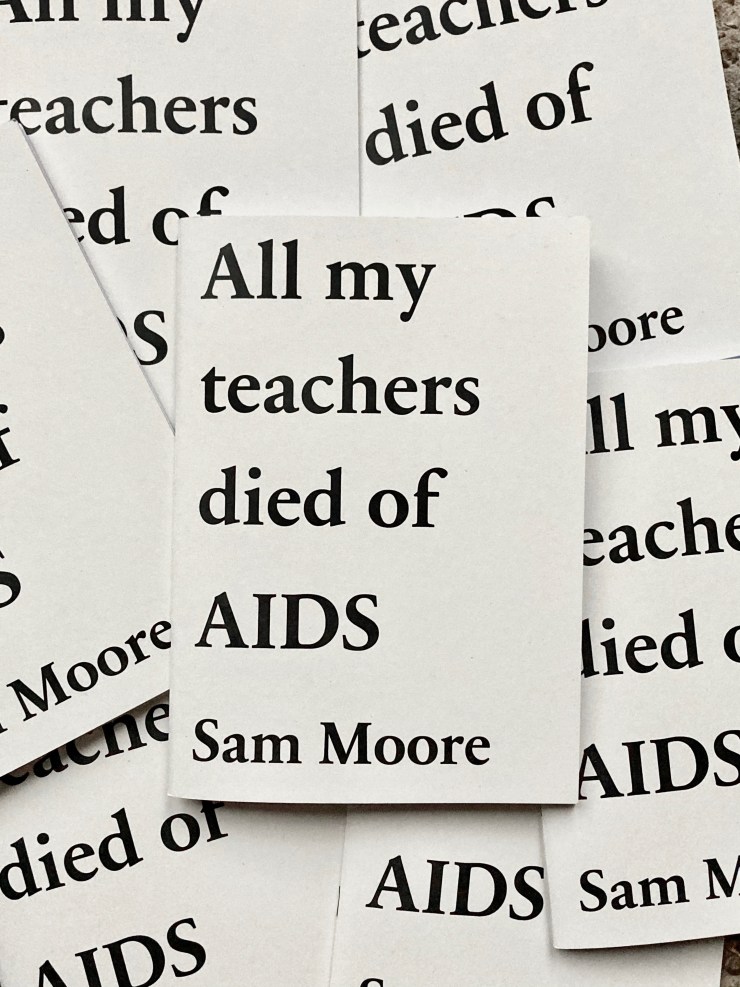
All my teachers died of AIDS by Sam Moore. Published by Pilot Press London. 2020.

Interview by Harper Wellman

CW: Death, discussion of transphobia

Sam Moore began their writing career while working toward their Master’s at the University of Oxford in 2017. While exploring various forms, Moore found their style, and success, with poetry and short stories, publishing pieces in Harts and Minds, DASH, Fearsome Critter, and Modern Queer Poets. Moore has developed a cross-genre style of writing that is on display in their book, All my teachers died of AIDS, from Pilot Press. Equal parts academic research, pop culture critique, and personal reflections, All my teachers died of AIDS explores the intersection of queer identity and death, and how the inseparable two inform each other. Below, Moore discusses Teachers, their process, their community, and what’s next. Moore is an editor for Third Way Press and a freelance journalist in London, UK.

Thank you for talking with us Sam. Teachers is a wonderful book that I think many people can relate to. Can you talk about how this project came to be? 

I spent a lot of time writing very traditional prose when I was finishing up my master’s degree – writing the first half of a novel for my thesis, something I keep saying I’ll come back to, and one day I will… but alongside that, I was also reading more and more experimental work, that existed between different styles and literary traditions. It was the first time I was reading Maggie Nelson, and diving into more of Chris Kraus’ work, and I basically ended up wanting to write something more along those lines, something that defied easy categorization. And then I went to a few of the Queers Read This events at the Institute of Contemporary Art here in London, run by Isabel Waidner, and Richard Porter (who runs Pilot, and would go on to publish the book), and was just incredibly struck by the range and strangeness of queer writing; Isabel read from their novel, Dodie Bellamy read from When the Sick Rule the World, Verit Spott read from Prayers, Manifestoes, Bravery, and it was impossible not to just be swept up in the power of this kind of writing, and wanting to contribute to it in one way or another.

Around the time I went to Queers Read This I also found the courage to start going to open mic nights (even after years of graduate workshops, the thought of actually standing up and reading poems out loud to strangers remains terrifying), and to begin with, I was reading lots of more traditional poems – all of which are from a book about bisexuality called Alex(andra), that I wrote between years one and two of my master’s degree and that I’m still hoping to get out into the world (so if anyone’s interested in publishing it, you know where to find me…) but gradually ran out of material and used that as an excuse to write something new and weird, which eventually became the first section of Teachers. I read it at a launch event for Modern Queer Poets (another book by Pilot that features a poem of mine, alongside some of my literary heroes like Eileen Myles and Wayne Kostenbaum), and jokingly said “it’s part of a longer, book-length poem, so if anyone wants to publish it come and talk to me after the reading.” Rich came to talk [to] me, and the rest is history.

I also think that Teachers kind of captures my development as a writer, in terms of this desire to write more experimental work; something that comes through in the sort of poem/essay hybrid (although structurally I don’t think it’s quite a lyric essay); poetry is the guiding force for the language when it comes to rhythm, line breaks, and the presence of rhyme in the text. But a lot of people have said that the depth of the book is more of an essay; rooted in an argument, in history and criticism, but written in the form of a poem. In their blurb for Teachers, Isabel (the author of We are made of diamond stuff, and Gaudy Bauble), calls it a “personal essay,” and the more time I’ve spent on the book the more I think that rings true. I also think that it’s ended up being a sort of signpost for how much more comfortable I’ve become writing about and through personal experience.    

Sam Moore, All my teachers died of AIDS excerpt.All my teachers died of AIDS by Sam Moore. Published by Pilot Press London. 2020.

Death is the major theme in Teachers. You discuss how there is danger in being queer and queer love, whether that is the physical act itself, or the threat of a bigoted society. How do you come to terms with the inherited history of HIV/AIDS, that still affects many members of our community? Was this book a way of navigating that?

It’s an incredibly difficult thing to come to terms with, and I feel like I also should acknowledge that it’s probably an easier thing for me to navigate than it will be for other queer people; living in the UK it’s arguably a relatively safe and liberal place (although there are still times when this theory is disproven), and I think as the continued fight for liberation goes on – which it very much is – we need to acknowledge that certain members of our community are more vulnerable than others. The continued quote-unquote debate around trans rights highlights the fact that while for some of us it’s become easier to feel safe, or assimilate, we still need to show up to fight for our trans brothers, and sisters (and those who are both or neither).

Teachers is something that’s more about navigating the past than it’s about offering any kind of roadmap for the present (something that feels vital but would probably be better off being written by someone else). A lot of the book is about coming of age – both from an individual perspective and across the wider landscape of queer history and culture – and is about the shadow of death that remains cast over the queer community. That’s what the book is about coming to terms with (or trying to come to terms with anyway; I don’t think it entirely offers neat closure, but I also think that that’s good), a way of trying to understand – if not accept – the generation of queer people who were taken too soon. And while things are better, the threat of a bigoted society remains; certain victories on politics or policy aren’t enough to erase the very real danger a lot of queer people still face, and I think that’s an easy thing to forget.

All my teachers died of AIDS by Sam Moore excerpt. Published by Pilot Press London. 2020.

Even with HIV/AIDS treatments progressing to where we are today, with viral suppression and PrEP, for some, especially multiply marginalized people, HIV/AIDS is not a thing of the past, and there remains a strong link between the queer community and death. Crimes against our trans and gender non-conforming friends are rising, while the number of hate and white supremacy groups increase.  What do you see as the next fight that queer communities must take on to stop these cycles of death and violence?

I think that the next fight for queer communities is one to defend the rights of trans people, which, even in supposedly liberal countries, are under attack; here in the UK, court rulings on trans teens being unable to consent to puberty blockers is a very real threat to trans people. Between that and the continued megaphones given to TERFs and transphobes, it becomes clearer and clearer that liberation is still a ways off, and we need to keep fighting for it.

And it’s things like this that restart cycles of death for queer people; I can’t help but go back to the puberty blockers court ruling, and can’t stress enough the kind of impact that this could have on trans people. Between rulings like this, the continued acceptance of transphobia in a lot of mainstream media, the atmosphere of violence and danger from a generation ago that’s in Teachers is still here today, it’s just that the violence has become more focused on a specific group of queer people. And as much as people like to talk about debating those who disagree on the issue of trans rights, this feels like an inherently disingenuous position to take; so often it forces people in marginalized positions to debate their existence as if it were some kind of Oxford union debating idea rather than the reality of people’s lives. 

It felt poignant to read Teachers during the current pandemic. The loss of life, marginalized communities being more harshly affected, and the loss of shared safe spaces, all feel somehow familiarly queer. What effect do you think COVID will have on queer communities moving forward? 

Back in Lockdown 1.0 here in the UK in the spring (which feels like forever ago), is when Rich and I first started talking about bringing Teachers into the world, and if this was the best or worst time to do it. In the end, I’m glad we ended up waiting a little while because I always wanted to bring it out on World AIDS Day. Having the conversation did make it clear how strange it might feel to bring out a book about plague during a new plague year (although I find the comparisons between COVID and AIDS to be a bit of a reach, especially when it comes to how politicians have responded; the rapid response for a vaccine is obviously wonderful and should be commended but it also seems to highlight just how stark and long-lasting the government inaction was during the height of the AIDS crisis).

You’re right about the way in which this current outbreak feels uniquely queer, like a kind of echo of queer history. And I think that COVID will impact queer communities in ways that remind us how precarious queer life can still be, and how vital solidarity is moving forward. The racial disparities in COVID mortality rates are something that we need to keep in mind, especially given the fact that communities of colour remain the most heavily impacted by continued cases of HIV/AIDS. This is something that should galvanize people to action, to continue fighting for members of the queer community who continue to struggle and face oppression.

All my teachers died of AIDS by Sam Moore excerpt. Published by Pilot Press London. 2020.

Have you found any new teachers during this pandemic? Have you read/seen/heard anything that has been inspiring you? 

I think my reading highlight of 2020 might be Writers who love too much, an anthology of New Narrative writing that was co-edited by Dodie Bellamy; it’s so uniquely queer to me in the way that it refuses to adhere to convention (especially when it comes to writing around politics and sex), and in the way it explores life and literature in inherently intersectional ways. I found myself reading more non-fiction, and specifically more political writing this year, and a highlight from that is absolutely If They Come in the Morning: Voices of Resistance, an anthology edited by Angela Davis about racism, activism, and the prison system that remains vital almost 50 years after its publication.

Finally, I wonder if you can tell us a little bit about your next project, Search History.

I touched on Search History a little at the end of the Teachers launch reading I did on the Pilot Press Instagram (which is still available to watch there, and if people are interested in checking out the book then that’s definitely a great place to start), and just like I did with Teachers at the reading last year – and with Alex(andra) in this interview – I decided to say “if anyone wants to publish this weird book of essays, slide into my DMs.”

Search History is, as the title suggests, about history; both in the big-picture way that Teachers was, but also specifically in reference to a computer’s search history. It’s a series of experimental, lyric essays that each look at different ways in which sex and desire are acts of performance. So the book is about erotic archetypes (cowboys, bikers, schoolgirls), the performance of gender roles, and how that plays into sexual power dynamics, internet porn, and (auto)biography. Like a lot of my writing, it balances pop culture criticism with a dive into specifically queer aspects of cinema, theory, and porn. There’s one essay about catholic schoolgirls and bikers (the two archetypes are tied together through an autobiographical thread), and it touches on Britney Spears, Kenneth Anger, and Kathy Acker. 

I’d say about half of the essays have been written in one form or another, and the first one to be published – An elegy to the Nob Hill Theatre, an exploration of the geography of 70s gay porn, and the non-space of the internet archive – is coming out in early 2021 with Take Shape.

________________________________________

With new work to come, Moore continues to explore more topics at the crossroads of queer identities, collective history, and personal experience. In All my teachers died of AIDS, Moore is able to weave together their research, exploring important and morbid topics in an earnest and engaging read that many queer people will find relatable. All my teachers died of AIDS is available now through Pilot Press, and Moore can be found musing on Twitter and Instagram.

Flowers are the stars of our fields: The Wildflower

In conversation with Becky Forsythe and Penelope Smart

Installation view, The Wildflower, Hafnarborg 2020. Photo: Vigfús Birgisson.
 

The Wildflower, Villiblómið, was exhibited at Hafnarborg – Centre of Culture and Fine Art (Hafnarfjörður, IS) between August 29 – November 8 2020.

Artists: Arna Óttarsdóttir, Asinnajaq, Eggert Pétursson, Emily Critch, Jón Gunnar Árnason, Justine McGrath, Katrina Jane, Nína Óskarsdóttir, Leisure, Thomas Pausz, Rúna Thorkelsdóttir

Curated by Becky Forsythe and Penelope Smart

By Juliane Foronda

Wildflowers can thrive without formal acknowledgement, reminding us how much effort is needed for something to appear effortless. Sprouting out of some of the toughest soils, wildflowers represent resilience and how much strength it takes to remain soft amid adversity. They can be constantly present and seemingly simple at first sight, but they’re rather innately complex and genuine.

I grew up believing that being born on Earth Day gave me a particularly special connection to nature and Mother Earth, and I still believe this to be true. My relationship with land and nature is complicated, constant, and intimate. It’s rooted in long walks, silence, and the smell of green in any climate. While I connect deeply to land and nature on an emotional level, I often struggle to connect to the cultural notions that surround it. Being a Canadian immigrant with neither Indigenous nor settler-colonial ancestry, I often struggle to speak about what anything Canadian really is —especially when speaking about land. While I don’t carry the same history, privilege, and power imbalance as those of settler-colonial descent, my family and I still immigrated to and eventually settled on stolen land, and I have lived in Tkaronto (Toronto) for the majority of my life. While I wholeheartedly recognize that my voice and the many voices like mine do not need to be at the forefront of the conversation regarding land ownership in Canada, neglecting diverse experiences entirely will only perpetuate the fact that any perspectives that exist on the margins of common convention are not valid or valued.

The multitude of connections between the Icelandic and Canadian landscapes are clear in their mutuality of large, open spaces and an abundance of dramatic nature. Both landscapes represented in this show are also personally familiar, having both been my home at some point in my life. I know nature at its core to be inclusive from my personal experiences of resting in fields or swimming in lakes, but my knowledge feels adjacent to these supposedly familiar landscapes, and my lived cultural experiences prompt me to question my permission for familiarity and sense of belonging in any conversation about land or nature.

Entering this conversation with curators Becky Forsythe and Penelope Smart, I grounded myself into the ideologies of all that I have learned from wildflowers and their ability to care into being. Their recent exhibition brought together artists from Canada and Iceland whose works personally lean into the ongoing dialogue surrounding land(scape) and nature. Using the framework of The Wildflower as a seed to a much larger conversation about the climate crises, land ownership, gender, and privilege, we were guided by a shared investment into learning how to see and speak about land and nature along its entire spectrum. Our conversation was honest, contemplative, and challenging, demonstrating how radical care can prompt a ripple effect towards future and extended visions and understandings of land.

Juliane Foronda: What landscapes are you most rooted in and why? As two Canadians, what does the landscape mean to you?

Penelope Smart: The landscape that I feel rooted in is the one that I’ve (just) returned to, which is northwestern Ontario. Boreal forest, bedrock and coniferous trees, brush, lots of open space, snow, and freshwater. The Canada you see on postcards – the image that settler Canada has produced of Canada. I grew up in this region. I find myself grounded in things like pinecones and pine needles, the sound of water on a shoreline, and the first snow. These things feel very much like they’re a part of me when I’m in it again. Coming back to this landscape as a curator, in this profession, you’re always asking yourself: What moves me? And what is the meaning of it? I’m in an interesting moment of relearning my own connection to this landscape.

Becky Forsythe: I feel most rooted in the landscapes of Ontario. Fields, mossy forests and being out on the lake. I grew up in a farm-suburbia. My father is from “up north” in Muskoka, and it’s an area I feel closest to and where the lake water is familiar. But my sense of land and landscape is also influenced by the fact that I am of settler descent and come from a long line of gardeners and cultivators. Both plant nurturers and hobby food growers, the thought of settlement or transplanting interests me in these micro landscapes.

JF: Becky, do you connect with the Icelandic landscape?

BF: In my first experience of it, I was driving through fjords in the West and they were coloured purple by the lupins, and there were literally whales jumping in the fjords—all of these symbols were happening, and I just did not know it yet. Ten years in, I’m realizing that the sea and the change of weather is more influential than I thought – the way that you sense the change of time, the air, the smells. The forests are still more familiar though.

Installation view, The Wildflower, 2020, Hafnarborg. Arna Óttarsdóttir, Untitled, 2014, mixed media, local flora  pressed in plastic (foreground). Photo: Vigfús Birgisson.

JF: I want to speak a bit about the problems and possibilities in land and land ownership, in Canada specifically. How did you approach these notions in The Wildflower?

BF: This is a problem that is so much greater than we are, and of course something pressing and current, and its deadline passed a long time ago. In our responsibility as curators, we can’t walk into an exhibition like this, with the artists that we’re working with, without letting the space for this dialogue to come up and happen. For myself, I’m currently in the process of learning a lot about this and trying to open myself up to the other stories that are happening in the land, and have always been happening in the land, hoping that in that way, my scope and lens as a curator can be more of a spectrum rather than based on my sole experience. Of course, in The Wildflower, some of the works are directly about this, both in Iceland and in Canada. In Eggert’s works, for example, he’s speaking very directly to the environmental consciousness, or lack of consciousness, in Iceland and how that relates to the landscape that he’s witnessed from childhood. This theme is recurring in many other works as well, like Emily’s, Justine’s and Asinnajaq’s. What was most important to both of us is that the artists’ stories are put at the forefront and that it’s presented in a way that the integrity of their work and storytelling is present and accessible. One of the ways that we meditated this was directly through their own words, so we used exhibition labels to build off of dialogue with them.

PS: In the show, there is a desire to think about the landscape as something that’s changing and alive, and unknowable for humankind wherever your history— whichever land or landscape you’re coming from, attached to, and belong to. There is this definite anthropogenic or urgent moment of change that we’re living in and were interested in thinking about in The Wildflower. The artists, their work, histories, and their own visions of the future were reflected throughout the show.

The orientation of the show is a horizon, or we used the horizon as a motif. This helped us think about what works are looking towards, or where they’re coming from, where the artists are in their minds, and what they’re thinking about landscape and a relationship to the land.

Rúna Thorkelsdóttir, Sun-set (Solsetur), in process since 1986, sunprint. Photo: Kristín Pétursdóttir.

BF: At one point, we discussed a young woman’s bedroom, imaging the voices of the time we are in, but that morphed into a space where thinking about gender needed to be more fluid. It got too locked into its role of thinking of gender in nature as a female experience. It’s problematic, and we could have opened that up further. When you think about what Thomas is presenting, this research with insects, flowers, and the language around that scientifically is very gendered. Words happen to be around sex, or the act of reproduction, so there’s a lot of interesting words connected to female anatomy and thought on gender fluidity. There’s a lot present here that we have yet to fully reflect on or work through.

PS: We were making the show at the time where the voices of young women like Greta Thunberg, Autumn Peltier, Inuk MP Mumilaaq Qaqqaq, and Vanessa Nakate were the voices of climate change. There was a young female voice as this eco-warrior or archetype leading the language around climate and voicing up concern. There was something that fed into this feminine energy in works such as Leisure’s or Justine’s, which was stained glass body armour, and was worn by young women in her video.

Justine McGrath, The Judge, 2020, digital video, filmed in Stone Mills, ON with help from Evan Davis of Shortspan Media. Model: Adrienne Chalaturnyk. Photo: Vigfús Birgisson.
 

JF: I think it’s important to acknowledge that the fight for land and climate justice is deeply rooted in social justice, such as issues of race, gender and class. Did you see this exhibition or your collaboration as a means of, or platform for political activism regarding the ongoing land and climate crises?

PS: There was very conscious research into artists whose work related to nature and wildflowers, which connected us to other projects doing work in the area of food security and land rights. There was a curatorial intent to have Indigenous voices in the show because this is what’s going on in Canada and it would be irresponsible to not include Indigenous voices in conversations around land. I think the idea of land being shown through one’s own perspective is there in everyone’s work, but it is especially important to see and hear Indigenous views of their current relationships to land, ideas of ancestral connection to the land, restoring land and power, and reclaiming land and histories.

I think it’s also important to say that some artists, like Justine, who is of mixed ancestry, are still figuring out their relationships to Indigeneity and this is also part of the conversation about land and identity in Canada. This can be true for non-Indigenous people as well, for anybody. It’s nuanced, people are different, and there’s many layers to it. The show is also operating at a level of subtlety rather than overt politics in the terms of the subject matter itself: flowers and floral material. I think of Runa, or Arna’s works, made with flowers she’s gathered from where she and her family go walking. Eggert does talk about his work having a political message. There is an interesting place where flowers and politics meet.

BF: It was really exciting for us to be able to present different voices from Canada here in Iceland, because it’s not something that we see daily in the local galleries, or at least not that I’ve ever seen. The hope was to invite new conversation in a place where consciousness of the history of Canadian land is less present. But I’m not sure about whether or not we were successful in doing that because we weren’t able to mediate the exhibition in the way we had imagined for practical reasons and were not able to engage in dialogue to address this history with the public.

Emily Critch, Wetapekksi / crow gulch, 2020, photographic print on Hahnemühle paper (foreground), Katrina Jane, Tools of being, Portugese marble, 2019 (background). Photo: Vigfús Birgisson.

JF: What does it mean for you to work together as women in a leadership position or space of power, using your voice to speak about land and nature?

PS: It’s amazing to have a close friendship where you can also work together. Speaking for myself, as a white curator who comes from a culture of settler colonialism in Canada, I am learning how to acknowledge that the history that I come from is one that has caused harm in terms of land and landscape. I’m finding this place of acknowledgement is uncomfortable and scary, but also generative because there’s no way to do it perfectly. There was an Instagram post circulating this spring about how you never “arrive” as an ally. This really resonated and made me more aware of how I use or don’t use my own position and power to amplify experiences different than my own. I want to be a part of creating new common ground for diverse experiences of land and landscape.

BF: This idea of being a part of our own time and contributing to how things are represented, knowing that history has to be multi-voiced and that for the most part, we’re really only seeing a very small sliver of it now. Being able to challenge ourselves in and amongst that, as Penelope said, in curating, is a really inspiring place to be. I think that what is clear in our approaches to working with others in the field, is this sensitivity and desired awareness, and a need to see many sides of the sphere. This is an extremely exciting time, and one that I know means sitting back and listening a lot more than reaching out and shouting.

PS: As soon as you start to generalize or use what somebody represents at first sight as the only way to interact with them, that’s a problem. I’m always being reminded of that and want to be a person who is taking everything one step at a time – person to person. For some, I represent a history of power imbalance, and I’m learning how to stand in this reality in a field where things are changing. It can feel uncomfortable claiming my privilege because it’s not something that I’ve had to do before. I’m trying to learn for myself and from others what it means to do that, to understand it. This takes time. The humanity there is letting the fear of not doing it right and vulnerability be part of it for everybody.

———-

I have always had a fondness for flowers. While simply weeds to some, I know the wildflowers scattered along the meadows, fields and pathways that I often walk along like old friends. Their familiar, deep and profound silences continuously offer me lessons without needing to say a word, reminding me of the wonder of my own inherent capabilities. I can’t look at a wildflower without reflecting on hidden labour and the urgency of maintaining constant care. They prove that power requires delicacy as much as it needs force. Consistently working to give themselves to the world without asking for much in return, I find wildflowers to be the epitome of compassion and generosity, and I remain invested in their philosophy as they keep me mindful of how much there is to learn as long as we’re willing to take the time to see it.

This conversation exists in two parts, with the other being on Artzine.

Becky Forsythe and Penelope Smart met at the Banff Centre for the Arts and Creativity in 2017. Their shared work is based in new and meaningful conversations about nature, materials and the feminine. The Wildflower is their first collaborative project.

Becky Forsythe is a curator, writer, and organizer in Reykjavík, Iceland. Penelope Smart is curator at Thunder Bay Art Gallery and writer based in Ontario, Canada.

Writer’s note of Land Acknowledgement:

For thousands of years, Tkaronto (Toronto) has been the traditional territory of many nations including the Mississaugas of the Credit, the Anishinaabeg, the Chippewa, the Haudenosaunee and the Wendat, and it is still home to many diverse First Nations, Inuit and Métis from across Turtle Island (North America). Tkaronto is covered by Treaty 13 with the Mississaugas of the Credit. I have lived on this land for the majority of my life, and it continues to significantly shape and impact my trajectory. I acknowledge and recognize the many privileges that I have because of immigrating to and having grown up on stolen land. I conducted this interview from Glasgow, Scotland, where I am currently based.

Penelope spoke to me from Thunder Bay, Ontario, located on the traditional territory of the Anishinaabeg, which is covered by the Robinson-Superior Treaty. She is grateful to live and work on the traditional territory of Fort William First Nation. Becky spoke to me from Reykjavík, Iceland. She acknowledges traditional territories of the Huron-Wendat, the Haudenosaunee, the Anishinaabeg, specifically Ojibway/Chippewa, the Odawa and Wahta Mohawk peoples whose presence on the land continues to this day, and where her time and experiences lived on this land continue to influence her person and practice.

Femme Art Review is based out of the traditional territory of the Anishinaabek, Haudenosaunee, Lūnaapéewak, and Attawandaron peoples (London, Ontario). Artzine is based out of Reykjavík, Iceland.

Profiles on Practice: Khadija Baker

By Nadia Kurd

Khadija Baker. “Birds Crossing Borders.” 2018. Photo Courtesy of Artist.

In 1987, Chicana poet and feminist Gloria Anzaldúa wrote, “a borderland is a vague and undetermined place created by the emotional residue of an unnatural boundary. It is in a constant state of transition.”[1] Born in the Northern Syrian town of Amûdê‎, Montréal-based multidisciplinary artist Khadija Baker fully understands this constant state of transition as her birthplace sits uneasily between Syria and Turkey. “I always saw the border in Northern Syria in the Kurdish region where I was born as a tool to divide and stop the fluency of daily activities,” reflects Baker.[2] 

As an artist, the border, both as a metaphor and the actual division between nation-states has long informed her approach to art making. Baker reflects that she has, “developed various ways to reflect on the re-creation of what we can literally and conceptually call a map in my artwork…[in my work], the border is a developing, changing form that can reflect our connection and comfortable daily lives and can also respond to human needs.”[3]

However, Baker’s work is not only informed by her lived experiences as a Syrian Kurd, but also the current events and Kurdish oral storytelling traditions. For example, in My little voice can’t lie, (2012/2019), Baker sits motionless on a plinth, with small speakers braided into her long hair. Gallery visitors can approach Baker, take hold of a braided plat and raise the speaker to their ears. What they will hear are the recorded stories of displaced women from Kurdish, Palestinian, and Persian backgrounds. Here, Baker’s body becomes the medium for these narratives, collapsing the distance between the women’s stories, the artist and the audience.

Khadija Baker. “My little voice can’t lie.” 2009, 2012. Photo courtesy of the artist.

The multimedia installation Behind Walls (2008/2017) looks at the systematic program of renaming of Kurdish places in Northern Syria since 1962.[4] To visually acknowledge this history, Baker made 80 clay spheres that are connected by a mesh of strings suspended overhead. These strings are spun from clothing and combined with sand to create an altogether web-like formation. An audio soundtrack that accompanies the installation and audio soundtrack of recordings by Kurds living in Montreal. Fading in and out, is a projection onto the clay spheres also reveals the Arabic names—directly onto the names of Kurdish places which have been inscribed in the clay. Viewers can walk through the work and reflect on the impact of a forced map on the daily lives of stateless Kurds—ultimately, to show audiences, as they move through the installation, “the arbitrary nature of maps and history, the fragile nature of memory, and even the interconnectedness of a diaspora scattered across the globe.”[5] 

Khadija Baker. “Behind Walls.” City Hall, Karsh-Masson Gallery, 2008,2011. Photo Courtesy of the artist.

In another installation, Birds Crossing Borders (2018), Baker weaves together a complex assemblage of water-filled and tube-connected Plexiglas boxes, video and live performance. One Plexiglas box is filled with tinted water, and with the connecting tubes, transports its contents to the next box, and so on. The eventual transference of colour serves as a metaphor for both migration and adaptation. Moreover, the videos that document the stories of Syrian refugees surround the linked containers, further emphasizing change and movement. In this project, Baker asks, “How will the host society own the collective memory and generate the sense of understanding? How will it grow more familiar with the newcomer?” In the installation space, the viewer is confronted with these questions, but more importantly, they are asked to examine disconnect in humanistic values that separate the refugee from the citizen.

Khadija Baker. “Coffin/Nest.” 2007, 2017. Photo courtesy of the artist.

Coffin/Nest (2007-2019) take up borders and displacement in a much more personal and material way. Using recycled clothing from friends and acquaintances, Baker weaves a circular nest around herself. Surrounding her woven fabric nest, are long, life-sized bundles of fabric, which mimic a cocoon or womb (or alternatively, body bags). As Baker weaves, she becomes fully immersed in her protective nest, and each time this work is performed, the final outcome manifests in different ways. The work examines on the difficult history of systemic mass murder and burial of people in northern Iraq (mostly ethnic Kurds, but also Shia Muslims), and how the only way to identify human remains was through articles of clothing.[6] The self-made nest also acts like a shelter – Baker enfolds herself within this history in a way to commemorate lives lost and to also recognize survivors.

An intuitive process guides much of Baker’s work, and she often relies on stories and materials to guide each project. “I work against a specific methodology,” notes Baker, “my work reflects things I have witnessed and lived.”[7] In other words, in each of her projects, Baker researches, embodies and pushes the narratives she gathers. Varied and never totally finished, her multidisciplinary performances and installation works are highly emotive and fused with a lived, collective sense of pain and mourning. Baker’s art channels and comes to terms with the current turbulent history of Kurdish displacement through performance and storytelling. By placing herself publicly at the forefront of this lived reality, Baker seeks to present and visualize not only her experiences, but also the humanity of Kurdish people.

Since completing her MFA (Fine Arts) in 2012, Baker has remained a core member of the Centre for Oral History and Digital Storytelling at Concordia University (Montreal). A participant in numerous international exhibitions and residencies, Baker’s work continues to articulate the story of forced displacement and struggles especially women and children who face violence around border issues in all its aspects. Her life and work straddles place, language and belonging – all borne from cruel necessity to preserve Kurdish life. The precariousness of life also echoes the poetic words of Gloria Anzaldúa when she writes:

This is her home

            this thin edge of

                        barbwire.

To see more of Khadija Baker’s artwork and upcoming projects, visit:  http://khadijabaker.com or follow her on Instagram @bakerkhadija

Nadia Kurd (she/her) is an art historian and curator based in Amiskwacîwâskahikan  (Edmonton, Alberta). Her work can be found on www.nadiakurd.com.


[1] Anzaldúa, Gloria. Borderlands/La Frontera: The New Mestiza (aunt lute press: San Francisco, 1978), 25.

[2] Baker, Khadija. “Imagining Borders” Liminalities: A Journal of Performance Studies, Vol. 12, No. 1 (2016), 1.

[3] Ibid.

[4] As Human Rights Watch reports, “In 1962 the government carried out a special census in al-Hasakeh province in northeast Syria on the pretext that many non-Syrian Kurds had crossed illegally from Turkey. Kurds had to prove that they had lived in Syria since at least 1945 or lose their citizenship.” This evolved into land expropriation and a process of “Arabization” of the region. For more on this history, see: “Repression of Kurdish Political and Cultural Rights in Syria,” Human Rights Watch (2009) https://www.hrw.org/report/2009/11/26/group-denial/repression-kurdish-political-and-cultural-rights-syria

[5] “Artist Spotlight: Khadija Baker’” Aesthetica Magazine https://aestheticamagazine.com/profile/khadija-baker/ (accessed 25 August 2020).

[6] Artist website, http://khadijabaker.com/index.html.

[7] Artist interview with the Author, 2020.


The Art of Fugue: In Conversation with Emilie Crewe

Questions by Adi Berardini

Emilie Crewe’s The Art of Fugue is a multi-channel video installation featuring five women working in trade industries. The Art of Fugue is edited using the traditional musical structure of a fugue, which is a compositional technique using multiple voices built on a subject that is introduced at the beginning. Each screen acts as a singular voice, interweaving together and contributing to the artwork as a whole. Highlighting women in trades is both an aesthetic decision and a symbolic choice. The piece captures the strength and resilience found in a performer whose work is in a typically male-dominated field.

Emilie Crewe is an interdisciplinary artist based in Vancouver, British Columbia, Canada. Her artwork often takes the form of video installation, single-channel video, multi-channel video, and sketch-work (drawings, collections & archives). She holds an MFA from the School of the Art Institute of Chicago, and a BFA from the Nova Scotia College of Art and Design University. Her work is exhibited internationally in galleries, museums, artist-run centres, experimental film/video festivals, and as public art.

In the Art of Fugue, you combine the actions of women working in trades that are viewed as male-dominated and masculine to the musical composition of a fugue. How did you first arrive at the idea of featuring women in trades and paralleling the film to ideas of music and composition?

The concept began with research that I was doing at the time, which was centered on the neuroscience of music.  I wanted to make an artwork that embodied musical properties and structure but did not incorporate literal music.  My intentions were for viewers to sense rhythm, cadence, and tone within their bodies.

The subject matter [focusing on] women in trades came after the decision to create a video using fugue structure (For reference, The Oxford Dictionary’s definition of a fugue is, a polyphonic composition in which a short melodic theme, the subject, is introduced by one part or voice, and successively taken up by the others and developed by their interweaving).

Trade industries and labour jobs have always been of interest to me as an artist since I relate to the act of using your hands to create something. There is a direct connection between the brain and the hands that has always fascinated me. I appreciate the process, investigative aspects and problem-solving within these specific jobs, and find that there is a distinct creative component to trade-work that I admire. There is beauty in functionality and repetition. I chose to work with women working in trade industries because of an [inclination] I have to feature characters that are somewhat “unseen”.

EmilieCrewe_MegIredale_3
Emilie Crewe. The Art of Fugue: A Polyphonic Instrumental Video Featuring Five Women in Trades still. 2019. Courtesy of the artist.

Can you explain more about your process organizing the sounds, footage, and editing?

I went into this project knowing that the editing would be a challenge.  I had never worked with five channels of video before, and I don’t think I really understood how complicated it would be until I began to sort through the footage.  After the shoots, I had over forty hours of footage to catalogue.  I narrowed the content down to about twenty hours of usable footage and then spent several days sitting at my desk feeling confused as to where to start.

At this point, I knew that I had to step away from the computer, and begin editing “by hand.” Using a system of colour-coded sticky notes, I began making connections between the different trades and the physical movements of the five performers.  For example, I would write down a note that would say, “Meg looks up,” and would pair this with another note that said, “Kate looks up,” After arranging these notes on the wall, I transferred the components that I liked into a notebook to work with at my desk.

The artwork was edited in Adobe Premiere Pro in one timeline that was divided into five channels, each colour-coded to represent a different performer in the video.  All of the editing was done using a metronome set to four beats per measure and eighty beats per minute.  This is a very typical time signature used in musical compositions, and it helped me to keep time and work using a structured rhythm.  The sound was the last component that I worked on, utilizing a mixture of live audio from the shoots, as well as my own Foley sounds that I recorded at home using audio equipment from VIVO Media Arts Centre in Vancouver.

Editing Notebook
Emilie Crewe. Artist’s process book. 2019. Courtesy of the artist.

In researching this project and filming in the women’s workspaces, what were some of the things you discovered about women working in trades? Did they share their struggles and/or successes in their careers?

I think a lot of people are fairly open-minded these days, especially here on the West Coast, but I do have an understanding that entering into a typically male-dominated job force as a woman comes with some stigma and possible [hesitation] from prospective employers.

With the nature of the work that I was creating, I talked with each performer about barriers that they had come across, from customers making inappropriate comments to contending for jobs amongst male competitors.  It was interesting hearing about the experiences of the performers that I was working with, and I learned a great deal about what it’s like to work in their respective industries.

The machinist, for example, was working in a large factory in Delta, of which she was the only female employee.  There was great sociability between her coworkers that she was very much a part of, so that was nice to see.

Three of the five of the women that I worked with are small business owners.  The plumber, Mary-Anne, employs an all-women crew, which is great for women seeking apprenticeships in the industry.  The most notable takeaway I think has been the realization of having to prove your worth simply because of your gender.  These things come up in a lot of different industries, including the art world, but within the trades, it seems important to show physical assertiveness.

If there are any readers that are interested in these types of barriers within trade work, I highly recommend the book, Journeywoman: Swinging a Hammer in a Man’s World, by Kate Braid. It’s a fascinating look at the experience of a Canadian woman working as a carpenter.  She mentions several situations where contractors would look her up and down, and then basically say, “no way,” all based on the simple fact that she was a woman.

EmilieCrewe_BrandieDoucette2
Emilie Crewe. The Art of Fugue: A Polyphonic Instrumental Video Featuring Five Women in Trades still. 2019. Courtesy of the artist.

Has your view transformed as to how gender comes into play for women and the workplace after creating this film?

I’m not sure if my view has transformed or changed, rather it has been expanded.  With many scenarios, the more information that we take in, the better our understanding is.  Being a woman myself, I have always had an awareness of how gender comes into play in the workplace.  Creating The Art of Fugue has certainly broadened my perspective.  Documenting these women at work served as a great inspiration as well, and I often came away from shoots feeling a sense of encouragement, optimism, and admiration.

Who are some artists/filmmakers that influence you as an artist?

Two meaningful influences for me have been Pipilotti Rist and Eija-Liisa Ahtila, both video installation artists [who are women].  [I have also been influenced] by the sound and video work of Janet Cardiff and Georges Bures Miller.  Artists that work in ways that envelop viewers, especially in terms of creating an immersive installation, always spark that creative drive in me.

When it comes to filmmakers, I love the work of Jesper Just, 
György Pálfi
 and Roy Andersson; all people working with moving images in strange, visceral ways.  Really, I’m drawn to work that makes my senses stir, literally and metaphorically.

Editing Timeline
Emilie Crewe. Artist’s editing process. 2019. Courtesy of the artist.

Do you have any other projects planned in the future that you would like to share?

Currently, I’m working out the logistics for a new multi-channel video featuring a female musician. I’ve secured some grant funding from the Canada Council to head to Winnipeg and shoot with Julia McIntyre, a prominent Canadian bass trombonist.  I will be working with the theme of a musical toccata, which is a quick, virtuosic musical interlude that shows off a performer’s “touch.”

This will be the first time that I have experimented with using a musician as a performer in my work, so I’m looking forward to seeing what comes of this project.  A lot of my creative process happens in post-production.  I go into a video shoot quite intuitively, usually ending up with a wealth of footage to sort through, as I did with The Art of Fugue.  So, I can’t really say how this will turn out, although I have some images in my head that I’m playing with.

I’ve always wondered how a classical composer can write a symphony with so many components and instruments and know how it is going to sound.  I guess the answer is that you really can’t know until you have an orchestra in front of you to play the music.   You can test the melodies and harmonies out all you want on a piano, but it will only exist as an imaginary sound in your mind until you have people to play it for you.  Video is in some ways like this.  I can imagine an artwork, but until I am actually shooting with a subject and then “composing” the timeline in the editing phase, I really have no idea what I’m going to come away with.

You can find out more about Emilie Crewe’s The Art of Fugue on the project website and on her Instagram @emiliecrewe.