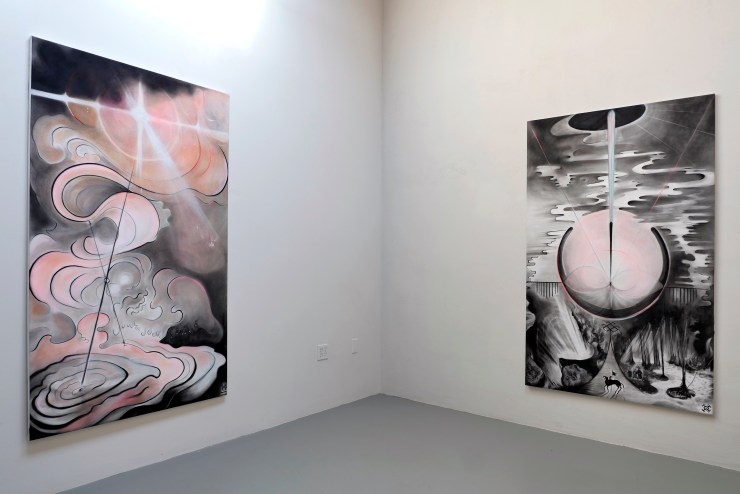
Tireslashers by Charlotte Zhang at The Polygon Gallery

Tireslashers by Charlotte Zhang. Installation photo by Dennis Ha, courtesy of The Polygon Gallery.

Tireslashers by Charlotte Zhang

The Polygon Gallery

Nov. 28, 2025 – Mar. 29, 2026

By EA Douglas

Busting off the walls ready to steal your attention, the works included in Charlotte Zhang’s Tireslashers at The Polygon Gallery are bright, bold, and confronting. Uniting two of Zhang’s ongoing projects, Rogue Pamphlets, a series of large textile collages, and Bloodsport/Playground Rules, a handpicked selection of “readymade” sculptures lifted from public property, the exhibit brings under scrutiny the historical and contemporary construct of the loveable outlaw.


Tireslashers
by Charlotte Zhang. Installation photo by Dennis Ha, courtesy of The Polygon Gallery.

The hand-sewn wall hangings of Rogue Pamphlets are composed of images of ruffians and rogues, pulled from historical and contemporary sources, and transferred onto shiny, polyester patches, using the sublimation dye technique. The pictures have been carefully cut out, then basted with large, loose stitches, one on top of another, piled up to the point of convergence. The Rogue Pamphlets seem to play with the act of installation: the tension of the backing fabrics held against the gallery walls causes the images to ripple and pucker, the brightness of the lighting bouncing against the polyester sheen, further distorting the pictures. The visual impact is stunning.


Tireslashers
by Charlotte Zhang. Installation photo by Dennis Ha, courtesy of The Polygon Gallery.

Romance Scammers (Gyges – Lyndon) is the largest and most impressive piece of the group. The work juxtaposes the naked Nyssia from William Etty’s Candaules, King of Lydia, Shews his Wife by Stealth to Gyges, One of his Ministers, as She Goes to Bed (1830) with a rising Lady Columbia, the female personification of the United States. Various versions of these historical heroines are stitched onto two blue stretches of fabric, interspersed with images pulled from surveillance cameras of pickpockets, and foregrounded by a film still of a just-about-to-happen kiss from Stanley Kubrick’s Barry Lyndon (1975). The assemblage brings together seducers, rakes, gold diggers, and America’s self-concept of nationhood, forcing the question of similitude.

Tireslashers by Charlotte Zhang. Opening reception photo by Alison Boulier. Photo courtesy of The Polygon Gallery.

The other standouts are Evasive Theatrics I (Irma Vep, the malevolent Other) and Evasive Theatrics II (Executioners and interrogated subjects), a duo of laser lemon yellow squares highlighting the roles of the femme fatale and the executioner, in turn, exploring the commonality of characters donning masks. Evasive Theatrics I (Irma Vep, the malevolent Other) features women’s bodies in black latex, reduced to only their eyes, with a snarling Musidora, pulled from Louis Feuillade’s seven-hour Les Vampires (1915-16), taking front stage. Each corner is labelled with an attribution of this character, top-to-bottom, left-to-right they read: HOSTILE, FLIRTATIOUS, APOLOGIZING, FANTASIZING. Its counterpart, Evasive Theatrics II (Executioners and interrogated subjects) centers an eerie, blurred-selfie-like image of a gloating criminal, overtop which, blood sprays from a freshly decapitated body, below grinning reapers from The Purge (2013) eyelessly confront the viewer, the labelling reads: ACCUSING, DISPIRITED, JOKING, ARROGANT. Together, these two works illuminate the double-sidedness of these social constructs, how both characters are caricatured as villains while simultaneously being glorified as heroes.

Bloodsport/Playground Rules by Charlotte Zhang. Installation photo by Dennis Ha, courtesy of The Polygon Gallery.

Furthering this concept of duality are the inclusion of the pieces from Zhang’s Bloodsport/Playground Rules series. Assembled across two low, bench-like plinths are thirteen metal arches in deep shades of phthalo green and navy blue. Smooth, shiny, sometimes marked with graffiti, these curved metal crests have, in some cases, been loosely locked together in pairs, or they stand solo, upright like the humps of a sea monster, or lay on their sides showing off spikey screws. It’s the screws that allude to the sculptures’ origins, with them the colourful Bondo crests were once affixed to the bus benches around L.A. A form of hostile architecture familiar to most metropolitans, to the point it has become normalized, under the guise of decoration, these simple curves of metal are a brutal way to keep people from sleeping in public spaces.  The “readymade” sculptures of Bloodsport/Playground Rules may look simple, but the affect of their inclusion in Tireslashers is distinct. Through the destruction of public property, Zhang has aligned herself with the glorified petty criminals who line the walls. Subsequently, by exhibiting these works, the art institution is thrown under the same level of scrutiny as the various entities explored in the Rogue Pamphlets series. In presenting this exhibition, the gallery has not only sanctified acts against the status quo of hostile architecture, but it has also become complicit in the crime. By placing these bench dividers on, albeit short, pedestals, the exhibition uplifts the yield of vandals’ exploits and, in turn, the acts of vandalism themselves. In doing so, the institution embodies the question that Zhang has been asking within her wall-bound pieces: who decides who is the hero and who is the villain?

The colourful works included in Tireslashers give the show the demeanour of childish playfulness while confronting serious concerns of the contemporary art audience. By pulling into parallel pieces from both Bloodsport/Playground Rules and Rogue Pamphlets, The Polygon Gallery forces us to see the picture bigger than the individual works themselves. 

Between the Senses and Horizons

“Tracing Memories”, Samina Hassan Laghari, 2023-24, Diptych video, 10 minutes. Photograph by the author, courtesy of Articulate Studios.

By Jabeen Qadri

Horizon is Home at Articulate Studios, Lahore, Pakistan, curated by Quddus Mirza, featuring artists Abdul Haadi, Samina Hassan Laghari, Salar Marri, Seema Nusrat, and Farooq Soomro. The exhibition ran from December 23, 2024, to January 5, 2025.

Dec 24. 5.45 pm. Shalimar Town, Lahore.

I’m still not accustomed to the sun setting this early. Despite being here for almost a month, my mind is operating on my hometown’s time, and I didn’t anticipate the darkness at this hour. Or it may be that my subconscious had a better experience planned for me to view the exhibition. I retrace the steps from the last time I visited this heritage house. It was almost a year ago, but I remember it quite vividly like it was yesterday. I remember having a sore throat in winter and wearing a pink sweater and an Afghan choker, neither of which I’m carrying today. I remember there were some lights leading up to the gallery space, and people buzzing about. It seemed a different place altogether today.

“Asalam o alaikum,” I hear a voice in the pitch-black darkness, as I’m turning off my phone’s torch, seeing the entrance lit and doors open. The guard must be wondering if he greeted a real person or a ghost. I think the same about the guard.

As I enter the exhibition, it is lit up and ready, but with no people, like Marie Celeste, found in the middle of the Atlantic Ocean, without a crew or passengers, but with all their belongings intact. The first two works are installed behind curtained rooms. I resisted going inside—the last thing I want is to step inside a dark room—but I find myself immediately drawn to the videos installed and forget about the dark or being alone in this aged building.

Seema Nusrat, 2024. Photograph by the author, courtesy of Articulate Studios.

The exhibition titled Horizon is Home, curated by Quddus Mirza, is an outcome of a three-week-long residency hosted by Articulate Studios in Chitral and Lahore. The artists include Abdul Haadi, Samina Hassan Laghari, Salar Marri, Seema Nusrat, and Farooq Soomro. Horizon as a concept has been celebrated by artists across history, compositionally, conceptually, and symbolically. Mark Rothko, for instance, used horizons notoriously in his colour field paintings. They say about Rothko’s work, “This is not the kind of painting you can talk about – you have to experience it.” [1] And though formally, the horizon functions as a point of separation, a sort of groundedness, that enables the eye to see what is depicted. Yet, the eye of the soul sees beyond the separations. “You feel as though you have been captured by infinite horizons and absorbed into imaginary seas with hallucinatory hues.”  In our daily occupied and chaotic lives, the eye of the soul remains quite suppressed, hidden behind the intellect. The simple act of viewing art is enough to open this suppressed sense. I feel a similar response to Horizon is Home, where my inhibitions are disrupted and I feel lost to the world of the imaginary, contemplating memory, identity, boundaries, and separations.

Inside the dark rooms, video works by Abdul Haadi and Samina Hassan Laghari greet me. I find the dialogue the works create with the building’s structure fascinating. The video projections feel like echoes of the past, the walls adorned with artists’ connection to their homelands, with environmental or geographical contexts. The dark room holds an intimacy; the exhibition soon turns into a confrontation with myself. The silence of the video works is deathly, making the projections more powerful. I feel teleported to my childhood. I notice there are fireplaces in the dark rooms; it’s an aged house after all. I wonder what stories the fireplace tells. At this point of metaphysical experience, I applaud my choice not to visit the opening of the exhibition but rather, to visit it the following day, where I could dive into the experience of the works together with the surrounding space, without human and social interruption. My social anxiety turned out to be my prize after all.

Farooq Soomro, 2024, archival ink print on photopaper. Photograph by the author, courtesy of Articulate Studios.

As I walk further, I find light and still images. I breathe a sigh of immense relief to see familiar monuments and figures, but the confrontation with myself continues, and I can’t escape it. I find destruction, congested houses, bougainvillea, and traffic, all reminiscent of Karachi. These are photographs by Farooq Soomro. No matter where I am, it’s a delight to find a trace of my home. Even though the artist created depictions of other cities and places, he uses the Lahore smog as a metaphor for blurry reality in contrast with a beautiful, blurry landscape of a valley from Chitral. Similarly, Salar Marri’s series of multimedia works Ambiguous Nature of Being is consumed with blurriness in imagery as well as the use of material, which takes me to another sphere of existential inquiry. I regret that to truly experience the ambiguity, I wish I hadn’t read the title of the series. What I see is the blurred boundary between the city I’m in and the city where I come from. It takes me back to my thought a day earlier: would I ever be able to see Lahore (or any other city) for what it is, or would I always compare it with home, Karachi?

Shortly after, I see models of homes arranged like apartments, made with green covers used during construction. The sculptural work by Seema Nusrat highlights the environmental damage caused as homes and trees are being replaced by buildings. I enjoy the placement of the work the most.

“Erosion”, Samina Hassan Laghari, 2024, inkjet print on tracing paper. Photograph by the author, courtesy of Articulate Studios.

Just when I think of leaving, my terrors reignite as I witness Samina Hassan’s print on tracing paper. Not that it was horrible; no, it was quite the opposite. As an artist who loves using tracing paper, I was immediately hypnotised and slightly afraid. The print combines various geographical landscapes, from Sindh and Chitral, depicting the environmental damage. I could see surreal objects and figures coming together in my mind’s eye. Combined with the scale of the work, the aesthetics of the aged building, and my childhood memories already invoked earlier, it reminded me of Count Dracula’s house at the top of the mountain. The isolation felt real and near. At this point, I think of the guard who must be wondering where I went, if I am real. The last thing I want is to be locked inside. I take a final look at Samina Hassan’s print, which is challenging to articulate, so I write a few lines of poetry and leave.

Bushes take me somewhere

They itch, they scratch the edges

Blood rushes, drip by drip

A voice calls me towards it

I’m scared to go, to look in the eyes

This could be home

References

[1] Art Basel. “Mark Rothko in a New Light.” Art Basel. Accessed December 25, 2024. https://www.artbasel.com/news/restrospective-mark-rothko-fondation-louis-vuitton-paris-reveals-lesser-known-aspects-american-painter-work.

Who’s Afraid of Labour Justice? In Conversation with Furqan Mohamed

Exhibition visitors at the opening reception of Who’s Afraid of Labour Justice? Image credit: Blue MBK.

Interview by Adi Berardini

What can our fears tell us about one another? Could embracing our fears instead of keeping them at arm’s length connect us closer together?

Furqan Mohamed curated the exhibition Who’s Afraid of Labour Justice? as part of this year’s Mayworks Festival of Working People and the Arts presented with Charles Street Video, featuring artists Nahomi Amberber, Saysah, and Farah Ghafoor. The exhibition asks what we are afraid of in the pursuit of justice for all workers and how workers are often painted to be monstrous or terrifying under the logic of capitalism. What does it look like to embrace the monstrosity? Through a multi-sensorial approach, Who’s Afraid of Labour Justice? touches upon how labour can leave one feeling like a ghost and a shell of an embodied human. Together, Mohamed and the artists explore the haunting in the fight towards liberation in a labour landscape steeped in white supremacy, patriarchy, and capitalism, and imagine what mending this could look like.

Furqan Mohamed is a writer, educator, and arts worker from Toronto. Her work has appeared in Room Magazine, Maisonneuve, mimp magazine, Canthius, and The Local, where she was an inaugural Journalism Fellow. Her digital chapbook, “A Small Homecoming,” was published by Party Trick Press in 2021. She is also the creator of the “Who’s Afraid?” reading series, which shares a December birthday with her.

Furqan Mohamed at the opening reception of Who’s Afraid of Labour Justice? Image credit: Blue MBK.

Adi Berardini:How did your curatorial vision for Who’s Afraid of Labour Justice? take shape? How does it relate you to your Who’s Afraid? poetry and writing series?

Furqan Mohamed:  I started with the reading series where writers that I know or writers that I want to know and work with are invited to share work based on the themes of fear. So, whether they are afraid or if they’re the ones who are used to being feared. We’ve had maybe a dozen events so far.

I think a lot of racialized folks, a lot of Black and Indigenous people, and women and queer folks, know what it’s like to be the object of other people’s fears. I think especially as a Muslim living in a post-9/11 world, it’s hard to not talk about fear in relation to being feared. Or what it’s like to have fears that are not always honoured or not always recognized or fears that are seen as less important than those of others. It’s the question of “Who exactly gets to be afraid?” And the response was beautiful. So many forms of writing came out of that. There were poets, people who wrote for the first time and shared in front of an audience for the first time in our series of flash fiction short stories, really beautiful pieces of prose.

I was blown away by how immediate and visceral it was. Everyone was just like, “Yes, I wanna talk about fear. I’m afraid all the time.” And for me, I think that resonated. But also, because fear is often so discussed as something to overcome, people are always thinking of how they’re going to face their fears and how they’re going to overcome them. And there’s less of an emphasis on just honouring them or sitting with them and naming them and being like, “I’m terrified.” And we’ve been given every reason to be terrified in a time of genocide, and a time of climate catastrophe, of late-stage capitalism. Seeing that I work with children, [it’s the feeling of] being afraid of what we’re leaving them and afraid of the treatment of our elders who are still with us. I think sometimes a crucial step in organizing is to be able to acknowledge that because you can’t gather with people or work with people unless you’re willing to accept all of them, including their fears.

Fear is a weaponizing tactic used against people. Fear has been often used to prevent people from gathering, from seeing one another, from being with one another. It’s used to halt and stifle and stop people from connection. I think that investigating that is also important. The reading series is fun for me to honour a literary tradition as a writer and a reader. Octavia Butler very much comes to mind to focus on, whether through poetry or through fantastical fictions.

Then I had been working or in conversation with Mayworks Festival. I had a writing poetry workshop activity at the last festival last year, and people of different ages, backgrounds, and abilities, and various relationships and experiences with writing and poetry came out. We had written this collective poem together on this super tall piece of fabric canvas. People were starting and stopping at different points on the banner and coming up against each other in beautiful ways. I remember being moved by that and appreciative because it was different than our traditional poetry reading. Even though I’m coming from spoken word and poetry and oral performance, there was that give and take with an audience. There’s a relationship there. But this one was even more involved, where after I was done connecting fear and poetry and labour, attendees then started to speak back to me and respond to these prompts and speak to one another on this living document.

Visitors at the opening reception of Who’s Afraid of Labour Justice? Image credit: Blue MBK.

This collective poem took things to a whole new level for me. I learned so much going from a traditional literary series that I still love, and I’m interested in, to a more involved kind of collective practice, to then being asked to apply as a curator as this year’s festival took shape. That was like a whole new kind of learning curve because I come from a teaching and facilitating background and then I come from a reading, performing, and writing background. I consider things like beauty, space, and material, but I’m currently in the pocket of Big Child.™ I’m not someone who makes things with their hands unless you count like craft in a kindergarten classroom or a grade four or five science or social studies project.

When it comes to a practice in visual arts, I come more from like a scholarly and appreciative lens. I’m the person who writes about them; I’m not the person who considers them in this space or curates them. And then I was suddenly in that role and having a wonderful time because certain things are quite similar. For instance, when you’re setting up for a reading, you think about where the mic stand is and where the chairs are going to be, and accessibility and where people are going to sit and hear you from, and in a classroom, you consider space and place.

When you invite people to listen to a reading, you do a lot of the prefacing for them. At every Who’s Afraid? I explain where I’m coming from. I talk about Edward Said and Orientalism, I talk about Octavia Butler. I talk about what we’re afraid of, what fear means to me, and then the writers come up and there’s a throughline. But at a visual arts show, there’s a curatorial essay, but I’m not there. When people come in to see the show, the artists aren’t there. People just come in as they please. They may or may not finish the essay. They will read Farah’s poem on the wall. They will listen to Saysah’s soundscape. They will read and admire Nahomi’s collage. But where they take it, there’s less holding my hand and following me as we think this through together. It is left to so much interpretation and I think that impacted that transition for me going from a reading series to a visual arts show, but it was a transition that I enjoyed.

Exhibition visitors at the opening reception of Who’s Afraid of Labour Justice? Work by Saysah. Image credit: Blue MBK.

The exhibition weaves together themes of alienation, liberation, and how labour can leave us feeling like a ghost in our own bodies. How did you approach curating works that engage these complex ideas?

For me, it was important for the show to make people feel aware of themselves. I think sometimes this can be the aim of the artist and curation, and it can be beautiful. However, sometimes you can get lost in the work and you as the subject kind of disappear into the world that the artist and the curator in the space have made for you.

I wanted it less to be about making you disappear and forget where you are and who you are for a second. Less about escapism and more about “I’m really aware of my own body right now and myself and my relation to this space.” Immediately as soon as you go in, the space is dark and you are aware of the light changing and your eyes adjusting, and the sound immediately through Saysah and Farah and the curtains. You’re aware of entry and where you can and can’t go or where you can and can move through. I think that my first consideration was this and the other themes were able to flow through that. You can’t think about alienation without first thinking about yourself and about where you are in the space that you’re in.

Artists Nahomi Amberber (left) and Saysah (right) at the opening reception of Who’s Afraid of Labour Justice? Image credit: Blue MBK.

I think that the fun thing about fear is that it does make us uncomfortable sometimes. When you are uncomfortable, you ask where that is coming from and then there’s that search for comfort. That’s where a lot of interesting opportunities can happen and can arise. Nahomi and Saysah are both talented artists in their own ways. They’re also partners in real life, which is a cool element of the show, to see in their process. They both wanted to talk about isolation and about how fear can make us feel separate. They also wanted to talk about how collective fears give people a reason to come together, how fear is both a halting and mobilizing force and what that means for labour justice in particular. Nahomi and Saysah drove home the storytelling that we do around fear in their work. Whether it’s a parent to a child or an elder in an organizing space to a young person, they [demonstrate] the warnings that we give one another, and the cautionary tales that we tell. Often, that is meant to encourage and guide people as they organize against injustice, but it is also a real source of anxiety and fear.

A visitor at the the opening reception of Who’s Afraid of Labour Justice? Work by Nahomi Amberber. Image credit: Blue MBK.

Nahomi cites their father and the stories they grew up hearing as part of their collage. I think those feelings are embodied and showcased by Saysah’s work with the projection and the soundscape that takes over the space because you are looking at them manipulating their own face and body in different ways that make you aware of your own. It makes you conscious of [how] fear manifests itself and where it comes from.

One of my favorite elements is this peephole. There’s a door in Charles Street Video with a peephole, like one in an apartment door, and a monitor behind it. As soon as you look in, these eyes are looking right back at you and a pair of headphones with some sound that Saysah included. For me, that speaks to that connection. Whether it’s Nahomi talking about their father and them, or it’s in an organizing space between one another as comrades, or people who work together, or it’s a stranger at a protest that you lock eyes with.

I might be afraid of you, and you might be afraid of me, and we might be terrified of one another. But I need you, and you can’t look away from me, and I can’t look away from you.

I think it talks to this forced feeling that we have no choice. We’re all afraid and have to be looking at one another—There’s accountability in that. I might be afraid of you, and you might be afraid of me, and we might be terrified of one another. But I need you, and you can’t look away from me, and I can’t look away from you. As terrifying as it is part of that collective spirit also comes in with the overhead projection that Saysah has installed as well, where people are invited to move the elements around on the overhead projector and answer some of the prompts or perhaps draw some cutouts and leave them for someone else to play around with, that kind of collaborative process with fear as well. I might not understand everything you’re afraid of, and you might not understand everything I’m afraid of, but I have to sit with these feelings regardless, and I need to be aware of them. Sometimes you really need someone else to spark that awareness in you.

Lastly, I think Farah’s poem ties everything together beautifully when she uses the old fable of a sheep and a wolf to explain the dynamics between the oppressed and oppressor, like a worker and a person in a relationship with them through an oppressive or dominating way but uses this language of care and false comfort. Like you don’t have any reason to be afraid, your fears aren’t real, and you should find comfort and solace in this unjust system. It’s very seductive with fear. It’s completely human and I don’t blame people sometimes for giving into fear a little bit. Maybe not siding with the wolf, but finding comfort or hiding behind the wolves in their lives, whether those wolves are big or everyday and small because fear can do that to people.

But as far as a kind of cautionary fable poem, I think it really interrogates that and asks us to think beyond that false comfort and understand that we have one another and have no reason to be afraid of one another. But that, of course, requires us to acknowledge our fears in the first place.

I think with the different sorts of elements of visual elements or sound in this space, you can hear Farah’s poem in a sound shower. You have to get to a certain point in the space to hear it. Then, when you step away, you are again surrounded and bathed in a soundscape. There are lots of times, whether it’s with the curtains or with the sound or with the headphones playing with public and private, the individual versus the collective is what it means to address and find comfort in the false stories that we tell around fear of the sheep and the wolf or the true stories that we hear from our elders, from Nahomi and her father. [It explores] the kind of discomfort that comes with fear, but also the childlike wonder of hiding under a blanket with a flashlight and being super scared. This is scary, but we’re okay. People were doing that together with the overhead projector at the opening night and revert[ed] to a very childlike state.

I also think that there’s a base human emotion around fear that I think encourages people to revert to a kind of innocent, vulnerable version of themselves that I think then is receptive to things like collaboration, receptive to things like a collective response to fear, and finding comfort in one another in that way. I think there’s so much happening all at once, which you hope for in a visual experience and art exhibition.

Poet Farah Ghafoor at the opening reception of Who’s Afraid of Labour Justice? Image credit: Blue MBK.

Each artist—Nahomi Amberber, Saysah, and Farah Ghafoor—brings a distinct practice rooted in personal, political, and sensory experience. How did their individual voices shape the curatorial direction and what dialogues emerged between their works? I think you’ve touched base on this already, but if there’s anything you’d like to add feel free.

Farah is a talented poet and has read for Who’s Afraid? before, during the second or third event that we had. She often considers capitalism, worth, and value in her work. And I knew that I wanted to work with her because she was already exploring those themes in her poetry. And she comes from the finance world because of her day job. The ways that we talk about human life in relation to the value of a dollar. How much a life is worth and how much a human being is worth for things like insurance. I think the Mayworks building in Toronto is neighbours to the Workplace Compensation Board. The people who compensate workers or lawyers for people to get compensated for an accident on the job. They will help you figure out how much your leg is worth or how much your arm is worth if you injure yourself.

Oh, that’s ominous.

I know. I think about how haunting that is and how ominous that is. And there was a previous show, I think it was last year or the year before that talked about how much a body is worth and more explicitly explored that question.

I remember hearing that and thinking about how disembodying that is and how quickly one can turn into a zombie or a person who is no longer full, but a collection of parts valued based on use. Who decides what use looks like and what is valuable and what isn’t? How could you ever possibly quantify what a human body and a human being is worth? But people do that.

I remember speaking with Farah about how that kind of system is then normalized quietly in a subtle way. We all have to get up for work everyday and participate in the system that is willing to dispose of us when we are no longer useful. We’ll often provide these kinds of false concessions and false comforts to keep us satiated so that we don’t engage in acts of resistance or so we don’t question these systems, and we don’t work together to create new ones. And I think narrative and storytelling are so important. And that story that capitalism tells us about how much we are “worth,” and how some people are worthless. And how we are only worthy or become worth something when we engage in X, Y, Z, or that our labour is not ours and belongs to someone else.

That narrative is a very real and strong one. The state tells stories and capitalism tells stories, and it tells these stories to keep us in place. And then you have these alternative stories, right? This world-building has to happen. There’s this adrienne maree brown quote that I love where she says that “organizing is like science fiction.”1 Like you do kind of have to bring people where you are to believe them so that they believe you.

Whether it’s imagining abolition, imagining a free Palestine, or imagining what it would look like to house everyone in the city. Or what it would look like for everyone to have a living wage what it would look like to not give in to Amazon and these big guys that think that we need them more than they need us. That takes quite a lot of storytelling to bring people there. It takes a lot of narrative-building and a lot of world-building that requires a lot of care at the same time.

And Nahomi and Saysah also bring that forward with their works, whether it’s the sharing of the intergenerational poem that Nahomi embroidered on fabric. I think about embroidery and textile work as being this very traditional form of labour, often done by women, particularly marginalized women, and racialized women. And what it means to sit somewhere and stitch something over and over and how that repetition is determined to tell that story. Like, I’m going to sit here and I’m going to weave and I’m going to thread and I’m going to commit this story that my father told me to textile because it means so much to me—I want people to come and be involved and be in this story with me and experience it with me. And the collaging of that photo over again, this beautiful family photo in different frames. I think that speaks to honouring and committing of memory of not being willing to let go of this ghost or this narrative.

And with Saysah’s projections, it’s the only light emitting in this space which is important because it is dark sort of everywhere, except the small lights used to light the poems. Most of the light in the room because it’s dark, is coming from the projections to call and pull people in. But also, to ground people and make them aware of themselves when they’re engaging with these stories to be very present. When they go to play with the overhead projector, I think people then take that awareness and are in the space together contributing to the creation of a counter-narrative. Another kind of campfire story that we tell one another in the pursuit of labour justice.

Visitors at the the opening reception of Who’s Afraid of Labour Justice? Work by Saysah. Image credit: Blue MBK

You already beautifully weave your influences throughout. But who are some other artists or writers or thinkers who have influenced you in thinking the thinking behind the exhibition?

I have a poem on my phone that I want to pull up, so I don’t forget.

The poem is “12 Questions” by Bhanu Kapil. She asks:

Number one, who are you and whom do you love?

Two, where did you come from? How did you arrive?

Three. How will you begin?

Four. How will you live now?

Five. What is the shape of your body?

Six. Who was responsible for the suffering of your mother?

Seven. What do you remember about the earth?

Eight. What are the consequences of silence?

Nine. Tell me what you know about dismemberment.

Ten. Describe a morning you woke without fear.

Eleven. How will you have you prepared for your death?

Twelve. What would you say if you could?2

All of those questions that the poem asks are what I want people to ask when they’re at the show, of themselves, of their neighbour. It’s a poem that I think about so often. But I also think about, for me as a Black writer as a person concerned with subjectivity, what makes a person denied their personhood and what are the things that people need?

I think a lot about beauty, which I think you also have to do as an artist. And about how fear is often an ugly thing. Whether it’s being made to feel ugly under the gaze of someone else, to be watched, or to feel like something is just undesirable to talk about. A fear that’s just too ugly to even bring up or have a conversation about. I’m interested in that no longer being the case. I don’t want us to be afraid of watching; I don’t want us to be afraid of looking.

I want us to look at each other, whether it’s looking at the peephole in the eyes or staring back at you, or you’re looking at another person who’s come in to see the show at the same time. I don’t want us to think of our fears as being ugly or undesirable things. They’re important, they’re valuable. They’re like a guide, a talisman. Our fears are sacred and important. So yes, that Bhanu Kapil poem, Edward Said, always Octavia Butler. And then I think Saidiya Hartman and Christina Sharpe always and Dionne Brand, always reading Dionne Brand.

How do you envision the exhibition inspiring viewers to reimagine and reflect on their own relationship to labour and work?

Like I said earlier, I want people to be aware of themselves when they go to the show, and to be very internal and reflective. I also want people to know that while we are not our jobs, while we are not our work, while we are people first and we have value outside, work is often the first place people can become radicalized and become acutely aware of their own conditions and then be able to form solidarity with people. Whether it’s immediately in their own workspace, in their field of work, in their kind of labour whether that’s in a union or not, or in the pursuit of one or international. [It’s] understanding how different tactics of oppression often are linked in the sense that the same people make and purchase the same weapons that are used against incarcerated folks here and then incarcerated folks in Palestine, or people suffering in Kashmir or Sudan or Congo. [Realizing] the narrative in stories that are told against or used to justify the suffering of Indigenous and Black people across the world.

I think labour justice in particular is this special thing because it encompasses so many other justices, like labour justice is a racial justice. It is a gender justice. It is climate justice. And I think this exhibition makes people think about their own workplaces. Whether you’re a writer and you’re signing on or an artist and you’re signing on to the Palestinian Academic and Cultural Boycott of Israel (PACBI), or it’s making you think about Boycott, Divest, Sanction (BDS) or it’s making you think about if you’re afraid to say Palestine in your workplace.

Are you afraid to ask your colleagues about what recourses you have if you experience sexual violence or wage theft in your place of work? And who can you turn to, and what’s stopping you, perhaps from asking for more for what you deserve? What’s stopping you from divesting from unethical practices or creating a new ethical way of existing with your neighbours, with yourself, with folks around the world? I would hope that that’s what people can take away from the show is an acute awareness of themselves in relation to where they work, how they work, and what possibilities there are to organize.

One of the things that I love is when I go to a protest and I see the teachers or the nurses contingent or the health care workers contingent. Or on the back of the Mayworks postcards, there’s all the union logos and numbers and locals. Or when you see different intergenerational workers and young workers connecting.

There is something that’s really intimate about labour. We are not our jobs, but we often identify with them quite a bit, and a lot of important relationships are made through our labour. I hope that people can experience that reflection internally and externally when they go to visit.

You can check out Who’s Afraid of Labour Justice? at Charles Street Video until May 30th, 2025, as part of Mayworks Festival of Working People and the Arts.

  1. adrienne maree brown, 2024. “all organizing is science fiction”, FUTURE/PRESENT: Arts in a Changing America, Daniela Alvarez, Roberta Uno, Elizabeth M. Webb ↩︎
  2. Kapil, Bhanu. (2001). The Vertical Interrogation of Strangers. Kelsey Street Press.  ↩︎

Raising our eyes to Metallic Skies: Christina Battle’s environmental exhibition

Christina Battle, dearfield, colorado  (still), 2012 video installation, (single-channel digital video, sound recording, metal, photograph), Courtesy of the Artist (Installation View, Christina Battle: Under Metallic Skies, June 1 – November 3, 2024) Image © Alex Walker

Under Metallic Skies by Christina Battle

Museum London

June 1st – November 3rd, 2024

Curated by Cassandra Getty

By Étienne Lavallée

Museum London’s exhibition Under Metallic Skies features the work of Christina Battle and considers how our community will function as a biome and how that biome is threatened by climate change. The exhibition looks at how we can continue to connect with each other during mass extinction events. Battle is an Edmonton, Alberta-based artist who earned her Ph.D at Western University. Battle’s environmental art focuses on climate change, land dynamics, and destruction, begging the question of how relationality and resilience will affect our communities during cataclysmic change. Battle’s work focuses on the environment but views community as inextricable from the ecosystem.

Christina Battle, Notes To Self (still), 2014—ongoing, compilation of single channel videos with sound, Courtesy of the Artist

“Notes to self” is a video piece with a series of brief sentences and sentiments displayed on a burning piece of paper. The presented format mimics the fleeting nature of communication through microblogging social media platforms like Twitter and Meta Threads, utilizing one brief sentence to represent the intimate thoughts of a stranger. The messages are anonymous, and uncredited. They could be held by Battle or Battle’s friends and colleagues. Similar to microblogging platforms, the messages displayed in the video are also commonly held, stating feelings such as “These are some truly dark times,” reflecting on the overall absence of hope in our lives and futures. “I’m pissed. Basically, all of the time” connects to the rage and helplessness of our social conditions. “The blatant grift of it all” critiques the absence of authenticity in online communication. “The never-ending extraction” reminds the viewers of our extraction-based economy in North America. “Heavy times,” “#fearwins,” “nobody wins, it’s just about who loses more slowly.” all impart the profound pessimism that both Battle and many viewers share.

“The climate crisis is not equally distributed” is deeply impactful. As the paper burns down, we are reminded how our unstable climate will affect countries like Somalia, Ethiopia, and Kenya, which are at risk of desertification and food insecurity.[1] As we view museum exhibitions in the comfort of air conditioning, we must recall the responsibility we hold to others on our planet. This portion of the exhibition calls for us to consider how privilege insulates us in North America from the worst effects of climate change.

Christina Battle, dearfield, colorado  (still), 2012 video installation, (single-channel digital video, sound recording, metal, photograph), Courtesy of the Artist

“Dearfield, Colorado” (2010) is an elegy to an African American settlement founded by Oliver Toussaint Jackson. This is a part of Battle’s Mapping the Prairies Through Disaster series. Dearfield was a bid for African American Sovereignty in the hostile racial landscape of the United States after the Civil War and WWI. Black Americans pursued self-determination in a post-war country that sought new means to oppress and exploit Black workers. Dearfield offered Black Americans a chance to thrive, but this was shuttered with the dust bowl conditions of the Great Depression. At Dearfield’s 1910 founding, the population was 700, and by 1940, the population was reduced to 12. All that remains are a few skeletons of buildings and a memorial plaque, a photo of which accompanies the video. Battle’s video is paired with text from Larry O’Hanlon:

“The process starts with a little dry wind in a dusty, arid place that kicks up small dust grains so they collide with larger sand grains…the smaller grains steal electrons from the larger grains, giving the smaller grains a negative charge and the larger grains a positive charge…Next, the negatively charged smaller grains are lofted above the ground by breeze, creating a negatively charged region in the air above the positively charged ground. That separation of charges is an electrical field.” [2]

The loop of video opens on ramshackle buildings against a blue prairie sky. The frames are bright and sun-filled, the wild Black-eyed Susan flowers forming a bottom border in cheery yellow, in contrast to the quiet desolation of the abandoned buildings. The video is without music, and the backing sound is purely environmental, the rushing of air and gentle bird song. At 1:45 in the video, the sound of a passing vehicle or possible airplane backs the images of empty homes. The video loop ends on a semi-truck rapidly passing by the remains of Dearfield before beginning again. The absence of people is the greatest presence in this loop, and the brightness of the prairie sky keeps the footage from becoming overly mournful, and yet Battle’s imagery and accompanying text suggest this could be in the future for prairie residents, given predicted increases in heat waves, droughts, intensive agricultural practices, and soil degradation.

Christina Battle, THE COMMUNITY IS NOT A HAPHAZARD COLLECTION OF INDIVIDUALS (detail), 2021, digital print banner on organic cotton, participatory project (artist website, grass & wildflower seed, mycorrhizal fungi, instruction set, postcards), Courtesy of the Artist

“The Community is not a Haphazard Collection of Individuals” is Battle’s ongoing participatory work, utilizing community engagement to plant seeds. The seed functions as a stand-in for both the individual and the community, because the mechanism of a seed may be individual, but they function as communities. The seed actuates the participating individual as a member of the community, and planting becomes the means to integrate the community as an organic biome. 

Christina Battle, are we going to get blown off the planet (and what should we do about it), 2022, video installation (single-channel HD digital video, collaged fabric, wallpaper element designed by Anahì Gonzalez Teran and Shurui Wang), Collection of Museum London, Purchase, John H. and Elizabeth Moore Acquisition Fund, 2022 Image © Toni Hafkenscheid

Environmental dread has a powerful presence in all of Battle’s art, including in the piece “are we going to get blown off the planet [and what should we do about it]” (2022). Environmental destruction exists all around us and lives within us. Yet these harrowing years of death are treated with tenderness. In the background of florals, the small blooming plants, there is a remarkable tenderness with which Battle treats the inconsolable loss of biodiversity.

The community engagement aspect of Battle’s exhibition gently counteracts the accompanying dread by giving museum goers the opportunity to take small but significant action. The opportunity to plant native plants to mitigate biodiversity loss is meaningful in the face of an all-encompassing event like climate catastrophe. Planting a seed makes us feel just a little less powerless.

Under Metallic Skies was on view at Museum London in London Ontario from June 1st to November 3rd, 2024.


[1] “Horn of Africa Drought Emergency,” UNHCR,” last modified March, 2023, https://www.unhcr.org/emergencies/horn-africa-drought-emergency.

[2] Larry O’Hanlon, “Dust Storms Are Truly Electric,” ABC Science. August 18, 2006, https://www.abc.net.au/science/articles/2006/08/18/1717965.htm.

How We Came to Be and Why We’re Here: In Conversation with Djenabé Edouard

Here & Home

The Riverdale Hub

Mayworks Festival of Working People & the Arts

Felicia Byron, Sydellia Ndiaye and Shai Buddah, curated by Djenabé Edouard

Here & Home Postcard. The Dive by Felicia Byron. Photos courtesy of Djenabé Edouard and the artist.

By Elizabeth Polanco

My eye first lands on the soft pink ear of a conch shell resting on a stack of books that are arranged just so. Crochet doilies make spiderwebs on a carved wooden coffee table and the soft red arms of a couch. Leaning against a steamer trunk with a record player rigged on top is the shining face of Rita Marley; I catch her smiling up at me through the thin plastic of a vinyl sleeve.

Mismatched wooden frames, the kind that would dot a grandmother’s wall with dated photos of weddings or graduations, enshrine a variety of portraits. There’s a smiling line of schoolgirls in lilac uniforms. There are solemn men, a mother and child, and boys playacting toughness. A young boy backflips off a pier in a glorious arc, his arms outstretched to the streak of azure waiting below.

Everything here – the photographs, the living room mise en scène – has been tenderly assembled to create the visual language of somewhere. The room is permeated with a distinct, diasporic feeling of place and belonging – to a somewhere that isn’t here. Yet this space understands that a sense of home can be conjured by something as simple as a meal, a song, a photograph, or a dance.

Here & Home, a group exhibition at the Riverdale Hub, explores the rocky, tenuous borderland between these two disparate places. In collaboration with Mayworks, the labour-centered community arts festival, the show celebrates Afro-Caribbean experiences of migration while addressing the difficult realities — exploitation, alienation — forged by unjust systems of labour. The exhibition is a patchwork of different mediums, featuring portraits from the photographic series “Out of Many, One People,” by Felicia Byron, “Visionary,” a choreographed dance film by Shai Buddah, and “Wild Flower,” a poem by spoken word artist Sydellia Ndiaye. It’s a project deeply invested in exploring how it feels when home is beyond reach, and cultivating growth often means forsaking the fruits of your labour.

I spoke with multidisciplinary artist Djenabé Edouard, the show’s curator, whose devotional approach to bringing visibility to Afro-Caribbean narratives and legacies radiates throughout Here & Home. This conversation has been edited and condensed.

Here & Home Installation Shot by Djenabé Edouard. “Wild Flower” by Sydellia Ndiaye. Photos courtesy of Djenabé Edouard and the artist.

I’d love to start with your vision of the show and how things manifested.

Right away, looking at themes of labour in the arts, I was immediately thinking about the photographer Felicia Byron and her work. I had actually mentored her as part of the NIA Centre‘s Creative Catalyst program in 2020; she showed me this series [Out of Many, One People] and it stuck with me for a while.

I was thinking about creating a dualistic approach within the Afro-Caribbean lens of here and home and what that feels like — where home truly is for Afro-Caribbean people of the diaspora — and Felicia’s series stood out as such poignant portraits of folks from Jamaica. It felt timeless, in the sense that we can always pinpoint these little cultural moments within these portraits and relate to them. People at the opening reception made remarks that these photos feel like they’re from St Kitts or Barbados, all the different islands. That was the key point, that it resonated with the whole Caribbean diaspora.

It was around themes of labour and legacy and migration and belonging, and how we have this nostalgic feeling of family being elsewhere, and our home being where we are. There’s a lot of layers to it, but the portraits were the cornerstone.

Then Sydellia’s poem followed. I had followed her work for some time and that poem really stood out as something that could be versatile, that the context could shift towards relating to someone in the labour field, who may not feel nurtured or even visible.

Felicia Byron. St. Hilda’s Girls. (Brown’s Town, Jamaica 2015). Photos courtesy of Djenabé Edouard and the artist.

One thing that really struck me in the exhibit was the lived-in feeling. There’s a couch, records, and even the frames for the photos — these feel like they would be in someone’s home, they’re not sterile gallery frames. I was curious about the importance of reminiscence or nostalgia to this show.

Creating a sense of home was a very big part of it. We wanted to create a living room installation and I actually worked with my mother, who selected the frames from Value Village! It was really meant to feel quaint and homey in that sense. Some of the pieces came from my mother’s house, like the conch shell, and that’s my vinyl player. It was about creating that space where people feel like they belong, and it feels familiar and nostalgic.

Felicia brought in some books and other trinkets from her mother, so it was a culmination of these little collected items from past generations. That’s what made it even more special. It was across time that these things were collected, instead of my contemporary belongings. We looked for those pieces that we could be like, “This is what I saw when I grew up.”

I feel like it’s more effective in creating recognition for a viewer than just looking at a framed photo on a wall. There are other markers in the space that tell you that you can see yourself here.

It was so important for people to feel like they were allowed to engage with the living room space. Often in galleries, you see this sterile set up, and I wanted people to feel like they could sit on the couch, flip through the books, hang out and take in the work.

Here & Home. Visionary Still. Choreography by Shai Buddah and Cinematography by Patricia Ellah. Photos courtesy of Djenabé Edouard and the artist.

Scanning the show, there’s a lot of different media being used. There’s photography, dance, and spoken word poetry — was it intentional to have artists from different pockets of the art world?

I wanted to merge these different mediums, as far as text, visual art, and movement — I felt like there’s these different capacities to evoke emotions from each of them. The dance piece was created specifically for Here & Home. Shai choreographed it, and Patricia Ellah was the cinematographer. That piece was really to speak to how the Afro-Caribbean diaspora moves through migration, emotionally, and how disorienting a lot of that can feel.

The dance itself was very intricate, in that it had these moments of rejoice, and other moments of depletion, sadness, and hopelessness. We wanted to capture the range of emotions that happens for folks who remove themselves from their initial home, and in coming to a new home feel alienated, unsure how to belong, how to feel and fit in. Those elements of culture shock came into play as well. The different mediums were very intentional — I wanted more ways than one to express the emotional arcs of migration and shifting where your home is.

Felicia Byron. Ride Through Town (Discovery Bay, Jamaica 2015). Photos courtesy of Djenabé Edouard and the artist.

Since this exhibit is in collaboration with the Mayworks Festival, there’s a heavy focus on labour. Can you speak to wanting to show the Afro-Caribbean experience and its relationship, as fraught or interconnected as it is, with labour and migration?

A lot of Felicia’s portraits spoke to the folks that are in the labour field, but with an intent to humanize them — to humanize our family members who work hard to give us the privileges we have, to put us in the positions we’re in as the following generation. And Sydellia’s poem was the narrative arc of how Afro-Caribbean people engage with the labour force and the sentiments that come from that: not feeling nurtured, like they don’t belong, and constantly questioning their worth.

We also had the chance to engage with the Black Class Action lawsuit folks. We went through a lot of their materials, and these narratives were coming up again and again. These workers come to a place to plant their seeds and grow, but they’re being continuously stifled, unable to be promoted, and kept in these same positions for years on end.

These were the big things we saw across the board, how stifling it can be to migrate and labour in a new place and not feel like you can grow there. You’re this specific cog in this specific wheel and that’s your only position. And it made me think back to a lot of my own family members — my uncle came from Jamaica; he was a butcher and had his own shop there. Here, he’s working for Maple Leaf and he’s still a butcher, but he hasn’t been able to cultivate more autonomy or promotions.

We create comfort back home, but we know that the shift is inevitably to grow and to access more, and that’s where the disconnect comes. With not being able to access more, we’re not able to give back to the next generation, and that creates a rupture in the legacy that our communities are trying to build overseas.

Legacy was an inherent theme that was going to run throughout the exhibit. 

You’ve written about preserving oral histories and its importance to your work. There’s so much that can be left behind — memories, myths, even entire ways of living or taking care of the land. What is it about that idea of legacy that attracts you as a curator?

It’s such an underlying factor in making work as an Afro-Caribbean person. It’s the same way that making art as an Afro-Caribbean person is inherently political — we’re always trying to build a legacy through art and tell our stories, ones that aren’t often told in the broader context of academic spaces. It becomes the only medium in which we can tell our stories — through art, through creating space for other artists. Legacy was an inherent theme that was going to run throughout the exhibit.

Sydellia’s poem follows you as you move throughout the gallery, it’s not fixed in one place. Can you speak to that process, and the intention?

That ended up being the most difficult part. Initially, I thought to have it in its own space, but I saw the value in breaking it up into stanzas and lines and placing it in particular areas, around certain photographs, to further amplify the message or call to it.

When Sydellia and I spoke about doing that, she was very open to it, which I was happy about — I know most artists want their full piece to be acknowledged as is. So that choice was intentional, but the actual placement and decisions were difficult. We tried to let it flow.

What would you like to see more of in curatorial practices, and in art spaces, moving forward?

More work from artists of colour, women artists. I advocate very heavily for Afro-Caribbean art and culture and heritage, and specifically, the female gaze. It’s a component that’s often missing — the female gaze unfiltered or unobstructed by male perspectives or input. That’s something we often lack in the art space. You’ll see female artists in a show, but with a male curator, and it’s still going through their lens. Being able to work with all women, all Afro-Caribbean women, and be the curator, was a very privileged opportunity for me. Allowing our work to speak from the core of our heart, what we really wanted it to mean, and how we wanted it to resonate was very important.

I also love that you got to collaborate with your mom on this. Legacy is really the glue between this show’s themes.

She’s such a creative person; I always love to engage her in that way and create that dialogue through art. And seeing work across generations is important — the older generation still has a lot to say, and we don’t take it in. We feel like we know what’s best now, how things work. But in the spirit of preserving oral histories, there’s still so much that has been left unsaid, so much that they can offer us, show us, teach us. We get wrapped up in this contemporary lifestyle — tech, advancement — and we forget the past and the value and gems that exist in those ideologies and ways of being. When we hear more of these backstories, of our families, we recontextualize our own stories in new ways. We have a broader perspective of how we came to be and why we’re even here.

Here & Home runs from May 2 – 18, 2023 at the Riverdale Hub as part of the Mayworks Festival of Working People & the Arts. You can find more of Djenabé’s work on her website and social media.

On May 17 at 7PM, attend a performance by spoken word poet Sydellia Ndiaye at the Here & Home Closing Reception.

Hear on Treaty 7: The Politics of Sound

The Politics of Sound. Installation Shot. Images courtesy of Galt Museum & Archives | Akaisamitohkanao’pa

jamilah malika abu-bakare, Adam Basanta, Marjie Crop Eared Wolf, Maskull Lasserre, Benny Nemer and Jessica Thompson

Curated by Tyler J Stewart
Exhibition design by Jane Edmundson

November 26, 2022 – May 7, 2023

The Galt Museum & Archives

By Migueltzinta Solís

You may have heard of something that unfolded recently here in so-called Lethbridge, Alberta at the University of Lethbridge. Philosophy professor Paul Viminitz, known for saying the n-word in class and for calling a Blackfoot student’s status card his “victim card,” invited residential school denier Frances Widdowson to deliver a lecture against teaching Indigenous Knowledge in secondary education. Thankfully, a mainly student-led grassroots response swiftly changed the University of Lethbridge’s tone from defending “free speech” to – somewhat – acknowledging the grievousness of allowing a bigoted and hateful provocateur to speak on campus. Colonial sound marks and speech acts are unmistakable in this prairie city, from the thundering of the train over the Highlevel Bridge to the gunshots that echo up and down the Old Man River valley from the police department’s shooting range. But these aren’t the only sounds, histories, and voices that make up the aural landscape of Treaty 7 territory.

The Galt Museum & Archives is one of several cultural institutions in Alberta welcoming art exhibitions into their programming, allowing creative work by contemporary artists to bring historical objects, sites, and stories into the present. The Politics of Sound, as exhibited at the Galt, is interpreted for a considerably broad audience, from K-12 school groups to senior citizens to post-secondary students. The didactics which accompany components of The Politics of Sound use accessible language to present thoughtful questions and critically engaged analysis of the works, drawing connections between the artworks and the historical objects on display.

Marjie Crop Eared Wolf’s Niitsi’powahsin Secwepemctsín.Installation Shot. Images courtesy of Galt Museum & Archives | Akaisamitohkanao’pa

Marjie Crop Eared Wolf’s Niitsi’powahsin Secwepemctsín is a combined video and drawing work that tells the story of her project to reclaim Siksikáí’powahsin and Secwepemctsín language knowledge. Three drawings are flanked by two screens paired with headphones, the videos framing the artist’s mouth, chin, and shoulders. In the video, Crop Eared Wolf wears headphones, repeating Blackfoot words in one video and Secwepemctsín in the other. Putting on the headphones, one hears Crop Eared Wolf speaking sporadically, repeating the words recited by the language tutorial (which is only sometimes audible) she is listening to. We are brought close to witness this act of language revival and survivance, an act which is as much about the embodiment of sounds that happens through listening, as it is about the embodiment that comes from speaking.

Marjie Crop Eared Wolf’s drawings pull you in—stepping close, one realizes that the delicate red curving forms are made of individual words in Siksikáí’powahsin and Secwepemctsín, respectively. The words flow, gather, and disperse across the paper like schools of red fish, and looking at them while listening to Crop Eared Wolf’s voice, language is alive, escaping the bind of the Latin alphabet. The images created are a visual expression of the reach for her mother tongue, for the richness of knowing that comes with understanding the untranslatable. Crop Eared Wolf does not speak for the benefit of the listener, rather she speaks for herself, for her cultures. As sonar has reached into the ground to find stolen Indigenous children at Tk’emlúps te Secwepemc (Kamloops), so does Marjie Crop Eared Wolf’s voice reach into herself and across time to reclaim stolen language-cultures which have survived that same genocidal system.

Adam Basanta. Installation Shot. Images courtesy of Galt Museum & Archives | Akaisamitohkanao’pa

Adam Basanta’s exhibited works dodge the entrapments of high conceptual work in favour of sociable and accessible invitations to consider unexpected materializations of sound.In The loudest sound in the room experienced very quietly, a sound as loud as a car horn plays in 30-second intervals, rendered inaudible by the thick double casing in which it is displayed. While simple, the added context of this being shown within a history museum makes me think of the narrative agency of objects which continue to speak to us from within the museum’s vitrine. This work is just a few cases away from a large brass bell, which moves me to think about the colonial sound mark of the bell – church bell, school bell, train bell – as a sound whose ideological impact continues even as it sits deactivated in the archive.

The Politics of Sound. Installation Shot. Images courtesy of Galt Museum & Archives | Akaisamitohkanao’pa

Jessica Thompson’s Walking Machine invites the listener to turn the ear toward the self. The “machine” consists of two small microphones that are attached to the cuffs of one’s pants. Through a small, handheld amplifier, the sounds of one’s walking are enjoyed in real time by the walker. While I had expected to hear my own footsteps, I had not expected to hear the creak of my leather boots amplified as well, not to mention the tfff of a dragged left heel. I was instantly taken back to a moment in undergrad when I walked into a friend’s home – a fellow proto-trans man at the time – who called out from another room, “Ah! It’s you!” as soon as he heard my footsteps coming across his wooden floor. When I asked how he knew, he told me he recognized the distinct way I dragged the heels of my oversized Harley Davidson boots. At times feeling like a pocket call to oneself, Walking Machine is successful as a prosthetic for facilitating self-listening, perhaps making a case for distinguishing self-reflection from self-hearing. As a walker, I am given the space to ask, How is the sound of my walking coded? How are my footsteps gendered? Racialized? How do I sound walking on Blackfoot territory? What does it mean to walk on this land as an uninvited guest?

Benny Nemer. The Last Song. Installation Shot. Images courtesy of Galt Museum & Archives | Akaisamitohkanao’pa

Benny Nemer’s The Last Song was of particular interest to me from my perspective as a trans man. A screen plays a video of a bald figure who sings – or seems to sing – Vivaldi’s La Verità in Cimento. The performer begins in a baritone and then undergoes a series of warbling breakages as the voice transitions into a soprano. The moment is prolonged and uncomfortable. I am reminded of that feeling of visceral in-betweenness when my voice suddenly changed as part of testosterone treatment. In the video, the performer’s face smooths into exaltation, triumphant in its passing as a different voice altogether. Is this the same singer producing these sounds or are these multiple voices seamlessly edited together? Is the figure the singer at all or are they lip-syncing? Is the singer trans?

Standing before the video, a sweet, musky scent envelopes the viewer/listener, compelling one to look for its source. In a vase on a plinth, a single purple lily gazes back, visually and olfactorily elegant, robust. A quote in French from trans queer theorist Paul B. Preciado is imprinted fancily on the wall alongside the ephemeral lily. In the quote, Preciado describes the experience of a transitioning voice as “a vibration which spreads in my throat as if it was a recording coming out of my mouth.” Though the didactics fall short of overtly saying so, transness importantly appears in this work not as a gender identity but as a sound, a song. The voice’s transition eludes binary linearity and becomes a composition of sensory information, a fleeting act one hears, smells, and feels. This auditory queerness becomes something not unique to trans experience, but an aural interpretation of transition that, if you think about it, can occur to anyone at any point in one’s life.

The Politics of Sound. Opening Reception. Images courtesy of Galt Museum & Archives | Akaisamitohkanao’pa

A trumpet that is also a bayonet, a clarinet with a sniper scope, a music box grenade that plays a song once when the pin is pulled: these are Maskull Lasserre’s Tools for A Second Eden. Fully functioning instruments that are also weapons, these sculptural objects are displayed at the ready, as if they might be deployed to the battlefield at a moment’s notice. Complete with their own custom-made hard-shell cases and mission directives – dossiers containing sheet music for various national anthems and documentation of musicians/soldiers performing with the instruments in situ – Lasserre’s instruments of war are beautiful and frightening. While impressive on their own, Lasserre’s works take on a second layer of importance through their shared staging with historical objects. A display of policing and firefighting equipment (a megaphone, a whistle, speed radars, a steam whistle, and a fire bell) from Lethbridge’s archive brings home the idea of sound as a tool for social ordering and control. One can’t help but ask the same questions of the historical objects as one did of Lasserre’s Tools for A Second Eden: What is it for? Who is it for? Is it dangerous? Interestingly, these are questions one does not always ask of art, but because of the context of a history museum, these questions seem inevitable.

Set apart from the rest of the exhibit, jamilah malika abu-bakare’s audio/photo installation listen to Black women (II) + offerings (III) is a striking space to walk into. An intricately woven mixscape of Black womens’ voices tumbles down from a directional speaker suspended overhead, including the voices of Keke Palmer, Rihanna, Angela Davis, Amara La Negra, Jully Black, and Azealia Banks. I sit on the bench and listen to them precisely speak about their lived realities of racism, sexism, injustice, and invisibility. It is uniquely important to listen to abu-bakare’s speechscape of Black women’s voices in Lethbridge, Alberta, at a time when white voices are actively co-opting the words “freedom” and “free speech” to advance racist agendas. On the walls surrounding the listening space for listen to Black women (II), offerings (III) is displayed as composites made of repeating posters with black and white macro images of jamilah malika abu-bakare’s skin, which visitors are invited to take. I turn one over to find the words of Jully Black:

“whatever you’re feeling
take it to the altar
cause i’m not the one
that’s responsible for
your feelings.”

For us here on Treaty 7 Blackfoot Territory, these last few weeks have called into question the responsibilities of cultural and educational institutions as sites of speech and discourse production. To insist on making space for critical BIPOC and LGBTQS2+ voices speaking to issues of race, gender, Indigenous sovereignties, surveillance, and nationalism continues to be a necessary and radical act. Fostering and protecting such spaces is particularly important in cities like Lethbridge that serve as cultural hubs for rural communities and small towns. Tyler J Stewart’s polyvocal curatorial approach presents questions of sound, speech, power, and relation through creative works which operate in multiple accessible registers. Through the artists’ works, sound as a discourse commodity is queered, no longer a weapon, but rather a series of aural spaces that resist further colonization and co-optation. Sound can be experienced as an expression of question-asking and relation-seeking, and not as hate speech staged by speakers who refuse to take accountability for their own words.

Sweet Decay: in and as an ecosystem by Shannon Taylor-Jones

Shannon Taylor-Jones, in and as an ecosystem exhibition installation. Photos by Shannon Taylor-Jones, courtesy of the artist.

Shannon Taylor-Jones

Good Sport Gallery

September 23 – October 22, 2022

By Reilly Knowles

Shannon Taylor-Jones has transformed the gallery into a tender, ghostly woodland.

Crossing the threshold of Good Sport Art Gallery & Studio in London, Ontario, I’m beckoned inside the space by mossy nets of knitting. At first, the woolen sculptures hanging from the ceiling evoke decaying flora, but as I draw close, figures reveal themselves: plush blobs like decomposing faces with stretched sockets, then intestinal snakes of bubble-gum pink. Their bodies are reclaimed by the forest, pleading for careful touches – indeed, gentle interaction is encouraged by the artist. Each sculpture feels painstakingly placed and distinct, disallowing the installation from truly feeling ‘wild,’ yet each one flows in and out of the other, like one lyric leading to the next.

Shannon Taylor-Jones, in and as an ecosystem exhibition installation. Photos by Shannon Taylor-Jones, courtesy of the artist.

Tucked inside and hanging from the textiles are specimens of crusted fungi and crispy leaves, chosen as carefully as jewels for their unique colours and shapes. Amidst the textiles are also oil paintings on panel, which appear like beetroot and rotted spinach smeared across lumber. The paintings are far stronger when intermixed with the textiles, and the span of wall dedicated to three panels feels quiet in proximity to its richer surroundings. Beneath the central corner of the installation is a blanket with three knitted pillows for visitors to rest and contemplate.

Taylor-Jones is an emerging interdisciplinary artist working in Toronto and London and has been a member of Good Sport (a collective as well as a gallery and studio space) since 2018.1 She explores decay and mycology as a way of thinking through the human body’s place in its ecosystem and its relationship to mortality. Her work is a way of affirming every organism’s tethers to the whole of nature, and every organism’s experience of the eternal tides of making and unmaking.2 As she writes in the exhibition’s accompanying text: “Corporeality is haunted by intimate kinship. That which is ‘human’ is not separate from ‘nature,’ but is deeply, intrinsically embedded within it. Art making is not an individual act, but a fertile collaboration of life, death, and the inbetween.”3

Shannon Taylor-Jones, in and as an ecosystem exhibition installation. Photos by Shannon Taylor-Jones, courtesy of the artist.

Taylor-Jones especially sees an affinity between the messiness of nature and the messiness of being disabled. That is to say, the messiness of being a body that is idiosyncratic beyond social acceptance, of being a body that feels both intense joy and intense pain. As she writes: “The intersection of disability/neurodivergence/madness is a liminal place of being, an ecosystem of simultaneous, disparate truths, where growth and decay both thrive.”3 She views the planet itself as disabled, its systems disjointed by climate change. In the face of surviving on this disabled globe, she contends: “people who live in disabled bodies are the people to look to for how to live and build on a disabled planet… To live on this planet, we need to think differently, and I think we need to think about the interconnection of all life (and death), and we need to recognize non-human beings as important, as equal, as intelligent.”5

Shannon Taylor-Jones, in and as an ecosystem detail. Photos by Shannon Taylor-Jones, courtesy of the artist.

The softness and slowness of the installation feels poignant at a point in the pandemic when people have long since been ordered to throw down their joyful, soft pursuits and return to their jobs per usual, to once more submit to the oppressive capitalist grind. As a person with severe chronic fatigue, Taylor-Jones critiques the notion that people must always be productive, as well as hypocritical discourse within disability activist spaces that often shames people for ‘not doing enough.’6

Amidst this onslaught, her exhibition beckons: ‘Come, rest awhile. Rest inside the coming and the going. Everything is not well, but it’s beautiful in any case. Sit inside my uneasy loveliness.’

in and as an ecosystem continues until October 22nd, 2022 at Good Sport Art Gallery & Studio (402.5 Richmond St., London, Ontario). The gallery is open Saturdays 12 – 4 pm, or by appointment. This exhibition review was written for Ruth Skinner’s course The Greatest Shows on Earth at Western University.

1 “Shannon Taylor-Jones,” Good Sport, Good Sport Art Gallery & Studio. Accessed September 26, 2022. https://www.good-sport.ca/shannon-taylor-jones.

2 Correspondence with the artist.

3 Shannon Taylor-Jones, “in and as an ecosystem,” Good Sport, Good Sport Art Gallery & Studio. Accessed September 26, 2022. https://www.good-sport.ca/current.

4 Ibid.

5 Correspondence with the artist.

6 Ibid.

Crossing Thresholds: 45th Parallel by Lawrence Abu Hamdan

March 26 – June 4, 2022

Mercer Union

Installation view of Lawrence Abu Hamdan, 45th Parallel at Mercer Union, 2022 (courtesy of the artist, photo by Toni Hafkenscheid)

By Sarah Sarofim

Among the many exhibitions that took place in the spring of Toronto as part of the 2022 Toronto Biennale was a powerful exhibition on the violence of borders at Mercer Union. Through a film with a brilliant monologue played by Mahdi Fleifel and two large paintings, Lawrence Abu Hamdan questions the nature and frailness of—what we know to be—borders. Drawing on incidents that have taken place on the Canadian-American border, the Mexican-American border and across the Atlantic in the Middle East, 45th Parallel unravels how surveillance and visibility toy with movement across nations. 

A big component of the exhibition is a film directed by Abu Hamdan (on Zoom) that is shot inside the Haskell Free Library and Opera House, a unique space that sits on the Canadian-American border. The monologue is performed in both spaces. While Fleifel stands on the stage that’s in the US, the empty room he’s talking to, full of wide wooden seats, is in Canada. A black line, probably 7 centimetres wide, is drawn throughout the space, marking a separation between Quebec and Vermont.      

The film feels like it has four acts. It starts in the library with Fleifel recounting how the space was used to smuggle guns across the borders. Two Americans bought guns in Florida and drove up to the library to get them through to Canada. Since the washrooms are accessible to both countries, one person walked through the washroom, left the arms in the third bathroom stall and Canadian Alex Vlachos took them and went back to Canada. Shots of shelves in the library and the bathroom are coupled with Fleifel’s narration. At times when we do see him, he’s sitting on a chair on one side of the black line with a table in front of him directly placed over it. The line, apparent and present, is irrelevant. Through this site and film, Abu Hamdan allows the viewer to visualize lines noting separations, before moving to two other cross-border cases, farther away from the Haskell Free Library and Opera House–where borders aren’t a black line on the ground.

Installation view of Lawrence Abu Hamdan, 45th Parallel at Mercer Union, 2022 (courtesy of the artist, photo by Toni Hafkenscheid)

A woman on the stage of the Opera House playing the pedal steel on stage appears. Behind her is a backdrop of dapperly dressed people by canals in Venice that slowly begins to lift up, revealing another. If one paid close attention to the space when walking in, not eagerly passing through to get to the film, they’d realise that the backdrop is the same as one of the ones that they just passed. 

The music from the pedal steel carries on, slightly unsettling yet compelling, and the viewer can make out a large painting that says “la frontera donde debe vivir.” The slow reveal and interlude music come to an end as if announcing the start of Act II. Fleifel starts recounting the case of Sergio Adrian Hernandez, a fifteen-year-old who was shot by a US border patrol on the Juárez-El Paso border. Jesus Mesa Jr, the US border patrol was standing in the states while Hernandez, and the friends he was with, were in Mexico. The bullet crossed the border and led to the murder of the unarmed boy. 

“Though Agent Mesa’s firearm was stretched out into Mexican territory, his feet were three inches behind the American border,” Fleifel tells the camera. He re-enacts the scene while standing over the black tape in the library, marking the border between Canada and the US, as to reinforce the absurdity of a line, lethal yet invisible, at the Juárez-El Paso border.

The Supreme Court in the US, 5-4, ruled in favour of the border patrol, claiming that since he was on US soil and Hernandez died in Mexico, he could not be prosecuted in the US. The judges were concerned that ruling in favour of Hernandez would implicate complications with the US foreign policy, namely, drone strikes launched from the US in the Middle East. 

The steel pedal starts again, and another backdrop is revealed. Unlike the first two acts, Fleifel stands first on the stage listing, in great detail, the drone strikes that took place in Kabul (2018), Yemen (2013), and Makeen (2009). The camera stands behind Fleifel’s back and the audience isn’t granted the chance to look at his face. No backdrops are seen–the performance coming to an end. Fleifel’s tone is firm and demanding; “If the judges were to find Mesa guilty of this one killing, then what about the 48,308 murdered by hellfire?” 

The last act of the film brings the viewer back to the Haskell Free Library and Opera House. Fleifel talks about how during Trump’s Muslim Ban the library was “one of the last little cracks in the border.” Families and friends who couldn’t leave the US in fear of not being able to get back in met their loved ones who could get a Canadian visa in the library. Instead of a no-talking sign, the library had “no burgers and extra-large cokes” signs–signs of a place of gathering. The film ends with Fleifel recounting how one of the librarians said, “we are a library, but I don’t want to shush you when you haven’t seen your grandmother in forever.” 

Installation view of Lawrence Abu Hamdan, 45th Parallel at Mercer Union, 2022 (courtesy of the artist, photo by Toni Hafkenscheid)

When the film ends, the viewer gets up and walks back as they entered. They are met–again–with the painted backdrop of an aerial view of Damascus followed by the backdrop of the Juárez-El Paso border, with the writing “the border where he should have lived.” The two massive paintings of landscapes where murder and injustice have taken place, stand tall demanding one’s attention. Abu Hamdan took inspiration from the Haskell Free Opera House, where the absurdity of sitting in Canada and watching someone on stage in the US was heightened by the painted backdrop of Venice, to create the two works. 

After having watched the film, the viewer is able to take in small details and break down the scene as a whole. Backdrops don’t become the suggestion of a place, a need for a suspension of disbelief, but rather a violent space, powerful in their placement and size. I remember being in awe walking out and stopping to look at them. The painting is a political ground where neutrality is eliminated. Abu Hamdan engages with the history of landscape painting and rejects its tradition of choosing aesthetics over honouring the site and its layers. 

The ceiling where the paintings are hung made me feel like I was in a theatre, and in fact, the space is the ghost of one. 1286 Bloor Street West, now Mercer Union, used to be the home of one of Toronto’s earliest movie theatres, called the Academy Theatre. It was built in 1913 in an Edwardian style and closed around the 1960s. Mercer Union has been around since 1979 and moved a bunch before settling on Bloor Street West in 2008. The space that now hosts the exhibition has witnessed many backdrops, suspensions of belief, and theatricals. 45th Parallel, borrowing elements of theatre and film, reads as a counter-narrative to the scripts that were performed in this space–exposing the consequences of American imperialism and border enforcement violence. 

Installation view of Lawrence Abu Hamdan, 45th Parallel at Mercer Union, 2022 (courtesy of the artist, photo by Toni Hafkenscheid)

This arbitrariness of borders is especially relevant to Canada, where lines drawn by the British have led to genocide. 45th Parallel was part of the 2022 Toronto Biennial of Art titled What Water Knows, The Land Remembers, a continuation of the 2019 Biennale The Shoreline Dilemma. The locations chosen were an ode to the water and ravines that have mapped the city’s geography and inhabitants, that once bordered places we walked by. 

One of the central questions to the biennale is “what does it mean to be in relation?” and “45th Parallel” immerses itself in it. The exhibition does not just look at relations and their meanings but the hierarchies that exist when being in relation–a bullet, a body, a law in relation to a border, a country, a field. It looks at the dismissal and negligence of relations as well as the selectivity and decisiveness of being in relation. 

The title of the exhibition, 45th Parallel, also points to other ways of being in relation. In this case, the invisible line that treads a surface to mark it isn’t institutionalised or militant. The 45th Parallel denotes “the middle of the earth,” where every place that this abstract passes through is equidistant from the North and South pole. The Haskell Free Library and Opera House sit on this line. While latitudes are often used as tools for movements and navigation, borders are usually restrictive. They implicate race and class, and self-serve the state, never the vulnerable or the migrant. The title of the exhibition acts as a cue to question the notion of borders and their relation to land and soil. The incredibly well-written dialogue treads that line as well. The Haskell Free Library and Opera and House were referred to as the “granite and brick loophole in the longest border in the world” and the “400 metre anomaly.” This huge play on words grounded the site in its materials and reinforced the absurdity and lethal power of borders. 

Installation view of Lawrence Abu Hamdan, 45th Parallel at Mercer Union, 2022 (courtesy of the artist, photo by Toni Hafkenscheid)

Today, the welcome page of the Haskell Free Library and Opera House website reads: “The library is opened [sic] for guided tours again! No family/friends reunions (cross-border visits) allowed.” What once embraced the frailness of borders, now complies with its authority.  

Abu Hamdan’s work continues to explore and reveal the neglected violence that happens across borders. One of his most recent projects is AirPressure.info, an extensive research project showing the physiological effects of aircraft noise and the extent of the Israeli air force surveillance in Lebanon post-war. Although the film in 45th Parallel speaks of a specific site, the installation grounds the work in the layered history of Toronto and is still able to highlight global injustices. The exhibition is documentative, critical, and–theoretically and linguistically–so accessible. It is an incredible example of the kind of exhibitions that are a reminder of the importance of producing and sharing work—in relation to the spaces we can or cannot navigate, the lives that we live, and the lives that could have been lived. 

Mother, Earth, Air: Yulia Pinkusevich and Sakha Aesthesis at MPAC

Sakha Aesthesis by Yulia Pinkusevich. Installation view 5, MPAC. Photo courtesy of the artist.

Sakha Aesthesis by Yulia Pinkusevich

MinEastry of Postcollapse Art and Culture

July 23 to September 29, 2021

By Mia Morettini

“As far as my identity is concerned, I will take care of it myself. That is, I shall not allow it to become cornered in any essence; I shall also pay attention to not mixing it into any amalgam”.[1] In his famed work The Poetics of Relation, Caribbean scholar Édouard Glissant raised an impassioned defense of personal opacity as an opposition to a prevailing liberal ideology, one that absorbs and assimilates difference into its multicultural quilt. As Glissant insists, while there is a need for mutual understanding and respect across cultures, this understanding cannot be found through assimilation. In fact, insisting on difference, on a relational opacity, opens space for a truly radical coexistence built on irreducible contrasts that colonialism has long sought to iron out.

I first encounter Yulia Pinkusevich’s Sakha Aesthesis from this position. Crafted in the slow, solitary beginning months of the COVID-19 lockdown, Pinkusevich’s installation reflects a singular and deeply personal perspective — one best approached with opacity in mind. Her visual lexicon approaches the surrealists; unnaturally pastel skies frame dreamlike, fluid forms. I immediately imagine Hilma Af Klint’s mystic abstractions lining the walls of the Guggenheim and attempt to follow what visions this artist might be summoning. But Pinkusevich’s work shudders past this relation, disrupting my index of her work into the art historical amalgam in which artists like Af Klint now firmly reside. 

Sakha Aesthesis by Yulia Pinkusevich. Installation view 6, MPAC. Photo courtesy of the artist.

I am humbled by scale. Six-foot-tall viewers are dwarfed by the saturated blacks of her imagery, pulled close into mysterious elliptical orbits. A challenging opacity permeates the odd figural and narrative glimmers scattered throughout. In one piece entitled Tree of Life, 2021, a disembodied mouth suspended in scream bursts with a radiance delineated by pale pink sunbeams forming a saintlike corona around it. In another piece, Mother Spirit (ije-kut), 2020, a triumphant, flag wielding figure on horseback confronts a walkway that bends unnaturally skyward. The eye dances across these vibrant, organic, and finely detailed shapes only to be stopped short by crisp, geometric lines that divide the compositions and sever their narrative potential. 

Sakha Aesthesis by Yulia Pinkusevich. Installation view, MPAC. Photo courtesy of the artist.

The exhibition text questions: “Can the ancient enunciate the present?”. I read Pinkusevich’s conversation with MinEastry of Postcollapse Art and Culture (MPAC) curators Ilknur Demirkoparan and Vuslat D. Katsanis, in which she cites her research into Gaia theory, a scientific theory adopted into the Western canon in the 1970s. The hypothesis posits that Earth operates as one large, complex organism sustained by interactions between both organic and inorganic material. Regularly woven into the multicultural amalgam through buzzword-ridden “everyone must do their part” incentives (see: Starbucks banning plastic straws), Gaia theory finds roots in Indigenous knowledge. This knowledge re-emerges with frightening urgency in the weeks since the Intergovernmental Panel on Climate Change declared a “code red” on impending environmental collapse. Pinkusevich heeds this warning and insists on space for ancestral knowledge, offering glimmers of personal history and Indigenous Siberian Sakha tradition to re-center a decolonial framework. 

The influence of these combined practices is immediately evident in Pinkusevich’s use of omniscient perspective representing the three central Sakha spirits—Mother, Earth, Air—that are carried with the individual throughout life. In this context, I feel the ova and womb filling the oxygen of Mother Spirit (ije-kut), 2020 and Tree of Life. I see Earth Spirit’s light graze the pinks of a baby’s blush, ribboning across the composed surface as tendrils of a tree’s roots carve a vascular pattern. Struggling to shake my post-Enlightenment vernacular, I see light above and beyond a horizon — composing a horizon, slipping beneath a horizon — as the promise of futurity or absolute truth. But any sense of grounded linear temporality in these paintings is unstable, trembling with an almost extraterrestrial levity.

Sakha Aesthesis by Yulia Pinkusevich. Installation view, MPAC. Photo courtesy of the artist.

Undulations of the Earthy Spiny Serpentina Making the World, 2021 call again to a sense of fecundity, to the garden, to the feminine. While its title speaks to a literal, reality-building enormity, the serpent itself is surprisingly mundane. Sculpted from biodegradable materials sourced from Pinkusevich’s own garden, its Jim Henson-esque face hovers mid-air, a casual, bemused expression revealing neither the historically-indexed predator nor temptress, but a figure approaching a companion—a co-inhabitant of the room. Glissant’s opacity finds harmony with the serpent. In contrast to the density of the images, the serpent’s gentle curvature around a too-silver air duct again guides the eye to yet another horizon beyond the pictorial plane, shattering the carefully composed gravity of Pinkusevich’s paintings.

Previously noted affinities between Pinkusevich’s work and other artist-mystics are only glancing, nestled on aesthetic similarities. Pinkusevich’s work finds home with MPAC for this very reason. MPAC provides Pinkusevich the space to insist on opacity, to celebrate the unique positionality of her work which, bolstered by the curators’ careful interpretation, reaches beyond the essentialist realm of aesthetics and into the experience of aesthesis. Wrenching discussion away from surface-level visuals, aesthesis denotes a sensuous and experiential relationship to art—one that resists formal classification or definition by adhering to a wider range of subjectivities. This range opposes a colonial amalgam and is essential to MPAC’s mission to explore contemporary art from the perspective of East Europe and Central and Western Asia post-1989.

Sakha Aesthesis by Yulia Pinkusevich. Installation view, MPAC. Photo courtesy of the artist.

Pinkusevich’s overlaying sense of humor within Sakha Aesthesis is one such opposition. While confronting an alarming present and a violent past, Pinkusevich admits her work is also, “about love and life; there’s hope in it. It’s also silly and there’s something a little funny about it”. I’m reminded of Bakhtin’s carnival—that which is immersive, joyous, and communal. That which confronts Order from societal margins, declares itself in a moment of “relational becoming.” That which sends a tremor through linear temporality. If Bakhtin floats in these well-lit walls, he bounces off the earth-colored serpent vertebrae and unassuming face. He lifts from the moments of pale pink fluidity in the paintings, from the silhouetted shoulders of the horse-drawn hero.

Activist and author adrienne maree brown asks in her 2017 text Emergent Strategy: Shaping Change, Changing Worlds, “How do we cultivate the muscle of radical imagination needed to dream together beyond fear?”[2] Following brown’s query, the hope that necessarily radical imagination can build a new dream, Pinkusevich proposes an elevation of heritage, humor, and humility as a multi-sensory site of imagining. She constructs a space of exploring how hidden knowledge may unveil healing possibilities between ourselves and the opaque, ancient, and re-emerging earthly systems at play.

Sakha Aesthesis is on view until September 29, 2021, at the MinEastry of Postcollapse Art and Culture at 2505 SE 11th Ave Suite 233 Portland, OR 97202.

Mia Morettini is a Chicago-based interdisciplinary artist and writer. She is recent graduate of the Master of Arts in Visual and Critical Studies at the School of the Art Institute of Chicago. Her curatorial and written work has been shared with Holly and the Neighbors, a grassroots arts  collective based in Chicago, and most recently at the Smart Museum’s 2021 Health Humanities  in Times of Crisis symposium.


[1] Édouard Glissant, The Poetics of Relation, trans. Betsy Wing (Ann Arbor: The University of Michigan Press, 1997), 192.

[2] adrienne maree brown, Emergent Strategy: Shaping Change, Changing Worlds (AK Press,  2017), 59.


Mes Beaux Enfants et Autres Anomalies

Montserrat Duran Muntadas, Mes Beaux Enfants et Autres Anomalies

Centre d’exposition Lethbridge

January 28 – March 21 2021

Montserrat Duran Muntadas. ©Centre d’exposition Lethbridge, 2021.

By Vania Djelani

Diagnosed with a uterine malformation in early adolescence, Montserrat Duran Muntadas’ solo Exhibition Mes beaux enfants et autres anomalies addresses a seamless blend between fragility and comfort through her material conscious practice. As a way of coping with a condition that causes infertility, Muntadas begins to negotiate concepts of femininity and motherhood. In displaying her own intimate experience within a public setting, the show aims to normalize conversation between the two terms that are often expected to be mutually exclusive in our society.

Montserrat Duran Muntadas. ©Centre d’exposition Lethbridge, 2021.

Following a series of wall hangings, visitors are faced with a rusted crib located in a sectioned-off area in the gallery. In exposing an empty frame with the mattress spring made entirely out of blown glass, the display embodies a material tension. Glistening in the dimly lit room and seen with an ultrasound projected on the wall, the heaviness of the installation is heightened through the apparent brittleness of each interlacing glass piece. There is an anxiousness inhabited by both works as it materializes the anticipation of a new life. In exposing the fragile stages of development, the significance of the crib is strengthened through the apparent absence that allows the structure to hold itself up. The installation acts as a painfully beautiful reminder of the gentle nature of life.

Montserrat Duran Muntadas. ©Centre d’exposition Lethbridge, 2021.

The rest of the exhibition leads to an array of blown glass sculptures embedded with multiple textiles. In making organic shapes with elements that extend, Muntadas’ pieces are reminiscent of cells and microorganisms. While anomalies are commonly associated with irregularity and error, the deliberateness of her installation demands the space for her condition to exist unapologetically. Her use of lush fabrics and vibrant colours that are incorporated within the glass adds sweetness to the internal landscape of struggle. The play between the ornaments mounted on the walls, cushion-like forms on pedestals, and bubbly orbs hanging from the ceiling transforms the sombre topic into an enlightening environment. The smoothness of the glass and the softness of the textiles alludes to a weightlessness that is no longer burdened by loss. As a coping mechanism created to take over and inhabit a place, Muntadas’ anomalies are uplifted.

Displayed at the Centre d’exposition Lethbridge in Saint Laurent, Québec, the gallery’s further position within the Library du Boisé adds to the transformative aspect of her show. As many of the visitors happen to be students and families passing by, this specific location enables the opportunity for conversation and liveliness that Muntadas intended. As an attempt in addressing the resilience of life, Muntadas creates these intricate, gut-wrenching, and humorous pieces. The exhibition invites us to engage with her experience, play within her installation, and incorporate art and healing in our daily lives.