Raising our eyes to Metallic Skies: Christina Battle’s environmental exhibition

Christina Battle, dearfield, colorado  (still), 2012 video installation, (single-channel digital video, sound recording, metal, photograph), Courtesy of the Artist (Installation View, Christina Battle: Under Metallic Skies, June 1 – November 3, 2024) Image © Alex Walker

Under Metallic Skies by Christina Battle

Museum London

June 1st – November 3rd, 2024

Curated by Cassandra Getty

By Étienne Lavallée

Museum London’s exhibition Under Metallic Skies features the work of Christina Battle and considers how our community will function as a biome and how that biome is threatened by climate change. The exhibition looks at how we can continue to connect with each other during mass extinction events. Battle is an Edmonton, Alberta-based artist who earned her Ph.D at Western University. Battle’s environmental art focuses on climate change, land dynamics, and destruction, begging the question of how relationality and resilience will affect our communities during cataclysmic change. Battle’s work focuses on the environment but views community as inextricable from the ecosystem.

Christina Battle, Notes To Self (still), 2014—ongoing, compilation of single channel videos with sound, Courtesy of the Artist

“Notes to self” is a video piece with a series of brief sentences and sentiments displayed on a burning piece of paper. The presented format mimics the fleeting nature of communication through microblogging social media platforms like Twitter and Meta Threads, utilizing one brief sentence to represent the intimate thoughts of a stranger. The messages are anonymous, and uncredited. They could be held by Battle or Battle’s friends and colleagues. Similar to microblogging platforms, the messages displayed in the video are also commonly held, stating feelings such as “These are some truly dark times,” reflecting on the overall absence of hope in our lives and futures. “I’m pissed. Basically, all of the time” connects to the rage and helplessness of our social conditions. “The blatant grift of it all” critiques the absence of authenticity in online communication. “The never-ending extraction” reminds the viewers of our extraction-based economy in North America. “Heavy times,” “#fearwins,” “nobody wins, it’s just about who loses more slowly.” all impart the profound pessimism that both Battle and many viewers share.

“The climate crisis is not equally distributed” is deeply impactful. As the paper burns down, we are reminded how our unstable climate will affect countries like Somalia, Ethiopia, and Kenya, which are at risk of desertification and food insecurity.[1] As we view museum exhibitions in the comfort of air conditioning, we must recall the responsibility we hold to others on our planet. This portion of the exhibition calls for us to consider how privilege insulates us in North America from the worst effects of climate change.

Christina Battle, dearfield, colorado  (still), 2012 video installation, (single-channel digital video, sound recording, metal, photograph), Courtesy of the Artist

“Dearfield, Colorado” (2010) is an elegy to an African American settlement founded by Oliver Toussaint Jackson. This is a part of Battle’s Mapping the Prairies Through Disaster series. Dearfield was a bid for African American Sovereignty in the hostile racial landscape of the United States after the Civil War and WWI. Black Americans pursued self-determination in a post-war country that sought new means to oppress and exploit Black workers. Dearfield offered Black Americans a chance to thrive, but this was shuttered with the dust bowl conditions of the Great Depression. At Dearfield’s 1910 founding, the population was 700, and by 1940, the population was reduced to 12. All that remains are a few skeletons of buildings and a memorial plaque, a photo of which accompanies the video. Battle’s video is paired with text from Larry O’Hanlon:

“The process starts with a little dry wind in a dusty, arid place that kicks up small dust grains so they collide with larger sand grains…the smaller grains steal electrons from the larger grains, giving the smaller grains a negative charge and the larger grains a positive charge…Next, the negatively charged smaller grains are lofted above the ground by breeze, creating a negatively charged region in the air above the positively charged ground. That separation of charges is an electrical field.” [2]

The loop of video opens on ramshackle buildings against a blue prairie sky. The frames are bright and sun-filled, the wild Black-eyed Susan flowers forming a bottom border in cheery yellow, in contrast to the quiet desolation of the abandoned buildings. The video is without music, and the backing sound is purely environmental, the rushing of air and gentle bird song. At 1:45 in the video, the sound of a passing vehicle or possible airplane backs the images of empty homes. The video loop ends on a semi-truck rapidly passing by the remains of Dearfield before beginning again. The absence of people is the greatest presence in this loop, and the brightness of the prairie sky keeps the footage from becoming overly mournful, and yet Battle’s imagery and accompanying text suggest this could be in the future for prairie residents, given predicted increases in heat waves, droughts, intensive agricultural practices, and soil degradation.

Christina Battle, THE COMMUNITY IS NOT A HAPHAZARD COLLECTION OF INDIVIDUALS (detail), 2021, digital print banner on organic cotton, participatory project (artist website, grass & wildflower seed, mycorrhizal fungi, instruction set, postcards), Courtesy of the Artist

“The Community is not a Haphazard Collection of Individuals” is Battle’s ongoing participatory work, utilizing community engagement to plant seeds. The seed functions as a stand-in for both the individual and the community, because the mechanism of a seed may be individual, but they function as communities. The seed actuates the participating individual as a member of the community, and planting becomes the means to integrate the community as an organic biome. 

Christina Battle, are we going to get blown off the planet (and what should we do about it), 2022, video installation (single-channel HD digital video, collaged fabric, wallpaper element designed by Anahì Gonzalez Teran and Shurui Wang), Collection of Museum London, Purchase, John H. and Elizabeth Moore Acquisition Fund, 2022 Image © Toni Hafkenscheid

Environmental dread has a powerful presence in all of Battle’s art, including in the piece “are we going to get blown off the planet [and what should we do about it]” (2022). Environmental destruction exists all around us and lives within us. Yet these harrowing years of death are treated with tenderness. In the background of florals, the small blooming plants, there is a remarkable tenderness with which Battle treats the inconsolable loss of biodiversity.

The community engagement aspect of Battle’s exhibition gently counteracts the accompanying dread by giving museum goers the opportunity to take small but significant action. The opportunity to plant native plants to mitigate biodiversity loss is meaningful in the face of an all-encompassing event like climate catastrophe. Planting a seed makes us feel just a little less powerless.

Under Metallic Skies was on view at Museum London in London Ontario from June 1st to November 3rd, 2024.


[1] “Horn of Africa Drought Emergency,” UNHCR,” last modified March, 2023, https://www.unhcr.org/emergencies/horn-africa-drought-emergency.

[2] Larry O’Hanlon, “Dust Storms Are Truly Electric,” ABC Science. August 18, 2006, https://www.abc.net.au/science/articles/2006/08/18/1717965.htm.

BLOOMDOOMROOM: Face to face with the slow apocalypse

BLOOMDOOMROOM

the plumb

March 12 – April 8, 2021

BLOOMDOOMROOM installation shot, documentation by Alison Postma, courtesy of the plumb. 2021.

By Angel Callander

One prominent outgrowth from the beginning of last year was the rush from European intellectuals to contextualize a burgeoning global health crisis for a frightened global public. Notably, Bruno Latour and Slavoj Žižek connected the pandemic to its already existing relatives in climate and economic crises. Giorgio Agamben, on the other hand, was heavily criticized by colleagues and journalists for his reactionary take on the false choice between health and privacy—neither mutually exclusive nor binary opposites—decrying quarantine as a loss of freedom (proceeding from a cynical and individualist definition of ‘freedom’).[1] Žižek’s book Pandemic!, an expansion on his mid-March essay “Monitor and Punish? Yes, Please!”, was offered for free pre-orders at the end of the same month, and available for eBook download by mid-April. This rush to add multiple voices to dissect a new crisis is characteristic of our oversaturated information economy within a larger system of excess.

Even so, it was smart for leftist thinkers to be quick in shaping a straightforward narrative that connected the dots from systemic exploitation to the Sixth Mass Extinction and something as (quasi-)unpredictable as a pandemic. By attempting to mediate our material processes through knowledge, there was a fundamental truth emerging about how regular people, particularly in the working class, are increasingly broken down to maintaining the bare minimum, to the fight for sheer survival. Horizons of understanding and possibility, cycles of growth and recovery, are all often forestalled by desperation. Solidarity—with each other and our environments—is clouded by obligation and discord.

The group show BLOOMDOOMROOM takes up a response to these problems. Described as “an exhibition about flowering, fruiting, ecological fall-out, late-stage environmental capitalism and art at the end of days,” the show adopts a unique approach in the ecosystem of art shows about climate anxiety and slow apocalypse. On view at the plumb gallery in Toronto from March 12 – April 8, 2021, partially during a spring lockdown, the exhibition uses these themes to tease out the necessary symbiotic relationship of vitality and entropy in all life, aspects of the fundamental dialectics in which all things are constantly in a dance with their own contradictions. It accentuates both the human and non-human dimensions in tandem,showing plant and animal life as equal agents in creative endeavours, while the human dimension fades into the background, revealing itself only through artifacts.

Zooming both in and out, the works in the show invoke larger philosophical and political questions as well as personal inventories of being in the world presently, conjuring a darkness without nihilism or despair.

Contrary to the didactic and moralizing strategies of large institutional shows like AGO’s Anthropocene in 2018, which seek to show ecological ruins that elicit feelings of despair—while also being beholden to not offending the capital interests of museum donors—BLOOMDOOMROOM benefits from the DIY artist-run model, allowing for a more autonomous approach. Zooming both in and out, the works in the show invoke larger philosophical and political questions as well as personal inventories of being in the world presently, conjuring a darkness without nihilism or despair.

Unsurprisingly, Anthropocene did not point to capitalism, instead vaguely referencing “how we, individually and collectively, are leaving a human signature on our world.”[2] Far be it from a large institution to do so, it is probably high time to dispel with the narrative that naming the system is radical, or that the responsibility for causing and consequently solving the crisis should be equally placed at the feet of every person on earth. Accepting that climate change is not just anthropogenic, but, to use Jason W. Moore’s word, capitalogenic (“made by capital”)[3], it is more apt to shift the focus in a different direction. BLOOMDOOMROOM carves out a space to contemplate these multifaceted relationships, aesthetics of transformation, and the value of creatively interrogating the present.


HaeAhn Kwon, The Baroness Model. 1874, 2021. Documentation by Alison Postma, courtesy of the plumb.

HaeAhn Kwon’s The Baroness Model. 1874 (2021) consists of an open suitcase with a working pond pump and small fountain inside, attached to meandering latex tubing and extension cords. As the fountain thoughtlessly dribbles into the suitcase, I imagine an abandoned airport strewn with long-neglected luggage. At once deliberate and involuntary, it is a strange relic. Describing her practice as recombinations of everyday objects, Kwon uses these items to emphasize a tension between our culture of excess and the ingenuity that emerges out of crises. This work emblematizes a certain feeling throughout the show, as though documenting not a human civilization as such, but its legacy through strange, disembodied artifacts, repurposed and repossessed by non-human entities and the passage of time.


Alex Tedlie-Stursberg, Woolly Marker, 2018. Documentation by Alison Postma, courtesy of the plumb. 2021.

Woolly Marker (2018) by Alex Tedlie-Stursberg lingers across the room, producing a similar impression. A tall abstract figure made with a mud-like texture, adorned with tufts of white fur and an artificial schefflera branch, the sculpture has the aura of something made with a distinct purpose and left behind long ago. The neon eyes of Colin Miner’s Untitled (red eye) (2017), one at each end of the room, along with sets of amphibious eyes peering out of Sarah Davidson’s paintings along the walls, follow and keep watch like portraits of ageless mystics as non-human stewards for the space.

Brennan J. Kelly, SUM, 2021, publication, 11 3/8” x 14 7/8.” Documentation by Alison Postma, courtesy of the plumb.

SUM, a broadsheet published by Brennan J. Kelly and available to take away, acts as a companion and sub-exhibition to the show through an archival object. Featuring works by Shannon Garden-Smith, Alex Tedlie-Stursberg, Sarah Davidson, Sonya Ratkay, an interview with HaeAhn Paul Kwon Kajander, and a recipe by Mohammed Rezaei, among other texts and printed works, the publication provides an alternative presentation space for creative experiments. In the same DIY model as the plumb itself, together they demonstrate the types of creative ecologies available outside of the institution.

Susannah van der Zaag, Gloriosa and Hellebore, 2021, Inkjet print on archival paper.16” x 14” framed.
Documentation by Alison Postma, courtesy of the plumb.
Susannah van der Zaag, Untitled arrangement, 2021, Documentation by Alison Postma, courtesy of the plumb.

Susannah van der Zaag contributed a series of photographic prints and a floral arrangement to the exhibition. A farmer and florist, as well as a multidisciplinary artist working in photography and ceramics, Van der Zaag has expressed her mixed feelings about making a living that revolves around the consumption of nature, and the demands for perfection from something so diverse and imperfect in service of a huge aesthetic industry such as floristry. Her prints play out this tension by composing plants she grows with less traditionally photogenic items, like bread, driftwood, and a cracked vase, while the large floral arrangement is left to decay and dry out in the gallery in front of where they hang.

Latour discusses the plight of a Dutch tulip grower, interviewed for the news in an emotionally wrought state at having to discard several tonnes of tulips, as fewer customers around the world meant fewer shipping opportunities. I recall a local news story at the time of a nursery in the Niagara region with the same bent, in which a certain shame about discarding beautiful things—things of nature—meets the fear of economic collapse. Latour notes a camera shot behind the florist of the tulips under artificial lights, not growing in any soil, in preparation to be shipped to the airport and flown on commercial air-freighters. He asks plainly about whether it is useful to maintain this model for producing and selling flowers (of course, it isn’t), following with a phrase that has deeply resonated: “Injustice is not about the redistribution of the fruits of progress, but about the very manner in which the planet is made fruitful.”[4] I would contend it is both in equal measure, accounting for multiple dimensions of our capitalogenic crises in both the environment and the economy.

Since the early to mid-2010s, there has been an influx of texts within the canon of Western science and academia (such as Timothy Morton’s Dark Ecology, Anna Lowenhaupt Tsing’s The Mushroom at the End of the World, Eduardo Kohn’s How Forests Think, and much of Donna Haraway’s oeuvre from the 1980s onward) that encourage a well-rounded, fundamentally anti-capitalist understanding of ecology as the solution to environmental crisis, invoking the knowledge Indigenous peoples have had for thousands of years. Nevertheless, the prevalence of these ethical discourses has not done much to sway policy makers. Because we live in the empire, theory in and of itself is non-threatening; it is only when knowledge resonates to precipitate a mass movement for serious changes that those with power may have their hands forced.

I have been thinking more about the text Desert (2011), written by a self-proclaimed British anarchist in their late 40s, but otherwise anonymously, and titled as a double entendre: one, detailing the rapid desertification of more regions on Earth through global warming, and two, the desire to desert the society that created this crisis as such. One particular line stands out to me within the scope of this exhibition: “Our lives can be better, freer, and wilder than this… we do our utmost to make them so, not in the ever-after of post-revolutionary heaven, but now.”[5] There are always small opportunities to make each other’s lives more liveable, even amidst collective anxieties and despair. In Pandemic!, Žižek describes an ecological public as “a group of bodies, some human, most not, that are subjected to harm.”[6] Hopefully, we have moved beyond internalizing this as true even if Western society at large does not reflect this understanding. BLOOMDOOMROOM takes this as a starting point, evaluating natural life in its many incongruities, and with the implied viewpoint that recognizing our larger entanglements is the most substantive. 


[1] See Latour: http://www.bruno-latour.fr/sites/default/files/downloads/P-202-AOC-ENGLISH_1.pdf; and Agamben: https://www.journal-psychoanalysis.eu/coronavirus-and-philosophers/

[2] https://ago.ca/exhibitions/anthropocene

[3] Jason W. Moore, “Capitalocene & Planetary Justice,” Maize Magazine 6 (Summer 2019), https://jasonwmoore.com/wp-content/uploads/2019/07/Moore-The-Capitalocene-and-Planetary-Justice-2019-Maize.pdf

[4] Bruno Latour, “What protective measures can you think of so we don’t go back to the pre-crisis production mode?” p. 3, http://www.bruno-latour.fr/sites/default/files/downloads/P-202-AOC-ENGLISH_1.pdf

[5] Anonymous, Desert (2011), p. 59

[6] Slavoj Žižek, Pandemic!: COVID-19 Shakes the World (OR Books, 2020), p. 97


Flowers are the stars of our fields: The Wildflower

In conversation with Becky Forsythe and Penelope Smart

Installation view, The Wildflower, Hafnarborg 2020. Photo: Vigfús Birgisson.
 

The Wildflower, Villiblómið, was exhibited at Hafnarborg – Centre of Culture and Fine Art (Hafnarfjörður, IS) between August 29 – November 8 2020.

Artists: Arna Óttarsdóttir, Asinnajaq, Eggert Pétursson, Emily Critch, Jón Gunnar Árnason, Justine McGrath, Katrina Jane, Nína Óskarsdóttir, Leisure, Thomas Pausz, Rúna Thorkelsdóttir

Curated by Becky Forsythe and Penelope Smart

By Juliane Foronda

Wildflowers can thrive without formal acknowledgement, reminding us how much effort is needed for something to appear effortless. Sprouting out of some of the toughest soils, wildflowers represent resilience and how much strength it takes to remain soft amid adversity. They can be constantly present and seemingly simple at first sight, but they’re rather innately complex and genuine.

I grew up believing that being born on Earth Day gave me a particularly special connection to nature and Mother Earth, and I still believe this to be true. My relationship with land and nature is complicated, constant, and intimate. It’s rooted in long walks, silence, and the smell of green in any climate. While I connect deeply to land and nature on an emotional level, I often struggle to connect to the cultural notions that surround it. Being a Canadian immigrant with neither Indigenous nor settler-colonial ancestry, I often struggle to speak about what anything Canadian really is —especially when speaking about land. While I don’t carry the same history, privilege, and power imbalance as those of settler-colonial descent, my family and I still immigrated to and eventually settled on stolen land, and I have lived in Tkaronto (Toronto) for the majority of my life. While I wholeheartedly recognize that my voice and the many voices like mine do not need to be at the forefront of the conversation regarding land ownership in Canada, neglecting diverse experiences entirely will only perpetuate the fact that any perspectives that exist on the margins of common convention are not valid or valued.

The multitude of connections between the Icelandic and Canadian landscapes are clear in their mutuality of large, open spaces and an abundance of dramatic nature. Both landscapes represented in this show are also personally familiar, having both been my home at some point in my life. I know nature at its core to be inclusive from my personal experiences of resting in fields or swimming in lakes, but my knowledge feels adjacent to these supposedly familiar landscapes, and my lived cultural experiences prompt me to question my permission for familiarity and sense of belonging in any conversation about land or nature.

Entering this conversation with curators Becky Forsythe and Penelope Smart, I grounded myself into the ideologies of all that I have learned from wildflowers and their ability to care into being. Their recent exhibition brought together artists from Canada and Iceland whose works personally lean into the ongoing dialogue surrounding land(scape) and nature. Using the framework of The Wildflower as a seed to a much larger conversation about the climate crises, land ownership, gender, and privilege, we were guided by a shared investment into learning how to see and speak about land and nature along its entire spectrum. Our conversation was honest, contemplative, and challenging, demonstrating how radical care can prompt a ripple effect towards future and extended visions and understandings of land.

Juliane Foronda: What landscapes are you most rooted in and why? As two Canadians, what does the landscape mean to you?

Penelope Smart: The landscape that I feel rooted in is the one that I’ve (just) returned to, which is northwestern Ontario. Boreal forest, bedrock and coniferous trees, brush, lots of open space, snow, and freshwater. The Canada you see on postcards – the image that settler Canada has produced of Canada. I grew up in this region. I find myself grounded in things like pinecones and pine needles, the sound of water on a shoreline, and the first snow. These things feel very much like they’re a part of me when I’m in it again. Coming back to this landscape as a curator, in this profession, you’re always asking yourself: What moves me? And what is the meaning of it? I’m in an interesting moment of relearning my own connection to this landscape.

Becky Forsythe: I feel most rooted in the landscapes of Ontario. Fields, mossy forests and being out on the lake. I grew up in a farm-suburbia. My father is from “up north” in Muskoka, and it’s an area I feel closest to and where the lake water is familiar. But my sense of land and landscape is also influenced by the fact that I am of settler descent and come from a long line of gardeners and cultivators. Both plant nurturers and hobby food growers, the thought of settlement or transplanting interests me in these micro landscapes.

JF: Becky, do you connect with the Icelandic landscape?

BF: In my first experience of it, I was driving through fjords in the West and they were coloured purple by the lupins, and there were literally whales jumping in the fjords—all of these symbols were happening, and I just did not know it yet. Ten years in, I’m realizing that the sea and the change of weather is more influential than I thought – the way that you sense the change of time, the air, the smells. The forests are still more familiar though.

Installation view, The Wildflower, 2020, Hafnarborg. Arna Óttarsdóttir, Untitled, 2014, mixed media, local flora  pressed in plastic (foreground). Photo: Vigfús Birgisson.

JF: I want to speak a bit about the problems and possibilities in land and land ownership, in Canada specifically. How did you approach these notions in The Wildflower?

BF: This is a problem that is so much greater than we are, and of course something pressing and current, and its deadline passed a long time ago. In our responsibility as curators, we can’t walk into an exhibition like this, with the artists that we’re working with, without letting the space for this dialogue to come up and happen. For myself, I’m currently in the process of learning a lot about this and trying to open myself up to the other stories that are happening in the land, and have always been happening in the land, hoping that in that way, my scope and lens as a curator can be more of a spectrum rather than based on my sole experience. Of course, in The Wildflower, some of the works are directly about this, both in Iceland and in Canada. In Eggert’s works, for example, he’s speaking very directly to the environmental consciousness, or lack of consciousness, in Iceland and how that relates to the landscape that he’s witnessed from childhood. This theme is recurring in many other works as well, like Emily’s, Justine’s and Asinnajaq’s. What was most important to both of us is that the artists’ stories are put at the forefront and that it’s presented in a way that the integrity of their work and storytelling is present and accessible. One of the ways that we meditated this was directly through their own words, so we used exhibition labels to build off of dialogue with them.

PS: In the show, there is a desire to think about the landscape as something that’s changing and alive, and unknowable for humankind wherever your history— whichever land or landscape you’re coming from, attached to, and belong to. There is this definite anthropogenic or urgent moment of change that we’re living in and were interested in thinking about in The Wildflower. The artists, their work, histories, and their own visions of the future were reflected throughout the show.

The orientation of the show is a horizon, or we used the horizon as a motif. This helped us think about what works are looking towards, or where they’re coming from, where the artists are in their minds, and what they’re thinking about landscape and a relationship to the land.

Rúna Thorkelsdóttir, Sun-set (Solsetur), in process since 1986, sunprint. Photo: Kristín Pétursdóttir.

BF: At one point, we discussed a young woman’s bedroom, imaging the voices of the time we are in, but that morphed into a space where thinking about gender needed to be more fluid. It got too locked into its role of thinking of gender in nature as a female experience. It’s problematic, and we could have opened that up further. When you think about what Thomas is presenting, this research with insects, flowers, and the language around that scientifically is very gendered. Words happen to be around sex, or the act of reproduction, so there’s a lot of interesting words connected to female anatomy and thought on gender fluidity. There’s a lot present here that we have yet to fully reflect on or work through.

PS: We were making the show at the time where the voices of young women like Greta Thunberg, Autumn Peltier, Inuk MP Mumilaaq Qaqqaq, and Vanessa Nakate were the voices of climate change. There was a young female voice as this eco-warrior or archetype leading the language around climate and voicing up concern. There was something that fed into this feminine energy in works such as Leisure’s or Justine’s, which was stained glass body armour, and was worn by young women in her video.

Justine McGrath, The Judge, 2020, digital video, filmed in Stone Mills, ON with help from Evan Davis of Shortspan Media. Model: Adrienne Chalaturnyk. Photo: Vigfús Birgisson.
 

JF: I think it’s important to acknowledge that the fight for land and climate justice is deeply rooted in social justice, such as issues of race, gender and class. Did you see this exhibition or your collaboration as a means of, or platform for political activism regarding the ongoing land and climate crises?

PS: There was very conscious research into artists whose work related to nature and wildflowers, which connected us to other projects doing work in the area of food security and land rights. There was a curatorial intent to have Indigenous voices in the show because this is what’s going on in Canada and it would be irresponsible to not include Indigenous voices in conversations around land. I think the idea of land being shown through one’s own perspective is there in everyone’s work, but it is especially important to see and hear Indigenous views of their current relationships to land, ideas of ancestral connection to the land, restoring land and power, and reclaiming land and histories.

I think it’s also important to say that some artists, like Justine, who is of mixed ancestry, are still figuring out their relationships to Indigeneity and this is also part of the conversation about land and identity in Canada. This can be true for non-Indigenous people as well, for anybody. It’s nuanced, people are different, and there’s many layers to it. The show is also operating at a level of subtlety rather than overt politics in the terms of the subject matter itself: flowers and floral material. I think of Runa, or Arna’s works, made with flowers she’s gathered from where she and her family go walking. Eggert does talk about his work having a political message. There is an interesting place where flowers and politics meet.

BF: It was really exciting for us to be able to present different voices from Canada here in Iceland, because it’s not something that we see daily in the local galleries, or at least not that I’ve ever seen. The hope was to invite new conversation in a place where consciousness of the history of Canadian land is less present. But I’m not sure about whether or not we were successful in doing that because we weren’t able to mediate the exhibition in the way we had imagined for practical reasons and were not able to engage in dialogue to address this history with the public.

Emily Critch, Wetapekksi / crow gulch, 2020, photographic print on Hahnemühle paper (foreground), Katrina Jane, Tools of being, Portugese marble, 2019 (background). Photo: Vigfús Birgisson.

JF: What does it mean for you to work together as women in a leadership position or space of power, using your voice to speak about land and nature?

PS: It’s amazing to have a close friendship where you can also work together. Speaking for myself, as a white curator who comes from a culture of settler colonialism in Canada, I am learning how to acknowledge that the history that I come from is one that has caused harm in terms of land and landscape. I’m finding this place of acknowledgement is uncomfortable and scary, but also generative because there’s no way to do it perfectly. There was an Instagram post circulating this spring about how you never “arrive” as an ally. This really resonated and made me more aware of how I use or don’t use my own position and power to amplify experiences different than my own. I want to be a part of creating new common ground for diverse experiences of land and landscape.

BF: This idea of being a part of our own time and contributing to how things are represented, knowing that history has to be multi-voiced and that for the most part, we’re really only seeing a very small sliver of it now. Being able to challenge ourselves in and amongst that, as Penelope said, in curating, is a really inspiring place to be. I think that what is clear in our approaches to working with others in the field, is this sensitivity and desired awareness, and a need to see many sides of the sphere. This is an extremely exciting time, and one that I know means sitting back and listening a lot more than reaching out and shouting.

PS: As soon as you start to generalize or use what somebody represents at first sight as the only way to interact with them, that’s a problem. I’m always being reminded of that and want to be a person who is taking everything one step at a time – person to person. For some, I represent a history of power imbalance, and I’m learning how to stand in this reality in a field where things are changing. It can feel uncomfortable claiming my privilege because it’s not something that I’ve had to do before. I’m trying to learn for myself and from others what it means to do that, to understand it. This takes time. The humanity there is letting the fear of not doing it right and vulnerability be part of it for everybody.

———-

I have always had a fondness for flowers. While simply weeds to some, I know the wildflowers scattered along the meadows, fields and pathways that I often walk along like old friends. Their familiar, deep and profound silences continuously offer me lessons without needing to say a word, reminding me of the wonder of my own inherent capabilities. I can’t look at a wildflower without reflecting on hidden labour and the urgency of maintaining constant care. They prove that power requires delicacy as much as it needs force. Consistently working to give themselves to the world without asking for much in return, I find wildflowers to be the epitome of compassion and generosity, and I remain invested in their philosophy as they keep me mindful of how much there is to learn as long as we’re willing to take the time to see it.

This conversation exists in two parts, with the other being on Artzine.

Becky Forsythe and Penelope Smart met at the Banff Centre for the Arts and Creativity in 2017. Their shared work is based in new and meaningful conversations about nature, materials and the feminine. The Wildflower is their first collaborative project.

Becky Forsythe is a curator, writer, and organizer in Reykjavík, Iceland. Penelope Smart is curator at Thunder Bay Art Gallery and writer based in Ontario, Canada.

Writer’s note of Land Acknowledgement:

For thousands of years, Tkaronto (Toronto) has been the traditional territory of many nations including the Mississaugas of the Credit, the Anishinaabeg, the Chippewa, the Haudenosaunee and the Wendat, and it is still home to many diverse First Nations, Inuit and Métis from across Turtle Island (North America). Tkaronto is covered by Treaty 13 with the Mississaugas of the Credit. I have lived on this land for the majority of my life, and it continues to significantly shape and impact my trajectory. I acknowledge and recognize the many privileges that I have because of immigrating to and having grown up on stolen land. I conducted this interview from Glasgow, Scotland, where I am currently based.

Penelope spoke to me from Thunder Bay, Ontario, located on the traditional territory of the Anishinaabeg, which is covered by the Robinson-Superior Treaty. She is grateful to live and work on the traditional territory of Fort William First Nation. Becky spoke to me from Reykjavík, Iceland. She acknowledges traditional territories of the Huron-Wendat, the Haudenosaunee, the Anishinaabeg, specifically Ojibway/Chippewa, the Odawa and Wahta Mohawk peoples whose presence on the land continues to this day, and where her time and experiences lived on this land continue to influence her person and practice.

Femme Art Review is based out of the traditional territory of the Anishinaabek, Haudenosaunee, Lūnaapéewak, and Attawandaron peoples (London, Ontario). Artzine is based out of Reykjavík, Iceland.

Josiane Vlitos: Illustrating Environmental Awareness

Josiane Vlitos. Feminist Editorial Illustration, 2020. Image Courtesy of the artist.

By Juilee Raje

As we make our way through the last quarter of 2020, most of us are growing accustomed to turning our screens on around midday and intuitively scrolling through informative graphics peppered across social media. Some offer new developments and tips on how to run alongside, rather than into, the mouth of a stealthy virus which has been slithering into our communities overnight. Conversations bounce back and forth between anti-maskers and compassion fatigue. As most of the world is recovering from sheltering in place, the residue of an impulse to collect vast bits of information from various sources and then retreat deep into ourselves remains. 

In survival mode, it can feel familiar and comforting to circle certain questions while avoiding larger, or more difficult ones about our planet and violent interactions with environmental diversity—preventable measures often ignored most by people who have the power to implement them. Journalist and scientist Sonia Shah, who authored the book Pandemic in 2017, explains that rather than a reductionist approach of framing ourselves simply as victims of a foreign invasion, we should reconsider environmental and social policies—such as deforestation and a failure to resolve a persistent housing crisis among vulnerable communities—which are the real culprits behind harmless microbes developing into irreversible outbreaks. Indigenous scholar and environmental activist Melissa K. Nelson refers to the Ojibwe edgewalker and tidewalker trickster figure Nanabozho to explain the urgency of cultivating marginalized ecological biodiversity, and that our relationship to nature should be regenerative and reciprocal. Having truthful understanding of the communities and animals that thrive in our inherited environment, and the complex challenges they face at the hands of other humans, is the first step to influencing policy and strengthening inter-social well-being. 

In these times, mindful image-making is vital in allowing more people to flip to the same page faster. Illustration is an essential artistic practice that has the ability to compartmentalize issues beyond our immediate realm of understanding, especially when it comes to rapidly evolving topics. Around the beginning of summer, I interviewed North-Vancouver based Illustrator Josiane Vlitos to gain more insight on her research-based art practice and her work around intersectional environmental activism. Vlitos studied Communication Design with a focus on Illustration at Emily Carr University, and has since worked on various children’s books and freelance projects. She is an arts and design educator, as well as the author and illustrator of the picture book Bee Friend. Her endearing characters with carrot-shaped noses and their expressive journeys stem from mindful storytelling and her English roots, and her contemporary style certainly shows an experimental approach to representation.

Josiane Vlitos. Togetherness, 2020. Image Courtesy of the artist.

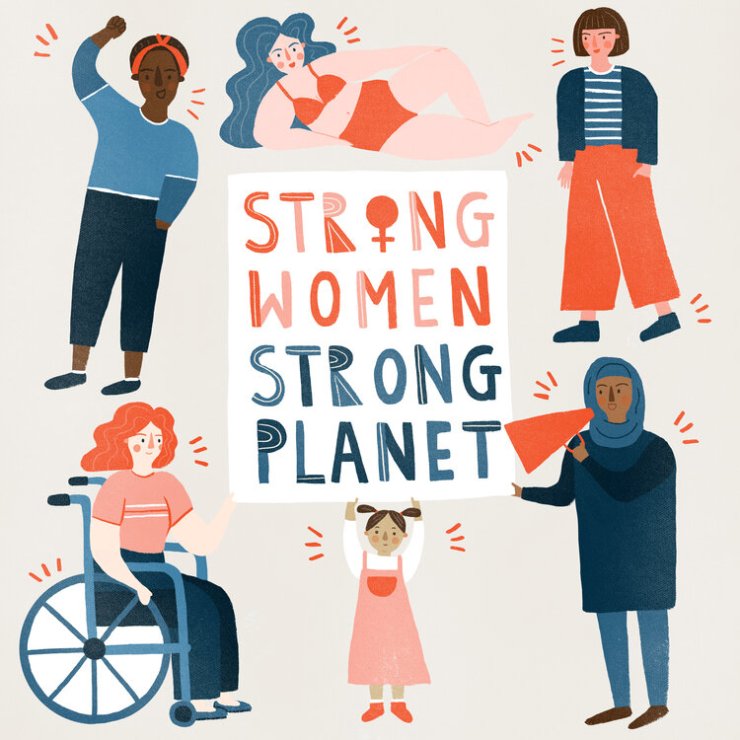
 Sometimes, a message can be driven further when there is a face associated with the words. A distinctive attribute of Vlitos’s work is her ability to conjure characters which feel simultaneously unfamiliar and familiar; especially in her editorial works. Though there is representation of bodies and faces that don’t often receive enough overt visibility, Vlitos finds a way to avoid reducing them to stereotypes by switching up details of attire and palettes of appearances on a spectrum of realistic skin colour shades to blues, greens, and yellows. Curiously, though they rarely show a relationship to each other or hint at an interpersonal dynamic, their individuality is affirmed when they are shown in very specific contexts of coming together as an intersectional community to spread urgent messages, as seen in Feminist Editorial Illustration (2020) or Togetherness (2020).

Seeing yourself represented in a feminist illustration around topical content can inspire more personal accountability and less political apathy. Vlitos says, “As an engaged citizen, I desperately want to contribute to meaningful social dialogue… Illustration empowers me to participate in these important conversations and allows me to engage with people who might otherwise be disengaged from the discussion.First and foremost, when I’m creating an image with a message, I spend a considerable amount of time on research—images can be powerful, so I need to be sure that my message is grounded in truth.” She explains that though her degree in communication design has equipped her with the skill to distill a few key points of research into an image, fine-tuning work is necessary as social dialogue evolves.

Josiane Vlitos. Bee Friend book page spread. 2019. Image Courtesy of the artist.

The artist borrowed from these values when she wrote, illustrated, and self-published the children’s book Bee Friend at the brink of her professional career. The story is spearheaded by a gender-neutral character named Charlie and pulls young readers’ attention to the issue of colony collapse disorder among honeybees. Vlitos shared some insight on why children’s books are a great vehicle to tackle unfamiliar topics by revealing, “As a child, because of my dyslexia, picture books were my only means of reading to myself. Decades later, I’ve never outgrown their charm, both as a reader and an illustrator.” The severity of CCD has fortunately been on the decline; according to the U.S. Environmental Protection Agency, the number of hives lost was halved between 2008 and 2013. Still, as of the last five years, beekeepers see colony loss as a concerning matter that may not be paid attention to due to a skewed stigma of honeybees and lack of public awareness around the role our globalization footprint plays in interfering with pollination.

Josiane Vlitos. Bee Friend book page spread. 2019. Image Courtesy of the artist.

Bee Friend pulls inadequate forage and poor nutrition into focus as a cause of colony collapse disorder. The “cuteness” of the artist’s style takes away the threatening reputation of a honeybee, making it seem more likeable and invoking sympathy, while chipping away at some of the stigma. Though the bee is fleshed out as a mystery and a difficult guest to entertain, its presence in the community is welcomed. The focus leans on Charlie as he engages in trial-and-error in order to learn what is causing the bee to become disempowered and ill. Through tuning into the bee’s reaction to holding a lone flower, the solution is eventually discovered; the book then shifts gears into subtly putting out a call to action to adults and children alike to plant more bee gardens if they are able to do so. While reading aloud Bee Friend to young children, Vlitos engages the bustling class by asking them what flowers and vegetables they are able to identify in a brilliantly illustrated fold-out section. Though it is natural to feel frustration over an initial lack of knowledge or understanding of biodiversity, the character of Charlie illustrates that remaining open, listening to the affected party, and showing reflexivity in his desire to help is the successful approach.

In every form—whether they are erected on the walls in our homes, spread across books and magazines, or present on social media—images undeniably take up space in influencing public perception surrounding an issue. For the visual learners, for disabled individuals, for young learners, and many others, images are more powerful than words alone in creating an emotional and rational impact. During the Black Lives Matter social movement and global pandemic, illustrators are in the position to sketch an accurate portrayal of issues outside of our windows. The good news is, these subjects are not exhaustive and accessible illustration practices make headway for many entry points into engagement. The responsibility of the viewer, however, is to recognize that the images we consume often have short lifespans, and to extend their messages and how they apply to our own practices or routines.

You can view more of Josiane Vlitos’s work on her website or her Instagram.

Pleasure Prospects: Counter-Prospective Feminist Futures

TBA_NewMineralCollective_259LakeShore_02
New Mineral Collective, Pleasure Prospects, 2019, single-channel video, 4k. Commissioned by the Toronto Biennial of Art. On view at 259 Lake Shore Blvd E as part of the Toronto Biennial of Art (2019). Courtesy of the artists.

295 Lake Shore Blvd, 2019 Toronto Biennial

September 21-December 1, 2019

By Courtney Miller

The calm, soothing voice of a narrator asks the viewer, “…how to extract meaning, not material?” Pleasure Prospects, a video installation by the New Mineral Collective (NMC), analyzes the current state of resource extraction industries, countering realities of environmental destruction with imagined reparative futures. Responding to the Toronto Biennial’s overarching question what does it mean to be in relation? artist duo Tanya Busse and Emilija Škarnulytė present a dreamy, placid recourse through contemporary dance and alternative medicines, refusing a capitalist trajectory of progress. In an era of panicked attempts to combat the climate crisis, what function does feminist utopian dreaming serve? Positioning environmental ruin as a continuous invasion against a shared life body, NMC knows that this crisis is already well underway, in which Pleasure Prospects demonstrates the impetus for healing.

What happens when artists create space for dreaming and respite?

Beginning with what appears to be footage from a mining trade show, suited bodies strike-through booths and across polished floors, while screens depict the earth’s surface in networks of grids and topographical markers. The counter-narrative to surveying from an overhead view presents the viewer with gentle caressing gestures, touching both human and earth bodies. Whether skin or sand, hands move slowly across surfaces with the intention to console rather than siphon. Shifting from cold, hard edges and detached socialization, machinery is replaced by moving bodies, and what the NMC calls ‘geo-trauma healing theory’; dance, acupuncture, and hydrotherapy. Pleasure Prospects introduces what ‘the least productive mining company in the world’ offers as an approach to repairing and softening, in resisting extractive industry through radical care and rest. The setting of this presentation is Toronto’s Cinesphere, recycling the 1971 geodome theatre to a site of future projections. In the literal slowing of time, dancers glide in undulating and rotating motions, as synchronized swimmers float in star configurations through purple plumes of smoke— possibly a nod to Judy Chicago’s Biennial iteration of her Atmosphere series.

TBA_NewMineralCollective_02
New Mineral Collective, Pleasure Prospects, 2019, columns, casts of prospecting bore holes, rammed earth, hand-pulverized black copper slag, copper, zinc, steel, aluminum, fine gold and silver shavings, concrete. Commissioned by the Toronto Biennial of Art. On view at Small Arms Inspection Building as part of the Toronto Biennial of Art (2019). Photo: Vlad Lunin. Courtesy the artists. 

The Pleasure Prospects narrative begins with an overview of the extractive mining industry’s penetrative effects stemming from a decidedly neoliberal drive for supply and demand. Thinking through what it means to be in relation, the NMC recognizes human impact on land by acknowledging the “apocalypse all around us, and how to alter it.” Current conversations of the climate crisis from a Western perspective tend to position environmental threat as a future concern, rather than a process already begun. Recently, Métis scholar Zoe Todd and settler scholar Heather Davis have argued that the beginning of the Anthropocene on Turtle Island coincides with colonial contact, marking the beginning of apocalyptic changes for Indigenous nations[1]. The Biennial’s curatorial vision of The Shoreline Dilemma calls attention to the shifting and evolving Toronto shoreline, the history of this area as a meeting place for Indigenous societies for over 12,000 years. While the Pleasure Prospects video installation does not touch on Indigenous realities or colonial systems of the Toronto area, the focus remains on extractive industry as the culprit for one of the most aggressively scarring enterprises. Furthermore, NMC offers a contribution to WalkingLab’s and RiVAL’s programming The Bank, The Mine, The Colony, The Crime, in the form of an audio therapy guided tour of the headquarters of a mining company in Toronto’s Financial District. Although the Cinesphere and brief aerial views of Ontario are recognizable locations in the film, the Toronto shoreline is not specified, suggesting that the NMC operates through a global lens. The Biennial’s overarching question, what does it mean to be in relation? can be interpreted within this work as everyone in relation to each other, or extractive industry versus everyone else.

TBA_NewMineralCollective_259LakeShore_13 (1)
New Mineral Collective, Pleasure Prospects, 2019, single-channel video, 4k. Commissioned by the Toronto Biennial of Art. On view at 259 Lake Shore Blvd E as part of the Toronto Biennial of Art (2019). Courtesy of the artists.

In directly challenging the monetary driven power of the extractive industry, what happens when artists create space for dreaming and respite? Rest becomes a radical concept when the NMC touts itself as the least productive mining company in the world. Delivering a persuasive and soothing pitch for their services, the collective seeks to engage in counter-prospecting, the opposite of production, yet not the antithesis of work. The idea of counter-prospecting involves resting, dancing, repairing, and calming, as methods of extracting meaning fueled by desire, poetry, love, and resistance. A minimal amount of technology is present in the film, functioning more as props than tools: two women relax on the beach with a filing cabinet and laptop, and an indeterminate measuring/recording device fashioned out of aggregate materials, is carried in one hand and placed on the ground while dancers whisk by. The reparative approach towards resisting extractive industry, represented through dreaming of a feminist utopia may not outline a definitive plan of action, but rather an alternative to incessant production. This method calls to mind strategies within Afrofuturism and Indigenous futurities to invest power in imaginary prospects. In being ‘unproductive’, the NMC gently calls to halt further destruction of the environment in recognition of the damage already done.

The title, Pleasure Prospects, speaks to the pursuit of pleasure as an industry as well as to the connotation of the equine hobby. Whether this link is intentional or not is uncertain; a pleasure prospect is an equestrian term denoting a horse representing an aesthetic standard of balance, grace, and willingness. Given that these standards place human expectations on the output of intelligent animals, this can be paralleled with a Western view of the earth as an endless resource, taking without giving back. Within the spoken narrative is a clearly defined intention for resisting female characterization of the earth – a protective move in avoiding the essentialization of the earth’s body. Resisting extraction through gestures of care, the New Mineral Collective illustrates a compassionate alternative future.

[1] Heather Davis and Zoe Todd, “On the Importance of a Date, or, Decolonizing the Anthropocene,” ACME: A Journal for Critical Geographies, 16(4) (2017): 761.

This article is an excerpt from our first print issue. To purchase a copy visit our online shop.