Soft Bodies: Marianne Burlew and Brianna Gluszak

Marianne Burlew and Brianna Gluszak. Soft Bodies installation Shot. Wall Space Gallery. Photo credit: Ava Margueritte.

By Moira Hayes

Vulnerability of the self is created in how we choose to take up space. How do we present ourselves to others? What choices are we making to allow space for others? And more presently, what space are we holding for ourselves?

Soft Bodies was exhibited from March 11th through to April 4th at Wall Space Gallery in Ottawa. Marianne Burlew and Brianna Gluszak were paired together by the gallery’s curator, Tiffany April, to deliver an exhibition hinged on the idea of vulnerability.

Burlew is based in Ottawa. She draws from a background of video and sculpture to create her current work; emotionally driven pieces in a 3D modelling software. While her work is direct, the colourful imagery offers multiple interpretations for the viewer; striking questions about seriousness versus sarcasm. Burlew received her MFA from the University of Waterloo.

Gluszak is Ohio-based. They work in sculpture to create glasswork and textile rug hooking, addressing ideas of gender and body. Gluszak draws inspiration from cartoons and how viewing one another can become gendered. The varying scale of their work between the textile pieces and the glass work impose different connotations for the viewer. Gluszak has an MFA from The Ohio State University.

Marianne Burlew, Folly, Ed: 1/100, archival print on Hot Press paper, 16 x 20 in. Framed by Wall Space.

Marianne, you work with digital 3D modelling software, and working digitally makes things accessible. The feelings you point at in your work, patheticness or being a fool, are universal emotions. Can you speak to using digital software to express human emotions?

MB: My background is in sculpture and video. One of the biggest obstacles I was having was getting my work into a space due to budget, facilities, distance, and accessibility. In my current job at an engineering company, I weaseled my way into learning this modelling software.

I just fell in love with the software, and I saw it as an opportunity to make things that could reach a lot more people. You can make a print, put it on a screen, or put it on social media or different places a lot more easily.

I do feel hesitant in some ways to share work online publicly, just because it is easy to have your work taken. I’d love to have it on screens and more readily available on social media if I had a little bit more protection in that area.

I’ve also fallen in love with the print aspect of it. When it gets printed, there’s another transformation that’s amazing for me. That bright, vibrant, densely saturated paper with the colour, and how different parts of the work will be flat, and others will be three-dimensional is interesting to me.

Brianna Gluszak, Please don’t forget me, Blown glass, 19.5 x 12 x 7.5 in.

Brianna, can you explain the process of composing the positions of your glass pieces? They kind of look like people playing Twister.

BG: I love that read. First off, I think one thing I do with the glass works, in particular, is that I’ll make a bunch of them. I don’t know which ones are going to go with which ones. So, it ends up being a process of almost creating a library of glass objects. I’ll have a period of making in the studio where I’ll be doing drawings, and then I’ll be going into the glass shop trying to make that original drawn form.

But the glass is like, “No, I don’t wanna be that form.” I’ll go back to drawing, I’ll draw the form it did become, and through that translation, we’ll build up a variety of different shapes and colours and textures and objects. And then I play with them in my studio, and I just see which ones fit together and which ones I like together.

And maybe I’m too much of an object oncologist where I’m like, okay, so this one wants to be with this one today, and this one wants to be with that one. They’ve sort of become personified in a lot of ways for me. I do see them as being a representation of gender and body.

Marianne Burlew, Pathetic, archival print on Hot Press paper, 28 3/4 x 36 in, framed by Wall Space Gallery.

Marianne, you face the unavoidable, uncanny imagery of worship in your pieces. But you derail that with a practiced absurdity. Can you discuss the process of choosing the keywords in your pieces?

MB: You’re right about worship. My family is Christian, but I didn’t grow up going to church. I’ve never read the Bible.

There’s a lot of Western influence in what I make and so I just try to play with it. I’m not necessarily trying to cite any kind of religion, but for this series, I was very interested in shrines or putting together devotional pieces where it’s almost more of a spiritual devotion where the piece sits as an architectural niche.

Sometimes there are other objects. Sometimes it’s just the glass itself creating these moments where you can sit with these things and meditate on them. 

And for me, the word [aspect] of it seems essential. And choosing is hard to describe. It’s trying to capture things that are succinct and hard-hitting but don’t lean completely in one direction.

When I was making “pathetic,” I felt like it was harsh and I [thought] this might be too mean to just put pathetic in a window like that. You’re going to reflect that criticism of yourself. I feel like the colours were so nice then making it like that’s the twist, taking something so devastating and then trying to make it beautiful and fun.

I am interested in active looking and when a look becomes ingrained in gender.

Brianna Gluszak, I kissed a girl and I liked it…, tufted rug, 52 x 26 1/2 x 1/2 in. 

Brianna, your rug work possesses an unavoidable gaze disguised as fun and playful. The sheer size of the work denotes power over the viewer, especially up close. Are you proposing a struggle between the work and the viewer? What did you aim to convey with the choice of scale? It feels like a staring contest between the viewer and this work.

BG: I think the scale has become kind of like a natural choice for that work. The rugs started during COVID when I got locked out of the studio, and was like, okay, let’s figure out a way to make things at home.

This particular series of rugs is about research that I’ve been doing on Tex Avery’s character Wolfy, from “Red Hot Riding Hood,” which is the first instance in cartooning where the eyes come out of a character’s head at the sight of a woman.

The version available on YouTube ends as Wolfy pulls Little Red Riding Hood off a stage after his eyes have shot out at her. But that’s not where the cartoon actually ends. From going into the cartoon archives, I found the other half of the cartoon.

Wolfy goes to grandma’s house and grandma oogle’s him back with AWOOGA eyes, and the wolf runs away. But what I thought was so interesting about the archive version versus the version that was available on YouTube is that role switch.

We always constantly think of the wolf’s eyes shooting out at Little Red Riding Hood, but we don’t really think about grandma. You know, how she sort of gets him back because she’s like, “oh, you’re sexy wolfI’m gonna look at you that way.” 

I am interested in active looking and when a look becomes ingrained in genderWhen a look is perceived to be the male gaze or the female gaze and what things we like to note between that.

Marianne Burlew and Brianna Gluszak. Soft Bodies installation Shot. Wall Space Gallery. Photo credit: Ava Margueritte.

There is a conversation between the works about depth. Marianne’s work draws the viewer inward, holding space inside the pieces. Whereas Brianna’s work pushes into the viewer’s space, demanding room from the viewer. How do you find this lends to the overall idea of vulnerability in Soft Bodies?

BG: Some of the work stems from things that could be seen as vulnerable, but I am more interested in the opposite end of that word, and it being more explorative in an empowering way. Or in a way to have the viewer understand a different identity than they came in understanding.

For me, that kind of pushing out, and enveloping of the viewer, is about how to involve them in the work or have them gain a connection to it. The allowance of the viewer is to take as much or as little as they want of what I’m trying to get across.

And I do think that one of the interesting things about Marianne’s work is that you’re almost sucked into another world versus being present in this space.

MB: Brianna’s work is a lot more present in the space. Each piece is like its own body. And then mine is much more about an internal space or having space within them. But I think that push and pull can be great. I mean, vulnerability is just about rethinking or allowing yourself to be open to rethinking. I think Brianna’s talking about reaching into space being confrontational with the gaze and that engagement, whereas a lot of my inclination is to go smaller and deeper internally. I think the show has a good balance and a good variety to it because there are many different ways that you’re being reached out to, or you have to reach into.

And I don’t necessarily think we have to have done the same thing or have the same method to accomplish that. Vulnerability would just be like that shift of a boundary, right? Or that invitation to change your mind.

You can find more of Marianne Burlew and Brianna Gluszak‘s work on their Instagram.

A Method of Attunement: In Conversation with Candice Hopkins

Portrait of Candice Hopkins.

Interview by Adi Berardini

The focus and mandate of The Toronto Biennial of Art is to “make contemporary art accessible to everyone.” From March 26 to June 5th, local, national, and international Biennial artists will transform Toronto and its partner regions with free exhibitions, performances, and learning opportunities. Although the Biennial has its roots in diverse local contexts, it sparks global conversations through its exhibitions and city-wide programming. This year’s Biennial has the theme What Water Knows, the Land Remembers, expanding from the inaugural 2019 edition, A Shoreline Dilemma. In this interview, Candice Hopkins discusses her curatorial vision for the 2022 Toronto Biennial of Art and her exhibition ᑕᑯᒃᓴᐅᔪᒻᒪᕆᒃ Double Vision at the Textile Museum of Canada. Within the conversation, Hopkins speaks of the importance of the Biennial being place-specific and curatorial practice as a method of attunement.

Candice Hopkins’ writing and curatorial practice explore the intersections of history, contemporary art, and Indigeneity. Originally from Whitehorse, Yukon, Hopkins is a citizen of Carcross/Tagish First Nation. In addition to her role as senior curator for the 2019 and 2021 editions of the Toronto Biennial, she works as the Executive Director of Forge Project in New York. Additionally, she was part of the curatorial team for the Canadian Pavilion of the 58th Venice Biennale, featuring the work of the media art collective Isuma. She is co-curator of notable exhibitions including Art for New Understanding: Native Voices 1950s to Now; the 2018 SITE Santa Fe Biennial, Casa Tomada; documenta 14 in Athens, Greece and Kassel, Germany; Sakahàn: International Indigenous Art at the National Gallery of Canada.

Can you explain your curatorial vision for the 2022 Toronto Biennial of Art, with the theme of What Water Knows, The Land Remembers? How does it expand on the last edition focusing on the shoreline? 

We’re a team of three curators myself, Katie Lawson, Tairone Bastien, and we also worked on the first edition. We always knew from the beginning that the curatorial team would carry over. And we always imagined that 2019, and what’s now 2022 because of the six-month delay of the pandemic, [would be] two chapters and two editions of a whole. That means that some of the artists extend their projects over 2019 and 2022 with a thematic extension as well. The title of 2019 was A Shoreline Dilemma, and most of the venues were centered on the shoreline and the shoreline as spaces of imagination, colonial construction, militarization and demilitarization, [and] various kinds of expansion into the lake. Also, shorelines aren’t fixed; they’re constantly shifting and moving, they’re fractal. And because of their fractal nature, they resist any conventional forms of measurement, because they are constantly changing space. We see the 2022 edition as stemming from these initial questions.

The 2019 Biennial was centered around the question of what does it mean to be in relation? In 2022, we thought it was important to think about how in this case, many of the works are situated up the various tributaries of those lost and extant rivers in Toronto. Toronto is located on one of the largest natural watersheds in the world, which means that there were a lot of creeks and there were a lot of rivers that were feeding that lake. We have been thinking collectively together with artists and curators what does it mean to be in relation to the water? And through that, what does it mean to think about the kind of deeper and in some cases, the sediment of history, on this land that we’re on?

In 2022, the title is meant to be a kind of lead into some of the explorations various artists were taking on, what water knows, the land remembers. One of the things that we were struck by when we were meeting and speaking with artists was one, as far as we understand it, water has memory. It contains and remembers anything that has happened to it on a molecular level. So, we can understand water as an archive, but we can understand the land as an archive too. Last fall, I was part of a meeting with a soil scientist who’s at Duke University and he said, certain soils slowly move upwards, like a river, over in some cases thousands of years. In a way then, it’s almost as though the soil is constantly revealing its past to us if it’s left undisturbed.

What does it mean to attune ourselves to these histories that might be located under concrete, underneath our very feet? 

That was a moment of revelation for me and the curatorial team that if the land was always trying to reveal its history to us, what does it mean to attune ourselves to that? What does it mean to attune ourselves to these histories that might be located under concrete, underneath our very feet? I think one of the projects that we first initiated in 2019 that carried towards 2022 is a kind of direct response to this. So, that was what’s called Concepts and Contexts for Toronto and that was authored by Ange Loft with various collaborators. Ange Loft is a Mohawk artist, historian, playwright, and theatre director. And this year in 2022, we have been working together with Camille Turner and Yaniya Lee to add a kind of another layer to this idea of concepts and contexts for Toronto. They’ve been working on, a set of cards, like a deck, that looks at Black histories in Toronto. And one of the things that Yaniya and Camille noted was that these aren’t sedimented histories—that’s kind of an easy way out. They were saying that these pasts and these futures are right here in front of us, but not everyone pays attention to them. Sometimes we think that these histories are obscured, whether it’s the histories of people who are newcomers to these lands, or people who’ve been here for thousands of years, but they’re not for the people who’ve lived those histories.

We’ve also been very inspired by the fugitivity of water. The fact that even though something like Taddle Creek or Garrison Creek has been covered over, water still always finds a way home. It flows underneath houses, underneath real estate developments, it erodes concrete, it continues to flow. We thought of that fugitivity of water and what it carries with it and its insistence on its path. And I think that’s what we can learn, not only as curators but as artists too.

Jeffrey Gibson, I AM YOUR RELATIVE, 2022. Installation views, MOCA Toronto. Courtesy of Jeffrey Gibson Studio, Kavi Gupta Gallery, Roberts Projects, Sikkema Jenkins & Co. and Stephen Friedman Gallery. I AM YOUR RELATIVE is co-commissioned by MOCA and the Toronto Biennial of Art.

What are some considerations you have curating a biennial that’s place-specific, such as the Toronto Biennial? And a place that’s so diverse too. Do you have specific aspects you look for in artists and work and how it connects to place?

We knew that on embarking on the Toronto Biennial from the beginning, it needed to be place-specific. It couldn’t feel like an exhibition that could take place anywhere, it had to be done in relation to place. Whether that’s thinking about histories or various ways that we might shape the narrative of a place for ourselves. When we started in 2019, we brought artists together, especially those who were coming from outside of Toronto together with artists that were here. They met with Ange Loft, who generously shared some of the research she had done. And that Toronto context from Concepts brief was shared with all the artists who were working with the Toronto Biennial of Art as a kind of primary document. I think it’s really important to share histories, knowledge, and tools about a place. The pandemic shifted working models; we all went online like many teams. We worked with artists remotely, of course, some are still based here. A big part of that was being in dialogue.

Many of the artists that we worked with have created responsive works to this place or the Great Lakes, more in general, or to other narratives of lakes such as Great Bear Lake in Northwest Territories is one good example of work by Ts̱ēmā Igharas and Erin Siddall. Other projects looked very far into the future, such as part two of Syrus Marcus Ware’s Antarctica piece. I think every artist took it from their own perspective, but I think [most of the] work is grounded here. Part of that idea though was because a lot of biennials operate almost like a parachuting model that let’s say emerged in the 1990s with the proliferation of biennials around the world. What started with less than a hundred, is now I believe over 400 around the world. And there needs to be specificity to those, they can’t feel like there’s very little relation. I think audiences feel that too. One of our methods as well is that we are primarily a commissioning biennial, which differentiates us from some others.

Installation view of ᑕᑯᒃᓴᐅᔪᒻᒪᕆᒃ Double Vision: Jessie Oonark, Janet Kigusiuq, and Victoria Mamnguqsualuk. Photo by Darren Rigo.

Can you discuss the Biennial exhibition ᑕᑯᒃᓴᐅᔪᒻᒪᕆᒃ Double Vision that you curated at the Textile Museum of Canada and its focus on sharing Inuit histories?

In early 2013, I did travel to different communities in Nunavut, including Baker Lake. And I had already known, of course about ᔭᓯ ᐆᓇᖅ Jessie Oonark’s work, ᔮᓂᑦ ᑭᒍᓯᐅᖅ Janet [Kigusiuq]’s work, and ᕕᒃᑐᕆᔭ ᒪᒻᖑᖅᓱᐊᓗᒃ Victoria Mamnguqsualuk’s work. What I found when I was in Baker Lake was this matriarchy—The way that a lot of artistic production in Nunavut is done through mentorship, artist to artist, family member to family member, sometimes with the support of the co-op system, sometimes not. And the co-op in Baker Lake kind of operated in fits and starts. It was really production led by artists themselves. Jessie Oonark began making work only after she and her family relocated to Baker Lake. Baker Lake, as far as I know, is the only inland community in Nunavut so it’s not on a major water body, like other communities. And I was interested in how women’s perspectives were shaping the content of their work and how they made the work itself.

Installation view of ᑕᑯᒃᓴᐅᔪᒻᒪᕆᒃ Double Vision: Jessie Oonark, Janet Kigusiuq, and Victoria Mamnguqsualuk. Photo by Darren Rigo.

Jessie is primarily known for her textile work. She’s the only artist from Baker Lake to be included in the Cape Dorset print collection and she had her first prints included in 1960. They’ve all worked across media, drawing, prints, textiles, some sculpture even. What I was interested in was how pattern is both a tool and a technique for all of them. Janet later in her life, when arthritis didn’t allow her to make the kind of very high detailed drawings that she was known for began a different kind of practice. It began through a workshop in 1998 I think, with someone who was up there for a time teaching, making these paper collages. They are extraordinary because people might see them immediately as pure abstraction, but they’re not. Many of Janet’s collages are made to reference very specific places that they would visit, places where they’ve fished, for example.

Then Victoria Mamnguqsualuk, Jessie’s other daughter, was known for her narrative works. A figure that recurs in her practice is a migrant traveler–Kiviuq. He occurs a lot in her work and even intervened at certain moments like in the cold war. He’s a figurative legend, let’s say. [What is] fascinating to me about that was that Janet said in an interview that Victoria would stay up late at night, listening to their grandmother, Natak, tell stories. In a way, she became a chronicler through her prints and drawings, and textiles, of this oral history, which is fascinating. And then their mother, Jessie Oonark, is one of the best-known Inuk artists to have lived. What really struck me was the repeated representations of women, the tools of women, including the ᐅᓗ Ulu women’s knife, ᐊᑯᖅ amauti, ᖃᒧᑏᒃ qamutiik; and how pattern for her, again, became a kind of tool and technique, particularly in her textile works. But the title of the exhibition, in general, comes from, and I believe it was Jack Butler who said this, he described Jessie Oonark’s work as “double vision” because she used a lot of symmetry, but it was, I think quite deliberately, not perfect symmetries, so each side might look slightly different. In a way, what that does is it makes you pay attention to the variation of form. I feel like as the central point of the Biennial, we have a lot of matriarchal and matrilineal narratives. And I think that’s why Double Vision is one of the centerpiece exhibitions of the 2022 Biennial.

I also feel like personally, the work of Inuit artists isn’t always contextualized in this way, although increasingly more now. I wanted the audience to focus not just on the content of the work, but the kind of conditions of production in Baker Lake, who is teaching who, how they are communicating it, and seeing these pieces as a conceptual marker of art history.

Installation view of ᑕᑯᒃᓴᐅᔪᒻᒪᕆᒃ Double Vision: Jessie Oonark, Janet Kigusiuq, and Victoria Mamnguqsualuk. Photo by Darren Rigo.

Can you speak more about the practice of collaboration and listening in your curatorial practice and its significance while showcasing work by Indigenous artists and artists whose histories have been underrepresented?

I think sometimes curatorial practice is about resonances. We can understand resonances as part of an auditory experience, but also in many ways, curatorial practice can be a method of attunement. You’re attuned to not only what is taking place in society at any given moment, but [you are also] attuned to what artists are interested in communicating with their work. I think that you’re attuned to what ideas are forming and your potential audiences for an exhibition too. As well as the kind of practicalities of putting together a show in multiple venues where there’s different relations being formed in each of the spaces.

I think as well, and this happens very distinctly in the first edition of the Biennial too, we wanted to work directly with artists whose practices we were most excited about, of course. But it doesn’t necessarily mean that the artists that we worked with had a kind of corresponding place within what we might consider the larger artistic ecosystem. So, sometimes they might not have any commercial representation, for example, or maybe they’re just starting in their career. I think these kinds of exhibitions can be platforms for artists to make something new, for artists to make something responsive and I think for myself, paying attention to people who are making good, challenging work. We can use the exhibition as a kind of stage or a platform for what they’re making and doing. I think as well, curatorial practice is inherently dialogical. It’s in relationship to the ethos of our time, working in tandem with an artist as they develop something new.

Do you have any advice for emerging Indigenous artists or curators starting off their careers?

There are two different answers depending on whether you’re looking to pursue more of a curatorial track or an artist track. And that’s not to say that the two aren’t contingent or that people do both, because often people do both. I started out as an artist, for example.

I would say that for emerging curators, mentors have been the most important figures in my life and they sometimes come to you in expected ways. When I was very early in my career, I was grateful to have been mentored by folks like Lee-Ann Martin or Anthony Kiendl, or Sylvie Gilbert . I was able to work alongside them through my work at the Banff Centre. And I started at the Banff Centre as a work-study, that’s essentially like an intern. I think that we all start in various ways. I was incredibly lucky to have received a grant through the Canada Council for the Arts at the time. It was a grant that was for emerging Aboriginal curators, that was the terminology then.

I worked directly with Lee-Ann, and I learned so much from her, you know, she was one of the co-curators of Indigena, which is still a watershed exhibition. It was kind of like the political foil to Land, Spirit, Power that was on at the same time at the National Gallery of Canada, just across the river from one another.  She was both the person who was one of the Project Coordinators for the Task Force on Museums and First Peoples that was in the 1990s that emerged out of the kind of conflicts and direct open protests around the exhibition The Spirits Sings in 1988, which was one of the first publicly protested exhibitions. So, she was one of the people at the forefront of trying to negotiate a different relationship between Native people and museums and our representation.

Choose your mentors and work with them, and these relationships are always reciprocal, right? What can you give in exchange or provide as an exchange? I’m not implying monetary of course. Developing relationships with artists is incredibly important as a young curator, because those are your peers, and they might be people that you work with for the rest of your life in various ways. That’s definitely been the case for me.

I would say as well, understanding if you do want to work with museums or artist-run centers, or other alternative or commercial spaces, trying to find out how they function is important too. I think that these institutions are not always transparent, they don’t always speak from that subject position at all. I think any experience you can get within those places is always beneficial.

If you’re an emerging Native artist, do whatever you can to make sure that you can maintain a dedicated studio practice, even if your studio is your desk. It’s important to put a lot of energy into your work. Find out what kinds of funding opportunities are out there if you’re living and working in Canada, which is a very different funding landscape that the United States. I would say, think of your peers as you’re sounding board.

I always encourage people, and this might be intimidating for younger artists, to reach out to a curator. If there’s a curator you like, send them your work, and see if they’ll do a studio visit with you, with no expectation. What you’re trying to do is develop a dialogue and a relationship. As a young artist, I think it’s incredibly important to see as much work by others as you can, especially those artists that you respect so that you can learn from how work is installed. You can learn from one another, including other ways other [artists] might be contextualizing their work. This is your field. Spend as much time looking and watching as learning as you can.

Check out the Toronto Biennial of Art from March 26th to June 5th, 2022 at the 9+ Biennial sites across Toronto and Mississauga.

Tough Conversations: (un)happy objects at Artcite Inc.

(un)happy objects Installation photo, ArtCite Inc. Photo by Adrien Crossman.

(un)happy objects

Artcite Inc. Windsor, ON

October 15th – Nov 20th, 2021

By Adi Berardini

How one approaches tough conversations can be telling of who one truly is. When I first came out to my parents, I blurted out that I was queer while in the passenger seat of the car. I think that my reasoning behind this was that if there was a negative reaction, I could quickly escape after we had arrived. I worked up the scenarios in my head beforehand and often let the anxiety get the best of me. It’s a common desire to want to avoid difficult conversations for fear of rejection. Strategies, such as humour, can be used as a deflection for these anxiety-ridden conversations that are difficult to put into words.

Humour, intentional opacity, and inclusion versus exclusion, are demonstrated as themes in the exhibition (un)happy objects at Artcite Inc. featuring artists Madelyne Beckles, Vida Beyer, Kaythi, and Shellie Zhang, curated by Adrien Crossman. Through the framework of Sara Ahmed’s Happy Objects, which claims that we value an object based on how it affects us, orienting us towards what makes us happy and away from those that don’t,[1] the artists encourage viewers to face their anxieties around potentially “unhappy” topics relating to homophobia, racism, and white supremacy. As Édouard Glissant advocates for the “right to opacity” in Poetics of Relation, the oppressed, and those historically labelled as the “Other” should be allowed to be opaque, to not be completely understood, and to simply exist as different, challenging the reductive transparencies that classify others using dominant structures of worth.[1] Often referencing pop culture and focusing on text, the artists use accessible media such as textiles, video, and neon signs to address these topics.

Kaythi. Our Lady of Profound Failure. Photo by Adrien Crossman.

Walking into the exhibition, the first work I encounter is Kaythi’s Our Lady of Profound Failure, a brightly coloured rug that reads “DYKES ONLY.” The rug was created as part of a workshop on ‘Unwelcome Mats’ by artist and curator Lauren Cullen that introduced artists to rug hooking, featured in the exhibition Productive Discomfort at Xpace Cultural Centre. The piece features a figure in orange bent over with the text in black letters overlayed. At first glance, the rug reads as humorous, like a comment on how few lesbian spaces there are still surviving, carving out a specific queer-only space in a largely heteronormative world. The bent-over figure alludes to either prayer or oral sex. However, Kaythi is also interested in the politics behind lesbian-only spaces and how they have been exclusive to trans women through Trans Exclusionary Radical “Feminists” (TERFS) throughout history. Although the word dyke has been reclaimed, it’s also still a loaded term that resonates differently for everyone. As a femme, it also brings up some of my past feelings of discomfort in queer spaces, afraid that I seem out of place or simply not “queer enough.” The piece references the queer failures of the past, evoking potential feelings of inclusion and exclusion the phrase implies.

On the screen in the back left corner, the pastel aesthetic of Theory of The Young Girl by Madelyne Beckles brought me back to my teenage years, like a time machine back to my teenage bedroom. A large pink dice sits on the table and Beckles’ hand reaches out to touch a pink book with “theory” across the cover. While spraying her hair with hairspray, Beckles rehearses lines in response to the text Theory of the Young Girl by Tiqqun,[2] such as “When I was twelve, I decided to be beautiful.”[3] The film evokes the archetype of femininity as a cultural construction and its connection to heteronormative whiteness. In the panel discussion corresponding with the exhibition, Beckles explains how this work is connected to figuring out her place in femininity, particularly being mixed-race in her small town growing up.[4] The film juxtaposes the vapidness that one might attribute to sexist stereotypes of femininity with theory, commonly attributed to seriousness. Using humour, Beckles critiques how womanhood is prefabricated and marketed in a neoliberal society.

Vida Beyer. Nightmoves: Too Many Windows Open Feeling. Photo by Nadja Pelkey.

Vida Beyer’s adjacent textile work Nightmoves: Too Many Windows Open Feeling, mimics the overloaded sense of scrolling through the internet. Reminiscent of a karaoke night at a bar, the imagery spans from sensual lesbian hookups to song lyrics embroidered in the style of a karaoke sing-along. Beyer uses a mix of pop culture and more personal references, relying on intentional opacity which creates a sense of interest and intrigue. I couldn’t pinpoint the lyrics referenced at first, but after a google search, I determined that they are from “Head over Heels” by Tears for Fears and an Alice Cooper song. Many queer people who have grown up in the digital age can relate to looking things up on the internet as a means of finding some connection, especially while growing up in the 90s and early 2000s when queerness was not as represented in mainstream media. This piece connects to Beckles’ Search Herstory work on the far back wall, which exposes her past search history in an act of vulnerability, bringing the personal into the public sphere. These media references connect communities that can otherwise feel disparate.

(Un)happy Objects Installation photo, ArtCite Inc. Photo by Adrien Crossman.
Shellie Zhang. I am Terrified /我担心. Photo by Adrien Crossman.

Shellie Zhang’s piece, I am Terrified /我担心 consisting of a bright orange neon sign, addresses diaspora and intergenerational cultural erasure in western society. The piece reads: “I AM TERRIFIED THAT MY MOTHER WILL SEEM FOREIGN TO MY CHILDREN,” although there are two parts to this piece: one in Mandarin and the other part in English. The piece addresses white supremacy and cultural assimilation, and the anxiety of losing culture and shared understanding. Since they are displayed on two different walls, they also draw upon a sense of intentional opacity to some viewers because only viewers who understand Mandarin will understand the phrasing of the first sign.

In the exhibition panel, Zhang also explained how she was interested in how diasporic communities also use this sense of intentional opacity through shared experiences or jokes.[5] Her second work, It’s Complicated, reads “DIASPORAHAHA” In gigantic, gold lettering. If this seems like it’s something you’d view at an event, then you’ve guessed correctly since it was originally displayed at an event hosted by the queer Asian art collective, New Ho Queen.[6] Causing small rainbows to ricochet off the concrete, the glittery letters address using humour to relate through shared diasporic experiences and the sense of inclusion, and exclusion, this can bring.

By using culturally familiar and accessible methods such as neon signs and rug hooking, un(happy) objects encourages the audience to face their anxieties and difficult concepts head-on. The exhibition proposes the idea that working through discomfort can bring us closer together and forge new connections and healing. There won’t always be a clear escape plan and social isolation can’t be solved through a mere google search or doom scroll through an app. Sometimes it’s necessary to face what’s uncomfortable, even if it’s with the aid of an awkward laugh.


 [1] Édouard Glissant, Poetics of Relation, trans. Betsy Wing (Ann Arbor: The University of Michigan Press, 1997). (p.190).

[2] Ahmed, Sara. “Happy Objects.” The Affect Theory Reader, by Melissa Gregg and Gregory J. Seigworth, Duke University Press, 2010.(p. 42).

[3] Formed in 1999, Tiqqun is a French collective of authors and activists.

[4] Beckles, Madelyne. “Theory of The Young Girl.” 2017.

[5] un(Happy) objects online panel discussion. Nov 6, 2021.

[6] Crossman, Adrien. “un(Happy) objects exhibition essay,” ArtCite Inc. 2021.

Migueltzinta C. Solís’s “The Gay Villain Rides Again”

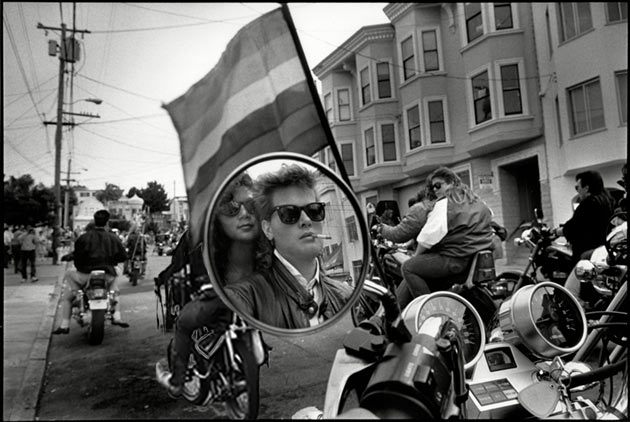
The Gay Villain Rides Again: The History of A Queer Biker” by Migueltzinta C. Solís

Performance lecture, 16 April 2021

Co-presented by the University of Lethbridge and Queer/Disrupt (UK)

This is Not a Bike, Migueltzinta Solís, 2021.Image from performative academic presentation, The Gay Villain Rides Again

By Lauren Gabrielle Fournier

TW/CW: Mention of residential schools

“I love a sloppy archive,” Migueltzinta C. Solís says during the Q&A of his recent performance lecture. There is power-to-be-harnessed in the mess, in the slop, in the spaces that resist sanitization and homogenization, that resist ossification. There is power in the sour spaces, the spaces where one can harness the possibilities of art practice, including performance and parafiction (art and literary work in which fiction is presented as fact), in history-making, in the resisting of the power of singular status-quo narratives that uphold those in power and protect them from being questioned. And at a time when the very grim aspects of Canada’s history are being revealed—with the unearthing of the remains of hundreds of Indigenous children at the former grounds of a residential school in Kamloops and, more recently, Manitoba—the urgency around Indigenous peoples and other marginalized groups having agency in the telling of history is resounding. These events remind us of the consequentiality of history and how it is told—what is included in historical stories and what is left out. While coverage of recent news events can make it look as though these horrors are outlying events, marking singular “sad days” for Canadians, Indigenous folks will point out, rightly, that these horrific, genocidal events are at the heart of the very founding of Canada—a colonial country on stolen, Indigenous lands, with very long histories for thousands of different Indigenous groups.

With the colonialization of lands comes other colonial inheritances, including the University. Academia and its rituals, methods, and languages are another impact of European colonialization, and we are experiencing a moment of reckoning right now. Challenging and subverting colonialist academia from Indigenous, BIPOC, and queer perspectives is a worthy endeavour. In Mestizx artist Migueltzinta C. Solís’s recent performance lecture “The Gay Villain Rides Again: The History of a Queer Biker,” we get what the artist himself calls an “academically-subversive performance.” In it, Solís tells a story from queer history that he happens upon and in some senses discovers; through personal experience, archival research, interviews, reading, and embodied reflection and deduction. As an artist with a background in performance art, Solís experiments with how research can be presented to academic, art, and non-academic communities, and in this way his practice can be said to ‘queer’ academic structures—which includes bringing more depth and breadth to the archives recognized by academic institutions,  and “queering” the very methodologies recognized as legitimate and worthwhile in those spaces.                           

Tugmented archival image from performative academic presentation, The Gay Villain Rides Again. This is Not a Bike, Migueltzinta Solís, 2021.Original photograph by Sylvan Rand.

The turning toward history from one’s personal and research-based art practice seems particularly generative in a present moment where issues from “history” are urgent and still being processed and uncovered—including the aforementioned news about Canada’s residential schools, and the challenging of the names of many Canadian universities, including Ryerson University, named after one of the architects of the so-named Indian residential school system. The tendency for queer artists to engage with history and the archive is common, often as a way for queers to find their “ancestors” and better understand their own selves and sense of belonging in history. Other queer artists working on the colonized lands of so-called Canada, like Cait McKinney and Hazel Meyer (their collaborations at the Toronto Reference Library and the Canadian Lesbian and Gay Archive in Toronto, for example), have used the performance lecture format to present their embodied findings as queer settlers engaging in the writing of queer histories and interventions in the archive. Solís extends the performance lecture from his perspective as a queer artist, Indigenous to Mexico but situated today on Treaty 7 Blackfoot territory, to reveal the changeability of history as a story. Indeed, the telling of “history” is always the telling of a story, from a particular, subjective perspective, even as there might be rhetorical attempts at objectivity by those who self-identify as historians.

This is Not a Bike, Migueltzinta Solís, 2021.

            The artist’s presentation centers on the story of a figure named Solitaire, a mysterious spectre in the background and fringes of gay and lesbian (queer) motorcycle clubs of the mid through late 20th century. Before he begins the story, Solís apologizes preemptively for his “treatment of history:” he is not trained as a historian or a sociologist, he notes, but is an artist “dabbling” in history and the archive. While I take his point, I have a feeling that his “dabbling” is going to be much more than what it sounds like. After all, this work emerged after nearly a decade of lived experience, research, and practice tied to the topic at hand, and demonstrates rigorous academic research alongside oral storytelling, imaging, and parafiction. The fact that Solís feels compelled to make this statement in his opening points to the urgency of decolonizing what constitutes legitimate methodological approaches within universities and who can do what kind of work, especially when it comes to the understanding, interpretation, and production of history—itself wrapped up in often violent colonialist, hetero and cis, Eurocentric biases.

            The story begins in San Francisco in 2012, when Migueltzinta lived in Oakland and was cruising on the Castro and shopping in consignment stores, before finding a leather jacket that fit him almost “magically.” He found a single playing card with handwritten inscriptions in the pocket, and this moment becomes the engine driving the narrative that ensues. It is this card as a cultural object which launches Migueltzinta into a practice of historical research, him comparing the card’s design to playing cards from the 1900s onward, and ultimately coming to the Satyrs, a Gay Motorcycle Club from the 1950s. Coincidence, happenstance, lived experience, all become drivers in what Migueltzinta researches and what questions he asks.

            The artist tells the story in the first-person “I,” moving between the autobiographical/anecdotal and the historical and presenting this in the form of a lecture: a Powerpoint presentation enlivened by Migueltzinta’s dynamic, live narration. Solís’s bridging of gay motorcycle clubs and Dykes on Bikes was a nice way of cultivating queer solidarity across differences—specifically gay male versus lesbian difference—with Solitaire as a figure being the figurative bridge between the two. Solís learns, through interviews and archival (specifically image-based/photographic) research, that Solitaire rode a bicycle which they called the “Gay Villain;” they put playing cards in the spokes of their bicycle to make it sound like a motorcycle, the cards loudly flapping in the wind. Contemporaneous historical events are discussed, including the Occupation of Alcatraz, an occupation of Alcatraz Island by Indigenous students and other Bay Area Native Americans from 1969 through 1971.

This is Not a Bike, Migueltzinta Solís, 2021.Original photograph sourced from The Los Angeles Times.

            Grounded in historical research and more traditional academic methods, Solís also engages in speculation as part of his process of forming hypotheses. As he works to uncover the “real story of Solitaire,” nearing a conclusion, he engages in a practice of “a theorizing of what Solitaire might have looked like,” and “a theorizing of what a female-presenting Solitaire might have looked like,” and a theorizing of a timeline of Solitaire’s life. And when he finally came to a place in the work where he felt he had a solid theory of Solitaire, Solís was presented with new evidence—photographs of Solitaire wearing what Solís lovingly calls the “vajacket” (jacket with a slit that resembles a vagina), and which radically changed what Solís had thought. “Had I been tricked?” Solís asked, aloud. “Had I somehow tricked myself?” Solís devises two solutions, which move the performance into the realm of parafiction: Solitaire might be a time traveler.

Solís does not stop there but goes on to auto-theorize his own parafictional move: “The act of longing for an idea of the past turns desire into a time machine.” Thus, the lecture concludes on the note of collective queer desire and the ways this drives what questions we ask.

Augmented archival image from performative academic presentation, The Gay Villain Rides Again. This is Not a Bike, Migueltzinta Solís, 2021.Original photograph by Saul Bromberger and Sandra Hoover.

            By bringing in his own queer, trans, Indigenous perspective alongside varied forms of research and writing, Solís shows the potential for autotheoretical modes of art practice in the present-day university. He brings in “queer evidence,” both forms of evidence that lie somehow outside of traditional, colonial, academic structures, but also queerness as itself a form of evidencing—an idea that Dr. Suzanne Lenon, a Professor of Women’s and Gender Studies at the University of Lethbridge, brings up in the Q&A after the talk. There, Lenon and Solís discussed academic methodologies and what it means to “queer” evidentiary support, as well as ideas of the “bad academic” and the politics, aesthetics, and ethics of engaging “unreliable” forms of knowledge and narration. The artist describes this performance as a “project of self-envisioning within a history;” here, he as an Indigenous and queer person is envisioned alongside and as part of the history, now present and speaking within and about contested histories that are changeable.


Memory and Place: In Conversation with Michelle Paterok

Michelle Paterok. Night Snow, oil on panel, 9×12″, 2021.

Interview by Adi Berardini

Michelle Paterok’s paintings are hauntingly arresting, depicting everyday landscapes and portraits of those surrounding her using deep hues of violet, cerulean blue, and pale pinks. In her painting untitled (snow) (2021), footprints in the snow lead over the scene as if walking over the horizon at the end of the earth, depicting a solemn landscape. Almost as if viewing the surrounding environment in a nightscape, the imagery in her work looks like it’s been pulled from a dream, like emotive snapshots of everyday life.

In the painting Spring Ends (2019), leaves are suspended in space, falling from mid-air amongst the obscured background. Although they take a familiar shape, the leaves seem uncanny like another dimension exists within them. The overlapping imagery is reminiscent of the difficulty in remembering life moments as they replay in our heads repeatedly, each variation straying from the next like an altered reel.

Paterok often uses photography from her travels abroad and everyday life as a starting point in her work, allowing for interpretation in the rendering of the images to embody memory and lived experience. Through this, she is interested in capturing the “poetic infrastructures” of everyday and exploring the subjective nature of memory and how it relates to place. Michelle Paterok is currently pursuing her Master’s in Fine Arts at Western University. She speaks more about her practice in the following interview.

Michelle Paterok. Night on Earth, oil on linen, 14×18″, 2021.

Can you further explain your interest in place and how you address the poetics of everyday life through your work? Can you speak to your interest in travel as well?

When I was an art student in my undergraduate years, I had the opportunity to travel abroad to complete a research project. Something about being in a completely different environment and country made me consider my immediate surroundings more closely than when I was here in Canada. For that project, I had a specific research interest, but the idea of a fascination with my (often mundane) immediate surroundings has persisted, and I have redirected that lens to my local environment here. I’ve found that if I pay everyday scenes enough attention, they often transform into unexpectedly beautiful, interesting things. In a way, it’s also destabilizing: looking at something seemingly familiar long enough, it starts to become unfamiliar. The practice of closely at things I may have otherwise taken for granted or not noticed—examining and reflecting on the things I encounter in everyday life with more consideration—is part of what sustains my interest in making art. When I sit and I paint a landscape, I have to contemplate what it meant to be in that place as I record it on a canvas. That exercise is fascinating to me.

I’ve noticed that in your work too. The paintings are of everyday scenes but the way you approach them is other-worldly, it reminds me of dreamscapes.

I like that idea of the dreamscape. When I was first learning how to paint, I aimed to represent things as realistically as possible—but once I felt I had a good handle of the medium, representing reality became much less interesting to me. Right now, I’m thinking a lot about how I can convey a precise emotional atmosphere in my work. What interests me the most currently is representing subjective experience and a sense of mood. The recent work has drawn just as much on imagination and memory as it has on references from life or photos.

I’ve found that if I pay everyday scenes enough attention, they often transform into unexpectedly beautiful, interesting things. 

You have a strong sense of layered imagery in your work, almost like double exposure photography. Can you describe your process of using photography as reference in your paintings? How does this tie into the broader themes of your work?

Working in layers started by accident. It was a way to reuse old canvases that I had deemed unsuccessful and left in the corner of the studio, hoping for a solution to materialize. After a few weeks (sometimes months or years), I lose my attachment to these images and feel less precious about them. Usually, rather than trying to complete the painting, I paint something new on top of the old image. Through this process, incidental narratives are created, and later I embraced them. I like the idea of material memories embedded in the layers of the paintings.

The relationship between painting and photography has a long history—the invention of photography fundamentally changed the medium of painting. Painting has existed in dialogue with photography ever since. In my own work, I think about painting’s affordances—what can paintings do that photos might not be able to? One of these is the kind of emotional atmosphere I mentioned previously. Representing subjective experiences, like perception, memory or dreams, is one of the affordances I think painting has. I often use photos as a kind of foundation for some of the work’s formal aspects, but reinterpret light, colour and composition through the process of painting. I’ve recently tried to challenge this working process, as it’s become something like a habit for me over the years. These days I’m more often working from observation or memory—the latter of which has really changed the direction of the work.

Michelle Paterok. Spring Ends, oil on wood, 10×16″, 2019.

In your work Spring Ends, you use a sense of obscurification that provides a snapshot glimpse into a landscape from the outline of falling leaves which I was intrigued by. I was wondering if you could speak more about this piece and your use of both opaqueness and fragmentation?

At the time I painted it, I was living in rural Japan and making work about my experiences there. I initially painted a landscape. Where I was living, the landscape was full of rice paddies, which farmers flood in the spring. I tried to capture the reflection of the sky in the flooded fields, but (as often happens when I try to paint a scene that’s already too beautiful) the painting wouldn’t work—it gets dangerously close to hyper-sentimental territory.

The painting sat unfinished for a while. A few months later, in the fall, the ginkgo tree near my workplace shed its leaves, which covered the ground in a huge yellow and green blanket. I thought the silhouette of the leaves might speak to the landscape I had painted previously. Both scenes—the flooded rice field and the fallen leaves—indicate seasonal change and time’s passage. Using the silhouette of the leaves to reveal and obscure parts of the landscape, I was thinking about how time exists in our memories: some aspects of memories obscured and others clear, but both experiences of memory are mediated by the present moment.

It might also be important to mention that all of the images that I use in my work are based on sketches or photos I took. I don’t usually go on missions to find art photos or anything like that. Often, I’ll be going for a walk, or be on my way to work, and I’ll see things on the street that I think are interesting or poetic [so] I try to record them.

I’m also a walker. I love to walk, especially when I lived in Vancouver, and even here, I just walk around my neighbourhood. If you look you can find some interesting things. Even though they’re just part of everyday life, they can spark interest in different ways.

Yes! I’ve always gravitated towards walking as a means of collecting references. I used to be self-conscious of this way of working, especially among peers with more research-based practices. Although, I guess walking is its own form of research, a kind of local research. It reminds me of the flaneurs—the idea of wandering as a means of reflecting on contemporary life.

Michelle Paterok. Existing Among Others, oil on linen, 14×18″, 2021.

What has your process been working on larger paintings? How do you think scale affects your process?

When I was living in Japan, I converted my living room into a studio, and there wasn’t much space to make large work. The pandemic added more challenges, and the result was that I didn’t make any large work for about three years. It wasn’t until recently, when I started my MFA, that I had the space to work large scale again.

It might just be a result of working this way for such a long time, but small-scale comes more easily for me: I can approach the canvas intuitively, and if I need to make a big change, the stakes (cost of materials, time) are low. There is also something important to me in the small-scale work about the economy of the brushstrokes. When the work is scaled up, for me it requires more planning—sketches, colour studies—and being minimal in my mark-making becomes much more challenging. That said, it seems like the current work is asking to be big. I’m interested in creating work that’s more immersive. I’m trying to listen to the work more and let it go in the direction it suggests it wants to, rather than imposing my own restrictions on it.

Who are some artists that inspire you and your work?

Even though I’m mostly making paintings these days, print artists have been a really big influence. I saw a retrospective of Tetsuya Noda’s work at the British Museum a few years ago, and I was really moved. I still think about it often. Since the late 60s, he’s created a diary series that’s become his life’s work—he has a distinct process of photographing places, objects or people in his daily life, then screen printing them onto paper printed with a subtle woodblock texture. I think the woodblock is a nod to the tradition of ukiyo-e, but his works depart significantly from traditional Japanese printmaking due to his use of a camera. What I really love about his work is that it’s personal and specific, but at the same time, somehow highly universal. Compiling all these seemingly mundane moments from daily life, when done over such a long period of time and with such focus and craft, turns them into something that feels really meaningful.

Of course, I also love paintings! Vija Celmins is my current favourite. I’ve also been staring at Maja Ruznic’s work a lot. My friend also recently introduced me to Agnes Pelton’s work, those paintings are magical.

Michelle Paterok. Ghost Plant, oil on canvas, 24×24″, 2021.

There can be a lot of meaning in the everyday. I think that’s the biggest question with painting is “what do I paint?” And like you were saying, there’s so much you can do with colour—It’s so tied to emotions. I’m drawn to your work because of the way you use colour too.

Before I start a painting, I ask myself, “what kind of emotional climate do I want this to have?” like I mentioned before. Often reducing my variables in terms of my palette has been a lot more conducive to capturing what I’m after as opposed to working with a lot of colours. This has grown into working with more of a limited palette in a more intentional way than what I used to. 

I was looking at these historical palettes, limited palettes people used to use. I made a few paintings with the Zorn palette, which is traditionally white and only three other colours—but its namesake (Anders Zorn) was able to get almost a whole spectrum of hues with just these colours. Working often with fewer hues, but more intention, has been useful for me lately in addressing the question of “how do I want this painting to feel?” Colour can be so evocative, and it’s one of those things that artists can spend their whole lives trying to understand. There are almost endless combinations and colour relationships. As a painter, you can never get bored.

Do you have any plans or projects coming up in the future that you’d like to discuss? I will be part of a Western MFA show in the fall—date TBA. My work right now is all very much in development, and I’m spending most of my summer in the studio seeing how things progress. I love this stage of the process where things feel like they could go in any direction. I’m excited to be starting a new larger-scale body of work and I’ll share things as they develop.

You can view more of Michelle Paterok’s work on her website and Instagram.

In Conversation with Rae Spoon: Mental Health

Rae Spoon1
Rae Spoon portrait by Dave Todon. Courtesy of the artist.

Questions by Adi Berardini

Rae Spoon is an award-winning, non-binary musician and author whose music bridges indie pop, rock, folk-punk and electronic. Spoon owns and runs an indie record label called Coax Records that has released fifteen albums by Canadian and international artists. They have also been nominated for two Polaris Prizes, a Lambda Literary Award and a Western Canadian Music Award. A strong songwriter and performer who has toured for over 20 years, Spoon’s music is often connected to social activism/change, especially within the LGBTQ2+ community.

Rae Spoon’s latest album Mental Health addresses their own experience with mental health and the issues that arise in LGBTQ2+ communities while navigating the stigma around both mental health and queerness. Spoon describes that “I often think of albums in themes and that will often guide my writing. I try to tie in the songs in terms of that so there’s some continuity between them.” Spoon is well known for their insightful and introspective lyrics, and their new album is initiating the conversation that we need to be having about mental health.

I noticed that water is a particular theme in your music. I was wondering if you could talk about this inspiration and what water symbolizes to you?

I moved to Lekwungen speaking people’s territories in Songhees, Esquimalt and W̱SÁNEĆ territory, otherwise known as Victoria, BC. I have lived on the west coast before, but it has been a while since I lived in Victoria. I live where the pipeline would be, intersecting with the ocean. We all know it’s a big deal in terms of politics right now. There’s a great deal of activism with Indigenous people not wanting the pipeline to be built and the government pushing back, the federal government especially. I feel even more tied to this issue especially being from Alberta originally. [As a result,] I feel especially connected to the water around. That’s how the water theme started and why there’s often landscapes and waterscapes in my songs.

Your book Gender Failure is a collection of autobiographical essays, lyrics, and images documenting co-author Ivan E. Coyote’s and your personal journey from “gender failure to gender enlightenment,” based on your live tour. I was wondering if you could talk more about this tour and the inspiration behind the book?

We started the stage show for Gender failure in about 2013, and it premiered in an off-Broadway theatre in New York. It was the first multi-media narrative show I was doing so I was very nervous.

It was interesting since we were connecting with local audiences in New York about all of these Canadian stories of growing up. It was pretty cool, we could see it was something that was really connecting people despite that since we were talking about the strict gender binary and the rules of the patriarchy or sexism. You would always end up at some point in your life when you’re like “I don’t wanna do that.” Even the people who are benefitting from it [are affected by] how toxic the masculinity is.

We were going to make a show about being transgender and/or non-binary and we realized we made the show about how the gender binary is failing everybody, connecting a lot of people when I look back. We made it into a big show, we did two sets and toured with it for a couple years and we did some in London I think and across North America and Canada. In that process, we figured out some of the book and we added more pieces to create it. Our friend Clyde Petersen who is in Seattle did the live visuals for the show and made the illustrations and visuals for the book.

I saw you in London at the brewery on top of the Root Cellar. I remember that it was really creative and intimate, it was really special. I was wondering what your favourite part of touring smaller communities and maybe difficulties with that as well?

It’s really nice to go to small communities often since the LGBTQ2+ scene is really supportive. Although I’ve also had the same things happen to me in downtown Toronto as I’ve had in small communities. I’ve had issues getting yelled at—it can happen anywhere that the people can be oppressive or violent. However, I don’t usually stick to large cities, I like how supportive it is being there in small communities.

Before I learned to drive it was a challenge to tour on the Greyhound and tour in Western Canada, but now that I can drive it’s a lot easier. It’s great, I can also make my own hours. Often a lot of different people have to hang out since it’s not big enough to separate people into groups. The [different] scenes and the sort of queer scenes will often be connected which I like, with different ages and different backgrounds.

I see that you have started an indie label, Coax, which supports LGBTQ2+ and under-represented artists through community building. Do you have any advice for gender non-conforming/non-binary musicians who are just starting out in the music industry?

I am really all about community building. I think one of the best ways to meet other musicians is to support the music community, so when you’re starting out going to other shows and you then meet the musicians who are playing or supporting college radio, volunteering at festivals, you can meet a lot of people there who like music. The easiest way to try and build a following is to meet a lot of people who like music.

To be able to tour as a new act helps that, you can meet people from other towns, and you trade having people at the shows so that they know who you are. The best way to start out, in the beginning, is to help out other people and it can help you as well. It’s great to build more live scenes and music opportunities.

Print
Rae Spoon, Mental Health. The album will be out on August 16, 2019.

You have an album coming out in August called Mental Health. I was wondering if you could talk about the inspiration behind the album?

The beginning of the inspiration behind [the album] is the communities I am in, and also my own mental health stuff that I face. I think music can sometimes make space for that. I wrote songs about my own journey with mental health and the different perspectives [I’ve had] during my life.

I think there’s still a lot of stigma about mental health and stigma around queerness and [being] LGBTQ+. It’s important to make space for marginalized communities. Often, we lack services, or you can’t go to the hospital since they’re not going to get your pronoun right. Trauma issues aren’t going to go away but there are ways to find different tools. I was thinking a lot about that and also that it’s not something that needs to be cured. Like getting out of ‘caring’ culture [which doesn’t address mental health as an ongoing struggle], and instead, talking about the everyday journeys of survival.

Check out Rae Spoon’s latest album Mental Health which comes out on August 16th, 2019.

The album launch for Rae Spoon’s Mental Health and celebration of the long-list Polaris nominations for Kimmortal’s X Marks the Swirl and LAL’s Dark Beings is happening on August 14 at Fox Cabaret in Vancouver, BC.