I Feel That Way Too, Too

i feel that way too by jaz papadopoulos. Image courtesy of Nightwood Editions.

i feel that way too
jaz papadopoulos
Nightwood Editions, 2024


Reviewed by Erin Kirsh

jaz papadopoulos’ debut poetry collection i feel that way too (Nightwood Editions, 2024) draws “lipliner runes for protection” and gloves up against rape culture and the pillars of disbelief, dismissal, and defense that uphold it. Broken into four sections, “The Rules”, “History of Media”, “I Feel That Way Too”, and “Epilogue”, papadopoulos studies the virology of misogynist ideologies, puts their queer shoulder to the forces that subjugate. Pulling inspiration from products marketed towards young girls, text from the Jian Ghomeshi sexual assault trial, Bob Hoskins’ hallucinations following the filming of Who Framed Roger Rabbit?, and the thorny territory of memory, i feel that way too is an incantation that names, reveals, then fortifies against the many-headed harms of patriarchy, heteronormativity, and cissexism.

i feel that way too asks who is considered reliable in the eyes of the public. In the section “History of Media”, papadopoulos illustrates how varying social norms and legal definitions have often meant that the news and the courts have demonstrated profound bias against those coming forward to seek justice. The poem “Lesson 2: Language” lays bare how victims of sexual assault have been labeled untrustworthy, conniving, or simply beneath caring about in order to uphold structures of power:

“until 1983 in Canada, any attempt to levy a charge of rape against a spouse would be ignored, thrown out, or tallied under the statistic of ‘false allegation’ since, after all, it is legally and linguistically impossible for a husband to rape his wife.

A false allegation here, there, another. Ah, yes, women: they are slick with lies, aren’t they.”[1]

Expanding this exploration, in “Lesson 3: Circulation,” the speaker asserts:

“It is impossible for anything shaped as a woman
to be well understood
especially in public.”

It isn’t just the public being examined in papadopoulos’ collection. The poems of i feel that way too dwell as much in the kingdom of the internal as they do the external, and the speaker themself is not above their own investigation. From the section “I Feel That Way Too,” the author quotes artist Adriana Disman from their performance art piece “care work (who cares?)”:

“Do you ever feel like violence and desire
are so closely intertwined you don’t know
what you want?”[3]

Here, there is a courageous subtextual question: Is it possible to empower and harm ourselves at the same time? How perfectly can we rely on ourselves to navigate these unsafe, entrenched societal networks without doing ourselves damage? This can be a frightening line of inquiry. There are those who would pounce on the opportunity to ascribe blame to a victim for questioning themself. Many would distort and pervert this responsible introspection into a mea culpa. From “The Rules”:

“Your confessions…
reluctance
eagerness
embarrassment

can and will
be used
against you.”[4]


One of the most heartbreaking threads in i feel that way too is the seeming impossibility of a clean escape from bias and enshrined violence. In sections that delve into the speaker’s past, readers are shown that ours is such a culture of patriarchy, heteronormativity, and ciscentrism that many young women and AFAB people are taught that efforts to kick back at harmful conventions should be met with derision. We learn it is safest and most acceptable to force ourselves into shapes and personas that don’t fit for the benefit of social belonging. From the section “I Feel That Way Too,” there is this wonderfully loaded stanza:

“I tell the other girls I’ve been invited
to be a model but my feminist mother is ruining my life.
She writes No Barbies Please
on birthday invitations, wipes my Bubble Gum
Yum Yum lip gloss on her sleeve. No lip colour,
no nail polish, no TV. Only rural Manitoba granite”[5]

It could be tempting to read this passage merely as an adolescent ignoring the wisdom of their mother, but there’s more here. In these ideas shuttled from mother to child, in this parent’s attempt to ward her “daughter” against the limiting, flattening, and otherwise hostile strictures of gender roles for women that she herself has had to contend with, there is also a demonization of that which traditionally belongs to the realm of the femme. Because things like lip gloss and Barbies have been foisted on so many of us as the correct and proper things to be interested in, because of these objects’ understood alignment with patriarchal demands of women, they have been tainted, rendered irredeemable, unacceptable. And here it is, beautifully illustrated: the brutal double bind in this resistance, this genuine act of motherly care. There’s nothing wrong with lipstick (the speaker later employs it on their own terms as a method of spiritual shielding), there’s no nefarious agenda in nail polish, and there is joy (so much joy!) to be found in Barbies. In our efforts to liberate ourselves from patriarchy, it’s easy to end up taking aim not against violent systems, but that which is linked (whether inherently or through socialization) to the feminine.

In addition to the strengths, knowledge, love, and bravery we gain from our forebears, there is a necessarily double-edged quality to what a child inherits from their mother in a woman-hating society.


“Everything that can be said about beauty
can also be said about pain.

Mom shrinks her body
with her teeth, pares nail beds
like potatoes. I will never be like that,
I think, but somewhere a hole licks its lips”[6]

There is no bruiseless extraction from these pervasive, oppressive systems. Our best attempts may bear barbs, but what is worthier than the pursuit of agency, of personal and collective safety?

i feel that way too is a book with so much to it that to read it only once would be a mistake. This book is the kindest kind of protector: it hears you. Tells you. Holds you. It is a work to revisit over and over again.


[1] jaz papadopoulos, i feel that way too, (Nightwood Editions, 2024), 17.

[2] jaz papadopoulos, i feel that way too, (Nightwood Editions, 2024), 18.

[3] Adriana Disman, “care work (who cares?)” as performed at the LIVE! Biennale in Vancouver, Canada in 2019, quoted in jaz papadopoulos, i feel that way too (Nightwood Editions, 2025), 80.

[4] jaz papadopoulos, i feel that way too, (Nightwood Editions, 2024), 10.

[5] jaz papadopoulos, i feel that way too, (Nightwood Editions, 2024), 61.

[6] jaz papadopoulos, i feel that way too, (Nightwood Editions, 2024), 51–52.


Being-With, Being Known: Critical Fictions by Hannah Godfrey

Critical Fictions by Hannah Godfrey. ARP Books. Image courtesy of the author.

By Jaz Papadopoulos

“Learning changes when relational context changes.”

  • Leanne Betasamosake Simpson[1]

“[W]e could not hear a melody as melody if our immediate appreciation of the note before our ears was not accompanied by our ‘memory’ of the note just before and an expectation of the note to follow.”

  • Eva Hoffman[2]


Between the covers of Critical Fictions, the latest collection from poet, storyteller, and art writer Hannah Godfrey, a pulse beats: a lineage and testament of queer intimacies is alive.

The five artists discussed within its pages––Derek Dunlop, Kristin Nelson, Hagere Selam shimby Zegeye-Gebrehiwot, AO Roberts, and Logan MacDonald––Godfrey knows on personal levels. Winnipeg is a mid-sized Prairie city, full of artists and social atmospheres in which to meet them; it would be difficult not to. I have also met most of the artists in question. We’ve shared dance floors, studio visits, and the occasional diasporic lineage-seeking trip back to the home country. Herein lies the crux of the text: where formal fields of discussion and analysis traditionally prioritize distance, objectivity, and supposed lack-of-relationship, Critical Fictions knows that we must “hold things to understand them, not as a means of tactile analysis, but…as a means of being-with.”[3]

At her Winnipeg book launch, Godfrey was asked about her choice to write about the work of artists she knows. (The text goes so far as to name one of the artists as chosen family.)

Somewhat bashfully, Godfrey shared that she considers this book a “book of love,” a text about artists and artworks to whom she feels affectionately and intimately connected. Godfrey’s assertion––the right to write about those she loves rather than see it as a conflict of interest––is a transgressive act prioritizing proximity and intimate knowledge over normative analysis. This is especially poignant in a queer context: we know so little about our queer ancestors, our history, and our culture; it becomes imperative to share the queer stories that we do know well.

Beyond relationships themselves, Godfrey introduces readers to the codes of queer history and art, while role modeling curiosity and the process of meaning-making. Godfrey’s book intimately and responsibly documents queer bodies of work, ensuring they are not lost to time, spatial distance (physical artworks that only exist in specific places, if also the internet), and the erasure of hegemonic narratives. 

RELATIONSHIPS, KNOWING, AND UNDERSTANDING

Intimacy need not be complicated. It can simply be the act of knowing: pink is Derek Dunlop’s favourite colour; he rubbed this part of the painting with his fingers. Such simplicity gives a sense of purity and an ability to see things as they truly are.

Dunlop is an artist making prints and installations, many of which the book discusses in relation to queerness, cruising, and the outdoors. One piece in particular, an installation titled Garden, is composed of “found objects and mud taken from the banks of the Assiniboine River in Winnipeg.”[4]

Knowing this river is key to understanding this piece. I have walked its banks innumerable times, in all seasons, save for when it’s flooded its paths. Godfrey, a Winnipeg resident for nearly a decade, has also developed a familiarity with the river, going so far as to audio-record river walks to play on her former community radio show, MonkeySparrow. Without knowing this river, one might see metal, cement, and rocks when looking at Garden. With more proximity, one would know that this river is a site for gay cruising and is one of the flows that brought colonial expansion into the Prairies. Downtown, it connects with the Red River, a site often dredged for Missing and Murdered Indigenous women.

Neither understanding is truer. Just as we come to know a friend better over time, so too we can better understand art by learning more about it. It’s not that you can’t or don’t know the art, but that you can always know it more.

Intimacy allows a depth of understanding. It assigns meaning to the codes embedded in queer culture and artwork alike. Godfrey’s use of association shows how one can labour to make meaning. It doesn’t try to be exclusionary, but it does not hide from the simple fact that closeness leads to understanding.

CODES AND UNDERSTANDING

Codes: an in-group language composed of symbols that communicate information, often in layered ways that require the navigation of many possible meanings.

Godfrey is aware of how her own units of meaning––words––are also encoded symbols and wields them with both precision and generosity. Just as Godfrey supports the reader in learning some of the codes in art and queer art, she makes clear the sheer quantity of choices that (can) go into creating artwork.

The outcome? There is no reason to shrug something off because “it just doesn’t make sense” or you “just don’t get it.” Take AO Roberts’ Say It Ain’t So: a series of prints where, at first glance, four words are printed on a darkly painted background. In fact, the text is hollow, “nodding at the porousness of language and context,”[5] and the “paint” is actually lampblack: smoke captured by the page, seemingly in motion around and within the outlined bodies of the words. Each set of words is from a particular era in human history––all different eras, but all pre-Industrial religious ones. Recognizing these different components as intentional communication choices leads to a much broader meaning than simply seeing four unusual words on darkly printed paper.

Finally, Godfrey supports readers in their own efforts to both perceive art and interpret her wordage. For example, she writes “The partialness (incompleteness) of Dunlop’s depictions speaks to the partialness (bias) of information and dissemination.”[6] By connecting the two distinct concepts of incompleteness and bias through a shared spelling––partialness––Godfrey offers one mode of recognizing artistic meaning through a sort of linguistic/conceptual repetition. Similarly, she identifies motifs of bondage to refer to a sexual practice, a form of kinship, and indebtedness.

In this way, discussing art––especially within the specificity of queer art––almost becomes the work of translation. Anne Carson’s translation of Catullus prompts the question, “There are so many words associated with each one; how does anything ever get translated or settled upon?”[7]

FOOTNOTES, PHOTOS, AND PARENTHETICALS

Critical Fictions’ abundant footnotes and absence of photos further assert the value of lineage and reciprocity.

The footnotes––averaging over 50 per essay––highlight both lineage and context as important modes of understanding. Though Western culture’s art writing prioritizes the individual (and the intellect of the individual), other more collectivist cultures prioritize stating where you and your family are from, from where you learned ideas, and who your mentors and teachers are. Choosing to use footnotes, rather than a less visible Endnotes section, lays it all on the table: there are citations for quotes, but also extra contextual information, tangential references, and statements of gratitude to those who directed Godfrey’s thinking and writing.

The effusiveness of Godfrey’s citation points to her valuation of lineage and interconnected webs of knowledge and offers readers a path forward should they wish to continue exploring one of the topics discussed in the book.

Often, art writing is accompanied by photos––visual aids so the reader may see what is being described in the text. Critical Fictions offers no such concession. Relationships take effort and reciprocity. The piles of words thought, written, and ordered over 219 pages show Godfrey’s efforts: years of viewing, pondering, discussing, researching. The act of opening an internet browser and searching for the works and exhibitions described is the reader’s (optional) task. To understand something is to work to understand it; you will only be led so far without reciprocity. True, I did not look up each piece discussed, but I did search for each artist’s website and exhibit––all were easily found online, Zegeye-Gebrehiwot’s yaya/ayat the only one behind a paywall, and a modest one at that ($3).

This itself seems a light-handed approach to coding and withholding, demanding reciprocity. All the information is available but is not quite placed in your palms. To understand, you too must do some seeking.

Another way to interpret the lack of images might be a resistance to the impulse to mistake images for the Truth. In her section about Logan MacDonald, Godfrey quotes Daniel Francis in his discussion of the use of photography as a colonial mode of knowledge-creation: “The image-makers returned from Indian Country with their images and displayed them as actual representations of the way Indians really were.”[8] Where images assert an objective representation of photo-as-thing, a relational approach to seeking and understanding engenders a much more nuanced and subjective perspective. [9]

It must be said eventually, and here seems as fair a place as any: the structure of this book is unusual. It is composed of five sections, each concerned with a particular artist, each bisected into two smaller sections: an essay, and “Fictions.” In the Fictions, Godfrey responds to each artists’ work through creative writing: poems and short stories.

One story, “Found object (fur stretcher, elastic bands)” imagines the scene that led to the creation of Dunlop’s Device for speaking to the dead, (fur stretcher, elastic bands, 2016). Godfrey weaves together themes identified and discussed in her essay––wilderness, haunting, cruising, erotics, backtracking, colour––and builds a rather beautiful basket in which to hold the sculpture––28 coloured elastic bands tightly wrapped around a wooden fur stretcher, evoking cock rings, a door, a tombstone.

“Homage to Hannah Arendt” (within Kristin Nelson’s section) is an experimental poetry piece made entirely of punctuation. Where many would leave such a work to “speak for itself”––without regard for its (il)legibility in the eyes of a viewer––Godfrey kindly leaves a footnote explaining the piece’s meaning. In this way, she props the door open behind her, letting the reader peek through and understand. Through this generous guidance, Godfrey leaves her readers more and more ready to understand a future experimental encounter.

This approach to artwork––casting a wide net of associations and seeing what stays––is replicated in Godfrey’s fictions. It shows how creation begets creation, and though a piece of art has its own background, references, theoretical underpinnings, and meanings, there is an entirely other world of production made by simply creating something so that others may digest it and be spurred to their own thoughts and creativities. One way to perceive art is to seek to conceptually understand it; another is to be spurred into creativity.               

FIN

Make no mistake, this book is rigorous. I learned enough to sprout a prosaic collection of queer art history, no doubt. And yet, as is Godfrey’s style, it is a discourse given amongst friends, shoulder-warming on a couch surrounded by books. It is a reminder of what rigor can look like in queerness, before such political efforts were moved behind the doors of academia, hoarded by button ups and thick rims. It is the table before us, full of snacks, this one from an uncle’s olive trees in the Peloponnese, that one a recipe passed down from a beloved past friend, this bottle inherited from a lover long gone who we may still taste on our lips. The stories that live on in the quiet places, between kin.


[1] Leanne Betasamosake Simposon, As We Have Always Done: Indigenous Freedom Through Radical Resistance (Minneapolis: University of Minnesota Press, 2017), 165, quoted in Hannah Godfrey, Critical Fictions (Winnipeg: ARP Books, 2023), 196.

[2] Eva Hoffman, Time (New York: Picador, 2009), 65, quoted in Critical Fictions, 79.

[3] Critical Fictions, 203. A concept shared in reference to Logan MacDonald’s artist talk.

[4] Ibid, 37-8.

[5] Ibid, 154.

[6] Ibid, 21.         

[7] Ibid, 58.

[8] Daniel Francis, The Imaginary Indian: The Image of the Indian in Canadian Culture (Vancouver: Arsenal Pulp Press, 1992), quoted in Critical Fictions, 205.

[9] Similar arguments against photos-as-truth are made by Orientalist theorist Edward Said.

Talking ‘Fred: An Unbecoming Woman’ with Annie Krabbenschmidt

Annie Krabbenschmidt author photo, courtesy of the author.

Interview by Adi Berardini

The book Fred: An Unbecoming Woman by Annie Krabbenschmidt came into my life when I truly needed to read it. It didn’t take long before I began underlining passages of the book with a bright blue pen as if it was the guidebook for the slightly nerdy queer. I had never read a book that I could relate to on so many levels—I felt like the book put my experience of queerness into such relatable passages. I suddenly felt less alone while looking back at my coming-of-age story.

Fred: An Unbecoming Woman highlights what it feels like to “fail” womanhood with perfectionist tendencies and made me both laugh out loud and tear up at moments.  Krabbenschmidt traces the lineage of their journey coming out often using 2000s pop culture references, including Booksmart, Twilight, and Mean Girls. Fred highlights the importance of moving through fear and anxiety to arrive at self-love and acceptance.

Originally from the California Bay Area and a Duke University graduate, Annie Krabbenschmidt is a writer and artist currently based in Los Angeles. A natural storyteller, they have done stand-up comedy, improv, written op-eds, and hosted the podcast, “Love is a Softball Field.” The following is an interview with Krabbenschmidt about autotheory, humour and pop culture in writing, and how their debut book came to be.

There were many parts of your coming out experience that you detailed that I could relate to, which felt healing. From how you cherished your close friendships growing up to being unable to come out at first because of the anxiety. Can you speak more about how autotheory lends itself well to sharing these experiences? Can you explain your process of writing Fred?

I remember distinctly taking a journalism class when I was [17 or 18] and thinking that I was missing journalism. I was writing a long time ago before the book came into existence. I [thought that] maybe I’m missing journalism because I know that one of the beauties of journalism is talking about what’s going on and saying something that matters to people and it’s relevant. That relevancy was something I was trying to work into my writing.

I had these two teachers who were like, “Well, we don’t think first-person narratives should exist anymore. It’s over. Hunter S. Thompson already did it.” And I felt so frustrated listening to that. I think that it’s so silly to say something is over first of all, but I also feel like autotheory is like the genre of the underrepresented because who’s going to talk about us except ourselves? I am a little bit bitter that that was the take they took, [thinking that] no one wants to read it anymore. I think we’re just experiencing this kind of revolution of reading these stories.

I’m thinking of writers like Nikole Hannah-Jones, who wrote about choosing a school for her daughter in New York and seeing how segregation would impact her personally, which is hugely important because she’s an upper-middle-class to upper-class Black woman, so these choices are so multilayered for her. It’s one of those things where all the writers I looked up to were doing autotheory, whether they called it that or not.  I think we need to place a lot of value on writing that comes from that position and not overlook it.

I’m a big fan of autotheory as a lens to kind of like unearth stories that we need to hear.

If you think about it, we’ve been doing autotheory for the heteronormative and mainstream, whatever you want to call it. Like from the position of power, the white straight man, whoever that person is, whoever that biography is, we’ve kind of been doing that autotheory for a long time. We just haven’t been calling it that. We’ve just been letting it be philosophy, letting it be theory, or letting it be the Declaration of Independence. These have been autotheory without being called that because that’s just what they were.

I’m a big fan of autotheory as a lens to kind of like unearth stories that we need to hear. Carmen Maria Machado is a big influence and as a writer, I look up to her a lot. Her whole thesis in her book In the Dream House is about unearthing the archives. I think that being able to embrace autotheory and not having it be some code word for frivolous or unimportant, I wanted to embrace a personal narrative. I think it’s maybe clear throughout the book, but I have done plenty of academic work and school and research and I’ve read academic texts and enjoyed them. But then I was like, do they apply to me? For this first, big project I am working on I thought let’s write what I know. And I know myself or I will by the time this book is done.

I think autotheory is a way to lend credibility to people who are trying to grapple with their position, especially if they’re in an oppressed position. I think it’s an important avenue for people to—I’m not sure if this is the right word—but claw their way out from under this position. Not because they’re inherently low value, but because they’re being pressed upon. So, I think that it’s a beautiful way to give those identities more attention is to let people speak for themselves. For many reasons, the process of writing Fred [was] a lot of fear.

It must be hard to recount those memories.

I want to reiterate that I think I’ve come out of this as a much more confident and assertive artist. There are many years when I was just gaining the confidence to move forward and write. I read something at a reading night, and someone said, “Would you like to write a book?” And within that one moment of asking, my answer was, “Yes.” It was such an easy way for me to decide that this was something that I want to do. And I think that it’s too bad that I needed to have that question asked of me. But I’ve always been a storyteller, or I don’t know if [I was] specifically a writer in terms of a pen to paper writer, but I’ve always been sharing at family, doing annoying poems that little kids do at gatherings, and I’ve been trying to make the table laugh. I just didn’t know that I was allowed to call myself a writer.

Fred: an Unbecoming Woman by Annie Krabbenschmidt. Published by Radical Queer Dinner Party.

It was moving to me since I’ve never really seen that anxiety depicted around coming out explained in such thorough detail. I felt that I can relate to this, especially coming into my identity a bit later. I was drawn in by how you detailed queer loneliness and sexual repression, especially since these are not often included in the broader narrative of queerness. Can you expand more on why you unpacked these themes in Fred?

I’ve always been plagued by that. I mean, even now 19 was relatively early compared to many of my peers that come out even later than that. For me, I [thought that] if I’m coming out like I’ve seen it on TV, I should be 15. And I should be done when I come out of the closet. But it was so much more of a long journey of confusion, clarity, and shame. I mean, shame was there the whole time, but it was not clear cut until I wrote in the book, like the exact moment I went to college, and I was like, “Oh, duh, of course.” Maybe it was in the back of my head, but it was never clear. One of the reasons I wanted to write the book was that I’ve never read about someone really untying every single fibre of their being and being like, “where did the gay part get in here?”

All of those things that I was grappling with held me back in terms of declaring myself. I felt lonely and I was confused because I had kissed boys and not been attracted or had [feared] physical intimacy with women. I had never seen it before. It was a matter of wanting to make sure this experience was documented, just so that other people can know that shame can be a huge part of coming out and not everyone can come out. I would probably say it’s more rare than people think to come out confident and declaring oneself. I had just never seen it so meticulously turned around and examined in such a way. So, I [thought that] this is a good story just because I’ve never read it.

And people are always kind of coming out, whether it’s for the first time as queer or another time as non-binary or any other way that you might be exploring your identities. It was about six months before finding out that I was going to be writing a book that I owned my identity as a writer and this realization that I was very intimidated by women and sexual activity. I don’t know how else to explain it, except that it’s possible that I’m on this demisexual spectrum. I’m more of an intimate person, a romantic and intimate non-physical person. I’m not interested in one-night stands. And I think more people would [think] you add another sexual identity to yourself and you’re like, “God, there’s just so much to explain,” but I think that’s an actual all-encompassing theme, is explaining yourself. That was a part of my preoccupation was I feel like I need to explain myself over again.

I think I’ve arrived at I am both things, I’m no longer sexually repressed, but I can acknowledge that I was repressed and scared of exhibiting sexuality and exhibiting desires specifically. I think that word is the one really scared me. It was desire and imposing your desires, announcing your desires, and telling people that you have desires—all of that scared me. Now I can acknowledge that I am able to have desires and I can support my own desires.

You incorporate humour in your writing so seamlessly. Can you speak more about your thoughts on humour and writing, especially when discussing more serious and difficult-to-talk-about topics?

I’m going to start by really reversing this question just because I think as opposed to incorporating humor and serious writing, I had to start by trying to incorporate seriousness in humour writing. At one time was a wannabe comic. I started my whole writing dream wanting to be a TV writer. Tina Fey was my big idol and I wanted to do that. I kind of planned on doing that throughout college and was trying to set myself up to go write at a TV show like 30 Rock or SNL or something like that. I started off being quite dedicated to just humour.

And when I was in high school, I used humour as a shield and to keep people at an arm’s length, which is very commonly understood at this point. I think I punched down a lot more and for one thing, I was much more sheltered as a 17-year-old than I am now. I don’t think I was ever mean with that humour, but I was keeping the attention away from me. I was making self-deprecating jokes about myself. I think I used to use humour to avoid honesty, And I think one of the things I’m most proud of in the book is that humour comes around in the most honest moments, like genuine things that I did that I cannot believe. It’s embarrassing, but to not include it so that I could be taken more seriously would feel too serious.

I think I started off being too funny. And then I was like, you know what? I have a lot of feelings and I need people to know this, so then I got serious. And then now I’m kind of blending it in a way that I feel more comfortable with. I think the actual question for me is how challenging it was to incorporate super serious moments in the book. The challenge of writing about self-harm later as not a climax, but it kind of is. For me, it felt like the emotional climax of the book was revealing that I had hurt myself on purpose and acknowledging there’s shame around that. There’s societal shame around that and I had never talked about it even before writing.

I just wanted to touch and not [fear] the things that were the most serious because my biggest fear was that people read this book thinking it was a comedy book. And then being like, “Oh my God, I didn’t expect this.” The reverse is what drove me, like how I can brave being very vulnerable in writing as opposed to hiding behind humour. I think it’s a question of balancing that.

An aspect that stands out in the book is the varying formats including graphs and illustrations, which helped capture my attention as a reader. I also enjoy how you used pop culture to make the book accessible. Can you speak more about how you use pop culture (like Twilight and Booksmart) to tie in your personal experiences?

Like I mentioned, I’m in-between the non-academic world and I’m very much into pop culture. And I also kind of fancy myself an intellectual, even though that is loaded. But I’m glad that I just decided to put that essay on Twilight in because I feel like there’s this meta experience going on, where I want to prove to you that I’m smart, but I’m talking about Twilight.

The joke of that chapter is how much I was lost trying to be intelligent or trying to understand things without really understanding theory or philosophy very well. But a scholar named Jack Halberstam writes about how important it is to understand pop culture. And I couldn’t agree more with that because it is an immediate reflection of what’s going on in our lives. Why wouldn’t it be an artifact that we talk about? I can think about every time I’ve heard someone make a gay joke in a show and how that impacted me. Of course, I need to dissect these things as we’re moving forward.

And I believe in the power of symbolism and symbology, not as in Dan Brown, but the power of words and how they can affect people. And I think that something I wanted to explain to people as soon as I came out was “Hey, these jokes weren’t that funny to me. And here’s why my self-loathing is more severe than your need to crack this joke. Let’s talk about this so we can all be a little more sensitive.” And I think I wanted to tackle all the ways that we get the subliminal messaging through pop culture, because pop culture is the thing that we see all the time. It impacts me and everyone [engaging in it].

Jack Halberstam is the one who can articulate this better, but it’s the subconscious mirror, as opposed to [how] the university attempts to really theorize, pop culture is the more instant, subconscious, immediate response to what’s going on in our lives. I think it’s super important and that ties into my desire to include drawings. Once I had the authority to write a book, which is arguably self-permitted, I was like why wouldn’t I include the drawings? And some people would say, well, [you will be] taken less seriously as a “writer.” But at the same time, I don’t know if I want to be taken seriously as a writer. I won’t be taken seriously as an artist perhaps. And as someone who has things to say, a huge part of me is that I like doodles, and cartoons, and visuals, and I was always a math person. Having graphs made sense to me. And having the musical theater interlude for me, I had to draw a theater scene and acknowledge the fact that a huge part of my sharing experiences was about singing and trying to enjoy all the different ways that we express ourselves.

I think in that same way that pop culture gets overlooked or undermined, a population of writers and scholars doesn’t love the idea of not taking your own books seriously and adding these cartoons in. But for me, trying to undermine the seriousness and preciousness of the writing and the book was a huge, important thing that I’ve only recently been able to embrace. I’ll be silly, and you might think that I don’t know what I’m talking about, but I am processing things more than you think I am. I don’t announce it as a theory book, but I do think there’s some theory in it and it’s also accessible. I hope more art gets made that incorporates multi-media because I think we’re all better off for it.

Make sure to check out the book Fred: An Unbecoming Woman by Annie Krabbenschmidt, available on June 3rd, 2022.

Talking to Myself: On the Occult

The Star Card display. Photo courtesy of Emme Lund.

By Emme Lund

In 2015, in the shed behind the Small Press Distribution warehouse in Berkeley, CA, I had a tarot reading with CA Conrad during Halloween weekend. The shed was warm. Christmas lights lined the crease where the walls met the ceiling. The poet’s painted fingernails bent over the edge of the deck, bracelets dangling from their wrists. “What would you like to ask the cards?” they said.

            “I’m stuck. How do I unstick?”

            I’d had a terrible week, month, whole year, actually. My partner and I were moving to Portland, OR in a couple of weeks. When I first moved to Oakland, I thought I would live there forever, eventually dying in the Bay Area, but capitalism ruins all and the tech industry had pushed rents far past what we could afford.

            CA Conrad shuffled the cards, their eyes closed.

            They laid out three cards on the table in front of me. One for the past, one for the present, and one for the future. I don’t remember the exact cards, but I remember the story they told.

            The first card was a jumbled mess, a forest burning to the ground. They tapped the card. “You’ve had a hard time. Your past was difficult.”

            There’s a feeling I get when something rings true for me, a feeling that I’ve chased for much of my life because, for a long time, most things did not ring true. Everything felt wrong, even things that felt right to others. This feeling comes up in my chest, catches in my throat, and a burning finds the backs of my eyes. I have always been quick to tears. I was reckoning with a lot then. My drinking was out of hand. Queerness was bubbling inside of me but right beside it was bubbles of shame. I had been thinking a lot about that feeling of wrongness I’d felt my whole life, the thing that made it so that many things did not ring true.

The Death Card display. Photo Courtesy of Emme Lund.

            They moved on to the next card. Someone walked among the burnt forest, assessing the damage, a card later in the same series. “Here you are now,” they said, “going over your past, understanding how hard it was for you.”

            This rang less true for me. I wasn’t dealing with my past. I was looking to the future, looking for a way to happiness.

I must have made a face, because CA Conrad smiled and then tapped the next card, a star exploding. “This is a very good card,” they said. “In this card, you are surrounded by people who love you. Life feels like a party. This is your future, but you won’t get there until you’ve reckoned with your difficult past and figured out who you are.”


I felt a kinship to these people and so I let them read tarot for me, I looked up my natal chart, and over and over again, I experienced that feeling of something ringing true, a feeling I had not felt in some time.

It took me a long time to find a home in reading tarot and following astrology. I was raised in a devoutly Evangelical Christian home, a household so strict that I was once forbidden from owning anything related to aliens after my grandfather walked in one day and claimed all things outer space to be the work of Satan. My aversion to the occult was based on the false dichotomy that if tarot and astrology were the work of the Devil, the opposite to Christianity, then it was also a religion, the opposite side of the same coin. I didn’t want anything to do with any religion. I’m a queer trans girl who asks questions about everything around her. All I ever heard was that I was either born wrong or choosing a path that led to my own destruction, all in the name of religion.

            I must admit that when I first left Christianity, I swung too hard into the world of logic and reason. I abandoned any search for magic out of fear that I would find myself trapped in another religion. But I quickly found that something deep inside of me wanted me to explore my depths. My gravitation towards the occult grew out of a desire to know myself.

            And some magic cannot be denied.

            In 2005, I met the person who later became my wife. I fell in love. Early on in our relationship, they said something to the tune of, “Magic is simply science we can’t explain yet.” We moved to the Bay Area together and quickly fell in with a crowd of witchy poets, the kind of friends who throw parties where someone is reading tarot in the corner and new acquaintances ask what your sun, moon, and rising sign is as soon as they learn your name.

I felt a kinship to these people and so I let them read tarot for me, I looked up my natal chart, and over and over again, I experienced that feeling of something ringing true, a feeling I had not felt in some time.

The High Priestess Card display. Photo courtesy of Emme Lund.


I don’t think astrology or tarot can predict the future.

I believe astrology lays out a blueprint for the kind of person we may become and the challenges we may face within ourselves, but I don’t believe it is absolute nor is it the totality of our person. We are also our genetics and our social status and where we were born and who raised us and so much more. We have been watching the stars for thousands of years and astrology is a collection of our observations.

For me, tarot offers an opportunity to inquire how I feel about something, a chance to convene with my intuition. In 2017, exactly two years after CA Conrad read tarot for me in the shed, I got sober. I don’t think the cards or the stars could predict I would get sober, but I think I knew, deep down, that sobriety was something I wanted and astrology and tarot gave me the power to tell my story in a way that led to sobriety. For humans, stories help us make sense of the world. Astrology and tarot are a way for our intuitions to apply form and structure to the chaos of this life on earth. They lead us to what we want.

If you do A and B, eventually you will find C.


What I like about astrology and tarot, about magic in general, is that it does not care if you believe in it. It is not like the religion of my youth, full of absolutes. A refrain I hear often when I listen to horoscopes or teachings on tarot is “Take what you will and leave the rest.”

Nearly every morning begins with me seated at my altar, lighting a candle, and drawing a card from my tarot deck. In the quietness of the room and the space between my dreams and the emerging day, I can find a stillness that lets me consider what I’m feeling. Some mornings the card I draw feels exciting. Sometimes it is harder for me to understand what a particular card could mean in the context of the day. Often a card will only make sense later when I look back at what I was doing at the time I drew it, when the details of what my intuition was working on become clear.

             When I look back on my life now, it seems inevitable. Like, of course, I would end up here, a sober trans woman who knows herself better than she ever thought possible. I often think about that time in the shed with CA Conrad, when they told me I would not find happiness until I came to terms with my difficult past and got to who I truly was. I don’t know. Maybe my life was inevitable, but really, I can’t help but look back at all those times I’ve shuffled a tarot deck or read about what the stars were doing, trying to apply both to the context of my life. There’s no doubt in my mind that astrology and tarot gave me the space to convene with myself, to speak with my own intuition, and to choose which way I wanted my life to go. But as with all things: Take what you will and leave the rest.


The Boy with a Bird in His Chest by Emme Lund.

Check out Emme Lund’s debut novel, THE BOY WITH A BIRD IN HIS CHEST, out from Atria Books on February 15, 2022.

Nameless: Exploring Bezimena by Nina Bunjevac

Bezimena by Nina Bunjevac.Photo courtesy of Fantagraphics.


By Anna Maria Sordjan

CW: Sexual Assault, Rape, Suicide

Bezimena (Serbian): Nameless

Nina Bunjevac is a Canadian-born artist, who was primarily raised in the former Yugoslavia but returned to Canada at the start of the Yugoslav wars in the early 1990s. Her second comic, ​Fatherland​ (2014), propelled her into the spotlight and earned her a spot on the ​New York Times ​best-seller lists. Bezimena is her third publication and won the Artemisia prize in the category of best drawing at the Angoulême International Comics Festival in 2019.                     

In her comics, Bunjevac explores contentious and harrowing topics and brings them out from under the shadows and into the public. Thematically, Bezimena is more akin to ​Heartless,​ her collection of comics dealing largely with female sexuality and sexual assault, in comparison to ​Fatherland’s f​ocus on complex family histories. Visually, however, Bezimena’s style echoes its direct predecessor ​Fatherland​, with a strikingly haunting and realistic stippled technique that “resembles woodcuts or intaglio . . . [that] creates a stagey tableau . . . [with] frozen pictures that suggest carefully posed selfies”.[1] 

Bezimena i​s a complex story to digest, both on the narrative and visual level. What does it mean to be nameless? T​o be without a name is, in large part, to exist without identity, agency, or power. The process of naming is a political one, bound by power dynamics and structures. In the author’s afterword, Bunjevac dedicates the graphic narrative “to all forgotten and nameless victims of sexual violence.” This situates the comic as one directly confronting the violence of sexual trauma and a traumatic past—one of the nameless victims at the center of the story is Bunjevac herself. In the Afterword, Bunjevac recalls her own experiences with sexual assault as a young teenager in Serbia, positioning the comic as semi-autobiographical. 

Bezimena ​is a graphic narrative that refuses to abide by the conventions of narrative or genre. Told through the perspective of the perpetrator, Bunjevac’s graphic text​ ​explores the psyche and mind of a sexual predator. The text details a story of a man named Benny who begins losing his grip on reality as he pursues an obsession with a former classmate. Many reviews of the comic highlighted the controversial and unsettling manner in which Bunjevac chose to tell a story of sexual violence. ​Bezimena ​is by no means an easy read, as Bunjevac explicitly confronts the morally grotesque both through narrative and visual tactics. It is this hybrid form of storytelling that positions the graphic narrative as unique and especially vital in our understanding of trauma.

Bezimena by Nina Bunjevac. Photo courtesy of Fantagraphics.

           The story opens with a mystical encounter between a young Priestess and an elderly witch-figure— Bezimena. The Priestess has come to the old lady for help following the desecration of her temple and idols. Despite the distress of the Priestess, Bezimena remains “calm, and seemingly undisturbed” which causes the Priestess to proclaim “how can you just lie there, so indifferent to my pain? Don’t you care, have you no heart?” Bezimena then takes the Priestess and plunges her into a body of water, akin to an aggressive baptism. This is where the comic takes its surreal turn. 

Readers are taken on a visual journey of reincarnation that culminates in the Priestess’ rebirth as a young boy. The story of Bezimena and the Priestess offers direct parallels to the Greek myth of Artemis and Siproites in which Siproites, after seeing Artemis naked, is punished and turned into a girl. However, in ​Bezimena​ this myth is inverted, and it is the victim rather than the predator who undergoes a transformation and is turned into a boy by the name of Benny. The comic follows Benny from his birth as a miracle child to parents who thought they would never get pregnant; his adolescence where “he was a funny child, always leering at his classmate ‘White Becky,’ with his hand down his pants”; and finally, to a young man who was “always lurking in the shadows, for the infliction of his childhood had never fully taken its leave—it had merely learned to hide.” Benny becomes an isolated and troubled young man struggling with his sexual obsessions. One day, he runs into Becky from his past and steals her sketchbook. This mysterious book contains sexually explicit instructions prophesying future sexual encounters between Benny, Becky’s maid and friend, and finally Becky herself. For Benny, “it was clear that the encounter had not been purely accidental, and that the sketchbook had been purposely left there for him to find, perhaps as an invitation to fulfill these fantasies.” This encounter propels the text into depictions of Benny’s sexual encounters with these women, told through a dark surrealist lens that allows Bunjevac to explore the unexplorable. By the end of the graphic narrative, Bunjevac subverts the expectations of readers by revealing that Benny has been delusional all along and that the reality of what was going on is much more sinister. It is revealed that the sexual encounters Benny has been partaking in were actually him raping and murdering young girls. This sinister revelation comes to readers as a gruesome shock, problematizing the content of the text as a whole, and leading us to ask: what is the purpose of exploring the psyche of a predator and acts of evil?

Bunjevac challenges culturally dominant portrayals of trauma most evidently by upending the assumption that these stories can only be told through the lens of the victim. She moves beyond this assumption by telling her story through the eyes of the predator. She then takes it one step further by blurring the lines between victim and predator, forcing readers to wrestle with taxing and complex questions about morality, violence, and the darkness that may linger deep within all of us.  Bezimena captures what comic scholar Hillary Chute’s calls the “risk of representation” which refers to the, “complex visualizing it takes [in order to] rethink the dominant tropes of unspeakability, invisibility, and inaudibility that have tended to characterize trauma theory as well as current censorship-driven culture.”[2] The “it” that Chute refers to encompasses the delicate and intricate work undertaken by the cartoonist who creates and constructs a series of visual images that challenge the status quo. 

Bezimena by Nina Bunjevac. Photo courtesy of Fantagraphics.

Throughout the text, Bunjevac blends the genres of dark surrealism and hyperrealism to explore the troubled psyche of a sexual predator. The surrealist style is seen through Bunjevac’s emphasis on the unconscious, dreams, and the uncanny, while the hyperrealism is evident in the way in which she draws her characters with extensive detail, almost as if they were being reproduced from photographs. Bunjevac alternates between the use of hyper-realistic visual images and more mystical, and surreal symbolism and metaphors. Bunjevac dedicates a lot of time to detailing the human body in very authentic and graphic forms. The drawing of Benny demonstrates this hyperrealism. On one page, Benny occupies the center of the page and is surrounded by a background of leaves. “In Understanding Comics, Scott McCloud writes that “backgrounds can be another valuable tool for indicating invisible ideas [… ] particularly the world of emotions”. He expands on this, highlighting the fact that “even when there is little or no distortion of the actual characters in a given scene, a distorted or expressionistic background will usually affect our “reading” of characters’ inner states.”[3] In this case, the leaves help submerge Benny within the shadows. The background that serves as a veil for Benny simultaneously serves as an instrument of clarity for readers, revealing his unseen, and troublesome nature.

Hyperrealism is also evident in Bunjevac’s depictions of sexual encounters. Bunjevac depicts bodies in their utmost raw and uninhibited state, her depiction of the female body being especially graphic. This can be seen, for example, in a lengthy eight-page spread dedicated to Benny’s first sexual encounter with Becky’s nameless friend. The first two pages depict the woman masturbating to the contents of a book. She is seen touching her breasts in one panel and in the next, she is stimulating her genitals. Her genitals are drawn with detail, down to the minute details of her pubic hair. The graphic and hyperreal depictions of sex force readers to engage with the abject as they depict visceral bodily interactions, BDSM, ejaculation, and blood. Bodily fluids are especially abject as they are both a part of the body, and outside of it. The visualization of ejaculation and blood both expose bodily vulnerabilities while simultaneously breaking the taboo of publicizing and visualizing sex, something often restricted to the private realm. Another element that is important to consider in these sexual encounters is the fact that the woman’s face emphasizes the eroticism of the act, and gestures toward her enjoyment and gratification.

Bezimena by Nina Bunjevac. Photo courtesy of Fantagraphics.

     This tension between titillation and disgust is one that Bunjevac explores through the visually visceral and hyper-realistic sexual encounters between Benny and the women. The depiction of these sexual encounters is complicated by the fact that by the end of the narrative, it is revealed that they have been a fabrication of Benny’s perverse and delusional mind. ​ Peggy Orenstein writes that “the most explicit images threaten to implicate the reader, transforming a sympathetic eye into a voyeuristic one.”[4] This implication is important as it forces the reader to confront the uncomfortable. It makes the reader grapple with the fact that the graphic scenes they have been witnessing have been the result of a man’s delusions, and that they have actually been witnessing rape. The fact that Bunjevac chooses to depict this through a lens of hyper-realism reinforces this unsettling reality.       

This sexually explicit and graphic scene is an example of how Bunjevac pushes back against invisibility and is taking what Chute calls the “risk of representation.” Bunjevac pushes the boundary of how the female body and sexuality can be talked about in a public and cultural space. Her graphic images can be labelled excessive, pornographic even. These types of images are powerful because they emphasize a deconstruction of tropes of unspeakability. They actively challenge what women are ​allowed​ to talk about.   

Bezimena ​ends with Benny’s suicide in jail, instigating a parallel to the beginning of the comic in which the Priestess is transformed into Benny, except this time, Benny is transformed back into the Priestess. Bezimena, the old mystical lady, pulls the Priestess out from the water. “Who were you crying for?” she asks, not once, but twice. [5]This emphasis suggests a controversial claim: that one may cry for the predator, as well as the victim. Through her visual style of both hyperrealism and surrealism and exploring her own sexual assault through the eyes of a predator, Bunjevac challenges the ethics of visualizing trauma and sexual violence. She demonstrates how emotional survival following sexual violence doesn’t always fit into a prescribed and correct box that society seems to impose upon victims. The ending is radical in that it explores what it means to go beyond sanitized and accepted forms of healing. It is within this radical reimagining that Bunjevac creates space for how we can begin to rethink and break free of what society has deemed an appropriate way to experience and heal from trauma. 

[1] Lehoczky, Etelka. NPR Review: ‘Bezimena’ by Nina Bunjevac. NPR.org, May 2019. 

[2] Chute, Hillary. Graphic Women: Life Narrative and Contemporary Comics. Columbia University Press, 2010. 

[3] McCloud, Scott. Understanding Comics: The Invisible Art. NY: HarperCollins Publishers, 1994.

[4] Orenstein, Peggy. A Graphic Life. The New York Times, August 5 2001. 

[5] Bunjevac, Nina. Bezimena. Fantagraphics, August 2018.


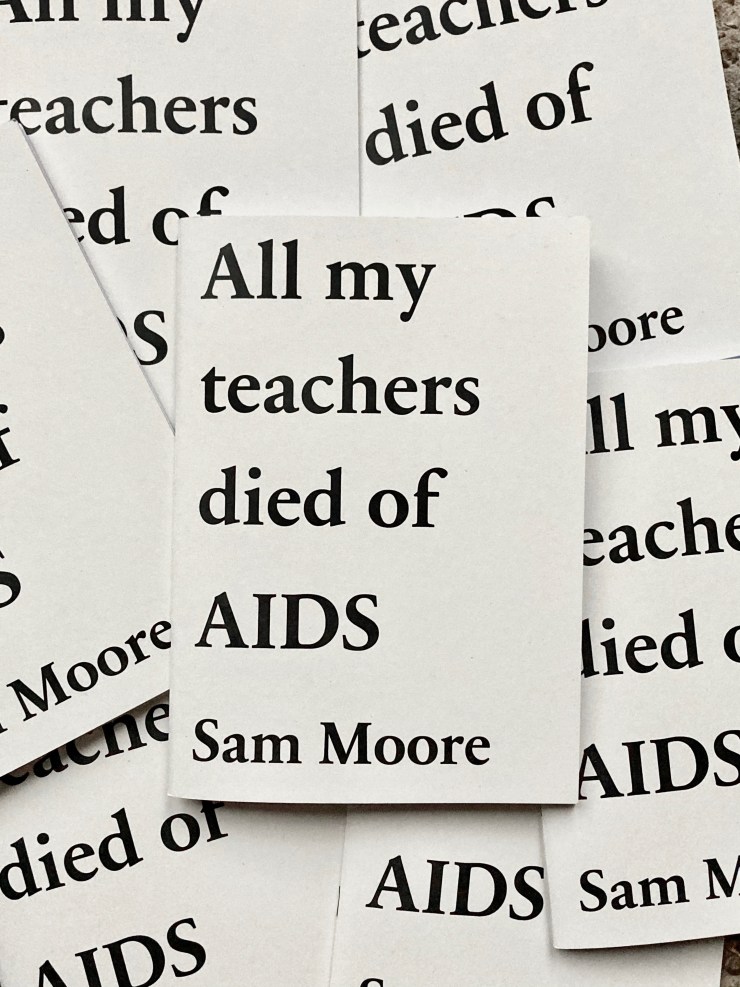
Talking Death with Sam Moore: All my teachers died of AIDS

All my teachers died of AIDS by Sam Moore. Published by Pilot Press London. 2020.

Interview by Harper Wellman

CW: Death, discussion of transphobia

Sam Moore began their writing career while working toward their Master’s at the University of Oxford in 2017. While exploring various forms, Moore found their style, and success, with poetry and short stories, publishing pieces in Harts and Minds, DASH, Fearsome Critter, and Modern Queer Poets. Moore has developed a cross-genre style of writing that is on display in their book, All my teachers died of AIDS, from Pilot Press. Equal parts academic research, pop culture critique, and personal reflections, All my teachers died of AIDS explores the intersection of queer identity and death, and how the inseparable two inform each other. Below, Moore discusses Teachers, their process, their community, and what’s next. Moore is an editor for Third Way Press and a freelance journalist in London, UK.

Thank you for talking with us Sam. Teachers is a wonderful book that I think many people can relate to. Can you talk about how this project came to be? 

I spent a lot of time writing very traditional prose when I was finishing up my master’s degree – writing the first half of a novel for my thesis, something I keep saying I’ll come back to, and one day I will… but alongside that, I was also reading more and more experimental work, that existed between different styles and literary traditions. It was the first time I was reading Maggie Nelson, and diving into more of Chris Kraus’ work, and I basically ended up wanting to write something more along those lines, something that defied easy categorization. And then I went to a few of the Queers Read This events at the Institute of Contemporary Art here in London, run by Isabel Waidner, and Richard Porter (who runs Pilot, and would go on to publish the book), and was just incredibly struck by the range and strangeness of queer writing; Isabel read from their novel, Dodie Bellamy read from When the Sick Rule the World, Verit Spott read from Prayers, Manifestoes, Bravery, and it was impossible not to just be swept up in the power of this kind of writing, and wanting to contribute to it in one way or another.

Around the time I went to Queers Read This I also found the courage to start going to open mic nights (even after years of graduate workshops, the thought of actually standing up and reading poems out loud to strangers remains terrifying), and to begin with, I was reading lots of more traditional poems – all of which are from a book about bisexuality called Alex(andra), that I wrote between years one and two of my master’s degree and that I’m still hoping to get out into the world (so if anyone’s interested in publishing it, you know where to find me…) but gradually ran out of material and used that as an excuse to write something new and weird, which eventually became the first section of Teachers. I read it at a launch event for Modern Queer Poets (another book by Pilot that features a poem of mine, alongside some of my literary heroes like Eileen Myles and Wayne Kostenbaum), and jokingly said “it’s part of a longer, book-length poem, so if anyone wants to publish it come and talk to me after the reading.” Rich came to talk [to] me, and the rest is history.

I also think that Teachers kind of captures my development as a writer, in terms of this desire to write more experimental work; something that comes through in the sort of poem/essay hybrid (although structurally I don’t think it’s quite a lyric essay); poetry is the guiding force for the language when it comes to rhythm, line breaks, and the presence of rhyme in the text. But a lot of people have said that the depth of the book is more of an essay; rooted in an argument, in history and criticism, but written in the form of a poem. In their blurb for Teachers, Isabel (the author of We are made of diamond stuff, and Gaudy Bauble), calls it a “personal essay,” and the more time I’ve spent on the book the more I think that rings true. I also think that it’s ended up being a sort of signpost for how much more comfortable I’ve become writing about and through personal experience.    

Sam Moore, All my teachers died of AIDS excerpt.All my teachers died of AIDS by Sam Moore. Published by Pilot Press London. 2020.

Death is the major theme in Teachers. You discuss how there is danger in being queer and queer love, whether that is the physical act itself, or the threat of a bigoted society. How do you come to terms with the inherited history of HIV/AIDS, that still affects many members of our community? Was this book a way of navigating that?

It’s an incredibly difficult thing to come to terms with, and I feel like I also should acknowledge that it’s probably an easier thing for me to navigate than it will be for other queer people; living in the UK it’s arguably a relatively safe and liberal place (although there are still times when this theory is disproven), and I think as the continued fight for liberation goes on – which it very much is – we need to acknowledge that certain members of our community are more vulnerable than others. The continued quote-unquote debate around trans rights highlights the fact that while for some of us it’s become easier to feel safe, or assimilate, we still need to show up to fight for our trans brothers, and sisters (and those who are both or neither).

Teachers is something that’s more about navigating the past than it’s about offering any kind of roadmap for the present (something that feels vital but would probably be better off being written by someone else). A lot of the book is about coming of age – both from an individual perspective and across the wider landscape of queer history and culture – and is about the shadow of death that remains cast over the queer community. That’s what the book is about coming to terms with (or trying to come to terms with anyway; I don’t think it entirely offers neat closure, but I also think that that’s good), a way of trying to understand – if not accept – the generation of queer people who were taken too soon. And while things are better, the threat of a bigoted society remains; certain victories on politics or policy aren’t enough to erase the very real danger a lot of queer people still face, and I think that’s an easy thing to forget.

All my teachers died of AIDS by Sam Moore excerpt. Published by Pilot Press London. 2020.

Even with HIV/AIDS treatments progressing to where we are today, with viral suppression and PrEP, for some, especially multiply marginalized people, HIV/AIDS is not a thing of the past, and there remains a strong link between the queer community and death. Crimes against our trans and gender non-conforming friends are rising, while the number of hate and white supremacy groups increase.  What do you see as the next fight that queer communities must take on to stop these cycles of death and violence?

I think that the next fight for queer communities is one to defend the rights of trans people, which, even in supposedly liberal countries, are under attack; here in the UK, court rulings on trans teens being unable to consent to puberty blockers is a very real threat to trans people. Between that and the continued megaphones given to TERFs and transphobes, it becomes clearer and clearer that liberation is still a ways off, and we need to keep fighting for it.

And it’s things like this that restart cycles of death for queer people; I can’t help but go back to the puberty blockers court ruling, and can’t stress enough the kind of impact that this could have on trans people. Between rulings like this, the continued acceptance of transphobia in a lot of mainstream media, the atmosphere of violence and danger from a generation ago that’s in Teachers is still here today, it’s just that the violence has become more focused on a specific group of queer people. And as much as people like to talk about debating those who disagree on the issue of trans rights, this feels like an inherently disingenuous position to take; so often it forces people in marginalized positions to debate their existence as if it were some kind of Oxford union debating idea rather than the reality of people’s lives. 

It felt poignant to read Teachers during the current pandemic. The loss of life, marginalized communities being more harshly affected, and the loss of shared safe spaces, all feel somehow familiarly queer. What effect do you think COVID will have on queer communities moving forward? 

Back in Lockdown 1.0 here in the UK in the spring (which feels like forever ago), is when Rich and I first started talking about bringing Teachers into the world, and if this was the best or worst time to do it. In the end, I’m glad we ended up waiting a little while because I always wanted to bring it out on World AIDS Day. Having the conversation did make it clear how strange it might feel to bring out a book about plague during a new plague year (although I find the comparisons between COVID and AIDS to be a bit of a reach, especially when it comes to how politicians have responded; the rapid response for a vaccine is obviously wonderful and should be commended but it also seems to highlight just how stark and long-lasting the government inaction was during the height of the AIDS crisis).

You’re right about the way in which this current outbreak feels uniquely queer, like a kind of echo of queer history. And I think that COVID will impact queer communities in ways that remind us how precarious queer life can still be, and how vital solidarity is moving forward. The racial disparities in COVID mortality rates are something that we need to keep in mind, especially given the fact that communities of colour remain the most heavily impacted by continued cases of HIV/AIDS. This is something that should galvanize people to action, to continue fighting for members of the queer community who continue to struggle and face oppression.

All my teachers died of AIDS by Sam Moore excerpt. Published by Pilot Press London. 2020.

Have you found any new teachers during this pandemic? Have you read/seen/heard anything that has been inspiring you? 

I think my reading highlight of 2020 might be Writers who love too much, an anthology of New Narrative writing that was co-edited by Dodie Bellamy; it’s so uniquely queer to me in the way that it refuses to adhere to convention (especially when it comes to writing around politics and sex), and in the way it explores life and literature in inherently intersectional ways. I found myself reading more non-fiction, and specifically more political writing this year, and a highlight from that is absolutely If They Come in the Morning: Voices of Resistance, an anthology edited by Angela Davis about racism, activism, and the prison system that remains vital almost 50 years after its publication.

Finally, I wonder if you can tell us a little bit about your next project, Search History.

I touched on Search History a little at the end of the Teachers launch reading I did on the Pilot Press Instagram (which is still available to watch there, and if people are interested in checking out the book then that’s definitely a great place to start), and just like I did with Teachers at the reading last year – and with Alex(andra) in this interview – I decided to say “if anyone wants to publish this weird book of essays, slide into my DMs.”

Search History is, as the title suggests, about history; both in the big-picture way that Teachers was, but also specifically in reference to a computer’s search history. It’s a series of experimental, lyric essays that each look at different ways in which sex and desire are acts of performance. So the book is about erotic archetypes (cowboys, bikers, schoolgirls), the performance of gender roles, and how that plays into sexual power dynamics, internet porn, and (auto)biography. Like a lot of my writing, it balances pop culture criticism with a dive into specifically queer aspects of cinema, theory, and porn. There’s one essay about catholic schoolgirls and bikers (the two archetypes are tied together through an autobiographical thread), and it touches on Britney Spears, Kenneth Anger, and Kathy Acker. 

I’d say about half of the essays have been written in one form or another, and the first one to be published – An elegy to the Nob Hill Theatre, an exploration of the geography of 70s gay porn, and the non-space of the internet archive – is coming out in early 2021 with Take Shape.

________________________________________

With new work to come, Moore continues to explore more topics at the crossroads of queer identities, collective history, and personal experience. In All my teachers died of AIDS, Moore is able to weave together their research, exploring important and morbid topics in an earnest and engaging read that many queer people will find relatable. All my teachers died of AIDS is available now through Pilot Press, and Moore can be found musing on Twitter and Instagram.