Beyond Binaries: In Conversation with Mahsa Merci


Mahsa Merci, Silent Stars, Mayten’s Projects. 2021. Image courtesy of Amir Sohrabpour / Mayten’s.

Interview by Adi Berardini

Mahsa Merci is interested in challenging society’s traditional concepts of beauty. Through her paintings, sculptures, and mixed media work she expands notions of the gender binary by depicting queer, trans and gender non-conforming individuals using viscous oil paint and building up layered textures. Born in Tehran, Iran, Merci holds a Bachelor’s degree in Graphic Design from Tehran University of Art and a Master of Painting from Azad University. Currently based in Toronto, ON, she has recently completed her Master of Fine Arts at the University of Manitoba, Canada.

In her latest exhibition Silent Stars at Mayten’s Projects, Merci displays two years of work examining the restrictiveness of social norms that affect the LGBTQIA+ community. Merci explains how “painting is one of the best ways to challenge strict binaries.” Through bending the binaries between man and woman, and beauty and the grotesque, she invites the viewer in closer to her work to experience the textures and relate to her subjects.

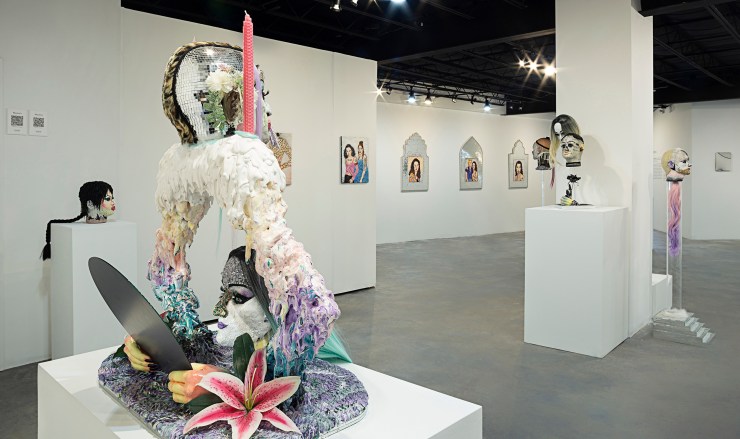
Along with her queer portraiture, in Silent Stars Merci explores the terrain of sculpture, often referencing Islamic architecture and broader queer culture. For example, her sculpture Find Yourself Through Myself consists of a figure with light teal hair peering into a mirror of another among a shrine of sequins and pastel pink candles, evoking both oral sex and self-reflection. Also referencing Islamic architecture and miniature painting, Merci includes portraits as an homage to the Iranian LGBTQ+ community. Merci’s depiction of identity is not edited or airbrushed, but displays imperfections and flaws, challenging society’s restricting binaries and expectations.

You depict the queer community, particularly drag queens, gender non-conforming, and transgender people in your work. How did you first decide on depicting the queer community as your subject matter?

I always worked on gender identity, beauty, and sexuality as a subject in my country [for] more than 10 years. In 2017, I was watching a documentary about a transgender [individual] in Iran who had to leave for Turkey since they could not live in our country. That documentary was like a hammer on my mind. I could see beauty, grotesque, sadness, all of these things. I started to work on this subject in 2018 and one year later, I understood my sexuality when I was 28 years old. After that, I understood why I decided to work on this subject in my art career. My subconscious knew about it, but my conscious mind didn’t know about it at all. We don’t have any education or educational materials, living in a religious country. When the educational materials don’t exist, how can you understand your sexuality soon and in a good way? In 2018, I understood my sexuality, but it was so hard for me until now.

I can relate in a way. I felt like I was late coming into my sexuality as well. It took me until my early 20s to clue in that this is who I am, and this is who I’ve always been. But because of religion or compulsory heterosexuality, you lose that.

Exactly. It’s hard to know that you are part of this community when you don’t see anyone, or you don’t hear anything, it takes so much time to find it. It is not easy.

Mahsa Merci, Stay, Oil on Canvas. 30 x 40 cm. 2020.

Can you talk further about how you use painting to challenge binaries such as masculinity/femininity, beauty/ugliness, etc.? In what ways are interested in redefining societal beauty standards through painting?

I can say I am multidisciplinary [since] I’m working with so many materials—I’m working with painting, sculpture, animation, collage, so many things. But with painting I [can] find something so special. I never had an academic background with painting, I never had an apple on a table that I had to paint. When I’m painting, it’s like I print the portrait—I start to build up the materials and textures. I find painting as a material that I can show myself [through]. I’ve always really liked to share the spectrum of everything: softness and harshness, beauty and grotesque, femininity and masculinity and I find that painting can help me to do it. Every stroke with my brush that I do I feel myself in it.

I want to make an atmosphere that the audience wants to come closer to the portrait. Heterosexual [people] may not want to come closer to our community. I don’t want to have two categories, heterosexual and homosexual, I want to see more friendship together.

Your work uses a great amount of texture through the building up of paint. Can you explain more about your use of texture and its significance?

I work with oil colours which help me get the textures that I use. I like working with oil on small portraits that invite the audience in closer to see the portraits. When paintings are larger, physically the viewers need to go far to view it. I want to make an atmosphere that the audience wants to come closer to the portrait. Heterosexual [people] may not want to come closer to our community. I don’t want to have two categories, heterosexual and homosexual, I want to see more friendship together. I want them to come and see the portrait and see the details, the textures, the beauty, and the grotesque of the characters. Some parts come out of the canvas, like nose, lips, hairs, and jewellery—they are 3D works and not flat works. It’s kind of a metaphor for me to show that these are real people. I want to show the feeling that they are coming out of the canvas.

Mahsa Merci, Silent Stars, Mayten’s Projects. 2021. Image courtesy of Amir Sohrabpour / Mayten’s..

Can you explain your inspiration for your latest show, Silent Stars at Maytens?

The main inspiration is myself and the challenges and concerns that I am facing as a queer person. I always look at the other LGBTQIA+ people all over the world. I feel all of us have the same problems living in a patriarchal society, but the level is just a bit higher or lower. Sometimes when I see my friends and some portraits on social media or the website, they are an inspiration to me—their clothes and the queer culture. Then, I reach out to them and paint them. I am inspired by two books, Gender Trouble by Judith Butler and Women with Mustaches and Men without Beards written by Afsaneh Najmabadi, an Iranian writer.

Mahsa Merci, Silent Stars, Mayten’s Projects. 2021. Image courtesy of Amir Sohrabpour / Mayten’s.

Your work featured in Silent Stars also plays upon sculptural and Islamic architectural elements. Can you speak further about these elements in your work?

The inspiration is from the book I mentioned, Women with Mustaches and Men without Beards written by Afsaneh Najmabadi. She is an Iranian professor from Harvard working on gender, sexual identity, and beauty in ancient Iran. Through reading this book, I found that there was no heterosexuality or homosexuality in ancient Iran. It was surprising to me that two men or two women could have love or a relationship together without judging or explaining it to anyone. You can see in the paintings that the male and female clothing was the same. But when the Europeans came, they changed the culture little by little. They enforced the idea that men and women should be together. Now, if you are part of the LGBTQ+ community in Iran, you [may wish to] escape from the country or not say it too loudly since your life can be threatened by your family or your government. Although it is not us, it was brought to us.

The portraits inside the mirror frame are all Iranian LGBTQ+ [people]: one of them is queer, one is bisexual, and in the middle two portraits; one of them is lesbian, and one is non-binary. I wanted to [display] Iranian LGBTQ+ people as monumental. I get the shape of the mirrors from a very old and traditional Iranian art called miniature. Miniatures are very old paintings that Iranians and Persians painted of a building, spaces, or narratives with very, very small brushes. It is very special.

Do you have any upcoming projects that you would like to speak further about or things you’re working on?

I just moved from Winnipeg to Toronto. I still don’t have a studio, so I don’t have any big project or exhibition planned. Although, a project I’d really like to start is to make more sculptures. I found that sculpture can show very different things than painting can, so I’d like to continue that. I also want to take more photography from the background of drag shows. I have so many ideas from quarantine that I’d like to do.

You can view more of Mahsa Merci’s work on her website and social media. The Silent Stars exhibition is on display at Mayten’s Projects until January 15, 2022.

Respect Your Elders: In Conversation with Biju Belinky

Biju Belinky. Drawing based on a 1993 photograph by Del LaGrace Volcano. 2021. Photo courtesy of the artist.

Interview by Adi Berardini

Based in Brazil, Biju Belinky is a visual artist and illustrator who recreates historical queer photographs, reinterpreting them into colourful and vibrant illustrations. Belinky captures the tenderness of these relationships, depicting the queer romance throughout history that has always existed but is rendered invisible by society. Often sensual and emotive, her drawings bring fresh energy to the historical photographs of the LGBTQ+ community of yesteryear.

Biju Belinky studied at Central Saint Martins and the London College of Fashion. Before working as a visual artist, she worked as an arts and culture journalist for seven years, which aligned with her interest in queer archives and documentation. Belinky also finds inspiration in tarot and magic, her drawings inspired by the bright colours and pastel palettes of animated shows and vintage Japanese advertisements. In the following interview, they speak more about drawing inspiration from historical queer photographs, overcoming self-doubt, and their creative process.

Biju Belinky. Self Portrait. 2021. Photo courtesy of the artist.

I am drawn to how you recreate historical and contemporary queer photos and create new energy and vibrancy to them through colour and line work. Can you speak more about your practice and why you use these historical photos and references? Do you have an example of a favourite photograph (or era) that you’ve recreated?

To talk about how I started working with that kind of subject matter, I would have to go back to four years ago, when I went through a long period of time not making art at all because it fucked with my self-esteem a lot. I just had a lot of issues with thinking that everything I did was not good enough. But I could see that not doing art was also fucking with my brain, so I decided that I was going to challenge myself and force myself to finish things without thinking too much about it. And I knew I had to do it working with something I thought was beautiful constantly, so that I was sure that my brain couldn’t go “this isn’t interesting anymore.”

I initially drew from my personal collection of images of queer love and affection that I had saved on my computer from previous research I had been doing for a while, and I started creating artwork from there. From then on, I kind of noticed that this subject was just an endless source of inspiration, and the documentation on it varies so much, from tender to sexy and affectionate. [There are] so many different expressions of queerness and women-loving-women relationships and through that, I had found a way to express myself through my art in a way that didn’t make me suffer. 

It was a cool exercise to find these photos and the history behind them. You end up finding more about these photographers that worked throughout the centuries, these images that were lost through time. For a while, I was interested in more Victorian photographs and women seemingly in love in vintage photos from the 1920s and the 30s. It was quite interesting spending a long time thinking “Where does this photo come from?”, “What’s their relationship?”. And the stranger one to research: “Are these women together or are they sisters?”, because oddly sometimes you’d find a photo where you think that they’re definitely a couple, but you do research and find out that they’re actually sisters. 

I always try to research a lot and find sources, to make sure I’m representing people correctly, [which] allows me to develop my practice more. Once I became more comfortable with drawing regularly, I started adding colour and I started figuring out again what I wanted to experiment with and the [types] of images I wanted to see in my work. From then on, I started to add different vibes to the images. When I started doing bright, colourful monochromatic representations of the black-and-white photos, it was fun to look at the photographs and think of what colour this makes me think of in a completely subjective way. I couldn’t explain why [one] feels pink or [one] feels purple. I’m not going to say it’s the aura of the photo because it’s not. It’s just me looking at the photo and feeling it. Like this thing feels yellow and so on.

My work and the images I draw from are not all soft; I hate describing them as soft. But they do exist at the intersection between sensual and tender. I’ve had long arguments with people about this because some people are like “your images are sexual.” And they are, but they aren’t. I’m not making explicit erotica. Even the images that are more overtly sexual where [the subjects] are naked or half-naked, have tenderness and sensuality to them. They’re not geared towards creating the sort of “Oo you’ll feel hot and bothered by this” feeling. If you find them sexy that’s cool, but at the same time for me, there’s more of a tenderness to it and I try to communicate that with my pieces.

Biju Belinky. Drawing based on a chloe atkin’s photograph from Girls Night Out. 2020.

That’s interesting. I wonder since they are queer images too, how that influences how sexual they seem. 

Yeah, people hypersexualize my work a lot. I’ve had quite a few commenters, especially men, come up and be like, “Oo sexy, threesome,” just that kind of gratuitous bullshit. If you want to consume sexy content geared towards straight men, there’s plenty of it out there. This work, my work, is not for them.

I think seeing my work as purely sexual kind of stems from the same type of thought where people see queerness as something that’s purely linked to sex and that’s it. Of course, sex and romance are a part of it, but queerness is such a complex, whole identity. So, for people outside of the community to just try to narrow it down to “oh it’s about who you want to bone,” feels reductive.

If queer women see it as super sexy it’s cool because it’s self-representation. But when it’s straight men projecting, fetishizing, and commenting weird stuff then it always makes me really uncomfortable. There is this skewed way of thinking that if something is queer and it involves women, it’s perceived by men as inherently sexual and often performative “for them.” So yeah, I think there is a hyper-sexualization of my images because they represent queer women being affectionate in a variety of ways. At the same time, thankfully my art has seemed to reach mostly the people it’s meant for.

Biju Belinky. Drawing based on an image printed on postcards by Steven Meisel for the SAFE SEX IS HOT SEX 1991 initiative, organized by the Red Hot Organization. 2020.

I think it’s good to have that sense of softness and tenderness in your work. I was drawn to it since it highlights that queerness has always existed by going back to the archive.

I think a lot about queer elders and older LGBTQ+ people and how many of us got the chance to meet older LGBT people that were around us growing up. It’s such an important reference to have and I didn’t realize how important it was until I met someone over the age of 60 who was a married woman with a wife, and I was like “you have so much knowledge in life.” I think this absence of role models doesn’t happen only because of the silence around sexuality but also the fact that almost an entire generation of LGBTQ+ people died throughout the 80s. There were so many major losses during that time that it just became commonplace to not know older LGBTQ+ people.

One time, I was showing my cousins some of my drawings. Only the very tame, appropriate ones, mostly from Victorian times, and with their mothers’ permission. My one cousin is around thirteen, and the other one is around ten, and they asked to see the drawings since I had been working on them nearby. My 13-year-old cousin was like, “How come none of these people are old? How come so many of them are so young?” And I was like, “Well it’s hard to find photos of older LGBTQ+ people to draw. I’d really love to do that, but it’s hard to find people above a certain age that you can draw. And in this era, people were often made to get married after a certain age, even if they weren’t in love.” And she [said], “That’s sad, I hope that you can find many pictures of old people and that you [can] draw them soon again.” 

I was emotional about that because she was rooting for there to be older queers. I never expected that at all. I [thought] how do I explain to this young child the horrible, horrible things that might have happened? I was coming up with ways in my head to explain it in a way that was simple but also was true.

I think that growing up as queer people in the 90s, we didn’t see cheerful representations of queerness. We saw the struggle, you see the trauma, you saw people coming out, and then how their parents now hated them. But we hardly ever saw affection for the sake of affection, in all its forms. I mean, small acts between queer people are revolutionary in themselves. But at the same time, it’s nice to just see yourself represented in something soft and loving without feeling like it needs to be a statement all the time. 

It’s nice too because a lot of the narrative in mainstream media is about coming out or trauma. I don’t want to say there’s a shame, but there’s stigmatization to queerness. To see that queer joy, does bring you so much joy.

I just want to see happiness; I want to see queer happiness and show as many sides of it as I possibly can and as many different types of relationships and kinds of people as I can because I feel like there’s not enough of that out there. I mean other artists are doing this kind of stuff, but when you look at other media like movies or TV shows it’s still so rare for you to be able to watch a film where the characters are queer and in love and that’s that, a film where you don’t have to watch a straight relationship for two hours just hoping for the side plot to be kind of queer. Sometimes you want to watch something sweet and soft and it’s not about suffering or about shame. Violence might happen in the street, that’s a reality, I don’t know anyone who hasn’t been afraid at one point or another. But it’s exactly because of that reality that I feel like my illustrations exist in a space outside of that, where violence is not a concern and there’s just this mutual understanding between the viewer and me of what the illustrations are and what they’re representing.

As much as we know this, logically, our history has been erased so many times that sometimes it’s good to remember that queer people have always been around, they’ve always been affectionate.

There’s a lot of art that I want to make about queerness that is a lot more painful or might be more complex in the way it develops and builds. But to have a space where I’m just able to see, especially when you look at older photographs, that queer people have always been around, is amazing. As much as we know this, logically, our history has been erased so many times that sometimes it’s good to remember that queer people have always been around, they’ve always been affectionate. People kissed and hugged and had sex and everything else for centuries. Queerness is not a side note in history, an imaginary bond we project today between “best friends” from the 19th century; it exists, it is registered. Its evidence is scattered throughout history and lives on even after so many attempts to wipe them out. It’s nice to be able to bring all that memory back to the surface through my work and to consume that for myself through my research.

Biju Belinky. The Lovers, 2021. Photo courtesy of the Artist.

Who are some of your artistic influences and artists you look up to?

I love anything by chloe atkins, her photos are amazing, and she did the Girls Night Out photography book. That photobook has such sexy and fun photos of nightlife. You can see that the people in the photos are so into each other, and drawing-wise it’s such a cool series of photos with so many dynamic poses. 

I also love the archival work that Gerber/Hart does. They have an online database of queer everything, they have zines and photography and stuff. They’re such a good reference, whenever I’m stuck, I always scroll down their website and Instagram [to find] inspiration. 

I’m really drawn to colour, not only in my drawings but also in the tarot series. I love the aesthetic of 70s and 80s Japanese advertisements for toys. They’re so bright and in your face, while still combining pastel tones with everything else. That is such a huge inspiration for me. As for artists that inspire me, there’s Nanaco Yashiro (@nanaco846) who’s a Japanese artist, and there’s also Choo (@choodraws) – they do very dynamic comic book-y scenes. Choo can draw clutter like no other person can. 

A lot of artists I’m inspired by have a unique voice to [their work]. I feel like I can see what type of person they are since they have such a clear visual language. Having that language [as an artist] is a huge ambition of mine. There’s an amazing wood engraving artist who does images of lesbian couples, Gessica Ferreira (@gessicaferreira100). There’s also Katie Aki (@miss_luckycat), Peter McAteer (@pete.ey), Anna Dietzel (@anna.dietzel), Helena Obersteiner (@helenaobersteiner), Savanna Judd (@heartsl0b), Joanna Folivéli (@foliveli), and Ing Lee (@inglee).

Biju Belinky. Spooky Girlfriends. 2021. Photo courtesy of the artist.

Do you have any advice for emerging artists who are just discovering their style and sensibility as an artist?

I’m an emerging artist myself – but a huge thing for me was a conversation that I had with one of my best friends, Helena, when I was initially getting back into writing. She has built her whole practice on the idea of mistakes and how accepting mistakes [can be one] of the best things that can happen to you. It was so important to talk to her and accept that my work isn’t going to immediately look the way that I want it to look. And it’s in the path of trying to make it look the way that it does in your brain that you’ll find the best things about your work. There’s a big way to go between your brain and your hand. When the image in your head is not doable hand-wise, you should just try to do it anyway—You’re never going to know what you find unless you try. That reaffirmed the phrase, “better done than perfect,” for me. I tend to be a perfectionist, but I can’t let my frustration stop me from finishing things. 

Another piece of advice I have is don’t be afraid to take breaks. I think we live in a culture where people want to consume things at way faster pace than what we produce things in. It’s okay to rest and take time for art. There’s a huge benefit of recognizing and respecting your limits. Do you, but don’t die trying to do you. Take breaks when you need them since it takes a lot longer to recover from burnout than it does to just stop once in a while.

Do you have any other future projects that you’d like to share?

I am currently working on my store that [has recently opened]. I will be including my art and an entire series on tarot cards. I am working on a zine with 20 other female artists in Brazil and the UK. It’s about myths about vengeful and raging women from across the world. We’re looking into feminine anger and stories of mythical creatures that are [based off angry] women. We’ve been working on it for a year and it’s in its finishing stages now.

[My friends and I] just opened a tattoo studio called Arachne (Arachne.tt). named after a mythical woman. The three of us have different levels of tattooing, I’m still starting out and practicing on willing victims. It’s all original designs by primarily fine artists in the language of tattooing. If you’re in Brazil come and get tattooed by us!

You can view more of Biju’s work on her website or Instagram.

Mother, Earth, Air: Yulia Pinkusevich and Sakha Aesthesis at MPAC

Sakha Aesthesis by Yulia Pinkusevich. Installation view 5, MPAC. Photo courtesy of the artist.

Sakha Aesthesis by Yulia Pinkusevich

MinEastry of Postcollapse Art and Culture

July 23 to September 29, 2021

By Mia Morettini

“As far as my identity is concerned, I will take care of it myself. That is, I shall not allow it to become cornered in any essence; I shall also pay attention to not mixing it into any amalgam”.[1] In his famed work The Poetics of Relation, Caribbean scholar Édouard Glissant raised an impassioned defense of personal opacity as an opposition to a prevailing liberal ideology, one that absorbs and assimilates difference into its multicultural quilt. As Glissant insists, while there is a need for mutual understanding and respect across cultures, this understanding cannot be found through assimilation. In fact, insisting on difference, on a relational opacity, opens space for a truly radical coexistence built on irreducible contrasts that colonialism has long sought to iron out.

I first encounter Yulia Pinkusevich’s Sakha Aesthesis from this position. Crafted in the slow, solitary beginning months of the COVID-19 lockdown, Pinkusevich’s installation reflects a singular and deeply personal perspective — one best approached with opacity in mind. Her visual lexicon approaches the surrealists; unnaturally pastel skies frame dreamlike, fluid forms. I immediately imagine Hilma Af Klint’s mystic abstractions lining the walls of the Guggenheim and attempt to follow what visions this artist might be summoning. But Pinkusevich’s work shudders past this relation, disrupting my index of her work into the art historical amalgam in which artists like Af Klint now firmly reside. 

Sakha Aesthesis by Yulia Pinkusevich. Installation view 6, MPAC. Photo courtesy of the artist.

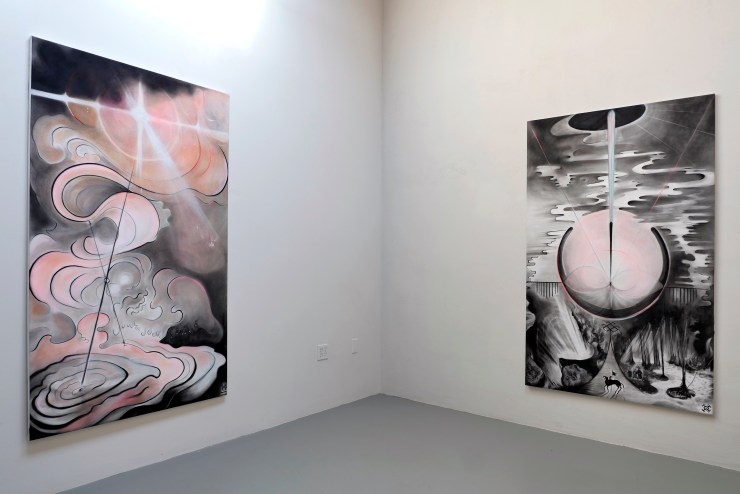
I am humbled by scale. Six-foot-tall viewers are dwarfed by the saturated blacks of her imagery, pulled close into mysterious elliptical orbits. A challenging opacity permeates the odd figural and narrative glimmers scattered throughout. In one piece entitled Tree of Life, 2021, a disembodied mouth suspended in scream bursts with a radiance delineated by pale pink sunbeams forming a saintlike corona around it. In another piece, Mother Spirit (ije-kut), 2020, a triumphant, flag wielding figure on horseback confronts a walkway that bends unnaturally skyward. The eye dances across these vibrant, organic, and finely detailed shapes only to be stopped short by crisp, geometric lines that divide the compositions and sever their narrative potential. 

Sakha Aesthesis by Yulia Pinkusevich. Installation view, MPAC. Photo courtesy of the artist.

The exhibition text questions: “Can the ancient enunciate the present?”. I read Pinkusevich’s conversation with MinEastry of Postcollapse Art and Culture (MPAC) curators Ilknur Demirkoparan and Vuslat D. Katsanis, in which she cites her research into Gaia theory, a scientific theory adopted into the Western canon in the 1970s. The hypothesis posits that Earth operates as one large, complex organism sustained by interactions between both organic and inorganic material. Regularly woven into the multicultural amalgam through buzzword-ridden “everyone must do their part” incentives (see: Starbucks banning plastic straws), Gaia theory finds roots in Indigenous knowledge. This knowledge re-emerges with frightening urgency in the weeks since the Intergovernmental Panel on Climate Change declared a “code red” on impending environmental collapse. Pinkusevich heeds this warning and insists on space for ancestral knowledge, offering glimmers of personal history and Indigenous Siberian Sakha tradition to re-center a decolonial framework. 

The influence of these combined practices is immediately evident in Pinkusevich’s use of omniscient perspective representing the three central Sakha spirits—Mother, Earth, Air—that are carried with the individual throughout life. In this context, I feel the ova and womb filling the oxygen of Mother Spirit (ije-kut), 2020 and Tree of Life. I see Earth Spirit’s light graze the pinks of a baby’s blush, ribboning across the composed surface as tendrils of a tree’s roots carve a vascular pattern. Struggling to shake my post-Enlightenment vernacular, I see light above and beyond a horizon — composing a horizon, slipping beneath a horizon — as the promise of futurity or absolute truth. But any sense of grounded linear temporality in these paintings is unstable, trembling with an almost extraterrestrial levity.

Sakha Aesthesis by Yulia Pinkusevich. Installation view, MPAC. Photo courtesy of the artist.

Undulations of the Earthy Spiny Serpentina Making the World, 2021 call again to a sense of fecundity, to the garden, to the feminine. While its title speaks to a literal, reality-building enormity, the serpent itself is surprisingly mundane. Sculpted from biodegradable materials sourced from Pinkusevich’s own garden, its Jim Henson-esque face hovers mid-air, a casual, bemused expression revealing neither the historically-indexed predator nor temptress, but a figure approaching a companion—a co-inhabitant of the room. Glissant’s opacity finds harmony with the serpent. In contrast to the density of the images, the serpent’s gentle curvature around a too-silver air duct again guides the eye to yet another horizon beyond the pictorial plane, shattering the carefully composed gravity of Pinkusevich’s paintings.

Previously noted affinities between Pinkusevich’s work and other artist-mystics are only glancing, nestled on aesthetic similarities. Pinkusevich’s work finds home with MPAC for this very reason. MPAC provides Pinkusevich the space to insist on opacity, to celebrate the unique positionality of her work which, bolstered by the curators’ careful interpretation, reaches beyond the essentialist realm of aesthetics and into the experience of aesthesis. Wrenching discussion away from surface-level visuals, aesthesis denotes a sensuous and experiential relationship to art—one that resists formal classification or definition by adhering to a wider range of subjectivities. This range opposes a colonial amalgam and is essential to MPAC’s mission to explore contemporary art from the perspective of East Europe and Central and Western Asia post-1989.

Sakha Aesthesis by Yulia Pinkusevich. Installation view, MPAC. Photo courtesy of the artist.

Pinkusevich’s overlaying sense of humor within Sakha Aesthesis is one such opposition. While confronting an alarming present and a violent past, Pinkusevich admits her work is also, “about love and life; there’s hope in it. It’s also silly and there’s something a little funny about it”. I’m reminded of Bakhtin’s carnival—that which is immersive, joyous, and communal. That which confronts Order from societal margins, declares itself in a moment of “relational becoming.” That which sends a tremor through linear temporality. If Bakhtin floats in these well-lit walls, he bounces off the earth-colored serpent vertebrae and unassuming face. He lifts from the moments of pale pink fluidity in the paintings, from the silhouetted shoulders of the horse-drawn hero.

Activist and author adrienne maree brown asks in her 2017 text Emergent Strategy: Shaping Change, Changing Worlds, “How do we cultivate the muscle of radical imagination needed to dream together beyond fear?”[2] Following brown’s query, the hope that necessarily radical imagination can build a new dream, Pinkusevich proposes an elevation of heritage, humor, and humility as a multi-sensory site of imagining. She constructs a space of exploring how hidden knowledge may unveil healing possibilities between ourselves and the opaque, ancient, and re-emerging earthly systems at play.

Sakha Aesthesis is on view until September 29, 2021, at the MinEastry of Postcollapse Art and Culture at 2505 SE 11th Ave Suite 233 Portland, OR 97202.

Mia Morettini is a Chicago-based interdisciplinary artist and writer. She is recent graduate of the Master of Arts in Visual and Critical Studies at the School of the Art Institute of Chicago. Her curatorial and written work has been shared with Holly and the Neighbors, a grassroots arts  collective based in Chicago, and most recently at the Smart Museum’s 2021 Health Humanities  in Times of Crisis symposium.


[1] Édouard Glissant, The Poetics of Relation, trans. Betsy Wing (Ann Arbor: The University of Michigan Press, 1997), 192.

[2] adrienne maree brown, Emergent Strategy: Shaping Change, Changing Worlds (AK Press,  2017), 59.


Sidney Mullis is Your Long-Lost Imaginary Friend

Sidney Mullis, The Town Between My Toes. Sand, wax, raw rigatoni and shell pasta, pleather, black food coloring, olives, carrots, olive pits, cotton string, resin, wire, wood, paint, rocks, teddy bears. 2019.

By Anna Mirzayan

For an artist interested in the possibilities of space, it seems fitting that Sidney Mullis’ studio is in the basement of a converted church. As we go through the doors down to her studio, the journey still invokes hallow memories. Small ornate windows stand alongside large arched wooden doors— there is even a gargoyle carefully watching as we pass. Mullis’ studio itself is a modern steel and concrete rectangle in premeditated contrast to the aesthetics around it. Most of the space is taken up by several of her large and bizarre installations that seem to reach out as you enter, inviting you to touch their points, joints, and protrusions. Her materials are carefully tucked away in buckets beneath large shelves and tables littered with smaller works. One table houses a sewing machine, surrounded by scraps of the black pleather she is fond of using.

Sidney Mullis. “Shrine for my Pocketed Youth.” Sand Murmurs/Tongue Pockets/Thumb Secrets Installation Shot. Bunker Projects, 2020.

Daughter of an army father, Mullis moved around a lot as a child. She spent her childhood years in Alabama, Kentucky, Tennessee, and North Carolina, and attended undergrad in Virginia before moving to Pennsylvania, where she now resides, for her MFA in sculpture. In the rural South, the gender roles and scripts assigned to her weighed heavily, and she became very attune to how social expectations changed and became more rigid as one aged. This first awareness informed the interest of roles and expectations that she now attempts to point out and subvert in her work. As a teacher of both studio art and art writing at Penn State, Mullis is keenly aware of the position of authority she occupies in the classroom. As in her art practice, she attempts to break down these power dynamics and focuses on having fun in the classroom. As a teacher, Mullis said she quickly learned that the worst thing she could do in adult space was “be childish,” so she asked herself why can’t silly “be here,” in this space?

Sidney Mullis. Purple Bush with Knuckle. Sand, wood, paint, string, handmade paper pulp made primarily of kid’s construction paper and gravestone dust. 2021.

Her work focuses primarily on recreating childhood spaces where one is free to create and imagine, asking how we learn the rigid roles we perform as adults and why we acquiesce to them so readily. She uses craft materials and processes, like sand, paper pulp (as in Purple Bush with Knuckle), Styrofoam and dried macaroni, along with unusual materials like gravestone dust (which she uses as a binder), and insists on doing everything by hand, to evoke the playful creation of childhood. Figuring out the processes for using the materials is itself a recreation of childhood play. The sand that makes up large pieces like Three Thumb Secret Keeper harken back to sandboxes and sandcastles and are part of Mullis’ goals of making landscapes as play spaces. The ingredients for the treated sand itself are kept under wraps like a childhood secret. The small spheres she uses as embellishments are made from individual wax grapes that are filled like molds and then cut apart one by one— a super laborious process that evokes the tension between play and tedium.

Sidney Mullis. Sand Murmurs/Tongue Pockets/Thumb Secrets. Bunker Projects, 2020. Installation Shot.

Mullis stumbled across one of her more macabre materials by accident. She was looking for somebody to drill rocks she collected to use as counterbalances for her trees and thought to try a longtime family-owned gravestone carver as a last resort. They broke every rock. However, the carvers were using leftover gravestone dust to cast small sculptures (one of them even made teeth for dentists on the side) and offered Mullis as much of it as she could carry. Mullis says she was fascinated by the joyful way the carvers created new objects from leftovers. Although losing a life is not quite the same as losing a tooth, both processes create some form of existence from death. “Parts of you die, parts survive,” says Mullis. Life is full of transformations. Her use of materials like gravestone dust to make playful objects reminds us that childhood is linked not just to joy but to loss as well. It is important to memorialize the dark and the difficult, and not to paint childhood with the rosy brush of nostalgia.

Her use of materials like gravestone dust to make playful objects reminds us that childhood is linked not just to joy but to loss as well.

Sidney Mullis, Altar to Resurrect my 7-year-old Self. Handmade paper pulp, gravestone dust, wax, sand, dry rigatoni and manicotti pasta, pleather, black streamers, discarded teddies, olive pits, paint, wire, shells & coins from childhood collections. 2017-2019.

Mullis makes sure to lean into the dark and the strange in her work. The center of her studio is populated by two large trees merging into an arch. The denizens of the “Forest” are made of starfish-like pillows made of black pleather. Because of the sensual material, adults who wander through the wood often read sexual innuendo into the works, associating them with queerness, leather, and BDSM. Mullis explains that she was more interested in the disorienting juxtaposition between the objects as pillows and their spiky appearance; however, she is also quick to remind us, pleasure is playful.

The works oscillate between attractive and repulsive, strange, and familiar. Some tower over the viewer, creating the scale of childrens’ vision, while others are toys that are strewn about the space, waiting on the ground to be discovered. The studio is an alluring sand and paper monument to the dwindling arts of childhood imagination, in both its joyful and nightmarish valences. Moving through Mullis’ invented spaces is a surprisingly intimate experience. She hovers on the periphery, allowing me to discover at my own pace. In the end, she gives me a small resin and gravestone dust keychain—one of a set made by squeezing the material until an impression of her hand remained— a memento mori, she says.


Weaving it all on the Dancefloor: A Discussion with dani lopez

dani lopez portrait. Courtesy of the artist.

Interview by Harper Wellman

There is something eternal and necessary about textiles — Clothing, canvas, tapestries, and tools are just a few of the almost universal applications of textile work. For dani lopez, textiles are at the center of an artist practice that transforms an ancient and ubiquitous undertaking into a modern and personal endeavour. Her work entwines weaving, text, and modern iconography with queerness, camp, pop culture, and personal experience, generating a body of work that is both sincere and relatable.

After studying at the University of Oregon for her BFA, and later at the California College of the Arts for her MFA, lopez has continuously shown at a variety of spaces, including Tropical Contemporary, Amos Eno Gallery, and the Frank Ratchye Project Space among others. As her work continues to evolve, the personal experience expressed in lopez’s early work has amalgamated into an expression of queer collectiveness, creating a cohesive body of work in which ongoing themes are given space to exist and evolve in time and various incarnations.


dani lopez,(for the ACT-UP dykes who cared for their gay brothers while they were dying of AIDS), film still from BPM (Beats per Minute) Hand-embroidered sequins, imitation silk, thread, and interfacing 36 in. x 18 in. 2019.

Can you tell us a little bit about what attracted you to textiles? You describe your work as a sight of both regret and redemption. Can you elaborate on that for us?

When I discovered textiles, it was the start of some soul searching. I was working with a fibers professor who is an out, Black man. I have often said that meeting and learning from him was a lot like a gay friend taking you out and showing you the ropes. I didn’t come out until my early 30s. Textiles gave me the space and time to process my life and why being straight felt so damn hard. Weaving was the meditative space that slowly unravelled the fact that I couldn’t stay in the closet anymore. I knew I was queer for over a decade, but thought, well if I like men too, why make it harder on myself? (This is something many bisexual women are familiar with). I can’t separate my coming out from discovering textiles. They are inextricably connected. My coming out late in life has so much regret tied to it. For a long time, there was also shame connected with that regret—Now I see that regret as an opportunity. I can attempt to redeem myself or atone for all the times I chose a man over a woman/non-binary person. Now, I’m giving myself back that lost time, the lost opportunities, the lost hook-ups, and those lost loves with the work I make and how I make it.

dani lopez, i want to be her/i want her. synthetic hair, muslin, fabric paint, cardboard 60 in. x 24 in. 2017.

dani lopez, your sinner in secret. handwoven fabric, cotton yarn dyed with commercial dye, crochet thread, dowel, finials, curtain tie backs 67”x108” 2016.

When looking at your work, there is seemingly a shift over time. Your early work, such as pieces like i want to be her/i want her, 2017, and your sinner in secret, (2016) are much softer and femme, evoking ideas of magic girls and comfortability. Your more recent works, DYKES ON THE DANCEFLOOR, 2019, are tonally darker and almost mysterious. There is also a shift, seemingly from the personal experience to the experiences of a community. How did this progression happen?

While the focus now is on the larger project, DYKES ON THE DANCEFLOOR, I shift back and forth from community-minded work to personal work. The shift is a big one and it came from the desire to see myself in culture and to also illustrate how and where other queer women could find their stories in the world. Coming out later in life is often compared to a “second adolescence” and that has been true for me. I was searching, desperately, to find stories that looked like mine or just to see stories of queer women in general (beyond The L Word). So, once I found those images, I decided to commemorate them, to celebrate them, and to adorn them. The progression always starts as a small question or idea that begins to grow and evolve, and if it becomes big enough, I start to pursue it. Often, access to resources and limitations of space have a bigger impact on the work than I’d like. With DYKES ON THE DANCEFLOOR, I had just finished grad school and lost access to the loom I worked on. I moved into a small studio and I wondered to myself, well, okay, what do I make now? What’s that saying? Necessity is the mother of invention? In my case, it was true.

dani lopez (for the trans dykes who never felt safe enough to come out), still from tv show Euphoria. Hand-embroidered sequins, imitation silk, thread, and interfacing 36 in. x 18 in. 2019.

Pop culture plays a big role in your practice. Euphoria, Carly Rae Jepsen, and Robyn are just a few references you have made throughout your career. Why was it important for you to consciously include and highlight queer, and queer-claimed, media and performers in your work?

I’m so glad you picked up these references because I often wonder if anyone is catching these signals I’m throwing out into the world. I would say personal and cultural research are at the crux of my practice. We find ourselves, as queers, looking out into the culture that at times doesn’t reflect much back. So, when I do find these signals being sent out to queer folks, I feel compelled to continue to push that signal forward. How far can these signals reach? Will someone feel connected to me or my work because they see a certain signal or clue? Artists love to leave little clues around in their work for certain audiences and having it picked up on is truly such a joy to me. It’s an acknowledgment, it’s a nod, it’s an “I see you,” which is what I’ve always wanted, being a straight-presenting queer woman. I’m not “visibly queer” (whatever that even means), so I am constantly trying to signal to others that yes, I am one of you.

We find ourselves, as queers, looking out into the culture that at times doesn’t reflect much back. So, when I do find these signals being sent out to queer folks, I feel compelled to continue to push that signal forward.

The dancefloor is another recurring theme, and I know personally, the dancefloor and clubs are often safe spaces for queer communities. How have you dealt with the loss of physical queer spaces throughout the pandemic, both personally and within your practice? Now that those spaces are opening again, what are you most looking forward to having back in your life?

Personally, it’s been a huge blow to the sense of community. [I miss] the sense of abandon, joy, and research that happens for me at a dance club. Within my practice, it means that I have to do other sorts of research and looking. Whether that’s through mainstream media, music, literature, or critical theory, I’ve continued to look and attempt to find others to talk about this. I’m still not ready to be in a club space, enclosed spaces still make me really nervous, and I highly doubt I’ll be going to a club until next year. For me, that just means more reading, more research, [and] more conversations. I miss the dance floor so much, but safety is important to me. But when I am ready, I’m just hoping to see joy, excitement, and lots of queer desire.

Finally, what can we expect to see from you in the future, and where can our readers find you online?

You can expect more work! The DYKES ON THE DANCEFLOOR series will get more sculptural and strange. I just got a grant to help with the exploration of that project. By the end of the year, I should have my own loom (!), so you’ll be seeing new weavings too.  Next year I am in the Bay Area iteration of Queer Threads curated by John Chaich, which I am so excited to be a part of. I will also be talking queer textiles with another artist, Liz Harvey, on Textiles Arts LA this September.

You can find more of dani’s work on Instagram at  @dani___lopez___, or at www.danilopez.us.

The Affect of Social Intimacy: Mélanie Matranga’s 0,1,2,3,4

Mélanie Matranga’s 0, 1, 2, 3, 4 

Nottingham Contemporary

Saturday, 22 May 2021 – Sunday, 31 October 2021

Mélanie Matranga, 0,1,2,3,4 Nottingham Contemporary, 2021. Installation shots, Stuart Whipps.

By Sophia Arnold

In Frames of War, Judith Butler explores the notion that surviving in the contemporary world is only possible due to the “social network of hands”[1] that supports, raises, and recognizes life, and in the current Coronavirus pandemic, it has never been more clear that this is the case. Mélanie Matranga’s exhibition 0, 1, 2, 3, 4 at the Nottingham Contemporary, her first solo show in the UK, is a stark reminder of Butler’s sentiment and an enriching break from the daily broadcasts of impersonal, popular jargon of the global economic instability caused by the pandemic.[2] Highlighting, both explicitly and tacitly, how care, community, and intimacy are essential in our daily lives, the exhibition evocatively invites the viewer to reflect on personal and societal pre-pandemic connection and speculate what our lives may look like post-pandemic, after the immense loss and instability of the past year and a half.

The sensuality, companionship, care, and connection that is omnipresent throughout the exhibition, yet simultaneously eerily absent depending on the room you are in, is the embodiment of the pandemic; it evokes what we, on an individual and societal level, have been deprived of in the name of safety and the effects of isolation. After a year of virtual exhibitions, Matranga’s exhibition was the first I had seen in person for what felt like a lifetime. Moreover, in conjunction with this already amplified initial viewing experience, I am writing and ruminating on my multiple ensuing visits to the exhibition while isolated in Canada’s legal hotel quarantine requirement, therefore heightening its impact. Curated by Olivia Aherne, the show is resoundingly pertinent at this moment; an effigy to all that has been lost since the early months of 2020.[3]

Mélanie Matranga, 0,1,2,3,4 Nottingham Contemporary, 2021. Installation shots, Stuart Whipps.

When first entering Matranga’s exhibition, you are welcomed into a model of the Nottingham Contemporary’s office kitchen, adorned with fruit and flowers that will slowly rot away until the end of the exhibition’s installation.[4] This materiality embodies one of Matranga’s main ideals for an exhibition: “to try to escape the notion of artworks as dead things in the exhibition”[5] in an almost ironic way, as the installation wilts with the passing of time. The kitchen itself, dimly lit and with an ambiance of abandonment, conceals a miniature replica of the artist’s own living space within one of the tenebrous cupboards. Matranga’s use of scale and temporality, suggests an almost heterotopia through the layered, juxtaposing environments, linked through their jarring absence of the human presence that would usually embody the spaces. This austere atmosphere is only heightened by the security guard sitting at behind you, waiting to ID you before entering the next room.

Mélanie Matranga, 0,1,2,3,4 Nottingham Contemporary, 2021. Installation shots, Stuart Whipps.

After proving to the guard that you are 18 years or older, visitors are guided through a door to a lightless room, with four socially distanced seats, to view Matranga’s video work, People (2021). The 25-minute black and white film, separated into parallel and conjoining storylines by the classic film countdown numbers, enters you in the minutiae of individual universes, exploring the social relationality of different couples and groups.[6] An illusion of historicity, created by the old-fashioned aesthetics, undulates throughout the film with stark reminders of the present social dynamics and almost prophetic scenes, of what friendships and communities could become, breaking through the aesthetics of the staged time period. 

The video work’s storyline seemingly jumps between different character’s environments and the complex interactions that take place inside them, despite the work being filmed in the artist’s apartment.[7] As Jon Day notes in Homing, “homes… provide the still, stable point around which our thoughts and lives orbit. But they are also thresholds: places we must depart from before we can fully understand what they mean.”[8] The minutiae of conversation explored in People wordlessly articulates how our homes have changed over the past year, from spaces of sociability to isolation and loneliness, and the running thread through the exhibition, of the eerie emptiness we have experienced during the pandemic, is once again brought to mind now that we have temporally crossed the ‘threshold’ from the pre-pandemic life portrayed in the video. From social gatherings in Matranga’s apartment to tarot card readings, to couples engaging in a multitude of sexual activities, to intimate confessions and reflection, the viewer is pulled into the characters’ world and home, whether that be a person or a place.

The shattering moment in People happens when one of the characters starts to display symptoms of the virus that we have become all too familiar with, and the insular bubble the visitors are lulled into by watching the characters in the video, safe from the world of COVID outside of the museum space, immediately breaks. At this moment, I couldn’t help but call to mind what Achille Mbembe called “the hour of autophagy.”[9] We have been sheltered from death, but the pandemic has brought a global reckoning, an explosive reality-check for those who have been’ ‘business as usual’ for decades. This was also brought starkly into mind when I revisited the exhibition a month later and all of the aforementioned kitchen flora was wilting down to their final moments, reminding us not only of the pandemic’s egregious, awful consequences but also of the intrinsic tie between nature and people that has become a recurring theme as we battle the climate crisis.

Mélanie Matranga, 0,1,2,3,4 Nottingham Contemporary, 2021. Installation shots, Stuart Whipps.

When entering the third and final last room of Matranga’s exhibition, the visitor enters a kind of effigy to this binaristic nature/human rhetoric: harsh plastic covers hanging from the ceiling with more decaying roses scattered on top, plastic-wrapped clothes, and mattresses as an installation in the center of the room, with more flowers under the plastic. It almost reflects the separation of humanity from the natural environment, as if we are outside of the decay and we can contain the spread of contamination. Yet at the same time, the bagged clothes and mattress, with cut-out felt the word ‘COME’ under the plastic in the center of the installation, could be a re-enactment of a crime scene, a liminal space, so silent, still, and sterile. 

However touching this work is for myself and potentially a large percentage of the population, it is hard to ignore the fact that the artist’s experience, portrayed specifically in People, inside a large Parisian apartment, is not the reality for those that Butler has described as ‘transient,’ debilitated and precarious before the pandemic began, with the pandemic only exacerbating the inequality and ostracization of certain societal groups.[10] Matranga captures a moment of upheaval and dissociation in a very postmodern way of individual storytelling and unique experiences. However, with a pandemic that is universal, affecting every being on this planet, and yet the burden of which is not universally felt, the video work remains within a specific socio-political reach. 

Mélanie Matranga, 0,1,2,3,4 Nottingham Contemporary, 2021. Installation shots, Stuart Whipps.

Despite the above, the slow ease of restrictions, the entire process of being able to go to a museum after months of restrictions, and the immense changes we have seen in the past year and a half, is paralleled by the installation of Matranga’s work; the trough to the peak of normality, sociability and loneliness, all separate affective curves the visitor is travelling through, intertwining in an almost emotional rendition of the government statistic graphs presented to us every day on the news. In contrast to the art that has been created during the pandemic that asked what it means to be alone, this exhibition asks what it means to be together, navigating ‘unprecedented’ times through affect; an urgent question that opposes the cold spirit of economic jargon.

As a closing reflection, I was completely overwhelmed with how this exhibition, in the short space of a two-hour visit, helped me understand and retrospectively reflect on how the extended, slow, enduring, measures taken over the past year and a half immensely affected myself and my community. I left empty, deflated, heartbroken, for all those who have been lost to the virus and all the connections severed the chances that were lost for interpersonal and societal care in due to the pandemic, but also optimistic that one day we could return and understand the importance of sentiment and the community that raises, cares, and shelters us. Now that we have crossed the “threshold” from our pre-pandemic experiences of home and community, and soon have the ability to create the infamous ‘new normal,’ Mélanie Matranga’s exhibition 0,1,2,3,4 provides a pertinent frame of reflection for an individual’s “social network of hands.”[11]  

[1] Judith Butler, Frames of War: When Is Life Grievable? (repr., London: Verso, 2016), 14.

[2] “Mélanie Matranga: 0, 1, 2, 3, 4”, Nottinghamcontemporary.org, 2021, https://www.nottinghamcontemporary.org/whats-on/melanie-matranga/.

[3] Ibid.

[4] Ibid.

[5] Fredi Fischli and Niels Olsen, “Melanie Matranga”, Kaleidoscope, 2018.

[6] Ibid.

[7] “Mélanie Matranga: 0, 1, 2, 3, 4”, Nottinghamcontemporary.org, 2021, https://www.nottinghamcontemporary.org/whats-on/melanie-matranga/.

[8] Jon Day, Homing: On Pigeons, Dwellings and Why We Return (London: John Murray Press, 2019).

[9] Achille Mbembe, translated by Carolyn Shread, “The Universal Right to Breathe”, Critical Inquiry, 2020, https://critinq.wordpress.com/2020/04/13/the-universal-right-to-breathe/.

[10] Judith Butler, “Capitalism has its Limits,” Blog, Verso Books, 2020, https://www.versobooks.com/blogs/4603-capitalism-has-its-limits.

[11] Judith Butler, Frames of War: When Is Life Grievable? (repr., London: Verso, 2016), 14.

Danielle Brathwaite-Shirley’s Black Trans Archives

Colonization of the digital space

By Virginia Ivaldi

Danielle Brathwaite-Shirley. Black Trans Archive (2020).Installation Shot. Photo courtesy of the artist.

While digital archives have existed since the internet, the digitalization of art during the pandemic feels like a quick and (too) easy response to this global crisis. This rush towards digitalization has created only flat commodities, undermining the work of artists that have long since relied on the internet to develop and broadcast their work. Virtual spaces, for example, have been used by creatives to give context to the speculative queer theory of fluidity. The post-internet era destroys the boundaries and dualities that have always been challenged by the LGBTQ+ community — online identity, indeed, is inextricable from offline identity and virtual and physical spaces melt in the reality of everyday life. Because virtual spaces have been used by members of the LGBTQ+ community as an alternative to a reality that discriminates them, digitalizing all art and life to respond to a health emergency means to colonize the foreign space of the ‘other’ for the benefit of the dominant classes (white, cisgender, bourgeois).

Danielle Brathwaite-Shirley’s work seeks to archive Black Trans experience and discuss gender and colonialism in online and offline spaces.  The artist employs virtuality as a place for self-narration, which is not limited by a physical body defined by chemical, anatomical, and social fixities. Brathwaite-Shirley’s archives are fully interactive, combining film and gaming, poetry, and music. More than an archive, Brathwaite-Shirley’s artworks are a full world designed to hold Black Trans ancestors, those who have been hidden and buried, “those living, those who have passed, and those that have been forgotten.”[1] Moreover, the archives are interconnected by the notion of Trans Tourism that explores the cultural politics of “din[ing] on Black Trans trauma.”[2] The artist states, “Throughout history, Black Queer and Trans people have been erased from the archives. Because of this, it is necessary not only to archive our existence, but also the many creative narratives we have used and continue to use and to share our experiences.”[3]

Everyone is welcomed to explore Brathwaite-Shirley’s artwork, however, the archives will confront the viewers with their identity, creating multiple experiences that differ depending on the viewer’s identity. Every project by Brathwaite-Shirley starts with a questionnaire about gender and identity as a legitimate form of security against Trans-tourism, to avoid whoever engages with the artwork to consume Black and/or Trans trauma as a commodity the labour of being studied.

Danielle Brathwaite-Shirley. Black Trans Archive (2020). Photo courtesy of the artist.

In Black Trans Archive (2020) the artist offers the possibility to explore the archived material after the viewers identify themselves. The storyline of this project unfolds differently depending on whether one identifies as 1. Black and Transgender; 2. Transgender or 3. Cisgender. As a cisgender individual, through entering Brathwaite-Shirley’s universe I am faced with my own privilege and historical fault, rather than with Black Trans trauma. The cisgender player is requested to assist the construction of the archive by using his/her privilege to help the Black Trans community both in the day-to-day and in the resurrection of their ancestors. Task 1 asks the player to resurrect a Trans-Black ancestor while Task 2 asks to help a Black Trans woman walk around undisturbed.  Brathwaite-Shirley explains “My work often has terms and conditions which require you to centre Black Trans people, because if you don’t centre Black Trans people, you are not welcomed to view my work.”[4]

Danielle Brathwaite-Shirley. Black Trans Archive (2020). Photo courtesy of the artist.

Resurrection Lands (2019), is an ongoing archive project that blends queer and postcolonial theory, aiming at resurrecting Black Trans ancestors. However, the project does not ruminate upon Black/ Trans traumas but aims to resuscitate Black Trans ancestors and create a speculative universe that can hold them. The viewer is introduced to Resurrection Lands by a mechanical voice saying “ […] how is it possible to store you in a place that once erased you, so we decided to build this place the Resurrection Lands, an archive designed for you, by others like you […] People found out that we had brought back our Black Trans ancestors and wanted to meet them, so few designed a way for those to access the archive, but not everyone that used the archive had good intentions […] it was misused, hacked, re-appropriated […].”[5] This introduction points out an earlier attempt of cis-gender/white people to invade the sacred space of the Other; the burial ground is a space that some want to explore for their own profit.

In 2021 (two years after the artwork was developed), during the COVID-19 pandemic and after the BLM/TBLM movement exploded, Resurrection Lands assumes new meanings that point to the threat of obsolesce looming over digital art resulting from the over-digitalization of every art form during the lockdowns and the repercussions of using civil rights as an online trend. In Updating to Remain the Same, Wendy Chun describes how updates save things by destroying and writing over the things they resuscitate. The writer explains “what it means when media moves from the new to the habitual–when our bodies become archives of supposedly obsolescent media, streaming, updating, sharing, saving. New media as we are told exists at the bleeding edge of obsolescence. We thus forever try to catch up, updating to remain the same. Meanwhile, analytic, creative, and commercial efforts focus exclusively on the next big thing: figuring out what will spread and who will spread it the fastest.”[6]  Describing politics of colonialism and ‘otherness’, Brathwaite-Shirley’s archives attempt to protect themselves not only from the cultural politics that exploit Black Trans trauma, but also from a new reality built on consumerism dynamics. In front of a reality forged on constant updates, fast-consumerism influences the danger for ‘resurrected’ individuals to be used as a disposable commodity and later being re-buried under millions of data – created for the sustainability of the main class (and of the art luxury market).

Brathwaite-Shirley’s archive projects create a world that can resurrect and hold Black Trans ancestors. While still struggling to bring all the ancestors back to life, the archive project is already threatened by the possibility of being re-buried under millions of data once again, cancelled by constant updates. In 2021, after the lazy decision of digitalizing the world to sustain it as we know it, Brathwaite-Shirley’s artwork highlights a new invasion of privacy, of space, of storage. It symbolizes a loss of trust – there is no solidarity in exploring Black Trans experience, only personal satisfaction. While Black Trans individuals are circulating new discourses, the society they try to change is already thinking about the next big thing.


[1] Danielle Brathwaite-Shirley, Black Trans Archives, 2020.

[2] Danielle Brathwaite-Shirley, “Dining on trauma: Danielle Brathwaite-Shirley talks trans-tourism, motherhood, & being a “Freaky Friday everyday” interview by Tamara Hart, AQNB, August 10, 2020, https://www.aqnb.com/2020/08/10/dining-on-trauma-danielle-brathwaite-shirley-on-trans-tourism-motherhood-and-being-a-freaky-friday-everyday/

[3] Meet the “Artist:Danielle Brathwaite-Shirley, QUAD, last modified October 26, 2020, https://www.derbyquad.co.uk/about/news/meet-artist-danielle-brathwaite-shirley

[4] “Meet the Artist: Danielle-Brathwaite Shirley”, QUAD, last modified October 26, 2020, 54s: 1m05s, https://www.youtube.com/watch?v=fR56AK7Cr5A

[5] Danielle Brathwaite-Shirley, Resurrection Lands, 2019.

[6] Wendy Hui Kyong Chun, “Summary” in Updating to Remain the Same, (MIT press), 2016. https://mitpress.mit.edu/books/updating-remain-same

Towards a Speculative Future: In Conversation with Maari Sugawara

Still from Dreams Come True Very Much (animation), 2021. Image Courtesy of the Artist.

By Nawang Tsomo

Maari Sugawara is a multi-disciplinary lens-based artist whose intersectional approach and combination of research and art-making explores personal and collective memories of what constitutes Japanese-ness. She recently graduated from OCAD University’s Interdisciplinary Art, Media and Design (IMAD) graduate program as “Promising New Artist” for her thesis exhibition Dreams Come True Very Much. In this work, she questions the state of the Japanese identity and how the so-called advancement of technology in Japan harms its citizens. Politicizing the personal, Sugawara pushes the boundaries of media and image-making through speculation, challenging the Eurocentric and patriarchal standards set by the Japanese nation. Now back in Tokyo, Sugawara and I have this conversation, via frequent emails, amidst the controversial Tokyo Olympics.

NT: Maari, can you discuss your background and what brought you to art-making?

MS: Growing up as a racialized, queer, Autistic, Japanese woman in England from the age of ten, issues of marginalized identities became central to my research. I have been particularly interested in what John Caughie calls the “subordinate’s double identification”[1] with see-er and seen; the pervasiveness of exploitation in capitalist and colonialist societies. This led me to become engaged with the intersection of Japanese studies, decolonial studies, gender studies, hauntology, and speculative fiction narratives in my digital medium-based art.

The intention of my ongoing project, Dreams Come True Very Much, is to point toward alternative Japanese future(s) by critically examining the sociogenic codes, which refers to how socio-political relations become materialized to form identities, towards reconstituting the category of “Japanese”. It undermines the sacrosanct position of “Japaneseness” which has been nourished by Orientalized discourses on Japanese culture and nationhood. It also centers on a critique of Japanese data-driven future(s) as being haunted by its colonial past. I illustrate how the traditional categories that are used to constitute identities are categorically interpellated and performatively constituted through discourse and suggest a departure from compartmentalizing identities.

NT: You recently completed your graduate thesis exhibition Dreams Come True Very Much. In this exhibition, consisting of several video installations, you use speculative fiction to imagine Japan in a post-Moonshot world where Japan no longer exists. Can you tell us about this narrative that you’ve created, specifically in the context of the Moonshot Research and Development program initiated by the Cabinet Office of Japan? 

MS: My works are set in the minds of the Avatar-Ms—cybernetic avatars of myself, and my narratives follow a theme of yearning and longing for “Japan(s).” The story takes place in a post-“Moonshot” future, where Japan has vanished after an unspecified man-made catastrophe; no one has seen Japan ever since. The Japanese are scattered around the world. Before Japan vanished, the government established the “Moonshot” program to create “Society 5.0,” a notion of a society that integrates cyberspace and physical space to realize economic growth. Each Japanese was suggested by the government to have ten avatars, and most Japanese multiplied themselves to “improve productivity” and become “more resistant to stress.”[2] The government uploaded individuals’ cognitive information, from birth to the point of bodily death, to machines. Such machines are programmed to think that they are the individuals. Although the program is no longer supported, the avatars live on in the virtual world—including Avatar-Ms, the ten copies of myself. In the virtual world, her cybernetic avatars dream of “Japan(s).”

The colonization of life (removing death from life), is perhaps, the ultimate form of violence.

NT: What does it mean that the avatar-Ms continue to live on virtually?

MS: The Japanese state-owned identities, forced to live forever post-“Moonshot,” are also colonized identities shaped by the Euro-American gaze and maleness. Essentially, the government is attempting to multiply Japanese national identity: with a life’s worth of data from every citizen, the Japanese state can practically eliminate the death of the Japanese people, as information lives forever—identity is information with self-awareness. The government can upload the individual’s data up to the point of their physical death to a machine that thinks it is the individual; thus, Japanese national identity lives on; it can be kept fully intact—in the sense that identities that are saved as “Japanese” data will therefore always be “Japanese”—solving the issue of the nation’s population decline without taking immigrants. In this scenario, a Japanese person, or at least a Japanese person’s identity, can work forever for the nation. The sets of data (people’s identities) will be used by the State to perform tasks. Japan is a self-proclaimed homogenous nation; this program would solidify that claim even further. The colonization of life (removing death from life), is perhaps, the ultimate form of violence.

Installation shot of When I use English: There is a Hole, Waiting to Eat Me, It’s Mouth Wide Open. Like a Vagina, 2021. Photo Courtesy of Artist.

NT: One of the most striking videos in the exhibit is When I use English: There is a Hole, Waiting to Eat Me, It’s Mouth Wide Open. Like a Vagina. Echo Comes Out. There is something painfully uncomfortable about watching a mouth move at that closeness, though I am reminded of a lifetime supply of discomfort that non-native English speakers/learners endure in order to grasp “good” English. Can you explain how this relates to Japanese identity, and how this contributes to a kind of cultural amnesia and self-Orientalization that you speak about?

MS: I was sent to England at the age of ten; my parents’ intention was for me to be educated in a “Western” way and to speak “good” English. Many in Japan believe in the necessity of mastering the English language due to its power but there is also a stagnant phenomenon within Japan that shames those with accents. I believe that this culture of shame is the sole reason why the majority of Japanese people don’t speak English at all which further motivates people’s obsession with “good” English. This is because Westernization, historically, has been seen as the equivalent of “modernization”. This is why Japan remains a country caught in the complicit opposition of being one of the first to “modernize” via Westernization in Asia, yet is still subordinate to Western countries. To sustain the imaginary superiority of Japan, Japan has also been complemented by a third party: an imaginary undesirable Asia which is underpinned by the country’s lingering asymmetrical power relations with other Asian countries. This has been re-asserted with the notion of soft power—the “Japan Brand Strategy”— a self-Orientalizing strategy propelled specifically to induce amnesia towards Japan’s wartime crimes.

How Japan aspires to be ethnically homogenous while wanting “whiteness” is also reflected in its language. For instance, Japan celebrates its ethnic purity, yet hāfus—which in most social contexts refer exclusively to Caucasian-mixed Japanese—are in many ways celebrated in mass media—a practice embedded in social norms. The term, hāfu, is in katakana (a Japanese syllabary system that Japanese textbooks explain to be for foreign loanwords). This textbook explanation regarding katakana frames Western words as “cool” while kango (Chinese-origin words) are defined as Japanese. Kango is codified in Japanese national dictionaries rather than foreign loanword dictionaries. Both the term hāfuand katakana reflect Japan’s historically changing relationships with other countries, such as the US—the dominant power in the West—and China, Japan’s recent economic-political hegemon. Such terms prove that Japan supports a dichotomous, totalizing distinction between that which is Japanese and that which is foreign in order to construct an exclusive national and cultural identity.

NT: Another interesting aspect of this work is that as a viewer and a “good” English speaker, I am confronted here by subtitles spelled out in the International Phonetic Alphabet–words that are quite frankly illegible to me. Could you talk about the significance of acknowledging this in the work?

MS: My intention was to highlight the discreet terror residing inside the acquisition of a new language, especially for ESL individuals—something that I am familiar with growing up abroad. In a standardized English context, ESL individuals’ dialects and registers are incommensurable with the hegemony of “Good English.” ESL students tend to find themselves in remedial classes in Western contexts situated in discourses that contribute to the construction of them as “lesser beings.” The subtitles spelled out in IPA adds pressure to the audience by situating them in the ESL learner’s subjectivity.

I also accidentally highlighted the experience of POC with ASD. As researchers suggest, autism continues to be underdiagnosed in BIPOC. I was diagnosed with ASD at the age of 27. I learnt that autistics fixate more on the mouth than eyes during an emotional conversation because emotionally charged topics (i.e. an English teacher demanding you to say “I saw sixty-six farmers laughing on the phone/farm in front of the mirror while checking that you are not using a Mandarin, Japanese, or Russian mouth position) place a high demand on working memory, which, when a threshold is surpassed, makes rendering information from the eye region particularly difficult.

Installation shot of Dreams Come True Very Much exhibition, 2021. Photo Courtesy of Artist.

NT: It’s interesting that you mention “indirect trauma.” I have recently been consumed with the concept of intergenerational trauma, but a particular kind–the trauma of not-knowing–that I have found myself in. For me, this trauma of not knowing resonates with how you think about 3:11 (the 2011 earthquake). Though you never physically experienced 3:11, you say that you developed an ownership over the memory of the event. How has this memory manifested over time through your work?

MS: This concept of artificial amnesia, or the trauma of not-knowing, was useful in thinking through Japanese nationalism and internalized Orientalism. This refers not only to the identities of Japanese but also diasporic identities; sometimes diasporas are coerced to assimilate or voluntarily white-wash themselves in order to survive. In terms of 3.11, for almost a decade, I had a sense of guilt for not experiencing 3.11 first-handedly. This guilt is perhaps a result of totalization of identity; but I developed a sense of ownership over my “memory” in a somewhat strategic way.

This came from an intention to counter the nationalist, male-dominant narratives embraced by Japanese media which reflects Japan’s ethnocentric and patriarchal socio-political structure, that disavows marginalized groups’ existence, as constitutive of the nation. This structure silences the subalterns—women, non-Japanese citizens, and other minority groups—to establish Japan as a country with a clean record. Japan has a history of doing that regarding its colonial history and war crimes committed in surrounding Asian countries. Through my research, I gained an understanding of the political nature of “memory” itself and that of 3.11. Memory is divergent, reiterative, and multiple. It does not exist outside of the boundaries of herstory. The official record of the 3.11 disaster is largely male-dominated, and this is also tied together with a strong socio-political pressure for Japan to erase the past of 3.11 in the name of “reconstruction.”

NT: How does the current Tokyo Olympics fit into the “Japan Brand Strategy?”

The “Japan Brand Strategy” is self-Orientalizing. It exploits Japanese popular culture through a Western-Orientalist lens. This is a mechanism for national mobilization to revitalize patriotic pride. The Olympics, or the so-called “the Reconstruction Olympics” in Japan, uses this chauvinistic nation-branding to forget the 3.11 and nuclear accident and, by doing so, it forgets the victims of the accident. The government’s use of “recovery” rhetoric or, what Naomi Klein calls “disaster capitalism,”[3] aims to construct a particular imagined post-recovery “Japan” with a clean record. This was done through bribery and corruption. An immense amount of resources that were to be spent on the disaster-hit regions in Tohoku 3.11-affected regions were allocated towards funding the Olympics instead. What the Olympics, which is a super spreader disaster, is revealing, is the utter inability of Japan’s nation-state to protect its own citizens. It shattered the public’s trust in the government almost entirely. Over 80% of Japanese oppose the Olympics this summer. The Olympics also shows how the economic driven “Japan Brand Strategy” not only disavows the existence of marginalized groups as constitutive of the nation, but puts the safety of the entire nation at risk.

nstallation shot of Inhabiting Distant Ghosts, 2021. Photo Courtesy of Artist.

NT: Language is certainly a significant theme throughout this exhibit; from the way you satirize it in When I use English: There is a Hole to your own use of the English language within the elaborate titles of your work. But I am also thinking here of Inhabiting Distant Ghosts, a moving diptych portraying two bodies of seemingly calm waters. In this work, it is your own writing that confronts the viewer with an underlying fear that haunts Japan. You write:

“There has always been a ghost that haunts those who forget and those who leave rice in their bowls.

Perhaps it is Japan.

I feel its presence.

In the morning, the teacups are clean,

the dust on the shelves is wiped,

and the garbage is neatly put away.

At night, I can hear the click-clack of footsteps

echoing as if something is walking through a hectic station.

Sometimes, it leaves the floor drenched,

the shelves overturned.

It makes the doors rattle

when there is no wind

and occasionally shakes the ground.”

Could you tell us more about this collective fear, what this does to Japanese identity, and where you see yourself within this collective fear?

MS: I came across this term, “collective, biological fear” during a conversation with theorist and performance artist Ayumi Goto. It is the collective fear of earthquakes, tsunamis, and radioactive substances released into the sea. These fears haunt the people who experienced 3.11, directly or not. Perhaps, it is the strongest biological bond I have with Japan. This fear, for me, is also tied with intense haji (the concept of public shaming) in Japan which especially has an overwhelming power over women. Japanese women’s sensitivity towards shaming is not natural but is constructed: Japanese schools imbue rigorous notions of propriety into children from an early age, especially to girls. Such sensitivity to public shaming is so intense in Japan that the imaginary gaze—which takes the form of a ghost in my poem—alone tends to generate shame which occasionally leads to self-censorship. What underlies haji is the code whereby individuals are expected to not violate norms.

 NT: What’s next for you Maari?

I’m currently working on a VR/AR/XR project which is an extension of Dreams Come True Very Much. My concern regarding the uprising of ultra-nationalism in Japan and the data-colonized future became twofold, both regarding the colonial past haunting the future. I’m seeking methods capable of breaking silence and producing catharsis, by incorporating contingency of selves into immersive, simulated experiences. I also wish to generate an experience to examine how the user’s understanding of language re-adjusts itself to adapt to a language system that this preordained artificial circumstance presents.

Dreams Come True Very Much is available for viewing on Sugawara’s website. She will also be screening her work as part of the upcoming 2021 Vector Festival at the Toronto Outdoor Picture Show. The project will be exhibited at the Japanese Canadian Cultural Centre as part of Nuit Blanche 2022 and will be her first solo show in Canada. Currently based in Tokyo, Sugawara is a student at the NEWVIEW SCHOOL JAPAN, where she is experimenting with xR (extended reality) and exploring 3-D space using VR/AR/MR technology. She will present new work at the end of the year.


[1] John Caughie, Playing at being American: Games and tactics In logics of television, ed. P. Mellencamp: (London: British Film Institute, 1990), 44-58.

[2] Cabinet Office, “Moonshot International Symposium Initiative Report,” (December 2019). 13. accessed from https://www8.cao.go.jp/cstp/stmain/mspaper3.pdf

[3] The Shock Doctrine: The Rise of Disaster Capitalism. (2021). Naomi Klein. Picador.


BLOOMDOOMROOM: Face to face with the slow apocalypse

BLOOMDOOMROOM

the plumb

March 12 – April 8, 2021

BLOOMDOOMROOM installation shot, documentation by Alison Postma, courtesy of the plumb. 2021.

By Angel Callander

One prominent outgrowth from the beginning of last year was the rush from European intellectuals to contextualize a burgeoning global health crisis for a frightened global public. Notably, Bruno Latour and Slavoj Žižek connected the pandemic to its already existing relatives in climate and economic crises. Giorgio Agamben, on the other hand, was heavily criticized by colleagues and journalists for his reactionary take on the false choice between health and privacy—neither mutually exclusive nor binary opposites—decrying quarantine as a loss of freedom (proceeding from a cynical and individualist definition of ‘freedom’).[1] Žižek’s book Pandemic!, an expansion on his mid-March essay “Monitor and Punish? Yes, Please!”, was offered for free pre-orders at the end of the same month, and available for eBook download by mid-April. This rush to add multiple voices to dissect a new crisis is characteristic of our oversaturated information economy within a larger system of excess.

Even so, it was smart for leftist thinkers to be quick in shaping a straightforward narrative that connected the dots from systemic exploitation to the Sixth Mass Extinction and something as (quasi-)unpredictable as a pandemic. By attempting to mediate our material processes through knowledge, there was a fundamental truth emerging about how regular people, particularly in the working class, are increasingly broken down to maintaining the bare minimum, to the fight for sheer survival. Horizons of understanding and possibility, cycles of growth and recovery, are all often forestalled by desperation. Solidarity—with each other and our environments—is clouded by obligation and discord.

The group show BLOOMDOOMROOM takes up a response to these problems. Described as “an exhibition about flowering, fruiting, ecological fall-out, late-stage environmental capitalism and art at the end of days,” the show adopts a unique approach in the ecosystem of art shows about climate anxiety and slow apocalypse. On view at the plumb gallery in Toronto from March 12 – April 8, 2021, partially during a spring lockdown, the exhibition uses these themes to tease out the necessary symbiotic relationship of vitality and entropy in all life, aspects of the fundamental dialectics in which all things are constantly in a dance with their own contradictions. It accentuates both the human and non-human dimensions in tandem,showing plant and animal life as equal agents in creative endeavours, while the human dimension fades into the background, revealing itself only through artifacts.

Zooming both in and out, the works in the show invoke larger philosophical and political questions as well as personal inventories of being in the world presently, conjuring a darkness without nihilism or despair.

Contrary to the didactic and moralizing strategies of large institutional shows like AGO’s Anthropocene in 2018, which seek to show ecological ruins that elicit feelings of despair—while also being beholden to not offending the capital interests of museum donors—BLOOMDOOMROOM benefits from the DIY artist-run model, allowing for a more autonomous approach. Zooming both in and out, the works in the show invoke larger philosophical and political questions as well as personal inventories of being in the world presently, conjuring a darkness without nihilism or despair.

Unsurprisingly, Anthropocene did not point to capitalism, instead vaguely referencing “how we, individually and collectively, are leaving a human signature on our world.”[2] Far be it from a large institution to do so, it is probably high time to dispel with the narrative that naming the system is radical, or that the responsibility for causing and consequently solving the crisis should be equally placed at the feet of every person on earth. Accepting that climate change is not just anthropogenic, but, to use Jason W. Moore’s word, capitalogenic (“made by capital”)[3], it is more apt to shift the focus in a different direction. BLOOMDOOMROOM carves out a space to contemplate these multifaceted relationships, aesthetics of transformation, and the value of creatively interrogating the present.


HaeAhn Kwon, The Baroness Model. 1874, 2021. Documentation by Alison Postma, courtesy of the plumb.

HaeAhn Kwon’s The Baroness Model. 1874 (2021) consists of an open suitcase with a working pond pump and small fountain inside, attached to meandering latex tubing and extension cords. As the fountain thoughtlessly dribbles into the suitcase, I imagine an abandoned airport strewn with long-neglected luggage. At once deliberate and involuntary, it is a strange relic. Describing her practice as recombinations of everyday objects, Kwon uses these items to emphasize a tension between our culture of excess and the ingenuity that emerges out of crises. This work emblematizes a certain feeling throughout the show, as though documenting not a human civilization as such, but its legacy through strange, disembodied artifacts, repurposed and repossessed by non-human entities and the passage of time.


Alex Tedlie-Stursberg, Woolly Marker, 2018. Documentation by Alison Postma, courtesy of the plumb. 2021.

Woolly Marker (2018) by Alex Tedlie-Stursberg lingers across the room, producing a similar impression. A tall abstract figure made with a mud-like texture, adorned with tufts of white fur and an artificial schefflera branch, the sculpture has the aura of something made with a distinct purpose and left behind long ago. The neon eyes of Colin Miner’s Untitled (red eye) (2017), one at each end of the room, along with sets of amphibious eyes peering out of Sarah Davidson’s paintings along the walls, follow and keep watch like portraits of ageless mystics as non-human stewards for the space.

Brennan J. Kelly, SUM, 2021, publication, 11 3/8” x 14 7/8.” Documentation by Alison Postma, courtesy of the plumb.

SUM, a broadsheet published by Brennan J. Kelly and available to take away, acts as a companion and sub-exhibition to the show through an archival object. Featuring works by Shannon Garden-Smith, Alex Tedlie-Stursberg, Sarah Davidson, Sonya Ratkay, an interview with HaeAhn Paul Kwon Kajander, and a recipe by Mohammed Rezaei, among other texts and printed works, the publication provides an alternative presentation space for creative experiments. In the same DIY model as the plumb itself, together they demonstrate the types of creative ecologies available outside of the institution.

Susannah van der Zaag, Gloriosa and Hellebore, 2021, Inkjet print on archival paper.16” x 14” framed.
Documentation by Alison Postma, courtesy of the plumb.
Susannah van der Zaag, Untitled arrangement, 2021, Documentation by Alison Postma, courtesy of the plumb.

Susannah van der Zaag contributed a series of photographic prints and a floral arrangement to the exhibition. A farmer and florist, as well as a multidisciplinary artist working in photography and ceramics, Van der Zaag has expressed her mixed feelings about making a living that revolves around the consumption of nature, and the demands for perfection from something so diverse and imperfect in service of a huge aesthetic industry such as floristry. Her prints play out this tension by composing plants she grows with less traditionally photogenic items, like bread, driftwood, and a cracked vase, while the large floral arrangement is left to decay and dry out in the gallery in front of where they hang.

Latour discusses the plight of a Dutch tulip grower, interviewed for the news in an emotionally wrought state at having to discard several tonnes of tulips, as fewer customers around the world meant fewer shipping opportunities. I recall a local news story at the time of a nursery in the Niagara region with the same bent, in which a certain shame about discarding beautiful things—things of nature—meets the fear of economic collapse. Latour notes a camera shot behind the florist of the tulips under artificial lights, not growing in any soil, in preparation to be shipped to the airport and flown on commercial air-freighters. He asks plainly about whether it is useful to maintain this model for producing and selling flowers (of course, it isn’t), following with a phrase that has deeply resonated: “Injustice is not about the redistribution of the fruits of progress, but about the very manner in which the planet is made fruitful.”[4] I would contend it is both in equal measure, accounting for multiple dimensions of our capitalogenic crises in both the environment and the economy.

Since the early to mid-2010s, there has been an influx of texts within the canon of Western science and academia (such as Timothy Morton’s Dark Ecology, Anna Lowenhaupt Tsing’s The Mushroom at the End of the World, Eduardo Kohn’s How Forests Think, and much of Donna Haraway’s oeuvre from the 1980s onward) that encourage a well-rounded, fundamentally anti-capitalist understanding of ecology as the solution to environmental crisis, invoking the knowledge Indigenous peoples have had for thousands of years. Nevertheless, the prevalence of these ethical discourses has not done much to sway policy makers. Because we live in the empire, theory in and of itself is non-threatening; it is only when knowledge resonates to precipitate a mass movement for serious changes that those with power may have their hands forced.

I have been thinking more about the text Desert (2011), written by a self-proclaimed British anarchist in their late 40s, but otherwise anonymously, and titled as a double entendre: one, detailing the rapid desertification of more regions on Earth through global warming, and two, the desire to desert the society that created this crisis as such. One particular line stands out to me within the scope of this exhibition: “Our lives can be better, freer, and wilder than this… we do our utmost to make them so, not in the ever-after of post-revolutionary heaven, but now.”[5] There are always small opportunities to make each other’s lives more liveable, even amidst collective anxieties and despair. In Pandemic!, Žižek describes an ecological public as “a group of bodies, some human, most not, that are subjected to harm.”[6] Hopefully, we have moved beyond internalizing this as true even if Western society at large does not reflect this understanding. BLOOMDOOMROOM takes this as a starting point, evaluating natural life in its many incongruities, and with the implied viewpoint that recognizing our larger entanglements is the most substantive. 


[1] See Latour: http://www.bruno-latour.fr/sites/default/files/downloads/P-202-AOC-ENGLISH_1.pdf; and Agamben: https://www.journal-psychoanalysis.eu/coronavirus-and-philosophers/

[2] https://ago.ca/exhibitions/anthropocene

[3] Jason W. Moore, “Capitalocene & Planetary Justice,” Maize Magazine 6 (Summer 2019), https://jasonwmoore.com/wp-content/uploads/2019/07/Moore-The-Capitalocene-and-Planetary-Justice-2019-Maize.pdf

[4] Bruno Latour, “What protective measures can you think of so we don’t go back to the pre-crisis production mode?” p. 3, http://www.bruno-latour.fr/sites/default/files/downloads/P-202-AOC-ENGLISH_1.pdf

[5] Anonymous, Desert (2011), p. 59

[6] Slavoj Žižek, Pandemic!: COVID-19 Shakes the World (OR Books, 2020), p. 97


Framing Black Sisterhood: An Interview with Gio Swaby By Nya Lewis

Claire Oliver Gallery (Harlem, NY) presents debut exhibition by artist Gio Swaby Both sides of the Sun on view April 10 – June 5, 2021

Gio Swaby. New Growth 8, Fabric and Thread Stitched onto Canvas, Claire Oliver Gallery 2021. Image courtesy of the artist.

By Nya Lewis

Gio Swaby‘s work seeks to underscore joy and resilience while showcasing the beauty in imperfection and individuality as a counterpoint to the often-politicized Black body. Ranging from creating life-scale black and white sewn line portraits, to polychrome floral quilted works, Swaby is a multimedia textile artist whose figurative work explores the intersection of womanhood and Blackness: celebrating individuality and multiple ways of being rather than a flattened singular narrative. Swaby is a graduate of Emily Carr University of Art + Design in Vancouver, Canada. She is currently an MFA candidate at OCAD University in Toronto, where she currently resides.

Sunday mornings are for waffle brunch, soulful music, plant watering, and sisterhood. I had the honor of sitting down with artist Gio Swaby, who allowed me to be a slow witness to her practice as we recapped her skyrocket success from her 2018 exhibit in a Vancouver storefront to the National Art Gallery of The Bahamas, The New York Times, and beyond. From one Carib transplant to another, she greets me with a warm recognizable accent. We immediately dive into anecdotes about missing home, food, sunny weather, grannies, and colorful contemporary art. After a decade of performance, film, painting, drawing, prominent art collectors enthusiastically receive her textile work, in her major debut show at the Claire Oliver Gallery.

Gio Swaby, Pretty Pretty 6. Fabric and Thread Stitched onto Canvas, Claire Oliver Gallery 2021. Image courtesy of the artist.

Contributing to a new wave of bad-ass crafters and quilters, Swaby’s bold silhouettes and fabric on canvas work comes alive, meeting the call of freedom, reckoning, and subtlety that encompasses the ever-expanding definition of Black womanhood. The works are in conversation with each other, as she creates an enclave of safety and healing, framing Black sisterhood. It is inspiring. Like many of her influences, Beverly Y. Smith, Bisa Butler, Sherry Shine, Faith Ringgold, Ebony Patterson, Tavares Strachan, and other unnamed, underrepresented, and under-supported Black women artists that have paved the way for textile portraiture to be considered in galleries and institutions, Swaby uses quilting as a medium to challenge identity politics and relay diverse narratives of Black womanhood, speaking to the splendor and skill of the sewing tradition. The humble 29-year-old artist exhibits like a distinguished archive in her evolved ability to capture detail. The life-scale line works, created entirely from thread, the small-scale, intimate 11 x 14 mixed-media textile portraits, every facial inflection, bend of the knee, and movement in the garment is made real through needlework. The works are delicate, emotionally coded, and strategically minimal.

She is reclaiming the aesthetic values of Caribbean practices; the works straddle African traditions and post-modern European ideas of creativity. Swaby’s creations are bright, colorful, tactile artworks that challenge the impossible possibility of inserting marginalized folk art into the mainstream western canon. Swaby is masterfully skilled and has firmly situated herself within art history’s portrait tradition. Afros, dreadlocks, widespread noses, and beautiful smiles on Victorian florals, laces, and needlepoint rings- Swaby contrasts modern diasporic identity, challenging the visual vocabulary and conventions of colonial history and prestige. The models dressed in their everyday clothing assume organic poses and postures, inviting the audience to a self-proclaimed visual inheritance, the Black feminine. Each work is as unique as its subject and successfully portrays a celebration of strength and vulnerability. Though the subjects and stylistic references for her textiles seem oddly juxtaposed, the exhibit speaks to a long and complex relationship with women and sewing. Embroidery, needlepoint, and sewing crafts historically are intrinsically tied to women’s art. Some of the earliest acknowledgments of women’s art are in religious embroidery script and textile. Stich work is loaded with a heritage of women’s protest, activism, and resourcefulness. Predating the right of Black women to be counted members of society, craft, and domestic arts were central to women’s artistic identity. At the unique intersection of womanhood and Blackness, enslaved Afro-descendants used quilting as an innovative way to record and transfer their knowledge and history, and later as one of the only viable forms of labor in colonized regions.

For Gio, there is tremendous ancestral pride and pleasure in crafting. The power is in the doing and in the process of making. The exhibit embodies her connection to the medium, as the artworks are founded on traditions handed down from her mother and grandmother. Swaby’s mother passed away in 2020 and was a lifelong seamstress whose home sewing station was never short of extra fabric and thread. Gio shares that her school uniforms, clothes, and linens were sewn by her mother, who taught her to use the machine. Fabric and tactile work are an ingrained influence that allows for closeness and connection to her departed mum. For her, sewing is meditative, reformative, and revolutionary.

NL: Nassau massive! I have had the privilege of following your career for the last four years, and one of the reoccurring themes for you has been an investigation of displacement and longing. What does Both sides of the Sun vocalize, and are there new concepts in conversation?

GS: My grandmother had a quote that hung in the house, the author always escapes me, but I will never forget the line, “To love and be loved is to feel the sun from both sides” All the women that I have represented and drawn in these works are from the Bahamas, and the physical separation from them (now due to COVID) but in life due to school and other opportunities, has also severed my connection to Black women I love, to the sisterhoods that fuels me. I see the sun as a connector, the spiritual bridge between when I feel the sun and when they feel the sun sustains me.

NL: How have your personal experiences shaped your solo exhibit?

GS: This exhibit needed to feel like joy. It has been a year of working through trauma- and this body of work allowed me to look at resistance through a lens of healing. Love, liberation, joy are all also forms of resistance when enacted by Black communities. There is an emotional labor that goes into Black sisterhood. The adjacency demands work and personal responsibility. On this spectrum of resistance lives restoration. Living in Canada, especially in Vancouver, you are completely isolated from Black community. Finding other Bahamian Black women, befriending them, has been my main support system. That sharing of experiences is important. We hold reflections of love up for one another. Bahamian women show up for you when it is difficult to show up and vocalize fear, pain, stress. They show up with little explanation needed. That is the cultural coding.

Gio Swaby, Love Letter 5. Fabric and Thread Stitched onto Canvas, Claire Oliver Gallery 2021. Image courtesy of the artist.

NL: Bisa Butler, whose exhibition at the Institute of Chicago headlines for the recognition of quilting currently, has influenced your work significantly. There is more discourse now about how Black women artists have contributed to the American canon historically, including the very significant aesthetic and tradition of quilting; how has this impacted your evolution?

GS: It is still unimaginable to me that Bisa Butler and I are represented by the same gallery. Her quilting made it possible for me to see a path to institutional engagement. She led the way. Artists like Faith Ringgold and Ebony Patterson, Tavares Strachan (who showed at the Venice Biennale) their technique specifically for Black artists have forged a distinct artistic identity in relationship to textile work and the diaspora. There are a million more writers and filmmakers, and practitioners who have shaped my perspective, Kachelle Knowles, and her minimalism and simplicity. All of these artists helped me to develop my own sense of authenticity.

NL: There has been a noticeable evolution in your work both in scale and medium. My first introduction to your work was with your moon man, which was more performance and film-based. Your show at the Cheeky Proletariat explored more intimately sized needlepoint portraits. At the time, you created by projecting your image onto the fabric and tracing your shadow. How has the articulation of your craft shifted?

GS: I didn’t want to be tied to any medium. I wanted to make sure I had access to whatever skill would be necessary for the work I was dreaming up. Bold silhouettes and fabric pieces are still a part of my aesthetic. I have introduced more line work. They are sewn some by hand, most by the sewing machine. Blind sewn and displayed on the reverse side of the canvas. There is a beauty in the imperfection of the knots and excess threading hanging, and bare stitching. Going home gave me an opportunity to have models sit for me. This shifted my process to a focus on capturing the power and detail from the photo reference to the canvas, this felt monumental, and so the pieces should be monumental in size. I like to think my practice is circular. I come back around to mediums and pieces as I explore different ways of making. I will never be finished; I am always reaching towards new levels.

NL: There is a complexity both in theory and in form that reminds me of Kehinde Wiley. You use the subject’s personal style as a tool to unpack this experience of invisibility and hypervisibility. It is a spectacle to see Black women in their natural form resisting the power dynamics and harm of misogynoir. Black bodies in public space can become overtly politicized. You have subverted the gaze by posturing them in regal-ity, a rewriting of history similar to Wiley, who repositions Black people into spaces of empowerment, inclusion, and unapologetic self-expression. How does your work respond to the times?

GS: This is a love letter to Black women. A celebration of strength, resourcefulness, usefulness, and vulnerability. I am making space to divest from the tropes and imposed imagery of Black normality to share a moment that encourages the audience to see every line detail that makes these individuals special. There is specificity to the work. It asks us to consider multiple ways of being and seeing. To challenge how we observe Black womanhood and to hold room to have primary, more important dialogue about Black sisterhood, which is to ask how do we want to see ourselves and each other?

Gio Swaby, Love Letter 3, Fabric and Thread Stitched onto Canvas. Claire Oliver Gallery 2021. Image Courtesy of the artist.

NL: Black Artists in North America are experiencing a heightened interest in their expertise and practice. After the murder of George Floyd, many institutions went into survivalist mode, quickly acquiring Black art and hiring Black practitioners as the lack of representation in their galleries was called into question. How do you navigate tokenism, and do you feel forced to create identity-based work?

GS: Not forced, but honored, part of my identity as a Black artist is that I feel called to this work. I have a strong interest in exploring Afro-diasporic identities in my work. This investigation is just for myself, and I often create without the expectation that anyone is going to see it. It is about the process. The work is in the visiting. I am building a balance between aesthetic and concept by trying to prioritize real connection. I love Blackness so much, the creativity and the uniqueness, the similarities between us, between Black women globally, there is always something inspiring to find there. I am always wary of tokenism. I try to take into consideration the historical evidence of the institution before I work with them. Is there a genuine interest in my work, or are you filling a column because you’re curating something “Black”? I position myself in a way where my work is always closely representative of my message, of my honest lived experience as a Black woman. This usually weeds out the possibility of my work becoming homogenous.

NL:Your series, “She Used to be Scared of Hair Comb” 2017 has found its permanent home in The Current in Nassau, Bahamas. What a homecoming! Though there are so many bridges to understanding Caribbean art as its genre or aesthetic, artists from the islands often do not get the recognition they deserve. How do you work to define yourself as an artist within the Caribbean contemporary canon?

GS: I would almost say I am in between. I go home now, and I am considered too Canadian to some Bahamians. It’s strange. When you say Caribbean art, people think of palm trees and beach landscapes, but The Bahamas has some of the most capable artists the world has ever seen. It’s a melting pot of all of our colonial influences. The color palette is representative of our lands—its flora and fauna, and metalwork, pottery, leatherwork, oil-based paintings, textile, beading, folk traditional art. I could go on. There are so many techniques and styles unique to the Caribbean- That mash of multiple identities. I do my best to embody those things when I create. To use bright colors and prints that remind me of home. I want to make sure I do not lose these parts of myself.

Gio Swaby, Love Letter 6, Fabric and Thread Stitched onto Canvas. Claire Oliver Gallery 2021. Image Courtesy of the artist.

NL: So, the saying goes for Canadian artists, it is not that your work is terrible, but that no one has seen it! How has it been to navigate the US art scene?

GS: It is hard to know. Everything has been digital and at a distance—these weird times. I have not even seen my work in person in Harlem. I have done all the press virtually from Toronto. I have been so removed from the physical process. I am not sure that I would call it navigating. It is hard to reconcile when my body isn’t there. It is been a rollercoaster—it is all so incredible exciting. It feels like my career has moved quickly in a very distinct direction in a short space of time. The gallery represents Bisa Butler and has a small roster including a number of Black Women artists, with a historic reputation of acknowledging and collecting Black artists and marginalized artists so I felt it was a good fit at Claire Oliver Gallery. There is definitely more opportunity for my work to be seen, and out in the world. I have more eyes on my work now. I also feel connected to Black collectors and have been prioritizing selling the works to Black collectors, which may not have been an option in Canada. There is a lot of accessibility to Black community with the gallery being situated in Harlem.

NL: Have you had time to take it all in, or are you already contemplating what’s next?

GS: I want to be present with my work. It is consuming to always be thinking about what’s next. It is hard to balance. I didn’t imagine it would get this kind of attention, so I want to manifest long and hard. How can I make the best work for me? How can I maintain a presence at home in the Bahamas? How can I stay connected?

Gio Swaby’s Work is exclusively represented by Claire Oliver Gallery in Harlem, NY. Works from her debut solo show can be seen online.


Nya Lewis is a Vancouver-based, independent curator and MFA student at OCAD. Moved by the goal of equitable access to art and diverse stories in Canada, her work is the culmination of African resistance, love questions, actions, study, and embrace. Currently, she serves as the Founder and Director of Black Art Gastown, a year-round programmer Vancouver Queer Film Festival, and guest curator at the Vancouver Art Gallery and UBC Museum of Anthropology.