The Resistance Tour: Saffron A’s Priceless Advice

304939F9-6FA2-4C7F-A5EB-93AE55EF9C51 (1)
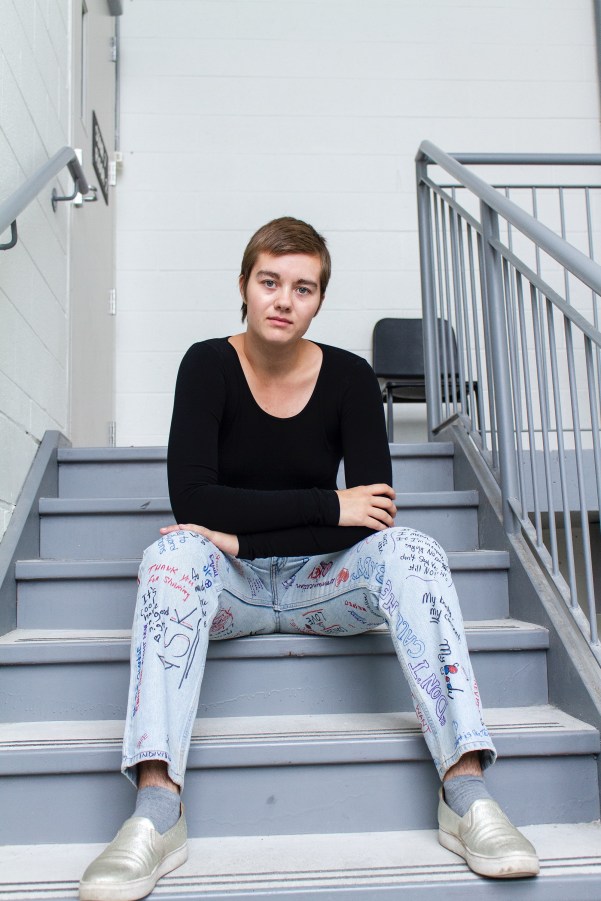
Saffron A, portrait. Photo by Kadee McFarlane. 2019.

By Adi Berardini

CW: Sexual assault

In the sadly saturated rape culture that we live in and the rise of the #MeToo movement, Saffron A’s music is more than timely. In their song “Priceless Advice,” victim-blaming statements are combined in a high energy pop-folk song. Through the strumming of strong chords, the song comments on the absurdity of shaming sexual assault survivors instead of holding rapists responsible.  Saffron A sings them with an ironic joy, and through that, asks their audience to join them on a journey exploring and challenging toxic masculinity and rape culture. In this song, they reclaim their power over the narrative that the behaviour of those affected by sexual assault is the root cause of their trauma.

Their lyrics mention a cop that blames what the victim is wearing for an assault, insisting that the perpetrator is simply “over-friendly.” It’s a narrative that many of us know all too well—not being taken seriously in our experience of pain and sexual assault. These words are difficult to write as I know it well myself. Too often, the responsibility is burdened on the survivor for what was ultimately a violation of trust and abuse of power. It takes a lot of healing after being sexually assaulted, and it can feel like the wound is still open at times. Saffron A uses their own experience to heal and also bring these problematic narratives to light.

FF3EF252-C135-425F-BF43-51DB9BED054C
Saffron A, portrait. Photo by Kadee McFarlane.

Additionally, the lyrics of “Priceless Advice” state, “wear boots so you can run away” and “don’t hang out on that side of town, maybe you should just stay inside.” The haunting statements of “don’t be so enticing, don’t be so inviting,” ring through the speaker. It’s the censorship of women’s behaviour instead of accountability that grinds away at me in hearing these statements. The culture of victim-blaming is the fuel that perpetuates these narratives and breeds shame that should not exist.

The song also has a more hopeful outlook when Saffron sings in the chorus that they will “wear what they like” and that they’re “not going to hide anymore.” It reclaims the bodily autonomy that feels so lost in the aftermath of a sexual assault. Saffron looks toward the possibility to move past these toxic assumptions and the disbelief of survivors in recounting their own experiences. Saffron contests being objectified in a public space, because, like the rest of us, they are tired of it.

98876FF4-3BB6-4E22-9DA9-AC36A12E7EBA
Saffron A, Consent Pants. Photo by Kadee McFarlane. 2019.

On the Resistance tour, Saffron A has brought along with them a pair of “consent pants,” which are jeans they ask the audience to write on them with markers about what consent means to them. “What began as a collaboration with Advocates for a Student Culture of Consent (ASCC), quickly became a community art project,” Saffron A explains. “I co-hosted two concerts at the beginning of my Resilience Tour with ASCC, and they wanted to have an artistic element at the events. I suggested we ask folks to write/draw/express what consent means to them on a pair of jeans.”

0A888215-1B38-4BE2-AE53-F0202F645562
Saffron A, Consent Pants. Photo by Kadee McFarlane. 2019.

The consent pants travelled from Brantford to Montreal, all the way up to Sudbury and beyond. I wrote on the jeans myself at the live show here at the Brown and Dickson Bookstore in London, saying that consent, to me, was “mutual respect.” Writing on these jeans evoked a lot of emotions, mainly since I had to think about what consent personally meant to me. The dictionary defines consent as “permission” or “agreement.” The pants say phrases such as “communication is key,” and “no consent on stolen land,” bringing up what consent looks like when Canadians occupy the land of Indigenous peoples outside of a mutual agreement. Both the consent pants and Saffron A’s music spark an essential conversation—when we don’t discuss consent, it masquerades its meaning, making it easier to become a grey area. The lack of understanding of consent only creates the potential to hurt others. Consent is something rooted in genuine care, and it’s an agreement that is so closely tied to power and trust.

Saffron A taps into their own vulnerability through their music and uses it as a tool for healing—they reclaim their own power and autonomy. Their music echoes so strongly in a society that perpetuates shame for rape survivors. Challenging toxic assumptions and how survivors are not taken seriously, they approach the subject in an open and engaging way. As they sing, “I’d laugh if I wasn’t terrified, I wouldn’t have to sing this song if this behaviour wasn’t going on.” Saffron A initiates the conversation about rape culture and sexual assault and asks us to collectively do better.

You can find Saffron A’s music on Bandcamp. Follow them on Instagram at @saffrockmusic.

Chris Strickler’s BIRD MILK

BIRD_MILK_still3
Chris Strickler. Bird Milk still. 2018.

Questions by Adi Berardini

Chris Strickler is an animator, installation artist, and live visual performer (VJ). He works with abstraction and interaction to create immersive and experimental animations. His experimental film, BIRD MILK, will be screened on October 19th at 7pm as part of Antimatter Media Art in Victoria, BC at Deluge Contemporary Art.

Your film is very influenced by electronic music, which was made by Gil Goletski. What was the process of collaboration like for you on your film Bird Milk?

Our collaboration was an interesting one, I think. To start, I gave Gil an energy chart, mapping out the mood of the song. Then part by part, they made each segment of the song and I would share my feedback. I don’t know how helpful my feedback was because I have no clue how to talk about music, but eventually, we ended with an amazing 7 and a half-minute song. Now, if you have the chance to see my film, you may notice that it is a sweet 4 minutes and 44 seconds. We ended up cutting it down and changing a section because there was no chance I was going to finish 7 minutes of animation in [9 months]. But if you ever want to listen to Gil’s full song, it’s out there, waiting for you.

How did you come about finding the particular textures and effects that you use throughout your experimental animation?

Norman McLaren’s Begone Dull Care was my kick in the pants to make something like BIRD MILK. It was messy, colourful, erratic, [and] chaotic. It spoke to me on a level an art piece had never reached before. McLaren used ink, so I used ink. McLaren scratched, so I scratched. But that was only the start. I dropped ink into water and alcohol to make delicious splashes of colour.

I did some parts of my film in Autodesk Maya, a 3D animation program. To integrate the 3D footage with the rest of my messy, experimental film, I printed out the frames onto transparent sheets at the size of postage stamps. The effect of close-up ink dots and the fact that these sheets would gather dust and scratches imbued what was previously a lifeless 3D animation with a tactile, textured feeling.

I did the same with some rotoscoped footage of birds and different animals I found, except instead of printing the frames, I laser-cut them. I had a grand time creating different method mark-making and then looking at everything under a macro lens, a lens meant for bug and flower photography. The macro lens is what made everything so juicy and crunchy, magnifying minuscule textures into giant pieces of art. Then once everything starts flashing at 24 frames per second (which may not be so fun if you are photosensitive), that’s when the magic starts happening.

BIRD_MILK_still7
Chris Strickler. Bird Milk still. 2018.
BIRD_MILK_still2
Chris Strickler. Bird Milk still. 2018.

How did you move from more representational to abstract/experimental animation and film? Do you move back and forth between them?

Back to Norman McLaren, it was his film that I mentioned before that opened my eyes to abstract animation. Up until that point, I was just going through the 2D character animation pathway because I didn’t quite know what I wanted to do. Then in 3rd year when I saw Begone Dull Care for the first time, it was a revelation moment. I didn’t have to do character animation, it was okay! Since then I have been doing almost exclusively abstract and non-representation animation. Maybe one day I will delve back into representational work, but today is not that day.

BIRD_MILK_still4
Chris Strickler. Bird Milk still. 2018.

Who are some artists and animators that inspire your work?

If it wasn’t already obvious, Norman McLaren is a big inspiration of mine. He was a pioneer of experimental filmmaking and is a pillar of film and animation history. I’m not one to idolize anyone, but I idolize McLaren. Not only his work do I adore, but his work ethic is something I aspire to. If he tried something new and it didn’t work out the way he wanted, he would file it away not as a failure, but as something he could use in the future. No effort went to waste, no such thing as a wasted opportunity. I’m also a big fan of Andrew Benson, Ryder Thomas White, Sara Goodman, and Nadya Bokk. These are all people I follow on Instagram or Twitter. Except [for] McLaren, he’s quite dead.

BIRD_MILK_still6
Chris Strickler. Bird Milk still. 2018.

Do you have any other projects you are working on that are coming up?

I have a music video with queer pop icon Devours that’s on the back burner until we both have the bandwidth to tackle it. Additionally, Flavourcel, the animation collective I’m a part of, has a couple irons in the fire that we are working on. One is a project for the Emily Carr University writing program, and another is a gallery show and workshop with the Surrey Art Gallery. Both of those will happen sometime in the spring. I’m also always up for VJ gigs that come my way, I love doing visuals for the local bands of Vancouver.

Follow Chris on Instagram at @doktorgrafiks.

Chris Strickler’s screening of BIRD MILK as part of the Antimatter Media Art Festival is happening on October 19th at 7pm at The Deluge Contemporary Art Gallery in Victoria, BC. 


So, You’re Going to an Art Event

By Sara Peters & Dave Karrel

So, you’re going to an art event. Don’t just stand there, get R E A D Y! Oh, it’s weeks away? Perfect, you’ll need the time to prepare. Maybe you’re thinking, but I already know how to go to art shows. Ha! You couldn’t be more wrong. But worry not, this handy guide to the art of art is 2000% certified by Marina Abramovic™ herself.

Preparing for the Event  

Don’t trust the Facebook event. All the people who say they’re going are not going. Anyone who marks themselves as ‘interested’ never gave it a thought.

FAR images-facebook
Illustration by Sara Peters.

Your friends can’t make it. Sorry to tell you, but it’s best you hear it from me now. One will get sick, one will be tired from a ‘brutal work day’, one will never text you at all.

If you do happen to spot someone you know, they will go missing within minutes. You will think, how is this possible in a 10×10 room? This is the art world, baby. Rules don’t apply.

Ah, the outfit. The cornerstone of any good disguise. Be sure to wear an unintuitive, semi-pre-mostly-post-modern combination of garments. Use this classic example as inspiration: Second-cousin’s work pants with a mesh top. Vintage back-issue of Life Magazine folded into a boat hat. Babybel cheese wax earrings.

To be truly unforgettable, wear a genuine mink shawl and insist it’s actually made of Beyond Meat™.

FAR images-lady
Illustration by Sara Peters.

Entering the Event

The gallery’s entrance may come in the form of a garage door, nondescript archway, parting in the bushes, or subtle parody of an existing fast-food chain, eg: McDonTalds.

Enter the event as though you expected to walk into a restaurant but, upon discovering your mistake, have decided to satisfy your bottomless appetite for contemporary arts and culture.

The Event

 You’ve arrived. Your need for high art is matched only by your growing thirst. In the back, you’ll find two near-identical near-angels selling tall cans from a makeshift booth.

Keep your head down. Approach slowly. Do not bare your teeth. When offered wine, take as many glasses as you can hold (the world record is 51) and consume immediately. Do not hesitate. If you hesitate, they will, in perfect synchronicity, read from their half-finished dissertations and lay a curse that renders you a permanent installation of the gallery.

Establish intellectual dominance from the outset: Take a hurried first lap. This will prove you consume art faster than anyone else in the room.

There will be a dimly lit back patio/parking lot/semi-outdoor area where people squat on tree stumps and take long wistful drags of hand-rolled cigarettes. You can find good conversation here, just don’t bring up the art.

If the artist is your friend, congratulate them before you’ve seen the work. Grasp them by the fingertips, fingerprint to fingerprint, gaze deep into their soul, whisper, Brave. So, so brave with your eyes fully closed.

FAR images - hands
Illustration by Sara Peters.

Talk over the video that is playing on loop. You’re not actually here to see the art, you’re here to be seen with the art.

There WILL be someone whose backpack is twice the size of a Foodora delivery bag. WHAT IS IN THERE????! you will wonder but never ask.

If you run into the gallery owner, say How much? When they ask which piece you’re referring to, laugh and shake your head as you float away.

Learning the Language

Dipping into a new culture requires learning enough of the language to get around. For instance, when someone asks, what do you do? what they’re really asking is, what can you do for me? Look around. Is everyone looking at you? Good. Stand on tiptoe and mention that you know a little Japanese. If you’re looking to make an ally for the night, say you moonlight as a grant writer.

If someone tells you they used to know the artist before they ‘blew up’, it means they once shared a kiln while studying trans-epoch Trotskian pottery at OCAD and have since heavily lurked their social media.

Practice reading didactic panels before you go. The most important part is holding your face perfectly still so as to mask your inevitable confusion as you try to decipher seemingly incomprehensible sentences such as:

FAR images-panel
Illustration by Sara Peters.

If you happen to find an error in a didactic panel, be sure to chuckle to yourself—bounce at the shoulders, shake your head. Make sure someone notices, to unwittingly confirm your superior intelligence.

If there is a Q & A, be prepared for an extended speech that betrays the asker’s prolific art-making history and (eventually) yields into a bumbling reference to one of the work’s materials and a half-hearted request for the artist to explain where they got the idea.

Leaving the Event

In order to leave, you’ll need to plan an escape route. Take into consideration the following likely obstacles:

  • The door is actually part of the exhibit
  • The group of intimidating art teens by the front door (How’d they get in here? How are they so cool? Are they real?)
  • The man by the bar who wishes to tell you about the recent ‘urban farm’ he is building in his “friend Todd’s parents’” backyard
  • Actually, where is the door though? This is frickin’ spooky
  • Spotting the artist, and in so doing, feeling obligated to ask about their process
  • Spotting the curator and having them tack you against the wall for 1-6 hours so they can tell you about their process
  • Uneven flooring
  • Literally no idea what’s happening with this door situation. Will I die here??

An older couple will wander in. The realization that this is not their destination will slowly drain the expectant joy from their faces until the woman grasps her husband gently at the elbow and whispers, “Ted, we need to go.” For an easy out, pretend they’re visiting you from out of town and follow their lead.

There—you made it. You’re now an Art World Veteran. Get yourself home, crawl into bed with your takeout, and post a couple Insta pics so everyone knows what a great night you had.

Profiles on Practice: Yen-Chao Lin


EG_Penny_01jpg
Yen-Chao Lin. The Eroding Garden. Copper, glass enamel, stainless steel. 200cm x 49cm. 2019.

By Nadia Kurd

Dowsing is known as the process of finding water using divination rods. This old technique of sourcing water can be found in various cultures across the globe. For modern-day dowsers, in addition to sourcing water, “they frequently can report its volume, depth, flow direction and potability.”[1]

For Taiwan-born, Montréal-based multidisciplinary artist Yen-Chao Lin, this practice has been a significant inspiration to art. Many of Lin’s works begin organically and can be sparked by the items she collects, hears or senses. The combination of spirituality, folklore, and DIY practices—as found in dowsing— has foregrounded much of Lin’s film, installation, and textile-based works. Moreover, as a child, she was exposed to a variety of religious philosophies, as her mother would take her to places such as Buddhist temples, Sunday mass, and Mormon gatherings.[2]

52605184_2821561034649559_4139083906123038720_n
Yen-Chao Lin, portrait. Photograph by Ashutoshk Gupta. Courtesy of the artist.
EG_Penny_04
Yen-Chao Lin. The Eroding Garden. Copper, glass enamel, stainless steel. 200cm x 49cm. 2019.

Lin’s long-term research into dowsing which included conducting interviews and attending monthly meetings with the Ottawa Dowser’s, led to the creation of her installation Eroding Garden (2019). As a result, Lin created a three-part installation that combines 2000 glass enamelled Canadian pennies, a porcelain bowl with an erected chopstick, and several suspended, casted hands holding dowsing sticks, both in real and imaginary ways. As Lin writes, the work also incorporates her own family history. This history is symbolically reflected, as Lin notes;

The porcelain bowl with the chopstick is drawn from my family oral history, where my grandmother made a chopstick stand in water and communicated with the spirit of a deceased relative who was causing illness to my mother. In many East Asian cultures, chopsticks should not be left vertically stuck into a bowl of rice because it resembles the ritual of incense-burning that symbolizes feeding the dead.[3]

While the work evokes a more intuitive approach to connecting with land and water, dowsing also has an insidious, political history as well. As Lin points out, “dowsing is also used by the petroleum industry to locate oil wells, mining companies for ore, as well as the US army in Korea and Vietnam,  to find tunnels and food caches.”[4]

EG_Bowl_02
Yen-Chao Lin. The Eroding Garden, 2019. Porcelain, hand-forged steel, 22k gold leaf. 12cm x 12cm x 25cm.

In another installation Perchance (2018), 23 booklets, silk tapestries, and several divination sticks are arranged in a way that creates a space whereself-administered divination is offered.”[5] For this project, Lin “visited fortune tellers in Hong Kong and Taiwan, observed different collective and individual divination practices, studied the ancient tradition of I Ching and explored the materiality of silk.”[6] The work melds the sensibilities of traditional East Asian aesthetics and religious practices to forge a contemporary ‘system for divination.’ Here, visitors are permitted to interact with the I-Ching bundle (placed in the centre of the silk banners) and interpret their own numerically based fortune from reading the 23 booklets on the wall. This process ultimately melds chance and instruction and asks visitors to reflect on “socially determined networks of information distribution.”[7]

2018-04-18-SBCDeadLetter-021
Yen-Chao Lin, Perchance, 2018. Photography by Paul Litherland, courtesy of SBC Gallery of Contemporary Art.

Her most recent project, The Spirit Keepers of Makut’ay (2019) also follows a highly intuitive process. This short, experimental film was shot on the rural coast of Taiwan in collaboration with the local Amis Indigenous community. Largely abstract in nature, the film poetically “unravels mixed-faith expressions from Daoist ritual possession to a Presbyterian funeral” to reveal the past Amis healers. For Lin, this work brings together the past and present to show how “nature, colonization and population migration” comes together in Taiwan’s unique spiritual landscape.[8] The Spirit Keepers of Makut’ay will have its Canadian premiere the Vancouver International Film Festival this October.

Makutaay still 10
Yen-Chao Lin. The Spirit Keepers of Makuta’ay Still. 10:57. 2019.

Since migrating to Canada at the age of thirteen to pursue an education, Lin recalls that she had, “this overwhelming strong pulsation darting out from my heart, telling me I must leave in order to pursue what I want out of this life. I wanted to leave since I was 11, it took two years to convince my parents and it was not easy.”[9] This determination led her to pursue an arts education. After earning a Cégep (Studio Arts) diploma and a BFA (Film Production) from Concordia University (Montréal) in 2008, Lin has gone on to participate in numerous residencies, exhibitions, and performances in Canada and abroad.

With an understanding of how she may be perceived as an immigrant woman of colour, a large part of Lin’s work has also involved working with arts organizations to develop equity policies and practices. In 2019, she was the Equity Officer for La Centrale Gallerie Powerhouse, a feminist artist-run centre in Montréal. This experience made her realize “how important and challenging it is to make space for equity-seeking folks within institutions, and how education, leadership development, and solidarity can contribute to change.”[10]

Combined with an intuitive sensibility, Lin’s practice, on the whole, is rooted in examining equity and justice. “I believe in self-empowerment, the accessibility of arts, and the possibility of change through art,” reflects Lin, “I’m a critical person and I will always question the dominant structure of power, either through my work as an artist or as a cultural worker.”[11]

To see more of Yen-Chao Lin’s art and upcoming projects, visit her website: yenchaolin.com

Nadia Kurd (she/her) is an art historian and curator based in Amiskwacîwâskahikan (Edmonton, Alberta). She tweets @nadia_kurd and her work can be found on nadiakurd.com.

[1] Canadian Dowsers Association. https://canadiandowsers.org/introduction-to-dowsing/ (accessed September 10, 2019).

[2] Yen-Chao Lin, interview by author, Edmonton, AB, September 6, 2019.

[3] Ibid.

[4] Yen-Chao Lin, Artist Website: yenchaolin.com, (accessed September 7, 2019).

[5] Ibid.

[6] Ibid. Note: I Ching can be described as “philosophical taxonomy of the universe, a guide to an ethical life, a manual for rulers, and an oracle of one’s personal future.” For more information, see: http://www.chinafile.com/library/nyrb-china-archive/what-i-ching

[7] Ibid.

[8] Ibid.

[9] Interview by author.

[10] Ibid.

[11] Ibid.

Profiles on Practice: Christina Battle

3_BADSTARS
Christina Battle. BAD STARS, Installation documentation, Trinity Square Video, 2018, Photo by Jocelyn Reynolds. Courtesy of the artist.

By Nadia Kurd

“The weather,” writes scholar Christina Sharpe, “necessitates changeability and improvisation; it is the atmospheric condition of time and place; it produces new ecologies.” For Sharpe, ‘the weather’ represents the social and political climate that shapes and produces anti-Blackness. The weather is contextual and ongoing. It is both the condition and the resulting effect on Black life in the aftermath of slavery.[i]

It is within the complexity of ‘the weather’ that Edmonton-based, media artist Christina Battle wants to articulate her interests in disasters and imagine how we cope and respond to change. The concept of disasters —be they social, political, ecological fallouts or otherwise —are the focus of Battle’s art practice. The interconnected nature of past events, history and ideas can manifest in contemporary disasters and as a result, continually create new circumstances and a need to address survival. In her work, Battle also looks at how these ideas and actions are circulated and communicated through social media.

10_Battle
Christina Battle. Portrait courtesy of the artist.

Her process begins broadly by reading and gathering information and images online. As Battle moves through her research, she also quickly makes gifs and other digital images “as a way to reflect on our larger visual sphere.”[ii] Her work brings together digital images and text to animate them in a variety of ways. Sometimes spontaneous, many of these pieces are either reworked or further developed into larger projects. For Battle, “different strategies are taken up depending on the issue at hand. If I’m thinking about satellite mapping and issues related to how we engage with tools that are continually tracking us…the work pulls from aesthetics reminiscent of those technologies.”[iii]

What drives Battle’s practice is her interest in how people use varying modes of communication with one another. “We don’t seem to be doing a very good job,” reflects Battle, “of even recognizing, let alone admitting the problems we face and that drives a certain sense of urgency for me.”[iv]

heavytimes
Christina Battle. Notes to Self, video still (2014-ongoing). Courtesy of the artist.

Her ongoing video-based work Notes to Self (2014-present), addresses this sense of urgency.  In the videos, Battle records the burning of paper, which features short phrases and words. Often lasting a few seconds, the notes mimic the visual and sound bites of social media. However, as Battle writes, this work is also unlike social media as “the fate of these updates is controlled and finite, existing only for a few seconds before being completely destroyed.”[v]

2_BASTARS
Christina Battle. BAD STARS, Installation documentation, Trinity Square Video, 2018, Photo by Jocelyn Reynolds. Courtesy of the artist.

In the multi-video installation work, Bad Stars (2018) Battle examines the theme of disaster from an astronomical perspective. Primarily a multi-screen and image installation, the exhibition of this work also brought together a collaborative group of individuals who “to help forward the discussion, beginning with the invitation to contribute to a wall of photographic imagery included in the exhibition.”[vi]  The parallel multidisciplinary discussions and presentations that occurred at Trinity Square Video in 2018, allowed for,

… room for those from various disciplines to come together for shared conversation and experience, programming invites those actively researching and working to tackle issues of disaster into the space of the gallery.[vii]

The participatory aspect of this installation allows for the images and videos in the installation to be grounded in tangible realities. Though not similarly interactive, the billboard project the view from here (2019) immerses images into the built environment. Mirroring the impact of advertising, the large-scale collage billboard merges satellite images (from where the works are located) and the texts to evoke self-reflection on situational environmental themes such as “How to Sense What You Cannot See” and “Locate Yourself”. In presenting these large-scale digital images, curator Jayne Wilkinson notes that the work, “asks viewers and passers-by to consider how the digital infrastructure and global networks are obscured by the surfaces of the sea.”[viii]

8_viewfromhere
Christina Battle. the view from here, Capture Photography Festival, 2019. Documentation by roaming-the-planet.

A large part of her creative work has included curating exhibitions. In 2020, Battle will be organizing a group exhibition titled Grasping at the Roots at the Mitchell Art Gallery (Grant MacEwan University, Edmonton). While still in development, this upcoming exhibition will feature both regional and national Canadian artists who work closely with communities through critical sustained engagement.

With a background in Environmental Biology, film studies and fine arts, Battle is currently completing a Ph.D. in Art & Visual Culture at the University of Western Ontario. As she researches and explores the changing nature of online communications, her work will no doubt shift in order to respond to the complexity of our world. “I am trying to make images as a way of starting conversations with people I don’t know,” writes Battle, “I consider how others might engage with the images and how through images we might come together and form some kind of collective understanding.”[ix]


To see more of Christina Battle’s art, visit her website or to see her work with seeds and plants visit @c_I_battle on Instagram.

Nadia Kurd (she/her) is an art historian and curator based in Amiskwacîwâskahikan (Edmonton, Alberta). She tweets @nadia_kurd and more of her work can be found on nadiakurd.com.


[i] Christina Sharpe, In the Wake: On Blackness and Being (Durham: Duke University Press, 2016), 104.

[ii] Christina Battle, interview by author, Edmonton, AB, August 4, 2019.

[iii] Ibid.

[iv] Ibid.

[v] Christina Battle, Artist Website: http://cbattle.com/, (accessed August 4, 2019).

[vi] Ibid.

[vii] Ibid.

[viii]  Capture Photofest. “Signals in the Sea”, https://capturephotofest.com/public-installations/signals-in-the-sea/ (accessed August 4, 2019).

[ix] Artist interview with Author.

The Art of Fugue: In Conversation with Emilie Crewe

Questions by Adi Berardini

Emilie Crewe’s The Art of Fugue is a multi-channel video installation featuring five women working in trade industries. The Art of Fugue is edited using the traditional musical structure of a fugue, which is a compositional technique using multiple voices built on a subject that is introduced at the beginning. Each screen acts as a singular voice, interweaving together and contributing to the artwork as a whole. Highlighting women in trades is both an aesthetic decision and a symbolic choice. The piece captures the strength and resilience found in a performer whose work is in a typically male-dominated field.

Emilie Crewe is an interdisciplinary artist based in Vancouver, British Columbia, Canada. Her artwork often takes the form of video installation, single-channel video, multi-channel video, and sketch-work (drawings, collections & archives). She holds an MFA from the School of the Art Institute of Chicago, and a BFA from the Nova Scotia College of Art and Design University. Her work is exhibited internationally in galleries, museums, artist-run centres, experimental film/video festivals, and as public art.

In the Art of Fugue, you combine the actions of women working in trades that are viewed as male-dominated and masculine to the musical composition of a fugue. How did you first arrive at the idea of featuring women in trades and paralleling the film to ideas of music and composition?

The concept began with research that I was doing at the time, which was centered on the neuroscience of music.  I wanted to make an artwork that embodied musical properties and structure but did not incorporate literal music.  My intentions were for viewers to sense rhythm, cadence, and tone within their bodies.

The subject matter [focusing on] women in trades came after the decision to create a video using fugue structure (For reference, The Oxford Dictionary’s definition of a fugue is, a polyphonic composition in which a short melodic theme, the subject, is introduced by one part or voice, and successively taken up by the others and developed by their interweaving).

Trade industries and labour jobs have always been of interest to me as an artist since I relate to the act of using your hands to create something. There is a direct connection between the brain and the hands that has always fascinated me. I appreciate the process, investigative aspects and problem-solving within these specific jobs, and find that there is a distinct creative component to trade-work that I admire. There is beauty in functionality and repetition. I chose to work with women working in trade industries because of an [inclination] I have to feature characters that are somewhat “unseen”.

EmilieCrewe_MegIredale_3
Emilie Crewe. The Art of Fugue: A Polyphonic Instrumental Video Featuring Five Women in Trades still. 2019. Courtesy of the artist.

Can you explain more about your process organizing the sounds, footage, and editing?

I went into this project knowing that the editing would be a challenge.  I had never worked with five channels of video before, and I don’t think I really understood how complicated it would be until I began to sort through the footage.  After the shoots, I had over forty hours of footage to catalogue.  I narrowed the content down to about twenty hours of usable footage and then spent several days sitting at my desk feeling confused as to where to start.

At this point, I knew that I had to step away from the computer, and begin editing “by hand.” Using a system of colour-coded sticky notes, I began making connections between the different trades and the physical movements of the five performers.  For example, I would write down a note that would say, “Meg looks up,” and would pair this with another note that said, “Kate looks up,” After arranging these notes on the wall, I transferred the components that I liked into a notebook to work with at my desk.

The artwork was edited in Adobe Premiere Pro in one timeline that was divided into five channels, each colour-coded to represent a different performer in the video.  All of the editing was done using a metronome set to four beats per measure and eighty beats per minute.  This is a very typical time signature used in musical compositions, and it helped me to keep time and work using a structured rhythm.  The sound was the last component that I worked on, utilizing a mixture of live audio from the shoots, as well as my own Foley sounds that I recorded at home using audio equipment from VIVO Media Arts Centre in Vancouver.

Editing Notebook
Emilie Crewe. Artist’s process book. 2019. Courtesy of the artist.

In researching this project and filming in the women’s workspaces, what were some of the things you discovered about women working in trades? Did they share their struggles and/or successes in their careers?

I think a lot of people are fairly open-minded these days, especially here on the West Coast, but I do have an understanding that entering into a typically male-dominated job force as a woman comes with some stigma and possible [hesitation] from prospective employers.

With the nature of the work that I was creating, I talked with each performer about barriers that they had come across, from customers making inappropriate comments to contending for jobs amongst male competitors.  It was interesting hearing about the experiences of the performers that I was working with, and I learned a great deal about what it’s like to work in their respective industries.

The machinist, for example, was working in a large factory in Delta, of which she was the only female employee.  There was great sociability between her coworkers that she was very much a part of, so that was nice to see.

Three of the five of the women that I worked with are small business owners.  The plumber, Mary-Anne, employs an all-women crew, which is great for women seeking apprenticeships in the industry.  The most notable takeaway I think has been the realization of having to prove your worth simply because of your gender.  These things come up in a lot of different industries, including the art world, but within the trades, it seems important to show physical assertiveness.

If there are any readers that are interested in these types of barriers within trade work, I highly recommend the book, Journeywoman: Swinging a Hammer in a Man’s World, by Kate Braid. It’s a fascinating look at the experience of a Canadian woman working as a carpenter.  She mentions several situations where contractors would look her up and down, and then basically say, “no way,” all based on the simple fact that she was a woman.

EmilieCrewe_BrandieDoucette2
Emilie Crewe. The Art of Fugue: A Polyphonic Instrumental Video Featuring Five Women in Trades still. 2019. Courtesy of the artist.

Has your view transformed as to how gender comes into play for women and the workplace after creating this film?

I’m not sure if my view has transformed or changed, rather it has been expanded.  With many scenarios, the more information that we take in, the better our understanding is.  Being a woman myself, I have always had an awareness of how gender comes into play in the workplace.  Creating The Art of Fugue has certainly broadened my perspective.  Documenting these women at work served as a great inspiration as well, and I often came away from shoots feeling a sense of encouragement, optimism, and admiration.

Who are some artists/filmmakers that influence you as an artist?

Two meaningful influences for me have been Pipilotti Rist and Eija-Liisa Ahtila, both video installation artists [who are women].  [I have also been influenced] by the sound and video work of Janet Cardiff and Georges Bures Miller.  Artists that work in ways that envelop viewers, especially in terms of creating an immersive installation, always spark that creative drive in me.

When it comes to filmmakers, I love the work of Jesper Just, 
György Pálfi
 and Roy Andersson; all people working with moving images in strange, visceral ways.  Really, I’m drawn to work that makes my senses stir, literally and metaphorically.

Editing Timeline
Emilie Crewe. Artist’s editing process. 2019. Courtesy of the artist.

Do you have any other projects planned in the future that you would like to share?

Currently, I’m working out the logistics for a new multi-channel video featuring a female musician. I’ve secured some grant funding from the Canada Council to head to Winnipeg and shoot with Julia McIntyre, a prominent Canadian bass trombonist.  I will be working with the theme of a musical toccata, which is a quick, virtuosic musical interlude that shows off a performer’s “touch.”

This will be the first time that I have experimented with using a musician as a performer in my work, so I’m looking forward to seeing what comes of this project.  A lot of my creative process happens in post-production.  I go into a video shoot quite intuitively, usually ending up with a wealth of footage to sort through, as I did with The Art of Fugue.  So, I can’t really say how this will turn out, although I have some images in my head that I’m playing with.

I’ve always wondered how a classical composer can write a symphony with so many components and instruments and know how it is going to sound.  I guess the answer is that you really can’t know until you have an orchestra in front of you to play the music.   You can test the melodies and harmonies out all you want on a piano, but it will only exist as an imaginary sound in your mind until you have people to play it for you.  Video is in some ways like this.  I can imagine an artwork, but until I am actually shooting with a subject and then “composing” the timeline in the editing phase, I really have no idea what I’m going to come away with.

You can find out more about Emilie Crewe’s The Art of Fugue on the project website and on her Instagram @emiliecrewe.

In Conversation with Rae Spoon: Mental Health

Rae Spoon1
Rae Spoon portrait by Dave Todon. Courtesy of the artist.

Questions by Adi Berardini

Rae Spoon is an award-winning, non-binary musician and author whose music bridges indie pop, rock, folk-punk and electronic. Spoon owns and runs an indie record label called Coax Records that has released fifteen albums by Canadian and international artists. They have also been nominated for two Polaris Prizes, a Lambda Literary Award and a Western Canadian Music Award. A strong songwriter and performer who has toured for over 20 years, Spoon’s music is often connected to social activism/change, especially within the LGBTQ2+ community.

Rae Spoon’s latest album Mental Health addresses their own experience with mental health and the issues that arise in LGBTQ2+ communities while navigating the stigma around both mental health and queerness. Spoon describes that “I often think of albums in themes and that will often guide my writing. I try to tie in the songs in terms of that so there’s some continuity between them.” Spoon is well known for their insightful and introspective lyrics, and their new album is initiating the conversation that we need to be having about mental health.

I noticed that water is a particular theme in your music. I was wondering if you could talk about this inspiration and what water symbolizes to you?

I moved to Lekwungen speaking people’s territories in Songhees, Esquimalt and W̱SÁNEĆ territory, otherwise known as Victoria, BC. I have lived on the west coast before, but it has been a while since I lived in Victoria. I live where the pipeline would be, intersecting with the ocean. We all know it’s a big deal in terms of politics right now. There’s a great deal of activism with Indigenous people not wanting the pipeline to be built and the government pushing back, the federal government especially. I feel even more tied to this issue especially being from Alberta originally. [As a result,] I feel especially connected to the water around. That’s how the water theme started and why there’s often landscapes and waterscapes in my songs.

Your book Gender Failure is a collection of autobiographical essays, lyrics, and images documenting co-author Ivan E. Coyote’s and your personal journey from “gender failure to gender enlightenment,” based on your live tour. I was wondering if you could talk more about this tour and the inspiration behind the book?

We started the stage show for Gender failure in about 2013, and it premiered in an off-Broadway theatre in New York. It was the first multi-media narrative show I was doing so I was very nervous.

It was interesting since we were connecting with local audiences in New York about all of these Canadian stories of growing up. It was pretty cool, we could see it was something that was really connecting people despite that since we were talking about the strict gender binary and the rules of the patriarchy or sexism. You would always end up at some point in your life when you’re like “I don’t wanna do that.” Even the people who are benefitting from it [are affected by] how toxic the masculinity is.

We were going to make a show about being transgender and/or non-binary and we realized we made the show about how the gender binary is failing everybody, connecting a lot of people when I look back. We made it into a big show, we did two sets and toured with it for a couple years and we did some in London I think and across North America and Canada. In that process, we figured out some of the book and we added more pieces to create it. Our friend Clyde Petersen who is in Seattle did the live visuals for the show and made the illustrations and visuals for the book.

I saw you in London at the brewery on top of the Root Cellar. I remember that it was really creative and intimate, it was really special. I was wondering what your favourite part of touring smaller communities and maybe difficulties with that as well?

It’s really nice to go to small communities often since the LGBTQ2+ scene is really supportive. Although I’ve also had the same things happen to me in downtown Toronto as I’ve had in small communities. I’ve had issues getting yelled at—it can happen anywhere that the people can be oppressive or violent. However, I don’t usually stick to large cities, I like how supportive it is being there in small communities.

Before I learned to drive it was a challenge to tour on the Greyhound and tour in Western Canada, but now that I can drive it’s a lot easier. It’s great, I can also make my own hours. Often a lot of different people have to hang out since it’s not big enough to separate people into groups. The [different] scenes and the sort of queer scenes will often be connected which I like, with different ages and different backgrounds.

I see that you have started an indie label, Coax, which supports LGBTQ2+ and under-represented artists through community building. Do you have any advice for gender non-conforming/non-binary musicians who are just starting out in the music industry?

I am really all about community building. I think one of the best ways to meet other musicians is to support the music community, so when you’re starting out going to other shows and you then meet the musicians who are playing or supporting college radio, volunteering at festivals, you can meet a lot of people there who like music. The easiest way to try and build a following is to meet a lot of people who like music.

To be able to tour as a new act helps that, you can meet people from other towns, and you trade having people at the shows so that they know who you are. The best way to start out, in the beginning, is to help out other people and it can help you as well. It’s great to build more live scenes and music opportunities.

Print
Rae Spoon, Mental Health. The album will be out on August 16, 2019.

You have an album coming out in August called Mental Health. I was wondering if you could talk about the inspiration behind the album?

The beginning of the inspiration behind [the album] is the communities I am in, and also my own mental health stuff that I face. I think music can sometimes make space for that. I wrote songs about my own journey with mental health and the different perspectives [I’ve had] during my life.

I think there’s still a lot of stigma about mental health and stigma around queerness and [being] LGBTQ+. It’s important to make space for marginalized communities. Often, we lack services, or you can’t go to the hospital since they’re not going to get your pronoun right. Trauma issues aren’t going to go away but there are ways to find different tools. I was thinking a lot about that and also that it’s not something that needs to be cured. Like getting out of ‘caring’ culture [which doesn’t address mental health as an ongoing struggle], and instead, talking about the everyday journeys of survival.

Check out Rae Spoon’s latest album Mental Health which comes out on August 16th, 2019.

The album launch for Rae Spoon’s Mental Health and celebration of the long-list Polaris nominations for Kimmortal’s X Marks the Swirl and LAL’s Dark Beings is happening on August 14 at Fox Cabaret in Vancouver, BC.

Profiles on Practice: Meera Sethi

Meera Sethi Headshot 2 website (1)
Meera Sethi headshot. Courtesy of the artist.

By Nadia Kurd

“I came to making art through a circuitous route,” says Canadian artist Meera Sethi. As a self-taught graphic designer, Sethi felt that her transition to a full-time visual artist was a gradual one. Despite earning a BFA (1998) and MA in Interdisciplinary Studies at York University (2001), it was only after graduation that Sethi began experimenting with acrylic paints and became more confident working directly with various materials in her studio. As Sethi reflects, “I sometimes wonder if it was because there were no clearly defined role models for me to follow as an emerging visual artist.”[1]

Her experimentations with paint eventually led to figurative paintings that explored her interests in South Asian identities and place. Painting series such as Firangi Rang Barangi (Colourful Stranger, 2009-2012), Foreign Returned (2013) and Upping the Aunty (2016) combine her graphic design and painterly sensibilities. These vivid and highly graphic paintings and drawings examine the hybridity and evolution of South Asian clothing, gendered norms and societal expectations. Most often portraits, these works emphasize the individuality of her subjects and provide insights [into] the diversity of South Asian culture.

Pinky Aunty - Med Res (1)
Meera Sethi. Pinky Aunty (Upping the Aunty series),  2016, acrylic, fabric and crystal on canvas, 36 in. x 60 in. Private Collection. Courtesy of the artist.

For example, in her three-part series Upping the Aunty, Sethi presents portraits of middle-aged South Asian women who are informally referred to as ‘aunties’. Though not always a biological relation, these women are part of the larger South Asian community, who Sethi points out, are “neither our mothers nor part of our peer group, aunties may be trusted confidantes or gatekeepers of social decorum.”[2] Along with these painted portraits, Sethi includes street-style photography and a colouring book. The playfulness and broad appeal of these illustrative works humorously highlight at the misconceptions about the personal lives of South Asian women.[3]

Moreover, the work of established artists such as Mona Hatoum, Doris Salcedo, and Louise Bourgeois have been important to Sethi for understanding how to foreground the feminist body and the ways in which these artists have linked personal histories to larger social and political events. However, it is ultimately the stories and histories of communities that she is connected to such as queer people of colour and her family relations that she is most invested in. For Sethi, it is the stories from these communities, particularly histories of migration, the global flow of capital and colonization that exposes the current, complex lived experiences of people today.

IMG_1858 (1)
Meera Sethi. Outerwhere Series, detail. Courtesy of the artist.

Sethi develops her work organically as her process involves preliminary drawings, reading, and written reflection. More recently, Sethi has shifted from working in a stationary, graphic design manner to one that is much more mindful and body-focused in nature. “When I work in a studio environment, I spend a lot of time sourcing material and understanding its visual and material language” observes Sethi, “I sit with objects and give them time to speak to me, trying not to force an outcome, if during the process I feel stuck, I get up and move.”[4]

In her current textile-based works, Outerwhere (2019), Sethi stitches together second-hand winter coats and various embellishments such as food wrappers, plastic flowers, fabric ribbons, and mirrors. As it develops, this project seeks to study “the binaries of inside/outside, personal/public, past/present as they relate to material culture and the migratory experiences of South Asian-Canadians.”[5] More importantly, the work reveals the intersections of textile, lived experiences, and objects through an everyday, protective garment.

IMG_3477 (1)
Meera Sethi. Outerwhere Series, mixed media textile, 2019-ongoing. Courtesy of the artist.

As she continues to evolve her work, Sethi has moved away from her past design practice to a more experimental, and time-sensitive approach—one that utilizes her history and memories in a more personal way. On this change in her artwork, she notes that “I find myself curious about new mediums such as durational sculpture, textile, and performance and I am also interested in exploring moments of transition and being in-between places, identities, and locations in a way that opens up questions rather than provide answers.”[6]

In 2018, the Melissa Levin Emerging Artist Award through the Textile Museum of Canada recognized Sethi’s work (alongside Indigenous artist Catherine Blackburn). For her, the move from her graphic design to a more visual arts practice has allowed her to move towards a deeper reflection on the world around her. “My work is about the undoing of myself,” says Sethi, “through working with the materials I know best and my own life, I am able to draw connections that make world-making possible.”[7]

To see more of Meera Sethi’s artwork, visit her website, meerasethi.com or follow her on Instagram @meerasethi

Nadia Kurd (she/her) is an art historian and curator based in Amiskwacîwâskahikan (Edmonton, Alberta). She tweets @nadia_kurd and more of her work can be found on nadiakurd.com.


[1] Meera Sethi, interview by author, Edmonton, AB, June 12, 2019.

[2] Meera Sethi, http://www.meerasethi.com, (accessed July 4, 2019).

[3] For more information on Sethi’s Upping the Aunty project, click here.

[4] Meera Sethi, interview by author.

[5] Artist website.

[6] Meera Sethi, interview by author.

[7] Ibid.

Tahira Rifath Humanizes Trauma Through Digital Portraiture

hyacinth rupasinghe5
Tahira Rifath. Hyacinth Rupasinghe. Courtesy of the artist. 2019.

By Devana Senanayake

Watching the Easter Sunday attacks unfold on the screens of her TV and smartphone, deeply impacted Tahira Rifath. 

“It was scary and traumatizing. I kept thinking what people at the attacks might have felt,” Tahira says of the violence she perceived as a spectator. 

The Easter Sunday attacks in Sri Lanka that claimed at least 257 lives (including churchgoers and tourists alike), targeted three churches and four hotels, rippled through the country and left it reeling. This is the deadliest attack on the country since the conclusion of the Civil War a decade ago. 

Sri Lanka is a country ripped apart by trauma. Black July and the 1983 Singhalese-Tamil riots are cited as incidents that initiated the twenty-five year long Civil War. 

“I was not alive when the Black July happened but once people start to talk about all those riots, it’s so hard for them and there’s so much anxiety about it,” Tahira says about the country’s inability to reconcile its past history. 

Unlike the victims of Christchurch, Tahira noticed a shift in focus in the Sri Lankan attack. The victim’s lives, achievements, and stories shrank in significance as the government and the media started hunting the back stories of the perpetrators of the attack. 

Stories about the group suspected of organizing the suicide bombings, National Thowheed Jamath (NTJ) and the strategist of the entire operation, Zahran Hashim popped up all over social media. Social media, particularly Facebook and Whatsapp groups, have become hubs for misinformation, fake stories and hate speech. Even the death toll initially reported as 359 casualties had been revised to 257 after further consultation. A feeling of uncertainty and doubt plague the country. 

“The people who lost their lives became a distant number. No one spoke about them.” the freelance graphic designer and illustrator says. “These people were more than just a number. They lived full, extraordinary lives. We were not giving them the attention that they needed.”

She began her portrait series by sketching out Ramesh Raju, a 40-year-old, building constructor that had saved the lives of many attending mass at the Evangelical Zion Church in Northeastern, Batticaloa. 

Shantha Mayadunne4
Tahira Rifath. Shantha Mayadunne. Courtesy of the artist. 2019.

Tahira has also sketched Sri Lankan celebrity chef and cookbook author Shantha Mayadunne. Shantha is remembered for her immaculate presence on Sri Lankan TV channels ITN and Rupavahini, dressed in a Kandyan style sari, presenting quick and simple recipes. 

Her daughter Nisanga Mayadunne, a service quality manager and TV presenter had also perished during a family breakfast at the hotel. 

Tahira gained more information about the casualties from organizations attacked on Easter such as Cinnamon Grand Hotel and the Shangri-La Hotel. Miyuru Yasakalum had been employed as a commis chef at the Shangri-La Hotel since October 2017. The ex-scout had also been a tour guide in Sri Lanka.

Miyura Yasakalum
Tahira Rifath. Miyuru Yasakalum. Courtesy of the artist. 2019.

To continue her project amid a storm of inaccuracy,  Tahira consults either a family member or a close friend of a subject before she sketches them. After she finished her first four portraits, she felt the secondary trauma of undertaking such an intense project focused on tragedy. Secondary trauma, sometimes called “vicarious trauma” happens through constant exposure and re-exposure to traumatic stories. Her physical health had been impacted – she contracted a fever and had to press “pause” on the project. 

Despite the impact on her mental and physical health, Tahira is eager to continue. She hopes to celebrate the lives of the victims and simultaneously convey a message to a racially divided country.  “Even though Sri Lanka was voted the “No. 1 Tourist Destination” by Lonely Planet for 2019, people are not really open to different perspectives. I want people to understand and empathize with different beliefs and cultural perspectives,” she concluded. 


The Poetic Everyday: In Conversation with Natalie Hunter

02_NatalieHunter_RodmanHall_2019
Natalie Hunter. Staring Into The Sun. Solo exhibition at Rodman Hall Arts Centre. Hansen Gallery. 2019. Documentation image by Jimmy Limit.

Questions by Adi Berardini

Natalie Hunter’s work brings the everyday experience into a wondrous technicolour world, where the present moment meets that of memory. Bridging photography, sculpture, and installation, photos of interior domestic spaces are re-imagined through a kaleidoscope of colours, cyan meeting magenta, yellow and violet. She often produces experiential installations using photographs on transparent film, light, and other fragile materials that engage with the poetics of time, memory, perception, and the senses.

Natalie holds an MFA from the University of Waterloo, and a Bachelor of Art in Visual Art with a Concentration in Curatorial Studies from Brock University. She has shown her work in Canada and the United States in numerous exhibitions, including Rodman Hall Arts Centre, Centre 3 for Print and Media Arts, Art Gallery of Windsor, Hopkins Centre For the Arts at Dartmouth College, Museum London, University of Waterloo Art Gallery, and the Hamilton Supercrawl. She is the recipient of several awards including an Ontario Arts Council Creation Project Grant, and a Canada Council for the Arts Research and Creation Grant.

08_NatalieHunter_RodmanHall_2019
Natalie Hunter. The sky seemed to fold in ribbons of palest sunlight. 2017. Giclee prints on transparent film, poplar, light. installation dimensions variable. 12” x 72” each print. Documentation image by Jimmy Limit.

It seems like your work facilitates a looking closer” since it often uses colour and layering of translucent images until they are nearly rendered abstract. Can you speak more about the conceptual ideas in your work and your process? How does it relate to perception and memory?

Natalie Hunter: My practice is multidisciplinary and concerned with the transformation of materials, objects, and images in ways that evoke an emotive or psychological response in the viewer. I often make images and installations and think of myself as a sculptor who fell in love with images. I’m interested in process and materials just as much as concepts. The starting point for most of my work boils down to light and time, both of which can be experienced differently through image and sculpture. I’m interested in really ephemeral things like light, air, memory, the senses, motion, stillness, and time. Things we can feel the effects of, how they shape experience, and how these concepts can be articulated in material ways. I very much look at photographs as material fluid things that are tangible objects vulnerable to the elements. I find sculpture and photography related in some way. There is an element of stillness in sculpture and photography that speaks to the present moment, but also the past. The negative and positive aspects of photography mirror that of sculpture and casting—both are traces just in different ways.

I’m really interested in the exploratory, transformative power of materials to translate these experiences of the everyday.

For the past seven or eight years, I’ve been working with layering images both physically (layering transparent photographs to make new images and spaces), and inside of the camera (multiple exposures). I find this act of layering both inside and outside of the camera transcends logical ideas of time. For me, the act of layering images subverts expected notions of a perfect photographic image and notions of linear time. I use layering in an attempt to connect with the processes of human memory. Layering both accumulates and loses information, and this is what happens as we accumulate memories, sensory information, and thoughts over time. Detail is lost, while sensation is accentuated.

When making images, I use colour filters to bring attention to these layers. They help me slow down and separate different moments of time while leaving clues as to how the images were made. I choose combinations of colour filters emotively; choosing colours that naturally occur in the spaces I occupy to further accentuate them. Colour is sensorial in the visual sense. I believe that the addition of colour heightens awareness. When I think about the strongest earliest memory that I have, I can’t identify details, but I can describe the sensations, and for me adding colour through the use of filters is a way of exploring sensation or sensory information through photography. In this way, I hope to make a predominantly visual medium physical.

06_NatalieHunter_RodmanHall_2019
Natalie Hunter. Helios (interior day view). Hand-applied dichroic film on window, light. variable dimensions. 2019. Documentation image by Jimmy Limit.

  You take photographs of what may seem ordinary or mundane, like the interior blinds and curtain shots in As the Light Touches and create something quite awe-inspiring and vibrant. Can you speak more about the transforming of everyday, familiar spaces?

NH: Artists should make work about their experience and how they perceive and understand the world. The mundane experiences we find ourselves in on a daily basis are often those in-between moments that we don’t really count as experiences. I’m really interested in the exploratory, transformative power of materials to translate these experiences of the everyday. Memory is just as important as breathing in our human experience and I’m interested in exploring how that manifests and transforms through time. I feel like we are all unconsciously shaped by the spaces we inhabit on a daily basis, and I know that my work is often influenced by the spaces I spend the most time in. Space is something psychological just as much as it is physical, and I want to explore both of these aspects of space in my work.

Gaston Bachelard’s The Poetics of Space is a text that I return to a lot. It has been influential in how I understand my work and its relationship to space, time, and memory. We participate daily in the creation of spaces we unconsciously make for ourselves. I don’t wish for my work to merely represent these spaces, but instead, act as experiences in and of themselves that become new spaces and encounters in their own right.

05_NatalieHunter_RodmanHall_2019
Natalie Hunter. Helios (interior day view). Hand-applied dichroic film on window, light. variable dimensions. 2019. Documentation image by Jimmy Limit.

Your work seems to incorporate the surrounding architecture of the space it occupies. For example, your installation Helios at the Rodman Hall Art Centre, a site-responsive piece that addresses the ephemeral qualities of light and how it affects familiar spaces, the body, and our perception. I was wondering what your process is like in terms of creating work that is more site-specific?

NH: I don’t like to ignore the space my work exists in. I try to consider the space it exists in at the time of exhibition as an element of the work itself. Often, my work changes when it’s installed a second or third time, or from my studio to the gallery space. I need to do site visits when thinking about site-specific work, and I usually respond in an emotive way that speaks to a unique characteristic of a space in order to converse with it. Memory plays a big part in this. When responding to a space site-specifically, I hope to produce a kind of encounter between viewer and work that elicits memory or a sensorial response.   

Helios was a site-responsive installation at Rodman Hall Art Centre exhibited in my solo exhibition Staring into the sun. When making Helios, I wanted to consider it a gesture, response, or conversation with Rodman Hall; a connecting work that bridges outside and inside and only exists for a short time in the space. I was really influenced by my memories and experiences of Rodman Hall as a student. I remember ascending the stairs and seeing the stained glass, which is located in various locations in Rodman Hall’s domestic spaces. I wanted to converse with these architectural elements while at the same time make something new. Something that made you more aware of time, your body, and the space you exist in a very present, albeit slow, way. Change and fluidity are important to this work. And the work took on its own life as winter stretched to spring and the light changed.

I think Helios points to the process of how I create images and think with materials. I spent about a little over a month playing with samples of dichroic film, doing material research, finding out what it does in different lighting conditions, bending, folding, layering, and draping it in various situations, and mixing it with different materials. A lot of my inquiries stem from testing materials to see what they will do. Helios is much about slow movement, the slowness of time, and how we perceive it through our human senses. I hope to continue exploring what I learned in making this work.

07_NatalieHunter_SunsRays
Natalie Hunter. The Sun’s Rays Do Not Burn Until Brought To A Focus. Installation at Centre 3 For Print and Media Arts, Hamilton, Ontario, Canada. 2018. Documentation courtesy of the artist. 

Q: Your installation The sun’s rays do not burn until brought to a focus creates a temporal experience for the viewer since as the sun moves across the sky, each work is animated with their own ephemeral rhythm.” I was wondering if you could speak more about this work and the use of natural processes, light and time?

NH: I use light in the making of images, but also physically in how they are exhibited and exist within space. For me, light is quite kinetic or makes the work kinetic through the passage of time. There is both stillness and subtle motion in my installation The sun’s rays do not burn until brought to a focus, achieved through different uses of artificial and natural light. I use light in this installation as a material that activates spaces.

Light is fundamental to photography, and I consider its manipulation as a material process in my work. Light is also fundamental to sculpture because it is how we are able to situate and perceive objects in space. Light is ephemeral, like time and memory. Natural sunlight is always changing, where as artificial light is static. In The sun’s rays do not burn until brought to a focus, natural sunlight is used in a kinetic way, gallery lighting is used in a rather still way, which casts latent imagery on the surfaces of the exhibition space. A viewer’s experience of the work is not static but always changing. Elements move with the subtlety of the air movement in the space, and the installation seems different on a cloudy day, or between dawn and dusk.

It’s hard to discuss photography without discussing time because time is so essential to the medium. Photography is always seen as a frozen moment, but for me, photographs are fluid things. A lot of my transparent film works require active movement in the space that they occupy in order to experience them. The light activates them, but the viewer does through movement too. For example, in The sky seemed to fold in ribbons of pales sunlight, it appears different when standing at different points in the room. When standing directly in front of the piece, the physical images almost disappear, and you only see latent imagery on the walls. When standing at an angle, the images appear layered with themselves and the latent imagery on the walls. You aren’t sure what the true image is; the physical photograph or its latent reflection.

Q: Who are some artists that are influential to you and your practice?

NH: A lot of the artists I admire often explore quiet and overlooked elements of our being and how they shape experience. I look to artists like Tacita Dean, Uta Barth, James Welling, Sabine Hornig, and Sarah VanDerBeek for their consideration of materiality in lens-based image making. I feel a kinship to artists like Ann Hamilton, Roni Horn, Kimsooja, and Alison Wilding for their conceptual and material research, and multidisciplinary approaches to working. In 2012, I spent a summer internship working for sculptor and installation artist Soo Sunny Park. This was a priceless opportunity and an integral part of my artistic development and education in terms of understanding space and place. She encouraged me to think about my images in material ways and take my interest both in sculpture and images into installation territory. She taught me that sculptors have a unique understanding of space. I want to continue to develop and explore that in my work—subverting expectations of what images and installation can be.

09_NatalieHunter_Dappled
Natalie Hunter. Dappled (detail). 2018. Archival inkjet prints on backlight film draped over poplar and aluminum sculptures. Approximately 24″ x 60″ x 36″ each. Documentation courtesy of the artist.

Q: Can you speak more about the upcoming exhibition Shaping Time: Natalie Hunter, Xiaojing Yan and Lois Schklarat at Latcham Art Centre? What work will you be displaying?

NH: Shaping Time: Natalie Hunter, Xiaojing Yan and Lois Schklar at Latcham Art Centre considers ideas of memory and time through a multimedia lens. Elisa Coish curated Shaping Time around the 40th anniversary of Latcham Art Centre. Part of her curatorial strategy involves inviting artists at different stages of their careers to create a larger dialogue surrounding these concepts and the different approaches and discussions that can arise from it. Both Xiaojing Yan and Lois Schklar are well recognized and established artists that have exhibited with Latcham Art Centre in the past. Elisa Coish invited me as the emerging artist to exhibit work in Shaping Time after my solo exhibition Staring into the sun closed at Rodman Hall in May. I will be exhibiting some of the work that was shown at Rodman Hall in Staring into the sun, but also some work that has never been exhibited that I made in 2018 with an Ontario Arts Council grant. The work going in Shaping Time is an overview of the many approaches and materials I use to consider light, time, and memory in both installation and photo-based ways. It will be interesting to see how I respond to the space during installation because Latcham Art Centre is essentially a white cube. Corners are often considered non-spaces, and I am fond of corners for their surreal shape and potential for activating a space. In this way, I’m hoping to converse with some of the architectural elements in the space during installation.

 You can view more of Natalie Hunter’s work from July 10 – August 24th 2019 in Shaping Time: Natalie Hunter, Xiaojing Yan and Lois Schklar at Latcham Art Centre, curated by Elisa Coish and on her website.