How We Came to Be and Why We’re Here: In Conversation with Djenabé Edouard

Here & Home

The Riverdale Hub

Mayworks Festival of Working People & the Arts

Felicia Byron, Sydellia Ndiaye and Shai Buddah, curated by Djenabé Edouard

Here & Home Postcard. The Dive by Felicia Byron. Photos courtesy of Djenabé Edouard and the artist.

By Elizabeth Polanco

My eye first lands on the soft pink ear of a conch shell resting on a stack of books that are arranged just so. Crochet doilies make spiderwebs on a carved wooden coffee table and the soft red arms of a couch. Leaning against a steamer trunk with a record player rigged on top is the shining face of Rita Marley; I catch her smiling up at me through the thin plastic of a vinyl sleeve.

Mismatched wooden frames, the kind that would dot a grandmother’s wall with dated photos of weddings or graduations, enshrine a variety of portraits. There’s a smiling line of schoolgirls in lilac uniforms. There are solemn men, a mother and child, and boys playacting toughness. A young boy backflips off a pier in a glorious arc, his arms outstretched to the streak of azure waiting below.

Everything here – the photographs, the living room mise en scène – has been tenderly assembled to create the visual language of somewhere. The room is permeated with a distinct, diasporic feeling of place and belonging – to a somewhere that isn’t here. Yet this space understands that a sense of home can be conjured by something as simple as a meal, a song, a photograph, or a dance.

Here & Home, a group exhibition at the Riverdale Hub, explores the rocky, tenuous borderland between these two disparate places. In collaboration with Mayworks, the labour-centered community arts festival, the show celebrates Afro-Caribbean experiences of migration while addressing the difficult realities — exploitation, alienation — forged by unjust systems of labour. The exhibition is a patchwork of different mediums, featuring portraits from the photographic series “Out of Many, One People,” by Felicia Byron, “Visionary,” a choreographed dance film by Shai Buddah, and “Wild Flower,” a poem by spoken word artist Sydellia Ndiaye. It’s a project deeply invested in exploring how it feels when home is beyond reach, and cultivating growth often means forsaking the fruits of your labour.

I spoke with multidisciplinary artist Djenabé Edouard, the show’s curator, whose devotional approach to bringing visibility to Afro-Caribbean narratives and legacies radiates throughout Here & Home. This conversation has been edited and condensed.

Here & Home Installation Shot by Djenabé Edouard. “Wild Flower” by Sydellia Ndiaye. Photos courtesy of Djenabé Edouard and the artist.

I’d love to start with your vision of the show and how things manifested.

Right away, looking at themes of labour in the arts, I was immediately thinking about the photographer Felicia Byron and her work. I had actually mentored her as part of the NIA Centre‘s Creative Catalyst program in 2020; she showed me this series [Out of Many, One People] and it stuck with me for a while.

I was thinking about creating a dualistic approach within the Afro-Caribbean lens of here and home and what that feels like — where home truly is for Afro-Caribbean people of the diaspora — and Felicia’s series stood out as such poignant portraits of folks from Jamaica. It felt timeless, in the sense that we can always pinpoint these little cultural moments within these portraits and relate to them. People at the opening reception made remarks that these photos feel like they’re from St Kitts or Barbados, all the different islands. That was the key point, that it resonated with the whole Caribbean diaspora.

It was around themes of labour and legacy and migration and belonging, and how we have this nostalgic feeling of family being elsewhere, and our home being where we are. There’s a lot of layers to it, but the portraits were the cornerstone.

Then Sydellia’s poem followed. I had followed her work for some time and that poem really stood out as something that could be versatile, that the context could shift towards relating to someone in the labour field, who may not feel nurtured or even visible.

Felicia Byron. St. Hilda’s Girls. (Brown’s Town, Jamaica 2015). Photos courtesy of Djenabé Edouard and the artist.

One thing that really struck me in the exhibit was the lived-in feeling. There’s a couch, records, and even the frames for the photos — these feel like they would be in someone’s home, they’re not sterile gallery frames. I was curious about the importance of reminiscence or nostalgia to this show.

Creating a sense of home was a very big part of it. We wanted to create a living room installation and I actually worked with my mother, who selected the frames from Value Village! It was really meant to feel quaint and homey in that sense. Some of the pieces came from my mother’s house, like the conch shell, and that’s my vinyl player. It was about creating that space where people feel like they belong, and it feels familiar and nostalgic.

Felicia brought in some books and other trinkets from her mother, so it was a culmination of these little collected items from past generations. That’s what made it even more special. It was across time that these things were collected, instead of my contemporary belongings. We looked for those pieces that we could be like, “This is what I saw when I grew up.”

I feel like it’s more effective in creating recognition for a viewer than just looking at a framed photo on a wall. There are other markers in the space that tell you that you can see yourself here.

It was so important for people to feel like they were allowed to engage with the living room space. Often in galleries, you see this sterile set up, and I wanted people to feel like they could sit on the couch, flip through the books, hang out and take in the work.

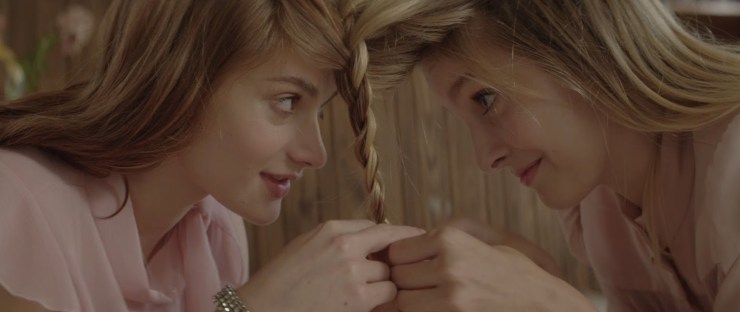
Here & Home. Visionary Still. Choreography by Shai Buddah and Cinematography by Patricia Ellah. Photos courtesy of Djenabé Edouard and the artist.

Scanning the show, there’s a lot of different media being used. There’s photography, dance, and spoken word poetry — was it intentional to have artists from different pockets of the art world?

I wanted to merge these different mediums, as far as text, visual art, and movement — I felt like there’s these different capacities to evoke emotions from each of them. The dance piece was created specifically for Here & Home. Shai choreographed it, and Patricia Ellah was the cinematographer. That piece was really to speak to how the Afro-Caribbean diaspora moves through migration, emotionally, and how disorienting a lot of that can feel.

The dance itself was very intricate, in that it had these moments of rejoice, and other moments of depletion, sadness, and hopelessness. We wanted to capture the range of emotions that happens for folks who remove themselves from their initial home, and in coming to a new home feel alienated, unsure how to belong, how to feel and fit in. Those elements of culture shock came into play as well. The different mediums were very intentional — I wanted more ways than one to express the emotional arcs of migration and shifting where your home is.

Felicia Byron. Ride Through Town (Discovery Bay, Jamaica 2015). Photos courtesy of Djenabé Edouard and the artist.

Since this exhibit is in collaboration with the Mayworks Festival, there’s a heavy focus on labour. Can you speak to wanting to show the Afro-Caribbean experience and its relationship, as fraught or interconnected as it is, with labour and migration?

A lot of Felicia’s portraits spoke to the folks that are in the labour field, but with an intent to humanize them — to humanize our family members who work hard to give us the privileges we have, to put us in the positions we’re in as the following generation. And Sydellia’s poem was the narrative arc of how Afro-Caribbean people engage with the labour force and the sentiments that come from that: not feeling nurtured, like they don’t belong, and constantly questioning their worth.

We also had the chance to engage with the Black Class Action lawsuit folks. We went through a lot of their materials, and these narratives were coming up again and again. These workers come to a place to plant their seeds and grow, but they’re being continuously stifled, unable to be promoted, and kept in these same positions for years on end.

These were the big things we saw across the board, how stifling it can be to migrate and labour in a new place and not feel like you can grow there. You’re this specific cog in this specific wheel and that’s your only position. And it made me think back to a lot of my own family members — my uncle came from Jamaica; he was a butcher and had his own shop there. Here, he’s working for Maple Leaf and he’s still a butcher, but he hasn’t been able to cultivate more autonomy or promotions.

We create comfort back home, but we know that the shift is inevitably to grow and to access more, and that’s where the disconnect comes. With not being able to access more, we’re not able to give back to the next generation, and that creates a rupture in the legacy that our communities are trying to build overseas.

Legacy was an inherent theme that was going to run throughout the exhibit. 

You’ve written about preserving oral histories and its importance to your work. There’s so much that can be left behind — memories, myths, even entire ways of living or taking care of the land. What is it about that idea of legacy that attracts you as a curator?

It’s such an underlying factor in making work as an Afro-Caribbean person. It’s the same way that making art as an Afro-Caribbean person is inherently political — we’re always trying to build a legacy through art and tell our stories, ones that aren’t often told in the broader context of academic spaces. It becomes the only medium in which we can tell our stories — through art, through creating space for other artists. Legacy was an inherent theme that was going to run throughout the exhibit.

Sydellia’s poem follows you as you move throughout the gallery, it’s not fixed in one place. Can you speak to that process, and the intention?

That ended up being the most difficult part. Initially, I thought to have it in its own space, but I saw the value in breaking it up into stanzas and lines and placing it in particular areas, around certain photographs, to further amplify the message or call to it.

When Sydellia and I spoke about doing that, she was very open to it, which I was happy about — I know most artists want their full piece to be acknowledged as is. So that choice was intentional, but the actual placement and decisions were difficult. We tried to let it flow.

What would you like to see more of in curatorial practices, and in art spaces, moving forward?

More work from artists of colour, women artists. I advocate very heavily for Afro-Caribbean art and culture and heritage, and specifically, the female gaze. It’s a component that’s often missing — the female gaze unfiltered or unobstructed by male perspectives or input. That’s something we often lack in the art space. You’ll see female artists in a show, but with a male curator, and it’s still going through their lens. Being able to work with all women, all Afro-Caribbean women, and be the curator, was a very privileged opportunity for me. Allowing our work to speak from the core of our heart, what we really wanted it to mean, and how we wanted it to resonate was very important.

I also love that you got to collaborate with your mom on this. Legacy is really the glue between this show’s themes.

She’s such a creative person; I always love to engage her in that way and create that dialogue through art. And seeing work across generations is important — the older generation still has a lot to say, and we don’t take it in. We feel like we know what’s best now, how things work. But in the spirit of preserving oral histories, there’s still so much that has been left unsaid, so much that they can offer us, show us, teach us. We get wrapped up in this contemporary lifestyle — tech, advancement — and we forget the past and the value and gems that exist in those ideologies and ways of being. When we hear more of these backstories, of our families, we recontextualize our own stories in new ways. We have a broader perspective of how we came to be and why we’re even here.

Here & Home runs from May 2 – 18, 2023 at the Riverdale Hub as part of the Mayworks Festival of Working People & the Arts. You can find more of Djenabé’s work on her website and social media.

On May 17 at 7PM, attend a performance by spoken word poet Sydellia Ndiaye at the Here & Home Closing Reception.

Make Me Less Evil: In Conversation with Angie Quick

Angie Quick. Make Me Less Evil installation shot, Museum London. Image courtesy of the artist.

By Adi Berardini

The first thing to know about Angie Quick is that she isn’t afraid to express herself. Whether that means speaking her mind or making fluid and fleshy paintings, Quick has a way of captivating an audience. I have gotten to know Angie since she is my studio mate and last spring, we switched studio spaces. We helped each other move our paintings and supplies, and I admit, I may have gotten a bit excited about stumbling upon one of the erotic lesbian magazines she uses as a reference. Tenderness across time is at the forefront of Quick’s mind. Inspired by the everyday and encapsulating effortless eroticism, she is interested in how modern life can seem just as antiquated as the classical periods before and what it means to envision a more empowered way of being.

Working in both painting and performance as a medium, Quick is a self-taught artist who has established herself in the local London art scene over the past years. Her recent solo exhibitions include The Moonlight Made Me Do It at the McIntosh Gallery in 2021 and when i die i will have loved everything at Glenhyrst Gallery in 2019. She has had an exciting year with her first commercial solo show at the Michael Gibson Gallery, A Life of Crime, and an exhibition at Museum London, entitled Make Me Less EvilQuick forefronts the question: Can art make you less evil? 

Angie Quick. i won’t be happy until you’re dead, 72x60in., oil on canvas, 2022. Image courtesy of the artist.

Can you explain more about your exhibition ‘Make Me Less Evil’ at the Museum London and your inspiration behind it?

I didn’t know what the show was going to look like. I was just looking at stuff, researching, trying to figure out what I wanted to make. The earlier paintings were the Vermeer paintings. I was looking at a lot of Vermeer work and that was the impetus for it.

I was looking at classical works and the idea of the figure within them. That body of work is about tenderness and vulnerability and looking at intimacy. And I think that was often portrayed through bodies and the title Make Me Less Evil. That came midway while I was working on the series.

I was thinking a lot about personal ethics, like the idea of [someone] asking to be made less evil. But then also the power of art and if art can make one less evil, by the viewer looking at the work. I like that title as an overarching theme because as I was making the work, it just seemed fitting. I think because people find some of my work eroticism or see erotic things within it there’s like this “turning away.” I think it’s asking a question of the viewer and embracing it.

Angie Quick Make Me Less Evil installation shot, Vermeer inspired series. Museum London. Image courtesy of the artist.

The way I interpreted it is a lot of times, especially women, if they’re promiscuous or sexual, they’re made out to be “evil” when that’s not the same standard as men. So, I thought that was an interesting title because it’s almost reclaiming eroticism itself.

 I felt like the title could mean something to anyone who reads it because I think anyone could have a sense of what that looks like to be made less evil or what they carry within themselves or what society puts on [them]. I think a lot of my work is breaking down those boundaries of what we consider right or wrong or what we’re allowed to do or not allowed to do.

In addition to ‘Make Me Less Evil’ you recently had a solo show at Michael Gibson Gallery, A Life of CrimeA Life of Crime deals more with the implication of people in the space, with a more abstract approach and an inspiration from the Rococo era of opulence. On the other hand, ‘Make Me Less Evil’ is more erotic and depicts people in intimate settings. Can you explain the difference in your artistic vision in ‘A Life of Crime?’

I feel like the difference is more something I can see once I saw both works separately, but they almost bled into each other. They were similar and yet different. I made the museum work, but as I was making the museum work, Michael Gibson asked me to do this exhibition.

I made a whole new body of work and some of the work that was going to go to the museum ended up going to the Gibson Gallery. I think there must have been a shift occurring where fewer bodies were visibly present within the work. And it was almost like the bodies are present but absent at the same time. Whereas within the museum work, they’re very much in your face and present. I don’t know why that shift started happening. I do think I was looking at more Rococo work and more at the furniture and the interiors and the sense of someone maybe having just left the room or the memories that exist within the room.

Angie Quick. the night you wore your jogging suit to bed, 60 x 60, oil on canvas, 2022. Museum London. Image courtesy of the artist.

You can see the influence of your everyday life in your paintings. For example, referencing parts of your living room in ‘A Life of Crime’ or your self-portrait Make Me Less Evil depicting yourself napping on your studio couch. Can you explain more about your interest in referencing the everyday in your work? 

 I think everything that I experience in a day culminates onto the canvas. Not so much that it’s a portrait of myself, but I think my interest in being obsessed with something in my everyday life can make its way into the canvas and then it is next to something not directly related to me.

I think those things being in relation allows room for a viewer to make their own narrative within the canvas. So [that’s] why I like having personal stuff—it’s the same with my titles. My titles are probably the most autobiographical parts of all the paintings because those are usually direct snippets from my life while I’m working.

I think that kind of sensibility also lends itself to personal items that make it into [the work]. And I like the idea that there are moments in the canvas that are maybe just for me, but then suddenly it’s for everyone else. I think that the difference between what’s personal and impersonal. The lines blurring is exciting to me.

Can you touch upon your interest in depicting vulnerability in ‘Make Me Less Evil’? Can you also expand on your interest in intimacy and eroticism through your paintings?

It’s one of those things where I maybe am not hyper-aware that I’m making very erotic work. It’s maybe after the fact, having people look at the work and then tell me it’s either shocking or erotic. I don’t think I’m aware of it when I’m making a painting. I like the interactions of bodies and self and it just feels natural for me to come out into those dialogues. I don’t know if it just comes down to being shameless or if that’s just what I’m fascinated and obsessed with.

I love how you spoke about how butts are universal because everyone has one during your artist tour at Museum London.

I don’t even know what the psychoanalysis of that is, but I think there is something about how it’s a non-gendered thing. Everyone has a butt. And I also like the idea of the naked body just existing almost in a timelessness.

But are we just like a Caravaggio painting with a cell phone?

I sometimes wonder how much we’ve progressed or changed as people, when I’m looking at so much classical work and stuff, I think okay, now we have cellphones. But are we just like a Caravaggio painting with a cell phone? There’s so much moralism that still exists and restrictions that I have a hard time thinking that there’s much liberation within a lot of how we live.

I think it’s an interesting parallel to think of, they had letters before, but now we have texts. There are a lot of parallels even though it’s such a different time. 

I think now we can get things more immediately. We still love Shakespeare so much. It makes me think that as people, we only have a certain [number] of emotions and that’s why Shakespeare still seems relevant because it still resonates with all that we can express.

I also love Anne Carson. She’s like a classicist and she’ll take classical work and make it relevant to today so it’s almost like collapsing the timeline. But sometimes I can find that depressing too. It’s not that I don’t believe in progress necessarily, but sometimes when people look at my work and they’re like, “oh, this is happening,” I think that shouldn’t be shocking. It just seems like there’s no change.

You hope and you think that there’s progress, but even just seeing what’s happening now politically, rights are being rolled back. How far have we actually come?

It seems medieval almost. I feel like one of the differences now is that we do have the internet so it’s easier to make propaganda, but it’s also harder at the same time to control a whole population. I can be in communication with somebody in Europe and finding out information and stuff can be translated quicker. But sometimes I think we’re just very medieval, just wearing Adidas or something. Then that sense of humanity is important to me in my work and when I’m saying tenderness, it is seeing people as people.

Angie Quick. the cannoli eaters, 60x120in., oil on canvas, 2022. Image courtesy of the artist.

You have explained how you are interested in certain symbolism such as animals (lambs, rabbits, etc.) and religious symbolism in art historical contexts. Can you explain more about your use of symbolism?

I think because I was raised by two atheists that religion and Christianity are constantly very shocking to me. I was talking to my mom today about how people can be so horrified about sexuality or just like the freedom of an individual to be themselves.

And yet we can walk by churches all the time and there’s just like crosses and crosses resemble someone being killed. A naked man dying on a cross is constantly in our subconscious. Since I was a kid, I was wrapping my head around that.

I think I find it fascinating how so much of western art history uses those things, but they don’t necessarily mean what they’re supposed to mean to me, they become something else. I think I’m creating a personal narrative and ownership of certain symbols and then playing against universal ones. 

I think I just get attracted to certain things and I’m also really into emojis. I think the emoji is like the modern-day crucifix. It’s a sense of using something to delineate information in the shortest amount of time. And so, utilizing that in painting is interesting to me. And then, I can have my own symbolism that I start to create in my work by constantly or obsessively using it. I think they relate to each other since it’s a pictorial language and that’s why I find it exciting. I like the idea of information being condensed and then becoming something that can mean something to everybody. And then maybe skewing that slightly.

Who are some artists (or other inspirations such as books or music) that influence you and your work?

I like Salman Toor a lot. I liked like his sense of playfulness in his work, but then also there’s like a very strong resonance of personal meaning within it.  

I’ve read a lot of Sheila Heti this year, I read all her work. And Jesse Ball wrote Autoportrait, which is inspired by a [memoir by a French writer Édouard Levé], but I was reading a lot of works of autofiction and auto portrait. I think I was also listening to a podcast, and they were talking about how that’s like a new feminist way of writing and I think it’s taking control of one’s narrative. I find that was very influential in how I was working. I don’t know exactly how, but like somehow just taking in all that information. Anne Carson is also a huge influence.

I’ve always loved Cecily Brown because I think she’s like a good painter’s painter. Yeah, I feel like since I was fifteen, I’ve been haunted by Cecily Brown’s paintings.

Do you have anything you’re working on that you’d like to share?

I’m interested in the idea of horniness. At the Gibson opening, someone described my work as being horny and I love that. That’s the best compliment to me because I feel like that’s such a huge encompassing feeling. I’m interested in it and countering the impulse to procreate, the idea of being horny being almost universal, and the way that we can engage in that and the sense of purpose in life and horniness, but in a liberated sense. Like that horniness is liberation.

I was listening to a podcast with Meeka Walsh, who’s the editor for Border Crossings [Magazine], and she was talking about how a good piece of art makes you want to make love. And I was like, oh, horny. It was a more intellectual way of saying horny—I love that.

Check out Angie Quick’s exhibition Make Me Less Evil on view at Museum London until May 28th, 2023.

Taking up Space: In Discussion with Hanna Washburn

Hanna Washburn in the studio, 2023. Photo courtesy of the artist.

Interview by Adi Berardini

Artist Hanna Washburn’s work is undoubtedly playful and lively. Soft forms bulge, sag, and spill over, camouflaged in bold and delicate floral patterns stitched together. The sculptures are unapologetic, taking up space and asserting themselves, challenging the expectations put on feminine bodies. Washburn often incorporates nostalgic items from her childhood such as dollhouse furniture and her grandmother’s curtains, and other recycled fabrics from her everyday life. Embodying a range from the maternal to the sensual, Washburn’s work highlights the complicated experience of being in a body that is constantly transforming and changing.

Both an artist and a curator, Hanna Washburn is based in Beacon, New York, and holds a BA in Fine Art and English from Kenyon College, and an MFA in Fine Art from the School of Visual Arts. She has exhibited at Sotheby’s Institute of Art, Moody Center for the Arts at Rice University, SPRING/BREAK Art Show, and the Munson Williams Proctor Art Institute, among others. Hanna has been an artist in residence at Vermont Studio Center, the Woodstock Byrdcliffe Colony, and the Textile Arts Center. Currently, she works in the Curatorial Department at Storm King Art Center.

Hanna Washburn. Small Step. Photo courtesy of the artist.

Your textile sculptures are so animated and lively. Can you discuss how you’re inspired by the body to create your sculptures?

There is so much of the body in my sculptures, a body caught in the process of morphing and changing. Something that is in flux and not static. I think of my sculptures as representing different versions of the same body in different moods and phases. A body that is slipping between different things, that is many things at once. 

I am also interested in capturing certain moods and gestures with the work, without being too explicit about what exactly is happening. [I use] shapes and movement that make you think of your own body in relation. There are parts of my work that are more unsettling, but I also try to capture the joy of being in a body and the idea that all these different feelings can coexist.

Hanna Washburn. Pink Pivot. Photo courtesy of the artist.

Your sculptures assert themselves and take up space, challenging the associations and expectations put on women and femme bodies with forms that spill and sag over. Can you speak more about this concerning your work?

These things are all connected, what they look like and what they’re about—the body and expectations of femininity. They are layered in together. I construct my sculptures with this kind of patchworking as a visual tool, but it is also this thematic thing of these pieces of identity and body coming together, being stitched together.

I think especially with my freestanding sculptures, I am interested in creating something we have this almost one-to-one relationship with, like the way a viewer connects to it with their own body. This thing that’s standing, burdened but still upright—it’s struggling to stand, but it’s standing. And I think it becomes an exercise in empathy, to see something that is trying to maintain a certain balance. There is something of that I see in myself, and I believe others have that experience too. [Experiencing] how it feels to exist in a body, to feel certain expectations of your body, to feel the pressure of external definitions, so people can see and understand how to categorize you when we are really all un-categorizable. 

Our experiences in the home space are also a big factor in my work. I have a tendency to anthropomorphize things, especially in the home, like furniture. Something that is standing up has this bodily connotation for me, [like an] entity that has a certain stature. I have this irresistible urge to relate to it as a human or a living, bodily thing.

These things are all connected, what they look like and what they’re about—the body and expectations of femininity.

Hanna Washburn. Swell. Photo by Ally Schmaling. Photo courtesy of the artist.

You integrate certain childhood and nostalgic items in your work. Can you explain this inspiration further?

I am a big-time scavenger of things in the world but also of my own life, like clearing out my parent’s attic and pulling [items] that remain from my childhood as these kinds of fossils.

I incorporate things like my old doll beds, or toys or small little objects into my work. If I don’t still have the actual thing it often becomes about its memory. I try to recreate either something I had when I was a child, or an aesthetic that was formative for me. I think about childhood a lot, that identity-forming period. I was always really drawn to objects and creatures. 

I am also interested in the aesthetic of the suburban modesty of my upbringing. A lot of floral patterns, and a lot of muted domestic colors and textures. And again, sometimes I use literal curtains from my grandma’s house. But sometimes it’s about trying to recreate something that I remember or saw in pictures. I am interested in using that kind of modest aesthetic-to take its flatness and make it lumpy.

Hanna Washburn. Curiosities. Photo by Ally Schmaling. Photo courtesy of the artist.

I like how you use recycled fabrics and items from your life. It’s nice from an ecological perspective as well. Have you always been drawn to using textiles as a medium? Can you expand on your interest in using recycled materials and textiles?

Textiles are all around us. We wear them, we live with them in our homes, and we have so many attachments to them. It’s this intimate material we wear on our bodies and sleep in. I think a lot of people are drawn to textiles for reasons of comfort and familiarity. I’ve always really been interested in recycling things, both from an environmental standpoint, but also for the richness of something that has been around for a long time, that has changed hands and has its own memory. 

As far as sewing techniques, I’m a big fan of the whipstitch. It’s one of the first stitches you learn, this overhand, repetitive stitch. It also shows up in surgical stitches, so it has that bodily connotation. I love the visual of how it stitches things together; it’s just such an additive process. And my practice is very improvisational, so when I’m in the studio, I am making visual connections and directly responding and stitching. It feels like this extension of my brain in my hand.

I learned how to sew at home from my mother, my grandmother, and my great-grandmother. It’s a practice that I learned and inherited from outside of art school, outside the institution. It feels personal, as something that I learned from women in my family that I’m continuing as well as complicating. Having this practice connected to the personal and the familial makes a lot of sense to me.

Hanna Washburn. Rosy. Photo courtesy of the artist.

Who are some artists (or other things) that inspire you and your practice?

I try to look at as many different things as I can, not just sculpture or fiber art. I like to engage with a lot of other forms of art, too. I love to go to the movies; I love to read fiction. I try to immerse myself in different kinds of storytelling because it adds richness to my practice, but also just as a person in the world, and the way I think about things.

I’m lucky to know so many artists, visual artists and other kinds [of artists] with all different practices. [We have] casual interactions talking about ideas, going to see things, having informal crits, creative exchanges, and collaborations. I think a lot of my daily inspiration comes from surrounding myself with people with that kind of energy. And I treasure it, because it is important to keep questioning and pushing not just your own stuff but looking at so many other things and learning about other people and their practices and their stories. It’s just so enriching. I have my list of visual artists that I turn to again and again, but that daily stuff is equally important to me because it feeds the [creativity].

Check out Hanna Washburn’s work in the upcoming exhibition Homespun, a survey of textile artists in the Hudson Valley at the Samuel Dorksy Museum – SUNY New Paltz, opening on February 4th, 2023. 

Washburn will also be part of the NYC group show, Paroxysm, curated by Alison Pirie, from February 8 – 23rd at Westbeth Gallery, NYC. 

Additionally, Washburn will have a solo show this fall at the Lake George Arts Project from September 23 -October 27th, 2023.

You can find more of her work on her website and Instagram.

Captivated by Film: A Conversation with Eliza Brownlie

The Darcy’s - Itchy Blood - 2013
Eliza Brownlie. The Darcy’s, Itchy Blood. film still. 2013. Courtesy of the artist.

Interview by Harper Wellman

Eliza Brownlie is a Canadian writer-director who’s ethereal visual style creates atmospheres that beguile viewers and linger in the imagination. The quality visuals are balanced with strong storytelling, often exploring societal issues, cultural phenomena, and how they relate to the experiences of women. The combination of formal education and personal drive has led Brownlie to work with many musicians (most recently Big Gigantic), as well as companies like VICE and Dove. Through an innately collaborative practice, Brownlie has managed to establish a distinct voice for her work.

Could you please tell us a little bit about your background and how you got into filmmaking?

I started filmmaking about seven years ago. I was studying Communications at Simon Fraser University in my early 20s (I grew up in Vancouver, Canada), but found myself taking film theory and history electives every chance I could get. I think I always had this intuition that I wanted to direct… from an early age, I was obsessed with films, and I loved making art, writing, and shooting photos and videos on my parent’s camcorder. But when I was growing up, it was a few years before the women in film movement and diversity behind the lens wasn’t really a mainstream conversation, so I was limited in my awareness and ability to envision myself in the role of a director. You know, there’s that adage “if you can’t see it, you can’t be it,” which is painfully true. This is why visibility is so important and something that I push for. And I’m grateful that we’re finally starting to see some positive shifts happen as an effect of diversity initiatives, even though we still have a long way to go.

Anyways, in my second year of university, I decided to honour my desire to make films and pursue directing. I started out making music videos for Canadian indie labels, which gained some exposure and allowed me to develop my style as a director. I kept working on passion projects, pitching creatives, and shooting whenever I could (or whenever I could afford to). Gradually, more work within the music video, fashion film, and commercial space followed. Shortly after graduating, I decided to make the move to Los Angeles to attend film school at UCLA. During this time, I wrote and directed a short film that we funded entirely on Indiegogo, and that got into a few festivals in New York and California. I’m currently represented by Boldly– a Vancouver-based production company that does really amazing work.

Big Gigantic - Burning Love - 2020
Eliza Brownlie. Big Gigantic, Burning Love. film still. 2020. Courtesy of the artist.

What does your writing process look like? Are you able to visualize all the details while writing the first draft of a script, or do you find more ideas come to you the more you edit?

As much as I enjoy writing, I also find it to be one of the most daunting aspects of the filmmaking process. Honestly, I’ve had to deprogram a lot of perfectionism just to get words out on the page. I was actually listening to a Livestream recently with screenwriters Emily V Gordon, Jen Richards, and Naomi Ekperigin on the challenges of writing and I was practically in tears hearing that they experience the same mental gymnastics that I do… it’s hard work and it takes consistency, and even though the divine doesn’t always come through, you just have to show up at the altar every day and try.

Anyways, I think the first and most important part of the writing process is falling in love with an idea because naturally, everything will flow better if it’s an idea that absorbs you! Once I have found this, I will free write for a while and start to form the characters, the world, themes, and the story—remaining open to everything that comes through (even if I know that I’ll probably abandon certain elements later). From here, somehow, a rough foundation emerges, and I’ll start developing the narrative and mapping out the major plot points into a beat sheet, which is like a detailed outline of the screenplay. I’m also constantly collecting visual material—photography, art, and film stills—so early on during the writing process, I will put together a visual treatment or mood board. This provides a reference for inspiration for scenes and for the look and feel of the film (having graphic design skills helps tremendously). For me, it’s an important balancing act of capturing the images I see in my head, while also making sure I’m serving the story, character, emotions, and central themes.

Film is a visual medium, so when I’m writing a script, I’m always thinking cinematically—how can I show versus tell? I’ll often include camera directions in the script, which is generally frowned upon if you’re a screenwriter, but since I’m writing with myself in mind to direct, it’s helpful to dictate and remember how I want to shoot it. All that said, I often have a pretty good sense of how I want to visualize the details in the first draft, but inevitably there are always scenes that require more time and contemplation to figure them out. Sometimes you get lost, and the best thing to do is to step away for a bit and come back with fresh eyes and new ideas. I do a lot of revisions, so the script is constantly evolving as more ideas and imagery come to me.

The Invisible Ones - 2018
Eliza Brownlie. The Invisible Ones. film still. 2018. Courtesy of the artist.

While writing can be a much more individual undertaking, there is something unavoidably collaborative about directing. Throughout all your projects, your work retains a distinct, almost preternatural quality. How do you navigate all those new relationships on each project while still capturing your vision?

You’re right—directing is definitely one of the most collaborative forms of expression. Part of what I love about it is its inherently collaborative nature, and that film relies on all of these different people coming together, working towards a common goal of bringing a story to life on screen. And when the energy on set is good, and you’re in a flow and making something cool, there’s something really beautiful about that process. I live for those moments! 

I think that the key to capturing my vision and ensuring that it is carried through during all stages of production is first to communicate that vision clearly and get everyone excited about it and on the same page. It’s also so crucial that you surround yourself with a team who understands your aesthetic and point of view, and whose work you equally admire. There’s a lot of delegating with directing, so you have to trust people to be able to do their jobs. I try to make sure that everyone on set feels respected and appreciated, and provide a safe space for them to voice their perspectives and ideas. I’m grateful to get to work with many lovely, talented, and creative people who bring so much to the table with their unique expertise. My work has only benefited from these collaborations.

But of course, since you are leading the team as a director, you also have to be careful that you’re not compromising the version of the film you set out to shoot. With the self-confidence I’ve gained with more experience, I’ve learned to speak up when I’m not feeling something, or I don’t agree. Even if it seems super minor, you’re going to regret not having said something when you’re in the editing room and it’s too late to reshoot. That is the worst!

How do you feel like filmmaking will change, given the current social conditions?

We are going through a lot right now as a global community, we’re at the crux of several intersecting crises… it’s hard to say where things are headed right now. But in terms of discrimination, this has been a systemic issue in the film industry since its inception and change is long overdue. In the past few years, we’ve seen a lot of companies talking about equality and representation, partly because we are in an era in which “woke” culture has been capitalized on—but the statistics are still pretty bleak. The industry’s actions and implementation of initiatives don’t always match their words. We’ve reached a tipping point and people are sick of symbolism and tokenism in entertainment (rightfully so), underrepresented creators want transparency and action. Now it’s like, “how do you plan to commit to diversifying at all levels? We want accountability. We want to see the numbers, then we can have a conversation about diversity, equity, and inclusion.” True, systemic change will take time; it’s not going to happen overnight. I’m hopeful that this is the start of some transformation. But time will tell. 

The Darcy’s - Itchy Blood - 2013
Eliza Brownlie. The Darcy’s, Itchy Blood. film still. 2013. Courtesy of the artist.

Can you tell us about one writer who has influenced your work, and also one director who has influenced your work stylistically?

At the risk of sounding all too predictable, I’ve definitely been influenced quite a bit by Joan Didion and Sofia Coppola—two women who have developed their own distinct and singular sensibility and whose work has occasionally been dismissed as superficial (sexism!) I admire both for their poetic ability to juxtapose style and subject matter, astutely dissecting culture and tackling weighty existential themes through spare, haunting prose, or, in Coppola’s case, dreamy, hyper-feminine visuals.  

Many of us have been consuming a lot of film and television during the pandemic. What has been keeping you busy?

I just devoured Michaela Coel’s new HBO series, I May Destroy You. God, she is brilliant. 

I have also been enjoying High Fidelity and Normal People, both are coincidentally adaptations of novels that I have been meaning to read… I have a long list. 

Final question, what project of yours should people check out first?

One of my most memorable projects was getting to work with the wonderful Millicent Simmonds (star of A Quiet Place 1 & 2, Wonderstruck), on the music video for FRENSHIP’s song, Wanted A Name. Set against a lush natural landscape, the video aims to bring awareness to how the deaf community experiences and interprets music, with Millicent delivering the most incredible performance of the song in American Sign Language.

You can find more of Eliza Brownlie’s work on her website or Instagram.

Male Fear: Encounters with Roxanne Jackson’s Ceramic Monsters

bark at the moon (1)
Bark At The Moon. (View 1). Ceramic, glaze, underglaze decals, luster, hoop earrings; 19 x 16 x 10 inches. 2016.

By Chloe Hyman

A monster is a personified manifestation of societal fears. Some anxieties are primal, like a fear of death, while others are social, directed towards those whose distinctive appearance or behavior renders them dangerous. Sexual difference has long necessitated the creation of maternal monsters to legitimize a fear of the feminine. This anxiety motivates the policing of women’s bodies, in an effort to enforce a heterosexual gender binary. By transforming women and femmes into demons, patriarchy equates femininity with evil and masculinity with good; monstrous women keep men in power.

That is, until they don’t. Banshees and harpies that subvert monstrosity’s patriarchal parameters dispute the validity of gendered social divisions, threatening male dominance.

Such creatures abound in the oeuvre of Roxanne Jackson, a ceramicist who dissects the politics of monstrosity. In works like Bark at the Moon (2016) and Third Eye Fuck (2019), she oscillates between wish fulfillment and stereotype subversion, crafting figures that embody and disrupt tropes of feminine monstrousness.

The latter’s sexual title accentuates the comingling of fear and desire in monster tales. Film scholars Barbara Creed, Jeffrey Cohen, and Barry Keith Grant discuss how cinematic monsters attract and repulse men, fulfilling their submissive fantasies with the threat of the monstrous woman, and their dreams of domination when said threat is vanquished.[1]

This essay considers how the relationship between straight men and female monsters informs the same audience’s interpretation of Jackson’s work. Analyzing the interaction between an artwork and a particular viewer necessitates an understanding of art as a cultural product; although the artist’s intentions contribute to its significance, its many meanings are also a product of symbolic codes, dominant social ideology, and the viewer’s perspective.[2] By modeling the straight male’s encounter with subversive female monsters, this essay explores what Jackson’s work signifies to a powerful group—the descendants of the architects who constructed the myth of female monstrosity.

bark at the moon 2 (1)
Bark At The Moon. (View 2). Ceramic, glaze, underglaze decals, luster, hoop earrings; 19 x 16 x 10 inches. 2016.

The Archaic Mother

In The Monstrous-Feminine: Film, Feminism, Psychoanalysis, psychoanalyst Barbara Creed describes a number of monstrous cinematic archetypes. Her analysis provides a blueprint for an examination of fear, desire, and monstrosity in the bodies of monsters coded female. Creed’s description of the archetypal archaic mother elucidates how two of Jackson’s ceramic sculptures are implicitly gendered. Furthermore, it suggests that male viewers will respond to Bark at the Moon and Third Eye Fuck with repulsion, arousal, and fear.

The myth of the archaic mother centers parthenogenetic procreation—that is, female reproduction without a phallus. Mythological figures like Gaia (Greek), Coatlicue (Aztec), and the Spider Woman (Navajo) illustrate the historical lineage of self-reproducing mothers.[3] They appear today in cinema in the guise of monsters, like the titular figure in Alien whose eggs require neither phallus nor fertilization, but a human host. According to Creed, the archaic mother presents as “the voracious maw, the mysterious black hole that signifies female genitalia which threatens… to incorporate everything in its path.”[4]

At the center of Bark at the Moon sits such a mouth, its gaping lips emptying into nothingness. Ridged white tubes, caked in muck, wriggle around it like maggots. With their rounded ends, these tubes could be fallopian or phallic, an ambiguity that, paired with the mother’s vaginal maw, points to her self-reproduction. She also threatens to consume the viewer, who cannot escape her slimy hole. If the archaic mother faces him, he risks obliteration, but if she turns towards the gallery wall, then he must be inside her—an embryo-corpse.

The divine symbols ornamenting Third Eye Fuck invoke the archaic mother in a different context. Unblinking eyes adorn the deity’s cheekbones while cobalt spiders traverse her neck—a powerful allusion to her ancestor, the Spider Woman. Furthermore, the creature’s pearly-white face is bifurcated, revealing a fleshy, womb-like cave. The womb’s proximity to the creature’s mouth literalizes the narrative of the devouring mother. As Creed explains, “The archaic mother threatens to cannibalize, to take back, the life forms to which she once gave birth.”[5] Third Eye Fuck embodies this threat, collapsing the metaphor of the vaginal mouth into a single fleshy cavern, capable of consumption and ejection.

Due to their self-reproduction, Jackson’s creatures render the phallus superfluous. And because they layer vaginal and oral imagery, they threaten to consume man whole. According to Creed, this evisceration of man’s social status and bodily integrity appeals to “a masochistic desire for death, pleasure, and oblivion” that is common amongst men.[6] And yet, it is also repulsive and terrifying, which Creed attributes to abjection.


Abjection

The theory of abjection was introduced by the psychoanalyst and semiotician Julia Kristeva, who defined it as “that which evades borders and rules which define identity and maintain order.”[7] When matter passes the skin as it does during birth, people are reminded of their mortality and animal nature. Subsequently, the transgressive matter—in this case, blood and placenta—becomes abject, along with the tools that facilitated the transgression: the reproductive system. Men are more disturbed by abjection because they are less accustomed to the sight of blood than those with ovaries. Thus bleeding, birthing bodies become beacons of man’s inescapable death and epicenters of abjection.[8]

Historically, men in power have expressed their fear of abjection by demonizing the female body. Christian art abounds with womb-like depictions of hell and uteruses adorned with devil horns. Leviticus, for example, associates birthing bodies with decaying corpses, linking femaleness and death.[9] As Creed notes in her analysis of Alien, this trend continues in horror cinema. She describes crewmen entering a spaceship through a vaginal doorway and walking down narrow corridors (echoing fallopian tubes) to an egg-filled, womb-chamber.[10] This intra-uterine imagery roots the alien’s monstrosity in the abject female body.

A mass of tubes, holes, and flesh, Bark at the Moon and Third Eye Fuck exude abjection. Furthermore, each contains a passage through which organic matter can be imbibed or ejected. These vaginal/oral mouths repulse and terrify because they are abject reminders of human mortality.

3
Roxanne Jackson. Third Eye Fuck (View 3) Media: Ceramic, glaze, luster; 18 x 15 x 10 inches. 2019.

Subversion

While Bark at the Moon and Third Eye Fuck embody the archaic mother, they also subvert stereotypes of female monstrousness. Both are decadently glazed, their uterine linings shimmering like dew or diamonds rather than blood. Bark at the Moon is awash in lime, turquoise, and salmon pink, which almost obscures a floral motif that emerges from its crevices. This blue pattern, an allusion to Delft porcelain, features prominently on the pale skin of the deity that is Third Eye Fuck.

The ornamentation of monstrous bodies with bright, shimmering colors and courtly motifs subverts the binary between beauty and monstrosity.

The ornamentation of monstrous bodies with bright, shimmering colors and courtly motifs subverts the binary between beauty and monstrosity. Jackson’s sculptures occupy a liminal space between the two, where gender and morality also blur; Bark at the Moon is ambiguously gendered and Third Eye Fuck depicts a monster with an eye for Dutch design. The more viewers peer at each, the less frightening, and more intriguing, they become. To understand why this subversion elicits discomfort for male viewers, the theory of abjection proves useful.

Aesthetic codes, which are tied to gender and moral binaries, function like skin. Just as the epidermal layer protects man from blood and, therefore, the recognition of his mortality, social divisions protect members of the dominant group—men—from the knowledge that their superiority is unearned.

Media maintains these divisions by reinforcing the myth of female immorality. It also demonizes the defiance of heterosexual gender roles by giving female monsters traditionally masculine traits, like promiscuity or voracious appetite. Cinema is ripe with archaic mothers and other monsters who elicit fear in a controlled environment, for the sexual satisfaction of men whose dominance is never really at stake. It is expected that the banshee will be vanquished before the screen darkens, reasserting heterosexual gender roles.

But the fate of Jackson’s sculptures is not predestined. By deconstructing the notion that beauty equates goodness and gender clarity, while ugliness signifies immorality and gender ambiguity, the artist produces creatures of ambiguous moral character. Luminescent and bright, Bark at the Moon and Third Eye Fuck engage in an active dialogue with the male viewer. They threaten him, they tantalize him, and ultimately, they will dethrone him.

Editor’s Note: The beginning paragraph has been edited to use more inclusive language,  recognizing and clarifying that these cinematic tropes affect both cis and trans women and femmes.

This feature is an excerpt from our first print issue. If you’d like to grab a copy you can visit our online shop.

Notes

[1] Jeffrey Jerome Cohen, Monster Theory: Reading Culture (Minneapolis and London: University of Minnesota Press, 1996), pp. 7-17; Barbara Creed, ‘Horror and the Monstrous-Feminine: An Imaginary Abjection,’ in The Dread of Difference: Gender and the Horror Film, ed. Barry Keith Grant (Austin: University of Texas Press, 2015), pp. 42.

[2] Janet Wolff, The Social Production of Art (New York: New York University Press, 1984)

[3] Barbara Creed, The Monstrous-Feminine: Film, Feminism, Psychoanalysis, 1993 (London and New York: Routledge, repr. 2007), pp. 104-112; Shohini Chaudhuri, Feminist Film Theorists: Laura Mulvey, Kaja Silverman, Teresa de Lauretis, Barbara Creed (London and New York: Routledge, 2006), p. 95; American Museum of Natural History, ‘The Spider Woman,’ AMNH

< https://www.amnh.org/exhibitions/totems-to-turquoise/native-american-cosmology/the-spider-woman > [accessed 20 November 2019];

[4] Creed (1993), p. 116.

[5] Ibid. p. 83.

[6] Creed (1993), p. 170; 470-471.

[7] Julia Kristeva, Powers of Horror: An Essay on Abjection (Seuil: Paris, 1980) quoted in Creed (1993), p. 51.

[8] Creed (1993), pp. 190-193.

[9] Kristeva quoted in Creed (1993), p. 184; Margaret R. Miles, Carnal Knowing: Female Nakedness and Religious meaning in the Christian West (Beacon Press: Boston, 1989), quoted in Creed, p. 170; Creed, p. 170.

[10] Creed (1993), pp. 83-85.

The figure does not win every time: In Discussion with Celeste Rapone

By Elaine Tam

March in London gifted a few spring pleasures; memorably that telltale smell of oil paint, one takeaway impression among many from Celeste Rapone’s exhibition Retreat at Josh Lilley gallery. Dressed by electrifying palettes and deftly rendered textures, her eccentric characters go about their daily dealings in paintings oscillating between figuration and abstraction. Swelling to their borders, they occupy “impossible positions” and defy gravity in multiplanar views. Yet it seems that — for all their brazen flair and over-zealous accessorizing — a maelstrom of incidental activity surrounds the figures, swallowing them.

Rapone never does preliminary studies, which means that any self-doubt, struggle, or transformation becomes part of a complex unfolding on the canvas as the painting is realised. The result of this highly personal process is not overtly autobiographical. Nonetheless, the paintings impart an intimate insight into the painter’s psyche, and the ways in which the discomforts and discontents of painting parallel universal human experiences. With remarkable reflexivity, Rapone explores the many personalities of failure and the possibilities for invention, humour and discovery that lie therein.

Elaine Tam: How do you begin the process of creating new work?

Celeste Rapone: I’ll start a painting by mixing colour, usually with some sort of narrative prompt in mind. One of my favourite challenges is assigning a palette to a narrative that has no colour associations. I start my paintings like an abstract, rather than figurative, painter — with colour, shape, composition, form. The figure and environment are secondary elements that come after. There’s a lot of wiping down; I really like figuring it out on the canvas and having the problem exist there.

Elaine Tam: How does this tension register on the canvas or in its contents — with the presence of more control or less gestural swathes of paint?

CR: I’m constantly skeptical of my decisions as a painter. That’s one of the prerequisites of being a painter, right? Doubt about everything. The paintings I struggle through I have trouble seeing after they’re finished; it’s like seeing your significant other for the first time after a really big fight. There are ones that go a bit more effortlessly, but I’m also skeptical of those. Maybe I’ll second guess the speed of something being resolved.

Yawn
Celeste Rapone. Yawn, 2020. Oil on Canvas. Image courtesy of Corbett vs. Dempsey and the artist.

ET: Slightly earlier works like Flirt (2018) or Artist Wife (2017) centre on Guston- or Eisenman-esque caricatures, whilst a recent work like Yawn (2020) is more scenic and features lots of minutiae. How do you relate to your earlier work and the way your practice has developed?

CR: There’s something about the idea of the women contained, occupying these impossible positions anatomically, but also in terms of expectations, ambition, defeat and self-awareness. It is a lot of what embodies painting as a process and practice. In the past couple of years, I started having the figures fill out the entire composition, taking away flattering cropping. When the whole body is exposed, there is a discomfort [and] vulnerability.

ET: The objects slip and slide through the viewing corridors created by the entangled bodies. On your flattened planes, there is no hierarchy — the body never seems to fully possess or grasp the objects. You have described your paintings as anxious. Is anxiety an intended effect?

CR: I don’t set out to make anxious paintings. I see the paintings as an intersection of my personal history — growing up Italian Catholic in North Jersey — art history, and whatever the current circumstances are, both in my studio and in the world. Your comment about hierarchy is something I think about a lot. I’m interested in the figure sort of drowning in their environment and being totally overwhelmed by their context. When I was in grad school, an advisor once asked me: “How do you make figurative painting and not let the figure win every time?”

Screen Shot 2020-07-30 at 1.17.58 PM
Celeste Rapone. Practice for the Real Thing. 2017. Oil on Canvas. Image courtesy of Corbett vs. Dempsey and the artist.

ET: Yes, and in many of your paintings, certain objects are very prominent. Some are even named or branded.

CR: There is a specificity to the imagery. But because of my illustration major at Rhode Island School of Design during undergrad, I’m aware of not being too specific — that the narrative is not overly linear or only hits one note. RISD is a pretty technical school, [so] my whole background is in observational figure and portrait painting. I realized quickly I was not an illustrator. That’s why I went back to grad school for painting.

ET: So as to not be only illustrative or purely representational?

CR: It was about trusting and translating the skillset [so] that I had enough to make totally intuitive work, invent light scenarios or palettes for convincing flesh tones… For years, I was painting with a hyperrealist approach. Sometimes, I have to re-train my hand to paint in a way that’s looser, more gestural, guttural [and to] not paint this thing the way I know, but paint it for what the painting needs. One of my favourite essays is Mitchell’s What do pictures want? I’m interested in that dialogue.

ET: Your background as an illustrator explains so much, as your work certainly exhibits moments of stunning technical prowess. Yet the faces of the characters are mysteriously smudged and less defined…

CR: That’s been happening more lately; the portraits are getting more generic or partially concealed because they are less overtly autobiographical. I don’t know the identity of the person I’m painting, so it seems like a lie to give them a specific face. The more autobiographical elements have been popping up as objects and accessories, [such as the] sneakers I always wanted in junior high that my parents wouldn’t let me buy. I’m making a painting of a woman fishing right now. It’s a night-time painting, and just yesterday, I added those glow light necklaces.

ET: Of course! The ones that crack —

CR: And then they light up and they don’t last long. That was a very popular thing [to wear] when I was growing up, [if you wanted] to look really cool.

ET: Very raver chic.

CR: Totally! Except back in Jersey we weren’t ravers or chic. It was a thing you would wear to a party to have the aesthetic of raver chic. Some of these little nods in the paintings are [to] my own history and life, where I come from: a cough drop wrapper, tooth flosser, or a can of something on the floor of my studio that just makes it into the painting. But these are not things viewers need to know — I don’t want the paintings to turn into an archaeological dig — it’s about how they all collide in a composition.

27941_Rapone_Four Eyes
Celeste Rapone. Four Eyes, 2019. Oil on Canvas. Image courtesy of Corbett vs. Dempsey and the artist.

ET: For someone unfamiliar with “Jersey” as a cultural phenomenon, how would you describe it?

CR: I was growing up in Jersey, amongst all these opulent, maximalist visual stimuli, adopting bad taste tactics. And now I’m working through some of that when making the paintings. I’ll make a painting and look at an area and go, “That’s a real Jersey move”.

ET: That’s so telling!

CR: You know, I heard a recording of Charline von Heyl for her show at the Hirshhorn, and she talked about finding this level of “upgraded cringe”. What a wonderful phrase, right?

ET: It’s a fine line though. How do you distinguish between cringe and upgraded cringe?

CR: That’s a question I ask myself all the time in my studio. What’s one step too far? What’s about bad taste versus just bad taste? I’ve always been interested in this gentle idea of shame and embarrassment in the paintings, and that has become heightened in some of the moves I’ll make in recent ones.

ET: Could we consider these kinds of questions the “narrative prompts” that help you to start a work?

CR: What gets me into a painting can come from anywhere, which is one of the reasons I reference Dutch Golden Age painting. I love the idea of a simple start. There’s something in simplicity that allows me to have total freedom to take it wherever I want, like the women playing dominoes in Yawn. “What a dumb idea for a painting!” I’ll say in my head, but I love that because it’s something to push back against. What’s more interesting to me is the absurdity in how a painting is constructed. A woman stretching canvas, who would want to look at a painting of that?

Swan
Celeste Rapone. Swan, 2019. Oil on Canvas. Image courtesy of Corbett vs. Dempsey and the artist.

ET: It’s funny you say that, because I find this work of yours delightfully witty; the painting becoming the back of its own canvas, revealing its sub-structure. Why did you title it Swan (2019)?

CR: There’s something awkward about your body stretching a canvas. I wanted to play with that in the title; the lack of grace and this idea of transformation. But even if there are sub-narratives occurring in the paintings, inherently they are all about trying. That notion of effort or expectation that goes into trying, which tries to counter failure. But failure is always one aspect of a larger cycle, in life and in painting.

ET: That reminds me of the famed Beckett phrase: “Ever tried. Ever failed. No matter. Try again. Fail again. Fail better.”

CR: Absolutely. I see it as this overarching thing, and I like to think that failure enters the work in different ways: humour as a coping mechanism or trying really hard as the concealment of failure. It shows up in the painting as, perhaps, one too many accessories. She’s trying just a little too hard. Am I trying too hard to paint this necklace perfectly?

Viewfinding
Celeste Rapone. Viewfinding, 2019. Oil on Canvas. Image courtesy of Corbett vs. Dempsey and the artist.

ET: It’s like that fine line regarding “upgraded cringe.”

CR: Right, like I’m gonna paint this rainbow and it’s going to be très embarrassing, but is it going to be more embarrassing if it’s a perfect rainbow, or if it’s a crappily painted rainbow? These are conversations I have with myself ten hours a day, so it’s an all-encompassing practice: thinking about trying too hard, failing, starting over again. I always have to be really honest with myself about the painting. There has to be an evocative undercurrent. Then, there’s the laughter, which lets me know I’m hitting on something. There are times I tell my husband, “I haven’t laughed yet, so I don’t know how it’s going.”

Parameters and Play: A Conversation with Neah Kelly

neah kelly_1 (1)
Neah Kelly. Fodder for Fun series (SRRTt no. 2), recycled screenprint, paper sculpture, thread, plexiglass, 5″ x 6″ x 4″, 2020. Courtesy of the artist.

Interview by Harper Wellman

Neah Kelly is a visual artist currently based in Hamilton, Ontario. After earning her undergraduate degree from Concordia University, Kelly continued her formal education at Indiana University, finishing her MFA in 2018. Today, Kelly’s practice involves working within a self-imposed set of limitations, creating both 2D and 3D pieces. Using imagined shapes, Neah configures the shapes into various forms, again and again, in new and exciting ways. The completed works inspire new shapes, and the process is repeated. Within these parameters, Neah has found a sense of play in her practice leading to a portfolio of closely related but ever-evolving work, reflecting the chaos, beauty, and joy that can co-exist within a creative invention.

Could you please tell us a little bit about your personal history and your history in regards to art exposure, education, and career. Who or what led you down the path to being a visual artist? Who were some of your early artistic influences? 

I’m originally from Vancouver Island, growing up in a very small town (with just one intersection) called Shawnigan Lake. I am and was raised a Baha’i, attending a Baha’i boarding school for all of my high school years. These experiences, I think, set the tone for how I view the world and why I became an artist. Both of my parents are in the arts (my dad is a painter, and my mom is a musician), so it was natural to make art. We were raised looking and talking about my dad’s paintings and playing music with my mom. I really think it was the most natural thing for me to end up doing.

I can’t really remember a time when I wasn’t exposed to art, or when that first exposure was. My dad used to make these very large-scale hard-edge abstract paintings with only two colours. I remember one that was huge, it took up almost the entire length of our living room wall, and it was comprised of a shape that as a child reminded me of a whale. It was blue and black, flat with no depth, just very crisp, clean edges between the shapes. I remember constantly looking at that painting, even when I was really little, it had an impact on me. Besides that, I used to love looking at my dad’s art books, two books that I looked at a lot were by Rodin (his bronze sculptures), and Rothko. Artists that I think were early inspirations for me were people like Kandinsky, Rothko, and Frankenthaler (their use of colour and colour as an expression of the spiritual really interested me), and Eva Hesse. Hesse is wonderfully strange. She has such an engrossing talent with materiality and just seems to be truly creative. I loved that. I love that her work is so full of creative energy, experimentation, and a visceral reaction that you can almost feel through photographs. I’ve only seen a couple of her pieces in real life, and it was worth the anticipation!

Eventually, I went to art school, and started with the visual arts program at Camosun College in Victoria, then attended Concordia University in Montreal, earning a BFA in Studio Art, with a minor in Print Media. While at Concordia, I was able to learn a lot about printmaking and bookbinding, and I think that’s where my art practice started to develop into what it is now. I started doing a lot of lithography and bookbinding, primarily playing with less conventional forms of bookbinding. After undergrad, I attended Indiana University in the US and earned an MFA in Printmaking. I graduated in 2018 and since then have been exhibiting across the US and Canada, participating in residencies, etc. This year I have shows coming up in Hamilton, ON, at Centre[3] and a two-person show at Martha Street Studio in Winnipeg, MB.

neah kelly_2 (1)
Neah Kelly. fodder for fun: step 1a & accompanying form MIAAS no. 1, lithograph. Courtesy of the artist.

neah kelly_3 (1)
Neah Kelly. fodder for fun: step 1a & accompanying form MIAAS no. 1, lithograph / recycled lithograph, paper sculpture, thread, 38cm x 27.9cm / 6″ x 4″ x 5″, 2019. Courtesy of the artist.

Your practice today is centered around ideas of play, as you continually play with a series of imagined shapes again and again. Play is something many people can connect with from their childhood. When did you rediscover this sense of play within your practice, or was it always there?

When I began this current body of work, making use of rules was there from the very beginning. And I don’t think I connected rules to play and play to creativity until a while later. For me, rules have played a huge part in my personal life. I’ve lived with type 1 diabetes for almost 24 years. Although it was an unconscious translation into my art practice, I think learning to function within strict parameters is something that has been a huge component of my daily life for almost as long as I can remember. So, initially creating a premise like this for a project didn’t seem unique in any way or that it would potentially lead to anything in the future. It was more that this type of thinking was just a way of existing in the world that I am familiar with.

But, the play aspect, or realizing that play was an important aspect in my work, I think, began to evolve as my process did. I see the idea of play as a way to generate ideas, and the rules establish a criteria and set of parameters guiding that play and what I’m doing/producing. When I was completing my MFA I read a lot about play and games, and game theory, and at first I saw rules as being really important, but the more I read and learned and thought about what I was doing and how I was thinking about things, I realized that really everything I was doing fit very neatly into game theory, and how children often play. The play of children is so cool. It’s imaginative, the rules are flexible, they change and develop as the game goes on. The rules are most often used to establish an objective, but they also serve the purpose of maintaining the play and allowing the play to continue for as long as possible. I realized that this was very similar to how I was using rules as a way to continue the action of creative invention. Through this research, I learned that play has huge impacts on our ability later in life to form friendships, establish intimacy or not, ethics of fairness and justice and establishing relationships. And all of these attributes are developed through rules and play, ultimately you can’t have play without rules. And rules very often (if you’re open to it) can lead to play.

In line with that thinking, the first project that really used this idea was a book project that I completed in my first year of grad school. It was an absurdly shaped small book (4” x 4” x 9”) that used three repeating shaped copper plates as its imagery. They have unique qualities that I intentionally gave them so that there was room to come up with a variety of compositions, but it was still a huge challenge! The book has about three hundred prints, and one of my rules was that all the prints that I printed had to be included in the book — successful or not. Without the safety of an editing process, the pressure for creative invention was high, it was another prompt! The objective was that with these constraints, I would be forced to invent original compositions within this framework again and again. The theory being that I would never run out of new compositions if I actually succeeded in stimulating and prompting creativity. In the end, these restraints acted as a stimulus for creative solutions, and the activity that I was engaged in during this process was play, and that’s how I got to the idea of play. From there, the broader realization of my practice is about the creative impulse, stimulating and generating it through activities, devices, projects, so that we can all engage in playful activities, seemed to come about naturally. It felt like an explosion of possibility, with my results becoming more absurd, abstract, and silly, with every iteration and subsequent generation.   

neah kelly_4 (1)
Neah Kelly. FFF series: Peekaboo no. 1 (BBB …V), recycled drawing, hand-cut/hand-sewn paper sculpture, paper cut-outs, thread, coloured acrylic, 6” x 4” x 6”, 2020. Courtesy of the artist.

Are you able to elaborate on what initially informed the imagined shapes, and what they have come to mean or symbolize for you since working with them?

The first time I used these shapes was for the book project that kicked off this entire body of work, and when I started that project, I created those shapes with the explicit purpose of them being abstract. When I started I had goals in mind: I wanted the shapes to be different scales, and I wanted them to be truly abstract (or as much as possible) so that they would be hard to anthropomorphize, additionally I wanted them to have interesting and differing parts like angles, lines with dips, sharp edges, rounded corners, curves, notches, and uneven planes so that when these shapes interacted over and over again in the book, I would be able to create a unique and interesting composition with each print. I invented them through a process of formal consideration, and I settled on the shapes I ended up with when I thought they had the features that I was looking for, I thought they’d work well together, and I liked how they looked aesthetically.

I don’t really think of them as symbolizing anything. For me, the shapes were initially a tool to accomplish an idea –  the idea of perpetuating creativity from a restricted set of source material. Now that they have gone through so many translations and have been used in a multitude of consecutive projects, I think of them more as idea generators. That’s their function, that’s what they do but they’ve also come to mean just that for me: they are the prompters for my own imagination.

Where do you see your practice going in the future? Will your series continue, or is there something different in the works?

It is continuing, but it’s always changing. I’m currently working on an artist book that will be pretty interactive. I’m trying to create it in a way that people can handle it gently and participate more fully. The way things are progressing right now, I have pieces in the same vein that I am still creating, but I also have a couple projects that take these ideas but are more outward-looking and more active in soliciting viewer engagement. I really love the idea of working together at bolstering up our imagination skills, and I think that’s where my future projects are headed.

And in the same vein of more participatory projects, I have a collaboration in the works where we plan to use rules to dictate exactly what we make. And those rules will have a much more direct relationship with our personal lives and lived experience. This will be a project that begins with just two of us, and hopefully — through the use of social media — it will grow into a much more expansive, participatory practice.

neah kelly_7 (1)
Neah Kelly. Fodder for Fun: Belled Butt Becomes …Visage no. 5, recycled screenprint, hand-cut/hand-sewn paper sculpture, thread, coloured acrylic, 10” x 10” x 6”, 2020. Courtesy of the artist.

Regarding the broader art scene, what do you see on the horizon, and what are some issues you feel the art community needs to address? Can you think of any artists or organizations that are helping the arts community move forward?

Diversity, and equal representation throughout power structures within the broader arts community. Recently, I’ve been thinking about who the gatekeepers in the art world are, who decides whose art, where it’s shown, and what type of content is presented and highlighted. It’s not enough to diversify the artists making art, we need to have boards, curators, directors, and leadership that are reflective of our communities. Shifting these power dynamics, and not simply having white boards showing POC artists, but POC communities determining the content and the conversations that we’re ultimately having within the art world is where I think the art world needs to move and is going. A few institutions that I’ve seen actively changing and diversifying their organizing bodies are Open Space in Victoria, BC; Martha Street Studio in Winnipeg, MB; and Trestle artist-run center in New York.

Finally, how can we all incorporate a little more play into our lives?

I don’t know exactly. I think for adults, play is more an attitude than a set thing. If there’s one thing I learned when researching play amongst animals and children, it’s really that anything anywhere can be considered play. One thing that I’ve observed about myself is that rules, deadlines, constraints, bribing, etc. turn really anything into a game. Set a time limit, something that you need to accomplish in a certain way, and it really does turn into a game instead of a chore. I think that combined with a more relaxed attitude, a healthy and robust sense of humour would definitely succeed in incorporating a little more play into our daily lives. The same goes for art, hobbies, anything really. That’s just what I think. Play is incredibly diverse and unique to the individual —there’s no right or wrong way to do it.

Check out more of Neah Kelly’s work on her website and Instagram.

Lena Chen in Conversation with Chun Hua Catherine Dong

IMG_2903
Chun Hua Catherine Dong. I Have Been There. 2015 – ongoing. Photo credit: Oliver Santana & Elizabeth Ross. Photo Courtesy of the Artist.

By Lena Chen

The expansive practice of Chun Hua Catherine Dong utilizes the artist’s own body as a bridge between immigrant and nation, mother and daughter, and the personal and the public.

First and foremost a performance artist, her work has taken the form of photography, video, installation, and more recently, animation and augmented reality. Born in China, Dong immigrated to Canada, where she received a BFA from Emily Carr University Art & Design and an MFA from Concordia University. Her experiences occupying a racialized body and adapting traditions from her homeland have played heavily in her practice, which has explored marriage, death, and maternity.

Having performed and exhibited internationally, she was also a 2014 recipient of the Franklin Furnace Award for contemporary avant-garde art and a finalist for Contemporary Art Award at Le Musée national des beaux-arts du Québec ( Prix en art actuel du MNBAQ) in 2020.

Dong spoke with us about her experience of creating intimate body-based works that engage the participation of public audiences and spaces.

Lena Chen: I noticed that your most recent work, Skin Deep, and your long-running series I Have Been There, share a similar aesthetic through the use of traditional Chinese embroidered fabric. Can you talk about how they evolved?

Chun Hua Catherine Dong: These two works actually do not have many connections except using the same fabric. In 2014, I bought some fabric in Chinatown in Montreal, where the supply is very limited. The fabric was wrapped on my face very randomly and looked terrible, so I didn’t develop it further. But in 2017 and 2018, I went back to China and collected all kinds of new fabric that I began to work with. More recently, I expanded Skin Deep to animation and augmented reality to make this work more alive and architectural.

IMG_2909
Chun Hua Catherine Dong. Skin Deep. Photographs with Augmented Reality. 2014-2020.

 You have performed in performance art festivals around the world from The Great American Performance Art in New York to Infr’Action in Venice to Dublin Live Art Festival in Dublin to Miami Performance International Festival. Can you talk about how the site-specific performative work I Have Been There came out of your lifestyle as a traveling artist?

I started I Have Been There in 2015. I love traveling and really miss it right now [because of COVID-19]. One of the good things about being a performance artist is the chance to travel because the body is your material and your body is your work. If you travel to a new city, you need to see the tourist attractions. But I’m also a bit of a workaholic, and I considered it a waste of my time to just go see attractions without doing anything. I thought what if I could visit these sites while making work?

IMG_2904
Chun Hua Catherine Dong. I Have Been There. 2015 – ongoing. Photo credit: Oliver Santana & Elizabeth Ross. Photo Courtesy of the Artist.

Chen: I’m interested in how the work deals with your relationship to your own mortality and Chinese traditions around burial, especially because of the material you’ve chosen to use.

Dong: In my hometown, there’s a tradition that when the parents die, each daughter of the family makes a shroud and they cover the body with it.  When my father passed away, he had six daughters. So, his body was covered with these six layers that he was buried with.

According to Chinese tradition, it’s your children who bury you. And if you don’t have children, it’s your family. But I live here in Canada and everyone else in my family is in China. I decided not to have children, so I thought nobody’s going to bury me. But I’m still very young. I have these fantastic [opportunities] to travel around the world, so why don’t I just bury myself in the most beautiful desirable spaces wherever I want?

I have been doing this project for five years right now. Every time I travel to a new space, I would do another part of the series there. So far, I have traveled to 33 cities and 15 countries in the world. My plan is that I’m going to do it until I die or until I can’t travel anymore. This is my commitment.

Chen: Death seems to be a common theme in your work. I was also very moved by how you made peace with your mother’s passing through your art.

Dong: I was supposed to visit my mother in the summer of 2016, but I went to London because a curator invited me to do something. Then in October, she passed away very suddenly, so I have a lot of regrets about that. In the tradition of my hometown, they only keep the body for three days, and after three days that they have to bury her. But my passport was expired at the time and I couldn’t get my visa in three days, travel to Beijing, and then travel to the village. It would have taken me at least five or six days.

I wanted to do something dedicated to her because I feel I should have been there for her death, but I wasn’t. So in 2017, I went back to China, and originally, I wanted to find her personal belongings – her shoes, her clothes, her bed – so  I could do something right. But after her death, my family burned everything because of tradition. They believe when a person is dead, they need access to their belongings right away in the afterlife.

I was very disappointed there was nothing left of her belongings. It was very sad. There were no smells. There were no visible things. When I was in China, I realized I was looking for my mother everywhere. If I walked around and heard a voice that sounded like my mother, I would turn around and see this old lady and I would notice that the way she walked or wore her hair would be like my mother. Her smile would look like my mother, so I was looking for my mother through other people’s mothers.

IMG_2908
Chun Hua Catherine Dong. Mother. Photograph & Video: 14 pieces of photographs, inkjet prints, size varies, 2017.

Chen: Can you talk about how you decided to honor her memory by engaging with the women who were close to her?

Dong: I decided that I was going to looking for my mother’s childhood friends and relatives because since I came to Canada, I barely had contact with them. I visited them and I asked them because I don’t have any clothes to wear from my own mother if each of them could offer her clothes [for] me to wear. 

My mother also always loved these traditional beautiful cotton flower shoes. So, I brought a pair of shoes to each mother in my project. I thought about this kind of Cinderella story of whoever fits this crystal shoe is the bride. I started [to] imagine, whoever fits these shoes is my mother. I would take a photograph of us together, with me wearing their clothes and them wearing the shoes. At that time, I didn’t even think about what I was doing as work. I was doing it for myself, as a memorial to my mother.

Next year, I will return and live with each mother for a day as her daughter. I will document this day with the 14 mothers. This film is called Mothers with No Names.

Chen: Even though the work is very much tied to your own relationship with your mother, grappling with the death of a parent is such a universally understood experience. How has the public received this piece?

Dong: The mother is universal. Every time I show this work, people become very emotional,  People connect themselves to the mother in the photograph. When I showed it in Istanbul, this woman came to me and she was crying. She showed me that the jewelry she was wearing belonged to her mother.

The first time I showed this work was in South Korea and the curator said it made her think of her mother as well, who was getting older. When I had my artist talk,  she left and later apologized, saying that she knew I’d be talking about the piece and it was too emotional for her to be there thinking about her own mother.

IMG_2906
Chun Hua Catherine Dong. Husbands and I. Photography and performance. 2009-2011. Series photo credit: Ruth Skinner and Chad Darnford. Photo courtesy of the artist.

Chen: Even though they’re very different works, I see connections in the methods you used for your series Husbands and I, in which you documented entire days you would spend with strangers who you “married.” How did you go about getting participants for that work?

Dong: That was 11 years ago when I was still in art school. I used Craigslist and dating websites, hung flyers on the street, passed them out to people, and left them in coffee shops. At that time, I was very passionate about a performance. But now if you asked me to do it, if I could spend a day with a stranger, no, no, no, I wouldn’t. I never thought about the fact that there could be danger there because I was meeting this person I didn’t know and I went to this person’s home to spend a whole day with them. I could’ve been killed.

Chen: And did participants know this was supposed to be an artwork or was there also an expectation of intimacy?

Dong: Of course, they knew it, because I asked them to sign the contract. But also, there were many men who wanted to spend a day with me, until I said, “Okay, I’m going to film it. It will be an art piece and exhibited.” And then, 90% dropped out. They said, “Oh, I would love to spend a day with you without the camera” and I refused. 

I remember two participants. One still calls me his wife, but of course, he knows I’m not.  We had a ceremony, because he had a party, and I was at his house and he announced me as his wife, that we were getting married. He put a ring on my finger, and he felt that he really married me.

There was also another guy, and he was begging me to spend a day longer with him. He wanted me to be in his real life, but I couldn’t. Before this, I believed in the idea that art is life, but then I realized, if your art is really your life, you are going to mess with your life. I could not bring those men into my real life. I didn’t want to have any more connection with them, but of course, after that, [they] kept calling me, and I had to say no.

Chen: How did the project affect the way you thought of power and identity, as an Asian woman living in a Western society?

Dong: A reason I stopped doing the project is [that] after I spent the day with some of the men, I actually felt a little bit like I was taking advantage of them. The reason I was able to stay a day with them is because they don’t have partners. They are lonely people. Otherwise, they were not going to allow me to be in their life. Even though they know, it’s going to be filmed and it’s going to be an art piece, they still wanted to take this chance, because they needed this company and this kind of excitement. [In] the beginning, this work was a political piece because I always felt like I was an outsider despite living in Canada for a long time. But when you close the door and spend a day with this so-called privileged white person, I realized we were just two normal people, staying together and chatting. Before I was working on a lot of identity issues, but my work started to change after that.

Chen: What guidance do you have for other artists working in performance?

Dong: If you don’t doubt yourself, then other people won’t doubt you. When you do the performance, you have to 120% believe in what you’re doing at the moment.

Profiles on Practice: Tazeen Qayyum

tazeen.qayyum-painter_Installation (1)
Portrait of Tazeen Qayyum, courtesy of the artist.

By Nadia Kurd

Trained as a miniature painter from the National College of Art (NCA) in Lahore, Pakistan, artist Tazeen Qayyum points to her mother’s encouragement as the source of her success. “She constantly encouraged me, drove across town every evening after her tiring job to take me to after-school art lessons” reflects Qayyum.[1] Such foundational encouragement prompted Qayyum to have confidence in her own voice and to pursue her art in Pakistan.

This encouragement soon paid off and Qayyum’s time at NCA during the 1990s solidified her practice. Much of her work critically draws on the long illustrative tradition of Central Asia, South Asia, and Iran. The practice of miniature painting — the brilliantly coloured miniaturized folio images—emerged in the Islamic lands during the 8th century with the introduction of paper from China. Commonly referred to as karkhana or ‘the painting workshop’, numerous medical manuscripts, legal treaties as well as the histories of rulers and most importantly, the holy Quran, were part of the elevated art practices amongst Ottoman, Persian and Mughal empires.[2]

The practice of miniature painting is an arduous one. Students training in the karkhana will sit on the floor for hours, focused on mark-making on handmade paper. The paper is often mounted on a takhti or ‘tablet’, which the student keeps propped up on their lap. The brush and paints are also skillfully handmade during the student training. The technique consists of “minute, repetitive brushstrokes render delicate figures in a painstaking technique called pardakht, a kind of linear pointillisme.”[3] While this finite yet vibrant practice serves the basis of Qayyum’s past and present work, she has continuously pushed the genre both conceptually and formally.

Thee only do I love (1)
Tazeen Qayyum. Thee Only Do I Love. Flexible acrylics, canvas, and plastic, 2010. Courtesy of the artist.

For example, in the work “Thee Only Do I Love” (2010) the floral designs commonly found in traditional miniature works are transformed by the ice bags canvases upon which they are painted on. Moreover, the phallic nature of “Thee Only Do I Love” pushes the boundaries of accepted norms regarding sexuality and modesty within Muslim and South Asian cultures. The flowers depicted on the ice bags also represent fidelity and loyalty in Western culture.

Since 2002, one of the most enduring themes in Qayyum’s work has been the cockroach motif. The symbolism of the cockroach – a hardy insect that has long adapted to human life – is one that Qayyum uses because it elicits fear and has often been used as a metaphor for immigrants and those considered as outsiders.[4] In her 2011 work “Incubate” depicts a series of small paintings of cockroaches encased in Lucite (acrylic). In the 2013 work “A Holding Pattern”, installed at Toronto’s Pearson International Airport, the cockroach pattern features prominently throughout the backdrop and furniture of the work and is made of painted pieces of acrylic. These pieces are meticulously arranged in a grid pattern that mimics the wood lattice room dividers commonly found in Islamic architecture. The installation references the airport transit terminology for continuous routing loops when planes are unable to land, which serves as an apt metaphor for the various socio-political (often life or death) conundrums faced by refugees today.[5]


01-A Holding Pattern detail (1)
Tazeen Qayyum. A Holding Pattern. Site-specific, mixed media installation
at the Toronto Pearson Airport, 2013. Courtesy of the artist.

This repetitive patterning common in her cockroach themed work has evolved and informed her performance work. For example, in her recent performances such as “We Do not Know Who We Are Where We Go” (2012 and 2014-15), Qayyum centers herself on the drawing surface and begins to write in her native Urdu language using Perso-Arabic script in concentric circles. The repetitive, trance-like process of creating these works can span several hours. For Qayyum, the process to create these works allows the audiences of the performance to see how her body fully becomes the instrument, melded with the paintbrush, to create the cursive lines of script.[6]

MIXER-Yuula B (1)
Tazeen Qayyum. We Do not Know Who We Are Where We Go-II, drawing performance, MIXER. 2014-15. Photo by Yuula Benivolski. Courtesy of the artist.

“I am confident to say that I have always prioritized my home and being a mother over my professional life,” reflects Qayyum. This has often meant passing on opportunities that may have propelled her into the limelight, however, this has not lessened the potency of Qayyum’s artistic output. Instead, her work continues to be driven by “what my narrative is, what is it that I want to investigate or say, what has moved me enough that I need to express my feelings, and then comes the ‘how.’”[7]

Qayyum’s work continues to push the limits of modern miniature painting. Her latest project, a series of multidisciplinary works called “Cover The Same Ground” (2020), has been “created as worksheets of learning to draw a dead cockroach, breaking it down as fictional letters and language.”[8] Here, Qayyum continues to evaluate and piece together visual imagery to challenge the conceptions long shaped by colonialism and white supremacy in the imagining of the ‘Other’. Indeed, the ability to address the misuse of knowledge and its translation “into acts of bigotry and brutality through misrepresentations of socio-political and religious ideologies” features prominently in Qayyum’s art.”[9] In her work, Tazeen Qayyum brings these issues to the forefront using and expanding the established vocabulary of traditional miniature painting.  “Fear is no longer a mute condition” Qayyum points out, “I believe we are infinitely connected through thoughts, words, and actions, and I want my work to convey that as well.”[10]

To see more of Tazeen Qayyum’s artwork and future projects, visit www.tazeenqayyum.com or her Instagram @tazeenqayyum.

Nadia Kurd (she/her) is an art historian and curator based in Amiskwacîwâskahikan  (Edmonton, Alberta). Her work can be found on http://www.nadiakurd.com


[1] Tazeen Qayyum, interview by author, Edmonton, AB, May 16, 2020.

[2] Jonathan Bloom and Shelia Blair, Islamic Arts (New York: Phaidon Press Inc. 2006), 220.

[3] Louis Werner, “Reinventing the Miniature Painting”, (accessed May 20,2020).

https://archive.aramcoworld.com/issue/200904/reinventing.the.miniature.painting.htm

[4] Leah Sandals, “Into the Deep”, Canadian Art, https://canadianart.ca/features/into-the-deep/ (accessed May 20,2020).

[5] Ibid.

[6] CBC Arts, “Why Tazeen Qayyum is Willing to Suffer Joint Pain for Her Art” https://www.youtube.com/watch?v=cPUeQ4XSBMU, (accessed May 20,2020).

[7] Artist interview with Author.

[8] Ibid.

[9] Ibid.

[10] Ibid.

Complicated Signs: Marianne Nicolson in Transits and Returns

Transits_Returns_10_Nicholson copy
Installation view of Marianne Nicolson, Oh, How I Long for Home, 2016, neon, SFU Art Collection, Gift of the Artist, 2017, in Transits and Returns, exhibition at the Vancouver Art Gallery, 2019–20, Photo: Maegan Hill-Carroll, Vancouver Art Gallery.

Transits and Returns

Vancouver Art Gallery

September 26, 2019-February 23, 2020

By Ada Dragomir

As I sit down to write these words, I feel a kind of sadness that is hard to articulate. I miss my grandmother’s steady teasing, her unending superstitious habits, her proverbs and expressions which—when translated into this jagged, dagger-for-smiles language—shrivel on my tongue, making sense to no-one. I missed the instructions for how to be a Romani woman, forfeited ancestral knowledge on right relationship, my embodied cultural teachings traded in for a citizenship card. As I ride the Vancouver Art Gallery escalator up to ​Transits And Returns,​ I can’t help but bring the other places I have been with me: the port blockades in support of Wet’suwet’en sovereignty, the overnight at Broadway and Cambie, the Grandview rail barricade, and the Bucharest University square where they shot into the crowd while I jingled keys on my father’s shoulders; a four-year-old in pigtails in the middle of the Christmas revolution. Sometimes, all of these places are really the same place, and my settlerness—my dislocation—is bound up within the greater Gordian knot of global capitalism and the colonial state, connected to the dislocation of the Wet’suwet’en, the ​Kwakw​a​k​a​’wakw​, and the Kanyen’kehà:ka. As I come into the whiteness of the gallery, I am tired, oscillating between brazen hope and exhausted collapse, but, under it all, ​Oh, How I Long for Home​.

Transits and Returns presents the polyphonic work of 21 Indigenous artists thematically contextualized by movement, territory, kinship, and representation. Curated by 5 distinct voices—Tarah Hogue, Sarah Biscarra Dilley, Freja Carmichael, Léuli Eshraghi, and Lana Lopesi—the exhibition deftly bridges distinct Indigenous contexts with global experiences. If Transits and Returns aims to represent the complexity and multiplicity of Indigenous experience within the framework of rootedness and mobility, then Marianne Nicolson’s neon work, ​Oh, How I Long For Home,​ functions as a visceral and cerebral reminder that language, land, and home are the quiet and persistent spaces of resistance. The work speaks to generative refusal and the intricate negotiations—and frequent collapses—between past and present, here and not here, self and not-self. If ​Transits and Returns​ is about the discursive formation of Indigeneity in the ‘entre’ space of the Pacific, then Nicolson’s sculptural and linguistic sign is a hand that points in many directions simultaneously, making it easier and more difficult for us to find our way home.

For, if we truly desire justice beyond decolonial optics and performative solidarity, we must accept that the street signs and google maps, compasses and sextants, atlases, and star charts—though seemingly solid and incontrovertible—only function to set us further adrift.

For, if we truly desire justice beyond decolonial optics and performative solidarity, we must accept that the street signs and google maps, compasses and sextants, atlases, and star charts—though seemingly solid and incontrovertible—only function to set us further adrift. Nicolson’s neon reminds me of a conversation between UBC History Professor Coll Thrush, and Metis-Cree community planner and filmmaker Kamala Todd, in which they discuss our responsibility to place. Place has its own ancient laws, protocols, and cosmologies. They invite us—the uninvited guests—to sit in our disorientedness and to accept being off-balance and unsure. They talk about making space for paradox in order that we may find our way home.

Under the hot glow of a red neon sign, tucked away inside a grey offset room, I can feel the uncomfortable swelling in my chest that tells me I may cry. I breathe deeply, stare at the glowing words that are both familiar and unrecognizable, and ground myself again. Marianne Nicolson’s work makes me hot under the collar, forces my face towards the sun, and makes me think—confronted by my own lack of understanding. It brings to mind the teeming connections between the many frontlines at stake in the struggle for Indigenous sovereignty, territory, and representation both within and beyond the walls of the Vancouver Art Gallery. Working formally with text, electrons, and light, and in the long history of neon works from Kosuth, to Flavin, to Nauman and Emin, Nicolson’s ​Oh, How I Long for Home​ immediately invokes the complex experiences of urban Indigenous people. Neon, once ubiquitous in the urban post-war consumerist boom—think Fred Herzog’s 1959 ​Granville/Robson​—now has a double meaning, standing in symbolically for the “seedy underbelly” of the metropolitan core, the inner-city slums, the Downtown Eastside, a dead man in a shopping cart. A week and a half ago, I saw the last remnants of that neon explosion near Main and Hastings, walking with hundreds of people for the 29th annual Memorial March for Murdered and Missing Indigenous Girls, Women and 2-Spirit folks. ​Oh, How I Long for Home​ makes unsettling formal connections between the urban realities that displacement causes, and like the Memorial March itself, speaks to the forced movements to and from territory, towards and away from kinship ties, in the complex web of people endeavouring to survive colonial legacies, greeting the ordinary daily sunrise as best they can.

Nicolson’s work participates in what Indigenous scholar Audra Simpson and writer, scholar, and artist Leanne Betasamosake Simpson have termed generative refusal—refusal of the terms and conditions imposed on Indigenous subjects by the settler state, refusal of the neoliberal and colonial politic of recognition, refusal of the voyeuristic, fetishistic ethnographic gaze, and in many cases, refusal to centre settlerness at all[1]

According to the exhibition essay, the neon work “presents a phrase in ​Kwak’wala​, ‘​Wa’lasan xwalsa kan ne’kakwe,​’ which translates to the work’s English title,” while also sharing linguistic roots with ​Kwak’wala​ notions of returning home, and the dawn, or sunrise.

Transits_Returns_07-1
Installation view of Marianne Nicolson, Oh, How I Long for Home, 2016, neon, SFU Art Collection, Gift of the Artist, 2017, in Transits and Returns, exhibition at the Vancouver Art Gallery, 2019–20, Photo: Maegan Hill-Carroll, Vancouver Art Gallery.

Despite the act of translation, ​Oh, How I Long for Home​ intervenes as the sign of generative refusal for many gallery-goers as it denies us anything but an approximation of meaning, a jagged translation which misses entire worlds of embodied understanding, a symbol for an uncertain kind of belonging. Language—which contains entire universes of interrelationship, mental schemas, and cultural concepts, is an active site of resistance—another front-line for Indigenous resurgence. Alongside the linguistic implications of Nicolson’s work exist deeply political ones. The ​Kwak’wala​ language on the walls of the Vancouver Art Gallery, which until 1983 was the Vancouver Law Court, is a deeply meaningful act of ​Kwakw​a​k​a​’wakw​ visual sovereignty. But as I become more engaged in direct action and more politicized about Indigenous laws and titles, I would contend that visual sovereignty is not enough. Reserves are not enough, status is not enough, representation is not enough, reconciliation is not enough.

Neon words are only the beginning.

Home is invoked by Marianne Nicolson’s work in conceptual and embodied ways. From the fierce false heat of neon light, viewers must walk back and forth across the expanse of the grey room in order to access the work’s translated meaning. Placed opposite Bracken Hanuse Corlett’s Qvùtix, an animated creation myth displayed on a button blanket, ​Oh, How I Long for Home​ makes aggregate, non-stationary claims about what home actually is, and what it means to return home as an Indigenous person. Within the confines of the gallery space, home is an ideological and conceptual invocation, but to anyone who doesn’t currently live under a rock, Indigenous homeland in BC is a highly contested and deeply physical space, subject to colonial encroachment, capitalist greed, settler laws, and convenient “justice.” Returning home to live in one’s territories is a site of intricate personal, familial, and political negotiation for many Indigenous peoples living on the largely unceded lands of this province. It is no coincidence then, as Nicolson pines after home in ​Oh, How I Long for Home​, Indigenous youth across unceded British Columbia are demanding nation-to-nation dialogue, and above all, Indigenous reoccupation of traditional territories, that is, land back.

As I stare up into the face of this neon sun, I am reminded of another nuance; “​Transits​” can be read as movement—the journey of people, goods, ideas, and cultures—but also implies the passage of celestial bodies across each other’s planetary faces; the shadow of Europa traversing the face of Saturn, the glow of our overcast sunrise crossing Sydney’s round face as we pack up the last of the cold coffee, watched closely by VPD officers. ​Oh, How I Long for Home​ addresses the complexity of Indigenous pasts, presents, and futures in subtle and visceral ways, simultaneously invoking the contested spaces of land, language, and home but managing to dislodge us and disorient us from our familiar and flawed understandings.

Oh, How I Long for Home ​is a complicated sign, pointing simultaneously to our head, our heart, and our gut, asking us to sit in the strangeness of each other’s glow just a little while longer.

[1] Audra Simpson, Mohawk Mohawk Interruptus: Political Life Across the Borders of Settler States, 2014, Duke University Press

Leanne Betasamosake-Simpson, As We Have Always Done: Indigenous Freedom through Radical Resistance, 2017, University of Minnesota Press.