Beyond Binaries: In Conversation with Mahsa Merci


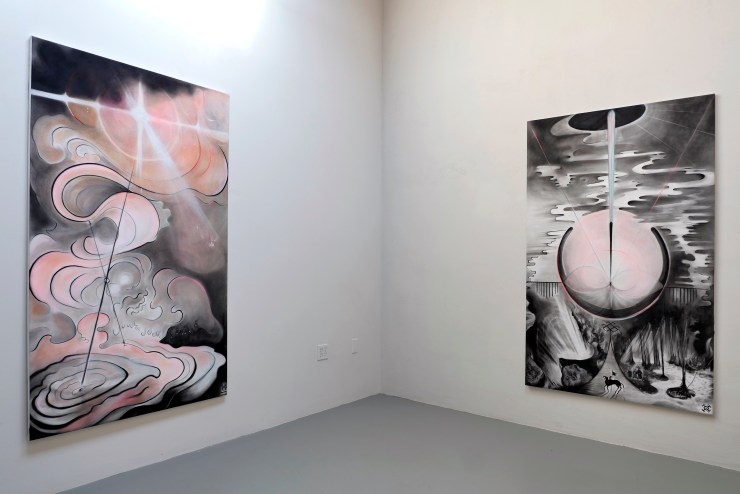
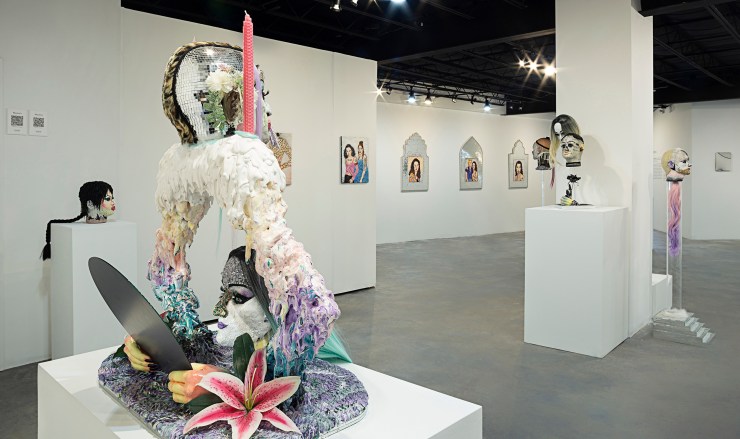
Mahsa Merci, Silent Stars, Mayten’s Projects. 2021. Image courtesy of Amir Sohrabpour / Mayten’s.

Interview by Adi Berardini

Mahsa Merci is interested in challenging society’s traditional concepts of beauty. Through her paintings, sculptures, and mixed media work she expands notions of the gender binary by depicting queer, trans and gender non-conforming individuals using viscous oil paint and building up layered textures. Born in Tehran, Iran, Merci holds a Bachelor’s degree in Graphic Design from Tehran University of Art and a Master of Painting from Azad University. Currently based in Toronto, ON, she has recently completed her Master of Fine Arts at the University of Manitoba, Canada.

In her latest exhibition Silent Stars at Mayten’s Projects, Merci displays two years of work examining the restrictiveness of social norms that affect the LGBTQIA+ community. Merci explains how “painting is one of the best ways to challenge strict binaries.” Through bending the binaries between man and woman, and beauty and the grotesque, she invites the viewer in closer to her work to experience the textures and relate to her subjects.

Along with her queer portraiture, in Silent Stars Merci explores the terrain of sculpture, often referencing Islamic architecture and broader queer culture. For example, her sculpture Find Yourself Through Myself consists of a figure with light teal hair peering into a mirror of another among a shrine of sequins and pastel pink candles, evoking both oral sex and self-reflection. Also referencing Islamic architecture and miniature painting, Merci includes portraits as an homage to the Iranian LGBTQ+ community. Merci’s depiction of identity is not edited or airbrushed, but displays imperfections and flaws, challenging society’s restricting binaries and expectations.

You depict the queer community, particularly drag queens, gender non-conforming, and transgender people in your work. How did you first decide on depicting the queer community as your subject matter?

I always worked on gender identity, beauty, and sexuality as a subject in my country [for] more than 10 years. In 2017, I was watching a documentary about a transgender [individual] in Iran who had to leave for Turkey since they could not live in our country. That documentary was like a hammer on my mind. I could see beauty, grotesque, sadness, all of these things. I started to work on this subject in 2018 and one year later, I understood my sexuality when I was 28 years old. After that, I understood why I decided to work on this subject in my art career. My subconscious knew about it, but my conscious mind didn’t know about it at all. We don’t have any education or educational materials, living in a religious country. When the educational materials don’t exist, how can you understand your sexuality soon and in a good way? In 2018, I understood my sexuality, but it was so hard for me until now.

I can relate in a way. I felt like I was late coming into my sexuality as well. It took me until my early 20s to clue in that this is who I am, and this is who I’ve always been. But because of religion or compulsory heterosexuality, you lose that.

Exactly. It’s hard to know that you are part of this community when you don’t see anyone, or you don’t hear anything, it takes so much time to find it. It is not easy.

Mahsa Merci, Stay, Oil on Canvas. 30 x 40 cm. 2020.

Can you talk further about how you use painting to challenge binaries such as masculinity/femininity, beauty/ugliness, etc.? In what ways are interested in redefining societal beauty standards through painting?

I can say I am multidisciplinary [since] I’m working with so many materials—I’m working with painting, sculpture, animation, collage, so many things. But with painting I [can] find something so special. I never had an academic background with painting, I never had an apple on a table that I had to paint. When I’m painting, it’s like I print the portrait—I start to build up the materials and textures. I find painting as a material that I can show myself [through]. I’ve always really liked to share the spectrum of everything: softness and harshness, beauty and grotesque, femininity and masculinity and I find that painting can help me to do it. Every stroke with my brush that I do I feel myself in it.

I want to make an atmosphere that the audience wants to come closer to the portrait. Heterosexual [people] may not want to come closer to our community. I don’t want to have two categories, heterosexual and homosexual, I want to see more friendship together.

Your work uses a great amount of texture through the building up of paint. Can you explain more about your use of texture and its significance?

I work with oil colours which help me get the textures that I use. I like working with oil on small portraits that invite the audience in closer to see the portraits. When paintings are larger, physically the viewers need to go far to view it. I want to make an atmosphere that the audience wants to come closer to the portrait. Heterosexual [people] may not want to come closer to our community. I don’t want to have two categories, heterosexual and homosexual, I want to see more friendship together. I want them to come and see the portrait and see the details, the textures, the beauty, and the grotesque of the characters. Some parts come out of the canvas, like nose, lips, hairs, and jewellery—they are 3D works and not flat works. It’s kind of a metaphor for me to show that these are real people. I want to show the feeling that they are coming out of the canvas.

Mahsa Merci, Silent Stars, Mayten’s Projects. 2021. Image courtesy of Amir Sohrabpour / Mayten’s..

Can you explain your inspiration for your latest show, Silent Stars at Maytens?

The main inspiration is myself and the challenges and concerns that I am facing as a queer person. I always look at the other LGBTQIA+ people all over the world. I feel all of us have the same problems living in a patriarchal society, but the level is just a bit higher or lower. Sometimes when I see my friends and some portraits on social media or the website, they are an inspiration to me—their clothes and the queer culture. Then, I reach out to them and paint them. I am inspired by two books, Gender Trouble by Judith Butler and Women with Mustaches and Men without Beards written by Afsaneh Najmabadi, an Iranian writer.

Mahsa Merci, Silent Stars, Mayten’s Projects. 2021. Image courtesy of Amir Sohrabpour / Mayten’s.

Your work featured in Silent Stars also plays upon sculptural and Islamic architectural elements. Can you speak further about these elements in your work?

The inspiration is from the book I mentioned, Women with Mustaches and Men without Beards written by Afsaneh Najmabadi. She is an Iranian professor from Harvard working on gender, sexual identity, and beauty in ancient Iran. Through reading this book, I found that there was no heterosexuality or homosexuality in ancient Iran. It was surprising to me that two men or two women could have love or a relationship together without judging or explaining it to anyone. You can see in the paintings that the male and female clothing was the same. But when the Europeans came, they changed the culture little by little. They enforced the idea that men and women should be together. Now, if you are part of the LGBTQ+ community in Iran, you [may wish to] escape from the country or not say it too loudly since your life can be threatened by your family or your government. Although it is not us, it was brought to us.

The portraits inside the mirror frame are all Iranian LGBTQ+ [people]: one of them is queer, one is bisexual, and in the middle two portraits; one of them is lesbian, and one is non-binary. I wanted to [display] Iranian LGBTQ+ people as monumental. I get the shape of the mirrors from a very old and traditional Iranian art called miniature. Miniatures are very old paintings that Iranians and Persians painted of a building, spaces, or narratives with very, very small brushes. It is very special.

Do you have any upcoming projects that you would like to speak further about or things you’re working on?

I just moved from Winnipeg to Toronto. I still don’t have a studio, so I don’t have any big project or exhibition planned. Although, a project I’d really like to start is to make more sculptures. I found that sculpture can show very different things than painting can, so I’d like to continue that. I also want to take more photography from the background of drag shows. I have so many ideas from quarantine that I’d like to do.

You can view more of Mahsa Merci’s work on her website and social media. The Silent Stars exhibition is on display at Mayten’s Projects until January 15, 2022.

Outdoor School Edited by Diane Borsato and Amish Morrell

Outdoor School: Contemporary Environmental Art Edited by Amish Morrell and Diane Borsato cover image. Photo courtesy of Douglas and McIntyre.

By Ashley Culver

In the past year or so due to the ongoing covid pandemic many of us, myself included, have found pleasure in being in nature[1]; yet, social distancing has meant this is often a solo activity. While Outdoor School: Contemporary Environmental Art was likely not written to address our current lack of collective engagement within nature, it does just that by gathering a multitude of artists, farmers, writers, facilitators, collaborators, and thinkers. Outdoor School offers dialogue around ways to be outside together and connect with the natural environment. This book is edited by Diane Borsato, a visual artist with a relational, interventionist and performance practice, and Amish Morrell, an editor, curator, and writer. It is a collection of 150 photographs and fifteen contributions including a foreword by Ann MacDonald, director and curator of the Doris McCarthy Gallery, along with Alana Bartol, Jacqueline Bell, Diane Borsato, Bill Burns, Carolina Caycedo, Jen Delos Reyes, Sameer Farooq, FASTWÜRMS, Jeneen Frei Njootli, Ayumi Goto, Maggie Groat, Karen Houle, Hannah Jickling and Reed H. Reed, Gabrielle L’Hirondelle Hill, Rita McKeough, Peter Morin, Amish Morrell, Public Studio, Genevieve Robertson, Jamie Ross, Aislinn Thomas, Vibrant Matter, Georgiana Uhlyarik, Jay White, Tania Willard, Terri-Lynn Williams-Davidson, and D’Arcy Wilson. With all of these voices meeting within the pages of Outdoor School, the book offers a complex conversation of art and nature.

Ayumi Goto, Rinrigaku, 2016. Photo: Yuula Benivolski.
Ayumi Goto Artist and organizer Ayumi Goto’s project focused on the idea of “passing through” the land as temporary occupants, and the responsibility that this entails. She ran the areas around the University of Toronto Scarborough campus for three days as a practice that aimed to honour and become better acquainted with traditional Indigenous territories and passages. Goto posits that running is a means of “passing through” and a practice by which we can develop a more respectful relationship with the land beneath our feet. The public was invited to join the artist as she ran each day, beginning at the Doris McCarthy Gallery. Scarborough, Ontario, 2016. Photo courtesy of Douglas and McIntyre.

I admit to feeling a high level of FOMO (fear of missing out) when flipping through the large publication for the first time. The cover image shows dozens of artists and mathematicians in bathing suits venturing into a glacier-fed river surrounded by evergreen trees – everyone including plants and humans bathed in golden sunlight. Another image near the beginning shows Diane Borsato and Amish Morrell holding hands with a young boy facing a gallery full of mushroom foray participants outfitted in rubber boots, and waterproof jackets, some holding red Tim Hortons coffee cups and wicker baskets.[2] Another of people congregating around two glowing points: a beach fire and LED light. The circles of faces lit by warm and blue glow respectively are engulfed by darkness with a couple stars and whiffs of clouds visible in the sky above the outline of treetops[3]. Further in on page 86, there is an image of about a dozen people sitting cross-legged on pebbly ground. There are charts of flowers and mushrooms as well as guidebooks, water bottles, and backpacks strewn in-between their knees. My knee-jerk FOMO stems from having missed out on the specific exhibitions, residencies, outings, walks and such described in Outdoor School or even more so from the lack of togetherness these days. These gatherings are a long way from anything I have experienced this year. I live in Toronto, where many of the contributors also reside, and Toronto residents experienced the longest lockdown in North America[4] this year – the same year Outdoor School was published.

Deirdre Fraser-Gudrunas/Vibrant Matter, Plant Identification Workshop, Scarborough ON. 2016. PHOTO: Natalie Logan.
In this workshop, artist-forager Deirdre Fraser-Gudrunas/Vibrant Matter led sensorial and experiential field identification in the University of Toronto Scarborough campus woods and invited participants to contribute to a subjective field guide. Scarborough, Ontario, 2016. Photo courtesy of Douglas and McIntyre.

It’s easy to feel some FOMO when reading Outdoor School; yet, when read with the same tone of curiosity, attentiveness, and openness the book takes and the artists included bring to their work, it is the opposite of the sensation of lacking. It points to possibilities. It is a guidebook for new ways of being in relation to each other and nature. As Borsato said, “We were looking for projects that reimagine our relationship to the outdoors, to nature and the land, that are rooted in performance and site-specificity. And also to teaching and learning.”[5]

My interactions with or into nature are much less spectacular than the ones highlighted in Outdoor School.  The insights shared in Outdoor School can be applied to our solitary activities at home and in our neighbourhoods. For instance, I can ponder Karen Houle’s ‘Farm as Ethics’[6] as I tend to my balcony garden of herbs: rosemary, two variations of mint, sage, and oregano that didn’t last the entire summer. I can think of the ‘Slow Walkers of Whycocomagh’[7] when I walk the railpath in the west end of Toronto. I can recall Terri-Lynn Williams-Davidson with Public Studio’s words in ‘The Earth’s Covenant’[8] when I speak to my mother, who lives on the West Coast, on the phone about the recent floods or what are now referred to as atmospheric rivers.[9]

Scarborough Mycological Foray, 2016. Photo: Natalie Logan. Photo courtesy of Douglas and McIntyre.

Even without partaking in any outdoorsy activities, I can contemplate Morrell’s land acknowledgment and consider my residence here. In ‘We Always Begin with an Acknowledgement of the Land’ Morrell recognizes “the Mississaugas of the Credit and the Anishinaabe, the Haudenosaunee and the Huron-Wendat, and the land agreements, like the Dish with One Spoon treaty.”[10]  However, he goes further than simply speaking their names by exploring how one connects to place and community as well as some of the problematic aspects of outdoor culture and education. This is not a land acknowledgement spoken out of obligation but thoughtful practice.

By shifting from feeling left out to joining in through participating in this new iteration of Outdoor School in the form of a book by reading, I find a new understanding of my relationship to the earth. In a period where many of us are seeking solace in nature, Outdoor School encourages us to consider our presence and the practices we have. Gathering almost thirty artists, the book activates the conversation of art and nature and how we fit into it.


[1] “Nature walks helping many relieve anxiety during COVID-19,” CBC, January 31, 2021, https://www.cbc.ca/news/canada/prince-edward-island/pei-nature-conservatory-1.5895421.

[2] Diane Borsato and Amish Morrell (with Feliz Morrell), “Mushroom Foray,” in Outdoor School Contemporary Environmental Art, ed. Amish Morrell and Diane Borsato (Madeira Park: Douglas and McIntyre Ltd., 2021), Page 16.

[3] BUSH Gallery with Lisa Myers, Akwesasne Women Singers, imagineNATIVE Film + Media Arts Festival, “Beach(fire) Blanket Bingo Biennial,” in Outdoor School Contemporary Environmental Art, ed. Amish Morrell and Diane Borsato (Madeira Park: Douglas and McIntyre Ltd., 2021), Page 32.

[4] Robin Levinson-King, “Toronto lockdown – one of the world’s longest?,” BBC, May 24, 2020, https://www.bbc.com/news/world-us-canada-57079577.

[5] Diane Borsato and Amish Morrell, “Artist Spotlight: Contemporary art goes outdoors,” AGO Insider, May 26, 2021, https://ago.ca/agoinsider/contemporary-art-goes-outdoors.

[6] Karen Houle, “Farm as Ethics,” in Outdoor School Contemporary Environmental Art, ed. Amish Morrell and Diane Borsato (Madeira Park: Douglas and McIntyre Ltd., 2021), Page 88-99.

[7] Aislinn Thomas, “Slow Walker of Whycocomagh and Mountains Used to Be Ugl,” in Outdoor School Contemporary Environmental Art, ed. Amish Morrell and Diane Borsato (Madeira Park: Douglas and McIntyre Ltd., 2021), Page 120-123.

[8] Terri-Lynn Williams-Davidson with Public Studio, “The Rights of Nature,” in Outdoor School Contemporary Environmental Art, ed. Amish Morrell and Diane Borsato (Madeira Park: Douglas and McIntyre Ltd., 2021), Page 166-169.

[9] “What are atmospheric rivers, and how are they affecting the B.C. floods?,” CBC radio, November 18, 2021, https://www.cbc.ca/radio/whatonearth/what-are-atmospheric-rivers-and-how-are-they-affecting-the-b-c-floods-1.6253763.

[10] Amish Morrell, “We Always Begin with an Acknowledgement of the Land,” in Outdoor School Contemporary Environmental Art, ed. Amish Morrell and Diane Borsato (Madeira Park: Douglas and McIntyre Ltd., 2021), Page 19.

Can’t Buy Me Love: A Review of Sara Cwynar’s Source

Remai Modern, Saskatoon, SK

January 30- August 22, 2021


Sara Cwynar, Source, 2021, digital prints, Plexiglas, custom frame structure. Courtesy of the artist; Cooper Cole Gallery, Toronto; and Foxy Production, New York. Photo: Blaine Campbell.

By Madeline Bogoch

            “Beauty is a currency system like the gold standard,” claimed writer Naomi Wolf in her 1990 bestseller The Beauty Myth. I hesitate to open with this quote, as much of the book has not aged well, and Wolf’s recent gleeful tirades against vaccination and public health measures have further discredited any cultural authority the text still held. Despite these detractions, the notion of beauty as a political ideal has endured and is the conceptual terrain explored by artist Sara Cwynar in her recent exhibition, Source. Those familiar with Cwynar’s prior work will recognize the artist’s signature mix of vintage props and feminist-inflected pop-culture critique, tropes which are instrumentalized in Source to examine how late capitalism dictates our collective visual language.


Sara Cwynar, Red Film, 2018, 16mm film transferred to video, 13:00 minutes. Courtesy of the artist; Cooper Cole Gallery, Toronto; and Foxy Production, New York. Photo: Blaine Campbell.

            At the beginning of Red Film, the narrator states: “I am talking about American patterns and French painters” as a variety of cosmetics named for the painter Cézanne are displayed. Red Film is the third installment in a trilogy exploring how beauty and desirability are quantified and is featured here as part of the exhibition. The film is presented alongside two other works by Cwynar: Guide, a series of large-scale photographs, and an installation (also titled) Source, comprising a double-layered glass partition stretching across the length of the gallery. Within the plexiglass, Cwynar displays a collection of found images and texts that broadly elicit the themes synthesized in the rest of the show. The materials include a selection of critical theory texts (highlighted and underlined, evoking a lived-in quality), fashion and nature photography, and reproductions of historical paintings. Marilyn Monroe appears in paper doll form, a recurring figure in Cwynar’s work, and an icon of beauty reinforced by endless reproduction. Monroe’s presence acts as a foil to Cwynar’s textual sources, highlighting the cognitive dissonance between the desire for beauty and an awareness of its most toxic machinations, a tension palpably felt throughout the exhibition.

As feminist discourse has entered the mainstream, it’s an idea that has been exploited for profit by mobilizing the language of empowerment to sell consumer goods.

            Trained as a graphic designer, Cwynar’s visually seductive works demonstrate a honed fluency in commercial aesthetics. Her design background is most apparent in Guide, a selection of vinyl photographs plastered across the gallery walls, with smaller monitors embedded in them. If Source reflects Cwynar’s studio process of gathering materials, then Guide represents the intermediary phase, during which the synaptic nodes between the sources begin to take shape. This sense of provisionality is emphasized by Cwynar’s use of a green screen in several photos, one of which features her mid-scream, wearing Air Pods and a t-shirt printed with a portrait of Bernie Sanders alongside text reading “Rage Against the Machine.” With a degree of embarrassment, I’ll admit to recognizing the shirt, which was well-publicized after being worn by model Emily Ratajkowski last year—more on her later. Socialism, like feminism, could be said to be having a moment, as evidenced by the cult popularity of the shirt and Sanders himself. Yet Cwynar’s expression of inner conflict suggests an awareness of the limitation of consumerism as a form of political consciousness. While not mutually exclusive, the image evokes a timely consideration of the representation of politics versus the practice of one.


Sara Cwynar, Guide (detail),2021,vinyl print and videos on monitors. Courtesy of the artist; Cooper Cole Gallery, Toronto; and Foxy Production, New York. Photo: Blaine Campbell.


            Included in the plexiglass partition is an essay by the aforementioned Ratajkowski titled “Buying Myself Back: When Does a Model Own Her Own Image.”[1]The essay details the author’s experience being dispossessed of her visual likeness and the challenge of regaining control in an era of rampant image proliferation and commodification. The piece received considerable attention, garnering both praise, for Ratajkowski’s frank and engaging writing style, and backlash from those quick to point out the hypocrisy of the author condemning an industry while continuing to profit from it significantly. Ratajkowski is not alone in her conflation of financial success and empowerment, but to follow this suggestion to its logical conclusion leads to a bleak assessment of the potential of feminist politics to serve anyone other than the wealthiest and most privileged women. As feminist discourse has entered the mainstream, it’s an idea that has been exploited for profit by mobilizing the language of empowerment to sell consumer goods. This very phenomenon is parodied in Red Film when the artist declares, “I am speaking now from the inside of power… Woman creates life, man creates art, but not anymore suckers. I can buy anything I want.” But of course, what we want is not immune from politics—beauty, and the allure of that which promises us access to it are both manufactured products. The cheeky and ambivalent tone in which Cwynar delivers the line suggests that she is acutely aware of how easily dissent is co-opted by the systems it seeks to dismantle.

Sara Cwynar, Guide (detail),2021,vinyl print and videos on monitors. Courtesy of the artist; Cooper Cole Gallery, Toronto; and Foxy Production, New York. Photo: Blaine Campbell.

            There’s a self-reflexive underpinning to Cwynar’s brand of critique. Implicated in her line of questioning is art itself, particularly its dual function as both a tool of cultural critique and a luxury commodity. Cwynar implicates art (and artists) as part of a system that sustains the symbolic efficiency of desire and beauty. Although this exchange is most explicitly played out in Source through references to Baroque and Impressionist art, this transaction remains relevant to the contemporary landscape in which artists are incentivized to participate in self-branding, and cultural capital is increasingly brokered as a liquid asset.

            Throughout Red Film the narrator offers a barrage of cryptic statements against an ever-changing backdrop of imagery including red-clad dancers, the hypnotic mechanical motions of a cosmetic production line, and a close-up of boldly painted red lips belonging to Cwynar’s frequent collaborator, Tracy Ma. At one point Cwynar appears onscreen, but as she opens her mouth to speak, the voice that comes out is not hers but that of the calm and self-possessed male narrator. Reminiscent of Mark Fisher’s “slow cancellation of the future,”[2] which mourns the cessation of novelty in a culture of endless recirculation, Cwynar evokes the familiar anxiety of inauthenticity, that our ideas and words are not our own but merely poor imitations of sources we’ve absorbed along the way. While Cwynar exposes how both desire and beauty are fraught constructs, she stops short of implying we are powerless in this. We may never fully extricate what we want from what we’re told we ought to want, but detangling the knots which form our desires remains a worthwhile endeavour. As Cwynar says in Red Film, “I am living in the space between pure desire and actual enjoyment, and I don’t mind at all.”


[1] Emily Ratajkowski, “Buying Myself Back When does a model own her own image?” The Cut, September 15, 2020, https://www.thecut.com/article/emily-ratajkowski-owning-my-image-essay.html.

[2] Mark Fisher, Ghosts of My Life: Writings on Depression, Hauntology, and Lost Futures (United Kingdom: Zero Books, 2013).


The Possibility of Existence By Shigeru Onishi

Reintroducing the Forgotten Masterpieces

The Possibility of Existence

Foam, Amsterdam

September 17, 2021 – January 9, 2022

The Flicker Phase, 1950s © Estate of Shigeru Onishi, care of Tomoharu Onishi, courtesy of MEM, Tokyo.⁠

By Nona Chen

Fotografiemuseum Amsterdam pays homage to the career of a forgotten artist in this monumental first solo exhibition of Shigeru Onishi’s photographic works in Europe. Surreal and captivating, Onishi’s compositions selected for The Possibility of Existence elicit questions concerning life, memory, and reality. The inaugural exhibition curated by Mirjam Kooiman features fifty photographs and one painting by the artist, presenting a body of work in line with Onishi’s style of “transcend[ing] time and space.”[1] The curation appropriately conceptualizes a nonlinear progression by arranging the photographs sans chronology (with the exception of a painting in the concluding position) with no singular theme dominating a room. The result: a stunning compilation of Onishi’s most quintessential artworks.

Title unknown, 1950s © Estate of Shigeru Onishi, care of Tomoharu Onishi, courtesy of MEM, Tokyo.⁠

Born in 1928 in Takahashi, Japan, Shigeru Onishi studied topology before pursuing a career in art. His background in mathematics persists in his photographs; by layering together a montage of fragmented scenes into one image, he constructs a picture that appears to collapse time and space. This technique is consistent throughout his photographic oeuvre featuring bodies, domestic scenes, nature, inanimate objects, and indistinguishable shapes combined to create images that speak to a sense of intimacy and uncertainty. Vincente Todolí comments on the subject: “Onishi’s photography has a performance element; it is presented as an act. He brings freedom to the photographic process,” explains the artistic director and curator of the exhibition at Bombas Gens, whose collaboration is allowing the collection to be exhibited at Foam.[2] After 1957, Onishi renounced photography and transitioned to creating abstract ink paintings in a style described by art critic and curator Michel Tapié as informal art: art that “focused solely on the act of painting itself”[3] of which form is merely a side effect. Onishi worked exclusively in this medium until his death in 1994.

Onishi’s role appears to be one of reconciling contradictory motifs, blurring the lines between photography and painting, reality and imagination, organic and inorganic, and thus, existence and oblivion.

The exhibition at Foam opens in a gallery of black and white walls that reflect the contrasting values of Onishi’s work. The photographs throughout demonstrate a profound skill for manipulating images into dreamlike compositions using multiple exposures, fragmented components, and unconventional developing techniques, establishing Onishi as a pioneer of Japanese photography of his time. His method of using a brush to apply the emulsion during the development process creates distinct strokes that cut boldly across a photograph and contribute to the abstract nature of his compositions. Though the selection of objects is exclusive to Onishi’s achromatic works, the pieces—some in high contrast and others blended into a murky greyscale—are anything but homogeneous. One photograph overlays several exposures of a smiling face averted from the lens, a wrinkled hand splayed over a checker-patterned fabric, and swirling streaks of emulsion; another overlaps silhouettes of barren trees and irregular rings of brightness across a dark grey haze. Dark juxtaposed with light, anonymous figures, and blurry, indefinite forms suggest the presence of meaning in the face of obscurity while underscoring photography’s purpose in capturing the transitive moments of life. Onishi’s role appears to be one of reconciling contradictory motifs, blurring the lines between photography and painting, reality and imagination, organic and inorganic, and thus, existence and oblivion.

Title unknown, 1950s © Estate of Shigeru Onishi, care of Tomoharu Onishi, courtesy of MEM, Tokyo.⁠

Foam’s curation effectively balances contrasting artworks to create a visually varied yet congruent experience. Only one isolated section of the gallery presents some pieces unilaterally in a rather condensed row along one wall. Although economical, this secluded area sacrifices the individuality of the photographs and allows little room for contemplation. Despite the shortcomings of the space, the unifying element was the decision to arrange two photographs of the same subject—the broad leaves of a flowering plant—directly mirroring each other at either end of the hallway to provide an intentional symmetry that ties the room together.

The final room of the gallery displays independently on one wall a colossal untitled painting by Onishi that surpasses in size the rest of the photographs. A work of towering, deliberate black brushstrokes and inky grey spatters vividly contrasting a white surface, the painting is evidently the outstanding feature of the exhibition. Onishi’s own hand is unmistakable—the brushwork of the painting mirrors the same strokes used for the unique developing process of his earlier photographs. The painting, in line with the motifs of Onishi’s body of work, presents both a reflection of the artist’s enduring stylistic consistency and a marked deviation from his long-standing career in the medium of photography.

Title unknown, 1950s © Estate of Shigeru Onishi, care of Tomoharu Onishi, courtesy of MEM, Tokyo.⁠

Considering Foam primarily shows photographic works, the unorthodox decision to exhibit a painting is bold but essential when taking into account the significance of Onishi’s experimentation in both mediums. With only one monumental painting among fifty photographs, there is a clear attempt to emphasize the role of painting without monopolizing the primary directive of a photography exhibition (and museum). Some might consider the notion of having a painting, and such a large one at that, as the culminating act of the exhibition—and therefore insinuating its unique prominence with respect to the photographic works—to be antithetical to the mission of the museum whose tagline, after all, is “We are all about photography.” Yet, how else to captivate audiences with a debut exhibition showcasing the revolutionary career of an artist deprived of the recognition he undeniably deserves? A memorable occasion necessitates a departure from tradition.

            Foam has masterfully compiled Onishi’s artworks into a narrative as captivating as the artist’s photographs themselves, with the themes composed by Kooiman profoundly and authentically reflecting the artist’s objectives in context of his career. The Possibility of Existence is not an occasion solely to appreciate Shigeru Onishi so much as it is a celebration of artists not yet realized in the canon of contemporary art. Such an ambitious revival of an extraordinary artistic career propels 20th century Japanese photography to the forefront of contemporary art discourse. The decisions made towards this delicate task of balancing the inclusion of the most crucial elements of the artist’s career, the devotion to a novel exhibition, and a faithfulness to the goals of the museum are commendable.


[1]“Shigeru Onishi – the Possibility of Existence: Now at Foam.” Foam. 2021. Accessed October 14, 2021. https://www.foam.org/museum/programme/shigeru-onishi-the-possibility-of-existence.

[2]Gloria Crespo MacLennan. “Shigeru Onishi, photography as a gesture.” The Limited Times. September 24, 2021. Accessed October 14, 2021. https://newsrnd.com/news/2021-09-23-shigeru-onishi–photography-as-a-gesture.Hy4fItd9QK.html

[3] Edizioni Galleria D’Arte Cortina, Milan, April 1969. Retrieved from museum label October 11, 2021.

5 Must-Read Books by Trans and Non-Binary Authors

By Adi Berardini

To celebrate and recognize Trans Awareness Week from November 13-November 19, Femme Art Review has once again highlighted books written by transgender and non-binary authors for what we deem as “Trans Lit Week.” By sharing the books of transgender and non-binary authors, we hope it will help increase awareness of trans stories and experiences. Many of our favourite books are by trans and non-binary authors so read on and find a new favourite!

I Hope We Choose Love: A Trans Girl’s Notes from the End of the World by Kai Cheng Thom.

I Hope We Choose Love: A Trans Girl’s Notes from the End of the World

by Kai Cheng Thom


First featured is I Hope We Choose Love: A Trans Girl’s Notes from the End of the World by acclaimed poet and author Kai Cheng Thom. This book dives deep into the questions that haunt social movements today through a collection of heartbreaking yet hopeful personal essays and prose poems. I Hope We Choose Love “proposes heartfelt solutions on the topics of violence, complicity, family, vengeance, and forgiveness…This provocative book is a call for nuance in a time of political polarization, for healing in a time of justice, and for love in an apocalypse.” (Adapted summary via Arsenal Pulp Press)

Gender Outlaw: On Men, Women and the Rest of Us by Kate Bornstein.

Gender Outlaw: On Men, Women and the Rest of Us

by Kate Bornstein


In Gender Outlaw, first published in 1994 yet decades ahead of its time, Bornstein takes readers on a “wonderfully scenic journey across the terrains of gender and identity. On one level, Gender Outlaw details Bornstein’s transformation from heterosexual man to lesbian woman, from a one-time IBM salesperson to a playwright and performance artist. But this coming-of-age story is also a provocative investigation into our notions of male and female, from a self-described “nonbinary transfeminine diesel femme dyke” who never stops questioning our cultural assumptions.” (Adapted summary via Vintage Books)

Dear Senthuran: A Black Spirit Memoir by Akwaeke Emezi.

Dear Senthuran: A Black Spirit Memoir

by Akwaeke Emezi

In Dear Senthuran: A Black Spirit Memoir, best-selling author Akwaeke Emezi “reveals the harrowing yet resolute truths of their own life. Through candid, intimate correspondence with friends, lovers, and family, Emezi traces the unfolding of a self and the unforgettable journey of a creative spirit stepping into power in the human world. Their story weaves through transformative decisions about their gender and body, their precipitous path to success as a writer, and the turmoil of relationships on an emotional, romantic, and spiritual plane, culminating in a book that is as tender as it is brutal.” (text via Penguin Random House).

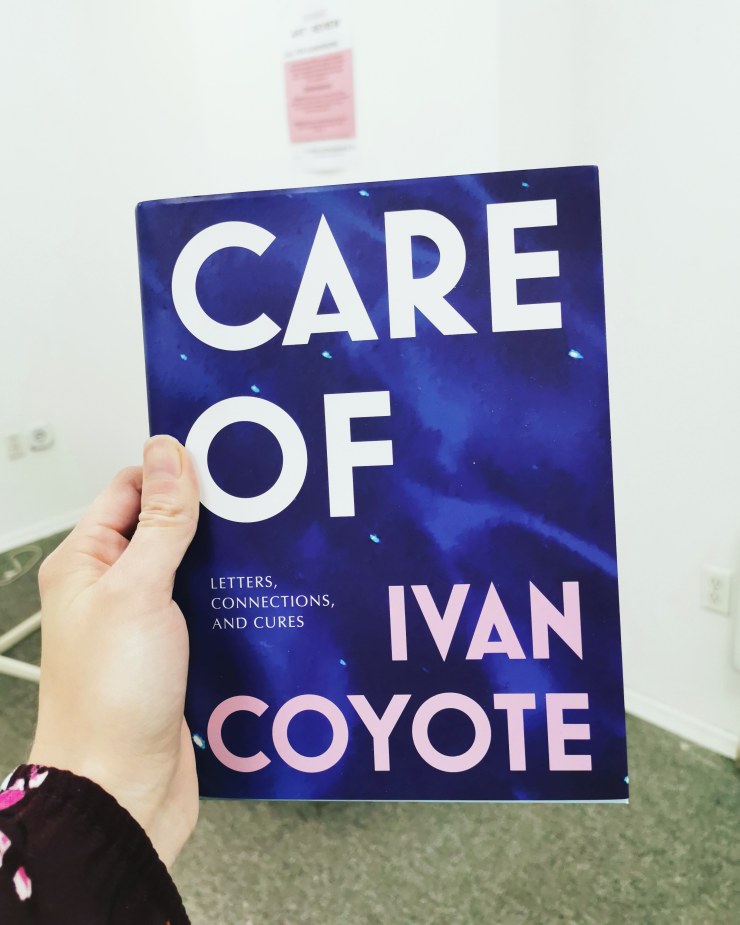
Care Of: Letters, Connections, and Cures by Ivan Coyote.

Care Of: Letters, Connections, and Cures

by Ivan Coyote


Storyteller Ivan Coyote has spent years on the road collecting letters from audience members and readers. Like many other artists, they found themselves at a standstill with the pandemic in early 2020. Their latest book Care Of combines the most powerful of letters they have received over time with their responses, creating a body of intimate correspondence. Taken together, “they become an affirming and joyous reflection on many of the themes central to Coyote’s celebrated work—compassion and empathy, family fragility, non-binary and trans identity, and the unending beauty of simply being alive.” (Adapted summary via Penguin Random House).

I’m Afraid of Men by Vivek Shraya

I’m Afraid of Men

by Vivek Shraya

Last but certainly not least, is I’m Afraid of Men by Vivek Shraya—a must-read about toxic masculinity, patriarchy, and accountability. In this book, Shraya unpacks both her fear and desire as a trans woman, delivering an “important record of the cumulative damage caused by misogyny, homophobia, and transphobia, releasing trauma from a body that has always refused to assimilate. I’m Afraid of Men is a blueprint for how we might cherish what makes us different and conquer what makes us afraid.” (Adapted summary from Penguin Random House).

We hope that you enjoy this selection and check out some of these books!

Tufting the Everyday: In Conversation with Mychaelyn Michalec

Mychaelyn Michalec.It’s not attractive for every use base. 42 x 42. 2021. Hand and machine tufted yarn rug on stretched cloth. Photo courtesy of the artist.

Interview by Adi Berardini

Mychaelyn Michalec is a fiber artist and painter based in Dayton, Ohio, depicting the mundane matters of domestic life and translating the documented scenes into tufted rug tableaus. Her meticulous tufting often features imagery in bed with her partner or her son looking nonchalant with his phone in the background. Addressing the “gendered issues of caretaking addressing both invisible and emotional labour,” Michalec’s work explores her home life with her partner and child and what it means to be an artist and a mother. She is also interested in the influence of life decisions and the ever-present force of technology in our lives, depicting text conversation bubbles and juxtaposing the tactility of texting with her textile work.

Michalec earned a BFA with distinction in Painting and Drawing and a BA in Art History from The Ohio State University and an MLIS in Library and Information Science from the University of Southern Mississippi. She has shown her work internationally and has been awarded residencies at The Vermont Studio Center in Johnson, VT, the Sam and Adele Golden Foundation for the Arts Residency in New Berlin, NY, and The Kimmel Harding Nelson Center for the Arts, in Nebraska City, NE. Additionally, Michalec is a 2021 recipient of an Individual Excellence Award in Craft from the Ohio Arts Council.

You capture everyday domestic scenes with your partner and family in your work. Can you speak more about the meaning behind capturing these domestic scenes for you as an artist?  

 I think a lot about Virginia Woolf bemoaning of “the accumulation of unrecorded life” in A Room of One’s Own. Women are disadvantaged by the lack of a comprehensive narrative of their own history. The quotidian is something that drives my work. I took a break from my studio practice that lasted over a decade. For me, the drive for making work again became about the thing that I felt prevented me from making work in the first place, which was everyday life. So, the work is a direct portrayal of the complexities of contemporary family life. 

Mychaelyn Michalec. I thought things were better but they were not. 2021. 35 x 28 IN. hand and machine tufted yarn rug. Photo courtesy of the artist.

I have followed your work in the past couple of years, and how you’ve transitioned from using paint to using textiles as a medium. Can you explain more about this transition and its significance to your practice?

 When I was painting with pigments, I was considering different ways to bring my concept full circle in both terms of material and subject matter. My subject matter, the domestic, the mundane is often critically overlooked, so I feel like craft which is often considered a lesser artform in some aspect is a good pairing for this work. I started looking at different methods and traditions in domestic craft that might suit the way I wanted to create.

I love the immediacy of paint on canvas, so a process like weaving wasn’t an option for me. I saw a video of an industrial rug tufting gun in my searches, and I thought that it looked great, and I could draw with it. I started teaching myself how to make rugs about 4 years ago. Some people see this as a huge transition, but I feel like what I do is still painting. Sure, I am using textiles and technically they are rugs, but I frequently stretch the rugs over stretchers just like paintings. A lot of utility is stripped just from their presentation alone. 

My subject matter, the domestic, the mundane is often critically overlooked, so I feel like craft which is often considered a lesser artform in some aspect is a good pairing for this work.

Mychaelyn Michalec. Mom@work on Facebook. 2021. 36 x 18. Hand and machine tufted yarn rug. Photo courtesy of the artist.

There’s an interesting tension at play since you use textiles and rug tufting to capture everyday life that is often dependent on technology and screens like texting, zoom, and phones, which are more urgent and fast-paced. Can you speak more about this juxtaposition?  

I think something is interesting in the works of artists who take things that are so fleeting and ethereal as screenshots and phone photos and recreate them using processes that are so labor-intensive. It was Berger who said, “We never look just at one thing, we are always looking at the relation between things and ourselves.” The contemporary nature of carrying a tiny computer around with us always is that we are constantly inundated with the visual and I can’t imagine we give it much thought due to this bombardment. But I do think something interesting happens when you turn these visual castaways into things. I am still figuring out these tensions.

Mychaelyn Michalec.I’m doing a poor job with life at this moment. 2021. 18 x 19 IN. Hand and machine tufted yarn rug. Photo courtesy of the artist.

Can you talk further about your interest in humour in your practice? 

I admire artists who can successfully employ humour in their works. 

I find that it is both difficult to do successfully and a necessary way to express my feelings. There is a duality to my life. I have both chosen a more conventional lifestyle—a partner, children and I also loathe the conventionality of my choices because as artists we [can] see all possibilities. I think humour helps me to address what I love and what I hate about my life.

Who are some artists that you are inspired by? 

I will only talk about living, working artists because the dead ones don’t need more credit. I love the work of Erin M. Riley (@erinmriley), not only is she extremely hardworking and dedicated to her practice but her work is unbelievable. It is some of the most powerful contemporary work about women I have seen. I also think that Meg Lipke (@meglipke) is an amazing artist. Her work is such a fine example of contemporary textile work- it is painting, it is sculpture. Meg is also very generous with her time and community building which is something that also inspires me. Plus, my three friends who I always bounce ideas off and share my failures and triumphs with- textile artist Heather Jones (@heatherjonesstudio), sculptor and painter Bridgette Bogle (@bridgettebogle), and painter Tania Alvarez (@taniaalvarezart).

Do you have any recent or future projects and exhibitions you’d like to mention? 

Currently, I’m the artist in residence at The Object Hotel in Bisbee, Arizona. All That We Went Though was for Nothing, a solo show of my work is opening in December at Sean Christopher Gallery in Columbus, OH.

You can find more of Mychaelyn Michalec’s work on her website and Instagram.

Glitch Feminism by Legacy Russell


Glitch Feminism: A Manifesto by Legacy Russell cover. Photo via Verso Books.

By Pauline Nguyen

Legacy Russell opens Glitch Feminism, a part-manifesto, part-art criticism essay collection, by bringing us back to her early teens growing up in New York City. At twelve years old, she christens herself with the online username “LuvPunk12” — a cyborgic meeting of worlds: an “away from keyboard” (AFK) reality and an online digital reality. In reading Russell’s personal history as a Black queer femme experimenting with their selfdom, we’re thrown back to our own first forays into the internet, from first usernames to direct messaging platforms — all existing alongside our AFK names and relations.

Glitch Feminism: A Manifesto by Legacy Russell. Photograph by Pauline Nguyen.

Published in fall 2020, Glitch Feminism is a pocket-sized book and a fairly quick read. The twelve short chapters all circle back to Russell’s central argument: to embrace glitch, as failure and refusal, is to move towards possibilities for other ways of being, worlding, and collectivity beyond the logics of the gender binary, capitalism, and neoliberalism. Russell, who’s a celebrated curator, spotlights contemporary artists who they argue are putting glitch feminism into practice. Russell emphasizes queer, trans, and Black artists such as Juliana Huxtable, Kia LaBeija, and Shawné Michaelain Holloway. Glitch Feminism embeds itself into the realms of art, criticism and curation, queer and feminist thought, Black studies, digital cultures and new media, and critiques of capitalism.

Legacy Russell, author portrait by Andreas Laszlo Konrath. Courtesy of Verso Books.

Glitch Feminism continues the legacies of cyberfeminism and cyborg feminism by evoking questions of how the complexities of embodiment, so entwined with experiences of gender, queerness, and racialization, extend into digital realms. How can glitch, which at its core is refusal, be reworked as something wonderful in our feminist, queer, and anti-racist utopic envisioning and collective mobilizations? What does it mean to embody glitch, to embody malfunction?

How can glitch, which at its core is refusal, be reworked as something wonderful in our feminist, queer, and anti-racist utopic envisioning and collective mobilizations?

Glitch Feminism firmly maintains that digital, online worlds are as real as AFK, offline worlds. The belief that “in real life” (IRL) is solely physical and AFK is to discount the very realness of our online selves and interactions. In fact, as Russell demonstrates, the digital realm and the online realm are deeply intertwined, the boundary between them dissolving, with us travelling seamlessly through this expansive, multidimensional reality. As such, the bridge between the two is bountiful with productive refusals and potential for world-building — beyond the gender binary and its restrictive categorizations, resisting surveillance capitalism, through the queering of digital space.[1] Alongside this grounding argument is the understanding that all technology is architected by people under neoliberal capitalism, white supremacy, and heteropatriarchy; thus, it is never neutral, always political. This continuity between online and offline spaces means that we can program errors, breakdowns, viruses into the fabric of such multidimensional worlds.

The White Pube, Instagram post, courtesy of The White Pube.

As a conceptual framework, glitch reconfigures the typically pejorative way we view failure, brokenness, and the refusal to function. Instead, as Russell convincingly invites us to do, glitch should be welcomed — “the error a passageway” to constructing better worlds.[2] This is because, and here Russell situates glitch feminism in queer-of-colour theory by quoting José Esteban Muñoz: “…this world is not enough, that indeed something is missing.”[3] Russell draws on Shaadi Devereaux’s analysis of social media as a tool for marginalized women to reach each other, build collective support, and engage in conversation where they might usually be excluded in AFK domains.[4] To break, to dismantle, to fail fantastically in the face of a machine that expects us to keep carrying on as if it isn’t stifling and isn’t programmed to reward some and marginalize others. It is to carve fissures in existing, oppressive systems and its limitations on who we might be and what realms we might inhabit.

As discussed in the chapter “Glitch is Cosmic,” we as embodied beings are multitudinous and constantly becoming, never static and singular in our identities. A person’s virtual avatar is as real in cyberspace, or the “digital real,” as their offline self.[5] We can travel beyond what we typically think of as a body (that becomes gendered) to consider our virtual selves. To break through the confines of what counts as a body is to destabilize the dualistic delineations of normativity imposed upon bodies, including binary gender categories. If the body is “inconceivably vast” like the cosmos, then to queer is to expand potential for being, because, recalling Russell’s reference to Muñoz, there are gaps that must be filled, a queer ethos of yearning for more.[6] To glitch is to disrupt systems, sledgehammering holes into taken-for-granted logics of oppression — a queering in itself. Glitch is queer, queer is cosmic.

Victoria Sin, Performance at “Glitch @ Night” organized by Legacy Russell as part of Post – Cyber Feminist International, 2017, ICA London, courtesy of ICA London, photograph by Mark Blower.

The chapter themes seamlessly flow into each other and consistently circle back to the core ideas of productive refusal, expanding definitions of embodiment, and queer futurity. The chapter “Glitch is Remix” continues along the lines of disrupting what it means to have a body. Here, Russell faces the question of data and surveillance capitalism head-on by bringing in examples that glitch biometric technology and experiment with strategic visibility. This is key because visibility can be dangerous, especially for those considered non-normative or non-conforming under white supremacist, heteropatriarchal capitalism. The epigraph to the chapter “Glitch Ghosts” is a line by poet Richard Siken: “Imagine being useless.”[7] To be useless to the system, to skirt the line between legibility and illegibility (to whom?) and render oneself unreadable to surveillance technology, to evade the oppressiveness of naming and categorization when being is cosmic: Russell brings light to these issues through the lens of refusal.

Russell thoughtfully frames every chapter around case studies of artists, writers, and fellow cyborgs who practice refusal and embody glitch — a perfect brew of glitch feminist theory and praxis. The extensive epigraphs at the very start of the book plus the ones that open each chapter take the form of both quotes and images, introducing us to those who’ve engaged with the themes at hand before Russell: Etheridge Knight, Mark Aguhar, Billy-Ray Belcourt, Ocean Vuong, E. Jane, T. Fleischmann, and so on. These spotlights and epigraphs certainly shine in Glitch Feminism, acting as Russell’s odes to fellow feminist, queer, trans, and racialized disruptors who’ve impacted their work.

Lil Miquela, courtesy of Brud.

There are some aspects to watch out for when reading this firecracker of a book, many of which have to do with who the target readers might be. The level of audience familiarity with online culture and human-computer interaction that Russell assumes is quite high. From terms like “avatar” and “GIF” to the opening lines where Russell tells us her first online username, this little book doesn’t devote time to defining what she means. The introduction works (and really well at that) for some readers because it thrives on relatability — the quick recognition that LuvPunk12 is a name Russell used on the Web. In a similar vein, other terms that are arguably academic are not unpacked either, such as “digital affect” and “living archive.” Glitch Feminism isn’t marketed as an academic text, though it does bare some academic framing. So, who is this book for? Will those born into the era of networked digital media read Glitch Feminism with an existing understanding of feminism, critical theory, and new media? (Even TikTok is mentioned.)

Glitch Feminism is a monumental publication in its (re)framing of glitch as feminist and as the power of “no.” It’s a timely release with well-chosen artists spotlighted (Russell is a curator after all!), with Russell’s art criticism angle bringing a fresh focus to thinking about the space of potential between intersectionality, data capitalism, and digital technology. Many of the themes Russell brings up greatly overlap with trans literature, such as the dilemma of visibility, (il)legibility, ethics of the archive and (mis)labelling, and the body; there is room here to further bring trans perspectives into Glitch Feminism. These essays hold great relevance to women and gender studies, queer and trans studies, anti-racism, critical encounters with archives, digital humanities, contemporary art, new media and visual/screen cultures, community-engaged arts, and so forth. If you’re interested in any of these areas or looking to read an intersectional take on embodiment, what it means to have a body in a digital age, and what it means to be connected, Glitch Feminism is highly recommended. Embodiment is time and time again positioned as parallel to glitch — both are ongoing, both hold potential for expansion and reconceptualization in tandem with each other: “One is not born, but rather becomes, a body. And one is not born, but rather becomes, a glitch”.[8]


[1] Legacy Russell. Glitch Feminism: A Manifesto (London: Verso, 2020), 47.

[2] Russell, 113.

[3] Russell, 22.

[4] Russell, 125-126.

[5] Russell, 124.

[6] Russell, 41.

[7] Russell, 63.

[8] Russell, 145.

Respect Your Elders: In Conversation with Biju Belinky

Biju Belinky. Drawing based on a 1993 photograph by Del LaGrace Volcano. 2021. Photo courtesy of the artist.

Interview by Adi Berardini

Based in Brazil, Biju Belinky is a visual artist and illustrator who recreates historical queer photographs, reinterpreting them into colourful and vibrant illustrations. Belinky captures the tenderness of these relationships, depicting the queer romance throughout history that has always existed but is rendered invisible by society. Often sensual and emotive, her drawings bring fresh energy to the historical photographs of the LGBTQ+ community of yesteryear.

Biju Belinky studied at Central Saint Martins and the London College of Fashion. Before working as a visual artist, she worked as an arts and culture journalist for seven years, which aligned with her interest in queer archives and documentation. Belinky also finds inspiration in tarot and magic, her drawings inspired by the bright colours and pastel palettes of animated shows and vintage Japanese advertisements. In the following interview, they speak more about drawing inspiration from historical queer photographs, overcoming self-doubt, and their creative process.

Biju Belinky. Self Portrait. 2021. Photo courtesy of the artist.

I am drawn to how you recreate historical and contemporary queer photos and create new energy and vibrancy to them through colour and line work. Can you speak more about your practice and why you use these historical photos and references? Do you have an example of a favourite photograph (or era) that you’ve recreated?

To talk about how I started working with that kind of subject matter, I would have to go back to four years ago, when I went through a long period of time not making art at all because it fucked with my self-esteem a lot. I just had a lot of issues with thinking that everything I did was not good enough. But I could see that not doing art was also fucking with my brain, so I decided that I was going to challenge myself and force myself to finish things without thinking too much about it. And I knew I had to do it working with something I thought was beautiful constantly, so that I was sure that my brain couldn’t go “this isn’t interesting anymore.”

I initially drew from my personal collection of images of queer love and affection that I had saved on my computer from previous research I had been doing for a while, and I started creating artwork from there. From then on, I kind of noticed that this subject was just an endless source of inspiration, and the documentation on it varies so much, from tender to sexy and affectionate. [There are] so many different expressions of queerness and women-loving-women relationships and through that, I had found a way to express myself through my art in a way that didn’t make me suffer. 

It was a cool exercise to find these photos and the history behind them. You end up finding more about these photographers that worked throughout the centuries, these images that were lost through time. For a while, I was interested in more Victorian photographs and women seemingly in love in vintage photos from the 1920s and the 30s. It was quite interesting spending a long time thinking “Where does this photo come from?”, “What’s their relationship?”. And the stranger one to research: “Are these women together or are they sisters?”, because oddly sometimes you’d find a photo where you think that they’re definitely a couple, but you do research and find out that they’re actually sisters. 

I always try to research a lot and find sources, to make sure I’m representing people correctly, [which] allows me to develop my practice more. Once I became more comfortable with drawing regularly, I started adding colour and I started figuring out again what I wanted to experiment with and the [types] of images I wanted to see in my work. From then on, I started to add different vibes to the images. When I started doing bright, colourful monochromatic representations of the black-and-white photos, it was fun to look at the photographs and think of what colour this makes me think of in a completely subjective way. I couldn’t explain why [one] feels pink or [one] feels purple. I’m not going to say it’s the aura of the photo because it’s not. It’s just me looking at the photo and feeling it. Like this thing feels yellow and so on.

My work and the images I draw from are not all soft; I hate describing them as soft. But they do exist at the intersection between sensual and tender. I’ve had long arguments with people about this because some people are like “your images are sexual.” And they are, but they aren’t. I’m not making explicit erotica. Even the images that are more overtly sexual where [the subjects] are naked or half-naked, have tenderness and sensuality to them. They’re not geared towards creating the sort of “Oo you’ll feel hot and bothered by this” feeling. If you find them sexy that’s cool, but at the same time for me, there’s more of a tenderness to it and I try to communicate that with my pieces.

Biju Belinky. Drawing based on a chloe atkin’s photograph from Girls Night Out. 2020.

That’s interesting. I wonder since they are queer images too, how that influences how sexual they seem. 

Yeah, people hypersexualize my work a lot. I’ve had quite a few commenters, especially men, come up and be like, “Oo sexy, threesome,” just that kind of gratuitous bullshit. If you want to consume sexy content geared towards straight men, there’s plenty of it out there. This work, my work, is not for them.

I think seeing my work as purely sexual kind of stems from the same type of thought where people see queerness as something that’s purely linked to sex and that’s it. Of course, sex and romance are a part of it, but queerness is such a complex, whole identity. So, for people outside of the community to just try to narrow it down to “oh it’s about who you want to bone,” feels reductive.

If queer women see it as super sexy it’s cool because it’s self-representation. But when it’s straight men projecting, fetishizing, and commenting weird stuff then it always makes me really uncomfortable. There is this skewed way of thinking that if something is queer and it involves women, it’s perceived by men as inherently sexual and often performative “for them.” So yeah, I think there is a hyper-sexualization of my images because they represent queer women being affectionate in a variety of ways. At the same time, thankfully my art has seemed to reach mostly the people it’s meant for.

Biju Belinky. Drawing based on an image printed on postcards by Steven Meisel for the SAFE SEX IS HOT SEX 1991 initiative, organized by the Red Hot Organization. 2020.

I think it’s good to have that sense of softness and tenderness in your work. I was drawn to it since it highlights that queerness has always existed by going back to the archive.

I think a lot about queer elders and older LGBTQ+ people and how many of us got the chance to meet older LGBT people that were around us growing up. It’s such an important reference to have and I didn’t realize how important it was until I met someone over the age of 60 who was a married woman with a wife, and I was like “you have so much knowledge in life.” I think this absence of role models doesn’t happen only because of the silence around sexuality but also the fact that almost an entire generation of LGBTQ+ people died throughout the 80s. There were so many major losses during that time that it just became commonplace to not know older LGBTQ+ people.

One time, I was showing my cousins some of my drawings. Only the very tame, appropriate ones, mostly from Victorian times, and with their mothers’ permission. My one cousin is around thirteen, and the other one is around ten, and they asked to see the drawings since I had been working on them nearby. My 13-year-old cousin was like, “How come none of these people are old? How come so many of them are so young?” And I was like, “Well it’s hard to find photos of older LGBTQ+ people to draw. I’d really love to do that, but it’s hard to find people above a certain age that you can draw. And in this era, people were often made to get married after a certain age, even if they weren’t in love.” And she [said], “That’s sad, I hope that you can find many pictures of old people and that you [can] draw them soon again.” 

I was emotional about that because she was rooting for there to be older queers. I never expected that at all. I [thought] how do I explain to this young child the horrible, horrible things that might have happened? I was coming up with ways in my head to explain it in a way that was simple but also was true.

I think that growing up as queer people in the 90s, we didn’t see cheerful representations of queerness. We saw the struggle, you see the trauma, you saw people coming out, and then how their parents now hated them. But we hardly ever saw affection for the sake of affection, in all its forms. I mean, small acts between queer people are revolutionary in themselves. But at the same time, it’s nice to just see yourself represented in something soft and loving without feeling like it needs to be a statement all the time. 

It’s nice too because a lot of the narrative in mainstream media is about coming out or trauma. I don’t want to say there’s a shame, but there’s stigmatization to queerness. To see that queer joy, does bring you so much joy.

I just want to see happiness; I want to see queer happiness and show as many sides of it as I possibly can and as many different types of relationships and kinds of people as I can because I feel like there’s not enough of that out there. I mean other artists are doing this kind of stuff, but when you look at other media like movies or TV shows it’s still so rare for you to be able to watch a film where the characters are queer and in love and that’s that, a film where you don’t have to watch a straight relationship for two hours just hoping for the side plot to be kind of queer. Sometimes you want to watch something sweet and soft and it’s not about suffering or about shame. Violence might happen in the street, that’s a reality, I don’t know anyone who hasn’t been afraid at one point or another. But it’s exactly because of that reality that I feel like my illustrations exist in a space outside of that, where violence is not a concern and there’s just this mutual understanding between the viewer and me of what the illustrations are and what they’re representing.

As much as we know this, logically, our history has been erased so many times that sometimes it’s good to remember that queer people have always been around, they’ve always been affectionate.

There’s a lot of art that I want to make about queerness that is a lot more painful or might be more complex in the way it develops and builds. But to have a space where I’m just able to see, especially when you look at older photographs, that queer people have always been around, is amazing. As much as we know this, logically, our history has been erased so many times that sometimes it’s good to remember that queer people have always been around, they’ve always been affectionate. People kissed and hugged and had sex and everything else for centuries. Queerness is not a side note in history, an imaginary bond we project today between “best friends” from the 19th century; it exists, it is registered. Its evidence is scattered throughout history and lives on even after so many attempts to wipe them out. It’s nice to be able to bring all that memory back to the surface through my work and to consume that for myself through my research.

Biju Belinky. The Lovers, 2021. Photo courtesy of the Artist.

Who are some of your artistic influences and artists you look up to?

I love anything by chloe atkins, her photos are amazing, and she did the Girls Night Out photography book. That photobook has such sexy and fun photos of nightlife. You can see that the people in the photos are so into each other, and drawing-wise it’s such a cool series of photos with so many dynamic poses. 

I also love the archival work that Gerber/Hart does. They have an online database of queer everything, they have zines and photography and stuff. They’re such a good reference, whenever I’m stuck, I always scroll down their website and Instagram [to find] inspiration. 

I’m really drawn to colour, not only in my drawings but also in the tarot series. I love the aesthetic of 70s and 80s Japanese advertisements for toys. They’re so bright and in your face, while still combining pastel tones with everything else. That is such a huge inspiration for me. As for artists that inspire me, there’s Nanaco Yashiro (@nanaco846) who’s a Japanese artist, and there’s also Choo (@choodraws) – they do very dynamic comic book-y scenes. Choo can draw clutter like no other person can. 

A lot of artists I’m inspired by have a unique voice to [their work]. I feel like I can see what type of person they are since they have such a clear visual language. Having that language [as an artist] is a huge ambition of mine. There’s an amazing wood engraving artist who does images of lesbian couples, Gessica Ferreira (@gessicaferreira100). There’s also Katie Aki (@miss_luckycat), Peter McAteer (@pete.ey), Anna Dietzel (@anna.dietzel), Helena Obersteiner (@helenaobersteiner), Savanna Judd (@heartsl0b), Joanna Folivéli (@foliveli), and Ing Lee (@inglee).

Biju Belinky. Spooky Girlfriends. 2021. Photo courtesy of the artist.

Do you have any advice for emerging artists who are just discovering their style and sensibility as an artist?

I’m an emerging artist myself – but a huge thing for me was a conversation that I had with one of my best friends, Helena, when I was initially getting back into writing. She has built her whole practice on the idea of mistakes and how accepting mistakes [can be one] of the best things that can happen to you. It was so important to talk to her and accept that my work isn’t going to immediately look the way that I want it to look. And it’s in the path of trying to make it look the way that it does in your brain that you’ll find the best things about your work. There’s a big way to go between your brain and your hand. When the image in your head is not doable hand-wise, you should just try to do it anyway—You’re never going to know what you find unless you try. That reaffirmed the phrase, “better done than perfect,” for me. I tend to be a perfectionist, but I can’t let my frustration stop me from finishing things. 

Another piece of advice I have is don’t be afraid to take breaks. I think we live in a culture where people want to consume things at way faster pace than what we produce things in. It’s okay to rest and take time for art. There’s a huge benefit of recognizing and respecting your limits. Do you, but don’t die trying to do you. Take breaks when you need them since it takes a lot longer to recover from burnout than it does to just stop once in a while.

Do you have any other future projects that you’d like to share?

I am currently working on my store that [has recently opened]. I will be including my art and an entire series on tarot cards. I am working on a zine with 20 other female artists in Brazil and the UK. It’s about myths about vengeful and raging women from across the world. We’re looking into feminine anger and stories of mythical creatures that are [based off angry] women. We’ve been working on it for a year and it’s in its finishing stages now.

[My friends and I] just opened a tattoo studio called Arachne (Arachne.tt). named after a mythical woman. The three of us have different levels of tattooing, I’m still starting out and practicing on willing victims. It’s all original designs by primarily fine artists in the language of tattooing. If you’re in Brazil come and get tattooed by us!

You can view more of Biju’s work on her website or Instagram.

Mother, Earth, Air: Yulia Pinkusevich and Sakha Aesthesis at MPAC

Sakha Aesthesis by Yulia Pinkusevich. Installation view 5, MPAC. Photo courtesy of the artist.

Sakha Aesthesis by Yulia Pinkusevich

MinEastry of Postcollapse Art and Culture

July 23 to September 29, 2021

By Mia Morettini

“As far as my identity is concerned, I will take care of it myself. That is, I shall not allow it to become cornered in any essence; I shall also pay attention to not mixing it into any amalgam”.[1] In his famed work The Poetics of Relation, Caribbean scholar Édouard Glissant raised an impassioned defense of personal opacity as an opposition to a prevailing liberal ideology, one that absorbs and assimilates difference into its multicultural quilt. As Glissant insists, while there is a need for mutual understanding and respect across cultures, this understanding cannot be found through assimilation. In fact, insisting on difference, on a relational opacity, opens space for a truly radical coexistence built on irreducible contrasts that colonialism has long sought to iron out.

I first encounter Yulia Pinkusevich’s Sakha Aesthesis from this position. Crafted in the slow, solitary beginning months of the COVID-19 lockdown, Pinkusevich’s installation reflects a singular and deeply personal perspective — one best approached with opacity in mind. Her visual lexicon approaches the surrealists; unnaturally pastel skies frame dreamlike, fluid forms. I immediately imagine Hilma Af Klint’s mystic abstractions lining the walls of the Guggenheim and attempt to follow what visions this artist might be summoning. But Pinkusevich’s work shudders past this relation, disrupting my index of her work into the art historical amalgam in which artists like Af Klint now firmly reside. 

Sakha Aesthesis by Yulia Pinkusevich. Installation view 6, MPAC. Photo courtesy of the artist.

I am humbled by scale. Six-foot-tall viewers are dwarfed by the saturated blacks of her imagery, pulled close into mysterious elliptical orbits. A challenging opacity permeates the odd figural and narrative glimmers scattered throughout. In one piece entitled Tree of Life, 2021, a disembodied mouth suspended in scream bursts with a radiance delineated by pale pink sunbeams forming a saintlike corona around it. In another piece, Mother Spirit (ije-kut), 2020, a triumphant, flag wielding figure on horseback confronts a walkway that bends unnaturally skyward. The eye dances across these vibrant, organic, and finely detailed shapes only to be stopped short by crisp, geometric lines that divide the compositions and sever their narrative potential. 

Sakha Aesthesis by Yulia Pinkusevich. Installation view, MPAC. Photo courtesy of the artist.

The exhibition text questions: “Can the ancient enunciate the present?”. I read Pinkusevich’s conversation with MinEastry of Postcollapse Art and Culture (MPAC) curators Ilknur Demirkoparan and Vuslat D. Katsanis, in which she cites her research into Gaia theory, a scientific theory adopted into the Western canon in the 1970s. The hypothesis posits that Earth operates as one large, complex organism sustained by interactions between both organic and inorganic material. Regularly woven into the multicultural amalgam through buzzword-ridden “everyone must do their part” incentives (see: Starbucks banning plastic straws), Gaia theory finds roots in Indigenous knowledge. This knowledge re-emerges with frightening urgency in the weeks since the Intergovernmental Panel on Climate Change declared a “code red” on impending environmental collapse. Pinkusevich heeds this warning and insists on space for ancestral knowledge, offering glimmers of personal history and Indigenous Siberian Sakha tradition to re-center a decolonial framework. 

The influence of these combined practices is immediately evident in Pinkusevich’s use of omniscient perspective representing the three central Sakha spirits—Mother, Earth, Air—that are carried with the individual throughout life. In this context, I feel the ova and womb filling the oxygen of Mother Spirit (ije-kut), 2020 and Tree of Life. I see Earth Spirit’s light graze the pinks of a baby’s blush, ribboning across the composed surface as tendrils of a tree’s roots carve a vascular pattern. Struggling to shake my post-Enlightenment vernacular, I see light above and beyond a horizon — composing a horizon, slipping beneath a horizon — as the promise of futurity or absolute truth. But any sense of grounded linear temporality in these paintings is unstable, trembling with an almost extraterrestrial levity.

Sakha Aesthesis by Yulia Pinkusevich. Installation view, MPAC. Photo courtesy of the artist.

Undulations of the Earthy Spiny Serpentina Making the World, 2021 call again to a sense of fecundity, to the garden, to the feminine. While its title speaks to a literal, reality-building enormity, the serpent itself is surprisingly mundane. Sculpted from biodegradable materials sourced from Pinkusevich’s own garden, its Jim Henson-esque face hovers mid-air, a casual, bemused expression revealing neither the historically-indexed predator nor temptress, but a figure approaching a companion—a co-inhabitant of the room. Glissant’s opacity finds harmony with the serpent. In contrast to the density of the images, the serpent’s gentle curvature around a too-silver air duct again guides the eye to yet another horizon beyond the pictorial plane, shattering the carefully composed gravity of Pinkusevich’s paintings.

Previously noted affinities between Pinkusevich’s work and other artist-mystics are only glancing, nestled on aesthetic similarities. Pinkusevich’s work finds home with MPAC for this very reason. MPAC provides Pinkusevich the space to insist on opacity, to celebrate the unique positionality of her work which, bolstered by the curators’ careful interpretation, reaches beyond the essentialist realm of aesthetics and into the experience of aesthesis. Wrenching discussion away from surface-level visuals, aesthesis denotes a sensuous and experiential relationship to art—one that resists formal classification or definition by adhering to a wider range of subjectivities. This range opposes a colonial amalgam and is essential to MPAC’s mission to explore contemporary art from the perspective of East Europe and Central and Western Asia post-1989.

Sakha Aesthesis by Yulia Pinkusevich. Installation view, MPAC. Photo courtesy of the artist.

Pinkusevich’s overlaying sense of humor within Sakha Aesthesis is one such opposition. While confronting an alarming present and a violent past, Pinkusevich admits her work is also, “about love and life; there’s hope in it. It’s also silly and there’s something a little funny about it”. I’m reminded of Bakhtin’s carnival—that which is immersive, joyous, and communal. That which confronts Order from societal margins, declares itself in a moment of “relational becoming.” That which sends a tremor through linear temporality. If Bakhtin floats in these well-lit walls, he bounces off the earth-colored serpent vertebrae and unassuming face. He lifts from the moments of pale pink fluidity in the paintings, from the silhouetted shoulders of the horse-drawn hero.

Activist and author adrienne maree brown asks in her 2017 text Emergent Strategy: Shaping Change, Changing Worlds, “How do we cultivate the muscle of radical imagination needed to dream together beyond fear?”[2] Following brown’s query, the hope that necessarily radical imagination can build a new dream, Pinkusevich proposes an elevation of heritage, humor, and humility as a multi-sensory site of imagining. She constructs a space of exploring how hidden knowledge may unveil healing possibilities between ourselves and the opaque, ancient, and re-emerging earthly systems at play.

Sakha Aesthesis is on view until September 29, 2021, at the MinEastry of Postcollapse Art and Culture at 2505 SE 11th Ave Suite 233 Portland, OR 97202.

Mia Morettini is a Chicago-based interdisciplinary artist and writer. She is recent graduate of the Master of Arts in Visual and Critical Studies at the School of the Art Institute of Chicago. Her curatorial and written work has been shared with Holly and the Neighbors, a grassroots arts  collective based in Chicago, and most recently at the Smart Museum’s 2021 Health Humanities  in Times of Crisis symposium.


[1] Édouard Glissant, The Poetics of Relation, trans. Betsy Wing (Ann Arbor: The University of Michigan Press, 1997), 192.

[2] adrienne maree brown, Emergent Strategy: Shaping Change, Changing Worlds (AK Press,  2017), 59.


Sidney Mullis is Your Long-Lost Imaginary Friend

Sidney Mullis, The Town Between My Toes. Sand, wax, raw rigatoni and shell pasta, pleather, black food coloring, olives, carrots, olive pits, cotton string, resin, wire, wood, paint, rocks, teddy bears. 2019.

By Anna Mirzayan

For an artist interested in the possibilities of space, it seems fitting that Sidney Mullis’ studio is in the basement of a converted church. As we go through the doors down to her studio, the journey still invokes hallow memories. Small ornate windows stand alongside large arched wooden doors— there is even a gargoyle carefully watching as we pass. Mullis’ studio itself is a modern steel and concrete rectangle in premeditated contrast to the aesthetics around it. Most of the space is taken up by several of her large and bizarre installations that seem to reach out as you enter, inviting you to touch their points, joints, and protrusions. Her materials are carefully tucked away in buckets beneath large shelves and tables littered with smaller works. One table houses a sewing machine, surrounded by scraps of the black pleather she is fond of using.

Sidney Mullis. “Shrine for my Pocketed Youth.” Sand Murmurs/Tongue Pockets/Thumb Secrets Installation Shot. Bunker Projects, 2020.

Daughter of an army father, Mullis moved around a lot as a child. She spent her childhood years in Alabama, Kentucky, Tennessee, and North Carolina, and attended undergrad in Virginia before moving to Pennsylvania, where she now resides, for her MFA in sculpture. In the rural South, the gender roles and scripts assigned to her weighed heavily, and she became very attune to how social expectations changed and became more rigid as one aged. This first awareness informed the interest of roles and expectations that she now attempts to point out and subvert in her work. As a teacher of both studio art and art writing at Penn State, Mullis is keenly aware of the position of authority she occupies in the classroom. As in her art practice, she attempts to break down these power dynamics and focuses on having fun in the classroom. As a teacher, Mullis said she quickly learned that the worst thing she could do in adult space was “be childish,” so she asked herself why can’t silly “be here,” in this space?

Sidney Mullis. Purple Bush with Knuckle. Sand, wood, paint, string, handmade paper pulp made primarily of kid’s construction paper and gravestone dust. 2021.

Her work focuses primarily on recreating childhood spaces where one is free to create and imagine, asking how we learn the rigid roles we perform as adults and why we acquiesce to them so readily. She uses craft materials and processes, like sand, paper pulp (as in Purple Bush with Knuckle), Styrofoam and dried macaroni, along with unusual materials like gravestone dust (which she uses as a binder), and insists on doing everything by hand, to evoke the playful creation of childhood. Figuring out the processes for using the materials is itself a recreation of childhood play. The sand that makes up large pieces like Three Thumb Secret Keeper harken back to sandboxes and sandcastles and are part of Mullis’ goals of making landscapes as play spaces. The ingredients for the treated sand itself are kept under wraps like a childhood secret. The small spheres she uses as embellishments are made from individual wax grapes that are filled like molds and then cut apart one by one— a super laborious process that evokes the tension between play and tedium.

Sidney Mullis. Sand Murmurs/Tongue Pockets/Thumb Secrets. Bunker Projects, 2020. Installation Shot.

Mullis stumbled across one of her more macabre materials by accident. She was looking for somebody to drill rocks she collected to use as counterbalances for her trees and thought to try a longtime family-owned gravestone carver as a last resort. They broke every rock. However, the carvers were using leftover gravestone dust to cast small sculptures (one of them even made teeth for dentists on the side) and offered Mullis as much of it as she could carry. Mullis says she was fascinated by the joyful way the carvers created new objects from leftovers. Although losing a life is not quite the same as losing a tooth, both processes create some form of existence from death. “Parts of you die, parts survive,” says Mullis. Life is full of transformations. Her use of materials like gravestone dust to make playful objects reminds us that childhood is linked not just to joy but to loss as well. It is important to memorialize the dark and the difficult, and not to paint childhood with the rosy brush of nostalgia.

Her use of materials like gravestone dust to make playful objects reminds us that childhood is linked not just to joy but to loss as well.

Sidney Mullis, Altar to Resurrect my 7-year-old Self. Handmade paper pulp, gravestone dust, wax, sand, dry rigatoni and manicotti pasta, pleather, black streamers, discarded teddies, olive pits, paint, wire, shells & coins from childhood collections. 2017-2019.

Mullis makes sure to lean into the dark and the strange in her work. The center of her studio is populated by two large trees merging into an arch. The denizens of the “Forest” are made of starfish-like pillows made of black pleather. Because of the sensual material, adults who wander through the wood often read sexual innuendo into the works, associating them with queerness, leather, and BDSM. Mullis explains that she was more interested in the disorienting juxtaposition between the objects as pillows and their spiky appearance; however, she is also quick to remind us, pleasure is playful.

The works oscillate between attractive and repulsive, strange, and familiar. Some tower over the viewer, creating the scale of childrens’ vision, while others are toys that are strewn about the space, waiting on the ground to be discovered. The studio is an alluring sand and paper monument to the dwindling arts of childhood imagination, in both its joyful and nightmarish valences. Moving through Mullis’ invented spaces is a surprisingly intimate experience. She hovers on the periphery, allowing me to discover at my own pace. In the end, she gives me a small resin and gravestone dust keychain—one of a set made by squeezing the material until an impression of her hand remained— a memento mori, she says.