Captivated by Film: A Conversation with Eliza Brownlie

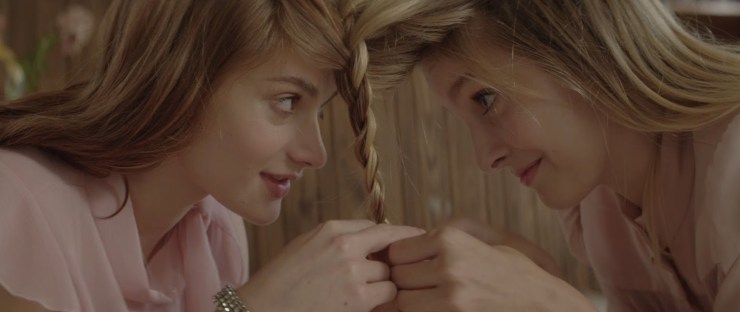
The Darcy’s - Itchy Blood - 2013
Eliza Brownlie. The Darcy’s, Itchy Blood. film still. 2013. Courtesy of the artist.

Interview by Harper Wellman

Eliza Brownlie is a Canadian writer-director who’s ethereal visual style creates atmospheres that beguile viewers and linger in the imagination. The quality visuals are balanced with strong storytelling, often exploring societal issues, cultural phenomena, and how they relate to the experiences of women. The combination of formal education and personal drive has led Brownlie to work with many musicians (most recently Big Gigantic), as well as companies like VICE and Dove. Through an innately collaborative practice, Brownlie has managed to establish a distinct voice for her work.

Could you please tell us a little bit about your background and how you got into filmmaking?

I started filmmaking about seven years ago. I was studying Communications at Simon Fraser University in my early 20s (I grew up in Vancouver, Canada), but found myself taking film theory and history electives every chance I could get. I think I always had this intuition that I wanted to direct… from an early age, I was obsessed with films, and I loved making art, writing, and shooting photos and videos on my parent’s camcorder. But when I was growing up, it was a few years before the women in film movement and diversity behind the lens wasn’t really a mainstream conversation, so I was limited in my awareness and ability to envision myself in the role of a director. You know, there’s that adage “if you can’t see it, you can’t be it,” which is painfully true. This is why visibility is so important and something that I push for. And I’m grateful that we’re finally starting to see some positive shifts happen as an effect of diversity initiatives, even though we still have a long way to go.

Anyways, in my second year of university, I decided to honour my desire to make films and pursue directing. I started out making music videos for Canadian indie labels, which gained some exposure and allowed me to develop my style as a director. I kept working on passion projects, pitching creatives, and shooting whenever I could (or whenever I could afford to). Gradually, more work within the music video, fashion film, and commercial space followed. Shortly after graduating, I decided to make the move to Los Angeles to attend film school at UCLA. During this time, I wrote and directed a short film that we funded entirely on Indiegogo, and that got into a few festivals in New York and California. I’m currently represented by Boldly– a Vancouver-based production company that does really amazing work.

Big Gigantic - Burning Love - 2020
Eliza Brownlie. Big Gigantic, Burning Love. film still. 2020. Courtesy of the artist.

What does your writing process look like? Are you able to visualize all the details while writing the first draft of a script, or do you find more ideas come to you the more you edit?

As much as I enjoy writing, I also find it to be one of the most daunting aspects of the filmmaking process. Honestly, I’ve had to deprogram a lot of perfectionism just to get words out on the page. I was actually listening to a Livestream recently with screenwriters Emily V Gordon, Jen Richards, and Naomi Ekperigin on the challenges of writing and I was practically in tears hearing that they experience the same mental gymnastics that I do… it’s hard work and it takes consistency, and even though the divine doesn’t always come through, you just have to show up at the altar every day and try.

Anyways, I think the first and most important part of the writing process is falling in love with an idea because naturally, everything will flow better if it’s an idea that absorbs you! Once I have found this, I will free write for a while and start to form the characters, the world, themes, and the story—remaining open to everything that comes through (even if I know that I’ll probably abandon certain elements later). From here, somehow, a rough foundation emerges, and I’ll start developing the narrative and mapping out the major plot points into a beat sheet, which is like a detailed outline of the screenplay. I’m also constantly collecting visual material—photography, art, and film stills—so early on during the writing process, I will put together a visual treatment or mood board. This provides a reference for inspiration for scenes and for the look and feel of the film (having graphic design skills helps tremendously). For me, it’s an important balancing act of capturing the images I see in my head, while also making sure I’m serving the story, character, emotions, and central themes.

Film is a visual medium, so when I’m writing a script, I’m always thinking cinematically—how can I show versus tell? I’ll often include camera directions in the script, which is generally frowned upon if you’re a screenwriter, but since I’m writing with myself in mind to direct, it’s helpful to dictate and remember how I want to shoot it. All that said, I often have a pretty good sense of how I want to visualize the details in the first draft, but inevitably there are always scenes that require more time and contemplation to figure them out. Sometimes you get lost, and the best thing to do is to step away for a bit and come back with fresh eyes and new ideas. I do a lot of revisions, so the script is constantly evolving as more ideas and imagery come to me.

The Invisible Ones - 2018
Eliza Brownlie. The Invisible Ones. film still. 2018. Courtesy of the artist.

While writing can be a much more individual undertaking, there is something unavoidably collaborative about directing. Throughout all your projects, your work retains a distinct, almost preternatural quality. How do you navigate all those new relationships on each project while still capturing your vision?

You’re right—directing is definitely one of the most collaborative forms of expression. Part of what I love about it is its inherently collaborative nature, and that film relies on all of these different people coming together, working towards a common goal of bringing a story to life on screen. And when the energy on set is good, and you’re in a flow and making something cool, there’s something really beautiful about that process. I live for those moments! 

I think that the key to capturing my vision and ensuring that it is carried through during all stages of production is first to communicate that vision clearly and get everyone excited about it and on the same page. It’s also so crucial that you surround yourself with a team who understands your aesthetic and point of view, and whose work you equally admire. There’s a lot of delegating with directing, so you have to trust people to be able to do their jobs. I try to make sure that everyone on set feels respected and appreciated, and provide a safe space for them to voice their perspectives and ideas. I’m grateful to get to work with many lovely, talented, and creative people who bring so much to the table with their unique expertise. My work has only benefited from these collaborations.

But of course, since you are leading the team as a director, you also have to be careful that you’re not compromising the version of the film you set out to shoot. With the self-confidence I’ve gained with more experience, I’ve learned to speak up when I’m not feeling something, or I don’t agree. Even if it seems super minor, you’re going to regret not having said something when you’re in the editing room and it’s too late to reshoot. That is the worst!

How do you feel like filmmaking will change, given the current social conditions?

We are going through a lot right now as a global community, we’re at the crux of several intersecting crises… it’s hard to say where things are headed right now. But in terms of discrimination, this has been a systemic issue in the film industry since its inception and change is long overdue. In the past few years, we’ve seen a lot of companies talking about equality and representation, partly because we are in an era in which “woke” culture has been capitalized on—but the statistics are still pretty bleak. The industry’s actions and implementation of initiatives don’t always match their words. We’ve reached a tipping point and people are sick of symbolism and tokenism in entertainment (rightfully so), underrepresented creators want transparency and action. Now it’s like, “how do you plan to commit to diversifying at all levels? We want accountability. We want to see the numbers, then we can have a conversation about diversity, equity, and inclusion.” True, systemic change will take time; it’s not going to happen overnight. I’m hopeful that this is the start of some transformation. But time will tell. 

The Darcy’s - Itchy Blood - 2013
Eliza Brownlie. The Darcy’s, Itchy Blood. film still. 2013. Courtesy of the artist.

Can you tell us about one writer who has influenced your work, and also one director who has influenced your work stylistically?

At the risk of sounding all too predictable, I’ve definitely been influenced quite a bit by Joan Didion and Sofia Coppola—two women who have developed their own distinct and singular sensibility and whose work has occasionally been dismissed as superficial (sexism!) I admire both for their poetic ability to juxtapose style and subject matter, astutely dissecting culture and tackling weighty existential themes through spare, haunting prose, or, in Coppola’s case, dreamy, hyper-feminine visuals.  

Many of us have been consuming a lot of film and television during the pandemic. What has been keeping you busy?

I just devoured Michaela Coel’s new HBO series, I May Destroy You. God, she is brilliant. 

I have also been enjoying High Fidelity and Normal People, both are coincidentally adaptations of novels that I have been meaning to read… I have a long list. 

Final question, what project of yours should people check out first?

One of my most memorable projects was getting to work with the wonderful Millicent Simmonds (star of A Quiet Place 1 & 2, Wonderstruck), on the music video for FRENSHIP’s song, Wanted A Name. Set against a lush natural landscape, the video aims to bring awareness to how the deaf community experiences and interprets music, with Millicent delivering the most incredible performance of the song in American Sign Language.

You can find more of Eliza Brownlie’s work on her website or Instagram.

Male Fear: Encounters with Roxanne Jackson’s Ceramic Monsters

bark at the moon (1)
Bark At The Moon. (View 1). Ceramic, glaze, underglaze decals, luster, hoop earrings; 19 x 16 x 10 inches. 2016.

By Chloe Hyman

A monster is a personified manifestation of societal fears. Some anxieties are primal, like a fear of death, while others are social, directed towards those whose distinctive appearance or behavior renders them dangerous. Sexual difference has long necessitated the creation of maternal monsters to legitimize a fear of the feminine. This anxiety motivates the policing of women’s bodies, in an effort to enforce a heterosexual gender binary. By transforming women and femmes into demons, patriarchy equates femininity with evil and masculinity with good; monstrous women keep men in power.

That is, until they don’t. Banshees and harpies that subvert monstrosity’s patriarchal parameters dispute the validity of gendered social divisions, threatening male dominance.

Such creatures abound in the oeuvre of Roxanne Jackson, a ceramicist who dissects the politics of monstrosity. In works like Bark at the Moon (2016) and Third Eye Fuck (2019), she oscillates between wish fulfillment and stereotype subversion, crafting figures that embody and disrupt tropes of feminine monstrousness.

The latter’s sexual title accentuates the comingling of fear and desire in monster tales. Film scholars Barbara Creed, Jeffrey Cohen, and Barry Keith Grant discuss how cinematic monsters attract and repulse men, fulfilling their submissive fantasies with the threat of the monstrous woman, and their dreams of domination when said threat is vanquished.[1]

This essay considers how the relationship between straight men and female monsters informs the same audience’s interpretation of Jackson’s work. Analyzing the interaction between an artwork and a particular viewer necessitates an understanding of art as a cultural product; although the artist’s intentions contribute to its significance, its many meanings are also a product of symbolic codes, dominant social ideology, and the viewer’s perspective.[2] By modeling the straight male’s encounter with subversive female monsters, this essay explores what Jackson’s work signifies to a powerful group—the descendants of the architects who constructed the myth of female monstrosity.

bark at the moon 2 (1)
Bark At The Moon. (View 2). Ceramic, glaze, underglaze decals, luster, hoop earrings; 19 x 16 x 10 inches. 2016.

The Archaic Mother

In The Monstrous-Feminine: Film, Feminism, Psychoanalysis, psychoanalyst Barbara Creed describes a number of monstrous cinematic archetypes. Her analysis provides a blueprint for an examination of fear, desire, and monstrosity in the bodies of monsters coded female. Creed’s description of the archetypal archaic mother elucidates how two of Jackson’s ceramic sculptures are implicitly gendered. Furthermore, it suggests that male viewers will respond to Bark at the Moon and Third Eye Fuck with repulsion, arousal, and fear.

The myth of the archaic mother centers parthenogenetic procreation—that is, female reproduction without a phallus. Mythological figures like Gaia (Greek), Coatlicue (Aztec), and the Spider Woman (Navajo) illustrate the historical lineage of self-reproducing mothers.[3] They appear today in cinema in the guise of monsters, like the titular figure in Alien whose eggs require neither phallus nor fertilization, but a human host. According to Creed, the archaic mother presents as “the voracious maw, the mysterious black hole that signifies female genitalia which threatens… to incorporate everything in its path.”[4]

At the center of Bark at the Moon sits such a mouth, its gaping lips emptying into nothingness. Ridged white tubes, caked in muck, wriggle around it like maggots. With their rounded ends, these tubes could be fallopian or phallic, an ambiguity that, paired with the mother’s vaginal maw, points to her self-reproduction. She also threatens to consume the viewer, who cannot escape her slimy hole. If the archaic mother faces him, he risks obliteration, but if she turns towards the gallery wall, then he must be inside her—an embryo-corpse.

The divine symbols ornamenting Third Eye Fuck invoke the archaic mother in a different context. Unblinking eyes adorn the deity’s cheekbones while cobalt spiders traverse her neck—a powerful allusion to her ancestor, the Spider Woman. Furthermore, the creature’s pearly-white face is bifurcated, revealing a fleshy, womb-like cave. The womb’s proximity to the creature’s mouth literalizes the narrative of the devouring mother. As Creed explains, “The archaic mother threatens to cannibalize, to take back, the life forms to which she once gave birth.”[5] Third Eye Fuck embodies this threat, collapsing the metaphor of the vaginal mouth into a single fleshy cavern, capable of consumption and ejection.

Due to their self-reproduction, Jackson’s creatures render the phallus superfluous. And because they layer vaginal and oral imagery, they threaten to consume man whole. According to Creed, this evisceration of man’s social status and bodily integrity appeals to “a masochistic desire for death, pleasure, and oblivion” that is common amongst men.[6] And yet, it is also repulsive and terrifying, which Creed attributes to abjection.


Abjection

The theory of abjection was introduced by the psychoanalyst and semiotician Julia Kristeva, who defined it as “that which evades borders and rules which define identity and maintain order.”[7] When matter passes the skin as it does during birth, people are reminded of their mortality and animal nature. Subsequently, the transgressive matter—in this case, blood and placenta—becomes abject, along with the tools that facilitated the transgression: the reproductive system. Men are more disturbed by abjection because they are less accustomed to the sight of blood than those with ovaries. Thus bleeding, birthing bodies become beacons of man’s inescapable death and epicenters of abjection.[8]

Historically, men in power have expressed their fear of abjection by demonizing the female body. Christian art abounds with womb-like depictions of hell and uteruses adorned with devil horns. Leviticus, for example, associates birthing bodies with decaying corpses, linking femaleness and death.[9] As Creed notes in her analysis of Alien, this trend continues in horror cinema. She describes crewmen entering a spaceship through a vaginal doorway and walking down narrow corridors (echoing fallopian tubes) to an egg-filled, womb-chamber.[10] This intra-uterine imagery roots the alien’s monstrosity in the abject female body.

A mass of tubes, holes, and flesh, Bark at the Moon and Third Eye Fuck exude abjection. Furthermore, each contains a passage through which organic matter can be imbibed or ejected. These vaginal/oral mouths repulse and terrify because they are abject reminders of human mortality.

3
Roxanne Jackson. Third Eye Fuck (View 3) Media: Ceramic, glaze, luster; 18 x 15 x 10 inches. 2019.

Subversion

While Bark at the Moon and Third Eye Fuck embody the archaic mother, they also subvert stereotypes of female monstrousness. Both are decadently glazed, their uterine linings shimmering like dew or diamonds rather than blood. Bark at the Moon is awash in lime, turquoise, and salmon pink, which almost obscures a floral motif that emerges from its crevices. This blue pattern, an allusion to Delft porcelain, features prominently on the pale skin of the deity that is Third Eye Fuck.

The ornamentation of monstrous bodies with bright, shimmering colors and courtly motifs subverts the binary between beauty and monstrosity.

The ornamentation of monstrous bodies with bright, shimmering colors and courtly motifs subverts the binary between beauty and monstrosity. Jackson’s sculptures occupy a liminal space between the two, where gender and morality also blur; Bark at the Moon is ambiguously gendered and Third Eye Fuck depicts a monster with an eye for Dutch design. The more viewers peer at each, the less frightening, and more intriguing, they become. To understand why this subversion elicits discomfort for male viewers, the theory of abjection proves useful.

Aesthetic codes, which are tied to gender and moral binaries, function like skin. Just as the epidermal layer protects man from blood and, therefore, the recognition of his mortality, social divisions protect members of the dominant group—men—from the knowledge that their superiority is unearned.

Media maintains these divisions by reinforcing the myth of female immorality. It also demonizes the defiance of heterosexual gender roles by giving female monsters traditionally masculine traits, like promiscuity or voracious appetite. Cinema is ripe with archaic mothers and other monsters who elicit fear in a controlled environment, for the sexual satisfaction of men whose dominance is never really at stake. It is expected that the banshee will be vanquished before the screen darkens, reasserting heterosexual gender roles.

But the fate of Jackson’s sculptures is not predestined. By deconstructing the notion that beauty equates goodness and gender clarity, while ugliness signifies immorality and gender ambiguity, the artist produces creatures of ambiguous moral character. Luminescent and bright, Bark at the Moon and Third Eye Fuck engage in an active dialogue with the male viewer. They threaten him, they tantalize him, and ultimately, they will dethrone him.

Editor’s Note: The beginning paragraph has been edited to use more inclusive language,  recognizing and clarifying that these cinematic tropes affect both cis and trans women and femmes.

This feature is an excerpt from our first print issue. If you’d like to grab a copy you can visit our online shop.

Notes

[1] Jeffrey Jerome Cohen, Monster Theory: Reading Culture (Minneapolis and London: University of Minnesota Press, 1996), pp. 7-17; Barbara Creed, ‘Horror and the Monstrous-Feminine: An Imaginary Abjection,’ in The Dread of Difference: Gender and the Horror Film, ed. Barry Keith Grant (Austin: University of Texas Press, 2015), pp. 42.

[2] Janet Wolff, The Social Production of Art (New York: New York University Press, 1984)

[3] Barbara Creed, The Monstrous-Feminine: Film, Feminism, Psychoanalysis, 1993 (London and New York: Routledge, repr. 2007), pp. 104-112; Shohini Chaudhuri, Feminist Film Theorists: Laura Mulvey, Kaja Silverman, Teresa de Lauretis, Barbara Creed (London and New York: Routledge, 2006), p. 95; American Museum of Natural History, ‘The Spider Woman,’ AMNH

< https://www.amnh.org/exhibitions/totems-to-turquoise/native-american-cosmology/the-spider-woman > [accessed 20 November 2019];

[4] Creed (1993), p. 116.

[5] Ibid. p. 83.

[6] Creed (1993), p. 170; 470-471.

[7] Julia Kristeva, Powers of Horror: An Essay on Abjection (Seuil: Paris, 1980) quoted in Creed (1993), p. 51.

[8] Creed (1993), pp. 190-193.

[9] Kristeva quoted in Creed (1993), p. 184; Margaret R. Miles, Carnal Knowing: Female Nakedness and Religious meaning in the Christian West (Beacon Press: Boston, 1989), quoted in Creed, p. 170; Creed, p. 170.

[10] Creed (1993), pp. 83-85.

LOVE MY DYSFUNCTIONS by Rea Sweets

LMD_DOCUMENTATION-5586
Rea Sweets. LOVE MY DYSFUNCTIONS installation shot, Charles Street Video. 2020. Photo by Roya Delsol. Images courtesy of the artist.

LOVE MY DYSFUNCTIONS

Charles Street Video

Organized by Margin of Eras Gallery 

February 14th – March 14th, 2020

By Adele Lukusa

LOVE MY DYSFUNCTIONS is both a figurative and literal invitation to Rea Sweets’ bedroom. Tucked into Margin of Eras Gallery’s Charles Street Video space, on the second floor of Toronto Media Arts Centre (TMAC), the immersive installation explores being a neurodivergent, mad, and disabled individual pursuing higher education. Swept in red lighting and underscored by soft indie tunes, the disheveled and realistic bedroom evokes the artist’s presence: a desk with stacks of discarded clothes, notebooks, and food; a bed and screen-printed pillow to rest your head on; and two towers of stacked empty prescription bottles, with an LED sign with the word “take your time” sitting between them. Slide the headset over your ears, and get transported to an all-nighter with Sweets typing rapidly with coughs. A short film documents her executive dysfunction. And if you’re lucky, you could converse with Sweets herself (or scribble messages in her guestbook if you miss her).

LMD_PORTRAITS-8277
Rea Sweets. LOVE MY DYSFUNCTIONS installation shot, Charles Street Video. 2020. Photo by Roya Delsol. Images courtesy of the artist.

If madness is messy, then Sweets embraces it passionately and unabashedly. At its heart, LOVE MY DYSFUNCTIONS is an ode to Sweets’ relationship — or rather, her break-up with post-secondary education. Through the interactive nature of the work and the accompanying public programming, LOVE MY DYSFUNCTIONS also demonstrates how vulnerable art can foster community dialogue.

Incorporating disability and madness into her art had not come to full fruition until Sweets signed up for Ryerson’s Cripping the Arts in Canada and A History of Madness.

Both classes are rooted in disability justice and encourage students to think critically about the ways in which society has created and enforced “normality” in relation to disability and madness, while examining the overlap between those two communities.

According to Eliza Chandler, former artistic director at Tangled Arts + Disability and disability studies professor at Ryerson, the term “mad” refers to individuals with a history of mental health diagnoses or experience with the psychiatric system, which may include institutional stays, prescribed medication use, therapy, and other medical intervention. Members of the mad community may identify as consumers, survivors, and current or ex-patients of the psychiatric system. Historically considered a slur, “mad” is currently being reclaimed by those classed as mentally ill or neurodivergent. It can encapsulate all who experience oppression due to sanism.

“[Mad] a small, monosyllabic three-letter word, but it really did afford me the kind of freedom to stop pretending,” said K Zimmer, a poet and English Literature student at the University of Toronto. 

LMD_PORTRAITS-8426
Rea Sweets. LOVE MY DYSFUNCTIONS installation shot, Charles Street Video. 2020. Photo by Roya Delsol. Image courtesy of the artist.

“Language is power,” said Sweets. By learning about terms like neurodivergent and mad, as well as hearing students speak about madness and disability, Sweets could better articulate her own experiences, specifically her executive dysfunction that had only been exacerbated in university.

“It’s like your capacity is always on cooldown mode,” said Sweets of executive dysfunction. “You’re smashing buttons, trying to get yourself to do things but your body-mind says ‘We can’t do that yet. We’re still recharging’.”

Within a university setting, Sweets routinely had to pull all-nighters to finish essays when professors refused accommodation.

“No matter how much you accommodate me, or think you’re leveling the playing fields, it will never be as if I am on the same level as of a neurotypical student,” Sweets says, “I’m still going to have to sacrifice my health or in some way, shape, or form.”

Art was a way to motivate herself to create beyond the academy. “At least if a situation is incredibly shitty, I can make and mold something out of this, she said. “Creating artwork for myself as a form of agency is really important for me.”

For folks like Sweets, stepping into mad-positive spaces is essential. Classes in disability studies were the first time she felt “welcomed and encouraged.” Instead of handing in an essay for her final Cripping the Arts assignment, Sweets asked if she could submit a proposal for a showcase idea. Chandler gave her the okay, and so LOVE MY DYSFUNCTIONS came to be.

At the front of the room, Sweets is on the mic asking about the ways madness manifests itself in art. By Sweets side are fellow mad student-poets Zimmer and Twoey Gray, as well as Max Ferguson, her mentor. Though set up as a panel discussion for the public, the conversation shared by these four artists is filled with uncommon honesty and vulnerability.

There’s no sugarcoating their experiences of sanism, of the ways pursuing post-secondary studies has impacted their desire to succeed academically at the expense of themselves. Their stories are being told, not as a heartfelt tale to make others feel better about themselves, but to embrace the good with the bad that comes with being mad.

Gray described the panel as a very “affirming” space, a sentiment echoed by Zimmer.

“There were times [when I thought], ‘Oh, I’m royally fucking up’,” they said, “[But] I could trust that I was going to be accepted in that space.”

LMD_PORTRAITS-8310
Rea Sweets. LOVE MY DYSFUNCTIONS installation shot, Charles Street Video. 2020. Photo by Roya Delsol. Images courtesy of the artist.

The comfort, acceptance, and vulnerability present within that discussion is an extension of Sweets and the artwork itself. Take, for example, the wall of actual diary entries, email exchanges, and therapy notes speaking to her madness, a kind of vulnerability described by Gray as “hypersharing.” 

“In some ways, the more naked and exposed and vulnerable I am, the more I’m giving [to the audience] and the more affirming my artwork happens to be,” said Sweets.

It’s what makes Sweets’ artistry so brave, according to Ferguson. “She’s incredibly good at balancing being approachable and being brave,” he said, “And she inspires others to be brave.”

When doing outreach for this show, both in-person and online, Sweets ensures she can be at the gallery. In order to accommodate for COVID-19 measures, she also narrated an online virtual tour of the exhibit through Facebook Live.

“Listening to and seeing the comments is inspiring,” Ferguson said, “It’s inspiring to see [Sweets’ art] inspire other people.”

That inherent reciprocity is what distinguishes LOVE MY DYSFUNCTIONS and all of Sweets’ work.

“That has helped me feel like [sharing] my vulnerabilities are worth it and I feel less like an open scar,” she said. “It doesn’t burn. It’s good.”