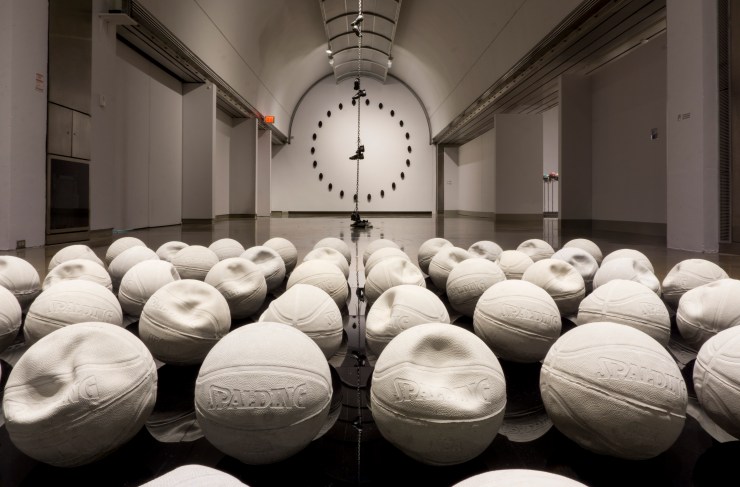
To Play in the Face of Certain Defeat By Esmaa Mohamoud

DSC01820 (1)
Installation view, Esmaa Mohamoud: To Play in the Face of Certain Defeat, Museum London, 2019, Photo: Dickson Bou.

Museum London 

September 14, 2019 – January 5, 2020

Curated by Matthew Kyba

By Adi Berardini

Walking into To Play in the Face of Certain Defeat by Esmaa Mohamoud feels dark and ominous. The lighting is dim, the works under a faint spotlight—the space itself feels oppressive with a prevailing sense of shadows. Through her work, Esmaa Mohamoud focuses on racial and gender inequality in professional sports culture. Multiples of concrete basketballs are reflected on a black plexiglass pond and chains are draped from the ceiling holding Under Armour Cleats. At the end of the main wall, there’s a large circular ring of black footballs, all subtly branded with a traditional Kente pattern if you look closely enough. Mohamoud brilliantly addresses toxic masculinity, identity, and lack of access in sports, criticizing the spectacle of violence towards Black bodies as a form of neo-slavery.

DSC_0899 (1)
One of the Boys (Black) and (White), 2019, colour photographs on paper, Courtesy of Georgia Scherman Projects, Photo: Lucas Link Stenning.

Mohamoud questions the binaries that are inherent in sports and in our broader society. As Matthew Kyba outlines in his curatorial text, in any sports game there’s a “winner” and a “loser,” perpetuating an “us versus them” mentality. The same sense of opposition is present in masculinity and femininity, the binary oppositions prevalent in western society privileges the earlier rather than the latter. In her two pieces One of the Boys (Black) and One of the Boys (White) she juxtaposes a Toronto Raptors jersey and an elaborate ballgown, melding the two gendered extremes together. The piece evokes the sense of masculinity expected in sports when someone strays away from the expectation, they immediately become criticized. The layers of oppression become multi-faceted since gendered expectations and homophobia can be implemented from varying communities. One of the Boys displays how celebrating a multiplicity of gender expressions can subvert this binary.

DSC_0874 (1)
One of the Boys (Black) and (White), 2019, colour photographs on paper, satin gowns, Courtesy of Georgia Scherman Projects, Photo: Lucas Link Stenning.

In her three-channel film installation From the Ground We Fall, two players are stuck in opposition. Juxtaposed with romantic music by Nina Simone, they try to pull away from each other in the sweltering heat, although inevitably fail, since they are bound by multiple chains. The film comments on the struggle within colonial systems where members of a community are pitted against each other. Sports also implement a sense of “neo-slavery” wherein players are placed within rankings and given value based on their physical qualities and performance. Through this process, a sense of identity is lost, and their worth is solely based on their abilities and rankings, perpetuating the violence and competition of pre-dominantly Black players.

This is further explored in Mohamoud’s notable work Glorious Bones, consisting of forty-six adorned helmets with a range of West and East African patterns. Although there’s a deliberately frustrating viewing experience since they are blockaded by another work Fences, a gigantic hockey net strung from the ceiling. The helmets prescribe a vibrancy to the ghost players since they are embellished in saturated African patterns of teal, cadmium red, and mustard. Glorious Bones highlights the richness of African culture within the context of North American sports, which feels lost through team uniforms that erase this individuality. The net barrier of Fences blocks the access and exploitation of culture which happens so frequently through a white, western gaze. This sense of the white gaze is guilty of enjoying Black culture but lacks the true respect for Black people.

DSC_0904 (1)
Glorious Bones, 2018-19, repurposed football helmets, African wax prints, faux soil, metal, and Fences, 2019, hockey goal mesh, Courtesy of Georgia Scherman Projects, Photo: Lucas Link Stenning.

As Mohamoud explains, Fences also comments on the lack of equality of access in sports, particularly hockey, due to hockey’s high expense to participate. Capitalism’s hands are a means of exclusion from these systems that perpetuates the feeling of being unwelcome. Mohamoud challenges the trope of “cultural acceptance” and “diversity” in a society that actively perpetuates exclusion through classism rooted in white supremacy. In a subtle intervention, a gold grill embedded in the wall, her work Why See the World When You Got the Beach? critiques the western obsession of wealth accumulation and material obsession. The gold entices and causes one to go to any length, including exploitation, to reach it. This intrusion into the museum’s architecture also has symbolic significance since the work positions itself into the white walls of the institution.

Further, she encourages viewers to contend with society’s enjoyment of a system that perpetuates toxic masculinity and the organized competition of Black players.

Additionally, Mohamoud addresses both the hyper-visibility and invisibility of racialized bodies. Through the effective use of discrete text composed of clear vinyl on the concrete floor, she quotes Ralph Ellison’s book, Invisible Man, creating an obstacle in reading the understated work below one’s feet. In Ellison’s book, the protagonist is never given an identity and is a tokenized figure fabricated from racist views and stereotypes. The subtleness of the texts conveys a sense of ignorance within whiteness, often oblivious to unconscious racism and the struggles of Black individuals.

At the artist and curatorial talk held at Museum London, Mohamoud speaks about how she both loves sports (the Raptors are her team) but views the sports entertainment industry with a critical eye. Esmaa Mohamoud’s To Play in The Face of Certain Defeat reflects on the toxic systems that exploit the violence of racialized bodies for entertainment. Further, she encourages viewers to contend with society’s enjoyment of a system that perpetuates toxic masculinity and the organized competition of Black players. Mohamoud’s work makes a lasting impact regarding sports entertainment and its connection to racial, class and gender inequality—causing one to think again before flipping to the NHL channel.

This review is an excerpt from our first print issue. If you’d like to grab a copy you can visit our online shop.

Socially Distant but Still United: Art in the time of COVID-19

By Adi Berardini

When I first posted a call for submissions for immunosuppressed artists and artists affected by COVID-19 cancellations I had no idea that we would have such a strong response—we had a large number of submissions and it was shared over 150 times. I spent hours getting back to artists who are affected by the pandemic; hearing many stories from both immunocompromised artists, artists who had faced closures, and students who had their final grad exhibitions cancelled. Although COVID-19 has brought upon a sense of collective trauma, artists with pre-existing conditions that put them at risk should be centered in the discussion. Through the call for submissions, I was able to connect with some of the artists who are also working as disability activists, fighting for their rights and accommodations that should have long been addressed by art institutions and the broader society long before this pandemic hit.

Launching this call for submissions re-affirmed what I already knew— that the community behind this small publication is in fact very large and interconnected. The following are some artist highlights from our social media call. The posts were curated around certain themes such as invisibility and chronic illness, memory and dreaming, land and the environment, the domestic and interiority, and biology and its relationship to art. You can view all of the features on the Femme Art Review Instagram under the stories highlight “Social Solidarity” and by following the hashtag #caringisnotcancelled and #sociallydistantbutstillunited.

CATlamora
Cat Lamora. Mok yok tang, We Bathe Here installation shot. The Margin of Eras gallery. 2019. Image Courtesy of the artist.

Cat Lamora

Cat Lamora @catlamora is a Toronto-based artist who creates large-scale installations with paper. “We Bathe Here” is an immersive paper installation by the artist that explores themes of connection within a shared and very vulnerable space—the Korean bath house, or mok yok tang, which translates to “bathing pools.” Traditionally, towns became named after the bodies of water flowing through them and to know the names of the bathhouses would be to get a glimpse of the town itself. The installation aims to interpret the transition where a long-used space becomes a physical, emotional, and cultural reflection of its people and how these spaces also influence the internal strata of experiences.

quarantine
Kimberly Edgar, Quarantine. 2020. Courtesy of the Artist.

Kimberly Edgar

Kimberly Edgar @deadbirdparty is an artist, cartoonist, illustrator, and designer living in the subarctic town of Dawson City, Yukon. Kim is chronically ill and uses comics to reflect on their experiences of both the medical system and the ennui that comes with being sick with no end. Edgar’s work transports the viewer to enchanted forests with mushrooms and flora and fauna. They explore the experience of bodily illness in comparison to the experience of climate change and how it impacts the land (which is also a body). Their works have been nominated multiple times for Best Comic with the Broken Pencil Zine Award, and in 2019 they won the award for their comic The Purpose.

9_Zdanovic_Nina_Turkish Coffee Divination
Nina Zdanovic, The Kitchen. Oil on Paper. Image courtesy of the artist.

Nina Zdanovic 

Nina Zdanovic @allaboutninka is a painter from Vilinus Lithuania living in Tokyo. As if referencing distant memories, in her paintings she refers to situations that have happened to her, places that she has visited, or people that she has met. Real stories often merge with similar memories and the emotions she associates with them. Most of her paintings are like a snapshot of a lucid dream: some things are real, some things are not, and it’s not possible anymore to tell them apart.

KatCope_4
Kat Cope. Onward March.

Kat Cope

Kat Cope’s @kat_cope_artist project titled, “Onward March,” is a sculptural installation comprised of a series of suits and fragmented pieces of armor made from paper.  They remain feminine in nature to contrast with armor, which is commonly perceived as masculine, despite historical women warriors. It is a documentation of how we build our own armor in the face of challenges through perseverance. Describing her process, Cope says, “Paper, like skin, is vulnerable to the materials and elements that assault it; yet, paper is an astonishingly resilient material. Sheets of paper can be made incredibly strong[…]While in most cases we as humans do not develop a thicker skin, both time and experience shapes us and we learn when, and where, to protect ourselves from harm both emotional and physical.” Starting this fall, she will be pursuing her PhD at Burren College of Art in Ballyvaughn, Ireland.

Bedrock (1)
Em Somoskey. Bedrock’ (84”x96”). Mixed Media on Canvas. 2020.

Emily Somoskey

Emily Somoskey @emsomoskey gives form to the complexity, instability, and enigmatic nature of our lived experiences. Through these large-scale, mixed media paintings, she explores the simultaneity between the actual and the psychological, the material and the immaterial, the visible and that which lies beyond sight. Domestic spaces are largely the carrier for this ambition, which offers multi-sensory and ever-changing material that the paintings build upon. Digital collage fragments and painted shards might reference a tiled floor, a stove-top burner, or the edge of a piece of furniture, but they also point to readings that move beyond the domestic. The complex tension of their visual density calls for contemplation; asking the viewer to slow down in order to navigate, discover and dwell within them.

femmeartreview--1587611774330
Isadora Vincent. Installation shot, Michigan State University. 2020.

Isadora Vincent

As part of her BFA exhibit at Michigan State University, Isadora Vincent @isadoravincent addresses the altered way she views the relationship between her body and her mind after she had to face her irrational fear of needles, foreign objects, and substances invading her strange cellular interior. The processes she uses to generate painting and sculpture initiates a rediscovery and connection. She investigates the complexity of the human body, specifically with feelings of pain, discomfort, and anxiety around the unknown.

Dana_Kearley_Relief_2019
Dana Kearley. Relief, 2019. Image Courtesy of the artist.

Dana Kearley

Dana Kearley  @danakearley is a multidisciplinary artist, illustrator, and jewellery designer on the unceded territory belonging to the Musqueam, Squamish and Tsleil-Waututh First Nations. Kearley depicts powerful figures among other-worldly landscapes with a digital airbrushed aesthetic. Her work is inherently autobiographical, dealing predominantly with themes of chronic invisible illnesses, disability, mental health, and tenderness. On COVID-19, Dana states, “I kindly ask abled folks to please remember that you still have an able body while in quarantine, and that a quarantined lifestyle is normal for many of us. It is VERY different being chronically ill and disabled during this time. Many of us are merely surviving…It makes me sad that abled folks who have recently been laid off due to covid are getting much more compensation for their lob loss than myself and other disabled folks ever will. Itʼs not that they donʼt deserve it, but why are people with disabilities still being paid less? Ableism! It is very, very hard to sit with. It hurts. I donʼt share my experiences for fun. I share them as part of my activism, to raise awareness around endometriosis and for disability visibility.”

image2 (1)
Madeline Walker, studio shot. 2020. Courtesy of the artist.

Madeline Walker

Living with an invisible illness has informed the majority of @madelinewalkerart‘s work, which is a combination of painting, sculpture, and digital fabrication. Using a range of mold-making and casting techniques, her sculptures and installations are commonly assembled out of cell-like parts that emerge as a visualization of various mental states, encouraging closer examination of what we thought we knew to be true.  Often coloured white, faint candy pink and blue, the molds resemble that of honeycomb or even bubble wrap packaging, merging natural structures with the artificial. Playful yet architectural landscapes of thought patterns and mind maps emerge in her recent series, Sensory Landscapes /Mind Maps 1. Forms, colors, textures, and everyday objects are re-contextualized as a form of re-writing and storytelling about unseen disability.

ProductsOfNatureInBloom (1)
Em Minyard Oppman. Products of Nature in Bloom. Supreme Court ruling Association for Molecular Pathology v. Myriad Genetics, Inc. screen printed on bacterial culture growth medium cast in a petri dish for hosting bacterial colonies, creating a living document. 2019.

Em Minyard Oppman

Em Minyard Oppman @emminyard_ is an interdisciplinary artist and scientist from New Orleans working in sculpture and genetic research.  They were recently part of the 0.1% exhibition at NAVEL Gallery in Los Angeles in collaboration with UCLA’s Institute for Society and Genetics, and EXPO Chicago. Oppman earned their BFA from The School of the Art Institute of Chicago with an emphasis in Art & Technology and Sculpture.

On their practice they state, “mixing lab protocol with sculpture and performance, I enjoy subverting systems of power and control by working within them to expose their depravity. My lab work focuses on the intersection of biotechnology and oppression.” Drawing upon their experiences with the medical industrial complex, they break down the alienation of the white coat by performing within it. Currently,  they are patenting mutations of their own genome, challenging SCOTUS’ 2013 decision in the landmark case that ruled for-profit corporations can no longer identify and patent isolated human genes. Having identified a loophole in the ruling, they are patenting mutations of their own genome to educate the public on issues of bioethics and prove that if they can do it, large corporations undoubtedly still can.  Following lab protocols including molecular cloning while collaborating with patent attorneys, this project is a conceptual exploration of the American patent system, as the artist navigates legal labyrinths and distributes NDAs. Minyard Oppman explains that “this work is about ending the monopolization of human genes and the further exploitation of sick people.”

Alvarez_Tania_Anywhere But Here
Tania Alvarez. Image Capture. Oil, Acrylic and Graphite on Canvas. 2019.

Tania Alvarez

Artist Tania Alvarez @taniaalvarezart paints in the same way that she recalls events in real time: Objects, lines, and figures may appear and disappear as she remembers them, but the process is left behind like a roadmap for the viewer. Regarding her practice, Alvarez says “Being diagnosed with a chronic illness, I have become increasingly concerned with how my own story will be remembered. While every day it becomes easier and faster to record our story in the digital world, it can just as easily become diluted and two-dimensional. The human experience is layered and full of nuance and mistakes.  My paintings aim to preserve the raw experience and tell a more complicated story.”

emilysara12345-1584544097943
Emily Sara. Image courtesy of the artist.

Emily Sara 

 Emily Sara @emilysara12345 is a disabled, interdisciplinary artist, designer, and disability rights advocate working within the language of advertising and animation to discuss the American healthcare system, pain, and the extent of social control over the disabled body. Her work mixes feminine signifiers with food, commenting on the infantilization of women with disabilities, and also how sickness affects one’s relationship to food. Emily received her undergraduate degree from Boston University in Advertising and Art History and her MFA from Cranbrook Academy of Art. She has exhibited nationally and is the recipient of grants from the Women’s Center for Creative Work in Los Angeles, and the Foundation for Inclusion Fellowship at Virginia Commonwealth University in Richmond, VA where she currently teaches in the Graphic Design Department. Emily has authored articles such as Fighting the Art World’s Ableism, first published by Hyperallergic in 2019, and is a current resident for the art criticism website The White Pube (London, England) where she utilizes the platform to highlight international disabled artists.
IMG_20200317_113207_897
Katrina Jurjans. Our Sanctuary underground (at times withdrawn). Acrylic on Canvas. Image courtesy of artist. 2019.

Katrina Jurjans

Katrina Jurjans @katrinajurjans is a visual artist creating poetic narrative heavy with symbolism— flowers embody feelings of absence and growth and rain clouds communicate intense emotion. She is interested in the power of analogies to tap into the feelings we all experience. Shifting into the surreal, the depicted scenes – intimate, often nostalgic and heavy – are anchored to this world while simultaneously departing away from it. Sometimes flesh and blood, other times ghostly outlines, the figures she paints exist between somewhere real and imagined.

IMG_7471
Mimi Butlin. Image Courtesy of artist. 2020.

Mimi Butlin

Mimi Butlin is the artist and creator of @cantgoout_imsick. Often using pop culture references, Butlin makes art to amplify the experiences of many sick and disabled womxn, making those who are chronically ill and disabled feel seen. She also aims to highlight medical trauma, and inaccessibility, and to break down disability stereotypes, provoking conversation around the many issues faced in a world not built for sick and disabled people.

Untitled Frosting
Amira Brown. Untitled (frosting). Image Courtesy of the artist. 2020.

Amira Brown 

Amira Brown @amirahb_art is an interdisciplinary artist based in New Haven, Connecticut. Currently experimenting with the limits and variations of subjects in paintings, she often uses random chance as the starting point for her series of work. Her work at the moment focuses on personal meaning and the obscuring of such through red herrings, whimsical aesthetics and deconstructing the picture plane.

These are just some highlights! To view the rest of the social media features, check out the Femme Art Review Instagram under the stories highlight “Social Solidarity” and by following the hashtags #caringisnotcancelled and #sociallydistantbutstillunited. Thank you again to all the artists who submitted their work. 

Colour and Commodity: Marilyn by Sara Cwynar

Sara Cwynar

Marilyn

27th February 2020 – 30th April 2020

The Approach

SaraCwynar_redlips
Sara Cwynar, Marilyn, installation view at The Approach, London. Courtesy the artist and The Approach.

By Adi Berardini

 “Cezanne…it’s Susan,” the voice in Sara Cwynar’s film Marilyn echoes. Cezanne jewellery boxes act as a signifier of high-class wealth, opening multiple times throughout the collaged-footage film. Suddenly, I have flashbacks of every time someone has mispronounced my name—something that many women likely know well. I have to introduce myself saying, “it’s Adi. Eighty like the number.” Then, I think of how it’s depressing that I have to assign a numerical value to my name in order to be remembered. Isn’t remembering someone’s name a sign of fundamental respect?

In Marilyn, featured as an online exhibition at The Approach, Vancouver born, New York-based artist Sara Cwynar addresses how the commodification of women’s desire is not only prevalent but ingrained in a capitalist society. On the inspiration of the title, Cwynar explains how “the X-Rays of Marilyn Monroe’s chest sold for $45,000—even the inside of her body was up for grabs.” Often with a seductive, vintage feel, the film specifically uses soft pinks and siren reds to display the relationship between colour and commodity. The narrator chimes in with, “colour, decided by someone else, handed down, placed upon us.”  Reminiscent of shopping for lipstick and attempting to find the perfect colour, it causes me to dwell on how individuality can be both a myth and a marketing ploy. I think of how it’s ironic that women don’t have full autonomy over our bodies, yet there are hundreds of shades of lipstick to choose from. 

SaraCwynar_image
Sara Cwynar, Marilyn, installation view at The Approach, London. Courtesy the artist and The Approach.

“I’m telling you these reds aren’t real,” the narrator states in a voice reminiscent of Patrick Bateman in American Psycho. 

The lips are referred to as a red wound, a seductive and vivacious symbol, but also one that is tied to violence. A hand strokes a lavender rose; the film repeatedly zooms in on a fashion editorial, a shot of a woman posing with matte red lipstick. Cwynar is interested in the production of photographic tropes and how they are just as manufactured as the makeup that the models wear. She has worked as a graphic designer for the New York Times, and frequently shoots her colleague Tracy Ma, since Ma is also familiar with media construction and its inherent power imbalance, particularly as a woman of colour. Footage of make-up manufacturers reel, showing the creation of buttery foundation and saturated glitter eye-shadows. While the cogs of the machine hypnotizingly churn, the darkness envelops us, consumed by the same cycles—a loop. Cwynar is fixated on the same few poses the models for popular e-commerce sites repeat. The film speaks of the idea of “a New Woman, “a Face,” and how the patterns were invisible to us before.

“I thought of the women of antiquity who were accused of lying for making up their faces.”

SaraCwynar_image2
Sara Cwynar, Marilyn, installation view at The Approach, London. Courtesy the artist and The Approach.

The film is primarily narrated by a man’s deep voice and a woman who chimes in at times, almost like she’s trying to get in a word during a meeting where a male colleague takes up too much space. The artist is pictured trying to lip-sync the narrator, an act that seems like a reclamation of what he’s saying in a tried but failed manner. The inter-spliced narration is in reference to a myriad of philosophers and cultural icons such as Descartes, Barthes, Plato, Sontag and Eileen Myles, and focuses largely on colour, art, capitalism, and gender. The artist says phrases like, “Women create life, men create art but not anymore, suckers,” and “I know I have a body of a weak, feeble woman but I have a stomach and a heart of a king.” Suddenly, the clearance sale is filmed from the vantage point of an escalator— “60% off!” the red tag reads, illuminated by fluorescent mall lighting. There are deliberately too many media snippets to contemplate simultaneously, enacting the oversaturation of advertisements one subconsciously faces during a trip to a shopping mall or scrolling through their phone.

“A new image comes without warning.”

SaraCwynar_men_bust
Sara Cwynar, Marilyn, installation view at The Approach, London. Courtesy the artist and The Approach.

A key aspect of the film is how nostalgia fades in a capitalist ploy. It also evokes how companies re-appropriate trends and nostalgia to sell their products to consumers. I witness not just the plaster nude bust, but the staging and the men behind it, setting it up. Several shots of a blonde woman’s slick red manicured nails are seen stroking a cherry convertible. Sliding by are a plethora of lipsticks, collaged over a shot of Claude Cahun and vintage film photographs of near-nude women. The voice of the narrator evokes the posts of Instagram influencers, inherently narcissistic in nature, but oh so deep. These days, it’s impossible to tell if someone genuinely likes something or they’re trying to sell it to you. The voiceover proclaims that she loves the times, she can buy anything she wants, but it’s hard to believe her when her face is visibly stressed, tears welling up in her eyes. She searches for pleasure where she can get it, but it hardly seems to be authentic—the glamour fades just as feelings do.

“To choose when to look and when to be looked at, that is the essence of true freedom.”

Cwynar addresses how in art women are thought of as objects and not subjects. With an array of commodified colours in her palette, the films address the painful reality of a society that uses the idea of “freedom” as a marketing method to sell back a sense of feminist empowerment. I can’t help but think we’re trapped in a system that’s difficult to escape.

The end of the road: Julia Frank’s Fine Corsa

1FC_Eye_Entrance1_JuliaFrank
Julia Frank. FC / Eye, Color print on semitransparent textile. Galleria Doris Ghetta. 2020.

By Victoria Dejaco

Preface: Julia Frank’s solo exhibition FINE CORSA at Galleria Doris Ghetta opens with a large curtain of fabric, an all-seeing singular eye. Through FINE CORSA, Frank addresses the environmental concerns of the warming planet we live on through cosmogony. The exhibition contains an artificial crystal—a large, melting block of contaminated ice filled with microplastics. The crystal causes the viewers to dwell on the power of our actions that taint its very nature. Frank asks us how long our human-made illusion can last if the earth’s ecological imbalances are ignored.

The exhibition is situated in the current Northern Italian Covid-19 hotspot. Regardless of its physical inaccessibility, the following text and visual material provide stimulus and relevance during this difficult time that we all face. The new work is accompanied with a text by Victoria Dejaco, a curator, art historian and her lifetime partner, in the form of a love letter. They are both from the same Northern Italian region but have left the area years ago because of its conservative and homophobic ideology.

Upstairs, the upper floor of the gallery is a curated exhibition by Siggi Hofer which has opened simultaneously. Altogether, even under sad circumstances, it seems historical because for the very first time two gay artists, born in the same area but who moved abroad, decided with united forces to provoke what they have been escaping and fearing for years.

Vienna/Ortisei/Vienna, February/March 2020

Dear Julia,

Your exhibition opens with an eye printed on a semi-transparent textile installed like a curtain separating us from the exhibition space. Not two eyes. One. Like we use it to look through a looking glass or a microscope. An invitation to look closer? One left and one right eye, a pair of eyes would be a familiar sight. It’s the one, isolated right eye that is unfamiliar. Seeing something unfamiliar influences our perception. Not long ago we had a conversation about how—in order to save energy—our brain constantly categorizes patterns and acts/reacts accordingly. It also means that we as humans are less susceptible to the details and irregularities of the everyday because automated categorizing blanks them out. To look at a pair of eyes is not irregular, and our brain would recognize the pattern as known. However, the single eye is alien enough for us to switch from a process-orientated everyday into a different rhythm—one that prepares us mentally and physically for the exhibition and focuses our attention.

Because our blind spot is approximately 30 cm in front of our noses, metaphorically this begs the question of how many other things we ignore that we have right before our eyes? The simple apology that puts an end to the fight? The heartfelt salutation that would turn the stranger into a friendly neighbor? Even solutions to the big challenges of our times might be similarly simple. A thorough global redistribution that also produces less CO2? Maybe we just cannot see it clearly yet. We don’t have much time left for good solutions and their implementation. In the race against climate change, we are already “in fine corsa,” if not behind schedule.[1]

Possibly, this is the most important outcome of any artistic practice: the invitation to look closer, to dwell on a topic, to decipher a riddle, to engage with an object longer that we are used to from the scrolling on platforms in our everyday hustle under constant and simultaneous impulses. Who will preserve this skill in the future to ponder on a question as long as it takes for the solution to arise? Or to lose oneself in a painting like the one at the beginning of your exhibition?

The time and skills for contemplation are getting scarce. We find “Contemplor” from “contemplare” in the Stohwasser, the Latin dictionary that always quotes the first person singular of every verb: “1. inspect, regard: contemplator (imp.) cum to observe, when V. 2 metaphor. contemplate, consider. E: templum: observation room.” The last remark is relevant for your exhibition. Temples (or cathedral) are rooms of observation. A room, in which we have time for contemplation, for observation. Not too long ago I read in the Swiss newspaper NZZ:
“In the 1980s […] society’s need for clearly defined spaces of art increased. Their closedness was experienced as reassurance, their institutional character is seen as a confirmation of certain values that seemed to disintegrate in a pluralistic, multicultural media society. […] Enhanced by a previously inexistent public interest the museum became the new community building: Incidentally, those new museums were called the new cathedrals.”[2]
With precise mise-en-scène of the lighting, you turn your exhibition into a cathedral, a temple (for observation). Already in medieval Gothic age, the dramaturgy of light was orchestrated for maximum enhancement of contemplation and worship. Cathedrals were built in order to have dim light in the entrance so that the eyes would need to adjust to the somberness and then be blinded by the rising sun through the colored windows of the apsis in the East during morning congregation.

3FineCorsa2020_ExpoView1_JuliaFrank
Julia Frank. Fine Corsa, Installation shot, Galleria Doris Ghetta. 2020.

The two light sculptures are oriented towards the poles. One towards the North, the other towards the South. Shining bright, albeit their ephemeral presence. Besides the wall text, they are the only source of light.

Light is also the guidance for the viewer through the exhibition: leading from the first sculpture in the South, along with the text work and the second sculpture in the North to the last installation, that closes the apocalyptic atmosphere of the exhibition with a symbol of hope.

The first wall work on the blue membrane on the left wall after passing the eye-“curtain” is part of a series of works in a technique you developed a few years back. The surface of the insulating material with layers of microplastics has as many familiar associations as unfamiliar ones. The newest work is the smallest one yet with a diameter of 150 cm. The works can’t be much smaller by nature because you are 170 cm tall and the synthetic layers applied under gas pressure are pressed together in the folds of the material under the weight of your agile and muscular body, pressed into one another and partly detached from the surface again. The viewer is looking at the backside of the layer of “paint” because the frontside was collapsed to become the middle or bottom layer.

To question things and to think outside the box is second nature to you. In general, sculptures are three-dimensional and have more than one obverse. Pictures, on the other hand, even abstract ones, from an art-historical point of view, traditionally don’t show the viewer their backside. However, we experience the layers of color in your works mainly through their backsides. A very sculptural approach to “painting.” Fittingly, their making is rather a performance than a work process. I am hardly surprised, that you succeeded in transferring the vehemence of stone carving (which you already mastered prize-winningly as a teenager) to the practice of painting. Who else? 80% of your artistic output was done without a studio to work in. Artistic production is like breathing to you; intrinsically interwoven in your actions and thoughts.

The rectangular versions of the membrane work have a cartographic character. Now you have turned the form into a circle and immediately it resembles a distant planet.

Or the iris of an eye? The single “components” of the surface are multi-faceted in their form, individual like configurations of clouds and as co-incidental. The clods seem as fragile as eggshells. Or moss lichen. Or corals. A piece of untouched nature. Or, on the contrary, like the garbage patches of plastic trash floating in our oceans trapping sea animals.

After all, the surface is made of microplastic particles undulating on the blue insulating membrane, like the residues of plastic that regularly get retrieved from the insides of dead sea animals. Every year a million birds and 100,000 ocean mammals die around the planet from ingesting plastic or being caught in it. Also, we humans apparently consume the weight of a credit card in plastic every week.[3] Plastic sediments in the bodies of mammals similarly as on the whole of our planet: in clods and layers. Future civilizations will be able to tell the period between 1970 and 2030 AD from the sedimentation of plastic in our geological strata.

Also, the layers of your wall work function like strata of sediment of colored plastic particles. Residues of this sediment can be found in the ice blocks that form the main body of the sculptures, that melt in front of our eyes, while we decipher your signs in the dimmed light.

18FC_Icewhite2020_detail2_JuliaFrank
Julia Frank. Fine Corsa, Installation shot. Galleria Doris Ghetta. 2020.

Your exhibition is plunged into darkness. Another contribution to sharpening our senses. Light only plays a role as part of three artworks and one wall installation. Implicitly you are showing us that light>enlightenment> (in-)sight comes from the works of art. Both sculptures are composed of a grid on which the ice blocks are resting, a frame, and a rotation motor, that moves a tube light up and down. It looks like a scanning process. In intervals of a few minutes, the wet lights are moving down and up the ice blocks, then switch off again. The first sculpture has a red light. Despite the light source being a cold light, the red color brings a feeling of warmth, a fire that melts the ice. We might think of spring, the sun that melts the ice and awakens nature since the exhibition takes place only a couple of weeks before the official start of spring. But the ice is melting with the room temperature that changes depending on the visitors in the exhibition space. The more visitors in the room, the warmer it gets and the faster the ice will melt. The more people there are on the planet, the more our planet is “sweating…”

Coincidentally, this exhibition takes place under a frightening global state of emergency. Nothing like humanity has ever experienced before. Due to the global pandemic spread of Covid-19 whose European epicenter became Lombardy towards the end of February, the Italian government banned meetings of more than 100 people in the week before Saturday 7 March, the date of the exhibition opening. Initial partial and local restrictions in Lombardy soon applied to the whole of Northern Italy. 48 hours after your unofficial opening, the whole country goes in lockdown. All cultural institutions have to close. 72 hours later, we are both back in our apartment in Vienna when all boarders to Austria shut down and everyone passing the boarders on Brennero, Sillian, and Passo di Resia by train, highway, or state road gets fever checked. In the following weeks, governments [from] all across Europe and most Western countries take up similar measures to curb the spread and “flatten the curve” of exponentially growing infections. International flights are reduced to a minimum. No international conferences are held. The Olympics are postponed for the first time in history. No festivals. No concerts. The CO2 values drop world-wide in the following days. After four weeks under lockdown, in Wuhan, where the virus first broke out emissions are reduced to the point of a blue sky showing behind the lifted smog.[4]Natural light reaches the citizens again.


6FC_IceRed&Cartography2020_JuliaFrank
Julia Frank, FC / Ice (rot). Ice, metal, rotation motor, electrical parts, wet- lamp, LED, translucent red film. Galleria Doris Ghetta. 2020.

The unnatural red light of your first sculpture reminds us of infrared light rather than sunlight. Infrared light is also associated with layers in art history since infrared reflectography is used to reveal underlying layers of a painting or sketches in a non-destructive manner because different pigments of color absorb the light differently. It hence references the synthetic layers of your membrane work too. But it is associated with a second function that relates to your work: The infrared spectroscopy is used in waste management to detect and filter plastic in waste separation processes.

The light bar installed prominently at the far end of the room combines two different practices of yours for the first time to my knowledge. The installation unites the text works that until now have appeared on paper, as photographs, on mirrors, or in shop windows with your sculptural practice. The text, in this case, is applied to a light bar. It connects the wall installation with the freestanding sculptures. It is mounted on the same height as one of the objects too and the residues are frozen into the ice block connect the sculpture with the wall work on the blue membrane. You give the viewer clear signals that for you nothing exists independently, that everything is connected. If this concept of interconnectivity would be clear to humanity, we might stand a chance…

The wall text reads: “You are my last breath. Tell me you care for me. You are the first and the last thing on my mind. We probably risk too much. Is this part of our destiny? You give us all we have, but it’s not enough and your patience has run out, we let it happen. The time is now. All eyes are on the clock (but) the time takes too much… Do we end our waiting? The atmosphere is charged. In you I trust. And I feel no fear as I do as I must. Seduced by the fear… I will not hesitate. The time is now, and I can’t wait. I am empty already too long. Tempted by fate. And I won’t hesitate. The time is now, the time has come.”

14FC_TTIN2020_Zeit_JuliaFrank
Julia Frank. Fine Corsa, Installation shot. Galleria Doris Ghetta. 2020.

Each sentence opens doors to multiple interpretations. The text could be read as a prayer. The worship of planet Earth. Seeing it as an equal partner, to not take the planet and its resources for granted as the basis of our livelihood. No fear of the grand gestures that are necessary for course correction. To shift the metaphor of the Earth as “Mother” to the Earth as “Lover” creates a more emphatic, equal relationship between humanity and the natural world.[5] “You give us all we have, but it’s not enough and your patience has run out.”

The second sculpture is illuminated repeatedly by clear cold-white light shining through the melting, impure ice. This ice block contains the residues of the layers of plastic from the performative membrane works. The lettering on the wall that picked us up in the South at the first ice block, lead the viewer in the North, where a second block is melting away before our eyes. You found a poetic expression, but your message is clear: the poles are melting.

21FC_IceWhite2020_JuliaFrank
Julia Frank. Fine Corsa, Installation shot. Galleria Doris Ghetta. 2020.

Also, outside around your exhibition during these first warm days of March, huge ice sculptures are melting. In the winter in Ortisei, Val Gardena, the valley where your exhibition takes place, up to 30-meter high ice sculptures are traditionally created along the river and in prominent places. They are created by a sprinkler system with a huge tree-shaped scaffolding underneath. It sprinkles the structure with water during the cold winter days that freezes into a big white-blue weeping-willow-resembling frozen waterfall. At night they are illuminated from inside. A bright glow comes from inside the frozen sculpture. They give the landscape the semblance of a magical world. The light behind your second block of ice has a rather disenchanting effect. It shines a clear light on the impurities of plastic scatterings inside the ice.

The South Tyrolean landscape, UNESCO World Heritage Site of the Dolomites, is a multifaceted and fascinating region in the Italian Alps. Mediterranean and alpine.[6] International and vernacular. Bilingual. A transit country and yet largely untouched and undiluted, for example in terms of language development (so many dialects!). Harald Pechlaner talks about a prominent facet of South Tyrol, tourism, in an audio piece that is set on a porphyry “seat.” You asked Harald, with whom you have already travelled half across Europe exploring the non-places along the most frequented routes, to take on the roles of tourist, resident, and critic around the topic of tourism and to alternate between those perspectives. You present this audio piece with headphones on a rock. The stone has a sprawling shape adapting to ones, hips, and thighs, inviting to linger. To observe, to rest, to contemplate. Listening on headphones, we know, creates an intimate space where one loses awareness of the noise level of the outside world. You give the listener the opportunity to dive into the globally omnipresent problem of the familiar abroad and the foreign at home.

27FC_detail_Amethist:Geoide_JuliaFrank
Julia Frank, Fine Corsa installation shot. Rock, Local porphyry rubble, MP3 Player, headphones Audiorecording by Harald Pechlaner. Galleria Doris Ghetta. 2020.

The surface of the stone is replicated on the wall of your last installation. A cave wall with cracks in it makes the viewer approach in curiosity to discover what is hidden behind. In Plato’s allegory of the cave, the true forms are behind the viewers, who are satisfied with shadows on the wall. In your narrative truth, purity, hope all hide behind the wall. As it happens, when you intensively engage with space over a longer period of time, you have intervened in the architecture of the gallery and used the space between the exhibition architecture and the building itself. In a custom-made display, different spotlighted gems nestle behind openings that look as if they were cracks in our dimension and the entrance to another. Hidden behind the wall are four rock crystals which are gems of pure quartz and amethyst, a variant of quartz. The rock crystal is generally assigned to the month of April, the month you were born in.

The Earth is made of 65% of silicon a mineral that derives from the rock crystal. In the Classical world, it was thought to be petrified ice. “Crystal” comes from the Greek “krystallos” which means “ice.”[7] We come full circle: At the end of your Parcours the crystals represent symbolically the rock strata of the planet, the sediments. Layers of history and the history of our planet before it was ours before the Anthropocene began to erode it. Before we added plastic to its historic geological strata.

Around the world, various cultures attribute healing powers to the quartz and in particular to the rock crystal, who can be found almost everywhere on the planet. Among the ancient Egyptians and the Romans, the Aztecs, Mayans, Celts, Tibetan Buddhists, Aborigines, Native American and African tribes, it is a supporting tool in diagnosing diseases. Hildegard von Bingen described its effect on the eyes, against ulcers, heart problems, and stomach troubles.

The rock crystal is a symbol of hope and renewal.[8] We encounter here the hope for healing. Originally you probably related the metaphor of healing to the climate disaster. Now, in an awful coincidence, simultaneously we are hoping for the healing of the over 500.000 infected[9] followed by the healing of the economy. The hope, that this disaster won’t be forgotten and give us a chance to find better methods of developing as a collective species. The last message of your exhibition is hence one of hope. A glimmer of light, the only thing we need, to see, to realize. We turn to leave the exhibition towards the entrance and look at the single left eye staring at us—the mirror image of our first impression when entering the exhibition.

Love, Victoria


[1] Buckminster Fuller, Operating Manual for Spaceship Earth, first edition 1969, new edition 2008/2017, Lars Müller Publishers, Zurich.

[2]  Vittorio Magnago Lampugnani, 23.09.2016, https://www.nzz.ch/feuilleton/kunst_architektur/museen-sind-die-kathedralen-von-heute-unterhaltung-und-erkenntnis-ld.118166 (Last accessed: 17.03.2020) (translated by the author)

[3] CNN Health. “You could be swallowing a credit card’s weight in microplastics each week.” June 17, 2019. (Last accessed 17.03. 2020) https://edition.cnn.com/2019/06/11/health/microplastics-ingestion-wwf-study-scn-intl/index.html

[4] https://www.tagesschau.de/ausland/coronavirus-china-luftverschmutzung-101.html (last accessed 17.03.2020)

[5] “We treat the Earth with kindness, respect, and affection. […] We will stop the rape, abuse and poisoning of the Earth” from the Ecosex Manifesto, (http://sexecology.org/research-writing/ecosex-manifesto/) (last accessed: 17.03.2020)

[6] South Tyrol accommodates many industry leaders of international relevance: Microgate (https://www.stol.it/artikel/wirtschaft/suedtiroler-teleskop-spiegel-fuer-die-nasa-und-co), Durst, Leitner (last accessed 17.03.2020)

[7] https://www.edelsteine.net/bergkristall/ (last accessed 17.03.2020)

[8] Ibid.

[9] The Number of infections globally still rising. 476.000 on the morning of March 26th, 2020. 523.000 on the evening of March 26th, 2020 when I finished translating the text from German. 9 Yuval Noah Harari, The world after Coronavirus. (https://www.ft.com/content/19d90308-6858-11ea-a3c9-1fe6fedcca75) (last accessed: 25.03.2020)