The Resistance Tour: Saffron A’s Priceless Advice

304939F9-6FA2-4C7F-A5EB-93AE55EF9C51 (1)
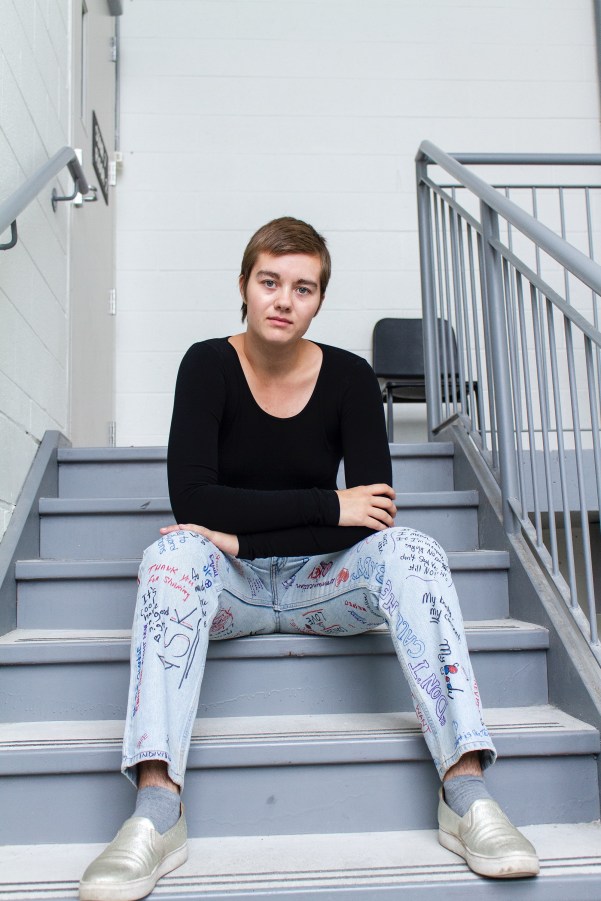
Saffron A, portrait. Photo by Kadee McFarlane. 2019.

By Adi Berardini

CW: Sexual assault

In the sadly saturated rape culture that we live in and the rise of the #MeToo movement, Saffron A’s music is more than timely. In their song “Priceless Advice,” victim-blaming statements are combined in a high energy pop-folk song. Through the strumming of strong chords, the song comments on the absurdity of shaming sexual assault survivors instead of holding rapists responsible.  Saffron A sings them with an ironic joy, and through that, asks their audience to join them on a journey exploring and challenging toxic masculinity and rape culture. In this song, they reclaim their power over the narrative that the behaviour of those affected by sexual assault is the root cause of their trauma.

Their lyrics mention a cop that blames what the victim is wearing for an assault, insisting that the perpetrator is simply “over-friendly.” It’s a narrative that many of us know all too well—not being taken seriously in our experience of pain and sexual assault. These words are difficult to write as I know it well myself. Too often, the responsibility is burdened on the survivor for what was ultimately a violation of trust and abuse of power. It takes a lot of healing after being sexually assaulted, and it can feel like the wound is still open at times. Saffron A uses their own experience to heal and also bring these problematic narratives to light.

FF3EF252-C135-425F-BF43-51DB9BED054C
Saffron A, portrait. Photo by Kadee McFarlane.

Additionally, the lyrics of “Priceless Advice” state, “wear boots so you can run away” and “don’t hang out on that side of town, maybe you should just stay inside.” The haunting statements of “don’t be so enticing, don’t be so inviting,” ring through the speaker. It’s the censorship of women’s behaviour instead of accountability that grinds away at me in hearing these statements. The culture of victim-blaming is the fuel that perpetuates these narratives and breeds shame that should not exist.

The song also has a more hopeful outlook when Saffron sings in the chorus that they will “wear what they like” and that they’re “not going to hide anymore.” It reclaims the bodily autonomy that feels so lost in the aftermath of a sexual assault. Saffron looks toward the possibility to move past these toxic assumptions and the disbelief of survivors in recounting their own experiences. Saffron contests being objectified in a public space, because, like the rest of us, they are tired of it.

98876FF4-3BB6-4E22-9DA9-AC36A12E7EBA
Saffron A, Consent Pants. Photo by Kadee McFarlane. 2019.

On the Resistance tour, Saffron A has brought along with them a pair of “consent pants,” which are jeans they ask the audience to write on them with markers about what consent means to them. “What began as a collaboration with Advocates for a Student Culture of Consent (ASCC), quickly became a community art project,” Saffron A explains. “I co-hosted two concerts at the beginning of my Resilience Tour with ASCC, and they wanted to have an artistic element at the events. I suggested we ask folks to write/draw/express what consent means to them on a pair of jeans.”

0A888215-1B38-4BE2-AE53-F0202F645562
Saffron A, Consent Pants. Photo by Kadee McFarlane. 2019.

The consent pants travelled from Brantford to Montreal, all the way up to Sudbury and beyond. I wrote on the jeans myself at the live show here at the Brown and Dickson Bookstore in London, saying that consent, to me, was “mutual respect.” Writing on these jeans evoked a lot of emotions, mainly since I had to think about what consent personally meant to me. The dictionary defines consent as “permission” or “agreement.” The pants say phrases such as “communication is key,” and “no consent on stolen land,” bringing up what consent looks like when Canadians occupy the land of Indigenous peoples outside of a mutual agreement. Both the consent pants and Saffron A’s music spark an essential conversation—when we don’t discuss consent, it masquerades its meaning, making it easier to become a grey area. The lack of understanding of consent only creates the potential to hurt others. Consent is something rooted in genuine care, and it’s an agreement that is so closely tied to power and trust.

Saffron A taps into their own vulnerability through their music and uses it as a tool for healing—they reclaim their own power and autonomy. Their music echoes so strongly in a society that perpetuates shame for rape survivors. Challenging toxic assumptions and how survivors are not taken seriously, they approach the subject in an open and engaging way. As they sing, “I’d laugh if I wasn’t terrified, I wouldn’t have to sing this song if this behaviour wasn’t going on.” Saffron A initiates the conversation about rape culture and sexual assault and asks us to collectively do better.

You can find Saffron A’s music on Bandcamp. Follow them on Instagram at @saffrockmusic.

Chris Strickler’s BIRD MILK

BIRD_MILK_still3
Chris Strickler. Bird Milk still. 2018.

Questions by Adi Berardini

Chris Strickler is an animator, installation artist, and live visual performer (VJ). He works with abstraction and interaction to create immersive and experimental animations. His experimental film, BIRD MILK, will be screened on October 19th at 7pm as part of Antimatter Media Art in Victoria, BC at Deluge Contemporary Art.

Your film is very influenced by electronic music, which was made by Gil Goletski. What was the process of collaboration like for you on your film Bird Milk?

Our collaboration was an interesting one, I think. To start, I gave Gil an energy chart, mapping out the mood of the song. Then part by part, they made each segment of the song and I would share my feedback. I don’t know how helpful my feedback was because I have no clue how to talk about music, but eventually, we ended with an amazing 7 and a half-minute song. Now, if you have the chance to see my film, you may notice that it is a sweet 4 minutes and 44 seconds. We ended up cutting it down and changing a section because there was no chance I was going to finish 7 minutes of animation in [9 months]. But if you ever want to listen to Gil’s full song, it’s out there, waiting for you.

How did you come about finding the particular textures and effects that you use throughout your experimental animation?

Norman McLaren’s Begone Dull Care was my kick in the pants to make something like BIRD MILK. It was messy, colourful, erratic, [and] chaotic. It spoke to me on a level an art piece had never reached before. McLaren used ink, so I used ink. McLaren scratched, so I scratched. But that was only the start. I dropped ink into water and alcohol to make delicious splashes of colour.

I did some parts of my film in Autodesk Maya, a 3D animation program. To integrate the 3D footage with the rest of my messy, experimental film, I printed out the frames onto transparent sheets at the size of postage stamps. The effect of close-up ink dots and the fact that these sheets would gather dust and scratches imbued what was previously a lifeless 3D animation with a tactile, textured feeling.

I did the same with some rotoscoped footage of birds and different animals I found, except instead of printing the frames, I laser-cut them. I had a grand time creating different method mark-making and then looking at everything under a macro lens, a lens meant for bug and flower photography. The macro lens is what made everything so juicy and crunchy, magnifying minuscule textures into giant pieces of art. Then once everything starts flashing at 24 frames per second (which may not be so fun if you are photosensitive), that’s when the magic starts happening.

BIRD_MILK_still7
Chris Strickler. Bird Milk still. 2018.
BIRD_MILK_still2
Chris Strickler. Bird Milk still. 2018.

How did you move from more representational to abstract/experimental animation and film? Do you move back and forth between them?

Back to Norman McLaren, it was his film that I mentioned before that opened my eyes to abstract animation. Up until that point, I was just going through the 2D character animation pathway because I didn’t quite know what I wanted to do. Then in 3rd year when I saw Begone Dull Care for the first time, it was a revelation moment. I didn’t have to do character animation, it was okay! Since then I have been doing almost exclusively abstract and non-representation animation. Maybe one day I will delve back into representational work, but today is not that day.

BIRD_MILK_still4
Chris Strickler. Bird Milk still. 2018.

Who are some artists and animators that inspire your work?

If it wasn’t already obvious, Norman McLaren is a big inspiration of mine. He was a pioneer of experimental filmmaking and is a pillar of film and animation history. I’m not one to idolize anyone, but I idolize McLaren. Not only his work do I adore, but his work ethic is something I aspire to. If he tried something new and it didn’t work out the way he wanted, he would file it away not as a failure, but as something he could use in the future. No effort went to waste, no such thing as a wasted opportunity. I’m also a big fan of Andrew Benson, Ryder Thomas White, Sara Goodman, and Nadya Bokk. These are all people I follow on Instagram or Twitter. Except [for] McLaren, he’s quite dead.

BIRD_MILK_still6
Chris Strickler. Bird Milk still. 2018.

Do you have any other projects you are working on that are coming up?

I have a music video with queer pop icon Devours that’s on the back burner until we both have the bandwidth to tackle it. Additionally, Flavourcel, the animation collective I’m a part of, has a couple irons in the fire that we are working on. One is a project for the Emily Carr University writing program, and another is a gallery show and workshop with the Surrey Art Gallery. Both of those will happen sometime in the spring. I’m also always up for VJ gigs that come my way, I love doing visuals for the local bands of Vancouver.

Follow Chris on Instagram at @doktorgrafiks.

Chris Strickler’s screening of BIRD MILK as part of the Antimatter Media Art Festival is happening on October 19th at 7pm at The Deluge Contemporary Art Gallery in Victoria, BC. 


So, You’re Going to an Art Event

By Sara Peters & Dave Karrel

So, you’re going to an art event. Don’t just stand there, get R E A D Y! Oh, it’s weeks away? Perfect, you’ll need the time to prepare. Maybe you’re thinking, but I already know how to go to art shows. Ha! You couldn’t be more wrong. But worry not, this handy guide to the art of art is 2000% certified by Marina Abramovic™ herself.

Preparing for the Event  

Don’t trust the Facebook event. All the people who say they’re going are not going. Anyone who marks themselves as ‘interested’ never gave it a thought.

FAR images-facebook
Illustration by Sara Peters.

Your friends can’t make it. Sorry to tell you, but it’s best you hear it from me now. One will get sick, one will be tired from a ‘brutal work day’, one will never text you at all.

If you do happen to spot someone you know, they will go missing within minutes. You will think, how is this possible in a 10×10 room? This is the art world, baby. Rules don’t apply.

Ah, the outfit. The cornerstone of any good disguise. Be sure to wear an unintuitive, semi-pre-mostly-post-modern combination of garments. Use this classic example as inspiration: Second-cousin’s work pants with a mesh top. Vintage back-issue of Life Magazine folded into a boat hat. Babybel cheese wax earrings.

To be truly unforgettable, wear a genuine mink shawl and insist it’s actually made of Beyond Meat™.

FAR images-lady
Illustration by Sara Peters.

Entering the Event

The gallery’s entrance may come in the form of a garage door, nondescript archway, parting in the bushes, or subtle parody of an existing fast-food chain, eg: McDonTalds.

Enter the event as though you expected to walk into a restaurant but, upon discovering your mistake, have decided to satisfy your bottomless appetite for contemporary arts and culture.

The Event

 You’ve arrived. Your need for high art is matched only by your growing thirst. In the back, you’ll find two near-identical near-angels selling tall cans from a makeshift booth.

Keep your head down. Approach slowly. Do not bare your teeth. When offered wine, take as many glasses as you can hold (the world record is 51) and consume immediately. Do not hesitate. If you hesitate, they will, in perfect synchronicity, read from their half-finished dissertations and lay a curse that renders you a permanent installation of the gallery.

Establish intellectual dominance from the outset: Take a hurried first lap. This will prove you consume art faster than anyone else in the room.

There will be a dimly lit back patio/parking lot/semi-outdoor area where people squat on tree stumps and take long wistful drags of hand-rolled cigarettes. You can find good conversation here, just don’t bring up the art.

If the artist is your friend, congratulate them before you’ve seen the work. Grasp them by the fingertips, fingerprint to fingerprint, gaze deep into their soul, whisper, Brave. So, so brave with your eyes fully closed.

FAR images - hands
Illustration by Sara Peters.

Talk over the video that is playing on loop. You’re not actually here to see the art, you’re here to be seen with the art.

There WILL be someone whose backpack is twice the size of a Foodora delivery bag. WHAT IS IN THERE????! you will wonder but never ask.

If you run into the gallery owner, say How much? When they ask which piece you’re referring to, laugh and shake your head as you float away.

Learning the Language

Dipping into a new culture requires learning enough of the language to get around. For instance, when someone asks, what do you do? what they’re really asking is, what can you do for me? Look around. Is everyone looking at you? Good. Stand on tiptoe and mention that you know a little Japanese. If you’re looking to make an ally for the night, say you moonlight as a grant writer.

If someone tells you they used to know the artist before they ‘blew up’, it means they once shared a kiln while studying trans-epoch Trotskian pottery at OCAD and have since heavily lurked their social media.

Practice reading didactic panels before you go. The most important part is holding your face perfectly still so as to mask your inevitable confusion as you try to decipher seemingly incomprehensible sentences such as:

FAR images-panel
Illustration by Sara Peters.

If you happen to find an error in a didactic panel, be sure to chuckle to yourself—bounce at the shoulders, shake your head. Make sure someone notices, to unwittingly confirm your superior intelligence.

If there is a Q & A, be prepared for an extended speech that betrays the asker’s prolific art-making history and (eventually) yields into a bumbling reference to one of the work’s materials and a half-hearted request for the artist to explain where they got the idea.

Leaving the Event

In order to leave, you’ll need to plan an escape route. Take into consideration the following likely obstacles:

  • The door is actually part of the exhibit
  • The group of intimidating art teens by the front door (How’d they get in here? How are they so cool? Are they real?)
  • The man by the bar who wishes to tell you about the recent ‘urban farm’ he is building in his “friend Todd’s parents’” backyard
  • Actually, where is the door though? This is frickin’ spooky
  • Spotting the artist, and in so doing, feeling obligated to ask about their process
  • Spotting the curator and having them tack you against the wall for 1-6 hours so they can tell you about their process
  • Uneven flooring
  • Literally no idea what’s happening with this door situation. Will I die here??

An older couple will wander in. The realization that this is not their destination will slowly drain the expectant joy from their faces until the woman grasps her husband gently at the elbow and whispers, “Ted, we need to go.” For an easy out, pretend they’re visiting you from out of town and follow their lead.

There—you made it. You’re now an Art World Veteran. Get yourself home, crawl into bed with your takeout, and post a couple Insta pics so everyone knows what a great night you had.